Britain is creating a mountain of nuclear waste it doesn’t know what to do with.
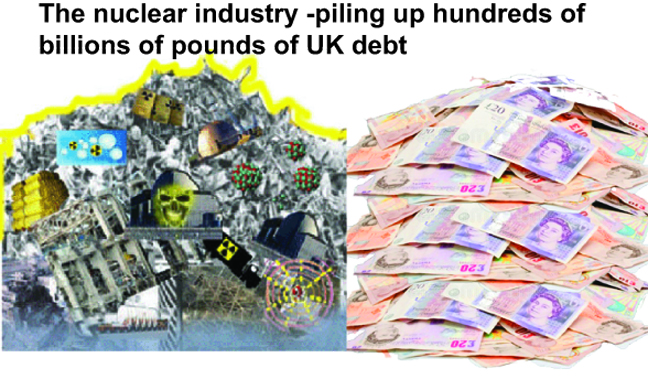
The UK is expected to accrue enough waste to fill four Wembley Stadiums
Jonathan Leake, Energy Editor. 03 May 2026
For Ed Miliband, these were the announcements he’d been wanting
to make for years. Britain was entering a new “golden age of nuclear”,
he said earlier this year. The Energy Secretary pledged to strip away
planning delays, committing to building a generation of small modular
reactors (SMRs).
The industry was delighted. Rolls-Royce was signed up by
Miliband to build the first mini nuclear reactor on Anglesey in Wales.
Rivals began planning their own SMRs across Britain.
But amid the “golden
age” branding and political hype, one major issue remains embarrassingly
unresolved. If all the planned new reactors get built, as well as the giant
ones under construction at Hinkley in Somerset and Sizewell in Suffolk, the
UK will have to work out what to do with a mountain of radioactive waste.
Some 137,000 cubic metres of waste across dozens of UK sites – including at
Sellafield, Britain’s main nuclear waste facility on the Cumbrian coast –
awaits a ministerial decision on how best to dispose of it. A significant
portion of that waste – enough to fill the Royal Albert Hall 1.5 times over
– has been sitting around since the 1960s.In the next few decades, the
level of waste is expected to swell to 4.5 million cubic metres, a 30-fold
increase, as current and past nuclear stations are decommissioned. That’s
enough to fill four Wembley Stadiums.
For the hottest waste – about 750,000
cubic metres worth – the plan is to bury it in a geological repository.
This will probably be tunnelled into the seabed off Cumbria. The Nuclear
Decommissioning Authority admits it is a job that will take until at least
2130 and cost a fortune.
SMRs and the planned advanced modular reactors may
generate more waste for a given power output, experts claim. The physics is
simple. Smaller reactors have a proportionately larger surface area – so
more of the internal radiation escapes. As it strikes surrounding equipment
and buildings, they too will become highly radioactive. A recent research
paper co-authored by Prof Alison Macfarlane, the former chairman of the US
Nuclear Regulatory Commission, included a warning that SMRs “will
increase the volume of nuclear waste in need of management and disposal by
factors of two to 30”.
Paul Dorfman, a Sussex University radiation expert
who advises the Ministry of Defence on dismantling nuclear submarines, says
this is not happening. He points out that the Department for Energy
Security and Net Zero (DESNZ)’s waste inventory omits waste that will arise
from the new Hinkley and Sizewell nuclear stations and from any SMRs that
are built.
Nuclear Waste Services, the government body charged with
building the repository, expects to start construction of a geological
disposal facility around 2040, beginning operations in the late 2050s and
operating through to 2200. Industry experts are sceptical of that
timetable. Insiders warn that this relies on Treasury approval for the
massive cost – which will always be a struggle. It is a cost that is only
likely to rise. In 2024, the Nuclear Decommissioning Authority estimated
Britain’s nuclear waste clean-up operation would cost £199bn. Last year, it
increased that to £216bn. However, the real cost – once a century of
inflation is added, along with waste from a new generation of reactors –
will be far beyond that.
Telegraph 3rd May 2026, https://www.telegraph.co.uk/business/2026/05/03/britain-creating-mountain-nuclear-waste-doesnt-know/
No comments yet.
1 This Month

9 September – online public forum THREE MILE ISLAND:
7-8:30 PM ET,
Legacy, resistance to reopening – https://us02web.zoom.us/webinar/register/WN_-LGJU4j6TD2Hgf0rpgAr1A#/registration
The nuclear industry and the U.S. Nuclear Regulatory Commission are threatening to restart Pennsylvania’s permanently closed and decommissioning Three Mile Island Unit 1 nuclear power station. Three expert speakers will present the resistance to this dangerous misadventure in a webinar hosted by the Clamshell Alliance, Beyond Nuclear and Massachusetts Peace Action.


No Nuclear in Cwm Llynfi! Stop the nuclear power station near Maesteg.
To see nuclear-related stories in greater depth and intensity – go to https://nuclearinformation.wordpress.com
-
Archives
- August 2026 (330)
- July 2026 (355)
- June 2026 (287)
- May 2026 (306)
- April 2026 (356)
- March 2026 (251)
- February 2026 (267)
- January 2026 (308)
- December 2025 (358)
- November 2025 (359)
- October 2025 (375)
- September 2025 (257)
-
Categories
- 1
- 1 NUCLEAR ISSUES
- business and costs
- climate change
- culture and arts
- ENERGY
- environment
- health
- history
- indigenous issues
- Legal
- marketing of nuclear
- media
- opposition to nuclear
- PERSONAL STORIES
- politics
- politics international
- Religion and ethics
- safety
- secrets,lies and civil liberties
- spinbuster
- technology
- Uranium
- wastes
- weapons and war
- Women
- 2 WORLD
- ACTION
- AFRICA
- Atrocities
- AUSTRALIA
- Christina's notes
- Christina's themes
- culture and arts
- Events
- Fuk 2022
- Fuk 2023
- Fukushima 2017
- Fukushima 2018
- fukushima 2019
- Fukushima 2020
- Fukushima 2021
- general
- global warming
- Humour (God we need it)
- Nuclear
- RARE EARTHS
- Reference
- resources – print
- Resources -audiovicual
- Weekly Newsletter
- World
- World Nuclear
- YouTube
-
RSS
Entries RSS
Comments RSS
 nuclear-news
Leave a comment