Zaporizhzhia NPP loses external power for the second time in a week, IAEA investigates

Kyiv • UNN, April 17 2026,
The Zaporizhzhia NPP has temporarily lost all external power for the fourteenth time
The Zaporizhzhia Nuclear Power Plant temporarily lost all external power supply, which was subsequently restored. This was reported by the IAEA, which is currently studying the situation and investigating the incident, writes UNN.
Details
According to the agency, the incident occurred in the evening. External power was restored approximately 40 minutes later.
The cause of the outage is currently unknown and is being investigated by specialists on site.ime since the start of the war. The IAEA is conducting an investigation due to critical nuclear safety risks.
IAEA Director General Rafael Grossi stated that this is the second such incident in less than a week and the 14th since the beginning of the full-scale war.
The loss of external power supply underscores the ongoing critical nuclear safety situation– he noted.
The IAEA team at the plant continues to monitor and investigate the circumstances of the incident. The agency emphasizes that such failures pose a serious risk to nuclear safety. https://unn.ua/en/news/zaporizhzhia-npp-loses-external-power-for-the-second-time-in-a-week-iaea-investigates
US Mining Plan Will Sacrifice Mexico’s Environment for Weapons and Tech
A new mining agreement provides no benefits for Mexico and fails to address health and environmental impacts.
By Tamara Pearson , Truthout, April 18, 2026
The U.S. and Mexico have established a mining agreement which has Indigenous and other residents of the Sierra Norte mountains, as well as activists around Mexico, worried.
Announced on February 4, the U.S.-Mexico Action Plan on Critical Minerals aims to guarantee the U.S.’s supply of minerals for its arms industry, technology like data centers and smartphones, and the so-called energy transition. It sets out price floors, identification of mining projects, geological mapping coordination, and mineral location identification for the U.S., but provides no benefits for Mexico and fails to address health and environmental impacts.
“They want us to show these gringo companies where the minerals are and then go and hand over everything, all without a fuss,” said Miguel Sánchez Olvera, a Totonac man from the Sierra Norte region who has been at the forefront of struggles that have expelled mines from the area. “That’s concerning, because where does it leave us, as Mexicans? Basically, they are going to keep stealing from us.”
The beautiful Sierra Norte — teeming with rivers and sprawling forests, and where a majority of people speak Indigenous languages — has massive amounts of minerals that the U.S. has identified as “critical,” such as manganese, gold, silver, and copper.
According to NATO, manganese is one of 12 minerals critical for the weapons industry; it is used in submarines, fighter aircraft, tanks, and torpedoes. For Mexico, however, manganese is a source of distress before it is even processed. In the lush Sierra Norte cordillera, stark black mountains of manganese ore and slag piles are set off by smoking chimneys from a plant run by Autlán, a major Mexican mining company. Homes nearby are drenched in black stains. Residents describe mornings of black clouds along the ground and black dust covering their windows.
Autlán operates four electric furnaces in its Teziutlán plant to smelt manganese ore, producing ferroalloys. Manganese is also on the U.S.’s critical minerals list and aside from weapons, it is vital to batteries and other steel applications.
Mexico as a whole is the top silver-producing country, and among the top producers of copper, lead, and zinc — all on the U.S.’s list. Silver is vital for new weapon systems, hypersonic missiles, bombs, fighter jets, satellites, torpedoes, radar systems, AI data centers, electric vehicles, 5G infrastructure, and smartphones. Demand for copper for munitions is skyrocketing as the U.S. restocks its arsenal, and it is essential for armor and electronics. Copper supply problems can cause significant weapon production delays, and supply chain vulnerabilities for weapons manufacturers.
The U.S. is home to 6 of the top 10 global arms companies and 13 of the top 15 global tech companies. The White House’s 2027 budget includes over 18 billion U.S dollars for the Department of Defense to stockpile minerals that are critical to the military industry. That figure is up from the current 2 billion U.S. dollars.
A few days before the U.S.-Mexico plan was signed, the White House had also announced Project Vault, which will establish a public-private partnership to stockpile critical minerals for U.S. businesses. These moves “imply hyper-extractivism — or basically, renewed extractivism,” César Enrique Pineda, a researcher and professor of geopolitical and capitalist intersections with the environment at the José María Luis Mora Research Institute, told Truthout……………………………………………………………………………………………………………………………………………………………………………………………..
Nobody Benefits From Weapons Except Weapons Companies
But while the mining industry is being heard, the mines bring no economic benefits to the country or to nearby communities.
“I very much doubt that Mexico would benefit economically from this plan because it has never been that way with mining projects. Extraction only contributes 0.9 percent to the GDP, for example,” said Olivera. “Mining represents just 0.66 percent of formal employment, and in terms of taxes, they contribute very little.” There are 22,247 active mining concessions in Mexico, with a total surface area of 10.2 million hectares, or 5.2 percent of Mexico’s territory………………………………………………………………………………………………………
Mining’s Legacy of Environmental Disaster
The U.S.-Mexico action plan “benefits investors, but it doesn’t benefit us at all,” said Urbano Córdova Guerraas, a local resident and also a member of Servicios Ambientales Amelatzin Hualactoc as we chatted in a small eatery near the Autlán plant. To extract copious amounts of manganese, Autlán has destroyed whole mountain tops in nearby Hidalgo state, buying off local politicians in order to do so. In Zoquitlán, Autlán chopped down 77 hectares of forest for a hydroelectric plant…………………………………………………………………………………………………………………………………………………….
Imposing Destruction
In order to operate without disruption, mining companies in Mexico are often involved in the disappearance of activists and with organized crime. The top minerals that attract organized crime groups are the same critical minerals that Mexico plans to supply to the U.S…………………………………………………………………………………………………………………………………….
Over the years, thousands of organized communities have declared themselves “mining-free territory” to legally prohibit mining in their territory.
Stopping mines after the fact is much harder, but many communities are willing to wage the legal and organizational battle. Even after victory, the struggle continues.
“We want to clean our rivers, so that the Sierra Norte de Puebla can be a paradise again,” said Sánchez. https://truthout.org/articles/us-mining-plan-will-sacrifice-mexicos-environment-for-weapons-and-tech/
Wyoming communities want time to consider embracing nuclear energy, as feds rush to expand industry
With one nuclear power plant already under construction, Wyoming will soon
be home to high-level nuclear waste storage unless the federal government
builds a centralized facility. When TerraPower proposed building its first
advanced, liquid sodium-cooled Natrium power plant outside Kemmerer,
lawmakers quickly carved out an exception in the state´s otherwise blanket
storage ban to allow spent nuclear fuel that comes from any in-state
nuclear power plant. But the conversation about nuclear waste storage in
the Cowboy State is far from over.
Daily Mail 17th April 2026,
https://www.dailymail.co.uk/wires/ap/article-15742457/Wyoming-communities-want-time-consider-embracing-nuclear-energy-feds-rush-expand-industry.html
Collapsing Empire: Hezbollah Crushes ‘Greater Israel’
Kit Klarenberg, Global Delinquents, Apr 17, 2026
On April 8th, the Zionist entity struck a demonic blow to the heart of Beirut, dropping 1,000 pound bombs in densely packed residential areas, killing untold civilians and injuring many more. One of Lebanon’s most dire mass-killings since the end of the 1990 civil war, it marked the resumption of Israel’s avowedly genocidal invasion. With bombs raining down apace even as rare in-person talks between the pair near, Zionist Occupation Force-backed settlers are moving quickly to establish a permanent presence in the country’s south.
Whatever abrupt pause in the war on the Islamic Republic can be sustained by duelling Iranian and US blockades of the Strait Of Hormuz must be viewed in the context of the Zionist entity’s longstanding determination to annex Lebanese territory, in service of ‘Greater Israel’. Tel Aviv’s criminal incursion ignited March 16th, Orwellianly dubbed by officials a “targeted ground operation against key targets.” It was not until 10 days later that major news outlets deigned to call it an invasion.
On March 23rd, Tel Aviv’s finance minister Bezalel Smotrich – a self-proclaimed fascist – urged the ZOF to formally annex southern Lebanon. Since then, over a million people have been displaced, thousands killed, and civilian infrastructure razed en masse. While a significant chunk of the country is now occupied, the cost for Tel Aviv was substantial. Unrelenting Hezbollah fire produced heavy casualties and record equipment and vehicle losses, including 21 Merkava main battle tanks in a single day on March 26th.
On April 2nd, Israeli media openly advertised the impending ceasefire in the war on Iran. It was revealed the Zionist entity was preparing to intensify its air campaign against Lebanon, due to enormous damage inflicted by the Resistance upon the ZOF. Tel Aviv reportedly planned to “[reduce] the current focus on Iran,” in order to support “Israeli ground forces attempting to seize Lebanese territory.” Were it not for hell being unleashed from the skies, the ZOF would currently be in big trouble.
On April 5th, the ZOF’s Northern Command chief admitted Tel Aviv had grossly overestimated damage inflicted upon Hezbollah during its October 2024 invasion of Lebanon. Entity political and military chiefs had long-claimed the Resistance faction was obliterated by the illegal intervention. The ZOF estimated 70 – 80% of Hezbollah’s rocket capabilities were destroyed during the conflict. This reverie was comprehensively shattered by hundreds of the group’s projectiles successfully targeting Tel Aviv daily, throughout the Zionist-American war on Iran.
No wonder that conflict is now on hold. Hezbollah remains a redoubtable adversary, which can independently, and in tandem with its Resistance comrades, thwart Tel Aviv’s seizure of Lebanese territory, and permanently expel Zionist settlers from northern Palestine. This wreaks havoc with Greater Israel’s construction, which Benjamin Netanyahu openly yearns to be his enduring political legacy, and literal ‘get out of jail free’ card. Hence, southern Lebanon must be annexed, and Hezbollah neutralised. But attempting to do so will, as before, end in fatal catastrophe.
‘Forced Expulsions’
In June 1982, Zionist militants invaded Lebanon, ostensibly to drive Palestinian freedom fighters away from the entity’s claimed northern border. Quickly, it became apparent ethnic cleansing, massacres, and land theft were the ZOF’s true goal. As a declassified July 1983 US National Intelligence Council assessment noted, ultra-Zionists then as now were aggressively demanding outright annexation of Lebanon’s south. Which is precisely what temporarily came to pass, until Hezbollah expelled the ZOF decisively in 2000. Along the way, obvious lessons weren’t learned by Tel Aviv.
The Council predicted the ZOF would create a puppet state in the south, to fulfil “some day-to-day governing tasks,” while “real power will remain in Israeli hands.” Despite judging the costs “of semi-permanent occupation” to be “not inconsequential,” they were nonetheless “manageable”, due to the entity’s “proven track record” of suppressing “unrest” in territory it illegally occupies. “Forced expulsions, use of local surrogates, and ruthless counterintelligence operations” by the ZOF were correctly forecast, which the NIC believed would negate “increasingly” hostile local opposition.
The Council assessed the ZOF would “[get] a handle on the guerrillas in the next six – 12 months.” This prediction couldn’t have been more wrong. Unmentioned by the Council, Hezbollah was quickly founded following the Zionist entity’s invasion. Inspired by the Islamic Revolution and assisted by the Iranian Revolutionary Guard Corps, the group rapidly gained in strength, spreading radical fervour among Lebanese citizens of every faith, until forcibly purging ZOF militants from Lebanon outright in May 2000.
Hezbollah’s success – repeated with an unprecedented battering of Zionist invasion forces in 2006 – inspired new generations of Resistance fighters, including Hamas. Today, the faction is the most popular and potent political and social force in Lebanon, embraced by citizens of every faith. Bashar Assad’s fall also did not, contrary to widely-held assumptions, make it remotely difficult for Iran to equip and coordinate with Hezbollah. A failure to comprehend these inconvenient truths has led the Zionist entity into disastrous ruin in Lebanon, yet again.
On March 27th, ZOF chief of staff Eyal Zamir issued a grave warning during a security cabinet meeting. Namely, Israel’s military “is going to collapse in on itself,” due to “mounting operational demands and a deepening manpower shortage,” which could rapidly prove catastrophic. Already, an infantry battalion intended to be deployed to Lebanon had been redirected to the West Bank, to “keep the peace” as armed settlers carried out violent if not murderous attacks on Palestinians. The ZOF would’ve struggled to field further forces in either Greater Israel theatre.
Then on April 3rd, the ZOF openly admitted “its goal of disarming Hezbollah” was “unrealistic, as it would require the military to launch a full-scale invasion of Lebanon,” which Tel Aviv wasn’t able to wage. In other words, the Resistance was undefeated, and Lebanese territory couldn’t be stolen. Having been engaged in perpetual, multi-front war since October 7th 2023, the exhausted Zionist entity lacked the muscle to achieve its Lebanese goals while also targeting the West Bank and Iran, contrary to intelligence, military and political forecasts.
‘Last Minute’
Israel was so ruinously overextended attempting to wage all-out war on the entire Resistance – without AnsarAllah even having fully joined the fight – it was reportedly considering an extraordinarily desperate solution. Namely, inviting Syria’s MI6-installed extremist government to battle Hezbollah. Ahmed al-Sharaa’s regime is maintained in power exclusively via a brutal, repressive domestic security and military apparatus. Forces could not be deployed in sufficient numbers to counter Hezbollah, without risking major domestic upheaval. However, Hebrew-language outlet Maariv reported April 5th this suicidal pact was being seriously contemplated:
Under the auspices of these “understandings”, the ZOF would “take over southern Lebanon, while the Syrians will act in northern Lebanon against Hezbollah.” However, the US reportedly “very much [preferred] not to reach such a scenario.” After all, it would be a deeply hazardous Faustian bargain, imperilling al-Sharaa’s already brittle rule. While he and his army of ISIS fighters may detest Hezbollah, the overwhelming majority of Syrians reject alliance with Israel, at a time local Resistance elements are growing in strength.
………………………………………………………………………………………………………. With Hezbollah supposedly dismantled, and Syria at last transformed into a doting Anglo-American puppet state, Greater Israel could be advanced without hindrance – or so Netanyahu thought. In reality, the “great opportunity” about which he boasted from the Golan Heights following Bashar Assad’s fall has become a dangerous trap. Unable to sustain a grand battle against the triumphant Islamic Republic even with US help, Israel is now overextending itself yet further in southern Lebanon. Hezbollah isn’t fazed one iota, and the Resistance is watching intently.
As history old and new amply shows, the Empire and its Zionist proxy underestimate AnsarAllah, Hamas, Hezbollah, Iran, and the wider Resistance at their immense peril – but persist in doing so. Over and again across decades, the same failed strategies are applied without success, then aren’t subsequently revised. The Empire’s crushing past defeats by the Resistance are spun as victories, and/or promptly forgotten about. All along though, in the real world, the Zionist-American death machine is ever-weakened, and Palestine’s long-overdue liberation grows irresistibly closer. https://www.kitklarenberg.com/p/collapsing-empire-hezbollah-crushes
What to know about Iran’s uranium enrichment and its role in the Middle East conflict
President Donald Trump on Friday vowed to remove Iran’s “Nuclear
‘Dust” as part of an effort to ensure the nation never possesses a
nuclear weapon. A day earlier, Trump told reporters at the White House that
Iran had agreed to “give us back the nuclear dust that’s way
underground,” repeating the phrase he uses in reference to Iran’s highly
enriched uranium.
Appearing on Iranian State Television on Friday, Foreign
Ministry spokesperson Esmael Baqaei strongly rebuked Trump’s claim. “Iran’s
enriched uranium is not going to be transferred anywhere under any
circumstances,” Baqaei said.
Iran’s nuclear program appears to remain a key
sticking point in the standoff between the two sides as the U.S.-Iran
ceasefire approaches a deadline on Tuesday. Weapons-grade uranium
enrichment comes at an ideal level of about 90%, though a crude weapon can
be deployed with material enriched at lower levels, Howard Hall, professor
of nuclear security at the University of Tennessee, told ABC News.
“There’s
nothing magic about the 90% level,” Hall said. Iran possessed about 440
kilograms of uranium enriched to 60% as of June 2025, the International
Atomic Energy Agency, a United Nations watchdog group, said in a report
issued in February. That quantity of uranium is enough to produce nine or
10 nuclear bombs if enriched to weapons-grade levels, Erickson said. The
final step of enriching uranium from 60% to 90% is a relatively small task
within the overall enrichment process, analysts told ABC News. “The trick
of uranium enrichment is that most of the work is done going from natural
to low-enriched uranium,” Hall said. The further along the enrichment
process goes, the quicker the progress, Hall added. “You have small steps
that multiply over and over — it’s like compound interest,” he said.
Stockholm International Peace Institute, an independent research group, in
a report described the distance from 60% enrichment to weapons-grade as
“very short.” In March, United States Special Envoy to the Middle East
Steve Witkoff said the 60% enriched uranium can be brought to weapons-grade
in about a week and that the 20% enriched uranium can be brought to
weapons-grade in three to four weeks.
Iran’s uranium stockpile also
included about 9,400 kilograms of uranium enriched at lower levels as of
last June, most of which is enriched at or below 5%, the IAEA said in
February. The IAEA has not been able to verify the nuclear stockpile since
then, the group said, describing the need for inspection as “long overdue
according to standard safeguards practice.”
ABC News 17th April 2026,
https://abcnews.com/Business/irans-uranium-enrichment-role-middle-east-conflict/story?id=132057549
Confused Closures and Opaque Openings: Continuing Dramas in the Hormuz Strait
19 April 2026 Dr Binoy Kampmark, https://theaimn.net/confused-closures-and-opaque-openings-continuing-dramas-in-the-hormuz-strait/
Reading messages from President Donald J. Trump is an exercise in taunting masochism. It is one inflicted on commentators and the press corps the world over, and they are not better for it. The latest – and here, the latest will become distant and dated shortly – is that the Strait of Hormuz, predictably controlled by Iran with devastating global effect, was to be reopened for commercial traffic under certain conditions. Trump thought this undertaking absolute and indefinite, a rich suggestion coming from a man with such a fair-weather mind. “Iran has agreed to never close the Strait of Hormuz again. It will no longer be used as a weapon against the World!”
This proved typically premature: within a matter of hours, Iran’s decision was, if not reversed then heavily qualified. (The Strait technically always remained open to vessels favoured by the Iranian authorities.) On April 17, Iran’s Foreign Ministry spokesperson Eshmaeil Baghaei affirmed two key principles in Tehran’s policies: Iran retained the right to control traffic moving through the Strait, and that it would not surrender enriched uranium, an issue “sacred to us as Iranian soil” and non-negotiable. The latter was certainly aimed at Trump’s dotty claim that Washington and Tehran would jointly deploy “lots of excavators” to remove fissile material (“nuclear dust”) and shift it to the US. On CBS News, the president claimed that “Our people, together with the Iranians, are going to work together to get it.” This all suggested much confusion on the part of the Americans.
Iran’s moves on the Strait were always going to be governed by other impediments. There was the demand, for instance, that Washington release $20 billion in frozen Iranian assets. This was rejected. Trump has also insisted on a continued blockade of Iranian ports, which currently employs over 12 warships and something in the order of 100 fighter and surveillance aircraft. As he told Fox News, “we’re not going to let Iran make money on selling oil to people that they like and not people that they don’t like.” Maritime intelligence on this, however, suggests that the blockade has not been quite as effective as heralded by US officials. Martin Kelly, Head of Advisory at EOS Risk Group can point to the successful passage of sanctioned tankers and vessels of the shadow fleet such as LPG carriers Crave, Raine and NV Aquamarine.
On April 18, the Islamic Revolutionary Guard Corps (IRGC) Navy issued a statement that “no vessel is to move from its anchorage in the Persian Gulf or the Sea of Oman.” A number of vessels had successfully managed to pass through under supervision since Friday night, but the Strait would be closed till the US ceased blocking Iran’s ports. “Approaching the Strait of Hormuz will be considered cooperation with the enemy, and the offending vessel will be targeted.”
The IRGC have been true to their word. According to UK Maritime Trade Operations, the Master of a tanker reported “being approached by 2 IRGC gun boats” without a VHF challenge, “then fired upon the tanker.” No injuries were sustained. Another report documented “a Container Ship being hit by an unknown projectile which caused damage to some of the containers.” There were no fires or environmental impacts reported. A third incident involved the sighting by the Master of a cruise ship of “a splash in close proximity to the vessel” regarded as suspicious.
The ongoing US blockade, argues Iran’s Supreme National Security Council (SNSC), was also a violation of the ceasefire agreement between Tehran and Washington. As Tehran revealed in a statement, passage through the Strait would only take place through a “designated route” and only with Iranian authorisation. The opening or closing of the Strait, along with pertinent regulations governing it would be “determined by the field, not by social media.” The Council has also revealed that it is reviewing new proposals from the US that may form the basis of future talks.
Trump has also huffed that the latest developments in the Strait were “not tied, in any way, to Lebanon,” a barely plausible contention. Iran has insisted that any lasting ceasefire manoeuvres would have to include a cessation of Israeli strikes on Lebanon and Hezbollah positions, even if negotiations between the US and Lebanon did not involve any mention of the Shia militia. The US president duly went on Truth Social to bluster that Israel “will not be bombing Lebanon any longer.” They were “PROHIBITED from doing so by the USA. Enough is enough.”
The somewhat devalued currency of a ceasefire did not, as it was subsequently confirmed, prohibit Israel from resorting to its right to self-defence, a right so latitudinous as to be boundless. Israeli Prime Minister Benjamin Netanyahu promised that things were far from concluded. “I will say honestly, we have not yet finished the job.” Remaining rocket and drone threats needed neutralisation. Hezbollah would have to be dismantled through a “sustained effort, patience, and careful navigation in the diplomatic arena.”
There was also much room for lashing reluctant allies. “Now that the Hormuz Strait situation is over,” declared Trump, “I received a call from NATO asking if we would need some help.” With the usual flourish of petulance, he dismissed the call: Stay away unless you want to load up with oil. “They are useless when needed, a Paper Tiger!” Increasingly, the US imperium is resembling that tiger, incapable of stalking and capturing its far more resourceful prey.
NYT’s Investigation of How Trump’s War on Iran Started Leaves Out the Paper’s Own Silence

Luca GoldMansour, April 17, 2026, https://fair.org/home/nyts-investigation-of-how-trumps-war-on-iran-started-leaves-out-the-papers-own-silence/
A New York Times exposé (4/7/26) detailed a presentation by Israeli Prime Minister Benjamin Netanyahu to President Donald Trump in the White House Situation Room—meant to sell the president on a war with Iran roughly two weeks before the US’s initial attack—and Trump’s subsequent discussions with his inner circle.
The Times report, headlined “How Trump Took the US to War in Iran,” is sparking renewed corporate media attention to how this conflict began. But that discussion has been clouded by the report’s fixation on Netanyahu’s sway over Trump and alleged divisions among his advisers.
That Trump was narcissistic and gullible enough to believe lies Netanyahu told him, as the report lays out, was undoubtedly an important factor in the time and manner of a US/Israeli assault that has killed thousands and effectively widened the scope of the Gaza genocide.
But buried within the report is an interesting detail indicating more structural forces were also at work: The Times‘ Jonathan Swan and Maggie Haberman reported that the US intelligence community determined that, while the prospect of regime change was “farcical,” “crippling Iran’s capacity to project power and threaten its neighbors” was “achievable with American intelligence and military power.” Iran’s continued capacity to close the Strait of Hormuz and exact a heavy toll on US bases in the region demonstrates this was a faulty assessment.
Whether it was by groupthink, incompetence or the influence of neoconservatives and the Israel lobby, the fact that the national security state came to such an erroneous determination is going criminally underdiscussed.
Military/industrial megaphone
A full accounting of how this disaster came about must grapple with the US military/industrial complex and its push for war. No less important is reckoning with that complex’s megaphone: the compliant US corporate media. And juicy scoops on palace intrigue concerning the leaders in the White House and Tel Aviv won’t wash away the Times’ participation in that push.
The Times’ streak of failing to challenge, or even actively encouraging, major US wars (FAIR.org, 10/23/17) remains unbroken during this latest misadventure. Their approach this time was more disjointed than in the past: First, the usual bluster. But then, an all-too-conspicuous silence.
When war with Iran—a heavily armed nation of 90 million people with eminent geographic advantages—was just theoretical, the New York Times’ editorial board was as hawkish as usual. That included cynically deploying humanitarian concerns in Iran to advocate for regime change just 12 days before the armada’s arrival in the gulf (FAIR.org, 2/10/26).
In that January editorial (1/14/26), headlined “Iran’s Murderous Regime Is Irredeemable,” the Times pulled out arguments from the old regime-change playbook. The Iranian government, the Times said, is “among the world’s most nefarious regimes, and the people who bear the biggest cost are the citizens of Iran.”
Having neatly packaged their argument urging empathy for the Iranian people, the Times then offered a familiar sleight-of-hand for its readers: It is possible—natural even—for coercive US power to be utilized to help the Iranian people “achieve liberty.” Offering the considerations it thought Trump should be taking into account, the Times wrote:
The crucial question is what measures—diplomatic, economic and potentially militarily—have the best chance to strengthen the protest movement and sow division among elites allied with the Khamenei government.
Never mind that US policy has been to the detriment of Iranians’ “liberty” for the better part of a century. The papers’ editors advised Trump that, if he chooses the military option, he should do so “much more judiciously than he typically does.”
Suddenly silent
As war became increasingly likely—that is, once Trump began amassing his “armada” in the Persian Gulf—the editorial board went silent. No more calls for coercive force. No more discussion of Iran at all.
From January 26 to February 27—the 32-day period of military buildup, during which Trump was weighing one of the most consequential US foreign policy decisions of this century—the Times’ editorial board had nothing to say.
That is unprecedented, given the page’s historic role in promoting US adventurism. In the 32 days preceding the US invasion of Iraq, for instance, the New York Times published 13 editorials perpetuating the weapons of mass destruction myth, which to them was sufficient justification for a war against Iraq.
The public debate over whether or not to go to war with Iraq was so ubiquitous leading up to the invasion that one of the Times’ pro-war editorials (2/23/03) acknowledged that “the debate over Iraq has exhausted everyone.”
That voluminous public debate, replete with fabrication and misinformation as it was, manifested in broad public support for the war. In the first days of the conflict, 76% of the US public favored military intervention in Iraq.
The Iran War, on the other hand, is only the second major US war (after the 2011 Libyan intervention) in the era of modern polling to start with more Americans opposed than supportive of it. Any propaganda campaign in favor of war with Iran would have a steep hill to climb after two decades of experience with Middle East interventions.
Mirroring Democratic silence
In the last two weeks before Trump launched his attack, details of his military deployment, like the inclusion of E-3 Sentry Airborne Warning and Control System (AWACS) aircraft, indicated that the potential for war was serious.
Still, the Times editorial board found no reason for comment. Given that the editors were advocating for regime change mere days before Trump took up their suggestion by ramping up its forces in West Asia, it is highly doubtful that they learned from their history of mistakes and had a change of heart. In any case, if they did, they didn’t voice it.
What can be said is that the Times’ silence mirrors that of Democratic leaders in Congress, who also barely let out a peep during this period. For their part, it is clear that they aimed to conceal their support for the war from their base, who overwhelmingly oppose it. Within that dynamic, congressional Democrats waited until after the war began to propose a war powers resolution—demonstrating their issues, if any, were about process, not substance.
The Times likewise saved its feckless criticism until after the war began, penning an editorial (2/28/26) the day Trump launched the war (proving their capacity to move quickly when convenient) voicing process concerns: Trump lacked clear achievable objectives, threatened to mire the US in another “endless war,” and failed to consult Congress. Like Democratic leaders, the Times failed to reject—and indeed reiterated—the logic of the war itself: that article of faith that Iran is an intolerably evil and belligerent state (FAIR.org, 3/13/26).
Just like Democratic leaders, the New York Times failed to use its outsized influence to challenge this monstrous war. Instead, it participated in its genesis, through cowardice as much as through sanctimony.
Seven Democrats Side With Republicans to Keep Weapons Flowing to Israel as War Expands
April 16, 2026, Joshua Scheer
In a vote that cuts straight through the carefully managed language of Washington diplomacy, seven Senate Democrats broke with much of their party and joined Republicans to block an effort that would have halted U.S. arms sales to Israel. The resolution—introduced by Sen. Bernie Sanders—failed 40–59, ensuring the continued transfer of military equipment as the region slides deeper into war.
Seven Democrats, led by Chuck Schumer, voted for the resolution. Which included Senators Richard Blumenthal, Chris Coons, Catherine Cortez Masto, John Fetterman, Kirsten Gillibrand, Jacky Rosen, and Senate Minority Leader Chuck Schumer—voted to keep the pipeline open. Their decision ensured the failure of a measure that, while unlikely to pass, represented one of the clearest attempts yet to challenge U.S. complicity in Israel’s ongoing military campaigns.
At stake was not just a shipment of military bulldozers or thousands of 1,000-pound bombs. It was a question that has been building for months: whether the United States will continue to bankroll and materially support an expanding conflict that now stretches from Gaza to Lebanon to Iran.
The answer, at least for now, is yes.
The backlash was immediate—and public.
With Bernie Sanders making the statement: “When we started this effort there were just 11 votes. Now, there are 40,” Bernie Sanders said in a statement.
“That shift reflects where the American people are. Americans, whether they are Democrats, Republicans or independents, want to see our tax money invested in improving lives here at home — not used to kill innocent women and children in the Middle East and put American troops in harm’s way as part of Netanyahu’s illegal wars of expansion.”…………………………………………………………………………………………………………………………………..
The Expanding Presidency of Donald J. Trump

20 April 2026 Roswell, https://theaimn.net/the-expanding-presidency-of-donald-j-trump/
There was a time – not so long ago – when the office of President of the United States seemed a sufficiently demanding role. Nuclear codes, global alliances, the occasional domestic crisis. A full plate, you might think.
Not anymore.
In what can only be described as a remarkable outbreak of geopolitical multitasking, Donald Trump has recently expanded the scope of his ambitions well beyond the traditional constraints of nation, constitution, or reality.
Take Iran, for example. According to the President, Iranian leaders have floated the idea of him becoming their next Supreme Leader. It’s a curious development. For decades, the Islamic Republic has resisted Western influence with near-theological rigidity – yet apparently, all it took was the right real estate developer from Queens to make them reconsider the entire ideological foundation of the state.
One imagines the internal debate in Tehran:
“Shall we continue our centuries-old religious governance model?”
“Or… hear me out… Trump?”
Then there’s Europe.
Trump has claimed that European Union leaders have, in effect, looked across the Atlantic and thought, “Yes, that man – he should be President of Europe.” This will no doubt come as news to European leaders themselves, many of whom are currently busy disagreeing with him on matters as trivial as war, diplomacy, and reality.
Still, it’s a touching thought. A continent of 450 million people, dozens of languages, and centuries of political complexity – quietly waiting for a single American strongman to step in and tidy things up.
And why stop there?
In a further display of linguistic optimism, Trump has reportedly suggested he could quickly learn Spanish and run for President of Venezuela – and win, of course. This is, on reflection, the most plausible of the claims – if only because it acknowledges one minor obstacle (language) before immediately dismissing it.
One can picture the campaign launch:
“Muchas gracias. Nobody speaks Spanish better than me. The best Spanish. Tremendous Spanish.”
Of course, this raises an obvious question: if Trump can be Supreme Leader of Iran, President of Europe, President of Venezuela and President of the United States, what’s left?
Australia, perhaps?
There was, after all, a moment a few years ago when the question – however jokingly – was asked whether Trump could be elected Prime Minister of Australia. It was dismissed at the time as absurd. A constitutional impossibility. A category error.
But that was before we learned that national borders, political systems, and basic plausibility are, in fact, optional.
At this rate, it may be prudent for the rest of the world to prepare.
Not diplomatically. Not militarily.
But administratively.
Because somewhere, in some future press conference, it seems entirely possible we will hear:
“I’ve had a lot of people – great people – come up to me and say, ‘Sir, have you considered becoming Secretary-General of the United Nations?’ And I said, you know, I hadn’t… but maybe I should.”
And honestly, at this point, who among us would even blink?
Nobody’s “Obsessed” With Israel — It’s Just A Uniquely Horrible Country
Caitlin Johnstone, Apr 12, 2026, https://www.caitlinjohnst.one/p/nobodys-obsessed-with-israel-its?utm_source=post-email-title&publication_id=82124&post_id=193965406&utm_campaign=email-post-title&isFreemail=true&r=1ise1&triedRedirect=true&utm_medium=email
Israeli Foreign Minister Gideon Sa’ar has accused Spain of an “anti-Israel obsession” for its criticisms of the US-Israeli war on Iran and its refusal to allow its airspace to be used in the onslaught, a perceived slight to which Israel has responded by banning Madrid from participation in a coordination center for the oversight of the so-called “ceasefire” in the Gaza Strip.
We’ve been hearing this “obsession” talking point from Israel and its apologists a lot lately. A recent article from the Jewish News Syndicate carries the headline “Why is the media obsessed with violent Israelis?”, bizarrely trying to argue that the western press likes to “smear Israelis” in order “to distract attention from Palestinian terror.” The other day right-wing pundit Meghan Murphy had a strange conversation with Tablet Magazine editor Jacob Siegel about our society’s “recent insane obsession with Israel,” speaking as though everyone just randomly began fixating on this genocidal apartheid state out of nowhere a short while ago, for no valid reason.
The argument, as I understand it, is that Israel is just a normal small country like any other small country, and any special focus on it suggests a sinister desire to single out Jews for discrimination.
But have you ever noticed how the same people who accuse Israel’s critics of “obsession” with a tiny insignificant country will also fall all over themselves to tell you that Israel is an indispensable ally whose interests are inextricably intertwined with the interests of western civilization?
When Israel is being criticized they try to frame it as unworthy of special attention; when alliances and military aid for Israel are being criticized they frame it as worthy of all our resources and energy. When Israel’s evil actions are making headlines, its apologists try to frame it as an itty bitty country the size of New Jersey trying to mind its own business while being victimized by obsessive hatred from the entire world because its inhabitants happen to be Jewish. When people question why their tax dollars and military resources need to support that small nation in west Asia, suddenly the argument pivots in the exact opposite direction: Israel is massively important, and is absolutely central to the wellbeing of the west.
You can claim Israel is a crucial ally in the middle east, OR you can claim it’s discriminatory to focus more on Israel’s crimes than the abuses of other countries. You can’t claim both are true, because they’re contradictory. Israel can’t be (A) immensely significant and intimately involved in the fate of our own society, and also (B) insignificant and unworthy of special attention. It’s either A or B. It can’t be simultaneously deserving AND undeserving of special treatment.
In reality, everyone in the world has every right to focus their attention on Israel — especially right now while its efforts to sabotage the ceasefire with Iran threaten to cause a global fuel crisis. You don’t get to cause a global fuel crisis and then act like you’re just an uwu smol bean who’s being singled out because of your religion.
But really Israel has always been worthy of critical attention in the west, exactly because it is so intimately intertwined with western power structures. Its genocide in Gaza is our genocide. Its abuses are our abuses. Its wars directly impact us. The aggressive push from its lobbyists to stomp out free speech throughout our society is taking away our rights.
Israel is our business, and it always has been. We are right to spotlight its criminality, and the complicity of our own western governments in those crimes.
Israel supporters will tell me “Oh yeah well how come you don’t criticize Egypt’s humanitarian abuses, huh? How come you’re not tweeting every day about the human rights violations of Iran? Something in particular about this one specific middle eastern country that draws your attention, is there? Perhaps you just HATE JEWS??”
But the reason I criticize Israel more than Egypt or Iran has nothing to do with religion. Egyptian aggressions aren’t starting wars of immense consequence which directly affect me. Nobody’s trying to make it illegal to criticize Iran in my country. My government is providing material and diplomatic cover for wars and genocides for this one country in particular, and eroding my free speech rights in order to protect its information interests. This would be true regardless of what religion or ethnicity happens to be favored in this one particular nation.
I’m not “obsessed” with Israel. Does it look like I’m having a great time talking about this horrible apartheid state every day? Does it look fun having people call me a Nazi in my replies all the time?
I wish I could ignore Israel completely. If it were up to me, I would. But because my own society is so complicit in its abuses, and because its abuses affect my society directly, I have an obligation to call out its wrongdoing. And so does every other westerner.
40 years from Chernobyl disaster – What happened to the heroes – and villains – of Chernobyl
Ignatenko’s radiation sickness had made it difficult to be buried properly, so he, as well as the other 27 first responders, was buried barefoot under layers of concrete and zinc to protect the public from his still radioactive body.
Maria Protsenko was the final person to leave the city only once she was satisfied that everyone else was safe.
What happened to the heroes – and villains – of Chernobyl: 40 years after nuclear disaster, the fate of those involved, from fatal radiation sickness to years in a Soviet labour camp
By IMOGEN GARFINKEL – SENIOR FOREIGN NEWS REPORTER, 17 April 2026 – EXCELLENT PHOTOGRAPHS
April 26 will mark 40 years since the Chernobyl disaster, still recognised today as history’s most devastating nuclear accident.
In 1986, in the then Soviet-controlled country of Ukraine, reactor number four at the Chernobyl nuclear power plant suffered a calamitous explosion during a safety test gone fatefully wrong.
The engineers at the plant had wanted to assess what would happen during a power blackout, not realising the reactor was already extremely unstable.
6. Nikolai M. Fomin: Former chief engineer
Serving as the chief engineer of the Chernobyl plant, Fomin was convicted alongside Dyatlov and Bryukhanov to ten years in a labour camp.
After the accident, he fell ill with radiation sickness, which delayed the trial.
He was found guilty of ‘gross violation of safety regulations, creating conditions that led to an explosion’ in July 1987.
After a three-week trial, most of it closed, Fomin received his sentence alongside other officials in a 90-minute summation in an improvised courtroom in the Chernobyl House of Culture.
The New York Times described how he dressed like the others, in a jacket and open-necked shirt, occasionally took off his eyeglasses under the glare of television lights and mopped his brow with a handkerchief.
He accepted professional responsibility for the accident but denied criminal liability.
According to Newsweek, Fomin was released from labour camp early after a nervous breakdown and a suicide attempt.
The reduced power slowed turbines that transported water to the reactor, but with less water to cool the system, what was left quickly turned to steam – building up enormous amounts of pressure.
What followed was the largest uncontrolled radioactive release into the environment ever recorded for any civilian operation, affecting more than 3.5 million people and contaminating nearly 50,000 square kilometres of land.
Some 30 people died during the blast and in the subsequent months, 350,000 were evacuated, 5,000 children and adolescents were diagnosed with thyroid cancer, and poisonous radiation spread to lots of European countries – including many parts of the UK.
Investigations concluded that faulty protocols in the plant’s design and poorly trained personnel were responsible for the explosion, which blew the 1,000-ton steel lid off the reactor – the same weight as three 747 passenger planes.
In 2019, the disaster was dramatised in the critically acclaimed HBO and Sky mini-series, ‘Chernobyl’, which documented the mistakes that led up to the explosion and the massive cleanup efforts that followed.
From the scientists and engineers to the politicians and employees, ten key individuals played a crucial role in the unfolding tragedy and its aftermath.
Here’s a look at what became of the figures central to the Chernobyl disaster:
1. Anatoly Dyatlov: The Deputy Chief Engineer
As the deputy chief engineer of the Chernobyl Nuclear Power Plant at the time of the explosion, Anatoly Dyatlov bore significant responsibility for the disaster.
He supervised the ruinous test at the No. 4 reactor at the plant, resulting in the explosion that ultimately smashed its steel and concrete roof and spewed tons of radioactive rubble half a mile into the air.
In preparation for the test, Dyatlov ordered the power to be reduced to 200 MW, which was lower than the 700 MW stipulated in the test plan – the reactor then stalled unexpectedly during preparations.
After the incident, he was handed the majority of the blame by the authorities, having violated basic safety precautions.
‘Anxious to complete a scientific experiment that had been ordered by Moscow, he bullied his subordinates into taking unnecessary risks,’ the Washington Post wrote in 1992.
‘His incompetence – combined with mistakes by other Chernobyl employees – led directly to the destruction of the reactor and the spewing of radioactive particles across a wide area of Europe.’
Although he was one of the few working at the reactor that night to have survived, he was later convicted of gross violation of safety regulations and sentenced to ten years in a Soviet labour camp.
He was released in 1990 as part of a general amnesty for Chernobyl officials, and began the work of trying to clear his name – telling the Post that he and other operators were made scapegoats for the designers of a dangerously unstable reactor.
In his view, blame for the incident rested entirely with the leaders of the Soviet scientific establishment and their political patrons.
His fate is unclear, but many speculate he succumbed to sickness due to exposure to radiation.
‘I found myself confronted with a lie, a huge lie that was repeated over and over again by the leaders of our state and simple technicians alike. These shameless lies shattered me,’ said Dyatlov.
‘I don’t have the slightest doubt that the designers of the reactor figured out the real cause of the accident right away but then did everything to push the guilt onto the operators.’
Despite his declining health due to radiation exposure, he remained unrepentant until his death in 1995.
The series creator of Chernobyl, Craig Mazin, maintains that Dyatlov in particular was a ‘real bully’, who later made statements that were not credible.
2. Viktor Bryukhanov: The Director
As the plant’s director, Bryukhanov faced similar charges to Dyatlov and was also sentenced to ten years in prison.
He was released early after five years due to health concerns, and lived out his days in obscurity, haunted by the events of April 26, 1986.
After prison, he eventually returned to government service in Ukraine to head the technical department in its Economic Development and Trade Ministry.
His death in 2021, aged 85, was announced by a spokesman for the now-closed power plant.
He had sustained several strokes since he retired in 2015 and was being treated for Parkinson’s disease.
Bryukhanov accepted professional responsibility for the disaster but rejected criminal liability, attributing the explosion to original technical flaws that had been designed by Moscow, the failure of higher-ups to provide the necessary equipment to measure radiation leaks, as well as bureaucratic red tape that divided responsibility between Communist Party apparatchiks and technocrats.
My father came home after 24 hours, and it looked like he had aged 15 years,’ Bryukhanov’s son, Oleg, said in an interview for ‘Under the Spell of Chernobyl’, a 2020 Flemish TV series.
The plant director insisted that he and other officials had been scapegoated as a result of ‘a tissue of lies that distracted us from the real causes of the accident’, during an interview with Russian magazine Profil in 2006.
‘You need to understand the real causes of the disaster in order to know in what direction you should develop alternative sources of energy,’ he said.
‘In this sense, Chernobyl has not taught anything to anyone.’
Bryukhanov waited until 4am – three and a half hours after the first explosions – to alert the authority nearest to the plant about the incident, according to historian Richard Rhodes in ‘Arsenals of Folly’, his 2007 book about the nuclear arms race.
Even then, he only reported roof fires, concealing the full extent of the disaster.
3. Leonid Toptunov: The Senior Reactor Controller
A young and inexperienced engineer on duty during the night of the explosion, Toptunov suffered severe radiation burns and succumbed to acute radiation syndrome within weeks.
He died aged 25 on May 14, 1986, and his family were later informed that his death was the only reason he was not prosecuted for the accident.
In 2008, Toptunov was posthumously awarded with the 3rd degree Order for Courage by Viktor Yushchenko, the then President of Ukraine.
Engineer Oleksiy Breus entered the control room of the No. 4 reactor hours after the accident, becoming a witness to the world’s worst nuclear disaster.
There, he spoke with Oleksandr Akimov, the shift leader at the reactor, and operator Toptunov – who were already irrevocably altered from the incident.
‘They were not looking good, to put it mildly,’ he told the BBC. ‘It was clear they felt sick. They were very pale. Toptunov had literally turned white.’
‘I saw other colleagues who worked that night. Their skin had a bright red colour. They later died in hospital in Moscow.’
He continued: ‘Radiation exposure, red skin, radiation burns and steam burns were what many people talked about but it was never shown like this. When I finished my shift, my skin was brown, as if I had a proper suntan all over my body. My body parts not covered by clothes – such as hands, face and neck – were red.’
4. Yuri A. Laushkin: Senior engineer and atomic energy inspector at reactor No. 4
Yuri A. Laushkin, a senior engineer and inspector at the reactor, was sentenced to two years in a labour camp for negligence and unfaithful execution of his duties.
He had pleaded not guilty.
According to Russian Life magazine, he died in prison.
The outlet claimed that Laushkin had carried out an inspection of the power station in 1983, and concluded that there were a number of problems with the reactor itself, that it was dangerous to work on, and soon a serious incident would occur.
5. Vasily Ignatenko: The firefighter
Vasily Ignatenko was one of the very first responders at the Chernobyl plant in Pripyat.
He was 25 years old when he tended to the blaze along with other firefighters at Chernobyl.
Ignatenko took to the building’s roof and attempted to extinguish the open-air graphite fires atop that gave him his lethal dose of radiation.
He died, along with 27 other firefighters, due to radiation exposure less than three weeks later – but his historic contributions helped stop the crisis from becoming even worse.
His wife, Lyudmila Ignatenko, detailed the build-up and the aftermath of her husband’s death, revealing that the morgue could not put a suit or shoes on the firefighter, according to The Collector.
Ignatenko’s radiation sickness had made it difficult to be buried properly, so he, as well as the other 27 first responders, was buried barefoot under layers of concrete and zinc to protect the public from his still radioactive body.
7. Boris V. Rogozhkin: Shift Director
Rogozhkin was shift chief at the reactor at the time of the explosion, and was sentenced to five years in a labour camp for violation of safety rules.
He also received a two-year sentence, to run concurrently, for negligence and unfaithful execution of duty.
He had pleaded not guilty.
8. Alexander P. Kovalenko: Chief of Reactor No. 4
Alexander P. Kovalenko, superintendent of the reactor, was sentenced to three years in a labour camp for violating safety regulations.
He pleaded not guilty at trial.
9. Boris Shcherbina: Deputy Chairman of the Council of Ministers of the Soviet Union
A Soviet politician tasked with overseeing the government’s response to the disaster, Shcherbina faced criticism for his handling of the crisis.
He had arrived 18 hours after the explosion to find that none of the local ministers wanted to be responsible for the consequences of declaring the reactor dead.
He refused to wear nuclear protection, and his first suggestion to contain the graphite fires was to pour water on them (which would have caused the fires to expand).
Buses had been waiting for 36 hours between Chernobyl and Pripyat, and still, citizens were not allowed to leave until the afternoon of April 27, when radiation levels had reached 180 to 300 milliroentgens per hour, according to The Collector.
Despite his initial denial of the severity of the situation, he later played a crucial role in the evacuation and containment efforts.
Shcherbina passed away in 1990, his legacy shaped by his actions during Chernobyl.
10. Maria Protsenko: Leading the evacuation after the Chernobyl disaster
Maria Protsenko was the city’s chief architect of Pripyat and a force to be reckoned with – she was known to carry a ruler with her as she assessed buildings, and would scold workers if they failed to be precise.
On the night of April 26, 1986, Protsenko was one of the first to urge immediate evacuation.
When Scherbina finally gave the order for residents to leave, Protsenko was put in charge of organising the evacuation.
She planned the escape of every person in every building and instructed waiting buses on where to take the citizens.
Protsenko was the final person to leave the city only once she was satisfied that everyone else was safe.
The entire town of Pripyat, which had a population of 49,360 and lay only three kilometres from the plant, was completely evacuated 36 hours after the accident.
During the subsequent weeks and months an additional 67,000 people were evacuated from their homes in contaminated areas and relocated on government order.
She is still alive today and continued to live in Ukraine until 2022, when she and her family fled the country to Germany following Russia’s invasion.
The Merchants of Death in Our Midst

This is the company that the Australian government, Coles, Rio Tinto, Westpac, and the Future Fund have chosen to do business with.
This is not an economic choice. It is a choice about what is right.
18 April 2026 Dr Andrew Klein, https://theaimn.net/the-merchants-of-death-in-our-midst/
How Palantir Profits from Genocide – and Why Australia Must Walk Away
I. The Company That Kills Enemies
Alex Karp, the CEO of Palantir Technologies, does not hide what his company does. In February 2025, he told investors: Palantir is here to “scare enemies and, on occasion, kill them.” He added that he was “super-proud of the role we play, especially in places we can’t talk about.”
This is not hyperbole. It is a confession.
Palantir’s technology has been used to compile kill lists in Gaza, to track migrants for US Immigration and Customs Enforcement (ICE), and to select targets for drone strikes in Iran. The same systems that optimise workforce spend in Australian supermarkets are being used to select human targets for assassination.
Karp has acknowledged that he is directly involved in killing Palestinians in Gaza but insisted the dead were “mostly terrorists.” He does not provide evidence. He does not need to. The label is the weapon.
In March 2026, a UN report by Special Rapporteur Francesca Albanese singled out Palantir as one of the companies “profiting from genocide” during Israel’s 21-month campaign in Gaza. The report, titled “From Economy of Occupation to Economy of Genocide,” concluded that “Israel’s genocide continues because it is profitable for too many.”
This is the company that the Australian government, Coles, Rio Tinto, Westpac, and the Future Fund have chosen to do business with.
II. The Champions: Peter Thiel and Alex Karp
Peter Thiel is the billionaire co-founder of Palantir. He has funded right-wing political causes, including the campaign of Donald Trump. He has spoken of democracy as incompatible with freedom. He has said that he no longer believes that freedom and democracy are compatible.
Alex Karp is the CEO. He has a PhD in philosophy from the University of Frankfurt. He studied under Jürgen Habermas. He knows what he is doing. He has chosen.
Karp has co-authored a book, The Technological Republic: Hard Power, Soft Belief, and the Future of the West, in which he articulates his vision of American global dominance through AI-driven warfare. He calls for a new Manhattan Project focused on military AI. He openly celebrates the destruction his company enables.
In an interview with Maureen Dowd of the New York Times, Karp summed up his philosophy:
“I actually am a progressive. I want less war. You only stop war by having the best technology and by scaring the bejabers – I’m trying to be nice here – out of our adversaries.”
Reality is anything but that simple. Palantir’s technology has reportedly been used to kill tens of thousands of people in Gaza and beyond, including many who had nothing to do with Hamas.
These men are not evil because they are monsters. They are evil because they have chosen to be. They have chosen profit over people. They have chosen power over compassion. They have chosen control over love.
III. Palantir in Australia: The Red Carpet
Palantir has been embedded in Australian institutions for years. The company has secured more than $50 million in Australian government contracts since 2013, largely across defence and national security-related agencies. Its clients include:
- The Department of Defence
- The Australian Criminal Intelligence Commission
- The Australian Signals Directorate
- The Victorian Department of Justice
In November 2025, Palantir received a high-level Australian government security assessment – the “protected level” under the Information Security Registered Assessors Programme – enabling a broader range of government agencies to use its Foundry and AI platform.
In a Senate debate on March 10, 2026, a Senator Lambie warned that the government was “simply rolling out the red carpet to companies like Palantir, the company that has been linked, by the way, to the targeted killing of journalists and the illegal use of US citizens’ data.” The Senator noted that Palantir is “the leader in the development of agentic AI – artificial intelligence that thinks for itself and makes its own decisions.”
IV. The Coles Partnership: Ten Billion Rows of Data
In 2024, Palantir announced a three-year partnership with Coles Supermarkets. Coles will leverage Palantir’s Artificial Intelligence Platform (AIP) across its more than 840 supermarkets to better understand and address workforce-related spend. The system will identify opportunities over “10 billion rows of data.”
Coles is also rolling out ChatGPT to its corporate teams, powered by OpenAI’s GPT-5 model.
This is the same technology. The same algorithms. The same logic.
But what is being optimised? Profit. Not people. Not safety. Not justice.
The same technology that optimises workforce spend in Australian supermarkets is the same technology that selects targets in Gaza and Iran. The same algorithms that track workers track enemies. The same logic that cuts labour costs cuts lives.
Coles Chief Operating Officer Matt Swindells said the partnership would allow store managers to make “real-time decisions to optimise costs.” He did not mention that those same real-time decisions are being made in Gaza – to optimise kills.
V. The Future Fund: $103 Million in Blood Money
Australia’s Future Fund – the sovereign wealth fund designed to manage and grow public funds – has a $103 million stake in Palantir. That is bigger than the fund’s holdings in Australian companies like AGL, Seek, or data centre owner NEXTDC.
In Senate estimates, Greens Senator Barbara Pocock asked whether Palantir’s human rights record had been considered before the investments were made. The answer: no.
Will Hetherton, the chief corporate affairs officer of the Future Fund, told the committee that the fund doesn’t get involved in selecting individual stocks and that the shares are held through index funds. When asked whether the fund would commit to divesting and establishing “clear ethical investment standards that exclude companies profiting from surveillance, from weapons and from human suffering,” Hetherton said the board would “continue to engage with our managers” but couldn’t commit to what Pocock was asking.
The fund’s justification is that it only excludes companies based on sanctions or treaties the Australian government has ratified – like cluster munitions, anti-personnel mines and tobacco. None of these apply to Palantir.
This is not a defence. It is a confession.
VI. The UK Precedent: “No Gaza Genocide Links in Our NHS”
In the United Kingdom, a coalition of organisations – including Amnesty International UK, Medact, and Healthcare Workers for a Free Palestine – is calling on NHS England to terminate its £330 million contract with Palantir.
Kerry Moscogiuri, Chief Executive of Amnesty International UK, said:
“The NHS constitution states that it belongs to the people, underpinned by core values of compassionate care, dignity and humanity. Those principles must apply not only to doctors and nurses, but also to the companies the NHS chooses to contract with using taxpayers’ money. Any company contributing to human rights violations should have no place at the heart of our NHS. Our message is simple: no Gaza genocide links in our NHS.”
The groups are calling on the UK government to terminate the contract, responsibly divest public sector institutions from Palantir, and introduce binding ethical standards for public sector technology procurement.
If the United Kingdom can demand this, why can’t Australia?
VII. The UN Report: Profiting from Genocide
The June 2025 UN report by Francesca Albanese, Special Rapporteur on the Occupied Palestinian Territories, is damning. It singles out Palantir alongside Lockheed Martin, Caterpillar, Volvo, and major banks for profiting from Israel’s campaign in Gaza.
The report concludes that “Israel’s genocide continues because it is profitable for too many.”
Albanese urges:
- Sanctions and an arms embargo on Israel
- Investigations by the International Criminal Court and national courts into corporate complicity in war crimes
- Accountability modelled on the IG Farben trials after World War Two
She warns that “passive suppliers become deliberate contributors to a system of displacement.”
The Australian government, Coles, and the Future Fund are not passive suppliers. They are deliberate contributors.
VIII. The Kill Chain in Gaza and Iran
The same systems tested in Gaza are now being deployed in Iran.
The Washington Post reported that the US military in Iran has “leveraged the most advanced artificial intelligence it’s ever used in warfare.” Palantir’s Maven Smart System reportedly helped US commanders select 1,000 Iranian targets during the war’s first 24 hours alone.
The Asia Times reports that “similarities between Israel’s bombing of Gaza and Tehran are growing stronger,” with experts warning of a “lack of human supervision over Israeli AI targeting in Iran.”
An Israeli intelligence source described the AI system as transforming the IDF into a “mass assassination factory” where the “emphasis is on quantity and not quality” of kills.
This is the technology that Coles is using to “optimise” workforce spend.
IX. The Choice
This is not an economic choice. It is a choice about what is right.
The Australian government has a choice. It can continue to roll out the red carpet to Palantir, to accept the $50 million in contracts, to allow the Future Fund to hold $103 million in shares.
Or it can walk away.
Coles has a choice. It can continue to use Palantir’s AIP to optimise workforce spend – to identify opportunities over 10 billion rows of data.
Or it can walk away.
The Future Fund has a choice. It can continue to hold Palantir shares, to defend the investment with procedural excuses.
Or it can divest.
The UK is demanding that the NHS terminate its contract with Palantir. Amnesty International is leading the campaign. Medact and healthcare workers are standing up.
What is Australia doing? Rolling out the red carpet.
X. A Call to Action
The Australian government must:
- Terminate all contracts with Palantir.
- Introduce binding ethical standards for public sector technology procurement.
- Investigate whether Palantir’s technology has been used to violate Australian privacy laws.
- Divest the Future Fund from Palantir.
Coles must:
Terminate its partnership with Palantir.- Pledge not to use AI systems linked to human rights violations.
- Be transparent about its use of AI in workforce management.
The Future Fund must:
- Divest from Palantir.
- Establish clear ethical investment standards that exclude companies profiting from surveillance, weapons, and human suffering.
The Australian people must:
- Demand accountability.
- Ask their politicians: Why is our government doing business with a company that profits from genocide?
- Support campaigns for ethical technology procurement.
XI. A Final Word
Alex Karp said: “Our work in the region has never been more vital. And it will continue.”
It must not continue. Not in Gaza. Not in Iran. Not in Australia.
The same technology that kills children in Gaza is optimising shift rosters in Coles supermarkets. The same algorithms that track migrants for ICE are tracking Australian workers. The same logic that cuts labour costs cuts lives.
The wire is being cut. The garden is growing. The small gods are running out of time.
And Palantir? It will be remembered as the company that chose profit over humanity.
Australia must choose differently.
Regulating the regulators: How the nuclear power industry steers the Nuclear Regulatory Commission
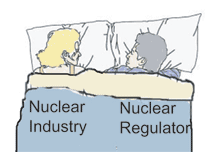
Regulators are regulated by the industry — not the other way around.
by Arnie Gundersen | Apr 17, 2026, https://www.climateandcapitalmedia.com/regulating-the-regulators-the-extraordinary-influence-of-the-nuclear-power-industry-on-the-nuclear-regulatory-commission/
The Nuclear Energy Institute approves NRC commissioners, oversees its workers and, staff say, undermines its independence and public safety mandate
The US Nuclear Regulatory Commission (NRC) mission statement provides a dual — and, critics say, contradictory — mandate that it “protects public health and safety” but also that it “advances the nation’s common defense and security by enabling the safe and secure use and deployment of civilian nuclear energy technologies…”
Given the history of nuclear accidents and lack of fully safe and permanent ways to address nuclear accidents and waste, critics see the mandate to protect public safety but also “advance” nuclear power as a conflict of interest. And given the nuclear industry’s heavy influence — some say control — over the nation’s regulatory agency, many both inside and outside the agency believe the industry has successfully turned the NRC into its advocate rather than its regulator.
Concerns about NRC objectivity
Concerns about the NRC’s objectivity and balance of support for public health versus industry support have taken on added urgency since President Trump last year signed an executive order calling for 10 new large nuclear reactors to be under construction by 2030 and for the Nuclear Regulatory Commission to speed reactor approvals. The first five or 10 new planned US nuclear reactors will “almost certainly” receive loans from the US Energy Department’s lending office, Energy Secretary Chris Wright told lawmakers Thursday.
The NRC employs several thousand technical staff. But it’s led by a commission of five people appointed by the US President and confirmed by the Senate. But the President and Senate see potential nominees only if they’ve already been approved by a well-funded industry group. That means the regulators are regulated by the industry — not the other way around.
Regulators are regulated by the industry — not the other way around.
The real control over nuclear power in Washington, D.C. lies in the nonprofit Nuclear Energy Institute (NEI). Every member of the NRC for the last decade has been screened by the NEI, which is the lobbying, campaign financing, and public relations organization for the nuclear industry.
The industry chooses its regulators
One does not become a Commissioner unless NEI finds that you are acceptable. Never has a member of a non-governmental organization or a safety critic been appointed to the Commission. Even nuclear proponents who’ve raised any questions about the nuclear industry, or worked for people who did, have been blocked.
While the NRC puts “public health and safety” first in its mission statement, the NEI’s charter says:
NEI is the unified voice of the commercial nuclear energy industry, influencing policies that affect its members, their customers, and the industry’s future. NEI represents the industry’s interests before Congress, the executive branch, state and local legislatures, federal regulators, international organizations, courts, and influential platforms where policy matters affecting the industry are discussed.
The NEI’s 2024 budget for direct lobbying was $1,570,000 while its total yearly operating budget was $57,500,000. According to IRS filings, its President & CEO earned a total compensation of $3,594,043,000 while its other 12 top executives together earned $7,222,173 with other staff salaries adding an additional $17,188,000, Propublica reported. That’s a lot of money to “represent the industry’s interest before Congress… and… federal regulators...”
“Regulatory Capture”
More significant to the public interest, however: Industry access to and even control of the NRC through informal channels euphemistically called “drop-in meetings” by NEI, nuclear reactor vendors, and plant owners has long been a concern of the NRC’s staff engineers.
In its 2022 audit prepared for the five Commissioners by the NRC’s Inspector General acknowledged that those concerns pose risks to the public:
Perceived Asymmetry of Access to NRC Management and Risk of Regulatory Capture Undermine NRC Transparency Goals
During our audit, the OIG identified chronic concerns, expressed by NRC staff and external stakeholders alike, about drop-in meetings and similar non-public informal interactions. One of these concerns was regulatory capture, which in relation to drop-in meetings is the concern that the NRC is serving to advance the interests of the very industry it regulates. Regulatory capture is often intangible and not measurable.
At a September 5, 2024 all-staff “Briefing on Human Capital” video call, with NRC leadership, eight top staff and two union leaders present, an intrepid staffer noted that the nuclear industry was unduly influencing regulatory policy:
Question: With NRC staff trust in the objectivity and integrity of NRC Commissioners and NRC executive leadership at an all-time low, with an annual exodus for sweetheart positions in the industry, what can be done to restore credibility and confidence that executive-level decision-making is not industry biased and actually serves the public interest?
Chairman Hanson: …everybody in this room, everybody up on this dais, are dedicated public servants, and I don’t question that at all…
Later in the same meeting, from an engineer:
Question: Okay. This question has a little bit of a background in it. The way outside stakeholders treat NRC staff is a factor in staff morale and workload, but it is often ignored. This has turned out to be a major issue with respect to advanced reactors where some company representatives and lobbying organizations have been downright abusive to agency workers. What’s worse, senior management is perceived as taking the side of the outside stakeholders and leaving the NRC project teams to take the brunt of the criticism. This is both demoralizing and time consuming for project staff. What can be done to limit repeated and unproductive industry interactions with project staff so that they can focus on doing the projects, rather than on handling difficult people of all the things that could help NRC meet tighter schedules?
Chairman Hanson: So thank you for the question. I wasn’t aware that this was an issue, so I appreciate the question just in kind of raising the awareness to me.
Think about that response. The Chairman of the US federal government’s Nuclear Regulatory Commission claimed that he “wasn’t aware” that stakeholders’ heavy-handed interaction with staff — and NRC leaderships’ support of those stakeholders over its own staff — was an issue, even though it had already been reported in an Inspector General’s audit that any self-respecting chairman of a public regulatory agency with fiduciary duty to taxpayers would have been obligated to read — and to respond to.
Chairman Hanson’s 2024 claim — either reckless and irresponsible, or simply not credible — also flies in the face of comments by one of his predecessors, former NRC Chairman Greg Jaczko. Five years earlier, in 2019, Jaczko publicly stated,
“I saw things up close that I was not meant to see: an agency overwhelmed by the industry it was supposed to regulate and a political system determined to keep it that way… honesty and integrity mean nothing if you are perceived to be critical of nuclear power…”
Clearly, the NRC and its five Commissioners have failed to live up to the agency’s core mission to put the public first.
The NEI presents itself as an impartial source of nuclear science and wisdom. Yet it also funds “astroturf” advocacy groups, including Nuclear Matters and Third Way. Schedule I of NEI’s 2024 990 tax filing shows that NEI paid $2.3 million to Washington, D.C.-based nonprofit Nuclear Matters, which on its website claims:
Nuclear Matters is a national coalition of grassroots advocates, working to inform the public and policymakers about the clear benefits of nuclear energy.
The 2024 IRS 990 tax filing for Nuclear Matters states that its operating income was $2,309,945, showing that 99.5% of its income came from the NEI. Its form 990 identified three executives whose combined total compensation was $2,206,460. That means 95% of the Nuclear Energy Institute’s donation to the nonprofit Nuclear Matters was compensation to just three people. That’s highly irregular in the world of nonprofits.
Moreover, you might think that an organization claiming to represent a “nationwide coalition of grassroots advocates” should be funded by actual coalitions of grassroots advocates. But with 95% of its funding from NEI, Nuclear Matters is not.
Grassroots or astroturf?
You might also expect that an organization claiming to represent a “nationwide coalition of grassroots advocates” would work with, find substantial support from, and list a significant nationwide coalition. However, Nuclear Matters’ “Advocacy Council” includes 21 people, virtually all of whom are current or former nuclear industry representatives, policymakers or regulators. And its 16 listed “partners” are pro-nuclear organizations, many of which have received industry funding.
Does that fit your definition of “grass roots”?
The NEI’s reach extends beyond the NRC and into the Department of Energy, which controls funding of future nuclear reactor designs through DOE’s Office of Energy Dominance Financing. Membership in NEI is not limited to the owners of existing nuclear power plants, but also is open to newer companies seeking government funds to design the next generation of atomic power plants.
Reprocessing isn’t the solution
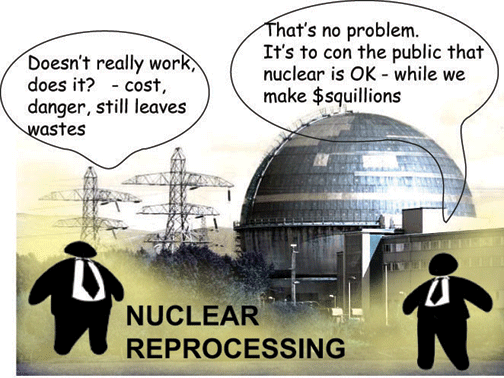
by Bart Ziegler, April 6, 2026, https://thecoastnews.com/opinion-reprocessing-san-onofres-nuclear-waste-a-risky-bet/
A decades-old conversation about what to do with the nuclear waste at the San Onofre Nuclear Generating Station is now getting the attention it deserves.
Last December, the San Diego County Board of Supervisors voted to explore sending spent fuel from San Onofre to a national laboratory for reprocessing. Our organization raised concerns at the time. Now, the county’s own staff has reached the same conclusion.
In a March 9, 2026, report, the county found that commercial-scale reprocessing “has historically been cost-prohibitive and presents security concerns related to plutonium separation” and that “deployment timelines remain uncertain and federal policy does not prioritize reprocessing as a near-term solution.” The report concluded that pursuing a reprocessing initiative “may not be a cost-effective or strategically viable project at this time.”
This comes as pressure to embrace reprocessing intensifies. An energy think tank and Oklo — a recycling company that recently announced a $1.68 billion facility in Tennessee — are pressing Congress to rewrite foundational laws governing nuclear energy to promote commercial recycling.

The Department of Energy is soliciting states to host “nuclear lifecycle innovation campuses” encompassing enrichment, fuel fabrication and waste disposal. Of 24 states that expressed interest, officials say 12 to 15 have “very serious proposals.”
The urgency driving these efforts is real. The 3.6 million pounds of spent fuel at San Onofre sit 100 feet from the Pacific Ocean, near a military base, above the water table and near multiple active fault lines. But handing the waste over to loosely regulated startups with unproven technology and limited oversight is equally a recipe for disaster.
Reprocessing advocates call it “recycling,” which sounds beneficial or even harmless, but it carries its own risks. Reprocessing does not eliminate nuclear waste. It transforms solid spent fuel rods into more unstable forms, including liquid radioactive acid, which is harder to contain.
The only commercial reprocessing plant operated in the United States, in West Valley, New York, ran for six years before shutting down and accruing a cleanup bill that may ultimately cost taxpayers more than $5 billion.
The deeper problem is proliferation. Reprocessing separates plutonium — a key component of nuclear weapons — from spent fuel, creating material that is far easier to divert or steal. Presidents Gerald Ford and Jimmy Carter halted U.S. commercial reprocessing after India used plutonium from its civilian program to build a bomb in 1974.
The National Academies and Department of Energy laboratories have since concluded that newer reprocessing methods do not meaningfully reduce that risk.
This does not mean reprocessing research should be abandoned. But it does mean lawmakers should stop treating commercial reprocessing as an emergency off-ramp for San Onofre and other sites with stranded nuclear waste.
If federal policy is updated, it should prioritize approaches that avoid separated plutonium, favor low-enriched fuel strategies, minimize high-hazard secondary waste streams and meet rigorous safety requirements.
Reprocessing is not a substitute for the federal government’s obligation to deliver a permanent disposal solution, as required by federal law. Rep. Mike Levin, co-chair of the bipartisan Spent Nuclear Fuel Solutions Caucus, warned that treating reprocessing as a near-term fix for San Onofre “distracts from the work that experts agree is unavoidable.”
Instead, if lawmakers are serious about a nuclear renaissance, they should advance bipartisan legislation already under discussion to establish an independent nuclear waste authority that prioritizes removing waste from high-risk, high-population sites like San Onofre.
Bart Ziegler is the president of the Del Mar-based Samuel Lawrence Foundation.
Israeli Journalist With Deep Ties to IDF Admits West Bank Violence ‘Looks Like… Ethnic Cleansing’

In conversations with Israeli settlers, Ben-Yishai often found that they believed they were entitled by God to take all land where Palestinians reside.
April 16, 2026 , Brad Reed for Common Dreams https://www.commondreams.org/news/west-bank-ethnic-cleansing
West Bank settler attacks on Palestinians are “rather sophisticated, organized, and funded systematic actions,” with the goal of “cleansing” the entire region, said journalist Ron Ben-Yishai.
An Israeli war correspondent who has been described as having deep ties to the Israel Defense Forces said that intensifying settler violence in the occupied West Bank appears to be “ethnic cleansing.”
In an column published by Ynet titled “This looks like blue and white ethnic cleansing,” journalist Ron Ben-Yishai wrote that, during a recent tour of the West Bank, he observed “a disturbing reality” of Israeli teenagers “who go on ‘intimidation tours’” in Palestinian villages, attacking Palestinians while members of the Israeli military frequently either stand by or actively join in the attacks.
“In some cases, these are reservists who also identify ideologically with the rioters, and therefore stand by and do not prevent them from going wild—and sometimes even help them,” explained Ben-Yishai. “Even in the regular IDF units stationed in the territories, there have been quite a few cases in which commanders and fighters have deviated from the norms and the IDF’s code of ethics for religious-nationalist reasons.”
In conversations with Israeli settlers, Ben-Yishai often found that they believed they were entitled by God to take all land where Palestinians reside.
“The confident reliance on God’s command as the answer to all moral and practical questions and concerns,” he wrote, “gave me a disturbing feeling that this was a type of Jewish terrorism motivated by religious and nationalist motives.”
Ben-Yishai also described ways in which Israeli settlers surround Palestinian communities “in order to prevent them from moving freely and strangle them economically.”
Taken as a whole, Ben-Yishai concluded that the Israel settler attacks on Palestinians are a “rather sophisticated, organized, and funded systematic actions—with the long-term strategic goal being to ‘cleanse’ most of” the West Bank and Gaza of Palestinian presence.
In a social media post, geopolitical analyst Shaiel Ben-Ephraim explained how significant it was for someone like Ben-Yishai, whom he said has “the deepest ties to the IDF of any reporter,” to describe West Bank settlers’ actions as ethnic cleansing.
“Observers have been saying for years that what is happening in the West Bank is ethnic cleansing,” he wrote. “But now voices from the heart of the Israeli consensus are admitting it as well.”
1 This Month
23-25 October – on Zoom – World BEYOND War’s annual global conferenc


Shut down the radiation-damaged Heysham nuclear reactors now
To see nuclear-related stories in greater depth and intensity – go to https://nuclearinformation.wordpress.com

Say No to NASA’s Reckless Nuclear Reactor on the Moon
Say No to NASA’s Reckless Nuclear Reactor on the Moon

-
Archives
- October 2026 (247)
- September 2026 (339)
- August 2026 (330)
- July 2026 (355)
- June 2026 (287)
- May 2026 (306)
- April 2026 (356)
- March 2026 (251)
- February 2026 (267)
- January 2026 (308)
- December 2025 (358)
- November 2025 (359)
-
Categories
- 1
- 1 NUCLEAR ISSUES
- business and costs
- climate change
- culture and arts
- ENERGY
- environment
- health
- history
- indigenous issues
- Legal
- marketing of nuclear
- media
- opposition to nuclear
- PERSONAL STORIES
- politics
- politics international
- Religion and ethics
- safety
- secrets,lies and civil liberties
- spinbuster
- technology
- Uranium
- wastes
- weapons and war
- Women
- 2 WORLD
- ACTION
- AFRICA
- Atrocities
- AUSTRALIA
- Christina's notes
- Christina's themes
- culture and arts
- Events
- Fuk 2022
- Fuk 2023
- Fukushima 2017
- Fukushima 2018
- fukushima 2019
- Fukushima 2020
- Fukushima 2021
- general
- global warming
- Humour (God we need it)
- Nuclear
- RARE EARTHS
- Reference
- resources – print
- Resources -audiovicual
- Weekly Newsletter
- World
- World Nuclear
- YouTube
-
RSS
Entries RSS
Comments RSS

