Philippines Says US Will Pull Out Controversial Mid-Range Missile System
The US deployed the Typhon missile system for annual military drills
by Dave DeCamp July 4, 2024 ore https://news.antiwar.com/2024/07/04/philippines-says-us-will-pull-out-controversial-mid-range-missile-system/
On Thursday, the Philippines said the US was pulling out a new missile system it deployed to the Southeast Asian country for annual military exercises.
The US sent the Typhon missile system for the Balikatan exercises, which were held in April and May. The Typhon is a controversial launcher since it would have been banned by the Intermediate-Range Nuclear Forces (INF) Treaty, a treaty between the US and Russia that the Trump administration withdrew from in 2019.
The INF prohibited land-based missile systems with a range between 310 and 3,400 miles. The Typhon can launch nuclear-capable Tomahawk missiles, which have a range of about 1,000 miles. It can also fire SM-6 missiles, which can hit targets up to 290 miles away.
Philippine Col. Louie Dema-ala told AFP that the US planned to withdraw the Typhon from the Philippines following the military exercises. “As per plan… it will be shipped out of the country in September or even earlier,” he said. “The US Army is currently shipping out their equipment that we used during Balikatan and Salaknib (exercises).”
China strongly condemned the deployment of the Typhon system, which US officials have acknowledged was developed to prepare for a future conflict with Beijing over Taiwan or the South China Sea.
Russian President Vladimir Putin also recently mentioned the deployment. He made the comments when calling for Moscow to follow the US and develop missile systems previously banned by the INF.
“We need to start production of these strike systems and then, based on the actual situation, make decisions about where — if necessary to ensure our safety — to place them,” Putin said last week.
“Today it is known that the United States not only produces these missile systems, but has already brought them to Europe for exercises, to Denmark. Quite recently it was announced that they are in the Philippines,” the Russian leader added.
Trump allies are peddling a catastrophic idea for U.S. nuclear weapon policy

Resuming live testing could spark an arms race and will reduce American security.
By Zeeshan Aleem, MSNBC Opinion Writer/Editor, 6 July 24
Allies and former advisers to former President Donald Trump are arguing that the U.S., for the first time in decades, should resume nuclear testing. They say it’ll advance American safety by ensuring that the U.S. has a decisive military and technological advantage over other nuclear powers. In reality, the U.S. — and the world — would be made more dangerous by the kind of arms race this could spark. And it seems plausible that if Trump were to win the White House he could adopt the policy because of the manner in which it aligns with the unilateral militance of the “America First” worldview.
Influential figures in Trump’s orbit are pushing the idea of breaking long-held norms and resuming live nuclear testing. Former Trump national security adviser Robert O’Brien wrote in Foreign Affairs in June that “Washington must test new nuclear weapons for reliability and safety in the real world for the first time since 1992” in order to maintain technical superiority over China and Russia. Christian Whiton, who served as a State Department adviser to President George W. Bush and Trump, told The New York Times that “it would be negligent to field nuclear weapons of novel designs that we have never tested in the real world.” And the Heritage Foundation, the right-wing think tank that’s backing Project 2025, widely considered a policy blueprint for Trump’s second term, is proposing that the federal government expand its capacity for immediate nuclear testing.
Since 1992, the U.S. has refrained from explosive nuclear testing and opted for other techniques, including expert appraisals and sophisticated modeling generated by supercomputers, to calculate the efficacy of its long-term stockpile and its newer weapons. That policy has helped nudge other countries away from pursuing live testing. Most countries don’t conduct live tests of nuclear warheads in adherence to the Comprehensive Nuclear-Test-Ban Treaty.
Multiple nuclear proliferation experts say that if the U.S. resumes explosive testing, other countries will have more incentive to do so. “Resuming U.S. nuclear testing is technically and militarily unnecessary,” wrote Arms Control Association executive director Daryl Kimball in response to O’Brien’s article. “Moreover, it would lead to a global chain reaction of nuclear testing, raise global tensions, and blow apart global nonproliferation efforts at a time of heightened nuclear danger.” Kimball’s argument is in line with President Joe Biden’s outlook. During his 2020 presidential campaign, Biden endorsed the U.S. continuing to abstain from explosive testing and said a resumption would be “as reckless as it is dangerous.” …………………………………………………………………………..more https://www.msnbc.com/opinion/msnbc-opinion/trump-nuclear-policy-election-rcna160459
EDF’s Nuward U-turn shows risk of betting on Small Nuclear Reactors – analysts
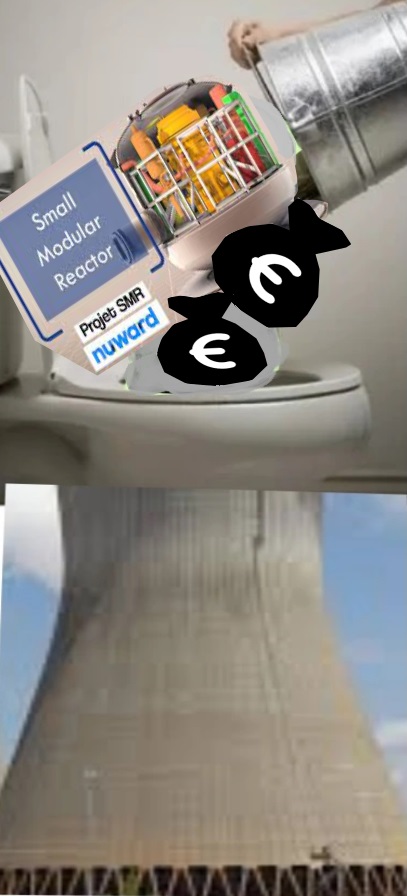
(Montel) French utility EDF’s decision to ditch the design of its Nuward small modular reactor (SMR)in France shows the risk of expecting too much of the nuclear technology – with delays to the project expected, analysts told Montel.
too many technical uncertainties, analysts said.
(Montel) French utility EDF’s decision to ditch the design of its Nuward small modular reactor (SMR)in France shows the risk of expecting too much of the nuclear technology – with delays to the project expected, analysts told Montel.
Montel News, by: Muriel Boselli, Sophie Tetrel , 03 Jul 2024
“SMRs must remain a possibility for keeping a nuclear fleet in the long term but they cannot be the pillar of a reliable electricity strategy at this stage,” said Nicolas Goldberg of Colombus Consulting. “Hence the need for electric renewables, which should not be overlooked.”
France is relying on SMRs as part of a broader plan to spur its nuclear power industry and lower carbon emissions.
In 2022, president Emmanuel Macron announced plans to invest EUR 1bn by 2030 in the development of small modular reactors, with EUR 500m going to Nuward.
Technical difficulties
EDF confirmed media reports on Tuesday that it was scrapping its SMR design due to technical difficulties. The company wanted to “move towards a design built exclusively from proven technological building blocks”, a spokeswoman told Montel.
The market had been sceptical about the project as there were too many technical uncertainties, analysts said.
“This announcement allows us to be a little less involved in utopian and rhetorical discussions about nuclear power and to return to something much more technical, which brings us back to the limits of SMRs at the moment,” said Franck Gbaguidi, an analyst at Eurasia Group…………………………..
Safety adaptation
Ditching the design meant EDF would have to adapt the safety plan it submitted to France’s ASN nuclear safety authority last July, an ASN spokeswoman said.
The Nuward project has been in development since 2019, managed by a consortium of companies including EDF, Naval Group, TechnicAtome, the French Alternative Energies and Atomic Energy Commission (CEA), Framatome and Tractebel. Construction was scheduled to start in 2030
The Nuward project has been in development since 2019, managed by a consortium of companies including EDF, Naval Group, TechnicAtome, the French Alternative Energies and Atomic Energy Commission (CEA), Framatome and Tractebel. Construction was scheduled to start in 2030.
France is currently developing 11 SMR projects and the nuclear development has been backed by right and far-right political parties. In April, the start-up Jimmy said it had submitted a request to the ecology ministry for authorisation of a pair of 170 MW capacity SMRs it hopes to build in France after the European Commission approved EUR 300m in state aid for the project.
In December last year, the company said it would stick with its SMR plans in Europe despite American firm NuScale Power scrapping its plan to build SMRs in the US. https://montelnews.com/news/2edd2bd8-fa29-4629-95f9-c876c1e4e6ce/edfs-nuward-u-turn-shows-risk-of-betting-on-smrs-analysts
Labour must act fast to fire up Rolls-Royce nuclear reactor deals

Rolls-Royce risks losing billions in overseas contracts if Labour delays
vital strategic decisions on nuclear reactors, in what is emerging as the
first crucial test of its business policies.
Other projects may also be in
jeopardy, imperilling thousands of jobs, if new ministers are slow to take
action to tackle the overflowing in-trays confronting them. The engineering
giant is considered to be a front-runner of the six groups in the race to
build Britain’s first mini nuclear plants, known as small modular reactors
(SMRs).
State funding has been key to the development of its designs. One
of the company’s goals is to create a major export market for its SMRs. It
is eyeing contracts worth billions of pounds. [Really !!] The Mail on Sunday
understands that central European countries including the Czech Republic
are among those in talks with Rolls. But these negotiations will stall –
and possibly end – if Labour does not give the UK’s formal backing to the
project by the end of the year.
This is Money 6th July 2024
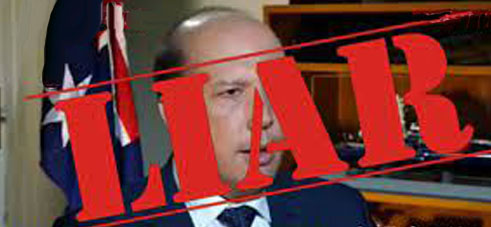
Australian Opposition leader Dutton’s claim about G20 nuclear energy use doesn’t add up
William Summers , July 5, 2024, https://www.aap.com.au/factcheck/duttons-claim-about-g20-nuclear-energy-use-doesnt-add-up/
WHAT WAS CLAIMED
Australia is the only G20 nation that doesn’t use nuclear power.
OUR VERDICT
Misleading. Five other G20 nations don’t generate nuclear power, and two of those don’t use it.
AAP FACTCHECK – Federal Opposition Leader Peter Dutton claims Australia is the only country not to use nuclear energy out of the world’s 20 largest economies.
This is misleading. Five other nations in the top 20 – Germany, Italy, Turkiye, Saudi Arabia and Indonesia – do not generate nuclear energy.
Germany, Italy and Turkiye import very small amounts of electricity generated from nuclear sources, but Indonesia and Saudi Arabia don’t consume any nuclear power.
Australia is the only top 20 economy that doesn’t generate, import or have a plan to do so.
Mr Dutton has made the claim at least four times in interviews about the coalition’s plan to build seven nuclear power stations in Australia without clarifying that he’s counting countries planning to use nuclear power among those that are actually using it.
Mr Dutton said nuclear power was “used by 19 of the 20 biggest economies in the world” at a June 18 press conference in NSW.
He again claimed that of the top 20 economies in the world, “Australia is the only one that doesn’t have nuclear” in a June 20 interview on Sky News.
That same day, the opposition leader spoke out about how Australia could benefit from nuclear power “as 19 of the world’s top 20 economies have done” in an ABC News Breakfast interview.
Mr Dutton again said Australia was the only one of the 20 biggest economies that “doesn’t operate” nuclear at a press conference on July 5.
When asked to clarify his claims, the opposition leader’s spokeswoman told AAP FactCheck that he’s counting countries that have nuclear power and those “taking steps towards embracing nuclear”.
Mr Dutton accurately stated 19 of the world’s 20 biggest economies used nuclear power or “have signed up to it” in another press conference on June 19, and a Today Show interview on June 21.
He also said Australia was the only G20 member that didn’t use or plan to use nuclear power in an ABC TV interview on April 21.
The G20 is a global forum for countries with large economies. Despite its name, the G20 includes only 19 nations, plus the African Union and the European Union. Spain is invited to the G20 as a permanent guest.
It’s unclear if Mr Dutton is referring to the G20 countries plus Spain, or the 20 largest nations by gross domestic product, as he’s used both interchangeably.
However, AAP FactCheck has analysed the former because the nations that don’t generate nuclear power and the nations that only import small amounts of it are exactly the same for both groupings, as per World Bank 2023 GDP data.
Fourteen G20 countries operate nuclear power plants: Argentina, Brazil, Canada, China, France, India, Japan, Mexico, Russia, South Africa, South Korea, Spain, the UK and the US.
Three G20 nations that don’t generate nuclear power but import small amounts are Germany, Italy and Turkiye.
Germany shut down its final three reactors in April 2023. That year, about 0.5 per cent of the electricity consumed there was imported from France, which generates about two-thirds of its electricity from nuclear sources.
Italy closed its last reactors in 1990. About six per cent of its electricity consumption is imported nuclear power.
The country effectively banned nuclear power in 2011, but the current government wants to restart it.
Turkiye is building a plant that could start generating electricity from 2025. The country is also planning to build two other nuclear plants.
In 2022, the country imported a tiny amount of the electricity it consumed, including 0.8 per cent from Bulgaria, which generates about 35 per cent of its electricity from nuclear sources.
Therefore, a fraction of Turkiye’s electricity consumption could be produced from nuclear – likely less than half a per cent.
Saudi Arabia doesn’t use any nuclear energy either but it’s taking steps towards doing so in future.
Indonesia doesn’t have any nuclear reactors but has tentative plans to build some in the coming decades.
Dr Yogi Sugiawan, a policy analyst at the Indonesian government agency responsible for developing nuclear energy policies and plans, told AAP FactCheck that his country doesn’t generate or import nuclear energy.
However, Dr Sugiawan says Indonesia’s government is considering nuclear power, with an initial plant “expected to be commissioned before 2040”.
THE VERDICT
The claim that Australia is the only G20 nation that doesn’t use nuclear power is misleading.
Evidence and experts say six G20 countries do not generate any nuclear energy, and three of those don’t consume it either.
Misleading – The claim is accurate in parts but information has also been presented incorrectly, out of context or omitted.
AAP FactCheck is an accredited member of the International Fact-Checking Network. To keep up with our latest fact checks, follow us on Facebook, Twitter and Instagram.
The obsolescence of war
War does not serve us. It represents the worst in humanity. Thankfully, we now have nonviolent tools to manage conflict in life-affirming ways.
Waging Non Violence Nadia Mejjati July 3, 2024
The proponents of war say that violence is necessary for “defense.” But is that true? Humanity has learned how to wipe itself out in a matter of minutes with just a fraction of its nuclear weapons capability. Our atrocious culture of violence shows thousands of children killed in cold blood like a relentless horror film playing out on social media. We have invented killer-drones to undertake massacres without personally witnessing the horrors inflicted. In the face of our threatened extinction as a species, we must do better. That starts with seeing war for what it is.
War is grotesque. It represents the worst of humanity: the cruelty of unharnessed anger and unhealed trauma, led by greedy leaders far from the frontlines, playing with human lives. No matter who wins or loses, the result is pain and increased trauma on both sides, fuelling further injustice and oppression.
Benjamin Casteillo describes, “In the past, dangers of hostility, scarcity and rejection were met with primal impulses of domination, accumulation and conformism, thus trapping a large part of humanity in self-perpetuating rivalries for power, resources and status. Yet, in the current context of exponential technological development which has resulted in weapons of mass destruction, multiplied extractive capacities, and amplified capacities for social engineering, these primal impulses are becoming increasingly obsolete and unsustainable, resulting in existential risks of catastrophic wars, ecosystems destruction and human obsolescence, threatening life itself.”
War does not create harmony. Despite this, we glorify it in our history classes when we could teach the history and practice of nonviolence, to our advantage. Erica Chenoweth and Maria Stephan provided us with statistical evidence that nonviolence is far more successful in reaching campaign objectives than violence. In other words, the belief that we must respond to violence with more violence to establish peace is now outdated by documented fact.
War is weak — especially compared to the hard work of nonviolent struggle, diplomacy and peacebuilding.
Transformational change takes courage and commitment. Nonviolence is not a wishy-washy choice we make because we have hippy parents. It is a response to the violence in our communities, our families, and most importantly, in ourselves. It is a dedicated yearning to find other ways to be, ways that favor life.
War is nonsensical, unless you profit from selling arms and destroying life. We face the ecological breakdown of our planet, while the military industrial complex is outrageously polluting, topping the fossil fuel consumption record, obliterating life and landscape. ……………………………………………………………………. more https://wagingnonviolence.org/cnv/2024/07/the-obsolescence-of-war/—
Starmer’s role in Assange’s persecution
As head of the UK Crown Prosecution Service, the newly elected British PM Keir Starmer played a key role in setting in motion the infernal legal machinery that crushed Assange for 14 years
THOMAS FAZI, JUL 05, 2024, https://www.thomasfazi.com/p/starmers-role-in-assanges-persecution
Even though Julian Assange was finally freed last month, after a 14-year-long ordeal, many myths still endure about the whole affair. One of these is that the case concerning Assange’s alleged rape of two girls in Sweden, in 2010, never went to trial because Assange evaded justice. In reality, Assange, who was then in the UK, made himself available for questioning via several means, by telephone or video conference, or in person in the Australian embassy. But the Swedish authorities insisted on questioning him in Sweden. Assange’s legal team countered that extradition of a suspect simply to question him — not to send him to trial, as he had not been charged — was a disproportionate measure.
This was more than a technicality: Assange feared that if he were extradited to Sweden, the latter’s authorities would extradite him to the US, where he had good reason to believe that he wouldn’t be given a fair trial. Sweden, after all, always refused to provide Assange a guarantee of non-extradition to the US — the reason why, when in 2012 the British Supreme Court ruled that he should be extradited to Sweden, Assange sought political asylum in the Ecuadorian embassy. From there, however, he continued to make known his availability to be interrogated by the Swedish authorities inside the embassy, but they never replied.
Thanks to a FOIA investigation by the Italian journalist Stefania Maurizi, it would later emerge that a crucial role in getting Sweden to pursue this highly unusual line of conduct was played by the UK Crown Prosecution Service (CPS), the principal public agency for conducting criminal prosecutions, then led by one Keir Starmer. In early 2011, while Assange was still under house arrest, Paul Close, a British lawyer with the CPS, gave his Swedish counterparts his opinion on the case, apparently not for the first time. “My earlier advice remains, that in my view it would not be prudent for the Swedish authorities to try to interview the defendant in the UK”, Close wrote. Why did the Crown Prosecution Service advise the Swedes against the only legal strategy that could have brought the case to a rapid resolution, namely questioning Julian Assange in London, rather than insisting on his extradition?
In hindsight, it seems clear that the CPS’s aim was precisely that of keeping the case in a legal limbo, and Assange trapped in Britain, for as long as possible, especially considering how shaky the case against Assange was in the first place. After all, what better outcome for Assange’s enemies than keeping him under investigation for years, suspected of being a rapist but never either charged or cleared once and for all, thus justifying his arbitrary detention? The CPS’s hostile treatment of Assange, the citizen of an allied country, continued even after he sought refuge in the Ecuadorian embassy, for example by insisting on denying him “safe passage” in UK territory in order to be treated in a hospital for a shoulder problem.
A year after Assange had taken refuge in the embassy, it appears that the Swedish prosecutor was considering dropping the extradition proceedings, but she was deterred from doing so by the CPS. The prosecutor was concerned, among other things, about the mounting costs of costs of the Scotland Yard agents guarding the embassy day and night. But for the British authorities this was not a problem; they replied that they “do not consider costs are a relevant factor in this matter”.
As a result of the Swedish authorities’ highly unusual behaviour, Assange had, by then, been arbitrarily and illegitimately forced into detention for seven years, as was concluded even by the UN Working Group on Arbitrary Detention.
What role, if any, did Keir Starmer play in all this as head of the CPS? During the period when the body was overseeing Assange’s extradition to Sweden, Starmer made several trips to Washington. US records show Starmer met with Attorney General Eric Holder and a host of American and British national security officials. Using the Freedom of Information Act, the British media organisation Declassified UK requested the itinerary for each of Starmer’s four trips to Washington with details of his official meetings, including any briefing notes. CPS replied that all the documents relative to Starmer’s trips to Washington had been destroyed. Asked for clarification — and whether the destruction of documents was routine — the CPS did not respond.
Similarly, when Maurizi submitted a FOIA request to the CPS to shed light on the correspondence between Paul Close and the Swedish authorities, she was also told that all the data associated with Paul Close’s account had been deleted when he retired and could not be recovered. This only beckoned more questions: why did the CPS destroy key documents on a high-profile, ongoing case? And what did the CPS destroy exactly, and on whose instructions? The CPS added that Close’s email account had been deleted “in accordance with standard procedure”. However, Maurizi would later discover that this procedure was by no means standard. The destruction of key emails was distinctly suspicious.
Since then, Maurizi has been waging a years-long legal fight to access documents related to the CPS and Assange case, but she has been systematically stonewalled by CPS — even despite a judge order ordering the CPS to come clean about the destruction of key documents on Assange. One cannot help but wonder: what are they trying to hide? It’s hard to shake the conclusion that the real purpose of the Swedish investigation, and of CPS’s unusual behaviour, was simply to keep Assange detained for as long as necessary to get him extradited to the US.
Now that one of the key people behind all this has just been elected prime minister, it’s even less likely that we’ll ever learn the truth. Indeed, one cannot help but wonder if releasing Assange just before the election wasn’t a way — for Starmer and everyone else involved — to make this story go away once and for all.
Now Keir Starmer Has to Decide If He’d Use Nukes
Becoming the British prime minister means giving top-secret orders—immediately—that could determine the fate of the world.
The Atlantic, By Brian Klaas, 5 July 24
Following a landslide victory for the Labour Party, Britain has a new leader. The moment Keir Starmer is officially made prime minister of the United Kingdom, he will be given a flurry of briefings, piles of documents, and the urgent business to run the country. Lurking among those papers is a moral land mine.
Starmer will be given a pen and four pieces of paper. On each paper, he must handwrite identical top-secret orders that—hopefully—no other human being will ever see. The previous set of orders, written by outgoing Prime Minister Rishi Sunak, will then be destroyed, unopened. These top-secret papers are called the “letters of last resort.”
Since 1969, Britain’s nuclear deterrent has operated at sea, with nuclear missiles that could be launched from at least one continuously deployed submarine. Destroying those vessels would eliminate the United Kingdom’s nuclear deterrent, so the secrecy of the patrolling submarine’s location is paramount. Once deployed, the submarine may not transmit messages, only receive them, to maintain its crucial cloak of concealment………………………. (Subscribers only) more https://www.theatlantic.com/international/archive/2024/07/british-election-nuclear-weapons/678919/
Book. Nuclear is Not the Solution. The Folly of Atomic Power in the Age of Climate Change.

New book by MV Ramana.
Nuclear power will slow our response
to climate change and increase the risk of weapons proliferation and
catastrophe. The climate crisis has propelled nuclear energy back into
fashion. Its proponents argue we already have the technology of the future
and that it only needs perfection and deployment.
Nuclear Is Not the Solution demonstrates why this sort of thinking is not only naïve but
dangerous. Even beyond the horrific implications of meltdown and the
intractable problem of waste disposal, nuclear is not practicable on such a
large scale.
Any appraisal of future energy technology depends on two
important parameters: cost and time. Nuclear fails on both counts. It is
more costly than its renewable competitors wind and solar. And, importantly
given the need for rapid transformation, it is slow. A plant takes a decade
to come online. If you include permits and fundraising, this adds another
decade.
And we should not forget the deep roots it has in the defense
industry. M. V. Ramana’s powerful book destroys any illusion that nuclear
is our answer to climate change, untangling technical arguments into simple
and sensible language.
Importantly, Nuclear Is Not the Solution also
unmasks the powerful groups with vested interests in the maintenance of the
status quo, currently working hard to greenwash a spectacularly dirty
industry. It’s why we believe that, as recommended by the Skidmore Net
Zero Review, there should be an Office for Net Zero Deployment, holding the
government to account against sustainability and Net Zero targets.
Penguin – Random House 5th July 2024
Europe is Quietly Debating a Nuclear Future Without the US

America has protected Europe with is nuclear umbrella for more than 70 years. In the era of Vladimir Putin and Donald Trump, the continent is quietly debating a different nuclear future.
Politico, By LAURA KAYALI, THORSTEN JUNGHOLT and PHILIPP FRITZ, 07/04/2024
In a castle near Stockholm, standing on a blue-curtained podium that hid the room’s gilt mirrors and sparkling chandeliers, French President Emmanuel Macron ripped open a debate that Europe had been avoiding not just for years but for decades.
Macron had chosen the time and place carefully; he was on a state visit to Sweden, one of the long-neutral European countries who decided in 2022 to join NATO in response to Russia’s full-scale invasion of Ukraine. He was sharing the stage with Sweden’s king and prime minister, and faced an audience of Swedish military cadets and officers who were recalibrating their mission and ideas about their country’s, and the continent’s, security. It was the last week of January, and Sweden’s final ratification as a NATO member was just weeks away. And he spoke in English, to make sure people outside of France and Sweden paid attention.
During the Cold War, Macron noted, “all the treaties were decided by the former USSR and USA. Everything that covered our territory was decided by the big guys in the room, not by the Europeans themselves.” Going forward, he said, looking around the audience to make sure his point was getting across, in the area of arms control, troop deployments and the entirety of Europe’s security architecture, that needs to change. “We have to be the one to decide,” Macron said.
The room of military officers was quiet. Macron hadn’t used the word “nuclear,” but he didn’t have to. A Swedish officer stood up and asked if France, as “the only EU country with an independent nuclear force,” had a “special responsibility” to protect the security of the continent’s northernmost region, the Arctic sea passage. In other words, was France prepared to use its nuclear weapons if Scandinavian countries were threatened from the north, presumably from Russia’s bases in the Arctic.?
“Definitely yes,” Macron responded without hesitation, as if he anticipated the question. “Part of our vital interest has a European dimension, which gives us a special responsibility, given precisely what we have and the deterrence capacity we have,” he added. ……………………………………………………………………………………………………….
Recently, Trump has been downplaying his threat to pull back from NATO, saying that he’ll keep the United States in NATO “100 percent.” But every time, he is still quick to add conditions on U.S. participation, including that allies keep up defense spending and “play fair.”
Both European and U.S. experts say it’s unlikely a Trump administration would decide to physically take out the nukes stationed in Europe. But nuclear deterrence depends on political credibility, and there’s an unspoken fear in Europe that Trump would be less willing to come to the aid of European allies than his predecessors. Would Putin be so confident that Trump would be willing to risk a nuclear war to save Estonia?
“The French and the British are going to have to think about their nuclear posture if Trump is elected and if he makes good on his threat to disengage from NATO,” said Daniel Fried, a former U.S. ambassador to Poland.
“It’s the first time since the 1960s that European countries have to question the American umbrella,” he added.
Macron’s ambitions for France’s nuclear deterrent haven’t exactly been a hit with his constituents, with far-right and far-left parties accusing him of selling out France’s sovereignty to the Europeans. But that hasn’t stopped him from continuing to promote the idea, mentioning it three more times in just the last few months.
Macron hasn’t provided many specifics about how exactly this arsenal would cover Europe, but has made clear that France would remain fully in charge: “It’s the President of the Republic as head of the armed forces who defines the engagement of this nuclear force in all its components and who defines France’s vital interests,” he told The Economist. “It’s not a question of changing that.” …………………………………………………………….
For its part, France has about 290 warheads, but is not a member of the NPG. In comparison, the U.S. has more than 5,000 nukes and Russia 5,580, according to a study by the Stockholm International Peace Research Institute.
At all times, London and Paris each have at least one nuclear-armed ballistic missile submarine patrolling the seas. A few days after the Russian invasion of Ukraine, Paris deployed three (out of four) submarines at the same time — an unprecedented level of alert. ……………………………………………………
It’s fair to say that quite a few European countries think that by reopening the debate over its nuclear umbrella, Europe has far more to lose than to gain. Chief among them is Germany, which has a history of saying no thank you to nuclear pushes from French presidents. …………………………………………………………………………………..
At least for now, the future of Europe’s conversation on nuclear deterrence depends on several high-stakes elections. Citizens from NATO’s three nuclear powers — the United States, the United Kingdom and France — are all going to the polls this year and NATO- and Euro-skeptics could soon be wielding power in both Paris and Washington.
That’s one reason why the topic is unlikely to be aired openly during the gathering of NATO leaders that will take place in Washington from July 9 to 11. “I do not expect European nuclear defense to be much of a topic at the summit,” one European diplomat said, “rather NATO will again affirm its deterrence and defense.”………………………….. more https://www.politico.com/news/magazine/2024/07/04/europe-us-nuclear-weapons-00166070
‘Letters of last resort’: deciding response to a nuclear attack among first of Starmer’s tasks

The handwritten instructions new PMs write for Trident submarine commanders contain instructions for what to do if Britain’s leaders are killed
Guardian Dan Sabbagh 5 July 24
ometime soon after entering Downing Street as prime minister, Keir Starmer will be briefed on the deadly capability of Britain’s nuclear deterrent – and asked to consider what instructions to give Trident submarine commanders in the unlikely event the UK is destroyed in an all-out attack and he is among the millions killed.
In the aftermath of an election victory, it is a sobering moment. Tony Blair is described as having gone “quite quiet” just over a quarter of a century ago when asked to handwrite four identical “letters of last resort” to the commanders in the event that the UK no longer in effect exists.
James Strong, a senior lecturer at Queen Mary, University of London, said the exercise acted as a counterweight to the drama of staying up all night, winning an election and visiting the monarch. “This is the moment where prime ministers say the reality of the job dawns on them, and that may be a reason why it keeps being done in this way”……………
While the previous Labour leader Jeremy Corbyn was personally opposed to Trident, Starmer has already signalled he supports it – and would if necessary fire nuclear missiles. “We have to be prepared” to unleash the deterrent’s destructive power, the new prime minister said last month, describing it as “a vital part of our defence.”
The briefing is led by Adm Tony Radakin, the head of the armed forces, accompanied by what one former Downing Street official described as “stern-faced admirals in improbably grey suits”
There are about 40 warheads on every Vanguard submarine that carries the Trident missiles, though the exact number is a secret and may be slightly higher. Each is estimated to have an explosive power of 100 kilotons, according to David Cullen of the Nuclear Information Service – theoretically powerful enough to cause serious blast damage in a 3km radius.
In a time of war, it would fall to the prime minister (or if he or she were unavailable or dead, a nominated alternative whose identity is not disclosed) to authorise a nuclear attack.
The letters to the four commanders are handwritten, not necessarily immediately but relatively promptly. There are considered to be four basic options: retaliate; do nothing; join forces with an allied nation, probably the US; and even leave the matter to the commander’s discretion. “Taking the last option really would be passing the buck,” Strong said.
Once written, the letters are sealed in an envelope, and can only be delivered physically. Soon after, they are deposited in what one former Trident commander described as a “safe within a safe” in each of the submarines. There has been a British nuclear-armed submarine at sea on patrol at all times since 1969.
Meanwhile, Sunak’s instructions to the submarine on patrol remain in force, until a new boat has gone out with one of Starmer’s letters. Once no longer needed, the old prime minister’s instructions are destroyed, and what they have said has never been publicly disclosed, to maintain an aura of uncertainty.
Navy insiders say a complex verification process exists before a letter can be opened, which requires determining whether the UK has been subject to an all-out nuclear attack. That involves listening for signals from home – which back in the 1960s could only come from Radio 4 and other longwave radio stations – but today comes from a wide variety of sources, including mobile phones, GPS and shipping radio.
It is also likely there would be world news, listened to at sea, describing a dramatic escalation of global tensions. “You might expect that the level of ‘proof’ which the commanding officer would be required to amass before opening the PM’s letter to be extremely high, and so it is,” one former navy submarine commander said. https://www.theguardian.com/world/article/2024/jul/05/letters-of-last-resort-deciding-response-to-a-nuclear-attack-among-first-of-starmers-tasks
World’s Largest Nuclear Fusion Reactor Delayed

By Matthew Norman, July 6, 2024, https://greekreporter.com/2024/07/06/largest-nuclear-fusion-reactor-delayed/
Construction on the world’s largest nuclear fusion reactor is now complete, but the site won’t be operational for at least another 15 years.
The $28 billion fusion reactor in France, known as ITER, has had its final magnetic coil installed. However, the reactor itself won’t actually fully function until 2039 at the earliest.
The International Fusion Energy Project (ITER) fusion reactor, comprised of 19 huge coils looped into several toroidal magnets, was initially set to begin its first full test in 2020, but now scientists say it will start operating in 2039.
This mean fusion power—of which ITER’s tokamak is leading—is seriously unlikely to be here on time to be a solution for the climate crisis.
“Certainly, the delay of ITER is not going in the right direction,” Pietro Barabaschi, ITER’s director general, said at a news conference on Wednesday, July 3rd. “In terms of the impact of nuclear fusion on the problems humanity faces now, we should not wait for nuclear fusion to resolve them. This is not prudent.”
ITER’s nuclear fusion reactor is the collaborative work of 35 countries, including every state in the European Union, Russia, China, India, and the US. It houses the world’s most powerful magnet, making it capable of producing a magnetic field 280,000 times as strong as the one shielding earth.
Costs and delays to the nuclear fusions reactor
The site was not cheap. It was initially touted to cost around $5 billion and begin operation in 2020, but it has now been hit by several delays, and its budget surged beyond $22 billion, with an additional $5 billion proposed to cover other costs. These delays have led to a 15-year delay already.
Researchers have been making efforts to harness the power of nuclear fusion, the process by which stars burn, for over 70 years. By fusing hydrogen atoms to produce helium under very high pressures and temperatures, stars convert matter into light and heat, bringing about an enormous amount of energy without emitting greenhouse gases or enduring radioactive waste.
However, replicating the conditions inside the hearts of stars is not easy. The most common design for fusion reactors, the tokamak, works by superheating plasma before collecting it inside a donut-shaped reactor chamber with powerful magnetic fields, as reported by Live Science.
It has been extremely difficult to keep the lively and superheated coils of plasma in the right place long enough for nuclear fusion to take place, however. Natan Yavlinsky, a Soviet scientist, designed the first tokamak in 1958, but no scientists have since been able to build a reactor capable of putting out more energy than it takes in.
A huge difficulty is handling the plasma that’s hot enough to fuse. Fusion reactors require extremely high temperatures, as they have to operate at lower pressures than those within the core of stars.
The commissioning of the Flamanville EPR, nuclear reactor is proving difficult
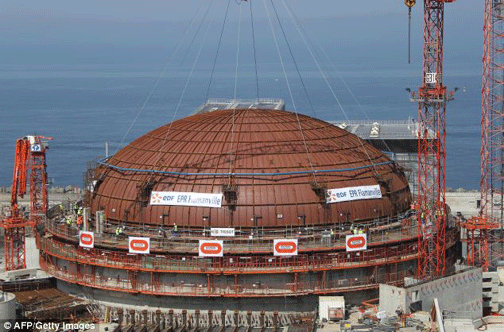
The commissioning of the Flamanville EPR, decided by the ASN on 7 May
2024, is proving difficult. This is not surprising when we remember the
many problems that this reactor has accumulated since the start of its
construction.
As Global Chance has repeatedly pointed out, there is a great
risk of seeing political imperatives take precedence over scientific rigour
and safety culture. The way in which information on commissioning is being
disseminated is worrying and does not in any way meet the conditions
stipulated by the ASN in its decision to authorise commissioning.
The next step, namely the search for criticality and the first divergence, is
crucial. Hasty implementation could prove problematic for the integrity of
the reactor and would put local populations at risk. This note is to be
updated regularly depending on the situation and the availability of
information relating to the EPR start-up operations.
Global Chance 4th July 2024
https://global-chance.org/Laborieuse-mise-en-service-de-l-EPR-de-Flamanville
Work to show UK nuclear ‘environmentally sustainable’ incomplete, 16 months after government announcement.

Stop Sizewell C executive director and company secretary Alison Downes believes labelling nuclear as green was a ploy to allow investors to justify their investment in the project.
04 JUL, 2024 BY THOMAS JOHNSON, https://www.newcivilengineer.com/latest/work-to-show-nuclear-environmentally-sustainable-incomplete-16-months-after-government-announcement-04-07-2024/
Government work to justify classifying nuclear energy generation as “environmentally sustainable” cannot be produced as it is incomplete, despite ex-chancellor Jeremy Hunt making the announcement in the 2023 Spring Budget, NCE can reveal.
NCE submitted a Freedom of Information (FOI) request to the Department of Energy Security and Net Zero (DESNZ) requesting all the documentation that was produced to back Hunt’s claim, but was refused because it is “still in the course of being completed”.
In March 2023 during the Spring Budget statement, Hunt announced the government would be consulting on listing nuclear energy as “environmentally sustainable” in a bid to increase private investment in the sector.
Hunt stated nuclear was a “critical source of cheap and reliable energy” to meeting the UK’s net zero obligations.
On the reclassification of nuclear energy, the government’s budget document stated: “Nuclear energy will also be included in the green taxonomy, subject to consultation, encouraging private investment.”
DESNZ’s reasoning for not responding to the FOI is due to the fact it has not completed the consultation as to whether it should go ahead with its plans to deem nuclear as “environmentally sustainable” which it started 16 months ago.
DESNZ stated that it “does hold information in scope of this request, however we will not be releasing this at this time as it is covered by exemption 12(4)(d) which states ‘a public authority may refuse to disclose information to the extent that the request relates to material which is still in the course of completion, to unfinished documents or to incomplete data’. Your request falls within the scope of this provision because the requested information relates to material still in the course of completion”.
It continued: “In order to apply the exemption detailed above we must also consider whether withholding such information is within the public interest. The consultation document to which the requested information relates has not been published, meaning the policy pertaining to the content of the consultation document is not finalised. For this reason, we feel it would not be in the public interest to release the information at this time.”
In its Mobilising green investment: 2023 green finance strategy document related to the consultation for nuclear to be included within the green taxonomy, it states the government intended to consult on this in autumn last year.
It further stated the consultation and getting this policy through was a priority that would be achieved by Q1 of this year.
Reaction
Stop Sizewell C executive director and company secretary Alison Downes believes labelling nuclear as green was a ploy to allow investors to justify their investment in the project.
She said: “The green taxonomy seems to be the final piece of the puzzle because the whole emphasis behind adopting the RAB model was to coax non-typical investors, like UK pension funds.
“Obviously the theory behind labelling nuclear as green would allow them to tick another environmental, social and governance (ESG) box that would enable them to justify the investment.”
Downes hypothesises that the reason behind the policy review not being completed yet could be due to the fact that Sizewell C’s recent attempt at leveraging private capital for the project in Spetember last year didn’t bring forward any atypical investors.
“If investors have an appetite for nuclear then great but if they don’t, this isn’t going to tip the balance,” she said.
“In our regular engagement with government officials they kept saying it’s coming, it’s coming, which in government speak it is ‘in due course’, which means sometime soon, maybe never.
“It was very much plugged for Q1 this year and then it didn’t happen.
“I wonder whether the fact they launched the capital raise last September where they had to get bidders to go through the pre-qualification process and it was apparent that very few were from that target market.
“Suddenly they mave have thought if we’ve got a lot on our plate, is it a priority to push this taxonomy review through?”
UK/Ireland Nuclear Free Local Authorities (NFLAs) secretary Richard Outram said it is astounding that the government was unable to come up with any justification for making the claim back in March 2023.
He said: “It is notable that even now 16 months after Jeremy Hunt claimed that nuclear is a ‘sustainable and environmentally friendly energy generation solution’ that officials in the DESNZ despite their resources, are unable to come up with the justification that underlines this claim.
“That says a lot.”
Stop Sizewell C and other anti-nuclear groups maintain that nuclear is not a environmentally energy generation solution due to the waste it creates, its contamination of the earth and other nature surrounding the power plants and the highly emission intensive methods of decommissioning old plants.
Outram continued: “The NFLAs believe that nuclear is simply too costly (Hinkley Point C’s original budget was £18bn now current real budget is £46bn and rising), too slow (Hinkley Point C was meant to be generating power to cook turkeys in time for christmmas 2017 but will now be 2031 earliest), always comes with the possibility of an accident, always cause environmental contamination, and leaves a massive and costly legacy of decommissioning redundant nuclear power plants and managing and disposing of nuclear waste (NDA current estimates £260bn).
“Events in Ukraine have also demonstrated that nuclear power plants represent a massive target and a potential ‘dirty bomb’ in the event of war with a hostile state actor and Britain’s nuclear reactors have historically been powered by uranium from Russia which is now an unreliable supplier as it is that hostile state actor.”
The NFLAs are instead calling on an energy strategy that prioritises the reduction of energy usage in the UK.
Continue readingSecond review of ARC’s Small Modular Nuclear Reactor not complete, despite layoffs

That’s after ARC Clean Technology Canada said it downsized with that review now over
Telegraph Journal, Adam Huras, Jul 04, 2024
A second design review of a New Brunswick-based company’s proposed small modular nuclear reactor is not yet complete, according to the Canadian Nuclear Safety Commission.
That’s after ARC Clean Technology Canada said it downsized with that review now over.
Brunswick News reported last month that ARC, one of two companies pursuing SMR technology in the province, had handed out layoff notices to some of its employees, citing its latest design phase coming to an end.
That’s as its CEO also departed.
But the Canadian Nuclear Safety Commission says it’s “months” away from completing its review, and may need more information from the company.
“We have received all of ARC’s major submissions as part of the vendor design review process and our experts are carefully reviewing them,” commission spokesperson Braeson Holland told Brunswick News.
“It is possible that staff will have additional questions for the vendor. In that case, additional information may be requested, and the company will be expected to provide it for the vendor design review to proceed.
“Provided that any additional information requested is submitted in a timely manner and that the company remains in compliance with its service agreement with the Canadian Nuclear Safety Commission, we anticipate that the review will be complete within several months.”
A vendor design review is an optional service that the commission provides for the assessment of a vendor’s reactor design.
The objective is to verify, at a high level, that Canadian nuclear regulatory requirements and expectations, as well as Canadian codes and standards, will be met.
The company did complete a Phase 1 review of its ARC-100 sodium-cooled fast reactor in October 2019.
An executive summary of that review, made public by the commission, noted that there were requests for additional information, as well as technical discussions through letters, emails, meetings and teleconferences, after an initial submission.
The result of that first review found that “additional work is required by ARC” to address findings raised in the review, specifically around the reactor’s management system.
It then lists a series of technical concerns, but concludes that “these issues are foreseen to be resolvable.”
A Phase 2 design review, which ARC is undergoing right now, goes into further detail, and focuses on identifying fundamental barriers to licensing for a new design in Canada, according to the commission.
That review started in February 2022, and was expected to be completed in January of this year.
It’s unclear why it has yet to be completed.
At a New Brunswick Energy and Utilities Board hearing last month into a recent power rate hike, NB Power vice president Brad Coady testified he doesn’t expect SMRs will be ready by an original target date of 2030.
The utility now believes they’ll be ready by 2032 or 2033……………….
https://tj.news/new-brunswick/second-review-of-arcs-smr-not-complete-despite-layoffs
1 This Month.
5 January -Webinar-What is Trump’s Golden Dome?
REGISTER AT Massachusetts Peace Action Education


New book – https://www.amazon.com/dp/1923372157?utm_source=substack&utm_medium=email
Now until to February 10, 2026 Radioactive waste storage in France: the debate is finally open! How to participate?
-
Archives
- December 2025 (293)
- November 2025 (359)
- October 2025 (377)
- September 2025 (258)
- August 2025 (319)
- July 2025 (230)
- June 2025 (348)
- May 2025 (261)
- April 2025 (305)
- March 2025 (319)
- February 2025 (234)
- January 2025 (250)
-
Categories
- 1
- 1 NUCLEAR ISSUES
- business and costs
- climate change
- culture and arts
- ENERGY
- environment
- health
- history
- indigenous issues
- Legal
- marketing of nuclear
- media
- opposition to nuclear
- PERSONAL STORIES
- politics
- politics international
- Religion and ethics
- safety
- secrets,lies and civil liberties
- spinbuster
- technology
- Uranium
- wastes
- weapons and war
- Women
- 2 WORLD
- ACTION
- AFRICA
- Atrocities
- AUSTRALIA
- Christina's notes
- Christina's themes
- culture and arts
- Events
- Fuk 2022
- Fuk 2023
- Fukushima 2017
- Fukushima 2018
- fukushima 2019
- Fukushima 2020
- Fukushima 2021
- general
- global warming
- Humour (God we need it)
- Nuclear
- RARE EARTHS
- Reference
- resources – print
- Resources -audiovicual
- Weekly Newsletter
- World
- World Nuclear
- YouTube
-
RSS
Entries RSS
Comments RSS
 nuclear-news