Judge to be Changed Just Before Tokai Daini Nuclear Power Plant Appeals Court; Plaintiffs See Problems with His Past Representation of the State
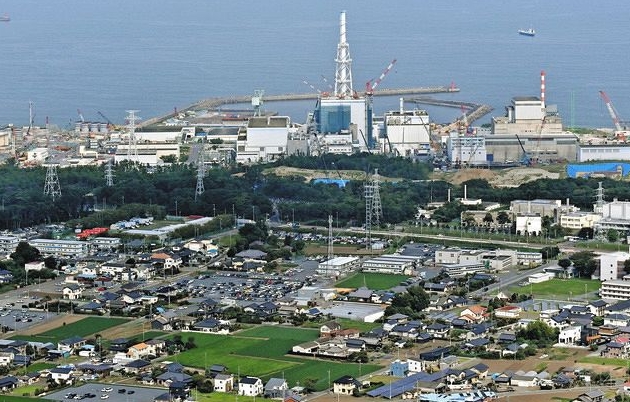
Tokai Daini Nuclear Power Plant is under construction for restart, from the Oozuru helicopter in Tokai-mura, Ibaraki Prefecture, in August 2021.
January 25, 2023
The Tokyo High Court, which is in charge of the lawsuit against Japan Atomic Power Company’s Tokai No. 2 Nuclear Power Plant (Tokai-mura, Ibaraki Prefecture), is expected to move to a different division in the appeal trial of the injunction lawsuit against the plant’s operation. The plaintiffs’ lawyers had asked the presiding judge to voluntarily withdraw from the case, citing problems with the fact that he had represented the national government in past administrative lawsuits related to nuclear power plants. The first date of the appeal hearing, which was scheduled for March 31, has been canceled. (Mayumi Kojima)
Defense team “appreciates the decision.
According to the defense team, the chief judge in charge of the case, Norio Nagatani, worked for many years in the Litigation Division of the Ministry of Justice, which is in charge of proving the government’s case in administrative lawsuits. In addition to representing the government in several nuclear power plant-related lawsuits, he was also a councilor in charge of litigation and in a position to direct the administrative lawsuit (later withdrawn) that sought an injunction against the operation of Tokai No. 2 from the government.
Last September, Nagatani was transferred from the head of the Hiroshima District Court to the Tokyo High Court, where he became the presiding judge for the appeal of the injunction lawsuit. In December, the defense lawyers asked Nagatani to voluntarily withdraw from the case on the grounds that a fair trial would not be conducted.
According to attorney Yuichi Kaito of the defense team, on the 25th of this month, Mr. Nagatani explained to them that “in view of various circumstances, the case will be reassigned. A new department is expected to take over the proceedings.
At a press conference held in Tokyo on March 25, attorney Hiroyuki Kawai said, “Mr. Nagatani said he would be fair and neutral regardless of his background, but objectively speaking, there is an inference that he is siding with the administration. (I commend him for making the decision to change the case. Mr. Kaito said, “You should not be both the representative of the government and the presiding judge in administrative lawsuits. (The exchange of judges (between judges and prosecutors) was banned by the DPJ administration, and the exchange of judges with representatives of the state in administrative lawsuits should also have been banned,” he noted.
◆Although the motion was filed… “It is highly unusual for a judge to actually be replaced.”
The appeal of the injunction lawsuit against the Tokai No. 2 nuclear power plant by Japan Atomic Power Company (JAPC), which resulted in the unusual prospect of a change in the trial division in charge of the case, was heard by the court. It is rare for judges to be replaced under the same circumstances, and an expert pointed out that “the very fact that he tried to preside over the case in the first place shows a lack of common sense.
According to the plaintiffs’ lawyers in the Tokai No. 2 lawsuit, a Supreme Court judge avoided participating in the hearing of the Hyakuri Air Base (Ibaraki Prefecture) lawsuit, in which the constitutionality of the Self Defense Forces was disputed and the Supreme Court rejected the appeal in 1989, because he had been involved in the government’s substantiation activities in the past. In 1991, a judge at the Odawara Branch of the Yokohama District Court was replaced after the plaintiffs alleged that he had conducted the case in a way that favored the defendants.
In 2018, the Kanazawa Branch of the Nagoya High Court rejected a motion by the plaintiffs to replace a judge at the first instance court that had vacated an injunction on KEPCO’s Nos. 3 and 4 reactors at the Ooi Nuclear Power Plant in Fukui Prefecture. The Kanazawa District Court also rejected the plaintiffs’ motion for an injunction against Hokuriku Electric Power Co.’s Shiga Nuclear Power Plant (Ishikawa Prefecture), which is currently under litigation.
Former judge Hajime Tada, attorney-at-law, commented on the replacement motion, “It is often a kind of a warning shot to the court. It is extremely unusual for a judge to actually be replaced. In the case of Tokai Daini, he pointed out, “It cannot be said that the court can make a neutral decision, and it is quite natural for the court to change the trial division. He criticized the change, saying, “It shows that the court is leaning toward the administration and disrespects the independence of the judiciary. (Kenta Onozawa)
Plaintiffs’ Residents Welcome the Decision
The plaintiff residents living near the Tokai Daini Nuclear Power Plant voiced their surprise and welcome. Hiroko Kawano, 80, whose home is 1.7 km from the plant, said, “It was too badly done, so I am glad. I think the plaintiffs’ petition was approved,” she said happily.
She learned of Judge Norio Nagatani’s background at a rally held by the plaintiffs’ group in Tokyo on April 22. I thought the government was doing an amazing job,” he said. Although there is supposed to be separation of powers, it looks as if the government has intervened in the appointment of the court.
Kiyoko Aizawa, 81, of Tokai-mura, said, “I thought the government would continue to forcefully proceed. The news reports have been covering the situation, so perhaps they couldn’t just ignore it. Tokai No. 2 is decrepit, and there are many people living around it. I don’t know who the next presiding judge will be, but I definitely want to win.
A 74-year-old man living in Hitachi City, a neighbor to the north of Tokai Village, said, “The court effectively accepted our side of the story, and I think they really meant to hit us where it hurts. I don’t think the government’s major policy of wanting to overturn the first trial at any cost has changed. I don’t think the government has changed its major policy of wanting to overturn the first trial at any cost, and I think they may try some more tricks.
On the other hand, Japan Atomic Power Company (JAPC) responded to an interview with this newspaper, saying, “We do not know the details of the case, so we will refrain from commenting. (Nagasaki High School and University)
https://www.tokyo-np.co.jp/article/227401?fbclid=IwAR2M8pe0zQeUjHI6qABHn-U-W6rBcrAcd5A5jElo-qNPkMf9RmUGhNtz5w4
Case blaming TEPCO ex-execs for 2011 nuclear accident goes to Supreme Court

Jan. 24, 2023
An appeal was filed with Japan’s Supreme Court on Tuesday over a high court ruling that acquitted three former power utility executives over the 2011 nuclear accident at the Fukushima Daiichi plant.
Former Tokyo Electric Power Company Chairman Katsumata Tsunehisa and former vice presidents Takekuro Ichiro and Muto Sakae were indicted in 2016 on charges of professional negligence resulting in death and injury. The indictment was based on a decision by a prosecution inquest panel composed of randomly chosen citizens.
Patients at a hospital in the northeastern prefecture of Fukushima and others died during evacuations prompted by nuclear meltdowns at the plant after the March 2011 earthquake and tsunami.
The former executives, who are in their 70s and 80s, are accused of being responsible for 44 of those deaths.
The Tokyo High Court found the three men not guilty last Wednesday, following a similar ruling by the Tokyo District Court in 2019.
In handing down its ruling, the high court deemed that the defendants were not required to suspend the plant’s operation to avoid accidents as there was no way to predict the giant tsunami.
Court-appointed lawyers acting as prosecutors in the case said after the ruling that the decision is tantamount to denying the need to take measures against earthquakes and tsunami that remain scientifically unpredictable.
TEPCO declined to make comments on the appeal, but said it apologizes for causing worries and troubles to many people.
Lawyers condemn acquittal of Fukushima ex-execs
Lawyers supporting the victims of the 2011 Fukushima nuclear disaster criticised a Japanese court’s ruling on Wednesday that absolved Tokyo Electric Power Company (TEPCO) of responsibility for the disaster.
Three former executives of TEPCO were found not guilty of negligence over the nuclear meltdowns and the subsequent deaths of more than 40 elderly residents during their forced evacuation.
Prosecution lawyer Shozaburo Ishida described the verdicts as “absolutely unacceptable.”
The Tokyo High Court ruling upheld a 2019 lower court decision that also acquitted the three former top TEPCO officials, noting that a tsunami of that magnitude was unforeseeable.
The court said ex-TEPCO Chairman Tsunehisa Katsumata, 82, and two other former executives were also not guilty of causing the deaths of 44 elderly patients whose already waning health deteriorated during or after forced evacuations from a local hospital and a nursing home.
The executives were accused of failing to anticipate the massive tsunami that struck the Fukushima Daiichi nuclear plant on March 11, 2011, following a magnitude 9 earthquake, and of failing to take measures that might have saved the plant.
Avoiding a Long War- the RAND corporation report
U.S. Policy and the Trajectory of the Russia-Ukraine Conflict. by Samuel Charap, Miranda Priebe https://www.rand.org/pubs/perspectives/PEA2510-1.html
Discussion of the Russia-Ukraine war in Washington is increasingly dominated by the question of how it might end. To inform this discussion, this Perspective identifies ways in which the war could evolve and how alternative trajectories would affect U.S. interests. The authors argue that, in addition to minimizing the risks of major escalation, U.S. interests would be best served by avoiding a protracted conflict.
The costs and risks of a long war in Ukraine are significant and outweigh the possible benefits of such a trajectory for the United States. Although Washington cannot by itself determine the war’s duration, it can take steps that make an eventual negotiated end to the conflict more likely. Drawing on the literature on war termination, the authors identify key impediments to Russia-Ukraine talks, such as mutual optimism about the future of the war and mutual pessimism about the implications of peace.
. The Perspective highlights four policy instruments the United States could use to mitigate these impediments: clarifying plans for future support to Ukraine, making commitments to Ukraine’s security, issuing assurances regarding the country’s neutrality, and setting conditions for sanctions relief for Russia.
Read report online. https://www.rand.org/pubs/perspectives/PEA2510-1.html
There’s no planet B
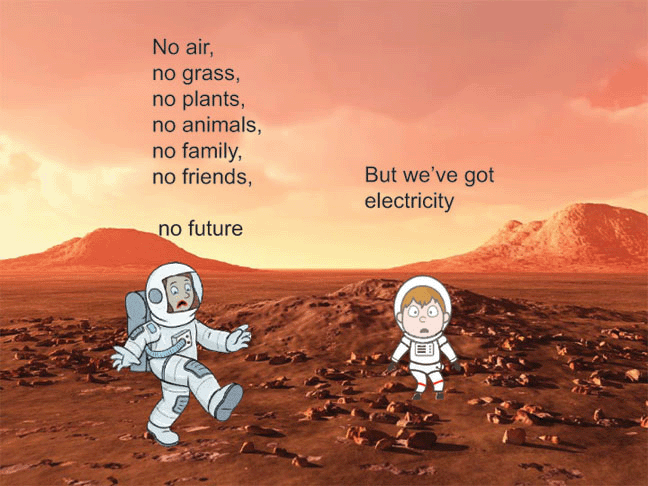
Gathering this observation-based information is essential to counter an increasingly popular but flawed narrative that the only way to ensure our survival is to colonise other planets.
The best-case scenario for terraforming Mars leaves us with an atmosphere we are incapable of breathing
The scientific evidence is clear: the only celestial body that can support us is the one we evolved with. Here’s why
AEON, Arwen E Nicholson research fellow in physics and astronomy at the University of Exeter in the UK, Raphaëlle D Haywood senior lecturer in physics and astronomy at the University of Exeter in the UK. 3 Feb 23
At the start of the 22nd century, humanity left Earth for the stars. The enormous ecological and climatic devastation that had characterised the last 100 years had led to a world barren and inhospitable; we had used up Earth entirely. Rapid melting of ice caused the seas to rise, swallowing cities whole. Deforestation ravaged forests around the globe, causing widespread destruction and loss of life. All the while, we continued to burn the fossil fuels we knew to be poisoning us, and thus created a world no longer fit for our survival. And so we set our sights beyond Earth’s horizons to a new world, a place to begin again on a planet as yet untouched. But where are we going? What are our chances of finding the elusive planet B, an Earth-like world ready and waiting to welcome and shelter humanity from the chaos we created on the planet that brought us into being? We built powerful astronomical telescopes to search the skies for planets resembling our own, and very quickly found hundreds of Earth twins orbiting distant stars. Our home was not so unique after all. The universe is full of Earths!
This futuristic dream-like scenario is being sold to us as a real scientific possibility, with billionaires planning to move humanity to Mars in the near future. For decades, children have grown up with the daring movie adventures of intergalactic explorers and the untold habitable worlds they find. Many of the highest-grossing films are set on fictional planets, with paid advisors keeping the science ‘realistic’. At the same time, narratives of humans trying to survive on a post-apocalyptic Earth have also become mainstream.
Given all our technological advances, it’s tempting to believe we are approaching an age of interplanetary colonisation. But can we really leave Earth and all our worries behind? No. All these stories are missing what makes a planet habitable to us. What Earth-like means in astronomy textbooks and what it means to someone considering their survival prospects on a distant world are two vastly different things. We don’t just need a planet roughly the same size and temperature as Earth; we need a planet that spent billions of years evolving with us. We depend completely on the billions of other living organisms that make up Earth’s biosphere. Without them, we cannot survive. Astronomical observations and Earth’s geological record are clear: the only planet that can support us is the one we evolved with. There is no plan B. There is no planet B. Our future is here, and it doesn’t have to mean we’re doomed.
At the start of the 22nd century, humanity left Earth for the stars. The enormous ecological and climatic devastation that had characterised the last 100 years had led to a world barren and inhospitable; we had used up Earth entirely. Rapid melting of ice caused the seas to rise, swallowing cities whole. Deforestation ravaged forests around the globe, causing widespread destruction and loss of life. All the while, we continued to burn the fossil fuels we knew to be poisoning us, and thus created a world no longer fit for our survival. And so we set our sights beyond Earth’s horizons to a new world, a place to begin again on a planet as yet untouched. But where are we going? What are our chances of finding the elusive planet B, an Earth-like world ready and waiting to welcome and shelter humanity from the chaos we created on the planet that brought us into being? We built powerful astronomical telescopes to search the skies for planets resembling our own, and very quickly found hundreds of Earth twins orbiting distant stars. Our home was not so unique after all. The universe is full of Earths!
This futuristic dream-like scenario is being sold to us as a real scientific possibility, with billionaires planning to move humanity to Mars in the near future. For decades, children have grown up with the daring movie adventures of intergalactic explorers and the untold habitable worlds they find. Many of the highest-grossing films are set on fictional planets, with paid advisors keeping the science ‘realistic’. At the same time, narratives of humans trying to survive on a post-apocalyptic Earth have also become mainstream.
Given all our technological advances, it’s tempting to believe we are approaching an age of interplanetary colonisation. But can we really leave Earth and all our worries behind? No. All these stories are missing what makes a planet habitable to us. What Earth-like means in astronomy textbooks and what it means to someone considering their survival prospects on a distant world are two vastly different things. We don’t just need a planet roughly the same size and temperature as Earth; we need a planet that spent billions of years evolving with us. We depend completely on the billions of other living organisms that make up Earth’s biosphere. Without them, we cannot survive. Astronomical observations and Earth’s geological record are clear: the only planet that can support us is the one we evolved with. There is no plan B. There is no planet B. Our future is here, and it doesn’t have to mean we’re doomed.
Deep down, we know this from instinct: we are happiest when immersed in our natural environment. There are countless examples of the healing power of spending time in nature. Numerous articles speak of the benefits of ‘forest bathing’; spending time in the woods has been scientifically shown to reduce stress, anxiety and depression, and to improve sleep quality, thus nurturing both our physical and mental health. Our bodies instinctively know what we need: the thriving and unique biosphere that we have co-evolved with, that exists only here, on our home planet.
There is no planet B. These days, everyone is throwing around this catchy slogan. Most of us have seen it inscribed on an activist’s homemade placard, or heard it from a world leader. In 2014, the United Nations’ then secretary general Ban Ki-moon said: ‘There is no plan B because we do not have [a] planet B.’ The French president Emmanuel Macron echoed him in 2018 in his historical address to US Congress. There’s even a book named after it. The slogan gives strong impetus to address our planetary crisis. However, no one actually explains why there isn’t another planet we could live on, even though the evidence from Earth sciences and astronomy is clear. Gathering this observation-based information is essential to counter an increasingly popular but flawed narrative that the only way to ensure our survival is to colonise other planets.
The best-case scenario for terraforming Mars leaves us with an atmosphere we are incapable of breathing
The most common target of such speculative dreaming is our neighbour Mars. It is about half the size of Earth and receives about 40 per cent of the heat that we get from the Sun. From an astronomer’s perspective, Mars is Earth’s identical twin. And Mars has been in the news a lot lately, promoted as a possible outpost for humanity in the near future. While human-led missions to Mars seem likely in the coming decades, what are our prospects of long-term habitation on Mars? Present-day Mars is a cold, dry world with a very thin atmosphere and global dust storms that can last for weeks on end. Its average surface pressure is less than 1 per cent of Earth’s. Surviving without a pressure suit in such an environment is impossible. The dusty air mostly consists of carbon dioxide (CO2) and the surface temperature ranges from a balmy 30ºC (86ºF) in the summer, down to -140ºC (-220ºF) in the winter; these extreme temperature changes are due to the thin atmosphere on Mars.
Despite these clear challenges, proposals for terraforming Mars into a world suitable for long-term human habitation abound. Mars is further from the Sun than Earth, so it would require significantly more greenhouse gases to achieve a temperature similar to Earth’s. Thickening the atmosphere by releasing CO2 in the Martian surface is the most popular ‘solution’ to the thin atmosphere on Mars. However, every suggested method of releasing the carbon stored in Mars requires technology and resources far beyond what we are currently capable of. What’s more, a recent NASA study determined that there isn’t even enough CO2 on Mars to warm it sufficiently.
Even if we could find enough CO2, we would still be left with an atmosphere we couldn’t breathe. Earth’s atmosphere contains only 0.04 per cent CO2, and we cannot tolerate an atmosphere high in CO2. For an atmosphere with Earth’s atmospheric pressure, CO2 levels as high as 1 per cent can cause drowsiness in humans, and once we reach levels of 10 per cent CO2, we will suffocate even if there is abundant oxygen. The proposed absolute best-case scenario for terraforming Mars leaves us with an atmosphere we are incapable of breathing; and achieving it is well beyond our current technological and economic capabilities.
Instead of changing the atmosphere of Mars, a more realistic scenario might be to build habitat domes on its surface with internal conditions suitable for our survival. However, there would be a large pressure difference between the inside of the habitat and the outside atmosphere. Any breach in the habitat would rapidly lead to depressurisation as the breathable air escapes into the thin Martian atmosphere. Any humans living on Mars would have to be on constant high alert for any damage to their building structures, and suffocation would be a daily threat…………………………………………………………………………………………….
Living on a warming Earth presents many challenges. But these pale in comparison with the challenges of converting Mars, or any other planet, into a viable alternative. Scientists study Mars and other planets to better understand how Earth and life formed and evolved, and how they shape each other. We look to worlds beyond our horizons to better understand ourselves. In searching the Universe, we are not looking for an escape to our problems: Earth is our unique and only home in the cosmos. There is no planet B. https://aeon.co/essays/we-will-never-be-able-to-live-on-another-planet-heres-why
France what to do as nuclear waste site risks saturation point?

Should saturation happen, France’s reactors would have nowhere to place their spent fuel and would have to shut down
France seeks strategy as nuclear waste site risks saturation point
Reuters, By Benjamin Mallet 3 Feb 23
- Summary
- Macron to chair Council on Nuclear Policy on Friday
- Macron has announced plan for at least six new nuclear reactors
- EDF working on extra refrigerated pool
- France also considering plan to bury waste in clay
LA HAGUE, France, Feb 3 (Reuters) – At a nuclear waste site in Normandy, robotic arms guided by technicians behind a protective shield manoeuvre a pipe that will turn radioactive chemicals into glass as France seeks to make safe the byproducts of its growing reliance on atomic power.
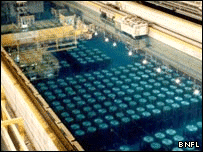
The fuel-cooling pools in La Hague, on the country’s northwestern tip, could be full by the end of the decade and state-owned Orano, which runs them, says the government needs to outline a long-term strategy to modernise its ageing facilities no later than 2025.

While more nuclear energy can help France and other countries to reduce planet-warming emissions, environmental campaigners say it replaces one problem with another.
To seek solutions, President Emmanuel Macron, who has announced plans to build at least six new reactors by 2050, on Friday chairs the first of a series of meetings on nuclear policy that will discuss investments and waste recycling.
“We can’t have a responsible nuclear policy without taking into account the handling of used fuel and waste. It’s a subject we can’t sweep under the rug,” a government adviser told Reuters, speaking on condition of anonymity…….
La Hague is the country’s sole site able to process and partially recycle used nuclear fuel.
France historically has relied on nuclear power for around 70% of its energy, although the share is likely to have fallen last year as the nuclear fleet suffered repeated outages.
Since the launch of the site at La Hague in 1976, it has treated nearly 40,000 tonnes of radioactive material and recycled some into nuclear fuel that can be re-used. The waste that cannot be recycled is mixed with hardening slices of glass and buried for short-term storage underground.
But its four existing cooling pools for spent fuel rods and recycled fuel that has been reused risk saturation by 2030, according to French power giant EDF (EDF.PA), which runs France’s 56-strong fleet of reactors, the world’s second biggest after the United States.
Should saturation happen, France’s reactors would have nowhere to place their spent fuel and would have to shut down – a worst-case scenario that led France’s Court of Audit to designate La Hague as “an important vulnerability point” in 2019.
COOL POOLS AND DEEP CLAY
EDF is hurrying to build an extra refrigerated pool at La Hague, at a cost of 1.25 billion euros ($1.37 billion), to store spent nuclear fuel – a first step before the waste can be treated – but that will not be ready until 2034 at the earliest.
Meanwhile, France’s national agency for managing nuclear waste last month requested approval for a project to store permanently high-level radioactive waste.
The plan, called Cigéo, would involve placing the waste 500 metres (1,640 ft) below ground in a clay formation in eastern France.
Construction is expected in 2027 if it gets approval. Among those opposed to it are residents of the nearby village of Bure and anti-nuclear campaigners
………… Orano, for which EDF accounts for 95% of its recycling business, says it needs clear direction from the government no later than 2025, to give it time to plan the necessary investments.
The costs are likely to be high. Just keeping up with current operations at La Hague costs nearly 300 million euros a year.
Options EDF and Orano are considering include finding a way to recycle the used fuel more than once, but critics say the recycling itself creates more radioactive waste and is not a long-term solution. For now, the backup plan is to fit more fuel containers into the existing pools.
After being cooled in a pool for about seven years, used nuclear fuel is separated into non-recyclable leftovers that are turned into glass (4% of the material), plutonium (1%) to create a new nuclear fuel called MOX, on which around 40% of France’s reactors can run, and reprocessed uranium (95%).
Options EDF and Orano are considering include finding a way to recycle the used fuel more than once, but critics say the recycling itself creates more radioactive waste and is not a long-term solution. For now, the backup plan is to fit more fuel containers into the existing pools.
After being cooled in a pool for about seven years, used nuclear fuel is separated into non-recyclable leftovers that are turned into glass (4% of the material), plutonium (1%) to create a new nuclear fuel called MOX, on which around 40% of France’s reactors can run, and reprocessed uranium (95%).
The uranium in the past was sent to Russia for re-enrichment and return for use in some EDF reactors, but EDF stopped doing that in 2013 as it was too costly.
In spite of the war in Ukraine, which has made many in the West avoid doing business with Russia, EDF is expected to resume sending uranium to Russia this year as the only country able to process it. It declined to confirm to Reuters it would do so.
The facility at La Hague, with its 1980s-era buildings and Star Wars-style control rooms, has its limitations.
“If we had to process MOX fuel in large quantities, the facility today isn’t adapted for it,” Varin said. “For multi-cycle recycling, the technology is not the same, so the modernisation or replacement of installations” would require “significant” investments, he said.
($1 = 0.9098 euros) https://www.reuters.com/business/environment/france-seeks-strategy-nuclear-waste-site-risks-saturation-point-2023-02-03/
Ukraine is sinking. Is the West about to bail out?

Ukraine Is Sinking. Are Western Elites Bailing Out? The UNZ REview, MIKE WHITNEY • FEBRUARY 1, 2023
What makes the RAND Corporation’s latest report on Ukraine so significant, is not the quality of the analysis, but the fact that the nation’s most prestigious national security think-tank has taken an opposite position on the war than the Washington political class and their globalist allies. This is a very big deal.
…………… The RAND Corporation’s new report, “Avoiding a long war: US policy and the trajectory of the Russia-Ukraine conflict”, represents just such a split. It indicates that powerful elites have broken with the majority opinion because they think the current policy is hurting the United States. We believe this shift in perspective is going to gain momentum until it triggers a more-assertive demand for negotiations. In other words, the RAND report is the first step towards ending the war.
Consider, for a minute, this excerpt from the preamble of the report:
“The costs and risks of a long war in Ukraine are significant and outweigh the possible benefits of such a trajectory for the United States.”
This quote effectively sumarizes the entire document. Think about it: For the last 11 months we have been told repeatedly that the US will support Ukraine “for as long as it takes.” The above quote assures us that that’s not going to happen. The United States is not going to undermine its own interests to pursue the unachievable dream of expelling Russia from Ukraine. (Even the hawks no longer believe that is possible.)
Rational members of the foreign policy establishment are going to evaluate Ukraine’s prospects for success and weigh them against the growing likelihood that the conflict could unexpectedly spiral out-of-control. That, of course, would serve no one’s interest and could ignite a direct clash between Russia and the United States. Also, US policymakers will decide whether the ballooning collateral damage is worth the expense. In other words, are the ruptured supplylines, the rising inflation, the increasing energy and food shortages, and the declining weapons stockpiles a fair trade-off for “weakening Russia”. Many would say, “No.”
In some respects, the RAND report is just the first in a long line of falling dominoes. As Ukraine’s battlefield losses mount –and it becomes more evident that Russia will control all the territory east of the Dnieper River– the flaws in Washington’s strategy will become more apparent and will be more sharply criticized. People will question the wisdom of economic sanctions that hurt our closest allies while helping Russia. They will ask why the United States is following a policy that has precipitated a strong move away from the dollar and US debt? And, they will wonder why the US deliberately sabotaged a peace deal in March when the probability of a Ukrainian victory is near zero. The Rand report seems to anticipate all these questions as well as the ‘shift in mood’ they will generate. This is why the authors are pushing for negotiations and a swift end to the conflict. This is an excerpt from an article at RT:
The RAND Corporation, a highly influential elite national security think tank funded directly by the Pentagon, has published a landmark report stating that prolonging the proxy war is actively harming the US and its allies and warning Washington that it should avoid “a protracted conflict” in Ukraine…
(The report) starts by stating that the fighting represents “the most significant interstate conflict in decades, and its evolution will have major consequences” for Washington, which includes US “interests” being actively harmed. The report makes it very clear that while Ukrainians have been doing the fighting, and their cities have been “flattened” and “economy decimated,” these “interests” are “not synonymous” with Kiev’s.” (“Rand calls for swift end to war“, RT)
While the report does not explicitly state that ‘US interests (are) being harmed’, it certainly infers that that is the case. Not surprisingly, the report doesn’t mention any of the collateral damage from Washington’s war on Russia, but, surely, that must have been foremost on the minds of the authors. After all, it is not the $100 billion or the provision of lethal weapons that is costing the US so dearly. It is the accelerating emergence of international coalitions and alternate institutions that has put the US empire on the fasttrack to ruin. We assume that the analysts at RAND see the same things that every other sentient being sees, that Washington’s misguided conflagration with Moscow is a ‘bridge-too-far’ and that the blowback is going to be immense and excruciating. Hence, the urgency to end the war quickly. Here’s a excerpt from the report that was posted in bold print halfway through the text:
“Since avoiding a long war is the highest priority after minimizing escalation risks, the United States should take steps that make an end to the conflict over the medium term more likely.”
…………………………….. Washington’s foolish intervention is clearing the way for the greatest strategic catastrophe in US history. And yet, even now, the vast majority of corporate and banking elites resolutely back the existing policy while shrugging off the obvious signs of failure. Case in point: The World Economic Forum posted a blanket statement of support for Ukraine on its website. Here it is: [on original]
……………………………….. the RAND report may represent the views of the Pentagon and the US Military establishment who believe the United States is racing headlong towards a direct conflagration with Russia. In other words, the report may be the first ideological broadsides against the neocons who run the State Department and the White House. We suspect this split between the War Department and ‘State’ will become more visible in the days ahead. We can only hope that the more judicious faction at the Pentagon prevails.
US Surrounds China With War Machinery While Freaking Out About Balloons
Caitlin Johnstone 4 Feb 23
In what Austin journalist Christopher Hooks has called “one of the stupidest news cycles in living memory,” the entire American political/media class is having an existential meltdown over what the Pentagon claims is a Chinese spy balloon detected in US airspace on Thursday.
Secretary of State Antony Blinken cancelled his scheduled diplomatic visit to China after the detection of the balloon. The mass media have been covering the story with breathless excitement. China hawk pundits have been pounding the war drums all day on any platform they can get to and accusing the Biden administration of not responding aggressively enough to the incident…………………
China’s foreign ministry says the balloon is indeed from China but is “civilian in nature, used for meteorological and other scientific research,” and was simply blown far off course. This could of course be untrue — all major governments spy on each other constantly and China is no exception — but the Pentagon’s own assessment is that the balloon “does not create significant value added over and above what the PRC is likely able to collect through things like satellites in Low Earth Orbit.”.
So everyone’s losing their minds over a balloon that in all probability would be mostly worthless for spying, even while everyone knows the US spies on China at every possible opportunity. US officials have complained to the press that American spies are having a much harder time conducting operations and recruiting assets in China than they used to because of measures the Chinese government has taken to thwart them, and in 2001 a US spy plane caused a major international incident when it collided with a Chinese military jet on China’s coastline, killing the pilot.
The US considers it its sovereign right to spy on any nation it chooses, and the average American tends more or less to see it the same way. This is highlighted in controversies around domestic versus foreign surveillance, for example; Americans were outraged over the Edward Snowden revelations not because spy agencies were conducting surveillance, but because they were conducting surveillance on American citizens. It’s just taken as a given that spying on foreigners is fine, so it’s a bit silly to react melodramatically when foreigners return the favor.
As Jake Werner explains for Responsible Statecraft:
Foreign surveillance of sensitive U.S. sites is not a new phenomenon. “It’s been a fact of life since the dawn of the nuclear age, and with the advent of satellite surveillance systems, it long ago became an everyday occurrence,” as my colleague and former CIA analyst George Beebe puts it.
U.S. surveillance of foreign countries is likewise quite common. Indeed, great powers gathering intelligence on each other is one of the more banal and universal facts of international relations. Major countries even spy on their own allies, as when U.S. intelligence bugged the cellphone of German Chancellor Angela Merkel.
Typically, even when such surveillance is directed against the United States by a rival power, it does not threaten the safety of Americans and it poses manageable risks to sites where secrecy is of the utmost importance. However — in the context of rapidly increasing U.S.–China tensions — foreseeable incidents like these can quickly balloon into dangerous confrontations.
Now let’s contrast all this with another news story that’s getting a lot less attention.
In an article titled “US secures deal on Philippines bases to complete arc around China,” the BBC reports that the empire will be adding even more installations to the already impressive military noose it has been constructing around the PRC.
“The US has secured access to four additional military bases in the Philippines – a key bit of real estate which would offer a front seat to monitor the Chinese in the South China Sea and around Taiwan,” writes the BBC’s Rupert Wingfield-Hayes. “With the deal, Washington has stitched the gap in the arc of US alliances stretching from South Korea and Japan in the north to Australia in the south. The missing link had been the Philippines, which borders two of the biggest potential flashpoints – Taiwan and the South China Sea.”
“The US hasn’t said where the new bases are but three of them could be on Luzon, an island on the northern edge of the Philippines, the only large piece of land close to Taiwan – if you don’t count China,” writes Wingfield-Hayes……..
The US empire has been surrounding China with military bases and war machinery for many years, in ways Washington would never tolerate China doing in the nations and waters surrounding the United States. There is no question that the US is the aggressor in this increasingly hostile standoff between major powers. Yet we’re all meant to be freaking out about a balloon……… https://caitlinjohnstone.substack.com/p/us-surrounds-china-with-war-machinery
The American Colony of Australia
19 Feb 2021Western media portrays Australia as a beautiful nation with independent people and a close ally of the United States. But the American Empire has no allies, only vassal states. Australia became a colony of the American empire in 1975 after an Anglo-American coup. Australians noticed nothing since Australia had been an British colony since its inception and dispatches military forces when ordered to fight empire wars.
Roundtable: Making nuclear injustice an agenda for change
Bulletin of the Atomic Scientists, By Franziska Stärk, Ulrich Kühn | February 2, 2023
In a recent essay for the Bulletin, we argued that the global nuclear order is fundamentally unjust. We called for critical reflection on past, ongoing, and future nuclear injustices to better connect the dots between scholarly fields and social movements. For this roundtable, we invited four scholars, practitioners, and abolition advocates to further articulate what a research agenda on nuclear injustice should look like.
Rebecca Gibbons stresses the importance of including those most burdened by past nuclear injustices in the discussion. Setting forth the impact of nuclear testing on the Marshallese people, Gibbons highlights their calls for an apology by the US government, sufficient medical care, and the right to return to a safe and remediated environment.
Alexander Kmentt highlights the Treaty on the Prohibition of Nuclear Weapons as a useful prism to examine current efforts—both substantive and procedural—to address nuclear injustice. Kmentt emphasizes the treaty’s contribution to the democratization and reframing of nuclear debates.
Benoît Pelopidas warns of the pitfalls of a nuclear injustice lens, which could ultimately strengthen arguments in favor of nuclear weapons if based on a conservative reading of nuclear deterrence. Instead, Pelopidas outlines several avenues for a productive research agenda, including a critical reflection on the consequences of nuclear injustice.
Mari Faines considers the effects of colonialism, White supremacy, and racial injustice on nuclear weapons policy. She concludes that efforts to address nuclear injustice must include marginalized voices, build on today’s young people, and be sensitive to intersectionality.
We welcome these valid arguments in favor of broadening the debate about nuclear injustice as they point to the necessity of an inclusive agenda, reaching beyond the usual boundaries of the nuclear policy field and community. One such boundary which deserves more emphasis pertains to the well-being of future generations……………………………………………………… https://thebulletin.org/2023/02/roundtable-making-nuclear-injustice-an-agenda-for-change/
Belgium looks to extend lives of oldest nuclear reactors.
DW. 3 Feb 23,
The Belgian government is assessing whether to extend the life of three nuclear reactors that had been due to close in 2025, citing a need to “reduce risks in the energy supply” in lieu of the war in Ukraine.
…………………………… Operational since 1975, the three reactors were initially set to be decommissioned in 2015 but had their lifetime extended until 2025 after Belgium held a review of its phase-out plan.
A delayed phase-out
Belgium has two nuclear plants, operated by French utility company Engie, with five reactors still working.
Belgium first decided on its nuclear phase-out in 2003 and it was scheduled to be completed by 2025. However, it decided last year to keep the newest plants open until 2035.
Belgium took one nuclear reactor, Tihange 2, off its power grid after 40 years on Tuesday evening as part of the country’s planned nuclear phase-out. The winding down of nuclear power began with the closure of a reactor at Doel, near the Belgian port city of Antwerp in September.
Those two reactors were known for repeated safety issues, having been shut down on previous occasions after the discovery of cracks in reactor pressure vessels. The Belgian government had considered keeping those two reactors online because of energy concerns.
……………. The German government and the German city of Aachen, which lies near the Belgian border have repeatedly called for the reactors to be decommissioned in the past.
In 2019, the European Court of Justice found that Belgium infringed European Union law by failing to carry out the required environmental assessments before prolonging the life of Doel 1 and 2 nuclear reactors…….. https://www.dw.com/en/belgium-looks-to-extend-lives-of-oldest-nuclear-reactors/a-64606438
China objects to more nuclear sub talks among UK, U.S, Australia
BEIJING, Feb 3 (Reuters) – China “firmly objects” to further cooperation between Britain, U.S. and Australia on nuclear submarines, its foreign ministry said in a regular briefing on Friday.
Chinese foreign ministry spokesperson Mao Ning said, “China is gravely concerned about this and firmly objects to it,” in response to a question that cited a media report saying British Prime Minister Rishi Sunak’s visit to the United States in March may yield announcements on more nuclear submarine cooperation…………. Reporting by Yew Lun Tian and Joe Cash ; Writing by Liz Lee; Editing by Christian Schmollinger https://www.reuters.com/world/china-objects-more-nuclear-sub-talks-among-uk-us-australia-2023-02-03/
As Ukraine crumbles, EU holds circus act summit in Kiev
Here’s one of the many comments below this video:
My guess is that the Western media will just slowly start reporting less and less on Ukraine. Exactly like they did with Afghanistan once it became clear that the US and NATO couldn’t win that war either. And then the public in the West will largely forget about it as they did with Afghanistan and Iraq.
Appeal Filed against 3 Ex-TEPCO Execs over Nuclear Crisis

Tokyo, Jan. 24 (Jiji Press)–Lawyers acting as prosecutors Tuesday appealed to the Supreme Court against a not guilty verdict for three former executives of Tokyo Electric Power Company Holdings Inc. over the 2011 nuclear crisis.
The lawyers took the action after Tokyo High Court dismissed their appeal against a Tokyo District Court ruling that acquitted the three–former Chairman Tsunehisa Katsumata, 82, and former Executive Vice Presidents Ichiro Takekuro, 76, and Sakae Muto, 72–of charges of business negligence resulting in death and injury.
Last week, the high court said it was “reasonable” for the district court to conclude that the three were not able to foresee a tsunami big enough to require a suspension of TEPCO’s Fukushima No. 1 plant at the center of the crisis.
The plant in northeastern Japan had an unprecedented triple meltdown after being struck by the March 2011 massive earthquake and tsunami.
The high court said the former executives could not have predicted the huge tsunami because a long-term evaluation by a government body was not reliable, upholding the lower court’s ruling.
1 This Month
23 April – WEBINAR – Why new nuclear reactors are the wrong tools for decarbonization Thursday, April 23 • 1 AM – 2 AM AEST


Pine Ridge Uranium is the real threat, not Tehran- Tell Burgum: Stop the Extraction.
Chernobyl: The Lost Tapes – A good documentary on Chernobyl on SBS available On Demand for the next 3 weeks– https://www.sbs.com.au/ondemand/tv-program/chernobyl-the-lost-tapes/2352741955560
To see nuclear-related stories in greater depth and intensity – go to https://nuclearinformation.wordpress.com
-
Archives
- April 2026 (275)
- March 2026 (251)
- February 2026 (268)
- January 2026 (308)
- December 2025 (358)
- November 2025 (359)
- October 2025 (376)
- September 2025 (257)
- August 2025 (319)
- July 2025 (230)
- June 2025 (348)
- May 2025 (261)
-
Categories
- 1
- 1 NUCLEAR ISSUES
- business and costs
- climate change
- culture and arts
- ENERGY
- environment
- health
- history
- indigenous issues
- Legal
- marketing of nuclear
- media
- opposition to nuclear
- PERSONAL STORIES
- politics
- politics international
- Religion and ethics
- safety
- secrets,lies and civil liberties
- spinbuster
- technology
- Uranium
- wastes
- weapons and war
- Women
- 2 WORLD
- ACTION
- AFRICA
- Atrocities
- AUSTRALIA
- Christina's notes
- Christina's themes
- culture and arts
- Events
- Fuk 2022
- Fuk 2023
- Fukushima 2017
- Fukushima 2018
- fukushima 2019
- Fukushima 2020
- Fukushima 2021
- general
- global warming
- Humour (God we need it)
- Nuclear
- RARE EARTHS
- Reference
- resources – print
- Resources -audiovicual
- Weekly Newsletter
- World
- World Nuclear
- YouTube
-
RSS
Entries RSS
Comments RSS
 nuclear-news