The energy from the nuclear fusion experiment was a tiny fraction of the energy put into the experiment.
The Real Fusion Energy Breakthrough Is Still Decades Away. US nuclear
scientists have achieved the long-sought goal of a fusion ignition—but
don’t expect this clean technology to power the grid yet.
To fusion scientists like Mark Cappelli, a physicist at Stanford University who
wasn’t involved in the research, it’s a thrilling result. But he
cautions that those pinning hopes on fusion as an abundant, carbon-free,
and waste-free power source in the near future may be left waiting.
The difference, he says, is in how scientists define breakeven. Today, the NIF
researchers said they got as much energy out as their laser fired at the
experiment—a massive, long-awaited achievement.
But the problem is that
the energy in those lasers represents a tiny fraction of the total power
involved in firing up the lasers. By that measure, NIF is getting way less
than it’s putting in. “That type of breakeven is way, way, way, way
down the road,” Cappelli says. “That’s decades down the road. Maybe
even a half-century down the road.”
Wired 13th Dec 2022
https://www.wired.com/story/the-real-fusion-energy-breakthrough-is-still-decades-away/
For Heaven’s Sake – Examining the UK’s Militarisation of Space
December 13, 2022, By Dr. David Webb of the Global Network Against Weapons and Nuclear Power in Space
I have been working on behalf of the Campaign for Nuclear Disarmament (CND) with Peter Burt from Dronewars UK on a new joint publication called “For Heaven’s Sake: Examining the UK’s Militarisation of Space”. It was launched in June and looks at the UK’s emerging military space programme and considers the governance, environmental, and ethical issues involved.
The UK’s space programme began in 1952 and the first UK satellite, Ariel 1, was launched in 1962. Black Arrow, a British rocket for launching satellites, was developed during the 1960s and was used for four launches from the Woomera Range Complexin Australia between 1969 and 1971. The final launch was to launch Prospero, the only British satellite to be placed in orbit using a UK rocket in 1971, although the government had by then cancelled the UK space programme. Blue Streak, the UK ballistic missile programme, had been cancelled in 1960andspace projects were considered too expensive to continue. 50 years on and things have changed.
Space is now big business – the commercial space sector has expanded and the cost of launches has decreased. The UK is now treating space as an area of serious interest. The government has also recognised that space is now crucial for military operations. So, the Ministry of Defence (MoD) now has a Space Directorate, which works closely with the UK Space Agency and is responsible for the military space policy and international coordination. UK Space Command, established in April 2021 ,is in charge of the military space programme and is closely linked with US Space Command and US Space Force. While the UK typically frames military developments as being for defensive purposes, they are also capable of offensive use………………………………………………………..
Although many of these launches may be for commercial companies, space use has evolved into a fuzzy military/commercial collaboration and Alexandra Stickings, a space policy and security analyst at the Royal United Services Institute in London, believes that the Shetland and Sutherland spaceports will need military contracts to be viable. She said “I am of the opinion that the proposed spaceports would need the MoD as a customer to survive as well as securing contracts with companies such as Lockheed” and the military will want to diversify their launch capabilities“so the Scottish locations could provide an option for certain future missions.” She also warned that: “There is also a possibility that if these sites become a reality, there will be pressure on the MoD to support them even if the cost is more than other providers.”………………………………..
Although many of these launches may be for commercial companies, space use has evolved into a fuzzy military/commercial collaboration and Alexandra Stickings, a space policy and security analyst at the Royal United Services Institute in London, believes that the Shetland and Sutherland spaceports will need military contracts to be viable. She said
“I am of the opinion that the proposed spaceports would need the MoD as a customer to survive as well as securing contracts with companies such as Lockheed” and the military will want to diversify their launch capabilities“so the Scottish locations could provide an option for certain future missions.” She also warned that: “There is also a possibility that if these sites become a reality, there will be pressure on the MoD to support them even if the cost is more than other providers.”…………………….
…………………… https://safetechinternational.org/for-heavens-sake-examining-the-uks-militarisation-of-space/
U.S. to deploy advanced Patriot missile interceptor batteries to Ukraine
Polish RadioDecember 14, 2022 US to send Patriot air defence system to Ukraine: CNN The administration of US President Joe Biden is finalising plans to provide Ukraine with the Patriot air defence system and could announce the move later this week, news outlets have reported. *** According to three US officials, who spoke to CNN […]
U.S. to deploy advanced Patriot missile interceptor batteries to Ukraine — Anti-bellum
Paul Dorfman: Nuclear power is just a slow and expensive distraction.

Despite recent breakthroughs in nuclear fusion, renewables remain the most
important technology for reaching net zero. “Fissile fuel” is back –
or so say the UK’s policy teams and press.
Rishi Sunak and Emmanuel
Macron are about to strike a deal on nuclear cooperation, and recent
editorials across national newspapers all reckon everything in the garden
is nuclear. Where, however, is the evidence for its efficacy?
The British and French governments can sign any deal they like – if key financial
investors don’t take up the remaining 60 per cent of construction costs,
the planned Sizewell C plant in Suffolk is going nowhere. The omens
aren’t good.
Recently Sir Nigel Wilson, group CEO of Legal & General, one
of the UK’s largest real assets firms, told BBC Radio Four: “We are not
big fans of Sizewell C.” Sir David King, the UK’s former chief
scientific adviser and a long-standing nuclear supporter, told LBC that the
plant would be “very difficult to protect from flooding” due to rising
sea levels on the Suffolk coast.
New Statesman 13th Dec 2022
Opinion is split on UK government plan for new nuclear and hydrogen projects
Ministers are considering requiring that all new domestic boilers be
“hydrogen-ready” from 2026, as they announced £100m for nuclear and
hydrogen projects. The Department for Business, Energy and Industrial
Strategy (BEIS) has launched a consultation on improving boiler standards,
and has argued there is a strong case for introducing hydrogen-ready
boilers in the UK from 2026.
The government is examining options to replace
polluting fossil fuel gas in Britain’s energy system and has offered
grants for households to install heat pumps. A ban on gas boilers in new
homes comes into force in 2025, although uncertainty remains over the
timeframe for the phase-out of fossil gas in existing homes.
While hydrogen
is expected to play a significant role in the decarbonisation of heavy
industry and the transport network, opinion is split on the practicality of
using it in Britain’s gas network and the resulting cost to households.
Plans for a pilot to examine the effectiveness of using hydrogen have met
local opposition in Whitby, outside Ellesmere Port, where residents have
expressed concerns over becoming “lab rats”. The consultation, which
closes in late March, will also examine the cost of hydrogen-ready boilers.
“The government needs confidence that consumers will not face a premium
for their purchase,” it said.
Guardian 13th Dec 2022
Fusion breakthrough thrills physicists, but won’t power your home soon.

A nuclear fusion milestone (with frickin’ laser beams!) is a big deal.
Alas, it could be decades before fusion might actually help clean up our
energy system. A reported breakthrough in fusion energy is generating
enormous excitement amongst scientists and the general public alike — but
you might not want to bet on fusion providing usable energy during your
lifetime.
Experimental results set to be announced by the U.S. Department
of Energy on Tuesday are being hyped as potentially heralding a new era of
zero-carbon energy from the power of a controlled fusion reaction, the same
reaction that powers our sun. Lawrence Livermore National Laboratory has
evidence of a net energy gain in a fusion reaction for the first time,
according to people with knowledge of preliminary results from a recent
experiment, as first reported by the Financial Times. The lab confirmed to
the paper that a successful experiment had recently been conducted at its
National Ignition Facility but said analysis of the results was ongoing.
Canary Media 13th Dec 2022
The SECOND suburban husband indicted for smuggling nuclear weapon tech to Russia
- Vadim Yermolenko helped smuggle tech used in nuclear weapons into Russia, according to court documents
- DailyMail.com can reveal his double life after it emerged co-defendant Alexey Brayman runs an online craft store in New Hampshire with his wife
- They are allegedly part of the ‘Serniya Network’, run by Russia’s security service
- Yermolenko lives in a luxury home with his wife, Diana, and their young children
- He allegedly used his wife’s signature to create forged documents for the plot
- The men, who were indicted and appeared in court on Tuesday, have been released after posting bail and will appear in court again in February
By LEWIS PENNOCK FOR DAILYMAIL.COM . 15 December 2022 …………………………… more https://www.dailymail.co.uk/news/article-11538183/SECOND-suburban-husband-indicted-smuggling-nuclear-weapon-tech-Russia.html
Very significant barriers to further progress on nuclear fusion
There are two approaches to nuclear fusion: call them doughnuts v lasers.
Magnetic confinement is the more common and longstanding method: picture,
if you can, a doughnut-shaped machine, with nuclear fuel inside it kept
afloat by magnetic fields and heated to incredible temperatures while the
reaction takes place.
The NIF is one of a smaller number of facilities
trying something different: inertial confinement. In the pithy summary of
White House science chief, Arati Prabhakar, yesterday:
“They shot a bunch of lasers at a pellet of fuel [hydrogen plasma] and more energy was
released from that fusion ignition than the energy of the lasers.” The
pellet, encased in diamond, sits in a tiny gold cylinder. By hitting it
with 192 giant lasers for less than 100 trillionths of a second at more
than 3 million celsius, scientists at NIF succeeded in producing 3
megajoules of energy from the 2.05 megajoules it took to make the reaction
happen.
But as good as that sounds, there are very significant barriers to
further progress. “It’s important to say that this is not trying to be
a fusion reactor, it’s simply trying to make fusion happen,” said
Bluck.
“But it lacks almost everything that you need to make a viable
reactor. “So, OK, the energy put in has resulted in a larger amount of
energy coming out – but the big caveat is that it depends where you draw
your perimeter: powering the lasers themselves required way more energy.
You have to draw a slightly artificial dotted line around the vessel to say
there’s been a gain.” The lasers may emit 2.05 megajoules, but they
took about 500 megajoules of energy to power, though defenders of the
experiment say that they are not optimally efficient and can be
significantly improved.
Guardian 14th Dec 2022
https://www.theguardian.com/world/2022/dec/14/first-edition-nuclear-fusion
A Tale of Two Nuclear Plants Reveals Europe’s Energy Divide
An upgraded power plant in Slovakia has angered neighboring Austria and fueled the debate over nuclear power and independence from Russian gas.
Wired, MORGAN MEAKER, DEC 13, 2022
……………………………………….. Europe remains deeply divided on the use of nuclear power. Of the European Union’s 27 member states, 13 generate nuclear power, while 14 do not. “It’s still a very national debate,” says Bunsen. That means public attitudes can drastically change from one side of a border to the other. Surveys show that 60 percent of Slovakians believe nuclear power is safe, while 70 percent of their neighbors in Austria are against it being used at all—the country has no active nuclear plants.
……… workers are preparing a new reactor—where nuclear fission will take place—for launch in early 2023.
………….. Europe remains deeply divided on the use of nuclear power. Of the European Union’s 27 member states, 13 generate nuclear power, while 14 do not. “It’s still a very national debate,” says Bunsen. That means public attitudes can drastically change from one side of a border to the other. Surveys show that 60 percent of Slovakians believe nuclear power is safe, while 70 percent of their neighbors in Austria are against it being used at all—the country has no active nuclear plants.
For the two neighbors, Mochovce has become a focal point in the debate over how Europe should transition away from fossil fuels. To supporters in Slovakia, Mochovce’s expansion—the launch of Unit Three is expected to be followed two years later by Unit Four—demonstrates how even a small country can become an energy heavyweight. Unit Three will make Slovakia the second-largest producer of nuclear power in the EU, after France. But neighboring Austrians cannot ignore what they consider to be the drawbacks: the mammoth costs associated with building or improving aging facilities, the problems associated with disposing of nuclear waste, and the sector’s reliance on Moscow for uranium, the fuel which powers the reactor. Last year, the EU imported one fifth of its uranium from Russia.
For years, politicians and activists in Austria have also alleged that Mochovce is not safe, with local newspapers using maps to illustrate how close Mochovce is to Vienna: just 150 kilometers. “It’s a Soviet design from the 1980s, without a proper containment,” claims Reinhard Uhrig, an antinuclear campaigner with Austrian environmental group GLOBAL 2000. The containment is one of a series of safety systems that prevents radioactive material being released into the environment in case of an accident. “Apart from these inherent design problems, there have been major issues with the quality control of the works,” he says, describing nuclear power as a dangerous distraction from real solutions to the climate crisis.
Concerns in Austria about Mochovce’s safety were exacerbated by Mario Zadra, an engineer turned whistleblower who worked on Mochovce units Three and Four between 2009 and 2018. Zadra alleges the plant’s emergency diesel generators were suffering serious technical issues and cooling towers fundamental for safety were built with the wrong material. “Other components important for safety, like the main steam isolation valves, were in a shameful condition,” says Zadra, whose video and photo evidence have been verified by GLOBAL 2000. Since Zadra and other whistleblowers went public in 2018, Mochovce has been accused of corruption, raided by police, and inspected by the International Atomic Energy Agency. “I’m sure things have improved since the inspections,” Zadra says, but he still doesn’t believe the plant is safe due to what he calls the company’s “poor safety culture.”
………………………………….. Long-term, Austria is aiming to run 100 percent on renewables by 2030. Wind, solar, and hydro power currently account for 77 percent of the country’s power generation.
Austria is now agitating to spread its antinuclear message on an EU level. Officials have criticized nuclear power plants not just in Slovakia, but also in other neighboring countries, including the Czech Republic and Hungary. On New Year’s Eve 2021, the European Commission released a proposal which defined nuclear as well as natural gas as “green investments.” In response, Austria launched a legal challenge, calling for the inclusion of the two energy sources to be annulled. “Neither nuclear energy nor fossil gas are green investments,” says Gewesseler.
Zwentendorf and Mochovce demonstrate the extremes of Europe’s nuclear power debate. But between those extremes, it’s messy. The EU might have agreed to become the first climate-neutral continent by 2050, but consensus on how that will happen remains elusive. Weish, the Austrian scientist, believes there’s a lot more debating to be done. “The EU needs to have the debate Austria had back in the 1970s,” he says. https://www.wired.com/story/nuclear-energy-europe/
Hungary’s risky bet on Russia’s nuclear power
By Nick Thorpe, BBC News, Hungary, 15 Dec 22,
“If this new power plant is built,”, says Janos, a tall, friendly nuclear engineer who works in Reactor block 2 of the existing nuclear power station at Paks, “it will be good for the town, and good for the country.”
It’s a big if.
Despite the Hungarian government’s unswerving commitment to the Paks 2 project, despite the Russian commitment to supply the finance and technology, the Russian war in Ukraine is making the new power station less likely by the day.
It is the biggest single investment in Hungarian history.
The government claims it will make the country less dependent on Russia, from which Hungary gets most of its oil and gas. Critics say it will make Hungary even more dependent on Russia for much of this century.
Paks 1 nuclear power station, on the shore of the Danube and an hour’s drive south of Budapest, was built by the Soviet Union in the 1980s, and its four reactors still supply around 40% of Hungary’s electricity needs.
Their working life is due to end in the 2030s. In 2014, Prime Minster Viktor Orban signed a deal with Russian President Vladimir Putin to build two new 1,200 MW reactors beside the old ones.
Russia will finance the plant with a €10bn loan, which Hungarian consumers should pay back in their electricity bills, starting in 2026, when the plant was due to come on line.
Years of delays with permits meant that ground-clearing work at the site only began last August.
While Hungary has pressed ahead with Paks 2, last May Finland cancelled a similar, Russian-built plant on the Hanhikivi peninsula in mid-construction, because of the Russian invasion of Ukraine.
The war in Ukraine is now hanging like a dark cloud over the Paks project, too.
Fighting in the early days of the war around Ukraine’s former nuclear plant at Chernobyl and artillery duels around the Zaporizhzhia plant, the biggest in Europe, have harmed the project.
Even those who believe in Paks 2 with an almost religious zeal sound worried.
“Isolation of Russia is not a solution, even in this war situation,” says Attila Aszodi, former government commissioner for Paks 2.
Died-in-the-wool opponents such as former Green MEP Benedek Javor are more blunt.
“Paks 2 is a purely political project,” he says, pointing to close relations established by Viktor Orban with Russian Vladimir Putin since 2009.
Since Russia’s invasion of Ukraine, the Hungarian leader has pushed back repeatedly against EU sanctions on Russia and its officials have maintained close diplomatic ties with Moscow.
“From an energy perspective it’s not necessary to build [Paks 2], and it’s definitely not necessary to build it with the Russians,” says Mr Javor.
Died-in-the-wool opponents such as former Green MEP Benedek Javor are more blunt.
“Paks 2 is a purely political project,” he says, pointing to close relations established by Viktor Orban with Russian Vladimir Putin since 2009.
Since Russia’s invasion of Ukraine, the Hungarian leader has pushed back repeatedly against EU sanctions on Russia and its officials have maintained close diplomatic ties with Moscow.
“From an energy perspective it’s not necessary to build [Paks 2], and it’s definitely not necessary to build it with the Russians,” says Mr Javor.
He argues the money would be better spent on renewables like solar, from which Hungary already gets 10% of its energy, and improving the electricity grid.
This autumn, the government abruptly ended subsidies for households installing solar panels, because the grid could not cope with the new inputs.
The Fidesz government has also made wind power practically impossible, by banning the construction of turbines within 10km (6.2 miles) of a settlement.
“We might arrive at a point where Paks 2 cannot be constructed but there is no alternative,” says Mr Javor. “Then Hungary will have a serious problem with the security of supply.”
The list of complications from the war in Ukraine is long.
Many major components of the plant are supposed to be built in Russia, and transported overland.
The original plan was to bring them through Ukraine and there are no obvious alternative routes.
Several thousand welders are supposed to be employed.
Back in 2014, everyone I asked said Ukrainian welders would be found. And the plant is not simply a Russian one.
Under EU pressure, it is now a hybrid, using Russian hardware and a control system to be built by the Siemens-led, French-German consortium Framatome.
The turbines are supposed to be built by GE Hungary, a subsidiary of US firm General Electric. It is hard to imagine US, German and French engineers working shoulder to shoulder with their Russian comrades, 400 km from the border of a country the Russians shell day and night.
There are other question marks, too. How will Russia supply nuclear fuel? How will Hungary send highly radioactive used fuel elements back to Russia?
And will the EU eventually extend sanctions to nuclear technology and employees of Russian state nuclear firm Rosatom?……………………. https://www.bbc.com/news/world-europe-63964744
Point Lepreau nuclear plant taken offline after power loss
Bobbi-Jean MacKinnon · CBC News · Dec 14, 2022
The Point Lepreau nuclear generating station has been taken offline, following a partial loss of power.
The Canadian Nuclear Safety Commission was informed of the incident Wednesday around 5:30 a.m. and has staff onsite, closely monitoring the situation, according to a news release late Wednesday afternoon..
“At the time of this update, NB Power has not identified any reports of injuries, radiation contamination or spills into environment,” said the commission, whose mandate includes protecting health, safety, security and the environment.
N.B. Power says further assessments are underway to perform the maintenance required to reconnect the station to the grid…….. N.B. Power spokesperson Dominique Couture did not immediately respond to a request for more information, such as when and why the power loss occurred, or how long it’s expected to take to get the plant back online……………
‘Major equipment replacement’ delayed until April
Point Lepreau was shut down for a week in August due to an undisclosed “equipment issue.”
That outage came only five days after the generating station came back online following scheduled spring maintenance, which dragged on for more than 100 days and wasn’t completed as planned.
Supply and personnel shortages and more significant problems with station equipment than anticipated all contributed to the delay, Couture had said.
She said a 22-day outage is planned for April 2023 to deal with the unfinished work — a “major equipment replacement … to ensure predictable, reliable station operations going forward.”
According to N.B. Power’s annual reports, unscheduled outages at the nuclear plant cost the utility between $28,500 and $45,700 per hour, depending on the time of year and market conditions, plus the cost of any required repairs.
According to filings with the New Brunswick Energy and Utilities Board, Lepreau has experienced 8,000 more hours of downtime than projected since it underwent a 4½-year, $2.4-billion refurbishment in late 2012, not including the spring outage.
Lepreau’s operating licence was renewed by the Canadian Nuclear Safety Commission in June for 10 years. N.B. Power had sought an unprecedented 25-year licence renewal. https://www.cbc.ca/news/canada/new-brunswick/point-lepreau-offline-power-loss-canadian-nuclear-safety-commission-nb-power-1.6686212
Japanese Power Plants Less Than 40 Years Old Are Experiencing Problems.
Due To Relatively Rapid Deterioration. A nuclear power plant that has been in operation for more than 60 years, there is no example in the world Design life is 40 years Piping breaks, holes due to corrosion … troubles occur one after another December 9, 2022, 06:00 ~ tokyo-np.co.jp https://www.tokyo-np.co.jp/article/218838...
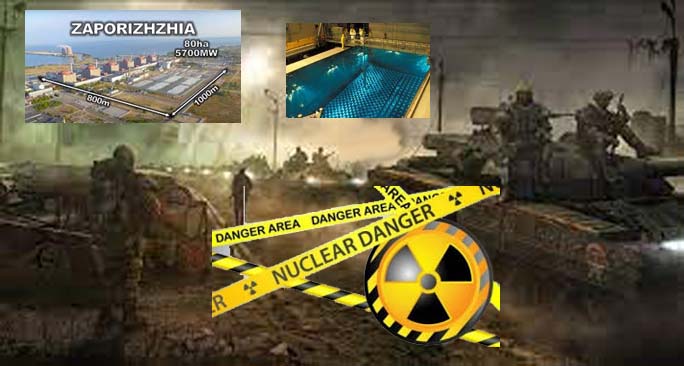
Safety of Zaporizhzhia nuclear plant hangs in the balance
Guardian, Julian Borger 13 Dec 22,
Shelling near the six-reactor facility plus a shortage of workers and uncertain backup power could be making it the most dangerous place on Earth…….
The Zaporizhzhia nuclear plant’s silhouette – with its two fat cooling towers and the row of six squat blocks – has become globally familiar since it was dubbed the most dangerous place on Earth: six nuclear reactors on the frontline of a catastrophic war.
On a fairly typical night last week, the Russians on the left bank of the river fired 40 shells and rockets into Nikopol, a town on the Ukrainian-held right bank, falling on its rows of krushchevky, five-storey blocks of flats built for factory workers in the 1960s and named after the Soviet leader of the time.
After 10 months of war, the blocks are half empty, so there are fewer people to kill. The only reported casualty on this particular night was a 65-year-old man who was taken to hospital, and whose flat now afforded such a comprehensive view of the power plant.
By the next morning, the repairs had already begun. An electrician restored power to the rest of the building, and two men were in the remains of the apartment itself, sweeping up and putting chipboard in place of absent walls.
There were four loud bangs as the Ukrainian army guns on the nearby riverbank opened fire on Russian positions and, a few minutes later, Nikopol’s air sirens sounded in anticipation of a Russian response, though none was forthcoming that morning.
The basements of the krushchevky have been turned into shelters with beds and school desks but most of the remaining population are so inured to bombardment, they just carry on with their day.
The Ukrainians insist they are extremely careful about what they shoot at, even when they receive fire from the vicinity of the Zaporizhzhia plant. On Thursday, the Ukrainian nuclear power company, Energoatom, accused Russia of bringing Grad multiple launch rocket systems near reactor number 6, which is near the area of where spent nuclear fuel is kept. The likely aim, Energoatom alleged, was to shell Nikopol and the nearby town of Marzanets, using their position as cover.
The walls of the reactors are thick enough to withstand artillery fire, but a direct hit on the spent fuel containers could well lead to the release of radioactive material into the atmosphere. Since seizing control of the power station in March, the Russians have begun building a concrete shelter over the spent fuel, but Ukrainian officials say it is being done without following the normal international safety protocols.
Earlier in the week, Russia’s defence minister, Sergei Shoigu, accused Ukraine of “nuclear terrorism”, saying its armed forces had fired 33 large calibre shells at the Zaporizhzhia plant over the previous two weeks. The most recent report from the International Atomic Energy Agency (IAEA), which has four inspectors at the Russian-occupied site, said last Friday there had been no shelling of the plant since 20 November, although artillery fire had landed in the vicinity………………………………………..
It was not possible to verify Kotin and Orlov’s accounts of the shelling, or the counter-claims from Moscow. Satellite imagery however, has confirmed that the Russian army is storing military equipment inside the plant.
The IAEA inspectors on site could theoretically determine the trajectory of incoming rockets or shells but such detective work is not within their mandate. The agency is negotiating the creation of a security no-fire zone around the reactors, but Kyiv is insisting Russia must first withdraw all its weapons and armour from the power station, something Moscow has not so far agreed to.
Meanwhile there is a parallel safety threat from within the plant itself: the steady attrition of its workforce over the 10 months of the conflict. Many key workers have left because of the danger to their families or because they refused to work for the Russians. Of the 11,000-strong workforce before the full-scale invasion, just 4,000 are left. In an attempt to stop the exodus, the Russians have circulated lists of plant staff to all military checkpoints in the region with orders they are not be allowed to leave, but it has been too late to stop a major outflow.
“In some cases, there’s only three people to cover a seven or eight-person shift,” Orlov said. “People don’t have enough rest. It causes exhaustion.”
Operating under armed occupation adds to the stress. The workers still at the plant are under constant pressure to sign contracts with Rosatom, the Russian energy company, signifying acceptance of Moscow’s control.
Melynchuk said there were just enough staff left to maintain the plant in its current state of suspended animation, with all the reactors shut down, and two of them deliberately kept hot, to provide heating for Enerhodar.
But keeping reactors in this hot standby mode is a difficult and delicate process, adding to the burden on the operators. The situation could get worse still. The Zaporizhzhia plant is currently connected to the Ukrainian grid, but there have been times the transmission lines have been brought down by shelling, forcing the power station to fall back on diesel generators to keep the cooling system running and prevent the reactor vessel from meltdown.
If the connection to the grid was severed again, it would add to the pressure on the overstretched workforce and on the generators, which were only designed as a temporary backup. They will need maintenance and no one knows how much diesel fuel the plant has left. Once the diesel generators failed, meltdown would begin in a matter of hours……… https://www.theguardian.com/world/2022/dec/12/safety-of-zaporizhzhia-nuclear-plant-hangs-in-the-balance
INTERVIEW: Ukraine has lost the war, it just isn’t over yet, says Col
“INTERVIEW: #Nato sabotaging the #NordStream2 pipeline and firing missiles 400 miles into #Russia is insanely reckless and risks provoking nuclear armageddon 9 Dec 22
Military Groomers Are Increasingly Infiltrating US High Schools

Caitlin Johnstone more https://caitlinjohnstone.substack.com/p/military-groomers-are-increasingly?utm_source=post-email-title&publication_id=82124&post_id=90145807&isFreemail=true&utm_medium=email 3 Dec 22.
Protect your kids.
A New York Times report has found that enrollment in the Junior Reserve Officers’ Training Corps (JROTC), a Pentagon-funded program designed to groom children for military service, is increasingly becoming mandatory in US high schools.
“J.R.O.T.C. programs, taught by military veterans at some 3,500 high schools across the country, are supposed to be elective, and the Pentagon has said that requiring students to take them goes against its guidelines,” the report says. “But The New York Times found that thousands of public school students were being funneled into the classes without ever having chosen them, either as an explicit requirement or by being automatically enrolled.”
“While Pentagon officials have long insisted that J.R.O.T.C. is not a recruiting tool, they have openly discussed expanding the $400 million-a-year program, whose size has already tripled since the 1970s, as a way of drawing more young people into military service. The Army says 44 percent of all soldiers who entered its ranks in recent years came from a school that offered J.R.O.T.C.,” the Times reports.
And before you ask, no, the Pentagon’s grooming program is not being forced on kids in Malibu and the Hamptons.
“A vast majority of the schools with those high enrollment numbers were attended by a large proportion of nonwhite students and those from low-income households,” the Times reports, naming Detroit, Los Angeles, Philadelphia, Oklahoma City, and Mobile, Alabama as cities where high schools are funneling kids into the program en masse.
Defenders of mandatory JROTC enrollment reportedly cite the need to “divert students away from drugs or violence” and “the allure of drugs and gangs” in urban areas, as though corralling them into the single most violent gang on Earth is a deterrence from violence and gangs. Grooming students to go kill foreigners for crude oil is not my idea of a healthy diversion from youthful error, but maybe that’s just me.
This would probably be a good time to remind readers that poverty in the United States is one of the Pentagon’s most effective recruiting tools, with Army officials explicitly acknowledging that young people’s inability to afford a college education on their own is responsible for their success in meeting recruitment goals, and US lawmakers warning that helping people pay off crushing student debt will hurt recruitment. US military recruiters have an established record of targeting poorer schools, because impoverished communities often see military service as their only chance at upward mobility.
The New York Times describes a cult-like environment in these JROTC programs where “parents in some cities say their children are being forced to put on military uniforms, obey a chain of command and recite patriotic declarations in classes they never wanted to take,” with special textbooks which “at times falsify or downplay the failings of the U.S. government.” And if even The New York Times believes you’re falsifying and downplaying the failings of the US government, it’s got to be pretty bad.
Victims of the military grooming program told the Times that they were put in frequent contact with military recruiters who pushed the idea of enlisting to pay for college, with one student saying a male recruiter “still texts me to this day” even well after graduation.
I’m not sure how American parents could possibly read of such things without being intensely creeped out.
Every day I see US conservatives mindlessly bleating about “groomers” in the LGBT community trying to turn children into sexual deviants, claiming kids are being “indoctrinated” in school by learning about gay marriage and respect for trans people, but none of them seem to have any problem with the real-life indoctrination and grooming kids are subjected to by the most murderous and depraved institution in the world.
1 This Month
26 April – Chernobyl: Inside the Meltdown airs on National Geographic on Sunday 26th April from 4pm


29 April – Nuclear Expert Webinar #1 – Radiation Impacts on Families with Mary Olson and Cindy Folkers
- 12:15 PM MT – 1:45 PM MT
- Location: Virtual – REGISTER TODAY

4 May -West Suburban Peace Coalition to discuss Iran war at May Educational Forum
Monday, May 4, 7:00 – 8:00 PM Central Standard Time
Title: : How Trump’s Narrative Tries to Shape the Reality of the War on Iran.
Contact Walt Zlotow, zlotow@hotmail.com 630 442 3045 for further information
14 May – online event From Bombs to Data Centres: the Face of Nuclear Colonialism

Pine Ridge Uranium is the real threat, not Tehran- Tell Burgum: Stop the Extraction.
Chernobyl: The Lost Tapes – A good documentary on Chernobyl on SBS available On Demand for the next 3 weeks– https://www.sbs.com.au/ondemand/tv-program/chernobyl-the-lost-tapes/2352741955560
To see nuclear-related stories in greater depth and intensity – go to https://nuclearinformation.wordpress.com
-
Archives
- April 2026 (317)
- March 2026 (251)
- February 2026 (268)
- January 2026 (308)
- December 2025 (358)
- November 2025 (359)
- October 2025 (376)
- September 2025 (257)
- August 2025 (319)
- July 2025 (230)
- June 2025 (348)
- May 2025 (261)
-
Categories
- 1
- 1 NUCLEAR ISSUES
- business and costs
- climate change
- culture and arts
- ENERGY
- environment
- health
- history
- indigenous issues
- Legal
- marketing of nuclear
- media
- opposition to nuclear
- PERSONAL STORIES
- politics
- politics international
- Religion and ethics
- safety
- secrets,lies and civil liberties
- spinbuster
- technology
- Uranium
- wastes
- weapons and war
- Women
- 2 WORLD
- ACTION
- AFRICA
- Atrocities
- AUSTRALIA
- Christina's notes
- Christina's themes
- culture and arts
- Events
- Fuk 2022
- Fuk 2023
- Fukushima 2017
- Fukushima 2018
- fukushima 2019
- Fukushima 2020
- Fukushima 2021
- general
- global warming
- Humour (God we need it)
- Nuclear
- RARE EARTHS
- Reference
- resources – print
- Resources -audiovicual
- Weekly Newsletter
- World
- World Nuclear
- YouTube
-
RSS
Entries RSS
Comments RSS
 nuclear-news