The Nuclear Site That Can’t Be Cleaned Up
‘Atomic Days: The Untold Story of the Most Toxic Place in America’ exposes the story of a Washington state complex that poses dangers that—like the nuclear industry itself—cannot be contained.
https://portside.org/2022-10-23/nuclear-site-cant-be-cleaned October 23, 2022 Ron Jacobs , In what I consider to be something between coincidence and synchronicity, I began reading journalist Joshua Frank’s newest book on the dangers of the Hanford Nuclear Reservation, Atomic Days: The Untold Story of the Most Toxic Place in America, the day after the California state legislature extended the Diablo Canyon Nuclear Power Plant’s license to operate for another five years.
Back in 1981, I spent a few days in jail for protesting the opening of the Diablo plant as part of a direct action initiative called by the Abalone Alliance, an anti-nuclear advocacy group. We were reasonably concerned about the dangers it could pose: For starters, it was built on an earthquake fault. Then there’s the question of nuclear waste disposal, the impacts these sites have on the water sources, and the industry’s relationship to the building and stockpiling of nuclear weapons.
Frank’s in-depth reporting of the Hanford site illuminates similar threats to those posed by Diablo and other nuclear plants. Constructed beginning in the spring of 1943, the Washington state nuclear production complex was built to create and stockpile plutonium and purified uranium for weapons of war. The site was chosen for its remoteness and ease of access to one of North America’s great rivers, the Columbia. Empowered by the War Powers Act of 1941, the United States government took the land from residents who lived, fished, and farmed there—descendants of settlers and Indigenous people alike—and developed it to serve as a plutonium processing plant for the Manhattan Project.
Like so much of the nuclear bomb project in its early years, the construction of the Hanford site involved dangerous shortcuts. The rationale given had to do with the war engulfing the world and the United States’ rush to develop a nuclear weapon, the desire to cut costs in that development, as well as the lack of practical knowledge among the scientists and engineers involved. Naturally, like virtually every other industrial element of war-making in the United States, the bulk of the research, development, and construction of nuclear weapons, even at these early stages, was privatized.
In fact, as Frank describes in his book, the Army Corps of Engineers lieutenant general in charge of the Manhattan Project, Leslie Groves, contracted with the DuPont Corporation to find a suitable site for the processing plant that ended up in Hanford. As Frank explains, a consistent theme is the sacrificing of safety for the sake of profit. Even so, many if not most of the contracts exceeded the original contract costs by millions.
Atomic Days also discusses the cleanup of the Hanford Reservation; a process that officially began in 1989. As Frank carefully documents, not only has this cleanup been less than successful, it has often created a bigger mess than that which it was supposedly cleaning up. In addition, the way the process is being done almost guarantees cost overruns and a task that will never be complete. Much of this is traceable back to the original construction of the site, especially of the nuclear waste storage containers. Once they started leaking, the task became one of how to stop the leakage and prevent more from occurring. In response, plans were designed to create a waste treatment plant. Like so much else associated with the nuclear industry, and Hanford in particular, this led to more dangers. Once again, many of these risks could have been avoided if profit were not the primary motive.
Frank relates tales of scientists being ignored after warning management that the fixes it preferred were not workable in the long term. He writes about a culture of fear inside the project—a culture fed by the employees’ sense of allegiance to their nation and the importance of their role in defending that nation. It is this allegiance that is manipulated by corporate interests into something close to its opposite. It is also a part of the basis for employees ignoring safety protocols at their own risk and poisoning themselves and the environment surrounding Hanford. As is the case in many government and corporate cultures, whistleblowers are punished and silenced. This allegiance was not always limited to the workers inside, many residents of nearby towns refused to believe reports of radioactive material being released and accidentally leaking when the reports first came out.
As if to verify Frank’s assertions, I lived in western Washington for seven years (1985-1992) and knew very little of the dangers. With the exception of a couple friends who were scientists and antinuclear activists, most locals knew less than I did. A friend who grew up in Kennewick, Washington, a town just a few miles away from Hanford, would argue with me, convinced that the site was completely safe, even though people he knew who had worked there were diagnosed with cancer in their thirties.
The Hanford Nuclear Reservation is testament to the war machine’s inhumanity. The fact that its primary purpose was the production of an element that remains deadly poisonous to humans and other life forms for tens of thousands of years is a damning testament to the suicidal nature of too many human pursuits. In writing Atomic Days, author Joshua Frank has done a great public service. The fact that he has done so in a narrative style that is both accessible and instructive makes one hope his story will be read by many.
US could directly intervene in Ukraine – ex-CIA chief
Rt.com 23 Oct 22, The US and its allies may join the conflict between Moscow and Kiev even if there is no threat to NATO, David Petraeus believes.
The US and its allies might directly intervene in the ongoing conflict between Moscow and Kiev, even if there is no threat to any NATO member states, retired US Army general David Petraeus told France’s L’Express weekly on Saturday.
Washington might form a new coalition of the willing in such a scenario and use it instead of NATO, Petraeus, who also briefly served as the CIA director, believes.
Russia could take some actions in Ukraine that would be “so shocking and so horrific” that it would prompt a response from the US and other nations, he said, adding that they “might react in one way or another, but as a multinational force led by the US and not as a NATO force.”
The military alliance would still likely be bound by its treaty and would only join the conflict if Article 5 is invoked, i.e. if one of its members is attacked, the general believes. Petraeus also said that Moscow is not interested in escalating the conflict and turning it into a global war. A wider conflict is “the last thing” Russian President Vladimir Putin needs right now, he added……………………………. https://www.rt.com/news/565160-petraeus-us-intervene-ukraine-conflict/
France’s Nuclear Reactors Malfunction as Energy Crisis Bites
B1 The linchpin of France’s energy security faces maintenance and pipe-corrosion problems plus labor unrest
WSJ, By Matthew Dalton Oct. 23, 2022
PARIS—France is falling behind in its plans to return the country’s fleet of nuclear reactors to full power this winter after a rash of outages, raising fears that one of Europe’s key sources of electricity won’t be ramped up to counter Russia’s squeeze on the continent’s energy supplies.
The nuclear fleet was designed to act as the front line of France’s energy security. Since Moscow cut the flow of natural gas to Europe—plunging the continent into its biggest energy crisis since the 1970s oil shock—France’s vaunted nuclear fleet has been about as effective as the Maginot Line, the French fortifications that did little to stop the German invasion during World War II…………….. (subscribers only) more https://www.wsj.com/articles/frances-nuclear-reactors-malfunction-as-energy-crisis-bites-11666517581
‘Whistleblower’ says legal battle with nuclear site owners ‘almost broke me’
A consultant who claims she was dismissed by Sellafield for exposing failures to address a “toxic” working culture has been granted an appeal against her employment tribunal loss.
Yorkshire Post, By Nathan Hyde, 23 Oct 22,
Equality and diversity consultant Alison McDermott said her contract at the nuclear processing plant ended after she wrote a damning “whistleblowing” report about the human resources (HR) leadership team, claiming they had failed to address complaints about bullying and harassment.
After refusing a £160,000 settlement, she took her case to an employment tribunal. But Employment Judge Philip Lancaster dismissed her claim and ruled she was not a whistleblower, following a hearing in Leeds.
She was then ordered to pay £40,000 to help cover the legal costs of Sellafield Ltd and its parent company – the Nuclear Decommissioning Authority.
Ms McDermott, from Burley in Wharfedale, has been granted an appeal and she is now raising money to cover her legal costs, ahead of the next hearing in January.
Her legal team have challenged the ruling, but also criticised the judge for refusing to look at the alleged “toxic culture” at Sellafield and alleged failure of the HR team. They said this provides vital context, as it explains Ms McDermott’s decision to become a whistleblower.
“I am doing everything I can because I’m really concerned about what’s going on at Sellafield,” she said………………………………
Ms McDermott signed a two-day-a-week contract with Sellafield Ltd to work as a consultant in equality and diversity at the nuclear fuel reprocessing and decommissioning site in September 2018.
After taking on the role, looked into allegations of sexual harrasment and homophobic abuse.
She also recieved an anonymous letter claiming “serious problems” about sexual harassment “are being ignored”.
The following month, she compiled a report on the HR leadership team, saying they were viewed as “broken and dysfunctional”
by some staff and failing to effectively deal with allegations of harassment and bullying.
Shortly after filing the report, she was told her £1,500-a-day contract would be terminated due to “funding constraints”.
But during the tribunal, Sellafield’s lawyers said it was because the report, which had cost around £12,000, was “questionable and insubstantial” and “lacked any meaningful analysis”.
According to the ruling, the judge accepted the funding constraints excuse was used to allow Ms McDermott to leave “with her head held high”.
He ruled she was not a whistleblower, because she could not make any “disclosures” which are protected under UK employment law.
Sellafield Ltd, which has previously stated it is committed to eradicating bullying and harassment, has been approached for comment. https://www.yorkshirepost.co.uk/news/people/whistleblower-says-legal-battle-with-nuclear-site-owners-almost-broke-me-3889870
Rishi Sunak’s Richmond constituency is one of the potential locations for a small nuclear reactor factory
Second Welsh location shortlisted for siting of new nuclear reactor
factory. Shotton has been added to the list of potential locations for one
of the three factories across the UK which will manufacture Rolls-Royce’s
fleet of new SMR reactors.
Deeside was confirmed as the first Welsh
location when the initial round of six potential sites were announced in
July. Redcar in the northeast of England has also been added to the
shortlist of candidates list alongside Shotton.
The Rolls-Royce-led
consortium developing the new technology has confirmed the eight locations
following a bidding process which was launched in January and involved
several English regional development bodies and the Welsh Government.
The eight sites also include Tory leadership candidate – and former
Chancellor Rishi Sunak’s Richmond constituency in North Yorkshire, along
with Sunderland, Ferrybridge in West Yorkshire, Stallingborough,
Lincolnshire, and Carlisle. The winning bid has been promised investment of
up to £200m and the creation of up to 200 jobs.
Nation Cymru 22nd Oct 2022
Second Welsh location shortlisted for siting of new nuclear reactor factory
What is Regulatory Asset Base and how will it affect future energy charges for Scots?
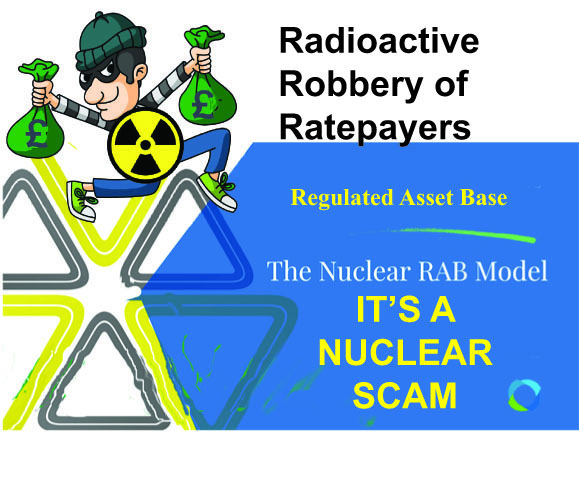
THE UK Government is set on using a Regulatory Asset Base (RAB) model to fund
nuclear projects south of the Border. This will directly result in Scots
paying more on their energy bills. Here, former Scottish Office chief
statistician Jim Cuthbert explains what an RAB model is, and the problems
behind it. There are two main problems.
First, the construction phase of
nuclear projects is extremely long. Further, nuclear construction is
notoriously beset by technical difficulties. Midway through a nuclear
construction project, it will be extremely difficult for the regulator to
resist pressure for the RAB base to be inflated to overcome any technical
problems or uncertainties.
Secondly, the operating life of nuclear projects
is again very long, with the UK Government’s current working assumption
being about 60 years. This means that any surplus which is built into the
stream of future RAB payments will be available to be capitalised over this
long period – which will greatly increase the potential windfall profits
to be extracted by the original equity investors.
The National 23rd Oct 2022
https://www.thenational.scot/politics/23071054.rab-will-affect-future-energy-charges-scots/
TODAY. The tangled web of deception about small nuclear reactors (SMRs).

It’s been a mess from the start . Nobody wants to admit that the only real purpose for small nuclear reactors (SMRs) is to keep the nuclear weapons industry going.
The big propaganda lie is that SMRs will fix climate change. If that worked (a huge “If”) the world would need millions of SMRs dotted about the planet in a very short time.
The pretense is that they’re needed for electricity production – despite the continuing success of relatively quick establishment of much cheaper and cleaner renewable energy.
The absurdity that SMRs will be cheap. That goes along with the reality that very few investors want to fund them So – NuScale had to set up a rather dodgy, complicated investment body
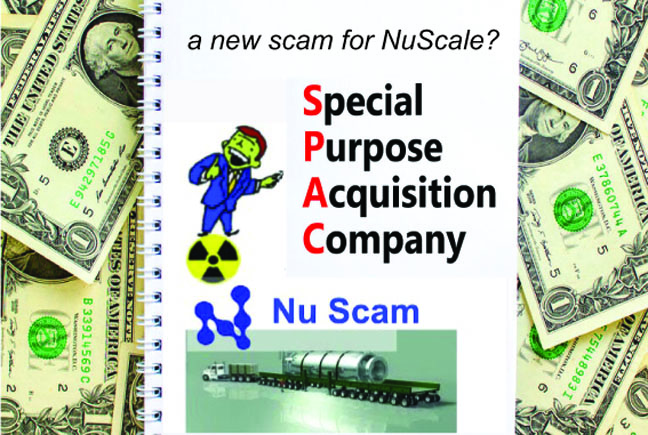
And UK’s Rolls Royce had to set up and even more complicated one

With no chance of getting real private investors, the nuclear lobby relies on billionaires (Bill Gates for USA, the Perrodo family for UK) – but even they want tax-funded development of SMRs.
Oh, by the way – there are safety, terrorism, and weapons proliferation dangers in SMRs. And they produce wastes that are even more toxic than that produced by large reactors.
But the bit they really like to leave out – is that the whole thing absolutely needs high assay low enriched uranium (HALEU) bought from Russia
NOWHERE TO HIDE -How a nuclear war would kill you — and almost everyone else.
Bulletin of the Atomic Scientists , 20 Oct 22, François Diaz-Maurin (@francoisdm) is the associate editor for nuclear affairs at the Bulletin of the Atomic Scientists.Thomas Gaulkin (@ThomasGaulkin) is multimedia editor of the Bulletin of the Atomic Scientists.
By François Diaz-Maurin, This summer, the New York City Emergency Management department released a new public service announcement on nuclear preparedness, instructing New Yorkers about what to do during a nuclear attack. The 90-second video starts with a woman nonchalantly announcing the catastrophic news: “So there’s been a nuclear attack. Don’t ask me how or why, just know that the big one has hit.” Then the PSA video advises New Yorkers on what to do in case of a nuclear attack: Get inside, stay inside, and stay tuned to media and governmental updates.
But nuclear preparedness works better if you are not in the blast radius of a nuclear attack. Otherwise, there’s no going into your house and closing your doors because the house will be gone. Now imagine there have been hundreds of those “big ones.” That’s what even a “small” nuclear war would include. If you are lucky not to be within the blast radius of one of those, it may not ruin your day, but soon enough, it will ruin your whole life.
Direct radiation is the most immediate effect of the detonation of a nuclear weapon. It is produced by the nuclear reactions inside the bomb and comes mainly in the form of gamma rays and neutrons. Direct radiation lasts less than a second, but its lethal level can extend over a mile in all directions from the detonation point of a modern-day nuclear weapon with an explosive yield equal to the effect of several hundred kilotons of TNT.
Microseconds into the explosion of a nuclear weapon, energy released in the form of X-rays heats the surrounding environment, forming a fireball of superheated air. Inside the fireball, the temperature and pressure are so extreme that all matter is rendered into a hot plasma of bare nuclei and subatomic particles, as is the case in the Sun’s multi-million-degree core.
The fireball following the airburst explosion of a 300-kiloton nuclear weapon—like the W87 thermonuclear warhead deployed on the Minuteman III missiles currently in service in the US nuclear arsenal—can grow to more than 600 meters (2,000 feet) in diameter and stays blindingly luminous for several seconds, before its surface cools.
The light radiated by the fireball’s heat—accounting for more than one-third of the thermonuclear weapon’s explosive energy—will be so intense that it ignites fires and causes severe burns at great distances. The thermal flash from a 300-kiloton nuclear weapon could cause first-degree burns as far as 13 kilometers (8 miles) from ground zero.
Then comes the blast wave.…………………………………….
Radioactive fallout…………………..
Immediate effects of nuclear war
In a nuclear war, hundreds or thousands of detonations would occur within minutes of each other.
Regional nuclear war between India and Pakistan that involved about 100 15-kiloton nuclear weapons launched at urban areas would result in 27 million direct deaths.
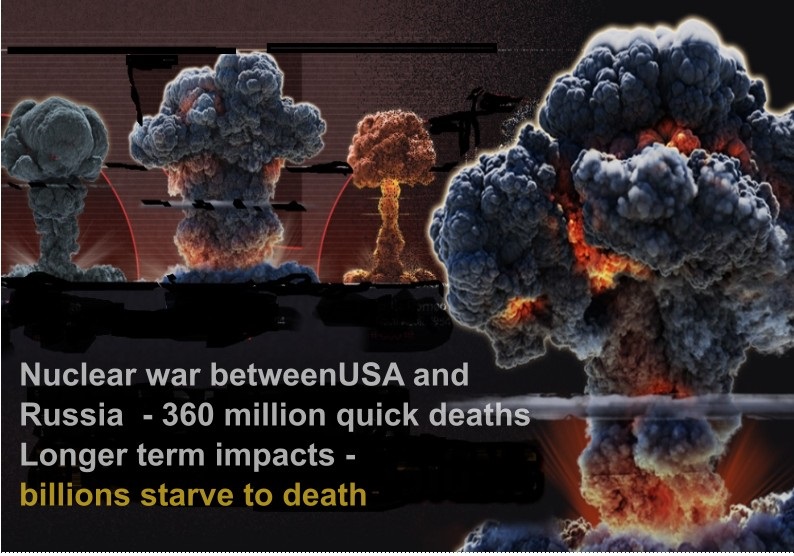
A global all-out nuclear war between the United States and Russia with over four thousand 100-kiloton nuclear warheads would lead, at minimum, to 360 million quick deaths.* That’s about 30 million people more than the entire US population…………………………..
As horrific as those statistics are, the tens to hundreds of millions of people dead and injured within the first few days of a nuclear conflict would only be the beginnings of a catastrophe that eventually will encompass the whole world.
Global climatic changes, widespread radioactive contamination, and societal collapse virtually everywhere could be the reality that survivors of a nuclear war would contend with for many decades.
The longer-term consequences of nuclear war
In recent years, in some US military and policy circles, there has been a growing perception that a limited nuclear war can be fought and won. Many experts believe, however, that a limited nuclear war is unlikely to remain limited. What starts with one tactical nuclear strike or a tit-for-tat nuclear exchange between two countries could escalate to an all-out nuclear war ending with the immediate and utter destruction of both countries.
But the catastrophe will not be limited to those two belligerents and their allies.
The long-term regional and global effects of nuclear explosions have been overshadowed in public discussions by the horrific, obvious, local consequences of nuclear explosions. Military planners have also focused on the short-term effects of nuclear explosions……………………..
widespread fires and other global climatic changes resulting from many nuclear explosions may not be accounted for in war plans and nuclear doctrines. These collateral effects are difficult to predict; assessing them requires scientific knowledge that most military planners don’t possess or take into account.
Global climatic changes……………………………………………..
Stratospheric soot injection………………………………
Changes in the atmosphere…………………………………
Changes on land…………………….
Changes in the ocean……………………….
Impacts on food production……………………………………….
Nowhere to hide
The impacts of nuclear war on agricultural food systems would have dire consequences for most humans who survive the war and its immediate effects.
The overall global consequences of nuclear war—including both short-term and long-term impacts—would be even more horrific causing hundreds of millions—even billions—of people to starve to death………………………………………………………
References & Acknowledgments…………………………
https://thebulletin.org/2022/10/nowhere-to-hide-how-a-nuclear-war-would-kill-you-and-almost-everyone-else/
“Present Danger: Nuclear Power Plants in War,” The US Army War College Quarterly: Parameters
what is still lacking, is a Pentagon assessment of what all this means militarily.
https://npolicy.org/present-danger-nuclear-power-plants-in-war-the-us-army-war-college-quarterly-parameters/ October 19, 2022, Author: Henry Sokolski
As the war in Ukraine drags on, daily developments at the Zaporizhzhia nuclear plant explode on our Google News screens. Last week, external power needed to prevent a core meltdown at the plant was cut off repeatedly, forcing reliance on emergency diesel generators.
Meanwhile, Russians have tortured, kidnapped, and killed Ukrainian staff at the plant to force them to renounce their loyalty to Ukraine and sign employment contracts with Rosatom, Russia’s electrical utility. Poland, Romania, Ukraine, Moldova, and Finland have all begun distributing iodine pills to reduce thyroid cancers if there is a loss of coolant accident at Zaporizhzhia and a radiological release that drifts their way.
And Washington’s response? Several senior US officials have condemned Russia’s assaults on Zaporizhzhia as being “irresponsible” and “dangerous.” Yet, well after Russia’s military assault on the plant, Westinghouse, the Energy and State Departments, and the President announced plans to construct nuclear power plants in Poland, Romania, and even Ukraine. No one has yet explained how or if these plants can be defended.
This is weird. Plants in Central Europe, like Zaporizhzhia, are not just electrical generators, they are stationary, potential slow-burning nuclear dispersal weapons that could conceivably trigger or even force a NATO response. Plants and such war zones present a real and present danger.
Late last month, the U.S. Army War College asked me to write a short piece on the military risks nuclear plants in war zones present. Attached, “Present Danger: Nuclear Plants in War,” is that analysis. It lays out a basic set of recommendations for the Pentagon.
Present Danger: Nuclear Power Plants in War
Zaporizhzhya’s nuclear plant, as of this writing, has been placed on cold shutdown. The plant and its military vulnerabilities, however, have generated some of the world’s most sensational headlines.1 Earlier this summer, online reports featured photographs of the plant’s damaged transformer, a system critical to assuring a steady supply of electricity to the plant’s all-important reactor coolant and safety systems. Throughout August and September, news organizations detailed how the plant’s external main power lines—built to keep electricity flowing to its reactors—had been cut. Some days, some of the plant’s six reactors were operating. Other days, none were. Repeatedly, the viability of the plant’s emergency diesel fuel electrical generators was “Topic A.”
Each of these stories raised the specter of a military-induced Fukushima: strikes against the plant or the power lines feeding into it that could cut off the electricity needed to run the reactors’ coolant pumps and safety equipment followed by nuclear fuel failures and a massive radiological release over Ukraine and its neighbors. Add to this firsthand accounts of Russian torture, the murder of “disloyal” Ukrainian reactor staff, and an emergency International Atomic Energy Agency visit, and you have everything needed for a Netflix docudrama.
What you would not have, however, and what is still lacking, is a Pentagon assessment of what all this means militarily.
Close friends have offered hints. Japanese Prime Minister Fumio Kishida called for stationing security forces at each of Japan’s nuclear plants, and his administration also suggested the possibility of deploying dedicated missile defense systems (as Belarus has done at its nuclear plant since 2019).2 Seoul crafted military exercises this year with US forces that included explosives detonating at one or more of South Korea’s civilian reactor sites.3 Ukrainian President Volodymyr Zelensky accused Russia of turning Zaporizhzhya into a prepositioned, slow-burning, radiation-dispersing “nuclear weapon.”4 Meanwhile, Tobias M. Ellwood, the British House of Common’s Select Committee on Defense chairman, insisted that if Russia intentionally struck Zaporizhzhya and spread harmful radioactivity to Poland or Romania, it would trigger NATO’s Article 5.5 Moldova, Romania, and Ukraine did more than talk. All three countries prepared to distribute iodine pills to their citizens (to reduce the thyroid cancers radiation might induce if Zaporizhzhya leaked radiation).6
Wikipedia, s.v. “Crisis at the Zaporizhizhia Nuclear Power Plant,” last modified September 14, 2022, https://en.m.wikipedia.org/wiki/Crisis_at_the_Zaporizhzhia_Nuclear_Power_Plant.- Eric Johnston, “Japan to Discuss Creating New Police Unit to Guard Nuclear Plants,” Japan Times (website), March 14, 2022, https://www.japantimes.co.jp/news/2022/03/14/national/nuclear-plant-police -unit/; and “TOR-M2 Air Defense Missile Systems to Protect Belarus Nuclear Power Plant,” Army Recognition (website), December 8, 2018, https://www.armyrecognition.com/december_2018_global_defense_security_army _news_industry/tor-m2_air_defense_missile_systems_to_protect_belarus_nuclear_power_plant.html.
- Sang-ho Song, “Upcoming S. Korea-U.S. Training Involves Drills on Repelling Attacks, Staging Counterattacks,” Yonhap News Agency (website), August 1, 2022, https://en.yna.co.kr/view /AEN20220801004000325.
- Rebecca Falconer, “Zelensky Says Russian Forces Using Zaporizhzhia Plant as ‘Nuclear Weapon,’ ” Axios (website), September 4, 2022, https://www.axios.com/2022/09/05/zelensky-russia-zaporizhzhia-plant -nuclear-weapon.
- Article 5 requires NATO members come to the defense of any other member that suffers a military attack. See Tobias M. Ellwood (@Tobias_Ellwood), “Let’s make it clear: ANY deliberate damage causing potential radiation leak to a Ukrainian nuclear reactor would be a breach of NATO’s Article 5. @thetimes,” Twitter, August 19, 2022, 1:55 a.m., https://twitter.com/Tobias_Ellwood/status/1560505699179925509?s=20& t=FYfhPvuxW0pHm8lwXfe99w.
- Josh Lederman, “Radiation Tablets Are Handed out near Ukrainian Nuclear Plants as Fears of a Leak Mount,” NBC News (website), August 26, 2022, https://www.nbcnews.com/news/world/russia-ukraine-war -zaporizhzhia-nuclear-plant-radiation-fears-iodine-rcna45041; Ben Turner, “Ukraine War: Moldova Ships in One Million Iodine Pills amid Fears of Nuclear Disaster,” Euronews (website), August 16, 2022, https: // www.euronews.com /2022 /08 /15 /moldova-ships-in-radiation-pills-as-fighting-rages-near-zaporizhzhia -nuclear-power-plant-i; and Helen Collis, “Romania to Issue Iodine Tablets as Russian War Continues in Neighboring Ukraine,” Politico (website), April 3, 2022, https://www.politico.eu/article/romania-to-issue -iodine-tablets-as-russian-aggression-continues-in-bordering-ukraine/.
Click here to read the full article.
America’s new nuclear power industry has a Russian problem
Kitco News Reuters Friday October 21, 2022,
WASHINGTON/LONDON, Oct 20 (Reuters) – U.S. firms developing a new generation of small nuclear power plants to help cut carbon emissions have a big problem: only one company sells the fuel they need, and it’s Russian.
That’s why the U.S. government is urgently looking to use some of its stockpile of weapons-grade uranium to help fuel the new advanced reactors and kick-start an industry it sees as crucial for countries to meet global net-zero emissions goals.
Production of HALEU is a critical mission and all efforts to increase its production are being evaluated,” a spokesperson for the U.S. Department of Energy (DOE) said……..
without a reliable source of the high assay low enriched uranium (HALEU) the reactors need, developers worry they won’t receive orders for their plants. And without orders, potential producers of the fuel are unlikely to get commercial supply chains up and running to replace the Russian uranium……
The fact that Russia has a monopoly on HALEU has long been a concern for Washington but the war in Ukraine has changed the game, as neither the government nor the companies developing the new advanced reactors want to rely on Moscow.
HALEU is enriched to levels of up to 20%, rather than around 5% for the uranium that powers most nuclear plants. But only TENEX, which is part of Russian state-owned nuclear energy company Rosatom, sells HALEU commercially at the moment.
While no Western countries have sanctioned Rosatom over Ukraine, mainly because of its importance to the global nuclear industry, U.S. power plant developers such as X-energy and TerraPower don’t want to be dependent on a Russian supply chain.
“We didn’t have a fuel problem until a few months ago,” said Jeff Navin, director of external affairs at TerraPower, whose chairman is billionaire Bill Gates. “After the invasion of Ukraine, we were not comfortable doing business with Russia.”
………….. with large-scale projects still challenging for reasons including huge up-front costs, project delays, cost overruns and competition from cheaper energy sources such as wind, several developers have proposed so-called small modular reactors (SMR).
While the SMRs on offer from companies such as EDF (EDF.PA) and Rolls-Royce (RR.L) use existing technology and the same fuel as traditional reactors, nine out of 10 of the advanced reactors funded by Washington are designed to use HALEU…….
Companies in the United States and Europe have plans to produce HALEU on a commercial scale but even in the most optimistic scenarios, they say it would take at least five years from the point they decide to proceed……
“Nobody wants to order 10 reactors without a fuel source, and nobody wants to invest in a fuel source without 10 reactor orders,” said Daniel Poneman, chief executive of U.S. nuclear fuel supplier Centrus Energy Corp (LEU.A)…..
TerraPower, for example, said it will need 15 tonnes of HALEU for the first fuel load of its advanced reactor.
Other potential HALEU producers are further behind.
French state-owned uranium mining and enrichment company Orano says it could start producing HALEU in five to eight years, but will only apply for a production licence once it has customers with long-term contracts.
In a response to a DOE request for information about how to establish a programme to support HALEU production, Orano said it would be down to the U.S. government to kick-start the industry.
“Orano’s assessment shows that the single most important factor enabling success is the DOE guaranteeing a certain volume of demand,” the company said in a statement on its website.
European uranium enrichment company Urenco, meanwhile, says it is considering sites in the United States and Britain for HALEU production but has yet to apply for licences.
CLOCK IS TICKING
For TerraPower and X-energy, which have projects planned in the U.S. states of Wyoming and Washington respectively, the clock is ticking.
Washington awarded them contracts to build two demonstration rectors by 2028 and shared the costs. But without Russian fuel, that deadline will fall well before any alternative commercial suppliers would be up and running.
While the 20% enrichment levels for HALEU are well below the roughly 90% level needed for weapons, companies need special licences to produce it. Additional security and certification requirements are also required for production sites, packaging and transportation of the fuel.
To speed up the process and break the deadlock, the U.S. government is looking to “downblend” weapons-grade highly enriched uranium sitting in its stockpile, though that will also take time…..
The Inflation Reduction Act U.S. President Joe Biden signed in August contained $700 million to secure HALEU supplies from the government and a consortium partnered with the DOE for use in advanced reactors and research.
In September, the White House asked Congress for another $1.5 billion in a temporary government funding bill to boost domestic supply of low enriched uranium and HALEU, to address potential difficulties in accessing Russian fuel.
Lawmakers took the measure out of the bill over concerns about costs, though it remains a priority for some Biden officials, including Energy Secretary Jennifer Granholm.
Last year, nuclear power stations in the United States imported about 14% of their uranium from Russia, along with 28% of their enrichment services, according to the U.S. Energy Information Administration.
Reporting by Sarah McFarlane and Susanna Twidale in London and Timothy Gardner in Washington; Editing by Veronica Brown and David Clarke https://www.kitco.com/news/2022-10-21/America-s-new-nuclear-power-industry-has-a-Russian-problem.html
SCOTT RITTER: Nuclear High Noon in Europe

Enter Volodymyr Zelensky, stage left. Speaking to the Lowy Institute, a nonpartisan international policy think tank in Australia, the Ukrainian president called for the international community to undertake “preventative strikes, preventive action” against Russia to deter the potential use of nuclear weapons by Russia against Ukraine
First and foremost, there has been zero talk about the employment of tactical nuclear weapons from the Kremlin.
The risk isn’t that Russia would start a pre-emptive nuclear war over Ukraine.
The risk is that America would.
https://consortiumnews.com/2022/10/19/scott-ritter-nuclear-high-noon-in-europe/ By Scott Ritter Consortium News 19 Oct 22, Now is the time for Biden to clarify U.S. nuclear doctrine. But he remains silent.
On Monday, Oct. 17, the North Atlantic Treaty Organization kicked off Operation STEADFAST NOON, its annual exercise of its ability to wage nuclear conflict. Given that NATO’s nuclear umbrella extends exclusively over Europe, the indisputable fact is that STEADFAST NOON is nothing more than NATO training to wage nuclear war against Russia.
Nuclear war against Russia.
Enter Joe Biden, center stage. Speaking at a fund raiser on Oct. 6, the president of the United States said that, “For the first time since the Cuban missile crisis, we have a direct threat of the use of a nuclear weapon if in fact things continue down the path they are going.”
Biden went on: “We’ve got a guy I know fairly well. He’s not joking when he talks about potential use of tactical nuclear weapons or biological or chemical weapons because his military is, you might say, significantly underperforming.”
Biden concluded: “I don’t think there’s any such thing as the ability to easily use a tactical nuclear weapon and not end up with Armageddon.”
The reader should let that sink in for a moment.
Don’t worry, NATO spokesperson Oana Lungscu reassured the rest of the world, the purpose of STEADFAST NOON is to ensure that NATO’s nuclear war-fighting capability “remains safe and effective.” It is a “routine” exercise, not linked to any current world events. Moreover, no “real” nuclear weapons will be used — just “fake” ones.
Nothing to worry about here.
Enter Jens Stoltenberg, NATO secretary general, stage right in the nuclear theater. In a statement to the press on Oct. 11, Stoltenberg declared that, “Russia’s victory in the war against Ukraine will be a defeat of NATO,” before ominously announcing, “This cannot be allowed.”
To that end, Stoltenberg stated, the STEADFAST NOON nuclear drills would continue as scheduled. These drills, Stoltenberg said, were an important deterrence mechanism in the face of Russian “veiled: nuclear threats.”
But they weren’t related to any current world events.
Enter Volodymyr Zelensky, stage left. Speaking to the Lowy Institute, a nonpartisan international policy think tank in Australia, the Ukrainian president called for the international community to undertake “preventative strikes, preventive action” against Russia to deter the potential use of nuclear weapons by Russia against Ukraine.
While many observers interpreted Zelensky’s words to imply a request for NATO to carry out a preemptive nuclear strike against Russia, Zelensky’s aides were quick to try and correct the record, saying he was simply asking for more sanctions.
Enter Joe Biden, center stage. Speaking at a fund raiser on Oct. 6, the president of the United States said that, “For the first time since the Cuban missile crisis, we have a direct threat of the use of a nuclear weapon if in fact things continue down the path they are going.”
Biden went on: “We’ve got a guy I know fairly well. He’s not joking when he talks about potential use of tactical nuclear weapons or biological or chemical weapons because his military is, you might say, significantly underperforming.”
Biden concluded: “I don’t think there’s any such thing as the ability to easily use a tactical nuclear weapon and not end up with Armageddon.”
While it has been made abundantly clear by the White House that Biden’s comments were his personal view, and not based on any new intelligence regarding Russian nuclear posture, the fact that a sitting U.S. president was speaking about the possibility of a nuclear “Armageddon” should send chills down the spine of every sane individual in the world.
No Kremlin Talk of Tactical Nuclear Weapons
First and foremost, there has been zero talk about the employment of tactical nuclear weapons from the Kremlin.
Zero.
Russian President Vladimir Putin has indicated that Russia would use “all the means at its disposal” to protect Russia. He said this most recently on Sept. 21, when in a televised address announcing partial mobilization, he accused the West of engaging in “nuclear blackmail,” citing “statements of some high-ranking representatives of the leading NATO states about the possibility of using nuclear weapons of mass destruction against Russia.”
Putin was alluding to a statement that Liz Truss made prior to her election as British prime minister, when, in response to a question on whether she was ready to undertake the responsibility of ordering the use of the U.K.’s nuclear arsenal, she replied, “I think it’s an important duty of the prime minister and I’m ready to do that.”
“I want to remind you,” Putin said,
“that our country also has various means of destruction and in some components more modern than those of the NATO countries. And if the territorial integrity of our country is threatened, we will certainly use all the means at our disposal to protect Russia and our people.”
Putin’s statements were consistent with that of Russian Defense Minister Sergei Shoigu, who in an address to the 10th Moscow Conference on International Security delivered on Aug. 16, asserted that Russia would not use nuclear weapons in Ukraine. According to Shoigu, Russian nuclear weapons are authorized for use under “exceptional circumstances” as described in published Russian doctrine, none of which apply to the Ukraine situation. Any talk of the use of nuclear weapons by Russia in Ukraine, Shoigu said, was “absurd.”
Apparently not to Biden, who despite his claim to know Putin “fairly well,” got it all wrong when talking about the potential for nuclear conflict.
The risk isn’t that Russia would start a pre-emptive nuclear war over Ukraine.
The risk is that America would.
Biden’s Pledge of ‘Sole Purpose Policy’
Biden came into office in February 2021 promising to enshrine in U.S. nuclear doctrine a “sole purpose policy,” under which “the sole purpose of our nuclear arsenal should be to deter — and, if necessary, retaliate against — a nuclear attack.”
It is now the middle of October 2022, and America finds itself in a situation where the president himself fears for a potential nuclear “Armageddon.”
If ever there was a time for Biden to make good on his pledge, now is it.
But he remains silent.
The danger inherent in Biden’s silence is that Putin and other Russian officials who are concerned about Russian national security must rely upon existing published U.S. nuclear doctrine, which continues to enshrine a policy of nuclear pre-emption promulgated during the administration of President George W. Bush. Under this doctrine, nuclear weapons are but another tool in the military’s toolbox, to be used as and when needed, including occasions where the destruction of battlefield targets for the simple purpose of gaining an operational advantage is the objective.
One can argue that this sort of non-nuclear preemption has its own inherent deterrence value, a sort of “madman” kind of vibe that makes an opponent question whether the president could act in such an irrational manner…………….
Former President Donald Trump breathed new life into Nixon’s “madman theory,” telling North Korea that if it continued to threaten the United States “[t]hey will be met with fire, fury and frankly power the likes of which this world has never seen before.” Trump went on to have three face-to-face meetings with North Korean leader Kim Jung-Un in a failed effort to bring about the denuclearization of the Korean peninsula.
It was under the Trump administration that the U.S. Navy deployed the W-76-2 low-yield nuclear warhead on its Trident submarine-launched ballistic missiles, giving the president a greater range of options when it came to the employment of nuclear weapons………………………………………………
As this article is being written, U.S. nuclear-capable B-52 bombers are flying to Europe from their U.S. bases, where they will practice delivering nuclear weapons against a Russian target. Dozens more aircraft, flying from Volkel Air Force Base in the Netherlands (home to an arsenal of U.S. B-61 nuclear bombs), will practice employing NATO nuclear weapons against…Russia.
Russia has responded to the NATO nuclear drill by going forward with its own annual nuclear exercise, “Grom” (Thunder). ………………….
Now is not the time for drama, or theatrically inflammatory rhetoric. Now is the time for maturity, sanity…restraint. A sage leader would have recognized the possibility of misperception on the part of Russia when NATO, a mere week after being encouraged by the Ukrainian president to initiate a preemptive nuclear strike on Russia, carries out a major exercise where NATO practices dropping nuclear bombs on Russia. A sober leader would have postponed these drills and encouraged similar action from Russia regarding its nuclear exercises.
Instead, America gets an unscripted, off-the-cuff reference to a nuclear Armageddon from a narcissistic egomaniac who uses the horror of nuclear annihilation as a fund-raising mantra.
It would take but one miscalculation, a single misunderstanding to turn STEADFAST NOON into “High Noon,” and “Grom” (Thunder) into “Molnya” (Lightening).
We’ve seen this scenario before. In November 1983 NATO carried out a command post exercise, codenamed ABLE ARCHER ’83, designed to test “nuclear weapons release procedures.” The Soviets were so alarmed by this exercise, which they believed could be used to mask a preemptive nuclear strike by NATO against the Soviet Union, that they loaded nuclear warheads onto bombers, bringing NATO and the Soviet Union to the brink of a nuclear war.
The Economics Of European Nuclear Power Don’t Add Up

the French nuclear industry is a basketcase, financially speaking………… the enormous public as well as private investment involved “will put a heavy burden on the French budget”
Rainer Baake, the managing director of the Climate Neutrality Foundation in Germany, puts it bluntly. “Why would anyone invest in nuclear?” he wonders.
https://www.forbes.com/sites/christinero/2022/10/21/the-economics-of-european-nuclear-power-dont-add-up/?sh=63eed2ae5d0c— Christine Ro, Oct 21, 2022,
There are clear climate and energy security benefits to nuclear power, of course. But Baake says that it’s telling that countries without liberalized markets are the ones mainly investing in new nuclear plants (China domestically and Russia internationally, including in Slovakia and Belarus).
For the huge startup costs and risks make nuclear power financially illogical, according to Baake, who as a politician helped craft a plan for Germany to transition away from nuclear energy.
In European democracies, governments need to be heavily involved in propping up the nuclear industry. And though extensive subsidies have also helped renewable power to expand, renewables are now historically cheap. (They would be even cheaper without old-fashioned wholesale pricing systems based on gas, as in the UK.)
One place that has seen massive reductions in the prices of solar and wind energy is Germany, which has embarked on a double phaseout of nuclear and coal power. After protracted legal and political negotiations, the nuclear phaseout was supposed to have been completed in 2022. But the energy price crisis, following the Russian invasion of Ukraine, has led to the decision to keep two plants running until at least April 2023.
One of those plants, Neckarwestheim 2, is in the state of Baden-Württemberg. Andre Baumann is the state secretary for the Ministry for the Environment, Climate Protection and Energy Sector in Baden-Württemberg. As he points out, “the sun will not send us an energy bill.” Thanks in part to cheap solar energy, by 2035 the state is expected to produce more energy than it uses. This will involve a rapid ramp-up of supply: “Currently we can’t deliver solar panels and converters fast enough.”
In France, currently half of nuclear power plants are offline. And according to Yves Marignac, who heads the Nuclear and Fossil Energy Unit at the négaWatt Association in France, the French nuclear industry is a basketcase, financially speaking.
For one thing, as with the Olympics, costs for decommissioning always overrun. There’s a “lack of provisions for covering long-term costs,” says Marignac, and French nuclear operators consistently underestimate the expenses. Marignac says that according to global experiences, it currently costs about EUR 1 billion (approx. USD 974 million) to decommission each reactor.
Part of the problem is that the French operators are allowed to factor in just hazy intentions of reusing nuclear materials, which are then excluded from their waste disposal responsibilities. The separated plutonium stockpile is now at 80 tons, according to Marignac, with nuclear companies claiming that they’ll firm up plans for this material in later decades. And plutonium from energy production wouldn’t be practical for military use, Marignac says.
Long-term waste disposal is an even murkier matter. In Switzerland, the government and nuclear operators both contribute to funds for decommissioning and waste disposal. The current financing, of CHF 23.1 billion (roughly the same amount in USD), includes two deep geological repositories, although they wouldn’t even begin operating until at least 2050. The funds wouldn’t need to be paid in until 2100 at the earliest. Even within these nearly-impossible-to-plan-for timeframes, that CHF 23.1 billion is almost certainly a vast underestimate.
As for creating a reactor in the first place, many construction projects never actually make it to the operation stage. There is “virtually no chance of making new reactors profitable under current market conditions,” Marignac asserts.
Indeed, the Swiss energy company Axpo would be uninterested in building new ones if the law there were to change to allow this, while the exhausted German nuclear operators don’t even want an extension of current licenses. Meanwhile, France has green-lit at least six new facilities.
As the enormous public as well as private investment involved “will put a heavy burden on the French budget,” Marignac argues that the French utility EDF needs to be fully nationalized.

What of smaller, less clunky sources of nuclear power: the small modular reactors (SMRs) championed by the likes of Bill Gates? Baake is again characteristically direct regarding SMRs. “There’s only one problem: they don’t exist.”
The obvious question then is what should replace nuclear power, especially in nuclear-dependent countries like France and Bulgaria. The usual answer is renewable energy, although it’s not clear how quickly their use could be increased given supply issues (not to mention the human rights abuses associated for instance with solar components sourced from Xinjiang, China).
Amid painfully high energy prices, Europe is bracing for a winter that will be even costlier. Eventually, the costs of energy infrastructure will be passed on to taxpayers in some form, for multiple generations.
For many nuclear observers looking just at the balance sheets, nuclear power should be relegated to the past.
A European scramble for nuclear energy is hampered by risks of terrorist and cyber attacks, as well as the wastes problem.

Fabian Lüscher, who heads the nuclearenergy section at the Swiss Energy Foundation (SES), says that Europe’s ageing nuclear fleet is not adapted to deal with contemporary terrorist attacks and cyberattacks. “You even have to think of those very unlikely possibilities when planning risky infrastructure,” Mr Lüscher argues. And then, of course, there’s the problem of nuclear waste.
Decisions around the future of nuclear energy are urgently needed in
Europe. Russian supplies of natural gas have been disrupted amidst the war
in Ukraine, energy prices have soared to emergency levels. Meanwhile, some
countries are suffering a lingering hangover from the Covid-19 pandemic.
In France, half of the clearcountry’s nuclear power plants are currently not
operating. The main reasons are corrosion, planned maintenance, and delayed
maintenance due to pandemic-linked staffing issues, explains Phuc Vinh
Nguyen, who researches European energy policy at the Jacques Delors Energy
Center in France. Mr Nguyen warns that across the EU the energy price
crisis will probably last until at least 2024.
In this situation, some see the use of nuclear reactors as a way to decouple from Russian natural gas.
Russian influence also looms over many aspects of nuclear power generation:
Russia dominates the supply of nuclear fuel, the enrichment of uranium, and
the building of nuclear power plants in other countries. At Leibstadt,
Switzerland’s largest and youngest nuclear power plant, half of the uranium
supply currently comes from Russia. There, as elsewhere, there’s a scramble
to source more uranium from outside the Russian sphere of influence.
Fabian Lüscher, who heads the nuclear energy section at the Swiss Energy
Foundation (SES), says that Europe’s ageing nuclear fleet is not adapted to
deal with contemporary terrorist attacks and cyberattacks. “You even have
to think of those very unlikely possibilities when planning risky
infrastructure,” Mr Lüscher argues. And then, of course, there’s the
problem of nuclear waste.
BBC 21st Oct 2022
USA’s planned small nuclear reactors must have special uranium fuel – from Russia!
Putin holds the key to Biden’s nuclear dreams as Russian fuel needed for
new US plants. The West has been scrambling to wean itself off Russian
energy amid the war in Ukraine, but a Kremlin-controlled firm has a tight
grip on a crucial part of the nuclear industry.
The US is vying to roll out its new small nuclear power plants amid the global energy crisis as it weans
itself off fossil fuels, but Russia is the only country which has the fuel
needed to power the next-generation reactors. Now, the US is scrambling to
use some of its stockpile of weapons-grade uranium, (uranium is the fuel
widely used in nuclear plants) as an alternative as it hopes to kickstart
the nuclear revolution.
Express 20th Oct 2022
NATO Chief Raises Nuclear War Fever
Eurasia Review, By Patial RC 22 Oct 22, The world fails to learn lessons from the past Cuban Missile Crisis of October 1962 and the NATO Exercise ‘Able Archer’ in November 1983 that almost triggered a Nuclear War.Soviet intelligence was suspicious that the US might carry out a nuclear strike under the guise of a drill. “In response to this exercise, the Soviets readied their forces, including their nuclear weapons for launch and that in a way scared the NATO.The Able Archer was designed to simulate the start of a nuclear war, and many argue that it almost did.
Putin told reporters following a summit of ex-Soviet nations in Kazakhstan. “We do not set ourselves the task of destroying Ukraine and does not plan more massive strikes against Ukraine for now.”
Putin has repeatedly signalled he could use nuclear weapons to defend his country. Russia’s nuclear doctrine envisions “exclusively retaliatory measures intended to prevent the destruction of the Russian Federation as a result of direct nuclear strikes or the use of other weapons that raise the threat for the very existence of the Russian state.”
NATO Chief Creates Nuclear War Hysteria
NATO Secretary General Stoltenberg having been the Prime Minister of Norway twice amid rising tensions with Russia over the war in Ukraine went ahead with the Western military alliance annual routine nuclear deterrent exercises “Steadfast Noon” from 17 October 2022. Fourteen NATO countries without France are taking part in this exercise led by the major headquarters of the Allied Powers in Europe, based in Mons. Some 60 combat aircraft, including Tornado and F-16s, are being used, as well as surveillance aircraft and tankers mobilized for this exercise organized more than 1,000 kilometers from the Russian border.
NATO Chief Jens Stoltenberg instead of canceling or postponing the NATO Nuclear Exercises ‘Steadfast Noon’ amid rising tensions with Russia said on the eve of a meeting of NATO defence ministers in Brussels “It would send a very wrong signal if we suddenly now canceled a routine, long-time planned exercise because of the war in Ukraine.
……………………………… Why could not the UN take the initiative to stop the NATO Nuclear Exercises ‘Steadfast Noon’ to avoid misunderstandings, miscalculations to increase the risk of escalation and mistakenly trigger a Nuclear War Hysteria!NATO Chief Stoltenberg through his actions and decisions is responsible for raising the Nuclear War Fever.This rash decision was not expected from the NATO Chief Stoltenberg who has been twice the Prime Minister of Norway. Appears his decisions come from the White House who looks to weaken Europe and Russia.US President Joe Biden has labeled Putin as a ‘War Criminal’ and has declared that Putin “Cannot remain in power.” https://www.eurasiareview.com/22102022-nato-chief-raises-nuclear-war-fever-oped/
1 This Month
26 April – Chernobyl: Inside the Meltdown airs on National Geographic on Sunday 26th April from 4pm
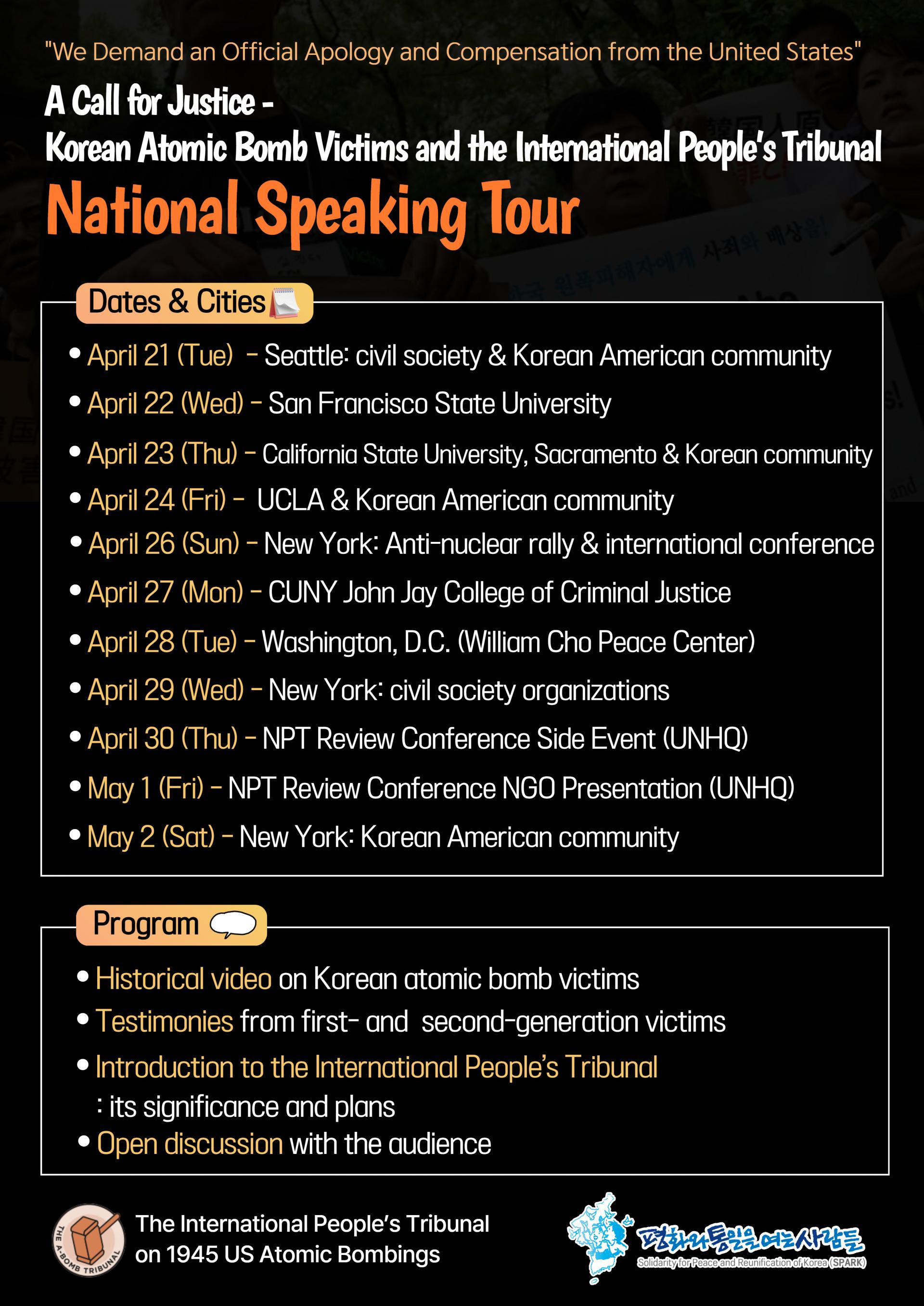
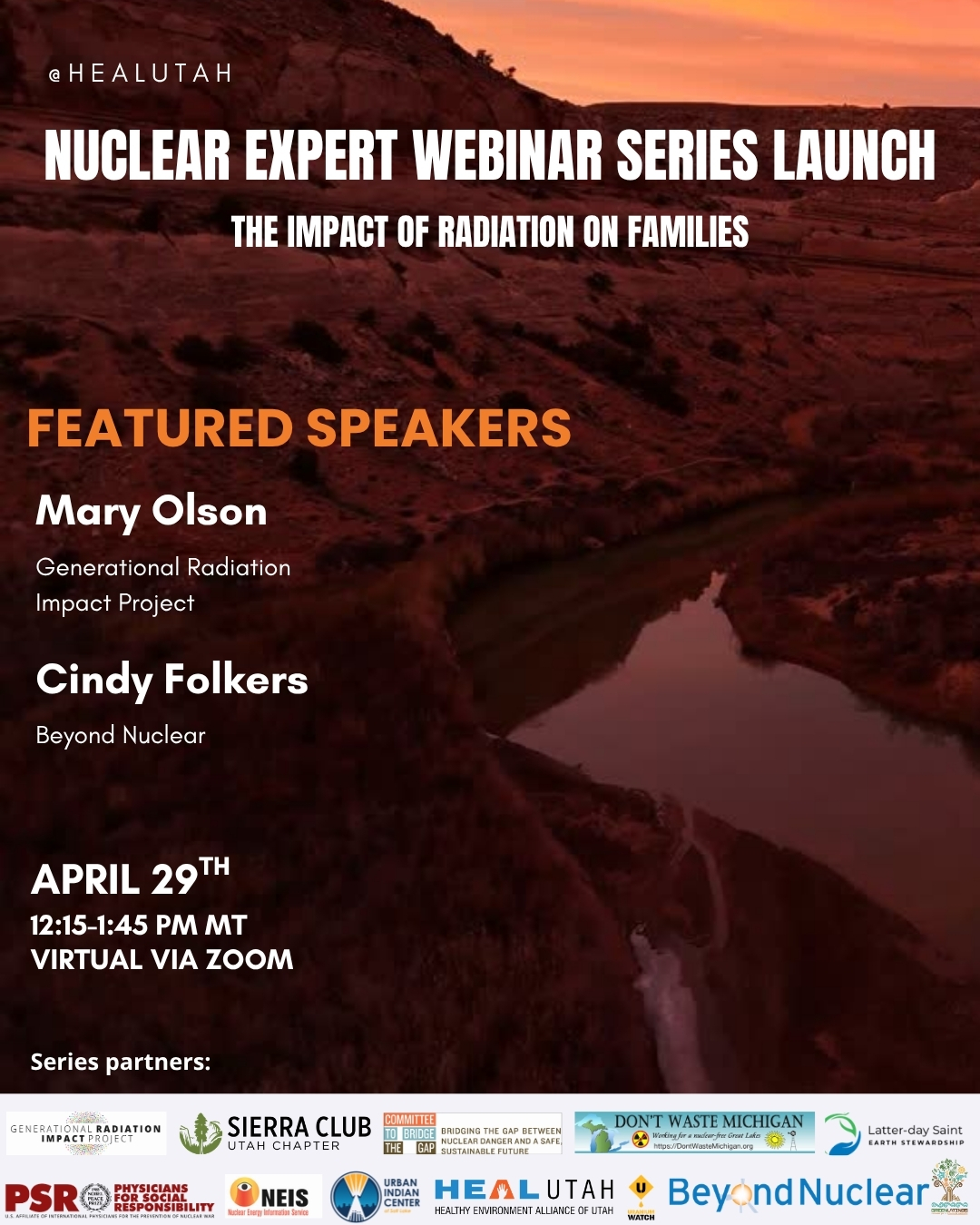
29 April – Nuclear Expert Webinar #1 – Radiation Impacts on Families with Mary Olson and Cindy Folkers
- 12:15 PM MT – 1:45 PM MT
- Location: Virtual – REGISTER TODAY

4 May -West Suburban Peace Coalition to discuss Iran war at May Educational Forum
Monday, May 4, 7:00 – 8:00 PM Central Standard Time
Title: : How Trump’s Narrative Tries to Shape the Reality of the War on Iran.
Contact Walt Zlotow, zlotow@hotmail.com 630 442 3045 for further information
14 May – online event From Bombs to Data Centres: the Face of Nuclear Colonialism

Pine Ridge Uranium is the real threat, not Tehran- Tell Burgum: Stop the Extraction.
Chernobyl: The Lost Tapes – A good documentary on Chernobyl on SBS available On Demand for the next 3 weeks– https://www.sbs.com.au/ondemand/tv-program/chernobyl-the-lost-tapes/2352741955560
To see nuclear-related stories in greater depth and intensity – go to https://nuclearinformation.wordpress.com
-
Archives
- April 2026 (300)
- March 2026 (251)
- February 2026 (268)
- January 2026 (308)
- December 2025 (358)
- November 2025 (359)
- October 2025 (376)
- September 2025 (257)
- August 2025 (319)
- July 2025 (230)
- June 2025 (348)
- May 2025 (261)
-
Categories
- 1
- 1 NUCLEAR ISSUES
- business and costs
- climate change
- culture and arts
- ENERGY
- environment
- health
- history
- indigenous issues
- Legal
- marketing of nuclear
- media
- opposition to nuclear
- PERSONAL STORIES
- politics
- politics international
- Religion and ethics
- safety
- secrets,lies and civil liberties
- spinbuster
- technology
- Uranium
- wastes
- weapons and war
- Women
- 2 WORLD
- ACTION
- AFRICA
- Atrocities
- AUSTRALIA
- Christina's notes
- Christina's themes
- culture and arts
- Events
- Fuk 2022
- Fuk 2023
- Fukushima 2017
- Fukushima 2018
- fukushima 2019
- Fukushima 2020
- Fukushima 2021
- general
- global warming
- Humour (God we need it)
- Nuclear
- RARE EARTHS
- Reference
- resources – print
- Resources -audiovicual
- Weekly Newsletter
- World
- World Nuclear
- YouTube
-
RSS
Entries RSS
Comments RSS
 nuclear-news