Rocket Lab: Helping the US wage endless wars from space

https://thedailyblog.co.nz/2022/10/25/rocket-lab-helping-the-us-wage-endless-wars-from-space/By John Minto, October 25, 2022
It’s clear local mana whenua were misled by Rocket Lab founder Peter Beck when iwi land at Mahia Peninsula was leased to launch satellites into space.
At the time Peter Beck was clear Rocket Lab would be used for civilian purposes only and would not take up military contracts, despite this being a particularly lucrative path to take.
Fast forward a few years and we find Beck has abandoned any principles he may have had and his company is now majority owned by the US military and is launching satellites for US military purposes.
The government has to sign off on each launch to make sure it is in line with what’s acceptable to this country but it’s clearly a rubber stamp process conducted by Stuart Nash.
Any assurances from Peter Beck or Economic and Regional Development Minister Stuart Nash, who signs off on the launches for the government, that Rocket Lab’s work is for the betterment of mankind are not credible.
Peter Beck sets up straw man arguments saying claims of Rocket Lab weaponizing space are “misinformation” and the company would “not deal in weapons”. “We’re certainly not going to launch weapons or anything that damages the environment or goes and hurts people,” he told Newshub last year.
What nonsense. These are “straw-man” arguments. No-one has claimed the rockets contain weapons but what is absolutely clear is that the US military launches rockets for military purposes and this is what is happening at Mahia.
The NZ Herald reported last year on the capabilities of “Gunsmoke-J satellites”, which have been launched from Mahia for the US military, saying:
The other is the “Gunsmoke-J” satellite being launched for the US Army’s Space and Missile Defence Command (SMDC).
Gunsmoke-J is a prototype for a possible series of nano-satellites that will collect targeting data “in direct support of Army combat operations” according to a US Army fact sheet and a US Department of Defence budget document.
Green MP and party spokesperson for security and intelligence, Teanau Tuiono, is right to speak out:
“Weaponising space is not in our national interest and goes against our international commitments to ensuring peace in space,”
“The government should put in place clear rules that stop our whenua being used to launch rockets on behalf of foreign militaries”
“We should not be a launching pad for satellites for America’s military and intelligence agencies,” Green Party security and intelligence spokesman Teanau Tuiono said.
Rocket Lab is donkey deep with US strategies for “full spectrum dominance of the planet – including space. In doing so Beck and the government have made Mahia a target for conventional or even tactical nuclear weapons if hostilities break out between the US and another world power.
It’s ironic that the government provided start-up funds for Beck to get Rocket Lab off the ground only for Aotearoa New Zealand to find the company has put us to bed with a foreign military and made us target for conventional or nuclear attack.
Mana whenua in Mahia are right to be concerned – and so should the rest of us.
The government is “consulting” at the moment on these issues in their Space Policy Review.
Make a submission for the peaceful use of space here (Deadline 31 October)
Worthless House Progressives Retract Mild Peace Advocacy Under Pressure From Warmongers
https://caitlinjohnstone.substack.com/p/worthless-house-progressives-retract 26 Oct 22, The Congressional Progressive Caucus has retracted an extremely mild, toothless letter its members had written to President Biden politely asking him to consider adding a little diplomacy into the mix to help end the conflict in Ukraine. The retraction followed a deluge of public outrage against their slight deviation from the official imperial narrative.
If you actually read the original letter signed by House progressives including Alexandria Ocasio-Cortez, Ilhan Omar, Ayanna Pressley, Rashida Tlaib, Jamaal Bowman and Ro Khanna, you will quickly see that it’s as innocuous and anodyne as any statement could possibly be while still containing words. It opens with effusive praise for Biden’s interventionism in Ukraine and condemns the Russian government unequivocally throughout, offering only the humble suggestion that he “pair the military and economic support the United States has provided to Ukraine with a proactive diplomatic push, redoubling efforts to seek a realistic framework for a ceasefire.” Its authors make it abundantly clear that they support making sure such diplomacy is agreeable to Ukraine at every step of the way.
This impotent nothing salad was bizarrely spun by The Washington Post as a call on Biden to “dramatically shift his strategy on the Ukraine war,” despite nothing that could be remotely construed as “dramatic” existing anywhere in the body of the text. The letter received backlash from warmongers in both parties, including from House Speaker Nancy Pelosi. It was personally slammed by Bernie Sanders, the pope of American progressivism. Trolls and warmongers swarmed the social media notifications of every account which posted the letter in an official capacity, mindlessly bleating the words “appeasement” and “Chamberlain” in unison.
In a statement on the retraction of the letter, CPC chair Pramila Jayapal says she accepts responsibility for the publication of the offending act of peacemongering while in the same breath blaming its publication on her staff.
“The letter was drafted several months ago, but unfortunately was released by staff without vetting. As Chair of the Caucus, I accept responsibility for this,” Jayapal said.
“Every war ends with diplomacy, and this one will too after Ukrainian victory,” the statement reads, ignoring mainstream reports that US officials quietly believe Ukraine stands no chance at outright victory in this war. “The letter sent yesterday, although restating that basic principle, has been conflated with GOP opposition to support for the Ukrainians’ just defense of their national sovereignty. As such, it is a distraction at this time and we withdraw the letter.”
Empire critics were quick to highlight the obsequious nature of this retraction.
“For progressives, I didn’t think it could get more pathetic than voting for a disastrous proxy war that the US provoked and prolonged, handing billions to arms makers in the process. In retracting their tepid call for diplomacy and blaming staffers for it, they somehow surpassed it,” tweeted Aaron Maté.
“Certainly speaks to the insanely hawkish atmosphere in Washington that pressured the progressive caucus to withdrawal a totally reasonable, responsible and necessary call for diplomacy in a conflict that risks escalating to nuclear armageddon,” tweeted Rania Khalek.
“Imagine being elected to Congress based on promises of challenging ‘the establishment’ or whatever, then being so petrified of anger from bipartisan DC establishment mavens that you can’t even wait 24 hours before meekly retracting the only mild dissent you’ve expressed,” tweeted Glenn Greenwald.
I don’t know what pressures were the ultimate deciding factor in the CPC’s decision to retract its feeble advocacy for a bit more diplomacy, or how much of that pressure was brought to bear behind the scenes by bigger political monsters in the Beltway swamp, but ultimately it doesn’t matter. The important take-home from this lesson, once again, is that progressive Democrats are worse than worthless at opposing the mechanisms of oligarchy and empire.
In fact if you look at their actions it’s not even really accurate to describe them as “progressive Democrats” as though they are a faction that has meaningful differences with the rest of that party. Aside from the occasional empty soundbyte about healthcare or debt forgiveness, they’re not doing anything to advance progressive agendas which make American lives better, and they’re certainly doing nothing to impede the expansion of the US war machine.
The progressive Democrat is a myth, like the good billionaire or the righteous American war. “The Squad” is nothing more than the social media-savvy branch of the Democratic establishment. The United States has two warmongering oligarchic parties, and a tremendous amount of narrative management goes into manipulating, cajoling and coercing Americans into staying psychologically plugged in to that fraudulent political paradigm.
This comes at the same time the defense minister of Romania was forced to resign for saying peace talks were necessary to achieve peace in Ukraine. It just reveals so much about where we’re at and where we’re headed that the most incendiary and outrageous thing you can say in our society is that we should probably attempt to diplomatically de-escalate hostilities between nuclear superpowers. The fact that the Overton window of acceptable political discourse has already been dragged that far in the direction of warmongering insanity prevents peace from ever having any space to get a word in edgewise.
Nuclear power – a ‘religion’ in France. now turning out to be a curse.
Paris dims the lights as blackouts threaten disaster for Macron. Years of
underinvestment in its aging nuclear fleet risk causing chaos in France
this winter. Xavier Barbaro, chief executive of France’s leading
independent renewables producer Neoen, is concerned about the growing risk
of shortages.
“It’s a possibility and no one would have thought that a
few years or even a few months ago,” he says. “Blackouts were something in
the past. and it can happen again. “We have heard literally for decades
that having nuclear was a chance for the country and in the end, it might
actually be a curse.”
France put all of its eggs in the nuclear basket,
but technical problems are now frequently cutting capacity at its aging
plants. While President Emmanuel Macron has ordered new reactors as part of
a nuclear “renaissance”, decades of inaction are coming back to haunt
the country. Like Liz Truss, Macron’s government has staked its
reputation on his country avoiding blackouts that would undoubtedly have
severe political consequences this winter.
However, industry bosses are
less certain than the President. “We’ve been told for ages that nuclear
power is safe, secure and so constant,” says Adrien Jeantet, director of
energy services at Enercoop, a French utility company using only renewable
energy.
“Now we see that it’s not dependable. We really need it now that
we have gas shortages and all of a sudden it’s not there. Half of the
reactors are shut down.” Barbara Pompili, Macron’s minister in charge
of the energy transition for two years, says nuclear power is almost like a
religion in France.
However, she adds that a widespread belief in its
“magic” has caused underinvestment in renewables that will be needed
for the future. “What I’m worried about is the strategic thinking in the
long run,” she says. “Maybe we were too confident on nuclear power and
we underestimated the importance of renewables. The reason is that too many
people considered that investing in renewables was bad for nuclear power.
“It’s totally crazy. We lost so much time thinking in this way… it’s
very difficult to have a serious rational debate in France on the energy
issue.”
Telegraph 24th Oct 2022
Cocooning the past. Plutonium reactor in Eastern Washington encased in steel to protect the river
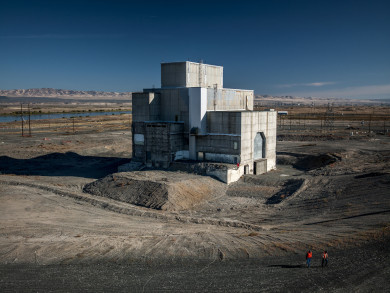
Beginning in 1943, the site was used to produce plutonium for the “Fat Man” bomb that was dropped on Nagasaki, Japan that brought an end to World War II. After a short lull, plutonium production was ramped up in 1947 and continued until 1987 when the last reactor ceased operation. Weapons production processes left solid and liquid radioactive wastes that posed a risk to the local environment including the Columbia River. In 1989, the U. S. Department of Energy (DOE), Environmental Protection Agency (EPA), and Washington State Department of Ecology began clean up of Hanford.
Tri City Herald, BY ANNETTE CARY OCTOBER 26, 2022
A reactor at the Hanford site has been “cocooned” for the first time in a decade. The addition of a new steel enclosure for the 1950s reactor is an “iconic change to the landscape” at the nuclear reservation along the Columbia River and helps protect the river, said John Eschenberg, president of Department of Energy contractor Central Plateau Cleanup Co. Eight of the nine plutonium production reactors that line the Columbia River in Eastern Washington are being put in temporary storage for up to 75 years to allow radiation in their core to decay to lower levels before a permanent solution is attempted.
The newest cocoon, with its straight sides and sloping roof, creates a new look for the Hanford skyline, much different from the other cocooned reactors which retain much of the original shape of the reactors. Completion of the cocoon over the K East Reactor leaves just one more to be cocooned at Hanford.
The K East Reactor was number seven, with its twin, the K West Reactor, not expected to be cocooned until about 2030. The ninth reactor, B Reactor, will remain unsealed and open for tours as part of the Manhattan Project Historical National Park. From World War II through the Cold War Hanford produced about two-thirds of the plutonium for the nation’s nuclear weapons program.
Production stopped with the end of the Cold War, and now the nation is spending for than $2.5 billion a year on environmental cleanup work at the 580-square-mile nuclear reservation by Richland.
For the K East Reactor a new form of temporary storage was used that Hanford officials expect to save money and better protect the reactor as it waits for final disposition in the coming decades.
No decision has been made on the final plan for disposing of Hanford’s defunct reactors, but allowing radiation to decay will provide safer conditions for workers then. In Hanford’s traditional cocooning, reactors are torn down to little more than their radioactive core, any openings are sealed up and the roof is replaced. NEW TYPE OF REACTOR COCOON But for the K East Reactor, a new, free-standing structure 123 feet tall and nearly 154 feet wide was built over the reactor for the first time.
The new method of cocooning should better protect the nearly 80-year-old concrete of the reactor from wind, sand and cycles of freezing and thawing that take a toll on Hanford structures, Eschenberg said. It also should reduce the need for roof maintenance.
Although the new steel enclosure was designed to last 75 years, Eschenberg said final disposition of the reactor is not likely to be done that late. No decision has been made on what final disposition will be.
Every five years Hanford workers will enter the reactor to check on its condition. New lighting installed within the reactor and between the steel cocoon and the original reactor walls will help make that easier as workers check the condition of the concrete, look for any rodents or other animals, and make sure there has not been any intrusion of water.
………………………………………………… DECADES OF CLEANUP BEFORE COCOONING The initial work at the K East Reactor to allow cocooning of the reactor, which operated from 1955 to 1971, started decades ago. The water basins at the K West and K East reactors were used to store uranium fuel irradiated at N Reactor but not processed to remove plutonium at the end of the Cold War.
The fuel was removed from the two basins, each holding 1.2 million gallons of water, in a 10-year project completed in 2004.
But the fuel had decayed after decades underwater, leaving a highly radioactive sludge that was not all contained and shipped to dry storage at Hanford’s T Plant until 2019, after first being consolidated at the K West Reactor.
Water next was drained from the K East Reactor basin, which is work not yet done at the K West Reactor. The dry K East Reactor basin was filled with grout that was then cut into pieces and removed, requiring the site to be backfilled.
A village of support structures had to be demolished, including the reactor’s powerhouse and fuel oil storage. In addition, sediment basins used for reactor cooling water had to be cleaned up.
Tens of thousands of tons of contaminated soil and debris, including underground piping and utilities, were removed, with most of it taken to a huge lined landfill in central Hanford for disposal.
Most of the soil contamination was from chromium, which was used as a corrosion inhibitor in reactor cooling water. Groundwater contaminated with chromium is pumped up, cleaned and returned to the ground before it enters the Columbia River, about 300 yards from the K Reactors. …………………………… more https://www.tri-cityherald.com/news/local/hanford/article267895437.html
Tactical Nuclear Fantasists
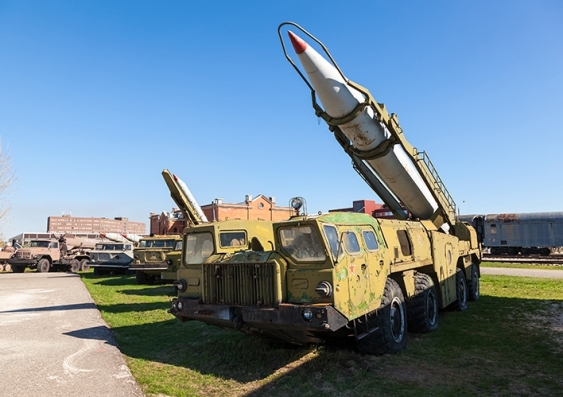
one category of nuclear weapon has continued to mark a grey area, lending a disturbed, even lunatic’s legitimacy to the battlefield deployment of such weapons. The tactical nuclear weapon is deceptively seductive to military planners.
Australian Independent Media, October 27, 2022 by: Dr Binoy Kampmark
Bogeyman politics tends to be flatly unimaginative. The image of the nuclear-mad Russian President, counting his diminishing options, has caught the imagination of press and propaganda outlets across the West. Will Mad Vlad go the distance and deploy a nuclear weapon in Ukraine?
Certainly, his rhetoric suggests the possibility. Vladimir Putin has promised to “make use of all weapon systems available to us” in the event Russia’s territorial integrity is threatened. ………….
The moment the innocents of Hiroshima were incinerated in August 1945, a weapon of mass lethality became a political option, the means to extract concessions and terrify opponents. Even more disturbingly, it also created an incentive on the part of powers to prevent others from getting it, thereby creating an exclusive club equipped with special amenities and privileges.
During a number of teeth-chattering moments of the Cold War, the use of nuclear weapons was contemplated. Historians note Cuba, Berlin and the Middle East. That they were not actually unleashed was a matter of unalloyed dumb luck and faux theory. Over time, this spawned an accepted, if nonsensical literature about the merits of having such lethal means. Precisely because of their potency, such weapons would never be used. Possessing them would be, to use a modern comparison, much like having unconvertible digital currency of huge value, more a matter of impressing your rivals than drawing direct benefit from them.
Having said that, one category of nuclear weapon has continued to mark a grey area, lending a disturbed, even lunatic’s legitimacy to the battlefield deployment of such weapons. The tactical nuclear weapon is deceptively seductive to military planners. Being of lower yield than their strategic, all-killing counterparts, they are seen as, in the words of the Union of Concerned Scientists, “more militarily useful, and less politically objectionable, and thus more likely to be used.” This does little to dampen the awful reality that such weapons can have yields greater than that of the first atomic weapon ever used.
The nature of such weapons is disturbingly nebulous in the military argot. In 2018, James Mattis, as US Secretary of Defense, opined to the House Armed Services Committee that there was no “such thing as a ‘tactical nuclear weapon’. Any nuclear weapon used at any time is a strategic game changer.”
Tactical nuclear weapons can comprise any number of devices with yields ranging from 1 kiloton to 50 kilotons. Alistair Millar, writing for Arms Control Today, mentions a few, including nuclear landmines, nuclear artillery shells, and missile warheads dropped by air or launched by missiles.
The 2018 US Nuclear Posture Review does away with much of the sentiment of the 2010 NPR in stressing the need to improve capabilities against Russia in various areas, including nonstrategic nuclear options. Moscow is specifically blamed for embracing a “limited first use” policy involving low-yield weapons that might “provide coercive advantage in crises and at lower levels of conflict.”……………………..
Ambiguity when it comes to a prospective use of nuclear weapons is considered one of the great flaws of military and political planning. Each party should know what the other proposes to do in certain circumstances, be it in terms of command structure, control and communications. Who has the authority to launch what weapons and when? What are the safeguards to cope with error? ………………….
Opacity is another factor complicating the whole business of how we cope with nonstrategic nuclear weapons. Numbers regarding the world’s tactical nuclear stockpiles remain sketchy………..
Paradoxically, even as such measures as the Treaty on the Prohibition of Nuclear Weapons gather greater popularity, the old members of the nuclear club continue to make mischief, modernising and adjusting their arsenals with little intention of ever abolishing them. The sheer allure of such weapons is unlikely to dissipate till their political dividends diminish. In the Ukraine War, such dividends abound. https://theaimn.com/tactical-nuclear-fantasists/
Kucinich Says Call for Diplomacy to end Ukraine-Russia War Must be Heard; Silencing of Congressional Progressive Caucus Casts Democrats as the “War Party”
https://worldbeyondwar.org/kucinich-says-call-for-diplomacy-to-end-ukraine-russia-war-must-be-heard-silencing-of-congressional-progressive-caucus-casts-dems-as-the-war-party/By Dennis Kucinich, World BEYOND War, October 26, 2022
CLEVELAND (Oct. 26) Weds – – Dennis J. Kucinich, former Congressman and former Democratic Presidential candidate today called upon Congressional Democrats to “rethink their opposition to diplomacy” as a means to end the war between Russia and Ukraine.
During his eight terms in congress, Kucinich led Democratic members’ efforts against the US-sponsored wars in Afghanistan, Iraq, Libya, Syria and worked to end the war in the Balkans and to divert war against Iran.
“War is ultimately a failure of political leadership. Diplomacy is difficult. It requires intelligence, skill and patience. The only way wars end is at the negotiating table,” Kucinich said.
Kucinich spoke in response to the recent retraction by the Congressional Progressive Caucus of the letter, signed by 30 Members of Congress, which called upon the Administration to aggressively seek diplomacy to end the most recent conflict which began with Russia’s invasion on February 24 of this year and which has resulted in over 15,000 deaths of Ukrainian civilians, and the deaths of tens of thousands of soldiers from both Ukraine and Russia.
“The Caucus’ letter, far from being sympathetic to Russia, sought to end the suffering of the Ukrainian people, while preserving their independence. The letter revealed an understanding of the risks of wider war, even a nuclear war, unless diplomacy is pursued,” Kucinich said.
Kucinich reminded Members of Congress that President Jimmy Carter used US diplomacy to achieve the Camp David Accords on September 17, 1978, with Israeli Prime Minister Menachem Begin and Egyptian President Anwar Sadat. US diplomacy brought about the Dayton Accords of November 21, 1995, which ended war in the Balkans. US Senator George Mitchell of Maine negotiated with multiple parties to bring about the Good Friday Agreement on April 10, 1998, which ended 30 years of deadly conflict in Northern Ireland, known as “The Troubles.”
“Remember the words from John F. Kennedy’s January 20, 1961, Inaugural Address: ‘Let us never negotiate out of fear. Let us never fear to negotiate.’ It was that type of thinking which produced negotiations between the US and the Soviet Union which averted a nuclear war during the Cuban Missile Crisis, October 16, 1962 – October 29, 1962.
Kucinich said that the obvious strong-arming and silencing of Caucus members who want a negotiated settlement in Ukraine casts the Democratic Party as a “Party of War,” he said. “It’s time for the Party to rethink Democratic opposition to diplomacy.”
“Democrats must not make support for the war, and its expansion, a test of party loyalty. We owe it to the people of Ukraine, Russia, the United States and the world to help negotiate a settlement to end this war which has already had severe global consequences, created energy and food scarcity and propelled sharp price increases,” he said.
US aid to Ukraine in 2022 currently stands in excess of $60 billion.
Russian delegation at UN calls on USA to join initiative to renounce weapons in space

Foreign Ministry Spokeswoman Maria Zakharova’s comment on the US initiative in the UN General Assembly First Committee
The other day, the US delegation submitted to the UN General Assembly First Committee an aide-memoire on proposed UN General Assembly resolution on destructive direct-ascent anti-satellite missile testing. We analysed the text to discover that our apprehensions concerning this US initiative were valid.
As before, we regard the moratorium on testing the above type of anti-satellite weapon (ASW) announced by the White House in April as a purely declarative move. The UN General Assembly statements and draft resolutions are clearly not enough to prevent an arms race in space (PARIS), all the more so for a country that has had experience – at least since 2008 – destroying space objects with ASW.
The United States remains bashfully silent about the most important thing: are they willing to permanently rule out the combat use of this type of weapon? The resolution says nothing about it. There are no commitments regarding the development and production of such systems, or the prospect of ever destroying the Pentagon’s existing anti-satellite capabilities.
Moreover, the possibility of deploying ASW means on the US reusable unmanned space shuttle X-37B, which is capable of staying in orbit for a long time, performing manoeuvres and carrying a payload, cannot be ruled out. By the way, our multiple requests to the United States to clarify the X-37B platform’s goals and objectives have so far remained unanswered.
Military dominance and superiority in outer space being set as clear goals in US doctrinal documents, their view of space as an arena of confrontation and their plans for achieving these goals are quite telling if one wants to understand Washington’s genuine motives. It is no coincidence that the US delegation at the Geneva Conference on Disarmament is doing its utmost to hinder the start of talks on a multilateral instrument which contains reliable international legal guarantees against deploying weapons of any kind in outer space and the renunciation of the use of force or the threat of force against space objects. The Americans are using every pretext to avoid working on the Russian-Chinese draft treaty designed to fulfill PARIS goals………………….
Washington can prove it has serious intentions if it revises its destructive stance and the US delegation that is participating in the Conference on Disarmament joins the efforts to start talks as soon as possible on a legally binding instrument with guarantees of non-deployment of weapons in space, non-use of force or threat of force against space objects.
Specifically, the approach promoted by Russia involves the following commitments:
– not to use space objects as a means of destroying any targets on Earth, in the air or outer space;
– not to create, test or deploy weapons in space to perform any tasks, including for anti-missile defence, anti-satellite activity, or use against targets on Earth or in the air, and to eliminate such systems that the states already possess;
– not to create, test, deploy or use space weapons for anti-missile defence, anti-satellite activity, or use against targets on Earth or in the air;
– not to destroy, damage, or disrupt the normal functioning and not to change the flight paths of space objects owned by other states;
– not to assist or encourage other states, groups of states, international, intergovernmental, or any non-governmental organisations, including non-governmental legal entities that were established, registered or located on the territory under their jurisdiction and/or control, to participate in the above activities.
In addition, the accession of the United States and its allies to the international initiative/political commitment not to be the first to place weapons of any kind in outer space would be a really important confidence-building measure. We are once again calling on Washington to follow the example of more than 30 UN member states and join this initiative, as well as to support the UNGA draft resolution on that matter.
We are ready to substantively and professionally discuss the US initiative in this context of multilateral efforts to arrive at a comprehensive solution to PARIS issues. https://mid.ru/en/foreign_policy/news/1835061/
US, Japan, S Korea vow response if N Korea tests nuclear bomb
US says full military capabilities will be used, including nuclear, to protect its allies South Korea and Japan.
An “unparalleled” scale of response would be warranted if North Korea conducts a seventh test of a nuclear weapon, the United States, Japan and South Korea have warned.
The warning was issued on Wednesday amid concerns by the US and its regional allies that North Korea could be poised to resume nuclear bomb testing for the first time since 2017.
“We agreed that an unparalleled scale of response would be necessary if North Korea pushes ahead with a seventh nuclear test,” South Korean first vice foreign minister Cho Hyun-dong told a news conference in Tokyo.
Cho made his comments alongside Japan’s vice foreign minister Takeo Mori and US Deputy Secretary of State Wendy Sherman.
North Korea has been carrying out weapons tests at an unprecedented pace this year, firing more than two dozen short and medium-range ballistic missiles in recent weeks, including a missile that over-flew Japan.
We urge (North Korea) to refrain from further provocations,” Sherman said, calling the North’s actions “reckless” and deeply destabilising for the region.
Sherman also said that the US will use its full military capabilities, “including nuclear, conventional and missile defence”, to protect its allies Japan and South Korea.
North Korea needs to understand that the US commitment to the security of South Korea and Japan is “iron clad”, she said.
“And we will use the full range of US defence capabilities to defend our allies, including nuclear, conventional and missile defence capabilities,” she said.
US State Department spokesman Ned Price said in a statement that Sherman also reiterated that the US was continuing to “seek serious and sustained dialogue with the DPRK” (Democratic People’s Republic of Korea) – the official name for North Korea.
Cho, during his talks with Sherman, raised concern that a new North Korean nuclear weapons policy adopted in September increases the possibility of its arbitrary use of nuclear weapons.
“This is creating serious tension on the Korean peninsula,” Cho said.
In September, the USS Ronald Reagan and accompanying ships conducted joint military exercises with South Korean forces in response to a North Korean ballistic missile test in what was their first joint military training involving a US aircraft carrier since 2017.
Angered by South Korea’s military activities, Pyongyang last week fired hundreds of artillery shells off its coasts in what it called a grave warning to its neighbour to the south.
Sherman met earlier on Tuesday with Japan’s Mori and reaffirmed the further strengthening of the Japan-US alliance and other shared goals, including the complete denuclearisation of North Korea and their joint response to China’s increasingly assertive actions in the region.
Japanese defence minister Yasukazu Hamada recently said that North Korea is believed to have achieved a miniaturisation of nuclear warheads while significantly advancing its missile capabilities by diversifying its launch technologies, making interceptions more difficult.
Japan has joined South Korea in also warning of a possible nuclear test by North Korea in the near future.
NATO primes 20 prospective new members for global strike force — Anti-bellum
NATOSupreme Headquarters Allied Powers EuropeOctober 25, 2022 SHAPE’s Partnerships Directorate hosts annual conference with over 20 Partner Nations The Operational Capability Concept Evaluation and Feedback team, (OCCE & F) as part of SHAPE’s Partnerships Directorate, recently hosted its annual conference in Mons, Belgium with over 20 Partner Nations in attendance. *** “This conference and the […]
NATO primes 20 prospective new members for global strike force — Anti-bellum
Atmospheric levels of all three greenhouse gases hit record high
Atmospheric levels of all three greenhouse gases hit record high
Scientists warn world ‘is heading in wrong direction’ amid rise in nitrous oxide, carbon dioxide and methane
Return to Fukushima: Decontaminated town reopens to residents, but is anybody living there?

October 24, 2022
If you ever wanted to live in a post-apocalyptic zombie film, now’s your chance.
Back in 2020, our Japanese-language reporter Tasuku Egawa visited two towns in Fukushima Prefecture that were affected by the accident at Fukushima Daiichi Nuclear Power Plant, which occurred at the time of the March 2011 Great East Japan Earthquake.
▼ Tasuku visited Futaba and Tomioka, which are five kilometres (three miles) and 11 kilometres, respectively, from the nuclear power plant.

Being within the 20-kilometre exclusion zone, both towns were evacuated after the accident, turning them into ghost towns for two years. In 2013, the government opened some areas of the towns for daytime access only, with other areas remaining closed off due to elevated radiation levels, right up to 2020 when Tasuku visited.
At the time of Tasuku’s previous visit, new decontaminated areas around both stations had opened up, with old blockades being removed as a sign of the land becoming habitable once again.
▼ The decontaminated Prefectural Route 165 and National Route 6 outside Tomioka’s Yonomori Station, as it looked in March 2020.

The west exit side of the station had returned to normal while the east side remained blocked. However, side streets on both sides remained cordoned off from the public, with permission required for anyone entering the other side of the blockade, including journalists like Tasuku.

Like all visitors, Tasuku was required to wear special protective wear due to the high radiation levels.

Back in 2020, nothing but the main roads and station buildings could be entered, and the only sign of life in the area was that of security guards at empty intersections and reconstruction-related vehicles and workers.

Both towns had their work cut out for them in terms of cleanup and redevelopment, especially as the local governments planned to repopulate the areas with thousands of residents in the next seven years.
Tasuku had high hopes they would achieve this goal, so when resettlement of the towns began in earnest earlier this year, he made a return trip to Tomioka and Yonomori Station to see what developments had taken place in the two years since he last visited.
So let’s take a look at his collection of photos chronicling the difference between 2020 and now, starting with Prefectural Route 165 and National Route 6 mentioned earlier.

Now, the barricades have totally disappeared, and the intersection looks like any other, complete with a cluster of vending machines on one street corner.

Continuing straight down this road, we come to a branch of the Yamazaki convenience store chain, located on the ground floor of a residential building.

Today, the barricades have gone, but the shutters remain closed and the curtains drawn, making it look like a scary house in a ghost town.

Heading south down National Route 6, Tasuku recalled a brightly coloured apartment block he’d photographed on his last visit.

Sure enough, the building was still there, and though the weeds and barricades had been cleared, the road, and the blinds on the store window on the left, looked a little worse for wear.

The more Tasuku walked around, the more he felt as if he were walking through a post-apocalyptic world, like the character of Jim in the British zombie flick 28 Days Later. Only this was no film set, it was a real-world town that once housed around 4,000 people.

With curtains drawn on the windows of so many buildings he walked past, the place looked like it was inhabited…but it was eerily quiet, and deep down inside, Tasuku knew there was nobody behind those curtains, as these residences had been abandoned as a matter of emergency eleven years ago.
▼ Still he kept up hope that he would see signs of life somewhere, other than this road where he spotted a wild boar and a plump male pheasant.

After walking for a while, Tasuku finally breathed a sigh of relief when he came across this new apartment building, which was advertising for tenants, where he saw fresh laundry hanging on a balcony, suggesting that someone had already moved in.

Close by, there was a demountable building which looked to be the prefabricated office of a construction company, and it too appeared to be inhabited by people, likely here on temporary assignment for reconstruction-related work.

While the two main roads had been cleared and were open to traffic, Tasuku came across some salient reminders that the entire town wasn’t yet back to normal, with other areas like the local park blocked off as a restricted location.

Yonomoritsutsumi Park , as it’s known, is closed for good reason — according to the dosimeter on the other side of the fence, radiation levels here are 0.413 microSieverts per hour. The Ministry of the Environment’s requirements for decontaminated areas is 0.23 microSieverts per hour.

The high radiation levels in the park would put the public at risk of health problems, which is a great shame, seeing as it looks like it would’ve been a nice place to unwind and relax before the disaster.

It’s a vast space, though, which would make decontamination work difficult, and looking at the expanse from a nearby hill shows it’s become wild and overgrown, with what once must’ve been a lake (marked in blue below) now covered in grass and weeds.

Before coming to the town, Tasuku had been hoping to meet up with the owner of a beauty salon who used to live here but was moved to nearby Koriyama after the earthquake. She had joined Tasuku on his previous visit to Yonomori and once she’d heard the evacuation orders were being lifted this year, she said she was looking forward to moving back here.
However, the government ban on living in the area is still in effect over a large portion of the town, with only one designated zone on one side of the station open to residents from April this year. With only around a dozen or so people applying to live in the town so far, it would be a long while yet before Tasuku’s friend would be able to re-open her hair salon here.
▼ The former site of the hair salon is now an empty lot.

It’s hard to live in a ghost town, let alone run a business there, so the government hopes to make a larger area inhabitable by spring next year, in an effort to entice more residents to support local businesses.
Business owners will need a lot of support from the government, though, as a lot of them will be starting from scratch. This York-Benimaru supermarket, for instance, has since been totally demolished in the two years since 2020, and is now an empty parking lot.


If he’s being honest, the town hadn’t progressed as far as Tasuku had hoped in the past two years. Despite reopening part of the town, the place still had a real ghost-town feel to it, and the waiting room at the unstaffed station was particularly eerie, with nothing inside but a bathroom and chairs.

By comparison, the waiting room at Futaba Station, where Tasuku visited next, was a lot more inviting, with a sense of vibrancy and life to it.
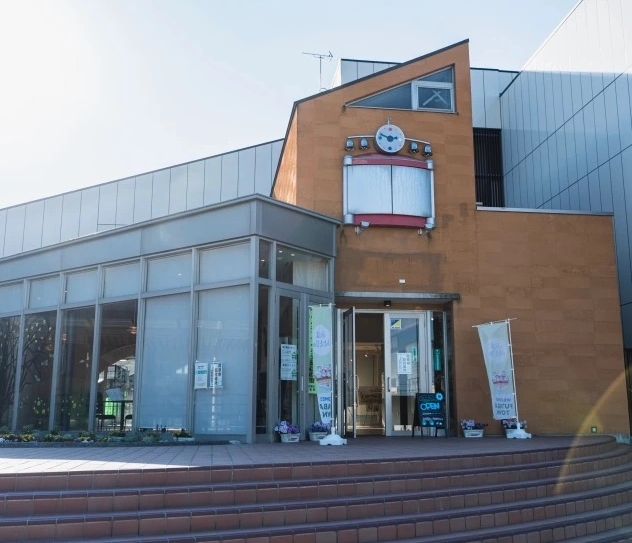
Yonomori is famous for its cherry blossom trees, which line one particularly beautiful street, and while there were fears the trees would die out in the decade that humans were prohibited access to the area, the street was finally opened to visitors this year, who were able to enjoy them for the first time since 2011.
▼ The local “standard tree” by which the Meteorological Agency declares the official start of the cherry blossom season, is still alive and well.
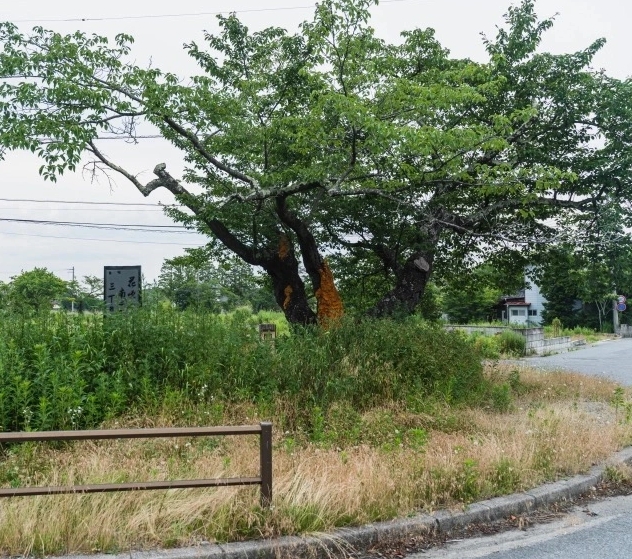
At the moment, Yonomori is mostly home to ruins, wild boars and fat pheasants, which makes it less than appealing to potential residents. However, with the cherry blossoms still blooming, there’s hopes that the the area will soon bloom too.
Now with the station open and trains operating, it’s the start the town needs to get back on its feet, and we look forward to visiting in another two years’ time, when hopefully Tasuku’s friend’s hair salon will be open, along with other blossoming businesses.
Fukushima Daiichi Nuclear Power Plant, method to remove debris by submerging the buildings in water: Symbolic of project difficulties after repeated changes, with no prospects for feasibility
October 24, 2022
In order to remove melted nuclear fuel (debris), which is considered the most difficult part of the restoration work at TEPCO’s Fukushima Daiichi Nuclear Power Plant, a method has emerged to submerge the entire reactor building, including its basement, under water. This would require unprecedented large-scale construction work, and there are doubts about its feasibility. The fact that the debris removal plan has been repeatedly changed and a proposal that seems to be grasping at a cloud has emerged is symbolic of the difficulties involved. (The fact that a proposal that seems to be grasping at a cloud has emerged is symbolic of the difficulties that lie ahead.)
Even the experts are not confident.
The first of its kind in the world,” “Technically quite difficult,”
◆”Not confident” even experts are bearish

At a press conference held on November 11 to explain the proposal that includes a new construction method for the Unit 3 reactor, Mr. Mitsuroku Ikegami, executive director of the Nuclear Damage Liability and Decommissioning Support Organization, who is in charge of providing technical support to help bring about a restoration from the accident, repeated his bearish comments.
The new construction method is based on the “hull construction method” used for tanker hull construction. The new method is characterized by enclosing the building with a structure that is resistant to water pressure, and ETIC is considering digging a tunnel under the building and enclosing the entire building with a structure consisting of a series of square rooms made of steel.
If this is realized, water filled with the building will be used to shield it from radiation, thereby increasing the safety of the work. On the other hand, submerging the building in water is expected to generate about 150,000 tons of highly contaminated water that has come into contact with debris. This is equivalent to about 150 tanks storing treated water on the site, and the risk of a leakage accident is immeasurable.
◆”Flooding” first, stop once, flood again.
At the beginning of the accident in 2011, the government and TEPCO planned to use the “flooding method” to fill the containment vessel with water and remove debris underwater. However, the containment vessels of Units 1 through 3, where debris was located, were all damaged, and even if water was filled, it would leak out of the vessels. The high radiation dose makes it inaccessible to humans, and it is still difficult to determine which parts of the containment vessels are damaged.

In 2005, they switched to the “in-air” method of removing debris without water, and are aiming to begin trial removal of debris from Unit 2 in the latter half of FY2011. However, since the method prioritizes easy access to the debris and uses a robot arm in a confined space, only about 1 gram of debris can be removed in a single operation. It is estimated that there is a total of 880 tons of debris in the three reactors, making it almost impossible to complete the removal using this method.
Therefore, JAEA has switched to a method to remove a large amount of debris from the Unit 3 reactor. The work is expected to involve the scattering of enormous amounts of radioactive materials, such as by cutting the debris into chunks, and if the debris is not shielded by water, it will be very dangerous. Since the containment vessel cannot be filled with water, the idea of submerging the entire building outside of it has emerged. In other words, it is a flooding method that has been reshaped on a large scale.
◆Even after 11 years, it remains unrealistic.
Debris from the Unit 1 reactor is believed to be scattered over a wide area of the containment vessel, and there is no way to remove the debris. Eleven and a half years after the accident, debris removal remains unrealistic.
A spokesperson for TEPCO has refused to go into the feasibility of the proposed new method, saying, “It is still in the idea stage. Even the OIST’s proposal suggests a bleak outlook, concluding with the following words: “If the criteria are not met, we will be forced to take out the debris. If the criteria are not met, we will have to start over from the identification of issues.
https://www.tokyo-np.co.jp/article/209821
The mishandling of scientifically flawed articles about radiation exposure, retracted for ethical reasons, impedes understanding of the scientific issues pointed out by Letters to the Editor

October 23, 2022
Tanimoto Y, Hamaoka Y, Kageura K, Kurokawa S, Makino J, Oshikawa M. The mishandling of scientifically flawed articles about radiation exposure, retracted for ethical reasons, impedes understanding of the scientific issues pointed out by Letters to the Editor. JoSPI. Published online October 23, 2022. doi:10.35122/001c.38474
Abstract
We discuss the editorial handling of two papers that were published in and then retracted from the Journal of Radiological Protection (JRP).1,2 The papers, which dealt with radiation exposure in Date City, were retracted because “ethically inappropriate data were used.”3,4 Before retraction, four Letters to the Editor pointing out scientific issues in the papers had been submitted to JRP. The Letters were all accepted or provisionally accepted through peer review. Nevertheless, JRP later refused to publish them. We examine the handling by JRP of the Letters, and show that it left the reader unapprised of a) the extent of the issues in the papers, which went far beyond the use of unconsented data, and b) the problems in the way the journal handled the matter. By its actions in this case, JRP has enabled unscientific, unfounded and erroneous claims to remain unacknowledged. We propose some countermeasures to prevent such inappropriate actions by academic journals in future.
Takahama Unit 4 postpones resumption of operation due to rising equipment temperatures

October 21, 2022
On October 21, KEPCO announced that it had postponed the restart of the Takahama Unit 4 reactor, which is currently shut down for routine inspections, due to a temperature rise in one of the devices inside the reactor containment vessel that is activated when there is a problem with the primary cooling system. The reactor startup scheduled for the 21st will be postponed due to a temperature rise in one of the devices that operates in the reactor containment vessel in the event of a primary cooling system problem.
After the reactor start-up on the 21st, the plant was scheduled to resume power delivery on the 24th and commercial operation on November 18. KEPCO was planning to resume commercial operation on November 18. KEPCO is investigating the impact on the process and the cause of the temperature rise.
According to KEPCO, the temperature rose because of one of the safety devices used to reduce the pressure that rose due to a problem in the primary cooling system. The temperature was 4.2 degrees Celsius at around 3:30 p.m. on March 21, but it rose to 77 degrees Celsius at around 4:35 p.m., triggering an alarm.
https://www.tokyo-np.co.jp/article/209502?fbclid=IwAR3dktnvsjEKFDfgo3U1N_aguXV53mX5X7AURPw_J7_XArDcUkMPgjIh-dk
Magnitude 5 earthquake jolts Fukushima; ‘no issues’ at nearby nuclear plants
‘No issues’ at nearby nuclear plants…. So they claim as usual, everything is always fine in Fukushima Daiichi….

Oct 21, 2022
A strong earthquake with an estimated magnitude of 5 jolted northeastern Japan on Friday afternoon.
The quake, which was revised downward from magnitude 5.1, occurred at a depth of about 30 kilometers off the coast of Fukushima Prefecture around 3:19 p.m., according to the Meteorological Agency.
The quake measured a lower 5 on Japan’s seismic intensity scale to 7 in the town of Naraha and 4 in the towns of Hirono, Tomioka, Okuma and Futaba.
According to the Secretariat of the Nuclear Regulation Authority, no issues have been reported at Tokyo Electric Power Company Holdings’s Fukushima No. 1 and No. 2 nuclear plants in the prefecture.
The No. 2 plant straddles Naraha and Tomioka, while the No. 1 plant, the site of the 2011 meltdowns following the Great East Japan Earthquake and tsunami, straddles Okuma and Futaba.
In a location close to the epicenter of Friday’s quake, a 7.4-magnitude temblor occurred at the depth of about 12 kilometers on Nov. 22, 2016, causing tsunami that reached up to 144 centimeters high at Sendai Port in the neighboring prefecture of Miyagi.
Unlike the 2016 temblor, which also registered up to lower 5 on the Japanese scale, Friday’s quake did not cause tsunami because it occurred at a greater depth and was smaller in scale.
https://www.japantimes.co.jp/news/2022/10/21/national/earthquake-jolts-fukushima/
1 This Month
26 April – Chernobyl: Inside the Meltdown airs on National Geographic on Sunday 26th April from 4pm
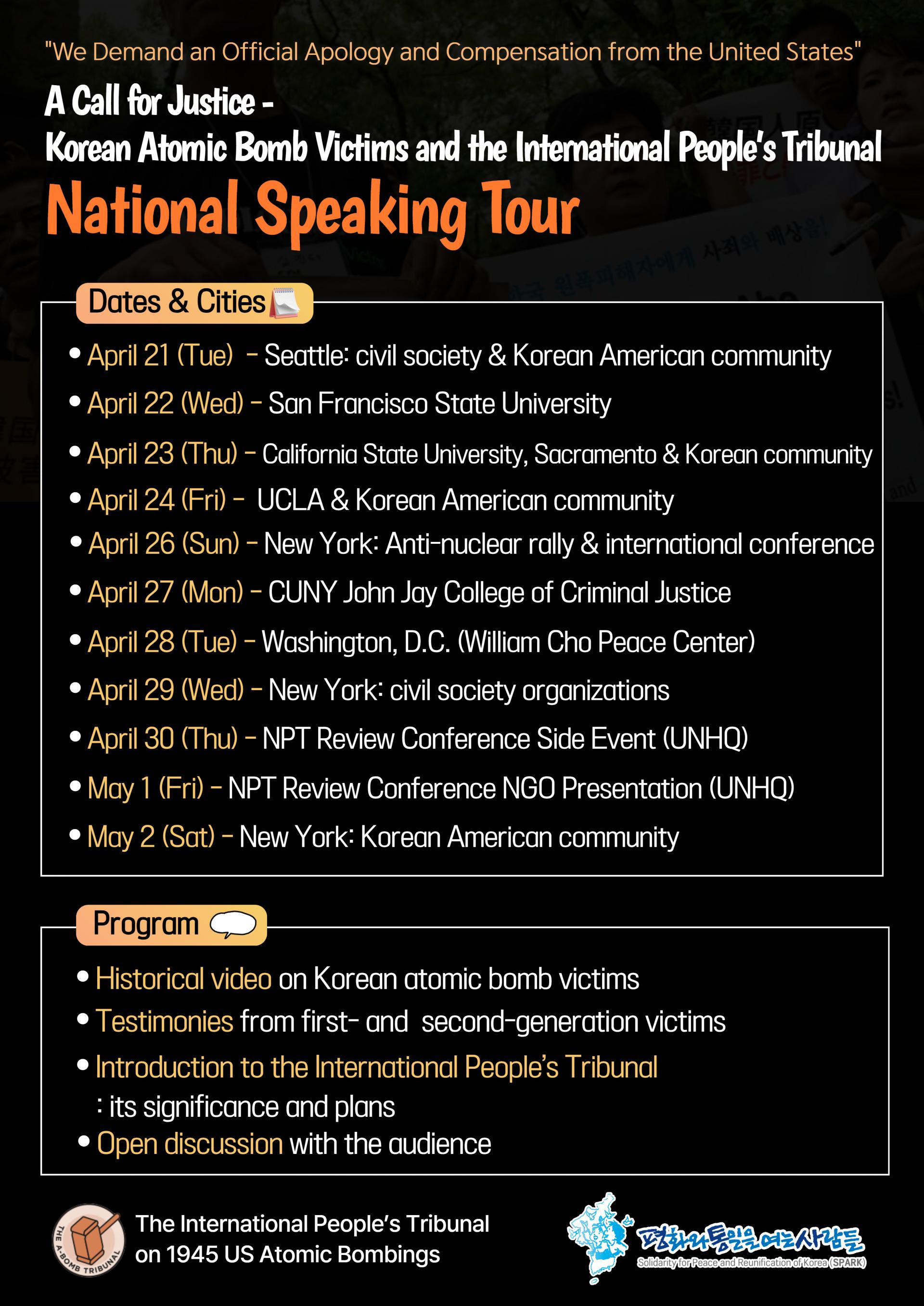
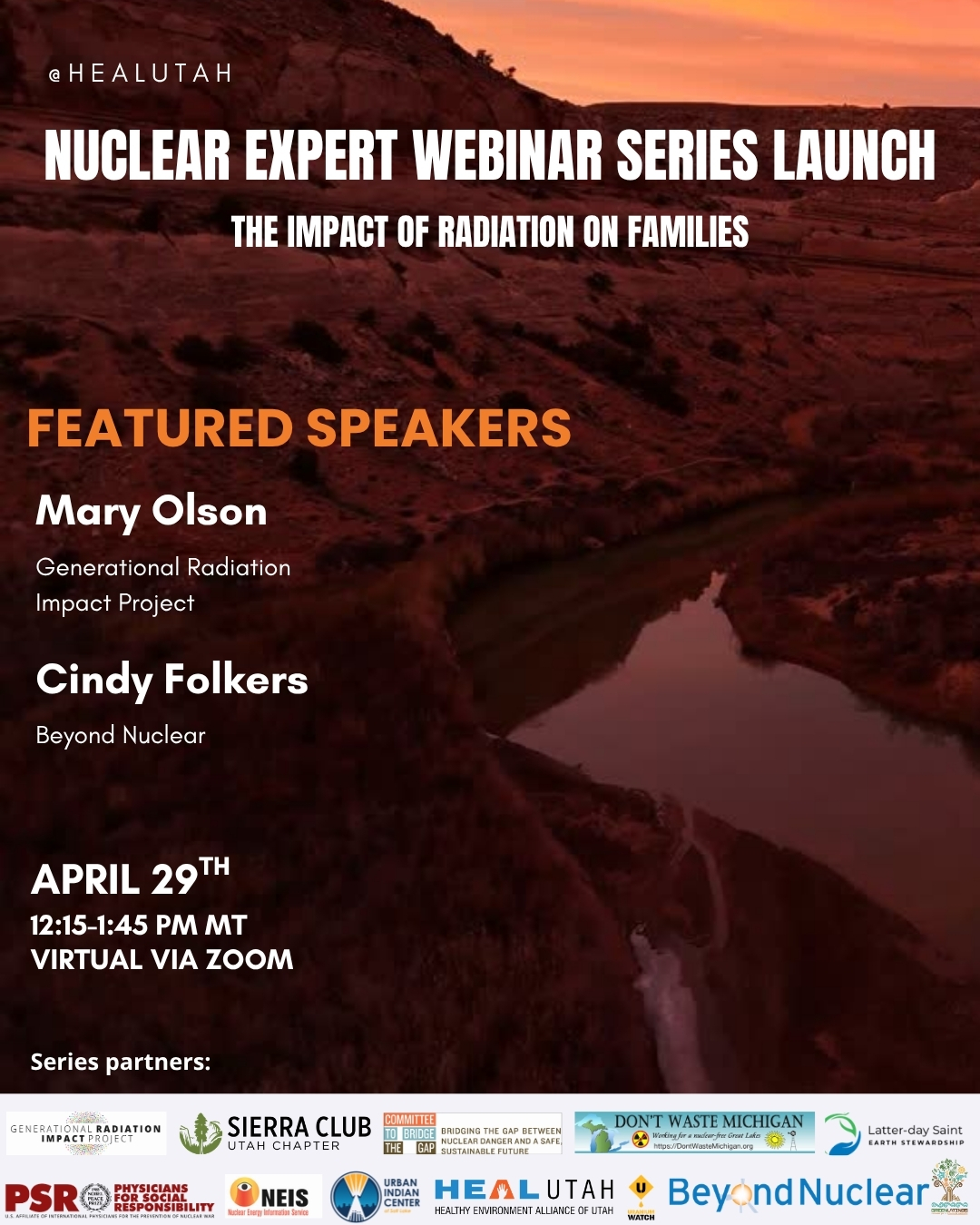
29 April – Nuclear Expert Webinar #1 – Radiation Impacts on Families with Mary Olson and Cindy Folkers
- 12:15 PM MT – 1:45 PM MT
- Location: Virtual – REGISTER TODAY

4 May -West Suburban Peace Coalition to discuss Iran war at May Educational Forum
Monday, May 4, 7:00 – 8:00 PM Central Standard Time
Title: : How Trump’s Narrative Tries to Shape the Reality of the War on Iran.
Contact Walt Zlotow, zlotow@hotmail.com 630 442 3045 for further information
14 May – online event From Bombs to Data Centres: the Face of Nuclear Colonialism

Pine Ridge Uranium is the real threat, not Tehran- Tell Burgum: Stop the Extraction.
Chernobyl: The Lost Tapes – A good documentary on Chernobyl on SBS available On Demand for the next 3 weeks– https://www.sbs.com.au/ondemand/tv-program/chernobyl-the-lost-tapes/2352741955560
To see nuclear-related stories in greater depth and intensity – go to https://nuclearinformation.wordpress.com
-
Archives
- April 2026 (300)
- March 2026 (251)
- February 2026 (268)
- January 2026 (308)
- December 2025 (358)
- November 2025 (359)
- October 2025 (376)
- September 2025 (257)
- August 2025 (319)
- July 2025 (230)
- June 2025 (348)
- May 2025 (261)
-
Categories
- 1
- 1 NUCLEAR ISSUES
- business and costs
- climate change
- culture and arts
- ENERGY
- environment
- health
- history
- indigenous issues
- Legal
- marketing of nuclear
- media
- opposition to nuclear
- PERSONAL STORIES
- politics
- politics international
- Religion and ethics
- safety
- secrets,lies and civil liberties
- spinbuster
- technology
- Uranium
- wastes
- weapons and war
- Women
- 2 WORLD
- ACTION
- AFRICA
- Atrocities
- AUSTRALIA
- Christina's notes
- Christina's themes
- culture and arts
- Events
- Fuk 2022
- Fuk 2023
- Fukushima 2017
- Fukushima 2018
- fukushima 2019
- Fukushima 2020
- Fukushima 2021
- general
- global warming
- Humour (God we need it)
- Nuclear
- RARE EARTHS
- Reference
- resources – print
- Resources -audiovicual
- Weekly Newsletter
- World
- World Nuclear
- YouTube
-
RSS
Entries RSS
Comments RSS
 nuclear-news