Putin flirts again with grim prospect of nuclear war – this time he might mean it
Guardian, Pjotr Sauer, 21 Sept 22, Russian leader’s speech marks biggest escalation of Ukraine war, and raises fears of unprecedented disaster
“This is not a bluff.”
The message from Vladimir Putin’s ominous morning speech, which marked the biggest escalation of the Ukraine war since the invasion on 24 February, was clear: Russia is willing to use nuclear weapons if Ukraine continues its offensive operations.
While the longtime Russian leader has previously flirted with the grim prospect of using nuclear weapons, experts say his latest statements went further, raising fears around the world of an unprecedented nuclear disaster.
Addressing the nation on Wednesday, Putin confirmed he was planning to annex four partly occupied regions of southern and eastern Ukraine after this weekend’s Kremlin-orchestrated “referendums”.
He added that he was prepared to use “all means” to defend the “territorial integrity” of the Russian-occupied lands and their people.
“Putin’s statements go beyond the Russian nuclear doctrine, which only suggests Russian first use in a conventional war when the very existence of the state is threatened,” said Andrey Baklitskiy, a senior researcher in the Weapons of Mass Destruction and other Strategic Weapons Programme at the United Nations Institute for Disarmament Research.
Ukraine, which has been making rapid military gains over the past few weeks, has stressed that it will continue its efforts to liberate occupied lands, with Ukraine’s president, Volodymyr Zelenskiy, stating on Wednesday that referendums will “act step by step to liberate our country”.
This means Putin’s resolve will probably be tested in the coming weeks……………….
Mark Galeotti, an expert on Russian politics, also said Putin’s nuclear threats were unprecedented but questioned whether the Russian leader was willing to go through with his threats, which would de facto mean nuclear war.
“It’s glib to assume anyone claiming they are not bluffing is bluffing, but the credibility of a threat to risk thermonuclear Armageddon if Ukrainian forces continue to move in territories still Ukrainian by law is questionable.”
Instead, Galeotti argued, the apocalyptic threats could have been intended to force the west and Ukraine into accepting Russia’s territorial gains in the war.
Zelenskiy, in an interview with the German newspaper Bild on Wednesday, likewise said he did not believe Putin would use nuclear weapons. “I don’t think the world will allow him to use those weapons,” he said.
The Ukrainian leader, however, did not rule out the possibility of a Russian nuclear strike, saying “we can’t look into Putin’s head”………………………………………………………..
Pentagon opens sweeping review of clandestine psychological operations

Ellen Nakashima, The Washington Post, Mon, 19 Sep 2022
The Pentagon has ordered a sweeping audit of how it conducts clandestine information warfare after major social media companies identified and took offline fake accounts suspected of being run by the U.S. military in violation of the platforms’ rules.
Colin Kahl, the undersecretary of defense for policy, last week instructed the military commands that engage in psychological operations online to provide a full accounting of their activities by next month after the White House and some federal agencies expressed mounting concerns over the Defense Department’s attempted manipulation of audiences overseas, according to several defense and administration officials familiar with the matter.
The takedowns in recent years by Twitter and Facebook of more than 150 bogus personas and media sites created in the United States was disclosed last month by internet researchers Graphika and the Stanford Internet Observatory. While the researchers did not attribute the sham accounts to the U.S. military, two officials familiar with the matter said that U.S. Central Command is among those whose activities are facing scrutiny. Like others interviewed for this report, they spoke on the condition of anonymity to discuss sensitive military operations.
The researchers did not specify when the takedowns occurred, but those familiar with the matter said they were within the past two or three years. Some were recent, they said, and involved posts from the summer that advanced anti-Russia narratives citing the Kremlin’s “imperialist” war in Ukraine and warning of the conflict’s direct impact on Central Asian countries. Significantly, they found that the pretend personas — employing tactics used by countries such as Russia and China — did not gain much traction, and that overt accounts actually attracted more followers.
…………………………. The U.S. government’s use of ersatz social media accounts, though authorized by law and policy, has stirred controversy inside the Biden administration, with the White House pressing the Pentagon to clarify and justify its policies. The White House, agencies such as the State Department and even some officials within the Defense Department have been concerned that the policies are too broad, allowing leeway for tactics that even if used to spread truthful information, risk eroding U.S. credibility, several U.S. officials said.
…………. ..A spokeswoman for the National Security Council, which is part of the White House, declined to comment.
Kahl disclosed his review at a virtual meeting convened by the National Security Council on Tuesday, saying he wants to know what types of operations have been carried out, who they’re targeting, what tools are being used and why military commanders have chosen those tactics, and how effective they have been, several officials said.
…………………… Congress in late 2019 passed a law affirming that the military could conduct operations in the “information environment”
……The measure, known as Section 1631, allows the military to carry out clandestine psychological operations without crossing what the CIA has claimed as its covert authority, alleviating some of the friction that had hindered such operations previously.
The first defense official recalled:
“Combatant commanders got really excited. They were very eager to utilize these new authorities. The defense contractors were equally eager to land lucrative classified contracts to enable clandestine influence operations.”
………………………………… https://www.washingtonpost.com/national-security/2022/09/19/pentagon-psychological-operations-facebook-twitter/
Nukes Are Our Corporate Death Wish…the Sun is the People’s Cure

replacing nuke power and fossil fuels with solar, wind, batteries and LED/efficiency means a parallel apocalypse in the world of corporate power—-an end to the centralized multi-national control our global energy supply.
The Diablo deal clearly puts the global fossil-nuclear utility industry on the path to extinction. If these two immense reactors can be smoothly overtaken by cheaper, cleaner, safer renewable energy…what about the rest of the dying fossil/nuke fleet? What does that say about the future of centralized corporate power?
| Christina Macpherson <christinamacpherson@gmail.com> | 7:56 AM (0 minutes ago) |  | |
| to me |
https://www.counterpunch.org/2022/09/21/nukes-are-our-corporate-death-wishthe-sun-is-the-peoples-cure/ BY HARVEY WASSERMAN, 21 Sept22,
Humankind’s ultimate extinction is now flowing through an atomic death spiral.
A single errant shell at Ukraine’s Zaporizhzhia…a single seismic shock at California’s Diablo Canyon…can bury us all in apocalyptic radiation.
The eruptions already stretch from Kyshtym, Iron Mike, Castle Bravo, Windscale, SL-1, Chalk River, Santa Susanna, Fermi I, Perry, Davis-Besse, North Anna, Tokaimura, Three Mile Island, Church Rock, Surry, Chernobyl, Vandellòs, Sosnovy Bor, WIPP, Fukushima, Fort Calhoun to South Texas and too many more.
It’s been clear since 1945 that A-Bombs can extinct the human race. Commercial reactors supply them with fissionable material and a work force.
Burning alongside thousands of nuclear warheads there are 400+ commercial reactors worldwide…decrepit, decayed, expensive, under-maintained, unstable and uninsured (except by token taxpayer funds). Six in Ukraine currently tremble in a war zone.
The average age of the 92 nukes in the US is nearly 40. The 1000+-square-mile dead zone around Chernobyl could be easily duplicated by any nuke. Just superimpose a similar lethal wound anywhere on a US map and calculate the damage.
But it’s a double-sided apocalypse.
Bombs & reactors can obliterate the human species with both explosive bangs and the agonized whimpers of radioactive murder.
But replacing nuke power and fossil fuels with solar, wind, batteries and LED/efficiency means a parallel apocalypse in the world of corporate power—-an end to the centralized multi-national control our global energy supply.
Cheaper, cleaner, safer, more reliable, more job-producing democratized green energy stands to obliterate the monetary and political death grip King CONG (Coal, Oil, Nukes, Gas) has on our species’ throat.
The decentralized, community-controlled green vision is as terrifying to global energy barons as is biological extinction to the rest of us. And thus the atomic hucksters somehow try to convince us their apocalyptic reactors are “clean, green, carbon-free,” you name it.
The scam’s cutting edge is now in California, where would-be president Gavin Newson is pushing nuclear power while conspiring to kill renewables.
At the End Time vortex is Diablo Canyon.
For more than a half-century, plus grassroots citizens have fought two atomic power reactors on the central California coast, eight miles west of San Luis Obispo.
Unit One’s first components arrived on site in pre-digital 1967. By 1984-5, when the hardware was already obsolete, more than 10,000 citizens (including me) were arrested there.
As Jerry Brown’s greening Golden State has welcomed more than 17,000 wind turbines, 1.4+ million rooftop solar installations and massive advances in battery and LED/efficiency technologies now dwarf the output from the state’s one remaining nuke plant.
Some 1500 Californians now work at Diablo; over 70,000 work in renewables, batteries and efficiency. Shutting Diablo and replacing it with real green power would add thousands of jobs to the state’s energy mix.
Early on Pacific Gas & Electric vehemently denied that there were any active earthquake faults threatening Diablo. They refused to allow experts who said otherwise to testify in official hearings. They also refused to build in the safeguards required to withstand certain levels of seismic shaking.
But then in 1973 the company admitted that they knew about an active earthquake fault—-the Hosgri—-sitting just three miles from the reactor cores. Just 45 miles from the San Andreas, a dozen more fault lines intertwine near the core. Dr. Michael Peck, the Nuclear Regulatory Commission’s site inspector for five years, warned in 2014 a likely quake could shake Diablo to rubble.
But the NRC has refused to force PG&E to physically upgrade the facility. Instead a series of “waivers” let Diablo run where any number of fault lines could rattle it—-and millions of us downwind—-to outright oblivion.
The NRC has long since admitted that Unit One is seriously embrittled. It’s well-known throughout the industry that the steel cylinder containing its super-hot core reaction will shatter in a melt-down. Explosive radioactive death clouds will then pour into Los Angeles, the Central Valley and/or Bay Area….and into the jet-stream and around the globe, doing terminal damage to the human species.
Diablo has not recently—-if ever—-been independently inspected. It has no private insurance. There are no public evacuation plans for California’s major population centers.
In 2016-8, then-Governor Brown and now-Governor Newsom helped plan Diablo’s closure. Local citizens, elected officials, unions, regulators, environmental groups and more mapped out an orderly shut-down.
As a result, workers are being compensated, with some retiring, some staying for decommissioning, the younger ones being retrained to work in the booming renewable industry.
As a reward for not meeting legal safety and ecological requirements, PG&E has ducked a wide range of upgrades and maintenance The plant has been set to operate through the expiration of Unit One’s NRC license in 2024, then Unit Two’s in 2025. Its owner has been allowed to ignore routine upkeep, becoming more dangerous by the day.
Hot radioactive water still pours into ocean, killing billions of marine creatures. There remains just barely enough on-site space to accommodate the ensuing spent fuel through 2024-5. Managing more is an epic unknown, requiring at very least exceedingly dangerous manipulations of what’s already in the fuel pools, along with untenable expansions of the dry casks and concrete pads on the site.
The venerable Mothers for Peace—and thousands more—-want Diablo to immediately shut.
The nukes’ 2400 megawatts are already fading below a well-planned, cleanly executed symphony of solar panels, wind farms, batteries and LED/efficiency. Massive off-shore wind turbines will soon send mega-juice pouring into Diablo’s switching stations.
By public consensus the 2016 phase-out plan embodies as rational and well-calculated a transition as the human species could concoct…a model for winding down the other 90+ American reactors, and maybe even the 400+ worldwide. It offers a sustainable green escape from the obscene financial and ecological failures of atomic power to the proven reliability of a Solartopian future.
Which has pitched King CONG (Coal, Oil, Nukes, Gas) into a Luddite state of terminal atomic panic.
The Diablo deal clearly puts the global fossil-nuclear utility industry on the path to extinction. If these two immense reactors can be smoothly overtaken by cheaper, cleaner, safer renewable energy…what about the rest of the dying fossil/nuke fleet? What does that say about the future of centralized corporate power?
With this giant hole poked into the obsolete energy Luddites’ Maginot line, what will happen to the trillions of dollars still sunk in the old ways of scorching the Earth? What will trillions of kilowatts of Solartopian electricity pouring into the grid do to the future of fossil/nuclear fuels?
The industry does not want to know—-and it does not want YOU to know.
Wind, solar, batteries and efficiency already sustain much of California’s and the nation’s grid, now commonly providing the flexible, reliable, low-cost, zero-aaron essential power needed to avoid blackouts, unsustainable rate hikes and lethal climate chaos.
First and foremost, King CONG’s anti-green blitzkrieg disrupts supply chains and assaults rooftop solar with taxes and regulations designed to kill it. Endless genuflections to the dead bird each big turbine kills per year accompany the assault. So do rightful worries over mining of lithium and cobalt, major polluters in regions with bad labor practices.
But these are solvable, non-plutonium-based problems in comparison with mining, milling and enriching uranium while failing to manage its wastes.
No windmill ever killed a fish, but nukes kill billions of marine creatures every day.
Every reactor burns at roughly 570 degrees Fahrenheit, spewing radiation, carbon 14 and lethal pollutants into the eco-sphere. Massive quantities of carbon pour from mining, milling, enrichment and disposal. All reactors and fuel pools can explode at any time.
The Trumpian Big Lie is that these ancient, uninsured instruments of mass extinction are somehow “emission and carbon free.”
So Newsom has strong-armed California’s legislature to trash Diablo’s shut-down deal and hand PG&E $1.4 billion to operate til the next quake blows the place apart.
With utility and fossil/nuke money in his presidential war chest, Newsom is poised to pursue the White House against a hard-right Ron DeSantis who actually vetoed solar taxes like the ones Newsom is pushing.
Polls in both Florida and California show 80% support for renewables. Fierce campaigns now rage against Diablo’s extension and Newsom’s attempt to kill rooftop solar.
The Governor now has the radioactive winds to his back.
But as fossil/nukes scorch the planet, and as their apocalyptic clouds pour over our biggest cities, and as their over-the-top inefficiencies bankrupt our economy, what will be left for his corrupt, cynical ilk to govern?
Harvey Wasserman wrote SOLARTOPIA! Our Green-Powered Earth. His Green Power & Wellness Show is at www.prn.fm.
Small modular reactors: What is taking so long?

Next-generation nuclear has long been just around the corner, but debate still rages over the silver-bullet credentials of small modular reactors.
By Oliver Gordon The growing urgency of the climate crisis and, more recently, the energy crisis has reawakened global interest in nuclear energy. Even the likes of Bill Gates and Elon Musk have waded into the debate to petition for a more prominent role for nuclear power in the transition to net-zero greenhouse gas emissions. To that end, there is much expectation surrounding the development of small modular reactors (SMRs), a new generation of nuclear reactors that are being marketed as the solution to all of nuclear power’s previous shortcomings.
To that end, there is much expectation surrounding the development of small
modular reactors (SMRs), a new generation of nuclear reactors that are
being marketed as the solution to all of nuclear power’s previous
shortcomings.
In fact, SMRs are not forecast to hit the commercial market
before 2030, and although SMRs are expected to have lower up-front capital
costs per reactor, their economic competitiveness is still to be proven in
practice once they are deployed at scale.
Nuclear reactors are extremely
complex systems that must comply with stringent safety requirements, taking
into account a wide variety of accident scenarios. The licensing process is
extensive and country-dependent, implying some standardisation will be
required for SMRs to properly take off.
However – beyond the perennial
oscillation of public acceptance of nuclear energy – there are still a
variety of challenges SMR technology needs to overcome before it can reach
commercial deployment. “The hardest is economics,” says M V Ramana, the
Simons Chair in Disarmament, Global and Human Security at the School of
Public Policy and Global Affairs at the University of British Columbia,
Canada, and author of The Power of Promise: Examining Nuclear Energy in
India. “Nuclear energy is an expensive way to generate electricity.”
Energy Monitor (accessed) 21st Sept 2022
https://www.energymonitor.ai/sectors/power/small-modular-reactors-smrs-what-is-taking-so-long
Nuclear industry Beating Retreat at Bradwell?
https://www.nuclearpolicy.info/news/beating-retreat-at-bradwell/ 21 Sept 22, Recent news received by the Nuclear Free Local Authorities from an Essex resident appears to indicate that the development of a new Chinese-backed nuclear power plant at Bradwell-on-Sea is at a halt.
Like Operation Sealion before it, this unwanted foreign invasion of Southern England seems also to have been indefinitely postponed.
The Bradwell B power station project has been led by majority shareholder, the China General Nuclear Power Group (CGN), a Chinese-state owned energy corporation, with junior partners, French-state owned EDF Energy. CGN owned 66.5% of the equity and EDF Energy the rest. CGN had proposed to install two of its own UK HPR1000 reactors designed specifically for the plant, and the design received approval from the Office of Nuclear Regulation only in February 2022.
However, even before then, things were turning sour for the project. UK – China relations have been on a downward track for many months and Conservative MP Iain Duncan Smith described Chinese investors as ‘not trusted vendors’ in Parliament. Giving substance to this sentiment, the Conservative Government passed the National Security and Investment Act, which entered into force in January 2022. This allows Whitehall ‘to intervene in certain acquisitions that could harm the UK’s national security’ such as civil nuclear power plants, and Ministers have frequently talked openly about their determination to terminate Chinese involvement in the Bradwell project.
Householders have now received letters that appear to indicate that the Bradwell B project team is indeed making a withdrawal from the site. Workers will soon be returning to fill in the exploratory boreholes they dug from 2018 to 2020 to conduct ‘early investigative surveys’ into ground conditions. Restorative work will take place from mid-September to make land available once more to enable local farmers to grow crops. And there is news that the project team will be ‘closing the current site compound’ and ‘removing the temporary site offices’ ‘by the end of the year’. Furthermore, there are no plans to ‘conduct further temporary ground investigation and load testing works’, for which planning approval has been granted, in 2023.
Commenting Councillor David Blackburn, Chair of the NFLA Steering Committee, said: “We do not know for certain if the Bradwell B project is finally dead and buried, but the fact that the project team is beating retreat from the site is a clear indication that no work will progress for the foreseeable future.
“Clearly Chinese involvement, which includes the bulk of the equity investment and the employment of a reactor specifically designed for this project, is as dead as the Dodo! It is unlikely that EDF Energy, which is already tens of billions of Euros in debt, will want to take on any further financial liability given its existing heavy involvement in both the Hinkley Point C and Sizewell C nuclear power projects, and frankly the appetite of most private investors to back new nuclear projects is almost nil”.
For more information, please contact NFLA Secretary Richard Outram by email on richard.outram@manchester.gov.uk or telephone 07583 097793
Aw gee shucks – Australia can be IMPORTANT if we lead USA’s attacks with our AUKUS submarines !

Marles said nuclear subs would make “the rest of the world take us seriously”,
Final design and cost of Australia’s nuclear submarines to be known in early 2023, Defence minister Richard Marles links the cutting-edge technology to Australia’s economic and trade success
Guardian, Josh Butler, Thu 15 Sep 2022 The defence minister, Richard Marles, says Australia’s pathway to acquiring nuclear submarines is “taking shape”, flagging key decisions within months about which ship to use, how to build it and boosting the country’s defence-industrial capability.
On the first anniversary of the Aukus pact, Marles said nuclear subs would make “the rest of the world take us seriously”, linking the cutting-edge technology to Australia’s economic and trade success.
Final design and cost of Australia’s nuclear submarines to be known in early 2023
Defence minister Richard Marles links the cutting-edge technology to Australia’s economic and trade success…………………………….
On the first anniversary of the Aukus pact, Marles said nuclear subs would make “the rest of the world take us seriously”, linking the cutting-edge technology to Australia’s economic and trade success.
“The optimal pathway is taking shape. We can now begin to see it,” he said. “With Aukus there’s a really huge opportunity beyond submarines of pursuing a greater and more ambitious agenda.”……..
Marles, also the deputy prime minister, said the first steps toward acquisition of nuclear submarines were on track. In a briefing call with journalists this week, he said the current timeline had Australia slated to make initial announcements in the first part of 2023.
The government plans to give answers to five questions by that time: the final design; when it can be acquired; what capability gap that timeline will create and solutions to plug it; the cost; and how Australia’s plans comply with nuclear non-proliferation obligations.
The government is said to be choosing between building American or British ships, or some hybrid. Marles said the government was not ready to announce which type of submarines would be built but hinted Australia’s design could be “trilateral” in nature………..
In a press conference with Marles in the UK earlier this month, the British defence secretary, Ben Wallace, said future submarine designs may see a combination of British, American and Australian components.
“We are on to our next design and our new one and that might well be fully shared with all three nations as a collaborative design,” he said.
The cost of the submarine program is not yet known but is expected to be in the tens of billions. Marles linked the Aukus arrangement not only to military but economic security, saying a boosted submarine fleet would protect freedom of navigation through vital shipping routes.
“We need a highly capable defence force which has the rest of the world take us seriously and enables us to do all the normal peaceful activities that are so important for our economy,” he said………

V Adm Jonathan Mead, the chair of the nuclear submarine taskforce, also spoke of protecting “sea lanes” on the call.
Mead said the navy was investigating workforce challenges, such as how to build and crew the ships – which may involve placing Australian staff in British and American nuclear schools or agencies, laboratories and shipyards
“The exchange of these personnel will be both ways and won’t just involve our submariners,” he said.
Facilities to build and maintain the submarines in Australia are part of the equation. Defence this year pinpointed Brisbane, Newcastle and Port Kembla as possible sites for an east coast nuclear base and consultation with those communities is said to be in its early stages.
Marles also spoke of building Australia’s defence-industrial capability on the back of the nuclear process…………………..“We hope Aukus can help develop a genuinely seamless defence industrial base across the US, the UK and Australia.”…………………….
A report from the Australian Strategic Policy Institute (Aspi), released on Thursday, recommended further investment in other Aukus streams like hypersonic missiles and artificial intelligence technology, to help plug a capability gap while the submarines are built………..
Such short-term investment may force government to make “difficult choices and trade-offs” in its defence strategic review, also slated for March, Aspi said. https://www.theguardian.com/australia-news/2022/sep/15/final-design-and-cost-of-australias-nuclear-submarines-to-be-known-in-early-2023
China, AUKUS clash over nuclear subs

By Francois Murphy, South Coast Register, September 17 2022 China has clashed with the countries in the AUKUS alliance at a meeting of the UN nuclear watchdog over their plan to supply Australia with nuclear-powered submarines, capping a week in which Beijing has repeatedly railed against the project.
Under the alliance between Washington, London and Canberra announced last year, Australia plans to acquire at least eight nuclear submarines that International Atomic Energy Agency (IAEA) chief Rafael Grossi has said will be fuelled by “very highly enriched uranium”, suggesting it could be weapons-grade or close to it.

To date no party to the nuclear Non-Proliferation Treaty (NPT) other than the five countries the treaty recognises as weapons states – the United States, Russia, China, Britain and France – has nuclear submarines.
The vessels can stay underwater for longer than conventional subs and are harder to detect.
“The AUKUS partnership involves the illegal transfer of nuclear weapon materials, making it essentially an act of nuclear proliferation,” China said in a position paper sent to IAEA member states during this week’s quarterly meeting of the IAEA’s 35-nation Board of Governors……………………
The AUKUS countries and the IAEA say the NPT allows so-called marine nuclear propulsion provided necessary arrangements are made with the IAEA.
China disagrees in this case because nuclear material will be transferred to Australia rather than being produced by it.
It argues the IAEA is overstepping its mandate and wants an unspecified “inter-governmental” process to examine the issue at the IAEA instead of leaving it to the agency.
In its seven-page position paper, China said AUKUS countries were seeking to take the IAEA “hostage” so it could “whitewash” nuclear proliferation.
Nuclear submarines are a particular challenge because when they are at sea their fuel is beyond the reach of the agency’s inspectors who are supposed to keep track of all nuclear material.
IAEA chief Grossi has said he is satisfied with the AUKUS countries’ transparency so far……………………
https://www.southcoastregister.com.au/story/7906718/china-aukus-clash-over-nuclear-subs/?cs=202—
The Defence Strategic Review – Australia is becoming a proxy or is it a patsy for the US in a possible conflict with China

Pearls and Irritations By John Menadue, Sep 16, 2022
The Defence Strategic Review must warn Minister Marles about the dangerous path he is committing Australia to. We are becoming a spear carrier for the US.
- Fearing its world hegemony is under challenge the US is goading China at every opportunity. Speaker of the US House of Representatives, Nancy Pelosi’s visit to Taiwan was but the most recent example of this goading.
- The threat we face from China is if we continue to act in our region as a proxy for the US. Other regional countries are not doing so.
- The ‘China’ threat is a rerun of the shameful and earlier ‘yellow peril’. China is not a military threat to Australia.
- The US is the most violent and aggressive country in the world, almost always at war. Its military empire includes 800 foreign military bases.
We need a strong US presence in our region but not the provocative and dangerous behaviour we see time and time again.- We are attaching ourselves uncritically to a declining but dangerous hegemon.
- Our ‘Washington Club’ has been on an American drip feed for a long time.It has a ‘colonial’ mind set.It accepts without serious thought the US view of the world.
- Northern Australia is becoming a US military colony.These points are developed further below.
Northern Australia is becoming a US military colony
In some political difficulty in 2011 Julia Gillard was anxious for President Obama to visit Australia and address the Parliament. Kim Beazley, our Ambassador in Washington was very keen to help. As part of the deal to lock in the Obama visit Gillard agreed to the rotation of Marines through Darwin with US hopes for more future basing in Perth and Cocos-Keeling.
This was the real door opening for the Americans.
The colonisation has continued apace since then with more and more Marines rotating through Darwin and USAF operations in Northern Australia.
But putting the foot on the accelerator of US military colonisation really came in September 2021.
On 16 September 2021, Secretary of State Antony Blinken and Secretary of Defence Lloyd Austin hosted Minister for Foreign Affairs and Minister for Women Marise Payne and Minister for Defence Peter Dutton in Washington D.C. for the 31st Australia-United States Ministerial Consultations (AUSMIN 2021). The Secretaries and Ministers endorsed the following areas of force posture cooperation:
Enhanced air cooperation through the rotational deployment of U.S. aircraft of all types in Australia and appropriate aircraft training and exercises.
Enhanced maritime cooperation by increasing logistics and sustainment capabilities of U.S. surface and subsurface vessels in Australia.
Enhanced land cooperation by conducting more complex and more integrated exercises and greater combined engagement with Allies and Partners in the region.
Establish a combined logistics, sustainment, and maintenance enterprise to support high end warfighting and combined military operations in the region.
See the Australia-US Ministerial Consultations (AUSMIN) joint statement.
We have committed ourselves to ‘high end warfighting and combined military operations and unfettered access for US forces and platforms’ in northern and western Australia.
Only yesterday the AFR highlighted the US focus on western and northern Australia. ‘Former foreign policy adviser to president George W. Bush and new United States Studies Centre chief executive Michael Green predicts the US will become more dependent on Australia for its military operations and intelligence. A shift in foreign policy focus from Asia-Pacific to Indo-Pacific meant that areas of western and northern Australia would be ‘‘critical’’ for the US and its allies. ‘‘We need access: we need purchase on the Indian Ocean and, so geographically, in technology, in terms of military operations and intelligence, the US is going to be more dependent on Australia,’’ Mr Green said. ‘‘There’s no two ways around it.’’
We have not seriously debated or considered the enormous and very risky consequences of all of this. Our sovereignty and integrity as a nation is on the line and at the whim of the US, a country that does not really know which path it is on, crypto-fascism, civil war or anarchy.
In AUKUS, at enormous cost and with great delay we are planning to fuse our future nuclear powered submarines with the US Navy to operate in the South China Sea against China.
Minister Marles has told us that we are not only working ‘inter-operatively’ with the US military in numerous ways but we are now committed to ‘inter-changeabilty’ with US forces. We are locking ourselves even more to a ‘dangerous ally’. Minister Marles seems unconcerned about the dangerous path we are on.Even worse he seems careless about surrendering our national sovereignty. He should be watched very carefully.
The US is the most violent country in the world and almost always at war
There is an enormous and powerful US constituency committed to continual war. We joined those wars in Vietnam, Iraq, Afghanistan and Syria. All were disastrous. Now the US is continually goading and provoking China and wants us to join it. And we are obliging…………….
In this blog, Is war in the American DNA?, I have drawn attention repeatedly to the risks we run in being “joined at the hip” to a country that is almost always at war. The facts are clear…………………..
Despite all the evidence of wars and meddling, the American Imperium continues without serious check or query in America or Australia………………………………………………………………
Australia is trapped within the American Imperium
This complex co-opts institutions and individuals around the globe. It has enormous influence. No US president, nor for that matter any Australian prime minister, would likely challenge it. Morrison and Albanese have the same view on the US imperium.
Australia has locked itself into this complex. Our military and defence leaders are heavily dependent on the US Departments of Defence and State, the CIA and the FBI for advice. We act as their branch offices.
…………………………………… AUKUS has locked us in even more. In AUKUS we are effectively fusing our Navy with that of the US so that we can operate together in the South China Sea and threaten China. We are surrendering more and more of our strategic autonomy by encouraging the US to use Northern Australia as a forward base against China as if the US does not have enough giant military bases ringing China in Japan, ROK and Guam.
A ’rules-based international order’; but not for America
The third reason for the continuing dominance of the American Imperium is the way the US expects others to abide by a “rules-based international order”………………………….
Derivative media compounds Australia’s lack of autonomy
A major voice in articulating American extremism and the American Imperium is Fox News and Rupert Murdoch who exert their influence not just in America but also in the UK and Australia. ………………………. But it is not just the destructive role of News Corp in the US, UK and Australia. Our media, including the ABC are so derivative. It is so pervasive and extensive, we don’t recognise it for its very nature. We really do have a ‘white man’s media’. We see it most obviously today in the way legacy media spew out an endless daily conveyor belt of anti-China stories…………………………………..
Read more in our Defence Strategic Review series of articles. https://johnmenadue.com/the-defence-strategic-review-we-are-ceding-our-sovereignty-to-the-us/
American-backed Ukrainian attack to recapture Zaporizhzia nuclear power plant is a critical part of the Western strategy
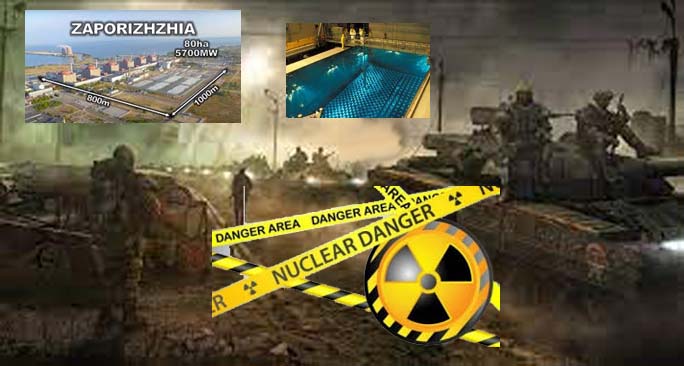
Eventually, Ukrainian officials believe their long-term success requires progress on the original goals in the discarded strategy, including recapturing the nuclear power plant in Zaporizhzhia
The Critical Moment Behind Ukraine’s Rapid Advance, New York Times, By Julian E. Barnes, Eric Schmitt and Helene Cooper, Sept. 13, 2022
WASHINGTON — The strategy behind Ukraine’s rapid military gains in recent days began to take shape months ago during a series of intense conversations between Ukrainian and U.S. officials about the way forward in the war against Russia, according to American officials.
The counteroffensive — revised this summer from its original form after urgent discussions between senior U.S. and Ukrainian officials — has succeeded beyond most predictions………..
The work began soon after President Volodymyr Zelensky of Ukraine told his generals he wanted to make a dramatic move to demonstrate that his country could push back on the Russian invasion. Under his orders, the Ukrainian military devised a plan to launch a broad assault across the south to reclaim Kherson and cut off Mariupol from the Russian force in the east.
……………………………………..Long reluctant to share details of their plans, the Ukrainian commanders started opening up more to American and British intelligence officials and seeking advice.
Jake Sullivan, the national security adviser, and Andriy Yermak, a top adviser to Mr. Zelensky, spoke multiple times about the planning for the counteroffensive, according to a senior administration official. Gen. Mark A. Milley, the chairman of the Joint Chiefs of Staff, and senior Ukrainian military leaders regularly discussed intelligence and military support.
And in Kyiv, Ukrainian and British military officials continued working together while the new American defense attaché, Brig. Gen. Garrick Harmon, began having daily sessions with Ukraine’s top officers…………….
This account of the lead-up to the counteroffensive is based on interviews with multiple senior American officials and others briefed on the classified discussions between Washington and Kyiv that helped Ukrainian commanders shape the battle. Many spoke on the condition of anonymity because of the secret nature of the talks…………………………
“We did do some modeling and some tabletop exercises,” Colin Kahl, the Pentagon’s policy chief, said in a telephone interview. “That set of exercises suggested that certain avenues for a counteroffensive were likely to be more successful than others. We provided that advice, and then the Ukrainians internalized that and made their own decision.”…………………………………………………….
Instead of one large offensive, the Ukrainian military proposed two. One, in Kherson, would most likely take days or weeks before any dramatic results because of the concentration of Russian troops. The other was planned for near Kharkiv.
Together Britain, the United States and Ukraine conducted an assessment of the new plan, trying to war game it once more. This time officials from the three countries agreed it would work — and give Mr. Zelensky what he wanted: a big, clear victory.
But the plan, according to an officer on the general staff in Kyiv, depended entirely on the size and pace of additional military aid from the United States.
Ukraine, a former Soviet republic that had used older Soviet weapons, exhausted most of its own ammunition. Learning how to use new weapons systems in the middle of the war is difficult. But so far the risky move has proved successful. More than 800,000 rounds of 155-millimeter artillery shells, for instance, have been sent to Kyiv, helping fuel its current offensives. The United States alone has committed more than $14.5 billion in military aid since the war started in February.
Before the counteroffensive, Ukraine’s armed forces sent the United States a detailed list of weapons they needed to make the plan successful, according to the Ukrainian officer.
Specific weapons, like the High Mobility Artillery Rocket System, or HIMARS, are having an outsize effect on the battlefield. The satellite-guided rockets fired by these launch vehicles, called GMLRS, each contain a warhead with 200 pounds of explosives and have been used in recent weeks by Ukrainian forces to destroy more than 400 Russian arms depots, command posts and other targets, American officials said.
More recently, Ukrainian forces have put American-supplied HARM air-launched missiles on Soviet-designed MiG-29 fighter jets, which no air force had ever done. The missiles have been particularly effective in destroying Russian radars.
“We are seeing real and measurable gains from Ukraine in the use of these systems,” General Milley said last week in Germany at a meeting of 50 countries that are helping Ukraine with military and humanitarian aid. “They’re having great difficulty resupplying their forces and replacing their combat losses.”
Ukrainian and American officials said the now weekly or biweekly Pentagon announcements of new shipments of weapons and munitions from American stockpiles have given Kyiv’s senior commanders the confidence to plan complex simultaneous offensives.
“The importance of Western military support is not just in specific weapons systems, but in the assurance and confidence that the Ukrainians can use in their future planning,” said Jack Watling, a senior research fellow at the Royal United Services Institute in London, who recently returned from Ukraine……….
Eventually, Ukrainian officials believe their long-term success requires progress on the original goals in the discarded strategy, including recapturing the nuclear power plant in Zaporizhzhia,…………….
While Ukraine may have an opportunity to recapture more territory in the east, U.S. and Ukrainian officials say the south is the most important theater of the war.
“Kherson and Zaporizhzhia are likely potential objectives,” said Michael Kofman, the director of Russia studies at CNA, a defense research institute. “We might see further Ukrainian Army operations to achieve breakthroughs there in the future.”………. https://archive.ph/ABurb#selection-933.0-945.244—
Offsite power supply to Zaporizhzhia nuclear plant destroyed

Offsite power supply to Zaporizhzhia nuclear plant destroyed
Guardian Isobel Koshiw in Kyiv, 10 Sept 22,
A vital offsite electricity supply to the Zaporizhzhia nuclear plant has been destroyed by shelling and there is little likelihood a reliable supply will be re-established, the United Nations’ nuclear watchdog chief has said.
Rafael Grossi, the director general of the International Atomic Energy Agency (IAEA), said shelling had destroyed the switchyard of a nearby thermal power plant.
The plant has supplied power to the nuclear facility each time its normal supply lines had been cut over the past three weeks. The thermal plant was also supplying the surrounding area, which was plunged into darkness.
Local Ukrainian officials said work was under way to restore the connection, which has been cut multiple times this week.
Grossi, who said he had been informed of the situation by IAEA representatives at the plant, called for an “immediate cessation of all shelling in the entire area”. “This is an unsustainable situation and is becoming increasingly precarious,” he said, without apportioning blame for the shelling.
Ukraine and Russia have blamed each other for shelling near Zaporizhzhia in southern Ukraine and within the perimeter of Europe’s biggest nuclear power plant, which has six reactors.
The thermal supply has been cut and restored multiple times this week and Enerhodar, the nearby town, has suffered several complete blackouts.
When the thermal supply has been cut the plant has relied on its only remaining operating reactor for the power needed for cooling and other safety functions. This method is designed to provide power only for a few hours at a time. Diesel generators are used as a last resort. The constant destruction of thermal power supply has led Ukraine to consider shutting down the remaining operating reactor, said Grossi. Ukraine “no longer [has] confidence in the restoration of offsite power”, he said.
Grossi said that if Ukraine decided not to restore the offsite supply the entire power plant would be reliant on emergency diesel generators to ensure supplies for the nuclear safety and security functions.
“As a consequence, the operator would not be able to restart the reactors unless offsite power was reliably re-established,” he said…………….. https://www.theguardian.com/world/2022/sep/09/offsite-power-supply-to-zaporizhzhia-nuclear-plant-destroyed
Plan to encase a Fukushima nuclear reactor and then flood it.

Its fuel rods melted and mixed with concrete, metal and other materials in the reactors, all fusing together as they cooled.
A plan is being considered to completely encase one of the reactors at the Fukushima nuclear plant in steel and then flood it with water in order to retrieve radioactive melted fuel. There are about 880 tonnes of melted nuclear fuel debris still inside the three reactors that suffered meltdowns in 2011, when a tsunami triggered by an earthquake off the coast of Japan disabled the plant’s cooling systems.
Nearly 20,000 people were killed and thousands more were injured by the tsunami, which also destroyed 123,000 homes. The highest waves topped 40m (133 feet). The nuclear plant was inundated, knocking out cooling systems and back-up generators.
Its fuel rods melted and mixed with concrete, metal and other materials in the reactors, all fusing together as they cooled.
Times 15th Sept 2022
Gullible governments – US Energy Department returns to costly and risky plutonium separation technologies

Bulletin of the Atomic Scientists, By Jungmin Kang, Masafumi Takubo, Frank von Hippel | September 14, 2022, On July 17, the United Kingdom ended 58 years of plutonium separation for nuclear fuel by closing its Magnox nuclear fuel reprocessing plant at Sellafield. This leaves the UK with the world’s largest stock of separated power-reactor plutonium, 140 metric tons as of the end of 2020, including 22 tons separated for Japan. The UK is also second in the world only to Russia in the size of its overall inventory of separated plutonium with 119 tons, including 3.2 tons for weapons. Russia’s stock, 191 tons, is mostly “weapon-grade” separated for use in nuclear weapons during the Cold War, but the UK’s power-reactor plutonium is also weapon usable, and therefore also poses a security risk. The UK has no plan for how it will dispose of its separated plutonium. Its “prudent estimate” placeholder for the disposal cost is £10 billion ($12.6 billion).
One obvious way to get rid of separated plutonium would be to mix it with depleted uranium to make “mixed-oxide” (MOX) fuel energetically equivalent to low-enriched uranium fuel, the standard fuel of conventional reactors. Despite the bad economics, since 1976 France has routinely separated out the approximately one percent plutonium in the low-enriched uranium spent fuel discharged by its water-cooled reactors and recycled the plutonium in MOX fuel.
But both the UK and the US have had negative experiences with building their own MOX production plants.
In 2001, the UK completed a MOX plant, only to abandon it in 2011 after 10 years of failed attempts to make it operate. For its part, the US Energy Department, which owns almost 50 tons of excess Cold War plutonium, contracted with the French government-owned nuclear-fuel cycle company, Areva (now Orano), in 2008 to build a MOX fuel fabrication plant. But the United States switched to a “dilute and dispose” policy for its excess plutonium in 2017 after the estimated cost of the MOX plant grew from $2.7 billion to $17 billion.
Despite decades of failed attempts around the world to make separated plutonium an economic fuel for nuclear power plants, the United States Energy Department is once again promoting the recycling of separated plutonium in the fuel of “advanced” reactor designs that were found to be economically uncompetitive 50 years ago. At the same time, other countries—including Canada and South Korea, working in collaboration with the Energy Department’s nuclear laboratories—are also promoting plutonium separation as a “solution” to their own spent fuel disposal problems. These efforts not only gloss over the long history of failure of these nuclear technologies; they also fail to take into account the proliferation risk associated with plutonium separation—a risk that history has shown to be quite real.
Renewed advocacy for plutonium separation. As the UK finally turns its back on plutonium separation, the United States Energy Department is looking in the other direction. Within the Energy Department, one part, the Office of Defense Nuclear Nonproliferation, is struggling to dispose of excess Cold War weapons plutonium, as two others—the Office of Nuclear Energy and ARPA-E (Advanced Research Project Agency – Energy)—are promoting plutonium separation……………………………………..
In fact, the Energy Department’s Office of Nuclear Energy is promoting sodium-cooled reactor designs based on the Idaho National Laboratory’s Experimental Breeder Reactor II, which was shut down in 1994 due to a lack of mission after the end of the US breeder program a decade earlier. The Energy Department’s office is now supporting research, development, and demonstration of sodium-cooled reactors by several nuclear energy startups.

Among them is Bill Gates’ Terrapower, to which the department has committed as much as $2 billion in matching funds to build a 345-megawatt-electric sodium-cooled prototype reactor—called Natrium (sodium in Latin)—in the state of Wyoming. One of Wyoming’s current senators, John Barrasso, is a leading advocate of nuclear power and could become chair of the Senate Committee on Energy and Natural Resources if the Republicans take control of the upper chamber in the elections this fall.
Terrapower insists Natrium is not a plutonium breeder reactor and will be fueled “once through” with uranium enriched to just below 20 percent and its spent fuel disposed of directly in a deep geologic repository, without reprocessing. Natrium, however, is set to use, initially at least, the same type of fuel used in Idaho’s Experimental Breeder Reactor II. The Energy Department maintains that this spent fuel cannot be disposed of directly because the sodium in the fuel could burn if it contacts underground water or air. On that basis, the Idaho National Laboratory has been struggling for 25 years to treat a mere three tons of spent fuel from the Experimental Breeder Reactor II using a special reprocessing technology called “pyroprocessing.”

In pyroprocessing, the fuel is dissolved in molten salt instead of acid, and the plutonium and uranium are recovered by passing a current through the salt and plating them out on electrodes. In 2021, Terrapower stated that it plans to switch later to a fuel for Natrium that does not contain sodium but then received in March 2022 the largest of eleven Energy Department grants for research and development on new reprocessing technologies.
Liquid-sodium-cooled reactor designs date back to the 1960s and 1970s, when the global nuclear power community believed conventional power reactor capacity would quickly outgrow the available supply of high-grade uranium ore. Conventional reactors are fueled primarily by chain-reacting uranium 235, which comprises only 0.7 percent by weight of natural uranium. Because of this low percentage, nuclear power advocates focused on developing plutonium “breeder” reactors that would be fueled by chain-reacting plutonium produced from the abundant but non-chain-reacting uranium 238 isotope, which constitutes 99.3 percent of natural uranium. (Liquid-sodium-cooled reactors are sometimes called “fast-neutron reactors” because they utilize fast neutrons to operate. Sodium was chosen as a coolant because it slows neutrons less than water. Fast neutrons are essential to a plutonium breeder reactor because the fission of plutonium by fast neutrons releases more excess secondary neutrons whose capture in uranium 238 makes possible the production of more plutonium than the reactor consumes.)
Large programs were launched to provide startup fuel for the breeder reactors by reprocessing spent conventional power-reactor fuel to recover its contained plutonium.
………………………………….. Only a few prototypes were built and then mostly abandoned. In 2020, the Organisation for Economic Co-operation and Development’s Nuclear Energy Agency estimated that sufficient low-cost uranium would be available to fuel existing conventional reactor capacity for more than a century.
Zombie plutonium-separation programs. Even though separated plutonium has morphed from the nuclear fuel of the future into a disposal problem, civilian plutonium separation continues in several countries, notably France, Japan, and Russia. It is also being advocated again by the offices within the US Energy Department that fund research and development on nuclear energy.
Russia still has an active breeder reactor development program, with two operating liquid sodium-cooled prototypes—only one of them plutonium fueled—plus a small, liquid, lead-cooled prototype under construction. But Russia has already separated 60 tons of power-reactor plutonium and has declared as excess above its weapons needs approximately 40 tons of weapon-grade plutonium. These 100 tons of separated plutonium would be enough to provide startup fuel for five years for six full-size breeder reactors.
China and India have breeder reactor prototypes under construction, but their breeders are suspected of being dual-purpose. In addition to their production of electric power, the weapon-grade plutonium produced in uranium “blankets” around the breeder cores is likely to be used for making additional warheads for their still-growing nuclear arsenals.
France and Japan require their nuclear utilities to pay for reprocessing their spent fuel and for recycling the recovered plutonium in MOX fuel, even though both countries have known for decades that the cost of plutonium recycling is several times more than using low-enriched uranium fuel “once through,” with the spent fuel being disposed of directly in a deep geological repository.
Claimed benefits of reprocessing. Advocates of plutonium recycling in France and Japan justify their programs with claims that it reduces uranium requirements, the volume of radioactive waste requiring disposal, and the duration of the decay heat and radiotoxicity of the spent fuel in a geologic repository. These benefits are, however, either minor or non-existent. First, France’s plutonium recycling program reduces its uranium requirements by only about 10 percent, which could be achieved at much less cost in other ways, such as by adjusting enrichment plants to extract a higher percentage of the uranium 235 isotopes in natural uranium. Second, with proper accounting, it is not at all clear that recycling produces a net reduction in the volume of radioactive waste requiring deep geological disposal. Third, the claimed heat reduction, if realized, could reduce the size of the repository by packing radioactive waste canisters more closely. But this is not significant because, with the currently used reprocessing technology, americium 241, which has a 430-year half-life and dominates the decay heat from the spent fuel during the first thousand years, remains in the reprocessed waste.
Claims of the reduced toxicity of reprocessed waste turn out to be false as well. For decades, France’s nuclear establishment has promoted continued reprocessing in part out of hope that, after its foreign reprocessing customers did not renew their contracts, it could sell its plutonium recycling technology to other countries, starting with China and the United States. But, with the notable exception of the canceled US MOX plant, these efforts so far have not materialized, and the willingness of the French government to continue funding its expensive nuclear fuel cycle strategy may be reaching its limits………………………..
Proliferation danger. Aside from the waste of taxpayer money, there is one major public-policy objection to plutonium separation: Plutonium can be used to make a nuclear weapon. The chain-reacting material in the Nagasaki bomb was six kilograms of plutonium, and the fission triggers of virtually all nuclear warheads today are powered with plutonium. Reactor-grade plutonium is weapon-usable, as well.
In the 1960s, however, blinded by enthusiasm for plutonium breeder reactors, the US Atomic Energy Commission—the Energy Department’s predecessor agency—promoted plutonium worldwide as the fuel of the future. During that period, India sent 1,000 scientists and engineers to Argonne and other US national laboratories to be educated in nuclear science and engineering. In 1964, India began to separate plutonium from the spent fuel of a heavy-water research reactor provided jointly by Canada and the United States. Ten years later, in 1974, India used some of that separated plutonium for a design test of a “peaceful nuclear explosive,” which is now a landmark in the history of nuclear weapon proliferation……………………….
False environmental claims for reprocessing. Since the 1980s, advocates of reprocessing and plutonium recycling and fast neutron reactors in the Energy Department’s Argonne and Idaho National Laboratories have promoted them primarily as a strategy to facilitate spent fuel disposal.
The George W. Bush administration, which came to power in 2001, embraced this argument because it saw the impasse over siting a spent fuel repository as an obstacle to the expansion of nuclear power in the United States. To address the proliferation issue, the Bush Administration proposed in 2006 a “Global Nuclear Energy Partnership” in which only countries that already reprocessed their spent fuel (China, France, Japan, and Russia) plus the United States would be allowed to reprocess the world’s spent fuel and extract plutonium. The recovered plutonium then would be used in the reprocessing countries to fuel advanced burner reactors (breeder reactors tweaked so that they would produce less plutonium than they consumed). These burner reactors would be sodium-cooled fast-neutron reactors because the slow neutrons that sustain the chain reaction in water-cooled reactors are not effective in fissioning some of the plutonium isotopes. After Congress understood the huge costs involved, however, it refused to fund the partnership…………………………….
Plutonium and the geological disposal of spent fuel. Despite the unfavorable economics, the idea of separating and fissioning the plutonium in spent fuel has been kept alive in the United States and some other countries in part by continuing political and technical obstacles to siting spent fuel repositories. Proponents of reprocessing have managed to keep their governments’ attention on plutonium because it is a long-lived radioelement, a ferocious carcinogen—if inhaled—and has fuel value if recycled.
But detailed studies have concluded that plutonium makes a relatively small contribution to the long-term risk from a spent fuel geologic repository for spent fuel from commercial power reactors.
……………………………………………….. risk assessments are theoretical, but they are based on real-world experience with the movement of radioisotopes through the environment.
The main source of that experience is from the large quantities of fission products and plutonium lofted into the stratosphere by the fireballs of megaton-scale atmospheric nuclear tests between 1952 and 1980. During that period, the Soviet Union, the United States, China, the United Kingdom, and France injected into the stratosphere a total of about eight tons of fission products and 3.4 tons of plutonium—comparable to the quantities in a few hundred tons of spent light water reactor fuel. These radioisotopes returned to earth as global radioactive “fallout.”
…………………………………… In addition to the proliferation danger dramatized by the case of India, plutonium separation also brings with it a danger of a massive accidental radioactive release during reprocessing. The world’s worst nuclear accident before Chernobyl involved the Soviet Union’s first reprocessing plant for plutonium production, in 1957……………………………………………..
Gullible governments. Nearly half a century after India conducted its first nuclear test in 1974 with assistance provided inadvertently by Canada and the United States, both countries’ governments seem to have forgotten about the proliferation risk associated with spent fuel reprocessing. Today, advocates of fast-neutron breeder or burner reactors are pitching again the same arguments—used before the test—to gullible governments that seem unaware of the history of this issue. This ignorance has created problems for Canada’s nonproliferation policy as well as that of the United States.
In Canada, a UK startup, Moltex, has obtained financial support from federal and provincial governments by promising to “solve” Canada’s spent fuel problem. Its proposed solution is to extract the plutonium in the spent fuel of Canada’s aging CANDU (CANada Deuterium Uranium) reactors to fuel a new generation of molten-salt-cooled reactors. The Moltex company also proposes to make Canada an export hub for its reactors and small reprocessing plants.
In South Korea, the Korea Atomic Energy Research Institute, with support from Energy Department’s Argonne and Idaho National Laboratories, has similarly been campaigning to persuade its government that pyroprocessing spent fuel and fissioning plutonium in sodium-cooled reactors would help solve that country’s spent fuel management problem.
It is time for governments to learn again about the risks involved with plutonium separation and to fence off “no-go zones” for their nuclear energy advocates, lest they unintentionally precipitate a new round of nuclear-weapon proliferation.
Notes:
[1] Carbon 14 and iodine 129 are difficult to capture during reprocessing and therefore are routinely released into the atmosphere and ocean by France’s reprocessing plant at La Hague. Also, had the uranium 238 in the spent fuel not been mined, its decay product, radium 226, would have been released within the original uranium deposit. So, even though some reprocessing advocates join with nuclear power critics in amplifying the hazards of plutonium and other transuranic elements in underground radioactive waste repositories, they generally omit comparisons with reprocessing hazards (in the case of reprocessing advocates) or with natural uranium deposits (in the case of repository opponents). https://thebulletin.org/2022/09/some-fuels-never-learn-us-energy-department-returns-to-costly-and-risky-plutonium-separation-technologies/
World BEYOND War Volunteers to Reproduce “Offensive” Peace Mural

https://worldbeyondwar.org/world-beyond-war-volunteers-to-reproduce-offensive-peace-mural/By David Swanson, World BEYOND War, September 14, 2022
A talented artist in Melbourne, Australia, has been in the news for painting a mural of Ukrainian and Russian soldiers hugging — and then for taking it down because people were offended. The artist, Peter ‘CTO’ Seaton, has been quoted as saying he was raising funds for our organization, World BEYOND War. We want to not only thank him for that but offer to put the mural up elsewhere.
Here is a small sampling of the reporting on this story:
SBS News: “‘Utterly offensive’: Australia’s Ukrainian community furious over mural of Russian soldier embrace”
The Guardian: “Ukraine’s ambassador to Australia calls for removal of ‘offensive’ mural of Russian and Ukrainian soldiers”
Sydney Morning Herald: “Artist to paint over ‘utterly offensive’ Melbourne mural after Ukrainian community anger”
The Independent: “Australian artist takes down mural of hugging Ukraine and Russia soldiers after huge backlash”
Sky News: “Melbourne mural of Ukrainian and Russian soldiers hugging painted over after backlash”
Newsweek: “Artist Defends ‘Offensive’ Mural of Ukrainian and Russian Troops Hugging”
The Telegraph: “Other wars: Editorial on Peter Seaton’s anti-war mural & its repercussion”
Here is the artwork on Seaton’s website. The website says: “Peace before Pieces: Mural painted on Kingsway close to the Melbourne CBD. Focusing on a peaceful resolution between the Ukraine and Russia. Sooner or later the continued escalation of conflicts created by Politicians will be the death of our beloved planet.” We couldn’t agree more.
World BEYOND War has funds donated to us specifically for putting up billboards. We would like to offer, should Seaton find it acceptable and helpful, to put this image up on billboards in Brussels, Moscow, and Washington. We would like to help with reaching out to muralists to put it up elsewhere. And we would like to put it on yard signs that individuals can display around the world.
Our interest is not in offending anyone. We believe that even in the depths of misery, despair, anger, and revenge people are sometimes capable of imagining a better way. We’re aware that soldiers try to kill their enemies, not hug them. We’re aware that each side believes that all the evil is commited by the other side. We’re aware that each side typically believes total triumph is eternally imminent. But we believe that wars must end with the making of peace and that the sooner this is done the better. We believe that reconciliation is something to aspire to, and that it is tragic to find ourselves in a world in which even picturing it is deemed — not just unliklely, but — somehow offensive.
World BEYOND War is a global nonviolent movement to end war and establish a just and sustainable peace. World BEYOND War was founded on January 1st, 2014, when co-founders David Hartsough and David Swanson set out to create a global movement to abolish the institution of war itself, not just the “war of the day.” If war is ever to be abolished, then it must be taken off the table as a viable option. Just as there is no such thing as “good” or necessary slavery, there is no such thing as a “good” or necessary war. Both institutions are abhorrent and never acceptable, no matter the circumstances. So, if we can’t use war to resolve international conflicts, what can we do? Finding a way to transition to a global security system that is supported by international law, diplomacy, collaboration, and human rights, and defending those things with nonviolent action rather than the threat of violence, is the heart of WBW. Our work includes education that dispels myths, like “War is natural” or “We have always had war,” and shows people not only that war should be abolished, but also that it actually can be. Our work includes all variety of nonviolent activism that moves the world in the direction of ending all war.
The Weapons Industry as a Taxpayer Scam
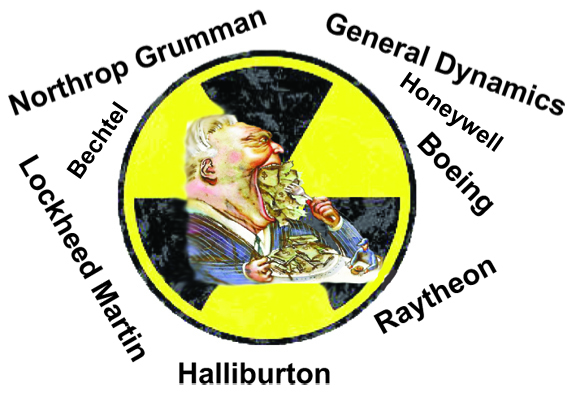
In all, the top five weapons contractors—Lockheed Martin, Raytheon, Boeing, General Dynamics, and Northrop Grumman—split more than $200 billion in “defense” revenue in the last fiscal year, mostly from the Pentagon but also from lucrative foreign arms sales. The new budget proposals will only boost those already astounding figures.
Military contractors and arms manufacturers cash in as Congress adds billions to the Pentagon budget each year.
The jobs card is the strongest tool of influence available to the arms industry in its efforts to keep Congress eternally boosting Pentagon spending, but far from the only one
So far, in the 2022 election cycle, weapons firms have already donated $3.4 million to members of the House Armed Services Committee
There are scant, if any, restrictions against members of Congress owning or trading defense company stocks, even those who sit on influential national-security-related committees. In other words, it’s completely legal for them to marry their personal financial interests to those of defense contractors.
https://www.commondreams.org/views/2022/09/12/weapons-industry-taxpayer-scam JULIA GLEDHILL, WILLIAM HARTUNG, September 12, 2022 Congress has spoken when it comes to next year’s Pentagon budget and the results, if they weren’t so in line with past practices, should astonish us all. The House of Representatives voted to add $37 billion and the Senate $45 billion to the administration’s already humongous request for “national defense,” a staggering figure that includes both the Pentagon budget and work on nuclear weapons at the Department of Energy. If enacted, the Senate’s sum would push spending on the military to at least $850 billion annually, far more—adjusted for inflation—than at the height of the Korean or Vietnam wars or the peak years of the Cold War.
U.S. military spending is, of course, astronomically high—more than that of the next nine countries combined. Here’s the kicker, though: the Pentagon (an institution that has never passed a comprehensive financial audit) doesn’t even ask for all those yearly spending increases in its budget requests to Congress. Instead, the House and Senate continue to give it extra tens of billions of dollars annually. No matter that Secretary of Defense Lloyd Austin has publicly stated the Pentagon has all it needs to “get the capabilities… to support our operational concepts” without such sums.
It would be one thing if such added funding were at least crafted in line with a carefully considered defense strategy. More often than not, though, much of it goes to multibillion dollar weapons projects being built in the districts or states of key lawmakers or for items on Pentagon wish lists (formally known as “unfunded priorities lists”). It’s unclear how such items can be “priorities” when they haven’t even made it into the Pentagon’s already enormous official budget request.
In addition, throwing yet more money at a department incapable of managing its current budget only further strains its ability to meet program goals and delivery dates. In other words, it actually impairs military readiness. Whatever limited fiscal discipline the Pentagon has dissipates further when lawmakers arbitrarily increase its budget, despite rampant mismanagement leading to persistent cost overruns and delivery delays on the military’s most expensive (and sometimes least well-conceived) weapons programs.
Inn short, parochial concerns and special-interest politics regularly trump anything that might pass as in the national interest, while doing no favors to the safety and security of the United States. In the end, most of those extra funds simply pad the bottom lines of major weapons contractors like Lockheed Martin and Raytheon Technologies. They certainly don’t help our servicemembers, as congressional supporters of higher Pentagon budgets routinely claim.
A Captured Congress
The leading advocates of more Pentagon spending, Democrats and Republicans alike, generally act to support major contractors in their jurisdictions. Representative Jared Golden (D-ME), a co-sponsor of the House Armed Services Committee proposal to add $37 billion to the Pentagon budget, typically made sure it included funds for a $2 billion guided-missile destroyer to be built at General Dynamics’ shipyard in Bath, Maine.
Similarly, his co-sponsor, Representative Elaine Luria (D-VA), whose district abuts Huntington Ingalls Industries’ Newport News Shipyard, successfully advocated for the inclusion of ample funding to produce aircraft carriers and attack submarines at that complex. Or consider Representative Mike Rogers (R-AL), the ranking Republican on the House Armed Services Committee and a dogged advocate of annually increasing the Pentagon budget by at least 3% to 5% above inflation. He serves a district south of Huntsville, Alabama, dubbed “rocket city” because it’s the home to so many firms that work on missile defense and related projects.
There are even special congressional caucuses devoted solely to increasing Pentagon spending while fending off challenges to specific weapons systems. These range from the House shipbuilding and F-35 caucuses to the Senate ICBM Coalition. That coalition has been especially effective at keeping spending on a future land-based intercontinental ballistic missile dubbed the Sentinel on track, while defeating efforts to significantly reduce the number of ICBMs in the U.S. arsenal. Such “success” has come thanks to the stalwart support of senators from Montana, North Dakota, Utah, and Wyoming, all states with ICBM bases or involved in major ICBM development and maintenance.
The jobs card is the strongest tool of influence available to the arms industry in its efforts to keep Congress eternally boosting Pentagon spending, but far from the only one. After all, the industrial part of the military-industrial-congressional complex gave more than $35 million in campaign contributions to members of Congress in 2020, the bulk of it going to those on the armed services and defense appropriations committees who have the most sway over the Pentagon budget and what it will be spent on.
So far, in the 2022 election cycle, weapons firms have already donated $3.4 million to members of the House Armed Services Committee, according to an analysis by Open Secrets.org, an organization that tracks campaign spending and political influence. Weapons-making corporations also currently employ nearly 700 lobbyists, more than one for every member of Congress, while spending additional millions to support industry-friendly think tanks that regularly push higher Pentagon spending and a more hawkish foreign policy.
The arms industry has another lever to pull as well when it comes to the personal finances of lawmakers. There are scant, if any, restrictions against members of Congress owning or trading defense company stocks, even those who sit on influential national-security-related committees. In other words, it’s completely legal for them to marry their personal financial interests to those of defense contractors.
The Cost of Coddling Contractors
Continue readingTODAY. The Ukrainian propaganda war becomes ever more sinister – with “filtration”

“Filtration” – yes – that’s the key word. It means the torture, expulsion, killing, of people that you call ‘collaborators” ETC. in Western propaganda now, there are dozens of media reports on how the Russians are abusing Ukrainians.
Then there’s just this one headline from the Wall Street Journal – “Ukraine hit squads are killing Russian occupiers and collaborators” (behind a paywall). What could they be thinking of? – When the standard Western dogma is that all the bad things are done by Russia, and Ukrainians are squeaky clean.
One report , from a pro-Russian media source, says “Ukraine cracks downs on civilians – official“
I can’t imagine why on earth the Wall Street Journal lapsed from its religious Western duty to blacken Russians, but I bet they won’t let it happen again.
A heretical thought from a Westerner – but is it possible that, not just Russia, but both sides are guilty of atrocities, in this hate-filled Ukraine situation?
1 This Month
23 April – WEBINAR – Why new nuclear reactors are the wrong tools for decarbonization Thursday, April 23 • 1 AM – 2 AM AEST



Pine Ridge Uranium is the real threat, not Tehran- Tell Burgum: Stop the Extraction.
Chernobyl: The Lost Tapes – A good documentary on Chernobyl on SBS available On Demand for the next 3 weeks– https://www.sbs.com.au/ondemand/tv-program/chernobyl-the-lost-tapes/2352741955560
To see nuclear-related stories in greater depth and intensity – go to https://nuclearinformation.wordpress.com
-
Archives
- April 2026 (275)
- March 2026 (251)
- February 2026 (268)
- January 2026 (308)
- December 2025 (358)
- November 2025 (359)
- October 2025 (376)
- September 2025 (257)
- August 2025 (319)
- July 2025 (230)
- June 2025 (348)
- May 2025 (261)
-
Categories
- 1
- 1 NUCLEAR ISSUES
- business and costs
- climate change
- culture and arts
- ENERGY
- environment
- health
- history
- indigenous issues
- Legal
- marketing of nuclear
- media
- opposition to nuclear
- PERSONAL STORIES
- politics
- politics international
- Religion and ethics
- safety
- secrets,lies and civil liberties
- spinbuster
- technology
- Uranium
- wastes
- weapons and war
- Women
- 2 WORLD
- ACTION
- AFRICA
- Atrocities
- AUSTRALIA
- Christina's notes
- Christina's themes
- culture and arts
- Events
- Fuk 2022
- Fuk 2023
- Fukushima 2017
- Fukushima 2018
- fukushima 2019
- Fukushima 2020
- Fukushima 2021
- general
- global warming
- Humour (God we need it)
- Nuclear
- RARE EARTHS
- Reference
- resources – print
- Resources -audiovicual
- Weekly Newsletter
- World
- World Nuclear
- YouTube
-
RSS
Entries RSS
Comments RSS
 nuclear-news