Nuclear energy for Colorado? The cost is one very big obstacle
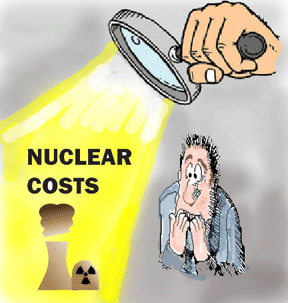
Post Independent, Allen Best 6 Aug 22, A nuclear reactor might be a nice addition to the economy of Craig, the community in northwestern Colorado. But can Colorado afford nuclear power?
……………….Sen. Bob Rankin in the last legislative session tried to get fellow legislators to appropriate $500,000 (amended to $250,000) to study the potential for nuclear.
…………Conspicuously absent was support from the administration of Gov. Jared Polis. The bill failed 3-2 on a party-line vote.
Nuclear has a nagging problem, though. It’s expensive. Advocates rarely mention this. Costs of Georgia’s Plant Vogtle, the only U.S. nuclear power plant under construction, have ballooned from $14 billion to now $30 billion-plus. In South Carolina, investors pulled the plug on a nuclear power plant after spending $9 billion. It has become among the very costliest of energy sources, only slightly less than rooftop solar, according to Lazard, the financial analyst.
Modular nuclear reactors have been promoted as a way to shave costs. Specific projects have been conceived in both Idaho and Wyoming. Bill Gates is an investor in the latter. Maybe they will overcome this cost problem. We won’t really know for another 10, maybe 15 years.
State Sen. Chris Hansen remains skeptical. He has expertise unsurpassed among legislators. He set out to become a nuclear engineer after first laying eyes on a reactor when a high school junior from the farm country of Kansas. He got his degree but had already turned his attention to economics. He went on to earn degrees from the Massachusetts Institute of Technology and, from Oxford, a Ph.D. in resource economics.
Nuclear, he told a county commissioner from Sterling in 2019, when I first heard him answer this question, simply does not compete in cost. Last week, when we talked, he offered more detail.
“I think those technologies will have to prove themselves,” he said of modular nuclear reactors. “Right now, in the best-case scenario it looks like they will deliver electricity at $60 to $70 per megawatt-hour. Wind and solar are coming in at less than $20.”
……….. Hansen suggests that reliability [of rennewables] may more economically be provided by less expensive alternatives. For example, he has pushed transmission and passed legislation to create organized markets that will allow electricity to be moved across broader geographic areas in response to consumer demands. Colorado is currently an island with limited bridges to other areas………… https://www.postindependent.com/opinion/allen-best-nuclear-energy-has-obstacles-too/
Drought may force nuclear power production cut
https://journalrecord.com/2022/08/05/drought-may-force-nuclear-power-production-cut/ Associated Press August 5, 2022 0
PARIS — French Prime Minister Elisabeth Borne warned that France is facing the “most severe drought” ever recorded in the country and announced the activation of a government crisis unit.
The crisis unit will be in charge of monitoring the situation in the hardest-hit areas and coordinate measures like bringing drinking water to some places. It will also monitor the impact of the drought on France’s energy production, transport infrastructure and agriculture.
The drought may force French energy giant EDF to cut power production at nuclear plants which use river water to cool reactors.
France now has 62 regions with restrictions on water usage due to the lack of rain.
Borne said many areas in France are going through a “historic situation” as the country endures its third heatwave this summer.
“The exceptional drought we are currently experiencing is depriving many municipalities of water and is a tragedy for our farmers, our ecosystems and biodiversity,” the statement said.
If we are to survive…we must change course — IPPNW peace and health blog.
[Former IPPNW co-president Ira Helfand, on behalf of the federation, will deliver the following statement today at the Non-Proliferation Treaty (NPT) Review Conference at the United Nations in New York.] More than 50 years ago the nations of the world, understanding the grave existential threat posed by nuclear weapons, came together in this Non-Proliferation Treaty […]
If we are to survive…we must change course — IPPNW peace and health blog
Fukushima Daiichi Nuclear Power Plant “Treated Water” Discharged TEPCO Announces Undersea Tunnel Construction to Begin in 4 Days “Already Started? Citizens were in a state of exasperation

August 3, 2022
TEPCO announced on August 3 that it will begin construction of an undersea tunnel and other facilities on August 4 to discharge contaminated water from the Fukushima Daiichi Nuclear Power Plant (Okuma and Futaba, Fukushima Prefecture) after purification and treatment. The company aims to begin discharging the water next spring, but if the offshore construction is delayed by weather conditions or other factors, the completion of the facilities may be delayed until next summer. However, there is strong opposition to the project, especially from those involved in the fishing industry, and it is unclear whether the facilities will actually be able to discharge the radioactive waste. (Nozomi Masui)
On the 2nd, the prefectural government and both towns in the area agreed to the construction work, and on the 4th, they will begin digging undersea tunnels and laying pipes to transfer treated water from the storage tanks. TEPCO is proceeding with some of the work outside the scope of the consent, and has finished digging the hole that will house the water storage tank that will lead to the undersea tunnel.
At the press conference, Junichi Matsumoto of TEPCO’s Fukushima Daiichi Decommissioning Promotion Company made it clear that “there is no doubt that we will comply with the document with fishermen,” regarding the written promise with the Fukushima Prefectural Fisheries Federation that no ocean discharge would take place unless understanding is obtained. However, he simply reiterated that he would “do his best to explain” how to gain their understanding.
When asked if TEPCO executives would brief fishermen before construction began, he replied, “We have no plans to do so. Meanwhile, Prime Minister Fumio Kishida met with Masanobu Sakamoto, chairman of the National Federation of Fishermen’s Cooperative Associations, on the same day. Regarding a large fund for the continuation of the fishing industry, he said, “We would like to obtain the fishermen’s understanding on how to use the fund after hearing their opinions.
According to TEPCO’s plan, the treated water, which is mainly tritium, will be diluted with a large amount of seawater to less than 1/40th of the national discharge standard, and then discharged through an undersea tunnel about 1 km offshore.
◆”Voices not being heard by the government,” citizens’ group protests.
On March 3, when TEPCO announced the start of construction of facilities to discharge treated water from the Fukushima Daiichi Nuclear Power Plant into the ocean, citizens’ groups in Fukushima Prefecture staged a protest in front of the prefectural government office, and the leaders of local governments where the plant is located asked the government to take thorough measures against harmful rumors.
On the afternoon of the 3rd, the co-chairman of the “Citizens’ Council” Oda, who heard about the plan to start construction on the following day, said, “What, it has already started? Chiyo Oda, 67, co-chairperson of the “Citizens’ Council” in Iwaki City, Fukushima Prefecture, was absolutely stunned. Construction began just two days after Fukushima Prefecture and the towns of Okuma and Futaba agreed to the work. She was concerned that the situation would become so dire that there would be no turning back.

In the morning of that day, the association held a banner in front of the prefectural office to protest. At a press conference held afterward, Mr. Oda said, “The plan is proceeding with the release of the waste. There are so many voices of opposition and concern, but the government is not receiving our voices? Kaoru Watanabe, 66, a resident of Date City in Fukushima Prefecture, expressed his concern, “I’m worried that they will push ahead with the construction work, create a fait accompli, and then push through with the discharge into the ocean.
Fukushima Governor Masao Uchibori, Okuma Mayor Jun Yoshida, and Futaba Mayor Shiro Izawa visited the Ministry of Economy, Trade and Industry and submitted a written request to METI Minister Koichi Hagiuda. Governor Uchibori told the press, “I hope that the government will work together to take the necessary measures (against harmful rumors, etc.) so that the efforts of the people of Fukushima Prefecture will not be undone by the release of the radioactive materials. (Natsuko Katayama, Nozomi Masui)
https://www.tokyo-np.co.jp/article/193622?fbclid=IwAR0TJASuRCsIfHc-zmKUqE7ERgUF3pJNe_vGHn8bYmkFdMTiS5Hn9RYhN5M
TEPCO Starts Construction of Fukushima Water Release Facilities
Get ready for a new wave… of radioactive wastewater!
ineptco’s tunnel will carry the enriched water a whole kilometer from the coast

August 4, 2022
Tokyo Electric Power Company Holdings Inc. on Thursday started the construction of facilities to release treated radioactive water into the ocean from its disaster-crippled nuclear plant in the northeastern Japan prefecture of Fukushima.
TEPCO aims to complete the construction work around next spring, although the company said the completion might be pushed back to around summer next year if the work at sea is delayed due to bad weather or other factors.
There are lingering concerns about negative rumors related to the planned release of the water, which contains tritium, a radioactive substance, into the ocean. Understanding from related local people would be essential for TEPCO to start the water release after the completion of the facilities.
TEPCO will construct an undersea tunnel necessary for releasing the treated water at a point 1 kilometer off the coast. Tanks and pipes will also be set up for stirring the treated water and checking whether radioactive substances other than tritium are below safety standards.

Also, the company will build a facility to dilute the treated water, after its levels of radioactive substances are measured, with seawater to lower the tritium concentration to less than one-40th of the level permitted under Japanese safety standards.
Ministry of the Environment – Draft Demonstration Plan for Reclamation of Removed Soil, Seeking Use as Road Fill

August 4, 2022
The Ministry of the Environment has compiled a draft plan for a demonstration project to recycle removed soil in order to reduce the final disposal volume of waste generated by the decontamination project for the Fukushima Daiichi Nuclear Power Plant accident. The project aims to expand the use of recycled materials based on removed soil at intermediate storage facilities in Fukushima Prefecture (in the towns of Okuma and Futaba), and is exploring the use of the materials for road fill. The design and construction methods and procedures will be studied until October, and construction will be carried out between October and January 2023. The project will be implemented from October to January 2023. After January, various tests and monitoring will be conducted. The project will also conduct demonstrations outside of the prefecture to demonstrate the use of recycled materials for parking lot construction and other purposes.
On March 3, the first meeting of the “Working Group to Study the Recycling of Soil Removal at Interim Storage Facilities” (WG, chaired by Professor Takeshi Katsumi, Graduate School of Global Environmental Studies, Kyoto University) was held in Tokyo, where the draft plan was presented. The WG will organize and evaluate the findings from the demonstration project, and study measures to safely use the removed soil as recycled materials. A practical guide for recycling will also be prepared.
According to the draft plan, recycled materials will be used for roadway fill in the interim storage facility. The road to be used for the general road standards is assumed to be a structure with sidewalks and a daily traffic volume of 4,000 to 20,000 vehicles (Class 3 and Class 2). The road is assumed to be a structure with sidewalks. Evaluation will be conducted after actual construction. The results of the project will be reflected in the guide.
A demonstration project will be conducted outside of Fukushima Prefecture with the aim of realizing final disposal outside of Fukushima Prefecture. Recycled materials will be used for the roadbed of parking lots, and different reclamation patterns will be demonstrated, including differences in pavement and roadbed materials. Cases in which recycled materials are used to create flowerbeds and plazas will also be investigated. During the construction and use of the reclaimed materials, air dose rates in and around the reclaimed areas and radioactive concentrations in seepage water will be measured to confirm safety. Construction will be conducted this year, and monitoring will begin after completion.
1 This Month

of the week – Shut Down Drone Warfare!


Tell the Ukrainian Government to Drop Prosecution of Peace Activist Yurii Sheliazhenko

Petition to revoke the licensing of the Near Surface Nuclear Disposal Facility (NSDF) at Chalk River. https://www.ourcommons.ca/petitions/en/Petition/Details?Petition=e-7247
To see nuclear-related stories in greater depth and intensity – go to https://nuclearinformation.wordpress.com
-
Archives
- April 2026 (7)
- March 2026 (251)
- February 2026 (268)
- January 2026 (308)
- December 2025 (358)
- November 2025 (359)
- October 2025 (376)
- September 2025 (257)
- August 2025 (319)
- July 2025 (230)
- June 2025 (348)
- May 2025 (261)
-
Categories
- 1
- 1 NUCLEAR ISSUES
- business and costs
- climate change
- culture and arts
- ENERGY
- environment
- health
- history
- indigenous issues
- Legal
- marketing of nuclear
- media
- opposition to nuclear
- PERSONAL STORIES
- politics
- politics international
- Religion and ethics
- safety
- secrets,lies and civil liberties
- spinbuster
- technology
- Uranium
- wastes
- weapons and war
- Women
- 2 WORLD
- ACTION
- AFRICA
- Atrocities
- AUSTRALIA
- Christina's notes
- Christina's themes
- culture and arts
- Events
- Fuk 2022
- Fuk 2023
- Fukushima 2017
- Fukushima 2018
- fukushima 2019
- Fukushima 2020
- Fukushima 2021
- general
- global warming
- Humour (God we need it)
- Nuclear
- RARE EARTHS
- Reference
- resources – print
- Resources -audiovicual
- Weekly Newsletter
- World
- World Nuclear
- YouTube
-
RSS
Entries RSS
Comments RSS
 nuclear-news