TEPCO to grow fish at nuclear plant to show water safety
No, it is not for April Fools’ Day only, for Tepco it is Fool’s Day everyday
April 1, 2022
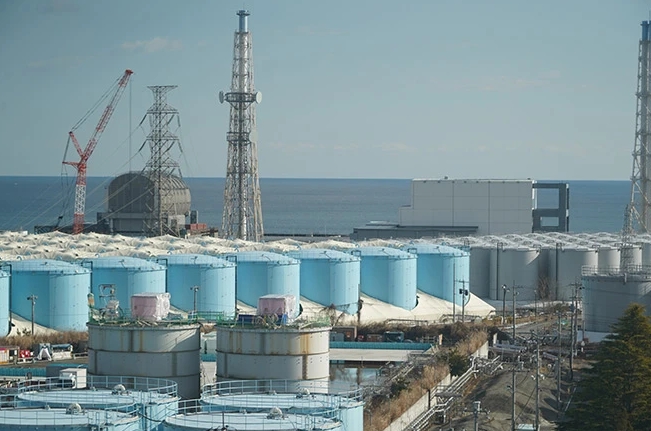
Tokyo Electric Power Co. will raise seafood at its stricken Fukushima No. 1 nuclear power plant in a bid to ease concerns about its plan to release treated radioactive water stored there into the ocean.
“We want to contribute to dispelling the public’s anxiety and reassuring people,” a TEPCO representative said.
The government and TEPCO last year announced the plan to treat and then discharge contaminated water accumulating at the nuclear plant into the ocean starting as early as spring 2023. More than 1 million tons of water have already been stored.
Local residents and fisheries industry officials, worried about reputational damage to marine products caused by the water release, asked the utility to demonstrate the safety of the water that will be discharged instead of just spouting off technical terms.
They suggested that TEPCO keep fish at the plant to show that the processed water will pose no health risk.
The water treatment process removes most radioactive substances, but not tritium. The water will be diluted with seawater to reduce the tritium concentration to less than 1,500 becquerels per liter, one-40th the legal standard.
On experts’ advice, TEPCO decided to culture flatfish and abalone on a trial basis because both species can be caught off Fukushima Prefecture and grown easily.
Preliminary farming started in March in seawater at the plant to gain expertise.
Around September, the utility will begin growing 600 flatfish and 600 abalone. Some will be raised in ordinary seawater while others will be in treated and diluted water containing tritium at the same level of the water that will be discharged.
The concentration of tritium and other substances in the creatures’ bodies will be analyzed, as will their growth rates in the two sets of tanks.
A continuing video of the experiment will be made available on the internet.
TEPCO said it expects the raised fish to have tritium readings similar to those in the water of their farming tanks. So the figure for flatfish raised in the processed water will likely be higher than their seawater-cultivated counterparts.
“We hope to counter negative publicity by showing that fish can grow healthily (in the treated water),” a TEPCO official said.
No comments yet.
1 This Month

of the week – Shut Down Drone Warfare!


Tell the Ukrainian Government to Drop Prosecution of Peace Activist Yurii Sheliazhenko

Petition to revoke the licensing of the Near Surface Nuclear Disposal Facility (NSDF) at Chalk River. https://www.ourcommons.ca/petitions/en/Petition/Details?Petition=e-7247
To see nuclear-related stories in greater depth and intensity – go to https://nuclearinformation.wordpress.com
-
Archives
- March 2026 (244)
- February 2026 (268)
- January 2026 (308)
- December 2025 (358)
- November 2025 (359)
- October 2025 (376)
- September 2025 (257)
- August 2025 (319)
- July 2025 (230)
- June 2025 (348)
- May 2025 (261)
- April 2025 (305)
-
Categories
- 1
- 1 NUCLEAR ISSUES
- business and costs
- climate change
- culture and arts
- ENERGY
- environment
- health
- history
- indigenous issues
- Legal
- marketing of nuclear
- media
- opposition to nuclear
- PERSONAL STORIES
- politics
- politics international
- Religion and ethics
- safety
- secrets,lies and civil liberties
- spinbuster
- technology
- Uranium
- wastes
- weapons and war
- Women
- 2 WORLD
- ACTION
- AFRICA
- Atrocities
- AUSTRALIA
- Christina's notes
- Christina's themes
- culture and arts
- Events
- Fuk 2022
- Fuk 2023
- Fukushima 2017
- Fukushima 2018
- fukushima 2019
- Fukushima 2020
- Fukushima 2021
- general
- global warming
- Humour (God we need it)
- Nuclear
- RARE EARTHS
- Reference
- resources – print
- Resources -audiovicual
- Weekly Newsletter
- World
- World Nuclear
- YouTube
-
RSS
Entries RSS
Comments RSS
 nuclear-news
Leave a comment