UK’s Ministry of Defence called out for lobbying MPs on nuclear weapons
MoD under fire for lobbying MPs on nuclear weapons, The Ferret, Rob Edwards. March 13, 2022
The Ministry of Defence (MoD) is facing criticism for lobbying up to 27 Westminster politicians on the “benefits” of nuclear weapons for “UK industry, economy and the union”
Four lords and 23 MPs were invited to two briefings by senior MoD officials at the Faslane nuclear submarine base on the Clyde in 2021. According to the MoD, the aim was to “educate” them on the “continued relevance” of the Trident nuclear weapons system, and how replacing it was “value for money”.
According to experts, it is “highly unusual” for a government department to lobby politicians in this way. Campaigners questioned whether it was an “appropriate” use of public money and accused the MoD of acting as an “influencer” for nuclear vested interests………………………
One lobbying expert disputed the MoD’s suggestion it was not trying to influence politicians. “This is clearly a lobbying and influencing strategy, thinly disguised as a briefing to promote dialogue about defence policy,” said Dr Will Dinan, a senior lecturer in political communications at the University of Stirling.
“It is highly unusual for a government department to lobby UK politicians in this way. While the rationale offered is that these briefings are simply educational, it is clear that the overall strategic aim is to increase support among parliamentarians for maintaining nuclear capability.”
Dinan maintained that the nuclear briefings were “hardly neutral, informational or apolitical”. The need for nuclear weapons was “highly political” and MoD officials appeared to have “strayed some way from offering neutral and balanced advice to inform decision makers”, he said.
The Nuclear Information Service, which researches nuclear weapons, was also critical of the MoD. “These documents make it clear that the purpose of this exercise is to bolster support for the UK’s nuclear weapons programme,” said the group’s director, David Cullen.
“Lobbying in this fashion is not an appropriate use of public funds and diminishes the prospects for meaningful parliamentary oversight.”
The Scottish Campaign for Nuclear Disarmament pointed out that retired military commanders had spoken out against nuclear weapons. “The MoD is acting as an influencer for the nuclear-military-industrial complex with vested interests in them being constantly modernised and never given up,” said the campaign’s chair, Lynn Jamieson.
“If the MoD had a genuinely educational agenda it would include consideration of how to move towards signing the Treaty on the Prohibition of Nuclear Weapons. But then their job isn’t education, it’s defence and security — and Scottish CND’s view is that nuclear weapons put that at risk
The SNP MSP, Bill Kidd, is co-president of the international group of Parliamentarians for Nuclear Non-Proliferation and Disarmament. He pointed out that MSPs from the Scottish Parliament had not been invited to MoD nuclear briefings.
He said: “Will this be because we, at Holyrood, have voted time and again against the maintenance of these weapons of mass murder being stationed in our midst and looking for their removal? Or could it be that it’s Westminster that votes on the budget and long-term future of nuclear weapons and therefore it’s MPs who need to be influenced?”
Kidd also criticised the House of Commons and Lords for voting through upgrades and increases in nuclear warheads. This breached article six of the nuclear non-proliferation treaty committing countries to nuclear disarmament, he claimed…………….. https://theferret.scot/mod-lobbying-mps-nuclear-weapons/
Former Yugoslav FM: U.S., NATO expansion root cause of Ukraine war
Former Yugoslav FM: U.S., NATO expansion root cause of Ukraine war https://wordpress.com/read/feeds/113283937/posts/3885959839 Xinhua News Agency
March 12, 2022 U.S., NATO expansion root cause of Ukraine crisis, says Serbian expert
U.S. and NATO military expansion in Eastern Europe is the root cause of the current Ukraine crisis, Zivadin Jovanovic, former minister of foreign affairs of Yugoslavia, has said.
In an interview with Xinhua, Jovanovic who currently presides over the think-tank Belgrade Forum for a World of Equals, said that the crisis resulted from “the U.S.-NATO strategy of military expansion to the Russian borders, rejection of the principle of equal and indivisible security.”
Serbia was the first victim of NATO’s expansion strategy, Jovanovic recalled.
In 1999, NATO troops led by the United States blatantly set the UN Security Council aside and carried out a 78-day continuous bombing of Yugoslavia under the guise of “preventing humanitarian disasters,” killing and injuring over 8,000 innocent civilians and uprooting nearly 1 million.
Jovanovic called for a peaceful solution to the conflict in Ukraine, “taking into account legitimate security concerns of all countries and peoples involved.”
Jovanovic said that the Ukrainian conflict and all that had preceded it, “calls to end the policy of military expansion, for recognition of legitimate rights of all countries to equal security without undermining the security of others,” as well as for the “global recognition of the new multi-polar world order.”
“We hope that the Ukrainian conflict will be resolved as soon as possible peacefully, through dialogue, taking into account the need for equal security of all countries and peoples. Sanctions, threats, double standards, one-sided approaches…are undermining peace efforts and therefore should cease,” he added.
Cumbria remembers Fukushima
Yesterday was the 11th anniversary of the ongoing Fukushima disaster.
Members of Radiation Free Lakeland met up with Kazuhiko Kobayashi in 2018
to show him the Sellafield area and he told us that there is money for
climate research but not so much for research into the impacts of radiation
on our food and health. He is a kind gentle man and he was visibly shocked
to see the scale of Sellafield. Kazuhiko broke down in tears within the
shadow of Sellafield, at the impacts the nuclear industry is having on our
children’s health. His passionate opposition to nuclear power and nuclear
weapons, his work for change and to help those impacted, is an inspiration.
Kazuhiko has organised respite for children and families who have been
impacted by the ongoing Fukushima disaster.
Radiation Free Lakeland 12th March 2022
«We forget and we consider ourselves superior… But we are after all a mere part of Creation.» – We all must revise our relationship with Nature and reorient our association with consumerism! — Barbara Crane Navarro,

« I do not see a delegation for the Four Footed. I see no seat for the Eagles. We forget & we consider ourselves superior. But we are after all a mere part of Creation. We stand somewhere between the mountain & the Ant. » Chief Oren Lyons, Seneca Nation, in an address to the Non-Governmental […]
«We forget and we consider ourselves superior… But we are after all a mere part of Creation.» – We all must revise our relationship with Nature and reorient our association with consumerism! — Barbara Crane Navarro
March 13 Energy News — geoharvey

Opinion: ¶ “Will Russia’s Attack On Ukraine Help Thaw US-Venezuela Relations?” • These are desperate times, and desperate measures are needed. Oil helps make the world go round and Venezuela has a lot of it – and when the world is in crisis, such as with the ban on Russian oil exports causing prices to […]
March 13 Energy News — geoharvey
Nuclear threat: Faslane, home to Trident, symbol of humanity’s power and folly
Nuclear weapons are often described as a deterrent. But do they really deter? That they have “kept the peace” is just a story, “a myth”, not backed by evidence of cause and effect, as New York Times writer Ward Wilson has put it. He observed, “We don’t accept proof by absence in any circumstance where there is real risk.”
Nuclear threat: Faslane, home to Trident, symbol of humanity’s power and folly, https://uk.sports.yahoo.com/news/nuclear-threat-faslane-home-trident-110835394.html?guccounter=1&guce_referrer=aHR0cHM6Ly9uZXdzLmdvb2dsZS5jb20v&guce_referrer_sig=AQAAAG3X514QPdgktFOrKbKPrnzoSz6joD3PVpI6uSj2DBv3oIZTOIzUDZWnifcsw_SXXPYtt3h1orA3QYlShoI_rlgBn5o675_PqDys5-xmgpGOEFmBJ1ooQWfTzK9RMofsPeZk-CfshnVXybppn5h7kGhpqKtNAaeAVwv0YCeavNKnVicky Allan
Sun, 13 March 2022, On the northern shore of Gare Loch, washed by salt waters that merge into the Firth of Clyde, is the naval base, Faslane, home to Vanguard-class submarines. The UK has four such Trident-carrying submarines, each armed with eight missiles, each of which carries three warheads. All together, currently, the UK holds a stockpile of 225 such warheads. This sea loch, and the wildlife it sustains, knows little of the destructive capacity contained within it.
Each warhead is said to be eight times as destructive as the bomb dropped on Hiroshima in 1945, which killed over 140,000 civilians. They are dark pearls of latent horror; symbols of humanity’s power and folly.
This stretch of shoreline has, for this reason, been one of the most controversial sites in Britain since the 1960s – first home to Polaris, more recently Trident. Concern over the threat of nuclear weaponry, has waxed and waned with the changes in global politics.
The SNP’s calls to scrap it were a key message of the Independence referendum, and one still repeated now. 2016 saw debate around whether the programme should be renewed at an enormous cost of £31 million for just the replacement submarines – CND estimated the overall cost would be more like £205 million. The House of Commons backed it, though only one Scottish MP voted in favour. Then, just last year, Boris Johnson announced a lift on the cap on the the number of Trident nuclear warheads it can stockpile by more than 40 percent by the middle of this decade. This ended thirty years of gradual disarmament.
UN Elder Mary Robinson’s view on this was clear, “While the UK cites increased security threats as justification for this move, the appropriate response to these challenges should be to work multilaterally to strengthen international arms control agreements and to reduce – not increase – the number of nuclear weapons in existence.”
We are now in another chilling moment. Vladimir Putin’s invasion of Ukraine, his threats of “consequences you have never seen”, have meant that the word nuclear is on our lips again. The threat, which not long ago had seemed half-forgotten, a childhood nightmare demoted down the current list of existential threats, was there again: “the nuclear option”. Might the Russian leader be mad and power-hungry enough to use it?
Ian Blackford recently confirmed the continuing support of SNP for getting rid of Trident, saying, “The idea that having nuclear weapons provides a deterrence that removes that threat is far-fetched, to say the least.”
Nuclear weapons are often described as a deterrent. But do they really deter? That they have “kept the peace” is just a story, “a myth”, not backed by evidence of cause and effect, as New York Times writer Ward Wilson has put it. He observed, “We don’t accept proof by absence in any circumstance where there is real risk.”
Above all Faslane is a reminder of the ridiculous nuclear arsenal the world has built. We may have already clambered down from the global peak stockpile of nuclear weapons which existed in 1986, but there is a long way to go. Approximately 13,080 nuclear warheads exist worldwide and almost 90 percent of them belong to two countries: the United States and Russia. There are more than enough, if such maths made any sense, to kill every human on the planet, one hundred times over.
That fact, and Putin’s terrifying recent posturings, should be a reminder that global nuclear disarmament must remain a key goal of our times.
No room at the ER — Beyond Nuclear International

Even one nuclear bomb would spell disaster for medical services’ capacity to cope
No room at the ER — Beyond Nuclear International
A fight for homeland — Beyond Nuclear International

Visual narrative of nuclear legacy is lived experience for Dene
A fight for homeland — Beyond Nuclear International
11 years later, Fukushima still faces a long road to full recovery

March 11, 2022
Eleven years after a broad swath of the northeastern Tohoku region was devastated by the Great East Japan Earthquake and tsunami, the government is stressing the progress made in the recovery and reconstruction of disaster-hit areas.
It points out, for example, that its plan to relocate 18,000 houses to areas of high ground for residential land development has been achieved. It also says 98 percent of the local seafood processing facilities have resumed operations in an encouraging sign of recovery of one of the mainstay industries in the region.
But the actual picture is less sunny with the process of recovery and reconstruction only halfway through for most local industries and people’s livelihoods. Local fish hauls are still around 70-80 percent of the pre-disaster levels in Miyagi and Iwate prefectures.
A survey by the Tohoku Bureau of Economy, Trade and Industry found that about 45 percent of affected companies have yet to return to the staffing levels before that day 11 years ago.
DISTRUST OVER FUKUSHIMA CONTAMINATED WATER
In particular, Fukushima Prefecture, where the catastrophic accident broke out at Tokyo Electric Power Co.’s Fukushima No. 1 nuclear power plant, is struggling to recover what it lost in the disaster.
Coastal fishing catches last year were only 20 percent of pre-disaster figures. Fukushima’s hardships will be further compounded by the scheduled start in spring next year of TEPCO’s plans to release treated radioactive water from the crippled nuclear plant into the Pacific Ocean.
Underground water that keeps flowing into the melted reactors is generating a steadily increasing volume of “treated water,” or water currently stored in tanks installed within the compound after being treated with special equipment to eliminate most of the highly radioactive materials.
The government emphasizes that it decided to discharge the water into the sea after explaining meticulously to local communities that scientifically the water poses no health hazard. But the fisheries associations in both Miyagi and Ibaraki prefectures as well as in Fukushima have voiced opposition to the step.
“The decision was made in Tokyo and has been imposed on us,” fumes Ayanori Sato, 31, a Sakhalin surf clam fisherman in the Yotsukura district of Iwaki, a city in Fukushima Prefecture.
In Yotsukura, local fishermen restarted Sakhalin surf clam fishing three years after the nuclear disaster. Since four years ago, the district has been holding Sakhalin surf clam festivals once or twice a month as part of its efforts to dispel unfounded negative rumors about the safety of locally caught clams.
The government and TEPCO have pledged to provide proper compensation if the release of treated water breeds rumors that damage local industries.
A recent Supreme Court ruling on a damages lawsuit filed by people forced to evacuate from their homes due to the Fukushima disaster has increased the distrust of the government and the utility among victims.
The ruling confirmed that the compensation standards set by the government’s interim guidelines are not sufficient. For Sato, who thinks of fishing as his lifelong job, money is not enough to compensate for what he has lost.
The release of treated water is expected to continue for 30 years or so. The government and TEPCO should establish a system to monitor the effects on the environment and locally caught seafood during the period.
There can be no real progress on this matter unless the government and the utility actively disclose information to win the understanding of local communities.
NO PROSPECT FOR MANY EVACUEES TO RETURN HOME
In Fukushima Prefecture, there remains some 340 square kilometers of land where the evacuation order is still in place, areas near the crippled plant with high levels of radiation, known as “kitaku konnan kuiki” (difficult-to-return zone).
The order is set to be lifted this spring in certain parts of the zone designated as reconstruction priority areas eligible for preferential policy support to help improve the living environment, such as intensive decontamination and infrastructure development efforts.
In the town of Futaba, home to the stricken plant and the only municipality in the prefecture that is still covered entirely by the evacuation order, local residents will be allowed to return home for the first time since the accident, possibly in June.
On March 4, a group of 12 workers, including TEPCO group company employees, were carrying 20 tatami mats, chests of drawers and other items placed on them out of the house of Kiyotaka Iwamoto, 74, located close to Futaba Station.
Although the household goods seemed to be still usable, they had to be replaced to lower the radiation levels in the room.
Iwamoto is hoping that the work to repair his home will be completed by summer. But he is expecting to have to shuttle between his home in Futaba and his evacuation site in the city of Nasushiobara in Tochigi Prefecture for the time being.
By the end of February, some 20 local households applied for permission to stay in special facilities within the town to prepare for returning to their homes.
There is no family preparing to return near Iwamoto’s home. He is also concerned about the fact that there is no facility within the town that offers rehabilitation programs for his 71-year-old wife, who suffered a subarachnoid hemorrhage after the disaster.
These reconstruction priority areas constitute only 8 percent of the difficult-to-return zone. The government has repeatedly said it will decontaminate the land and houses of local residents who want to return to their homes so that the order can be lifted for the entire zone by the end of the 2020s. But it has yet to offer any specific plan to achieve this goal, keeping the outlook uncertain.
Despite all these problems plaguing affected areas, the government has tried to paint a rosy picture of Fukushima’s future in its “Fukushima Innovation Coast Framework,” a policy initiative to nurture new high-tech industries in such areas as robotics and hydrogen energy.
Goals are important for efforts to rebuild disaster-hit areas. But promoting such an unrealistic dream does not lead to any progress in key goals. The first step in rebuilding ravaged communities in Fukushima should be mapping out down-to-earth visions for the future of the communities based on tough-minded assessments of the reality of Fukushima.
DEVELOP CONVINCING PLANS TO DECOMMISSION THE REACTORS
At the end of January, a robot arm designed to remove melted nuclear fuel debris at the bottoms of ruined reactors at the plant arrived in Fukushima. A trial run of the machine has started for use at the No. 2 reactor.
This is, however, only a small step in the long and complicated clean-up process. There are an estimated 880 tons of radioactive debris at the bottoms of the Nos. 1-3 reactors. Nobody knows, however, how the debris is scattered about and in what form.
The government has already dropped the goal of removing the debris in 20-25 years, included in the road map for decommissioning the reactors published in December 2011. But the goal of completing the decommissioning process in 30-40 years has been kept unchanged.
One big challenge is finding a location for the final disposal of contaminated soil and waste temporarily stored in Futaba and Okuma, where the plant is located. The completion of the work to deal with the consequences of the accident, which is far more difficult than the ordinary decommissioning process and requires different approaches, is vital for progress in the reconstruction of ravaged communities.
But the government has not offered any clear image of this future nor any reliable estimate of the total cost. While the government has estimated the total cost at 22 trillion yen ($189.15 billion), including the compensation to be paid to victims, one research institute has pegged it at 35 trillion to 80 trillion yen.
The government needs to lay out clear and concrete visions for the ultimate state of the Fukushima No. 1 plant and the process of achieving that state while subjecting the visions to Diet scrutiny. Without such visions, it will remain difficult to clear up the dark cloud of uncertainty hanging over Fukushima’s future.
It is, of course, impossible to find a quick solution to the challenge. The long road to Fukushima reconstruction is strewn with obstacles that have to be overcome one by one.
11 years on, Fukushima radioactive waste still tough challenge for Japan
TOKYO, March 11 (Xinhua) — Eleven years after the quake-induced Fukushima disaster, the aftermath of the nuclear meltdown, not least a large amount of contaminated water, remains a grave challenge for Japan as well as for the rest of the world.
On March 11, 2011, a magnitude-9.0 earthquake struck off the coast of Fukushima Prefecture in Japan. An earthquake-triggered tsunami engulfed the Fukushima Daiichi Nuclear Power Plant, causing core meltdowns in units one to three and leading to the worst nuclear crisis since Chernobyl.
Little progress has been made over the past year on the most pivotal and hardest work of decommissioning the Fukushima Daiichi power plant — how to remove the nuclear residue from the meltdown. Japan’s International Research Institute for Nuclear Decommissioning estimated that the total weight of nuclear waste mix from melted fuel rods and other materials in pressure vessels that melted during the accident could be 880 tons.
Since the end of 2011, No. 1 to No. 3 units have been in a stable state of low temperature cooling, but the internal radiation is still very high, making it difficult for personnel to work in close proximity. Relevant work has to rely on remote tools such as remotely controlled robots and mechanical arms, but not a single piece of nuclear residue has been removed so far. The Tokyo Electric Power Company (TEPCO) said it plans to first try to remove the nuclear residue from unit 2 this year.
Hiroaki Koide, a retired researcher at Kyoto University, said the Japanese government and TEPCO’s 30-40 year “roadmap” for decommissioning the reactors was an “illusion” that could not be achieved because it would be “impossible even in 100 years” to remove the large amount of scattered nuclear debris, which would have to be sealed in a “sarcophagus.”
In April last year, the Japanese government officially decided to discharge the nuclear contaminated water into the sea starting in the spring of 2023. The contaminated water at the Fukushima Daiichi Nuclear Power Plant contains radioactive cesium, strontium, tritium and other radioactive substances.
The Japanese government and TEPCO said the Advanced Liquid Processing System (ALPS), a multi-nuclide removal system, can remove 62 radioactive substances except tritium, which is difficult to remove from water.
Japanese fishing groups strongly oppose the plan to discharge contaminated water into the sea. Opposition parties, including the Constitutional Democratic Party of Japan, also criticized the Japanese government’s plan and demanded its withdrawal.
About 60 percent of the 42 mayors in the disaster-stricken Fukushima, Miyagi and Iwate prefectures opposed the decision. The Japan Federation of Bar Associations submitted a statement opposing the plan to Japanese Prime Minister Fumio Kishida and others, urging the government to consider other measures, such as mixing contaminated water with cement and sand.
At the invitation of Japan, an investigation team of the International Atomic Energy Agency (IAEA) visited Japan on Feb. 14-18 to complete its first field investigation.
Lydie Evrard, deputy director general of the IAEA, said Japan had studied several options for treating the contaminated water, but ultimately chose the option of discharging it into the sea, and the Japanese government invited the IAEA to conduct a safety review, hoping that the agency would give basic policy support to the treatment plan. What she pointed out was that it was up to the host country to decide how to deal with the contaminated water, and that the agency provides only technical assessments, not options.
China is seriously concerned about and firmly opposes Japan’s unilateral decision to discharge the nuclear-contaminated water into the sea and its proceeding with the preparatory work, Chinese Foreign Ministry Spokesperson Zhao Lijian has said.
He stressed that the handling of the nuclear-contaminated water from Fukushima is never Japan’s private matter. Instead, it bears on the marine environment and public health of the whole world.
Japan should heed and respond to the appeals of neighboring countries and the international community, and rescind the wrong decision of dumping the water into the sea. “It mustn’t wantonly start the ocean discharge before reaching consensus with stakeholders and relevant international institutions through full consultations,” Zhao said.
http://www.xinhuanet.com/english/asiapacific/20220312/cb7ee148bd8c4a9cb4f21a16f43d57fc/c.html
Bullying, suicide attempts…11 years for a girl in Fukushima… Before evacuation, she was cheerful: “It’s OK. You’ll just make more friends.”

March 11, 2022
Serialization “At the End of the Tunnel: Trajectory of the Girl and Her Family” (1)
On her last day of high school, a girl (18) nearly burst into tears when her name was called by her homeroom teacher at the presentation of her diploma. The teachers and friends at this school made me smile from the bottom of my heart. I was sad to graduate. I didn’t think so when I was in elementary and junior high school.
On March 11, 2011, just before the accident at TEPCO’s Fukushima Daiichi Nuclear Power Plant occurred, the girl was 7 years old and entering the second grade of elementary school. During the summer vacation after moving on to the next grade, she evacuated from Koriyama City in Fukushima Prefecture to Niigata. In the place where she sought a safe haven, she was bullied, saying “Fukushima is dirty” and “radioactive,” and cried out repeatedly that she wanted to go back to Fukushima. When she was in high school, she even attempted suicide.
Days went on in a long dark tunnel with no way out. Now, under a clear sky, I feel as if I have finally escaped from that exit. Whenever you feel lonely, come back to us. From April, she will attend a vocational school in Niigata Prefecture to fulfill her dream.
Classmates transferred one after another… “It’s my turn now,” she said.
March 11, 2011, 2:46 p.m. I was watching TV with my grandfather at home in Koriyama City. Furniture fell over and dishes broke as a result of the violent shaking. The cell phone was beeping incessantly with earthquake early warnings. I hit my head and body hard against the leg of the sunken kotatsu and the desk I was squatting on, and cried out in fear. I’m going to die, aren’t I? When she ran out of the house, she found a blizzard.
At the Fukushima Daiichi Nuclear Power Plant, hydrogen explosions occurred at the Unit 1 reactor on March 12 and at the Unit 3 reactor on March 14. A relative who had family members in the Self-Defense Forces told her father, “I heard the nuclear power plant is dangerous. We’re going to run away,” and her parents decided to evacuate temporarily.
In the early morning of the 16th, the car with the family of four, including her one-year-old sister, headed for Niigata. At the shelter where they took shelter, there was hot food and hot spring baths. A private room was prepared for the family’s young child, and the mother was small, saying, “Even though we are not from the evacuation zone. Every day was fun because I could play with other children who had evacuated.
When she returned to Koriyama in time for the new school term in April, she found her days suffocating. The children wore long sleeves, long pants, hats, and masks to avoid exposure to radiation, and the classroom windows were closed. The school building was covered with blue tarps, and the topsoil in the schoolyard had been stripped and piled up for decontamination. The homeroom teachers told us not to touch the soil.
In the middle of the first semester, one by one, her classmates moved away from the school. I think it’s dangerous here, so I’m thinking of going to Niigata. When my parents asked me about it, I thought, “My turn has come.
I was sad to leave my beloved father and grandparents who remained in Fukushima for work, but I knew that my parents were trying to protect me and my sister. So I thought positively and answered cheerfully. ‘That’s fine. You’ll just make more friends.”
At the closing ceremony of the first semester, I was filled with sadness when my friends told me, “It will be okay wherever you go,” and “I’ll be waiting for you to come back to Fukushima again. That day, we took a group photo in class. It is a treasure that I still look back on from time to time. (Natsuko Katayama)
Based on more than a year of interviews, this report tells the story of the girl and her family over the past 11 years in four installments.
Court rejects bid to suspend nuclear reactors in Takahama

March 11, 2022
NAGOYA–The Nagoya District Court on March 10 dismissed a citizens’ request that the government order Kansai Electric Power Co. to halt two reactors at its Takahama nuclear power plant as a safety precaution.
Nine plaintiffs from Fukui, Aichi and three other prefectures filed a lawsuit against the government seeking to suspend the No. 3 and No. 4 reactors at the facility in Takahama, Fukui Prefecture.
They argued that the nuclear power plant’s disaster-prevention countermeasures for dealing with ash from volcanic eruptions are insufficient.
“(The government) did not deviate from its discretion for not having ordered the suspension,” said Presiding Judge Tomohiro Hioki.
After the 2011 triple meltdown at Tokyo Electric Power Co.’s Fukushima No. 1 nuclear power plant, the government’s regulatory authority introduced a new “backfit” provision.
That requires utilities to prepare countermeasures for issues that have emerged after new findings, such as the effects natural disasters can have on their existing nuclear power plants. It also allows the regulator to halt reactors if they do not meet its standards.
This marks the first judicial ruling over the backfit provision.
In June 2019, Japan’s Nuclear Regulation Authority issued backfit orders for seven reactors at three Kansai Electric nuclear power plants, including the No. 3 and No. 4 reactors in Takahama.
The regulator contended that Kansai Electric had not taken sufficient measures against volcanic ash in the event of an eruption at Mount Daisen in Tottori Prefecture.
But it did not order Kansai Electric to halt its reactors on the grounds that there is no imminent risk of eruption.
“Mount Daisen is not categorized as an active volcano, so the NRA’s decision not to order the suspension was not a deviation from or abuse of discretion,” the district court ruling said.
The regulator had decided on its response after it was briefed by Kansai Electric, and did not establish a deadline for completing the countermeasures. On both points, the court ruled that the regulator’s actions were legal.
But on the other hand, the court also accepted some of the arguments made by the plaintiffs.
The presiding judge said that in the current situation, with the anti-volcanic measures not yet completed, the plant “holds realistic possibilities of safety deficiencies” and also “has some risk of receiving significant damage.”
Fukushima spill plan goes ahead despite local opposition

March 10, 2022
By Antonio Hermosin Gandul
Tokyo, March 10 (EFE).- Japanese authorities continued with their plan to dump contaminated and processed water from the Fukushima nuclear power plant into the Pacific Ocean in 2023, despite the rejection of local communities suffering the consequences of the nuclear disaster 11 years on.
The Fukushima Daiichi plant, damaged by the March 2011 earthquake and tsunami, faces an uncertain dismantling process that will last beyond 2050, and in which the growing accumulation of radioactive water is the most urgent problem due to sort out.
TEPCO, the plant operator, and the Japanese government approved in April a plan to pour thousands of tons of water into the Pacific Ocean from 2023 after being treated. It’s a measure supervised by the International Atomic Energy Agency that has generated strong opposition from local fishermen’s groups and environmental organizations.
Fukushima Daiichi faces a long list of unprecedented challenges in the history of nuclear energy, among which the removal of highly radioactive fuels from the reactors stands out, or the storage of these and other residues that represent a great risk to human health and the environment.
The most pressing of these headaches is what to do with the water contaminated with radioactive waste after it is used to cool reactors or leak into nuclear facilities, of which some 1.29 million cubic meters are accumulated in drums inside atomic facilities where space has run out.
After analyzing with a scientific panel a series of possible solutions of enormous technical complexity, including methods of evaporation or underground injection, authorities and TEPCO opted to dump all the water into the sea in front of the plant after decontaminating it.
The operator said the water will not represent any danger to human health or the environment, since its level of radioactivity will be “well below” the limits established by both Japan and the World Health Organization.
The water is subjected to a succession of filters that eliminate all radioactive materials considered dangerous with the exception of tritium, an isotope present in nature, although in low concentration.When diluted in seawater, this would generate ‘negligible’ levels of radiation, according to TEPCO and Japan’s government. EFE
11 years on: Fukushima governor wants all evacuation orders to be lifted

Mar 11, 2022
Fukushima – The government should lift all evacuation orders issued after the March 2011 nuclear accident in Fukushima Prefecture, Gov. Masao Uchibori said in an interview.
Uchibori welcomed the central government’s pledge to ensure that all evacuees from the triple meltdown at Tokyo Electric Power Company Holdings Inc.’s Fukushima No. 1 nuclear plant may return home by the end of the decade, if they wish.
“However, there are many challenges such as handling land and housing of residents who do not intend to return, and working out details of decontamination methods,” Uchibori said Monday.
“The situation differs by area. We will urge the central government to carefully listen to the intentions of each municipality and act in a responsible way to lift evacuation orders in all difficult-to-return areas and reconstruct such zones,” he said.
When asked about the central government’s plan to release treated radioactive water from the nuclear plant into the ocean, he said that he will urge the government to carefully give explanations to all people concerned and to give out more information to prevent any more harmful rumors.
“There are opinions in Japan and abroad opposing the water release and calling for the careful handling of the matter,” he said.
On the handling of contaminated soil from Fukushima, Uchibori said that it is the central government’s obligation to move it out of the prefecture for final disposal by 2045.
On last summer’s Tokyo Olympics and Paralympics dubbed the “Reconstruction Games,” the governor said that the event became a legacy although there were some restrictions.
“Due to the COVID-19 pandemic, the event was different from what we had imagined, but the prefecture’s products, such as peaches, were highly evaluated by people related to the Games,” he said.
“By utilizing the connections we gained at the Games, we will work to expand exchanges through sports, such as by hosting large-scale events and having children and athletes interact with each other.”
“We also want to further share Fukushima’s attractiveness both domestically and internationally through exchanges,” he added.
https://www.japantimes.co.jp/news/2022/03/11/national/fukushima-governor-evacuation-orders/
11 years later, fate of Fukushima reactor cleanup uncertain

By Mari Yamaguchi, March 11, 2022
OKUMA, Japan — Eleven years after the Fukushima Daiichi nuclear power plant was ravaged by a meltdown following a massive earthquake and tsunami, the plant now looks like a sprawling construction site. Most of the radioactive debris blasted by the hydrogen explosions has been cleared and the torn buildings have been fixed.
During a recent visit by journalists from The Associated Press to see firsthand the cleanup of one of the world’s worst nuclear meltdowns, helmeted men wore regular work clothes and surgical masks, instead of previously required hazmat coveralls and full-face masks, as they dug near a recently reinforced oceanside seawall.
Workers were preparing for the planned construction of an Olympic pool-sized shaft for use in a highly controversial plan set to begin in the spring of 2023 to gradually get rid of treated radioactive water — now exceeding 1.3 million tons stored in 1,000 tanks — so officials can make room for other facilities needed for the plant’s decommissioning.
Despite the progress, massive amounts of radioactive melted fuel remain inside of the reactors. There’s worry about the fuel because so much about its condition is still unknown, even to officials in charge of the cleanup.
Nearly 900 tons of melted nuclear fuel remain inside the three damaged reactors, and its removal is an unprecedented challenge involving 10 times the amount of damaged fuel removed in the Three Mile Island cleanup following its 1979 partial core melt.
The government has set a decommissioning roadmap aiming for completion in 29 years.
The challenge of removing melted fuel from the reactors is so daunting that some experts now say that setting a completion target is impossible, especially as officials still don’t have any idea about where to store the waste.
Nuclear Regulation Authority Chairman Toyoshi Fuketa said recently that extra time would be needed to determine where and how the highly radioactive waste removed from the reactors should be stored.
Japan has no final storage plans even for the highly radioactive waste that comes out of normal reactors. Twenty-four of the country’s 60 reactors are designated for decommissioning, mostly because of the high cost needed to meet safety standards set up in the wake of the Fukushima disaster.
On March 11, 2011, a magnitude 9.0 earthquake caused a tsunami 17 meters (56 feet) high that slammed into the coastal plant, destroying its power supply and cooling systems, causing reactors No. 1, 2 and 3 to melt and spewing massive amounts of radiation. Three other reactors were offline and survived, though a fourth building suffered hydrogen explosions.
The spreading radiation caused some 160,000 residents to evacuate. Parts of the surrounding neighborhood are still uninhabitable.
The melted cores in Units 1, 2 and 3 largely fell to the bottom of their primary containment vessels, together with control rods and other equipment, some possibly penetrating or mixing with the concrete foundation, making the cleanup extremely difficult.
Probes of the melted fuel must rely on remote-controlled robots carrying equipment such as cameras and dosimeters — which measure radiation — because radiation levels in those areas are still fatally high for humans.
In February, a remote-operated submersible robot entered the Unit 1 primary containment vessel, its first internal probe since a failed 2017 attempt. It captured limited images of what are believed to be mounds of melted fuel rising from the concrete floor.
Probes have moved ahead at Unit 2, where TEPCO plans to send in an extendable robotic arm later this year to collect melted fuel samples.
TEPCO Chief Decommissioning Officer Akira Ono said in a recent online interview that robotic probes at Unit 1 and 2 this year are a major “step forward” in the decades-long cleanup.
“It’s like we have finally come to the starting line,” Ono said. “Before, we didn’t even know which way we were supposed to go.”
Ono said the Unit 2 melted fuel test removal will start from a granule or two, all of which will be sent for lab analysis, meaning a storage facility won’t be necessary until larger amounts are hauled out. Even a tiny amount would provide valuable data for research and development of fuel and debris removal technology for all three reactors, he said.
Hideyuki Ban, the co-founder of the Citizens’ Nuclear Information Center who previously served on government nuclear safety panels, proposes the underground burial of solidified treated water for stable long-term storage, while entombing the three reactors for several decades — like Chernobyl — and waiting for radioactivity to decrease for better safety and access for workers instead of rushing the cleanup.
Since the disaster, contaminated cooling water has constantly escaped from the damaged primary containment vessels into the reactor building basements, where it mixes with groundwater and rainwater that seep in.
The water is pumped up and treated, partly recycled as cooling water, with the remainder stored in 1,000 huge tanks crowding the plant. The tanks will be full at 1.37 million tons by next spring, TEPCO says.
The government has announced plans to release the water after treatment and dilution to well below the legally releasable levels through a planned undersea tunnel at a site about 1 kilometer offshore. The plan has faced fierce opposition from local residents, especially fishermen concerned about further damage to the area’s reputation.
TEPCO and government officials say tritium, which is not harmful in small amounts, is inseparable from the water, but all other 63 radioactive isotopes selected for treatment ‘can be reduced to safe levels’, tested and further diluted by seawater before release.
Scientists say the health impact from consuming tritium through the food chain could be greater than drinking it in water, and further studies are needed.
At one of the water treatment facilities where radiation levels are much higher, a team of workers in full protective gear handled a container filled with highly radioactive slurry. It had been filtered from the contaminated water that’s been continuously leaking from the damaged reactors and pumped up from their basements since the disaster. Large amounts of slurry and solid radioactive waste also accumulate in the plant.
Radiation levels have fallen significantly after decontamination since the disaster, and full protection gear is only needed in limited areas, including in and around the reactor buildings.
On a recent visit, AP journalists used cotton gloves, goggles, a head cover and surgical masks to tour low-radiation areas.
Additional protection, including hazmat coveralls and double rubber gloves, was required when the journalists entered the Unit 5 primary containment vessel and stood on the grating of the pedestal, a structure beneath the defueled core, where officials explained the concept of using robotic probes in No. 1 and 2 reactors.
TEPCO has emptied spent fuel from the No. 3 and No. 4 reactor pools, but removal at the No. 1 and 2 reactors has been delayed several years because of high radiation and contaminated debris, posing concerns of a spent fuel meltdown in case another major quake caused water loss and overheating.
Futaba Mayor Shiro Izawa says the Fukushima Daiichi plant must be safely and fully decommissioned “to make our hometown a safe and livable place again.” Izawa said he wants the government to “wipe out the (region’s) negative image” by tackling the safe cleanup, which is a prerequisite for the town’s reconstruction.
1 This Month
26 April – Chernobyl: Inside the Meltdown airs on National Geographic on Sunday 26th April from 4pm

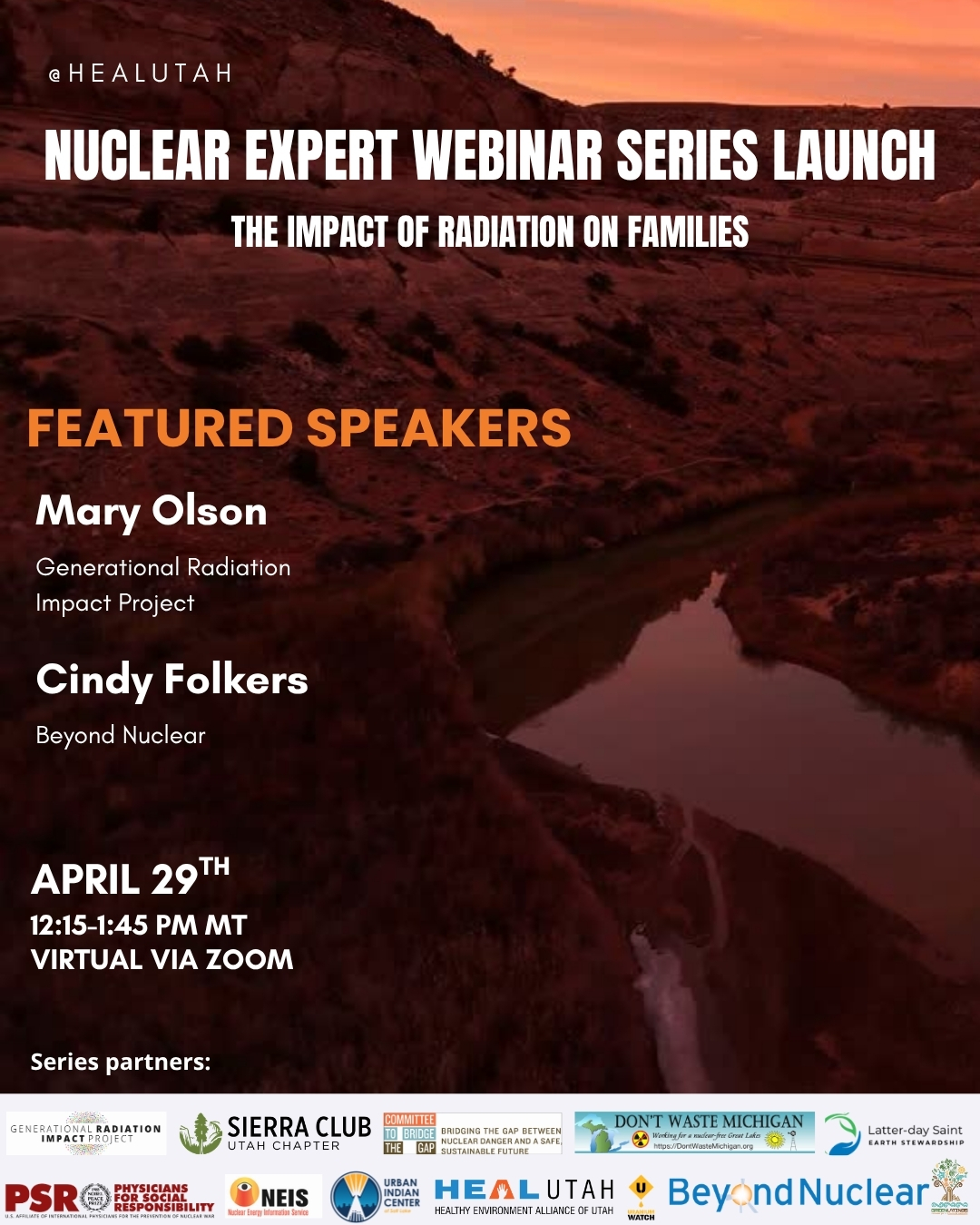
29 April – Nuclear Expert Webinar #1 – Radiation Impacts on Families with Mary Olson and Cindy Folkers
- 12:15 PM MT – 1:45 PM MT
- Location: Virtual – REGISTER TODAY

4 May -West Suburban Peace Coalition to discuss Iran war at May Educational Forum
Monday, May 4, 7:00 – 8:00 PM Central Standard Time
Title: : How Trump’s Narrative Tries to Shape the Reality of the War on Iran.
Contact Walt Zlotow, zlotow@hotmail.com 630 442 3045 for further information
14 May – online event From Bombs to Data Centres: the Face of Nuclear Colonialism

Pine Ridge Uranium is the real threat, not Tehran- Tell Burgum: Stop the Extraction.
Chernobyl: The Lost Tapes – A good documentary on Chernobyl on SBS available On Demand for the next 3 weeks– https://www.sbs.com.au/ondemand/tv-program/chernobyl-the-lost-tapes/2352741955560
To see nuclear-related stories in greater depth and intensity – go to https://nuclearinformation.wordpress.com
-
Archives
- April 2026 (317)
- March 2026 (251)
- February 2026 (268)
- January 2026 (308)
- December 2025 (358)
- November 2025 (359)
- October 2025 (376)
- September 2025 (257)
- August 2025 (319)
- July 2025 (230)
- June 2025 (348)
- May 2025 (261)
-
Categories
- 1
- 1 NUCLEAR ISSUES
- business and costs
- climate change
- culture and arts
- ENERGY
- environment
- health
- history
- indigenous issues
- Legal
- marketing of nuclear
- media
- opposition to nuclear
- PERSONAL STORIES
- politics
- politics international
- Religion and ethics
- safety
- secrets,lies and civil liberties
- spinbuster
- technology
- Uranium
- wastes
- weapons and war
- Women
- 2 WORLD
- ACTION
- AFRICA
- Atrocities
- AUSTRALIA
- Christina's notes
- Christina's themes
- culture and arts
- Events
- Fuk 2022
- Fuk 2023
- Fukushima 2017
- Fukushima 2018
- fukushima 2019
- Fukushima 2020
- Fukushima 2021
- general
- global warming
- Humour (God we need it)
- Nuclear
- RARE EARTHS
- Reference
- resources – print
- Resources -audiovicual
- Weekly Newsletter
- World
- World Nuclear
- YouTube
-
RSS
Entries RSS
Comments RSS
 nuclear-news