Small nuclear reactors for Scotland? Expensive, unpopular, and not even small
Nuclear power in Scotland: ‘Small modular reactors’ are expensive, will be
unpopular and they’re not even small – Dr Richard Dixon. The final
shutdown of reactor number four at Hunterston and the announcement the two
reactors at Torness will cease operating in 2028 have led nuclear
enthusiasts to talk even more about small modular reactors. Even if you
were not worried about creating yet more radioactive waste for which we
have no long-term storage solution and the £132bn public-money bill for
decommissioning and you were not worried about terrorists blowing up
reactors or just the likely delays and cost over-runs, these small(ish)
reactors still aren’t likely to become a reality.
Scotsman 20th Jan 2022
Nuclear Safety Authority (ASN) warns France on problems, costs, safety in nuclear projects
The French nuclear industry will need a “Marshall plan” to carry out new
projects, warned Wednesday the Nuclear Safety Authority (ASN), which also
calls on France to re-examine the scheduled closure of 12 reactors and
alert on increasingly fragile management of spent fuel from the EDF fleet.
Les Echos 19th Jan 2022
Doomsday clock stays at 100 seconds to midnight.

What the Doomsday Clock is really counting down to, The number of human-made existential risks has ballooned, but the most pressing one is the original: nuclear war. Vox, By Bryan Walsh @bryanrwalsh Jan 21, 2022 One hundred seconds to midnight. That’s the latest setting of the Doomsday Clock, unveiled yesterday morning by the Science and Security Board of the Bulletin of the Atomic Scientists.
That matches the setting in 2020 and 2021, making all three years the closest the Clock has been to midnight in its 75-year history. “The world is no safer than it was last year at this time,” said Rachel Bronson, the president and CEO of the Bulletin of the Atomic Scientists. “The Doomsday Clock continues to hover dangerously, reminding us how much work is needed to ensure a safer and healthier planet.”
As for why the world is supposedly lingering on the edge of Armageddon, take your pick. Covid-19 has amply demonstrated just how unprepared the world was to handle a major new infectious virus, and both increasing global interconnectedness and the spread of new biological engineering tools mean that the threat from both natural and human-made pathogens will only grow. Even with increasing efforts to reduce carbon emissions, climate change is worsening year after year. New technologies like artificial intelligence, autonomous weapons, even advanced cyberhacking present harder-to-gauge but still very real dangers.
The sheer number of factors that now go into Bulletin’s annual decision can obscure the bracing clarity that the Doomsday Clock was meant to evoke. But the Clock still works for the biggest existential threat facing the world right now, the one that the Doomsday Clock was invented to illustrate 75 years ago. It’s one that has been with us for so long that it has receded into the background of our nightmares: nuclear war — and the threat is arguably greater at this moment than it has been since the end of the Cold War.
The Doomsday Clock, explained
The Clock was originally the work of Martyl Langsdorf, an abstract landscape artist whose husband Alexander had been a physicist with the Manhattan Project. He was also a founder of the Bulletin, which began as a magazine put out by scientists worried about the dangers of the nuclear age and is now a nonprofit media organization that focuses on existential risks to humanity……………………. https://www.vox.com/22893594/doomsday-clock-nuclear-war-climate-change-risk
European States opposing inclusion of nuclear in ‘green’ taxonomy warn on diverting investement from genuinely clean technologies.

Austria, Denmark, Luxembourg and Spain continue to reject natural gas and
nuclear in the EU’s sustainable finance taxonomy, their energy and
climate ministers have said in response to a recent draft proposal.
The European Commission’s proposed conditions under which investments in
natural gas-fired and nuclear power plants would be deemed “green” in a
draft updated taxonomy sent “the wrong signals to financial markets and
seriously risks being rejected by investors,” the ministers said late on
Thursday.
The taxonomy aims to help investors identify suitable projects
that support the EU’s climate goals. It does not require investments in
projects that meet the criteria nor prohibit investments in projects that
do not. The ministers argued, however, that the long lifetimes of natural
gas and nuclear plants meant that including them in the taxonomy could lock
in their use for many decades and divert investments away from renewables.
Montel 21st Jan 2022
https://www.montelnews.com/news/1294402/four-eu-nations-reject-gas-nuclear-in-green-taxonomy
Does the Flamanville EPR nuclear reactor have a design fault?

Nuclear: is the Flamanville EPR vessel poorly designed? In its edition of
Wednesday January 19, 2022, Le Canard Enchaîné details the problem on the
Taishan EPR and links it to the Cotentin site. “EDF is struggling to sleep
off its nuclear”. This is the title at the top of page 3 of the Chained
Duck of this Wednesday, January 19, 2022.
Is this a new article following the announcement, a week ago, of a delay and an additional cost of 300
million euros for the construction of the future Flamanville EPR reactor?
No, there is no question of re-welding operations taking longer than
expected.
“The energy company must face a formidable puzzle encountered on
the reactor vessel, where nuclear fission takes place”, immediately
announces the journalist Hervé Liffran. The concern was flushed out
following an incident on the other side of the world, in China. The Taishan
nuclear power plant, with the world’s first operating EPR reactor, was shut
down on July 30, 2021, after damaged fuel rods caused a buildup of
radioactive noble gases in the reactor’s primary circuit .
La Presse de la Manche 20th Jan 2022
In Georgia, Bloated Costs Take Over a Nuclear Power Plant and a Fight Looms Over Who Pays,
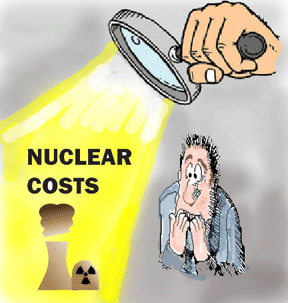
In Georgia, Bloated Costs Take Over a Nuclear Power Plant and a Fight Looms Over Who Pays,
Vogtle’s two new nuclear reactors are six years late and at least $16 billion over their original budget. The plant will have no direct carbon footprint, but critics say there are much cheaper ways to reduce emissions.
Inside Climate News, By James Bruggers, January 21, 2022 Ballooning cost overruns and construction delays at Georgia Power Co.’s Vogtle nuclear project threaten to cost the state’s electricity consumers billions of dollars in the decades to come, a new think tank report concludes.
The report, from the Institute for Energy Economics and Financial Analysis, a nonprofit advancing a sustainable energy economy, builds a case that stockholders of the company should take the lead on construction and carry much of the financial load, rather than ratepayers.
Once estimated to cost $14 billion, the price tag for two new reactors at Georgia Power’s Plant Vogtle property has climbed past $30 billion, and both units will be more than six years late in coming online, the institute reported after combing through public records including testimony at a Georgia Public Service Commission hearing in December. The plant already has two existing nuclear power units that began producing electricity in the 1980s.
Public Service Commission staff and consultants have blamed the project’s high costs and construction delays on Georgia Power, which is the lead partner in its construction and eventual operation, and a subsidiary of Southern Company, the energy policy institute found.
Georgia Power was warned in 2008 that using an unproven reactor design would likely cause overruns and delays, said David Schlissel, the report’s author and the institute’s director of resource planning and analysis. “However, the company challenged and the commission disregarded these warnings,” said Schlissel, a lawyer who has been a frequent expert witness in legal proceedings.
Commission spokesman Tom Krause said he could not comment directly on the institute’s report or the commission’s ongoing quasi-judicial proceedings that are designed to monitor the construction, which the Atlanta Journal Constitution has described as the largest project in Georgia history. The commission regulates Georgia Power, and as such, has a major say in Georgia energy policy.
Krause said future hearings, when the project is farther along, will be held to help the commission, made up of five members who are elected statewide, determine which of the Vogtle costs should be allocated to ratepayers, as opposed to shareholders.
“That will be a very significant docket before the PSC,” Krause said.
“I imagine it will be a knock-down, drag-out fight,” Schlissel said. “I have heard a fair amount of the documentation, and just reading what the PSC staff has been saying, clearly this project has been mismanaged.”
The institute, based in Lakewood, Ohio, is not an official party in those proceedings and its report was not prepared for any organization that is directly participating in them, Schlissel said.
Georgia Power’s customers have already paid more than $3.5 billion for the two units through a rider on their electric bills intended to cover financing charges, the report found.
“Our new Vogtle units will be clean energy sources and produce zero air pollution,” said Jeff Wilson, Georgia Power spokesman. “That’s why we remain fully committed to getting the job done, and getting it done right, with safety and quality our top priority.”
He also minimized the plant’s impact on customers’ rates.
The two units were originally to be placed in service in 2016 and 2017. The owners now estimate commercial operation will not begin until 2022 and 2023, according to the report. They are to be the first new commercial nuclear power units in the United States in the last three decades.
The institute’s report quoted a commission hearing in December at which an independent monitor of the project, Don Grace, told the commission that Georgia Power had on more than one occasion used low forecasts as a way to “try and continue to justify the project.”………….
Grace, in his testimony, described developing the plant as similar to driving “uphill in the snow.”
And the wheels are turning. Money is being spent and you’re trying to get to the goal of getting to the top of the hill,” he said. “But in some cases you’re making slow progress, but not at the rate you expected. And in some cases you’re actually slipping backwards somewhat.”……………………… https://insideclimatenews.org/news/21012022/georgia-power-vogtle-nuclear/
World’s largest iceberg melted – now one trillion tonnes of ice – gone

The monster iceberg A68 was dumping more than 1.5 billion tonnes of fresh water into the ocean every single day at the height of its melting. To put that in context, it’s about 150 times the amount of water used daily by all UK citizens.
A68 was, for a short period, the world’s biggest iceberg. It covered an area of nearly 6,000 sq km (2,300 sq miles) when it broke free from Antarctica in 2017. But by early 2021, it had vanished. One trilliontonnes of ice, gone.
BBC 20th Jan 2022
Class action suit against Tokyo Electric Power Company Holdings Inc. (TEPCO) by 6 thyroid cancer sufferers
6 people to sue TEPCO over thyroid cancer after Fukushima nuclear disaster
January 21, 2022 (Mainichi Japan) TOKYO — A group of six young men and women is set to file a class action suit against Tokyo Electric Power Company Holdings Inc. (TEPCO) claiming that they developed thyroid cancer due to exposure to radiation emanating from the Fukushima nuclear disaster, and demand the utility pay a total of 616 million yen (about $5.4 million) in compensation.
It will be the first group lawsuit in Japan by those who were minors at the time of the 2011 nuclear disaster and have since been diagnosed with thyroid cancer.
The plaintiffs, now aged between 17 and 27, were living in Fukushima Prefecture when the nuclear meltdowns occurred at the Fukushima Daiichi Nuclear Power Station in March 2011, and developed thyroid cancer after the disaster. They are filing the damages suit with the Tokyo District Court on Jan. 27, according to the legal counsel for the plaintiffs who revealed the plan at a press conference on Jan. 19.
An expert investigation committee set up by the Fukushima Prefectural Government has not recognized the causal relationship between radiation exposure from the Fukushima disaster and thyroid cancer, and whether there is such a correlation could be the focal issue in the lawsuit.
The six plaintiffs were aged between 6 and 16 at the time of the nuclear disaster. They were diagnosed with thyroid cancer between 2012 and 2018. Two of them had one side of their thyroid removed, while the other four had their thyroid fully extracted and need to take hormonal drugs for the rest of their lives. One of the patients had cancer spread to their lungs. Some of them currently reside in Tokyo and Kanagawa Prefecture………
According to the legal counsel, the cancer discovery rate in the Fukushima Prefecture survey stands several tens of times higher than usual. While the prefectural government points to the possibility of “overdiagnosis” through which many cancer cases requiring no treatment have been found, the plaintiffs’ cancer has actually progressed, the legal team asserted. The lawyers argue that none of the six plaintiffs’ cancer is hereditary, and that it is extremely highly likely that they developed their conditions due to the nuclear disaster.
In past pollution lawsuits including those over Minamata disease, there is a court precedent in which the company responsible for the pollution was ruled liable for compensation unless it could prove there was no causal relationship between the contamination and the plaintiffs’ diseases. The attorneys for the upcoming lawsuit claim that this decision could also be applied to nuclear plant accidents and that TEPCO should bear the burden of proving the absence of a causal link between radiation exposure and thyroid cancer.
Kenichi Ido, head of the legal counsel, commented, “Some plaintiffs have had difficulties advancing to higher education and finding jobs, and even given up on their dreams for their future.”……………. (Japanese original by Kazuhiro Toyama, Tokyo City News Department) https://mainichi.jp/english/articles/20220121/p2a/00m/0na/018000c
Options for Australia’s nuclear submarines – all of them impractical

Nuclear-powered submarines for Australia: what are the options? The Strategist , 20 Jan 2022, Pete Sandeman The political and strategic ramifications of the AUKUS pact involving the US, UK and Australia continue to reverberate, but the details of how Australia will acquire nuclear-powered submarines (SSNs) have often been overlooked. There are daunting technical, industrial and financial challenges on the long road to joining that club.
Even the acquisition of conventional submarines isn’t easy and projects completed on time and budget are rare. Nuclear propulsion adds another layer of complexity and cost, and the engineering challenge has been described as more demanding than building the space shuttle. There are good reasons why SSN ownership is limited to a small group of elite nations—the US, Russia, China, the UK, France and India. (With considerable French assistance, Brazil is on track to have its first nuclear boat in the late 2020s.)
………. Some commentators suggest that Australia’s first boats at least could be bought off UK or US production lines. Alternatively, old or ‘surplus’ submarines could be leased until new vessels are available. These assumptions are at odds with the US Navy’s and Royal Navy’s struggles with bringing new boats into service and maintaining ageing vessels.
…….Defence Minister Peter Dutton has said the RAN is considering leasing boats from the USN or RN but that’s far from a certainty. The RN is already severely short of active boats—nominally down to six SSNs, and able to field two or three on a good day. The USN is trying to maintain its existing force, struggling to build enough new Virginia-class SSNs while its Los Angeles-class boats are phased out. However supportive of Australia the UK may be, it has no suitable boats available to lease. The US has a far bigger fleet with 28 Los Angeles boats still active, but its force is already overcommitted and Washington is unlikely to offer anything, except perhaps a recently retired boat as a static training vessel.
Neither the US nor UK keeps submarines ‘in reserve’. The UK has already expensively extended the 1980s-vintage Trafalgar-class boats well past their 30th birthdays. None of the growing collection of decommissioned hulks could be returned to service with all the funds and will in the world. Their nuclear fuel is spent, and they would need colossally expensive refits and refuelling. More critically, submarines have finite hull lives. Every dive fatigues the pressure hull and pipework to a point where safe diving becomes severely restricted or the boat becomes unseaworthy. Older boats become increasingly hard to maintain and struggle to retain their all-important minimal acoustic signature.
The US has a more effective submarine dismantling program than the UK and its LA-class boats are gradually being scrapped. The inactive boats that remain intact are equally tired and some were withdrawn from service prematurely to avoid the cost of mid-life refuelling. There’s a slim chance that one or two of these boats could see further service with the RAN but only at enormous expense, and refitting them would put more strain on overburdened US industrial capacity.
………. Some suggest the Astute’s the best solution, optimistically proposing that the first couple be built in the UK before technology transfer enables the remaining six to be made in Australia. …… Unfortunately, there are almost insurmountable obstacles to the class ever numbering more than seven.
In the UK, completion of the remaining Astute-class boats is finely balanced with the construction of the Dreadnought-class ballistic missile submarines (SSBNs) and there’s not space in the shipyard or skilled people available to add additional boats….
People didn’t prepare for nuclear submarine exports and AUKUS was a bolt from the blue.
Assuming money was no object, new engineers could be recruited and the Barrow facilities could be enlarged, the project would still be in trouble because the Astute’s PWR-2 reactor no longer meets modern safety benchmarks and production has almost ceased……
Even if additional PWR-2 reactors could be acquired and the Astute boats could be constructed in Australia, they’d be semi-obsolete when they began to arrive in service by the late 2030s.
………….. Although the USN benefits from an established design and an industrial base that’s vastly more efficient than that of the RN, the yards and supply chain will need to expand significantly to fulfil the ambitious plans to grow the USN fleet. A recent report to Congress noted that ‘observers have expressed concern about the industrial base’s capacity for executing such a workload without encountering bottlenecks or other production problems in one or both of these programs’.
The USN also has issues maintaining its existing submarines. …………………..
When the AUKUS announcement was made, the Australian government promised to acquire at least eight nuclear submarines to be built by ASC in South Australia. There’s limited submarine building experience left at ASC since the Collins boats were completed in the early 2000s. The deal with the French to build Attack-class boats included technology transfer to regenerate the skills base. Whatever SSN design is selected, greater assistance will be needed from the UK or US. With limited nuclear infrastructure, Australia is unlikely to be able to enrich uranium to fuel the reactors. It’s likely that the reactor compartments will have to be imported pre-fabricated from the US or UK. The entire submarine enterprise will require Australia to establish a new safety and regulatory framework.
………. Former prime minister Malcolm Turnbull said of the AUKUS deal: ‘There is no design, no costing, no contract. The only certainty is that we won’t have new submarines for 20 years, and their cost will be a lot more than the French subs.’ This is broadly correct. The eventual acquisition of SSNs is possible, but there are many potential showstoppers. The single biggest factor will probably be just how much the US government is willing to prioritise industrial assistance to the RAN at the expense of growing and supporting its own submarine fleet. The US has only ever exported nuclear technologies to Britain and must amend its laws to do the same for Australia.
A couple of elderly SSNs might be available for lease in the 2030s, but realistically it will be the 2040s before the RAN has sufficient SSNs to exert a strategic effect. The geopolitical situation could be vastly different then, and growing Chinese power and influence won’t wait for others to attain parity. The Australian public will also have to buy in to a project needing political commitment for decades and the RAN will have to lean heavily on allies and provide an enormous budget to cover the true financial costs of nuclear ownership.
Pete Sandeman is the main writer and editor of the UK site Navy Lookout, which he founded in 2007. He is a regular contributor to Warships International Fleet Review magazine and a member of the UK’s Independent Defence Media Association. This is an edited version of a piece he wrote for Navy Lookout. https://www.aspistrategist.org.au/nuclear-powered-submarines-for-australia-what-are-the-options/
Nanoplastic pollution found at both of Earth’s poles for first time
Nanoplastic pollution found at both of Earth’s poles for first time
Tiny particles including tyre dust found in ice cores stretching back 50 years, showing global plastic contamination
UK FS: global coalition against Russia, China; “recreating USSR”; Ukraine new Afghanistan, Chechnya — Anti-bellum
One doesn’t get more provocative than this, especially the reference to Chechnya. From only the second female foreign secretary of the UK. (Margaret Beckett, who served barely a year, preceding her in that category.) UK foreign secretary compares Russia’s potential invasion of Ukraine with Afghan war Foreign Secretary Liz Truss has warned Russia that invading […]
UK FS: global coalition against Russia, China; “recreating USSR”; Ukraine new Afghanistan, Chechnya — Anti-bellum
Changing from a consumer economy to a conserver economy – painful but necessary


Political leadership is about telling it as it is, not pretending it is all painless.
Adjusting back to a sustainable consumption path would be painful in the short term, but not in the longer term — and it will be a lot less painful than continuing with Plan A.
Dieter Helm: One definition of madness is said to be persisting with Plan A in the face of all the evidence that it is not working, and avoiding even thinking about a Plan B. But, after 30 years and 26 COPs — Conferences of the Parties to the UN’s 1992 Framework Convention on Climate Change — that pretty much sums up our approach to climate change.
Every year since1990, we have added another two parts per million to the concentration of
carbon dioxide in the atmosphere — including in the lockdown years 2020 and 2021. The case for “one more heave” looks pretty slim.
The current preoccupation with economic growth based on stimulating demand, Keynesian-style, with negative real interest rates and quantitative easing, and ever greater borrowing for the next generation to repay, suggests the omens are not good.
This sort of economics is pretty obviously not environmentally sustainable. Yet the obvious consequence is ignored: it will not be sustained. With 3C or more of warming, the loss of a big chunk more of biodiversity, and the rainforests gone, all those new ideas and technologies will not be enough to stave off the costs of the environmental downhill our unsustainable consumption is causing.
Political leadership is about telling it as it is, not pretending it is all painless. Adjusting back to a sustainable consumption path would be painful in the short term, but not in the longer term — and it will be a lot less painful than continuing with Plan A.
FT 19th Jan 2022
https://www.ft.com/content/13702f42-a923-4cd8-a6c7-03f775a0742b
Robot for removing nuclear fuel debris at Fukushima Daiichi
19 janv. 2022
Footage of a robot developed to remove nuclear fuel debris from the No. 2 reactor at the Fukushima Daiichi nuclear power plant is released.
Six people to sue Tepco over thyroid cancer after Fukushima disaster
Jan 19, 2022
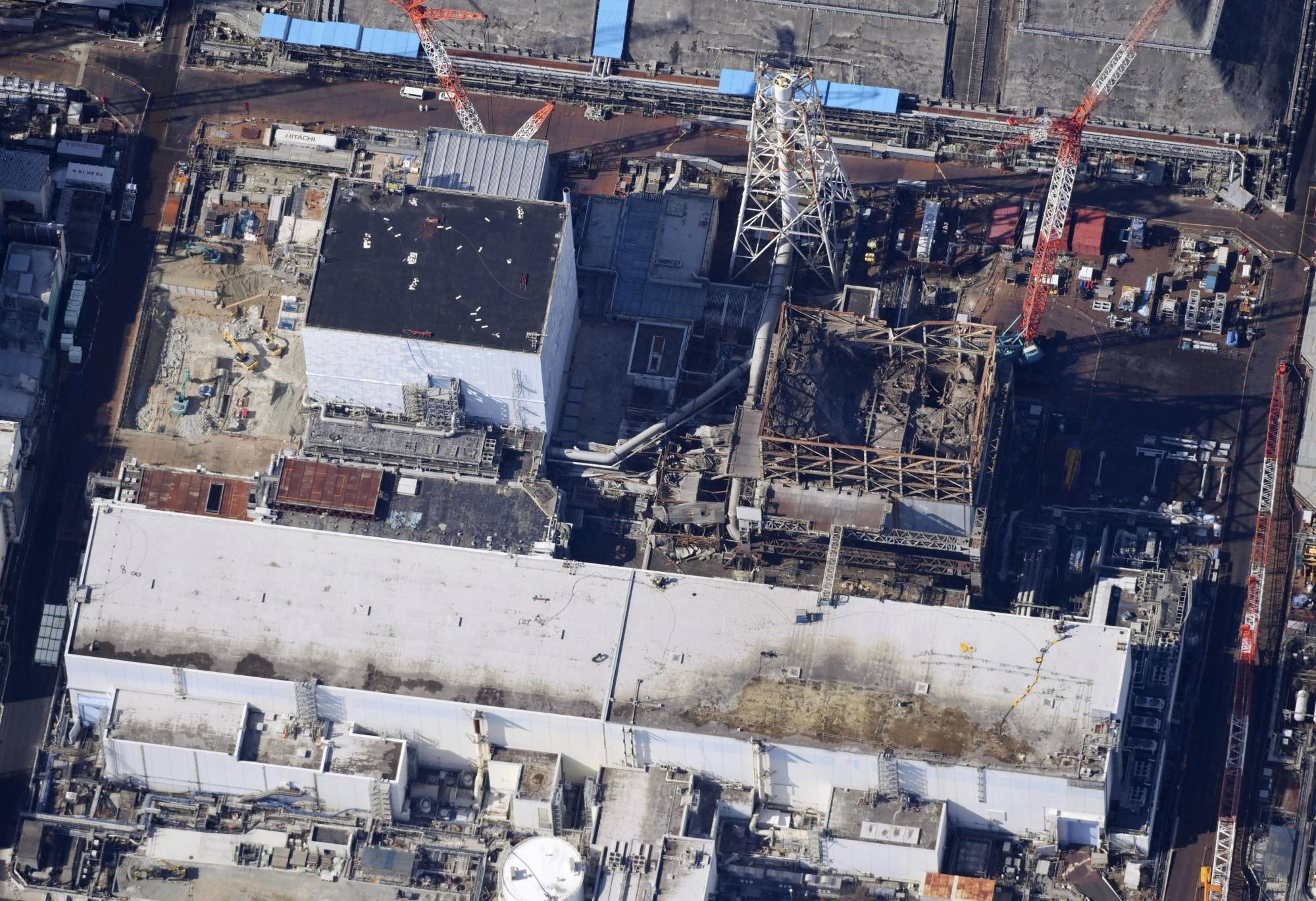
Six people are set to sue Tokyo Electric Power Company Holdings Inc. over thyroid cancer that they claim they developed due to exposure to radioactive substances released from the 2011 triple reactor meltdown at its stricken Fukushima No. 1 nuclear power plant, their lawyers said Wednesday.
The plaintiffs, who were between the ages of 6 and 16 at the time of the nuclear disaster and lived in Fukushima Prefecture, home to the plant, will seek ¥616 million in total damages.
This is believed to be the first lawsuit involving Fukushima Prefecture residents suing Tepco over thyroid cancer in connection with the nuclear disaster.
The six plan to file the suit with Tokyo District Court on Jan. 27, the lawyers said during a news conference.
They currently live in Tokyo, Kanagawa Prefecture and Fukushima Prefecture. Four of them have had their entire thyroid glands removed, the lawyers said. Some have undergone multiple rounds of surgery because of cancer metastasis or recurrence, they said.
A health survey by the Fukushima prefectural government, which covered some 380,000 people age 18 or younger at the time of the disaster, showed in October last year that 266 people had cancer or suspected cancer.
Some experts have pointed out the possibility of overdiagnosis, or the discovery of cancers that do not require treatment. The lawyers claimed that the plaintiffs developed cancer due to the nuclear disaster and needed to undergo surgeries.
A review committee on the prefectural health survey has said that the thyroid cancer apparently has nothing to do with what happened at the Fukushima No. 1 plant in March 2011.
Kenichi Ido, a former judge who leads the lawyers, criticized the Japanese government for determining that there has been no health damage from the disaster.
Lawyer Hiroyuki Kawai said that “there is strong social pressure to believe that cancer is not caused by the accident, so it took a lot of courage for the six plaintiffs to file the lawsuit.”
-
Archives
- February 2026 (228)
- January 2026 (308)
- December 2025 (358)
- November 2025 (359)
- October 2025 (376)
- September 2025 (258)
- August 2025 (319)
- July 2025 (230)
- June 2025 (348)
- May 2025 (261)
- April 2025 (305)
- March 2025 (319)
-
Categories
- 1
- 1 NUCLEAR ISSUES
- business and costs
- climate change
- culture and arts
- ENERGY
- environment
- health
- history
- indigenous issues
- Legal
- marketing of nuclear
- media
- opposition to nuclear
- PERSONAL STORIES
- politics
- politics international
- Religion and ethics
- safety
- secrets,lies and civil liberties
- spinbuster
- technology
- Uranium
- wastes
- weapons and war
- Women
- 2 WORLD
- ACTION
- AFRICA
- Atrocities
- AUSTRALIA
- Christina's notes
- Christina's themes
- culture and arts
- Events
- Fuk 2022
- Fuk 2023
- Fukushima 2017
- Fukushima 2018
- fukushima 2019
- Fukushima 2020
- Fukushima 2021
- general
- global warming
- Humour (God we need it)
- Nuclear
- RARE EARTHS
- Reference
- resources – print
- Resources -audiovicual
- Weekly Newsletter
- World
- World Nuclear
- YouTube
-
RSS
Entries RSS
Comments RSS
 nuclear-news