Aukus: France pulls out of UK defence talks amid row
Aukus: France pulls out of UK defence talks amid row, BBC, By Alex Therrien, 21 Sep 21,
BBC News France’s defence minister has cancelled talks with her UK counterpart as the row continues over a new security deal between Britain, the US and Australia.
Paris is angry after Australia signed the Aukus pact to build nuclear-powered submarines, pulling out of a major contract with France in the process.
UK PM Boris Johnson said France had nothing to worry about from the deal.
But Florence Parly’s meeting with UK Defence Secretary Ben Wallace in London this week has been called off.,,,,,,,,,,, Lord Ricketts, a former British ambassador to France who was due to co-chair the two days of talks, confirmed the meeting between Mr Wallace and Ms Parly had been “postponed to a later date”.
……… In a rare step among allies, French President Emmanuel Macron ordered the recall of the French ambassadors to Washington and Canberra.
The European Union has said it was “analysing” the impact of the Aukus agreement on its trade negotiations with Australia, which are due to resume in October.
BBC Brussels correspondent Jessica Parker said it appeared the EU had hardened up its position over the weekend, as the extent of France’s anger became clear.
She said the European Commission wouldn’t elaborate on what “analysing” the impact of Aukus could actually mean for the trade talks with Australia – but the language might lead to speculation that negotiations could even be suspended…
The agreement means Australia will become just the seventh nation in the world to operate nuclear-powered submarines.
The pact will also see the allies share cyber capabilities, artificial intelligence and other undersea technologies.
But it has been criticised by China, which has accused the three powers of having a “Cold War mentality”…………. https://www.bbc.com/news/uk-58620220
French ambassador says Scott Morrison gave no warning on the nuclear submarine deal
‘Maybe we’re not friends’: French Ambassador claims ScoMo offered no warning about AUKUS deal A powerful French official has slammed Scott Morrison, accusing the Prime Minister of one thing to do with the submarine deal. news.com.au , Helena Burke, 20 Sep 21
The former French Ambassador to Australia has ripped into Scott Morrison for his defence of the AUKUS submarine deal, claiming the Prime Minister lied about warning France about it.
Jean-Pierre Thebault, who had been the French Ambassador in Canberra since 2020, was recalled last week after France expressed outrage at being left out of the new nuclear submarine deal between the US, UK, and Australia.
Speaking to Radio National on Monday, Mr Thebault said France had been completely blindsided by Mr Morrison’s decision to accept the new deal.
“We discover(ed) through the press that the most important person in the Australian government kept us in the dark intentionally until the last minute and was not willing to at least have the decency to enter conversation about the alternative,” Mr Thebault said.
“This is not an Australian attitude towards friends.”
Maybe we’re not friends.”
Mr Morrison had previously rejected that he had not warned France about the new deal, insisting he told French President Emmanuel Macron in June that Australia might scrap its original submarine agreement,,,,
But the French Ambassador insisted France had never been warned about the potential for a new deal which would exclude them. https://www.news.com.au/national/politics/maybe-were-not-friends-french-ambassador-claims-scomo-offered-no-warning-about-aukus-deal/news-story/467293b479eca4741c116ba5ced54751
Scientists still don’t know how far melting in Antarctica will go – or the sea level rise it will unleash
Chen Zhao and Rupert Gladstone
The Antarctic ice sheet is the largest mass of ice in the world, holding around 60% of the world’s fresh water. If it all melted, global average sea levels would rise by 58 metres. But scientists are grappling with exactly how global warming will affect this great ice sheet.
Poland’s nuclear folly.

Government pursues six reactors while blocking opportunities for renewables
Alternatives in the form of citizen energy projects struggle within a capitalistic scheme based on nuclear energy or offshore energy sourcing. Despite the enormous potential of solar and wind energy, the Polish government blocked developing this infrastructure in 2016 – the so-called Distance Act was adopted. The law stipulates that wind turbines with a capacity of more than 40 kW can only be built at a distance of at least 10 times their height (including the rotor with the blades) from residential and mixed-use buildings, as well as areas of high environmental value. In effect, only large, off-shore wind farms can be built on the Baltic sea. There is a hope in increasing interest in solar citizen energy, with the government starting the “My electricity” programme, financing photovoltaic installations.
The European Green Deal is also concerned with energy security and independence. Although it does not include the aspect of nuclear energy in decarbonisation, an official letter to Ursula von der Leyen was recently written as part of an initiative by several countries, including Hungary, Slovakia, Romania, Bulgaria, the Czech Republic, Cyprus, Malta and Poland, to include nuclear and gas in green investments as a strategy for fighting global warming.
In Poland, it is hard to break through to the public discussion with anti-nuclear arguments. The government maintains its willingness to invest in nuclear energy despite its unprofitability, high costs, risks and lack of public support in order to replace coal-fired power plants with nuclear ones.
Few people in Poland are interested in discussing the sourcing of the uranium and connect this problem with energy security. Few people care about radioactive waste. We need more discussions, focusing not only on the costs and time of building a nuclear power plant, but also energy security, the consequences of failure and the non-sustainability of uranium. We need anti-nuclear rhetoric. Will we learn our Chernobyl lessons?
Poland’s nuclear folly, https://beyondnuclearinternational.org/2021/09/20/polands-nuclear-folly/ Refusing to learn the lessons from Chernobyl, Poland embarks on a rash nuclear power program
By Beata Cymerman,
It was April 28, 1986, early morning in Poland. The radiation monitoring station in Mikołajki, Mazury area (north-eastern region of Poland) showed that the radioactivity in the air was 550,000 times higher than the day before. The radioactive cloud from Chernobyl had travelled to Poland. The story of the catastrophe began here.
The Chernobyl disaster in Poland
The government of Poland didn’t immediately release an official statement regarding the catastrophe. Poland was a satellite state of the Soviet Union. After the day of the explosion, April 26, no information was presented by the Polish media. One of the first people informed about the catastrophe was Prof. Jaworowski – Chairman of the Scientific Council of the Central Laboratory for Radiological Protection (CLOR) in Warsaw. He obtained information about the catastrophe from BBC radio and connected it to the unusual measurements from the Mikołajki station.
Together with the President of Polish National Atomic Agency, he set out to monitor the situation. After taking several more measurements on the same day, it became clear that they were dealing with a high radiation risk. Despite the obstacles presented by the Soviet bureaucratic system and with the help of Jaworski’s wife, who was affiliated with the Polish Academy of Science, they managed to directly inform the Prime Minister of their findings.
Continue readingUK’s nuclear industry decline is a permanent process
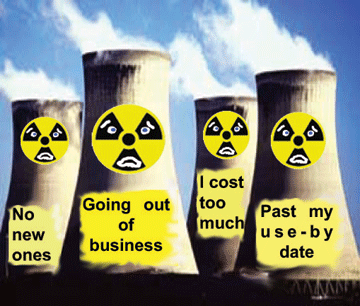
Cash-strapped nuclear industry has no answers to Britain’s energy shortages. While the issues limiting the UK’s nuclear power plant capacity may be temporary, its broader pattern of decline is not. As power
prices spike to record levels this week, one vital corner of Britain’s energy supply is failing to operate at full tilt. A nuclear reactor at Hartlepool has been floundering over an issue with a gas turbine, while another at Heysham 1 is offline after a forced outage last month.
Overall, the capacity of Britain’s ageing nuclear fleet of reactors is down by about one-third (5.2GW compared to 8GW) this week amid planned maintenance and unexpected problems. It is only adding to pressure on officials attempting to balance the electricity system as gas prices soar to record highs on a supply crunch, and wind output drops as weather calms.
But while the issues limiting nuclear power plant capacity may be temporary, its broader pattern of decline is not. The industry, which produces about 18pcof UK power annually, sits at a crossroads amid a rapidly evolving energy system. Most of the ageing nuclear fleet is set to shut down by the end of
the decade and several within the next few years.
Whether and how it will be replaced is uncertain, with industry critics accusing the Government of
dragging its feet at a time when Britain needs low carbon power to fill gaps in wind and solar generation. In a bid to help the flailing sector, ministers are set to bring forward a new finance mechanism which supporters believe can help reduce the costs of large nuclear projects. Consumers
would pay for the projects upfront while they are being built.
This,however, is sure to be a much tougher sell this winter given the soaring wholesale costs likely to boost bills. Whitehall is aiming to bring forward at least one large-scale nuclear project this parliament, and is puttingsome money into developing the next generation of technology: Advanced Modular Reactors and small modular reactors (SMRs).
So, does it matter if more nuclear power is not developed? Many experts say yes, given the stable
role they can provide. But that doesn’t mean it should be at any cost……….
Telegraph 15th Sept 2021
Samuel Lawrence Foundation loses court case to keep spent fuel pools as safety backup at San Onofre nuclear station
Judge tosses out lawsuit that sought to stop San Onofre nuclear plant dismantlement, Ruling says Coastal Commission properly granted permit, San Diego Tribune, BY ROB NIKOLEWSKI , . 20, 2021
Deconstruction work at the now-shuttered San Onofe Nuclear Generating Station — known as SONGS for short — will continue after a judge in Los Angeles County turned back a lawsuit filed by an advocacy group that looked to put a halt to it.
Deconstruction work at the now-shuttered San Onofe Nuclear Generating Station — known as SONGS for short — will continue after a judge in Los Angeles County turned back a lawsuit filed by an advocacy group that looked to put a halt to it.
In a 19-page decision, Los Angeles County Superior Court Judge Mitchell Beckloff ruled last week the California Coastal Commission acted properly when it granted a permit in 2019 to Southern California Edison — the operators of the plant — to proceed with dismantlement efforts.
The Samuel Lawrence Foundation filed the suit, arguing the commission violated its own regulations and provisions by issuing the permit………….
Samuel Lawrence Foundation president Bart Ziegler said in an email that his group “will continue to push for strict monitoring, protocols and handling facilities at Edison’s nuclear waste dump.”
The heart of the lawsuit centered on two spent fuel pools that are scheduled to be torn down.
At commercial nuclear power plants, when the highly radioactive fuel rods used to generate electricity lose their effectiveness, operators place the assemblies in a metal rack that is lowered about 40 feet into a “wet storage” pool, typically for about five years, to cool.
Edison has since taken the assemblies out of the pools, placed them into stainless steel canisters and moved them into two “dry storage” facilities on the north end of the plant. One facility holds 50 canisters and another, more recently constructed site, holds 73 canisters.
Edison says now that the spent fuel has been transferred to dry storage, the pools are unnecessary and should be dismantled.
The Samuel Lawrence Foundation argued Edison should keep the pools in case the canisters ever get damaged or degrade over time………..
Despite issuing the permit and related measures, the commission has complained about being put in a tough position.
Edison says now that the spent fuel has been transferred to dry storage, the pools are unnecessary and should be dismantled.
Schwartz said until the federal government comes up with a long-term storage site, “we are forced to live with the increased risks of storing (waste) on our coast. Commissioners and staff have communicated to the (Nuclear Regulatory Commission) the urgency of moving these spent fuel facilities out of the coastal hazard zone, and we will continue to press the NRC on this issue.”
There are 3.55 million pounds of used-up fuel in the canisters at SONGS, which is located between the Pacific and Interstate 5.
But keeping the waste on-site is not unique to San Onofre. About 80,000 metric tons of spent fuel has stacked up at 121 commercial nuclear sites in 35 states………..
Under a “special condition” agreed to in 2015, the commission is allowed by 2035 to revisit whether the storage site should be moved to another location in case of rising sea levels, earthquake risks, potential canister damage or other scenarios……
SONGS’ dismantlement began in March 2020 and is expected to take about eight years to complete. Roughly 2 billion pounds of equipment, components, concrete and steel will be removed from the plant.
The two distinctive containment domes, each nearly 200 feet high, are scheduled to come down around 2027.
About 450,000 tons of material labeled low-level nuclear waste will be shipped — mostly by rail — to a disposal facility in Clive, Utah. Another 35 tons of low-level waste will get shipped by truck to a facility in the West Texas town of Andrews.
According to Edison’s plans, all that will remain at SONGS will be two dry storage facilities, a security building with personnel to look over the waste, a seawall, a walkway connecting two beaches north and south of the plant, and a switchyard with power lines. The rest of the property will revert to the U.S. Navy and Marine Corps Base Camp Pendleton. https://www.sandiegouniontribune.com/business/energy-green/story/2021-09-20/judge-tosses-out-lawsuit-that-sought-to-stop-san-onofre-nuclear-plant-dismantlement
Russia developing more floating nuclear power plants
A Russian plan to build more floating nuclear power plants advanced this
month after two subsidiaries of Rosatom, Russia’s state nuclear
corporation, signed a cooperation agreement to power a remote mining
facility on Siberia’s northeastern tip. The new waterborne facilities
will come on the coattails of the Akademik Lomonosov, the audacious
experiment on floating nuclear power that Rosatom connected to a remote
port in Chukotka in 2019 after spending more than a decade constructing it,
amid objections from environmentalists.
Bellona 17th Sept 2021
Russia advances on plans for new floating nuclear plants
Don’t Let Presidents Start Nuclear Wars on Their Own

Don’t Let Presidents Start Nuclear Wars on Their Own
In the U.S., one person has vast, essentially unchecked power to launch a nuclear strike. The country needs stronger guardrails to protect against a catastrophic miscalculation. Bloomberg, By Editorial Board 20 September 2021 In the final days of Donald Trump’s administration, General Mark Milley, the chairman of the Joint Chiefs of Staff, offered some very unusual instructions to senior military officials. If they received orders to launch an attack, up to and including the use of nuclear weapons, they were to “do the process” of consulting with him first. The general asked all of the officers to verbally signal their assent, which he reportedly considered “an oath.”
That’s according to a new book by Bob Woodward and Robert Costa. Milley had become so alarmed at Trump’s addled behavior, the authors say, that he felt the added safeguards were necessary to forestall a calamity……..
.. highlight a longstanding but largely unresolved danger: the lack of guardrails to prevent a reckless or unstable president from starting a nuclear war.
Following the latest revelations, Republicans have accused Milley of everything from insubordination to treason. But whether he acted improperly is debatable.
…… As it happens, there’s no evidence that Trump was contemplating using nukes. But that doesn’t mean the world is safe from future presidents in a similar situation…… https://www.bloomberg.com/opinion/articles/2021-09-20/milley-trump-controversy-shows-need-for-nuclear-guardrails
North Korea says Australia’s submarine deal could trigger ‘nuclear arms race
North Korea says Australia’s submarine deal could trigger ‘nuclear arms race’ WP, By Rachel Pannett 20 Sep 21, North Korea on Monday condemned a new defense pact by the United States, Australia and Britain, and a plan to share nuclear submarine technology with Australia, saying the deal could trigger a nuclear arms race and upset the balance in the Asia-Pacific region………Responding to news of the trilateral security pact on Monday, the unnamed North Korean ministry official described the United States as “the chief culprit toppling the international nuclear nonproliferation system,” adding that its “double-dealing attitude” was threatening “world peace and stability.”…….. https://www.washingtonpost.com/world/2021/09/20/north-korea-submarine-nuclear-aukus/
Czech government will subsidise nuclear power
Czech lawmakers approve nuclear support, WNN, 17 September 2021
The Czech Republic’s support framework for nuclear investment has been approved by the lower house of parliament. The Low Carbon Act should come into effect from 1 January 2022, the energy ministry said. “Currently, there are no market incentives for investment in new nuclear or other emission-free energy sources,” noted Tomáš Ehler, the deputy minister of industry and trade, saying, “These market failures have been confirmed by the European Commission itself.”
The new law, approved by large majority in the Chamber of Deputies yesterday, seeks to address this by allowing for a state-owned company to purchase electricity from new nuclear plants at a fixed rate for at least 30 years with the possibility of extension. …. The new law, approved by large majority in the Chamber of Deputies yesterday, seeks to address this by allowing for a state-owned company to purchase electricity from new nuclear plants at a fixed rate for at least 30 years with the possibility of extension. ……. https://www.world-nuclear-news.org/Articles/Czech-lawmakers-approve-nuclear-support
Rolls-Royce’s grandiose plan to mine the moon and Mars
Rolls-Royce’s nuclear plan to mine on the Moon: New space race for vital resources – and a launch pad to Mars, By ALEX LAWSON, FINANCIAL MAIL 20 September 2021 Rolls-Royce is developing a nuclear reactor that it hopes will be capable of powering mining operations on the Moon and even Mars, The Mail on Sunday can reveal.
Dave Gordon, head of the company’s defence division, said it is studying how a micro-nuclear reactor could be used to propel rockets while in space at huge speeds. He revealed that Rolls-Royce is investigating whether that technology could then be redeployed to provide energy for drilling, processing and storage for socalled ‘Moon mining’. ……………..
No nation can claim sovereignty of the Moon under the Outer Space Treaty, signed in 1967, but the US and Soviet Union brought back lunar soil samples in the 1960s and 1970s. Nuclear systems have been used on the Moon before. In 1969, the crew of Apollo 12 used a generator to provide the electricity to operate scientific instruments. ….
Gordon admitted that to bring the project to fruition would take ‘hundreds of millions of pounds’, but that early stage work could be achieved for far less……. https://www.thisismoney.co.uk/money/markets/article-10004081/Rolls-Royces-nuclear-plan-Moon.html
Nuclear Modernization Casts Budget Shadow Over Air Force Plans
Nuclear Modernization Casts Budget Shadow Over Air Force Plans
“There’s no free money, right, so it has to come from somewhere,” said Lt. Gen. Clinton Hinote, deputy chief of staff for strategy, integration and requirements. Breaking Defense, By THERESA HITCHENS September 20, 2021
| AFA: The fundamental budget challenge facing the Air Force is the “nuclear bow wave” of spending required to modernize its nuclear force structure, with a “major danger” that those costs will make all the service’s other modernization plans untenable, said Lt. Gen. Clinton Hinote, who leads future force development. |
“There’s no free money, right, so it has to come from somewhere,” he told reporters during the annual Air Force Association conference here. “But if it comes from the top line of the Department of the Air Force, and frankly the Department of Navy, it’s going to crowd out other things, other investments, and it’s going to be very difficult to have a modern Air Force and a modern Space Force, a modern Navy, and recapitalize the nuclear triad. That’s where we are right now.”
The Congressional Budget Office in May 2021 estimated the price tag for the total DoD triad modernization effort at $405 billion from 2021 through 2030, up from the $238 billion it estimated in 2019. This ginormous price tag does not include spending by the Energy Department to build the nuclear warheads that would be carried by DoD’s ICBMs, bombers and subs……. https://breakingdefense.com/2021/09/nuclear-modernization-casts-budget-shadow-over-air-force-plans/
Aukus fallout: for years, US told India it couldn’t share nuclear submarine technology. ‘And now this
Aukus fallout: for years, US told India it couldn’t share nuclear submarine technology. ‘And now this …’
Deal between Australia, the US and Britain to share nuclear-powered submarine technology has some in India asking why it hasn’t been granted similar access to US technology…….. https://www.scmp.com/week-asia/politics/article/3149446/aukus-fallout-years-us-told-india-it-couldnt-share-nuclear?module=perpetual_scroll&pgtype=article&campaign=3149446 Pranay Sharma 20 Sep 21.
Fukushima aims to attract new residents
September 20, 2021
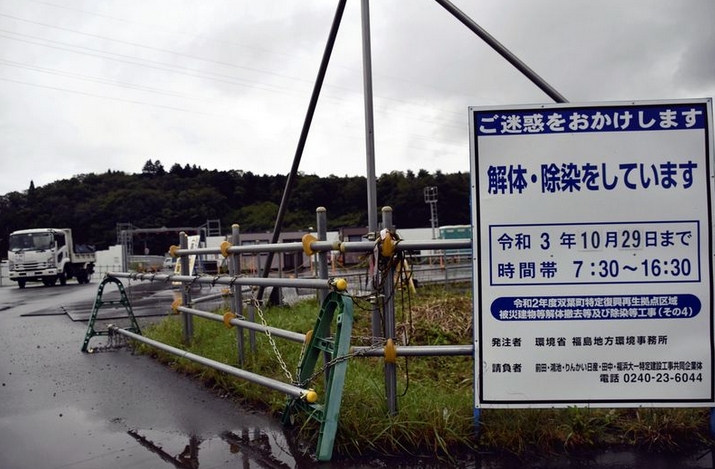
FUKUSHIMA – The central and local governments have begun encouraging people from outside Fukushima Prefecture to move into areas surrounding Tokyo Electric Power Company Holdings, Inc.’s Fukushima No. 1 nuclear power plant, hoping that new residents will revive the areas.
The central government plans to lift evacuation orders in all areas categorized as difficult-to-return zones so that residents wishing to return to their homes can do so within the 2020s. However, in areas where such an order has already been lifted, residents have been slow to return.
300 newcomers sought
I’ve long wanted to contribute to the reconstruction of Fukushima, said Daisuke Yamamoto, 49, an engineer who moved from Sapporo to the city of Tamura, Fukushima Prefecture, in August.
Yamamoto said he aimed to set up his own business there.
The central government’s financial support system, which began in July, encouraged him to move in. The system grants up to 2 million Yen to those who move into 12 municipalities near the nuclear plant from outside the prefecture. Additional funds of up to 4 million Yen will be paid if they launch a business there. The government’s goal is to bring in 300 new people this fiscal year alone.
Local municipalities are preparing for new residents. In July, the Fukushima prefectural government set up a joint support center with the 12 municipalities. In Minami-Soma, vacant houses will be renovated into rental housing. In the village of Katsurao, eight units of municipal apartment housing will be constructed.
10% want to return
Behind the move is the slow return of residents to areas where the evacuation orders were lifted. The Reconstruction Agency and others surveyed the residents of five towns, including Futaba and Okuma, and found that only about 10% wanted to return.
The town of Namie, where the evacuation order was partially lifted in 2017, now has a population of 1,717. In fiscal 2019, 70 people in 49 households moved into the town from outside the prefecture, thanks in part to the presence of factories opened by 10 companies, but the population is still only about a tenth of its pre-disaster size.
The only way to keep the town going is to further increase the number of new arrivals, a town official said.
Commuting, restoring
Over 10 years after the nuclear accident, people who have rebuilt their lives in areas to which they evacuated will have the option of having residences in two locations, commuting to Fukushima Prefecture while carrying on with their present lives elsewhere.
A 66-year-old man who moved his family to Hitachi, Ibaraki Prefecture, has a home in an area categorized as a difficult-to-return zone in Namie. In order to return to that home, he would need to repair the now dilapidated house. His children have found jobs in Ibaraki. The man’s life in Ibaraki, where he grows vegetables in rented fields, has become settled.
I have no choice but to spend two hours each way to get to and from Fukushima, he said.
In a survey conducted last fiscal year by the towns of Futaba, Okuma and Tomioka on their residents, about 60% said they wanted to maintain ties with their hometowns.
The evacuation order for Naraha was lifted in 2015, but the number of residents in the town now has leveled off at 50% of the population before the accident. The town aims to raise the figure to 60% by 2030, or 5,130 people, by subsidizing JR train fares for residents who live in two locations.
The town of Tomioka supports residents who have been evacuated outside the town in the hope of bringing about reconstruction by commuting. It opened social center and support office facilities in Iwaki, Fukushima Prefecture, and Saitama City, which are two places where many evacuated Tomioka residents now live. In those facilities, staff check up on the health of the evacuees or give counseling.
Those who want to go home someday will become important people for the progress of reconstruction, said Yusuke Yamashita, a sociology professor at Tokyo Metropolitan University. The central and local governments should continue to provide assistance from the perspective of reconstruction by commuting.
Japan eyes disposal abroad of radioactive plant equipment
Watch out! Japan’s hoping to export now its radioactive junk!
September 20, 2021
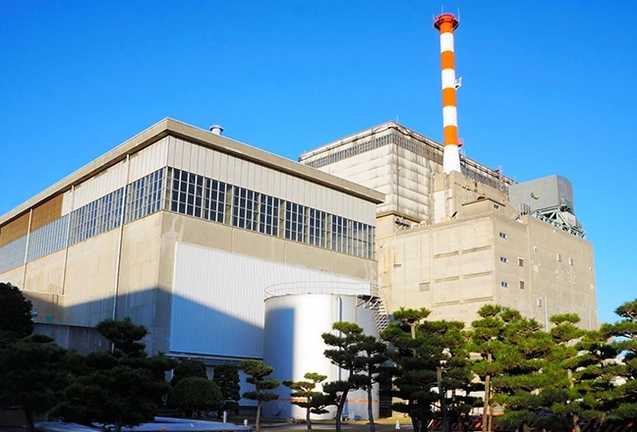
Japan plans to ease regulations to allow exports of large, disused equipment from nuclear power plants for overseas disposal as a way to reduce the mountains of radioactive waste accumulating at home.
The setup would mark a major shift from the government’s existing principle of disposing of all radioactive waste inside the country.
The industry ministry mentioned the revised disposal policy in the draft of the updated Basic Energy Plan, which awaits Cabinet approval in October at the earliest.
Even if the plan is approved, it will likely take some time for the government and nuclear plant operators to clear a slew of hurdles, such as estimating the costs of the project and ensuring the safety of shipments.
The Ministry of Economy, Trade and Industry, which oversees the nuclear industry, is considering outsourcing the disposal of three kinds of large low-level radioactive equipment overseas: steam generators, feed-water heaters and nuclear fuel storing and shipping casks.
These components range in size from 5 to 20 meters and weigh 100 to 300 tons.
Although they are not highly contaminated, compared with nuclear debris generated by spent fuel, they must be disposed of and managed properly, including being buried deep in the ground for years.
The ministry is considering their export as an “exceptional measure” to deal with the grave issue of the radioactive waste accumulating at nuclear facilities across Japan.
“Export regulations will be reviewed to allow for export (of low-level radioactive waste) when certain conditions are met, such as their safe recycling into useful resources,” the draft for the latest version of the Basic Energy Plan said.
The industry ministry is soliciting public opinions on the outsourcing plan until Oct. 4.
Nuclear plant operators have decided to decommission 24 reactors, including the six units at the crippled Fukushima No. 1 nuclear plant.
Work to dismantle those reactors is expected to go into full gear starting in 2025.
Excluding the reactors at the Fukushima plant, the decommissioned units will produce an estimated 165,000 tons of low-level radioactive waste.
But more than 90 percent of that waste has nowhere to go for dismantling and disposal.
Japan still lacks a dedicated disposal site for equipment used at nuclear plants, forcing plant operators to store the waste at their facilities.
The ministry says the storage of the out-of-service equipment is getting in the way of the decommissioning process.
Experts say some businesses in the United States and Sweden clean, melt and recycle metal from radioactive waste sent by foreign countries.
“Japan should first learn the know-how of disposal by outsourcing the work to foreign businesses with a reliable track record in the area and eventually become capable of doing it at home,” said Koji Okamoto, a professor of nuclear engineering at the University of Tokyo.
Under the Joint Convention on the Safety of Spent Fuel Management and on the Safety of Radioactive Waste Management, signatory countries that produce radioactive waste are obliged, in principle, to dispose of it within their territories.
But they can export the waste as exceptional cases if they obtain the consent of countries where business partners are based.
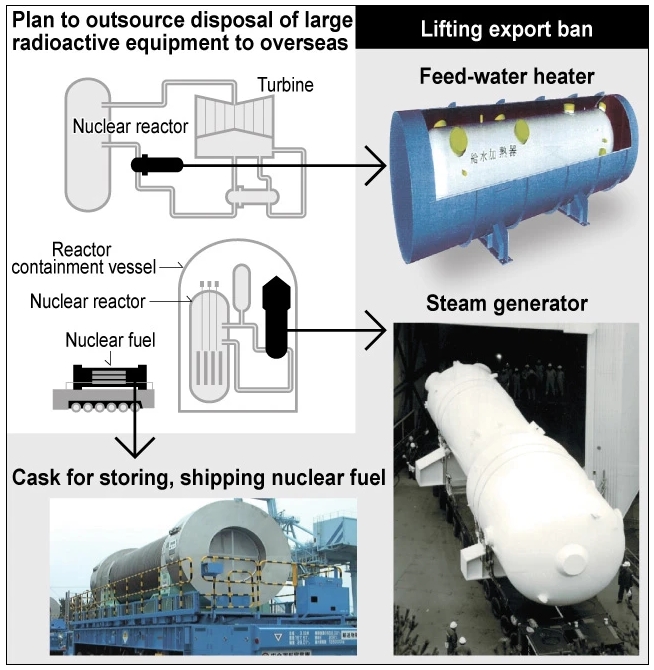
However, Japan’s Foreign Exchange and Foreign Trade Control Law bans such exports.
Utilities have pressed the government for a change in the disposal policy, and the industry ministry has been reviewing the existing setup alongside experts on nuclear technology.
Although the ministry intends to follow the principle of doing away with the waste within Japan, it plans to approve exports of the three types of nuclear plant equipment on condition that they will be recycled.
Ministry officials say the plan can be achieved through a revised ministry directive, without having to change the law.
The equipment intended for recycling overseas could include components kept at nuclear plants that still generate power.
But the ministry needs to work out many issues to turn the plan into reality.
Nuclear plant operators have the primary responsibility for disposing of low-level radioactive waste. And the actual costs these Japanese companies would have to pay to recyclers overseas is still unknown.
The bill could be far more expensive than initially estimated.
How to safely ship the radiation-contaminated equipment abroad is another unresolved issue.
The amount of nuclear waste in Japan has been growing since the 2011 Fukushima nuclear disaster. Utilities have gradually resumed operations at nuclear plants, but some have decided to decommission reactors, particularly aging ones, largely because of the costs needed to upgrade them under new safety standards.
For decades, Japan has been unable to secure a final disposal site for such waste inside the country, mainly because of opposition from residents of candidate sites.
-
Archives
- February 2026 (228)
- January 2026 (308)
- December 2025 (358)
- November 2025 (359)
- October 2025 (376)
- September 2025 (258)
- August 2025 (319)
- July 2025 (230)
- June 2025 (348)
- May 2025 (261)
- April 2025 (305)
- March 2025 (319)
-
Categories
- 1
- 1 NUCLEAR ISSUES
- business and costs
- climate change
- culture and arts
- ENERGY
- environment
- health
- history
- indigenous issues
- Legal
- marketing of nuclear
- media
- opposition to nuclear
- PERSONAL STORIES
- politics
- politics international
- Religion and ethics
- safety
- secrets,lies and civil liberties
- spinbuster
- technology
- Uranium
- wastes
- weapons and war
- Women
- 2 WORLD
- ACTION
- AFRICA
- Atrocities
- AUSTRALIA
- Christina's notes
- Christina's themes
- culture and arts
- Events
- Fuk 2022
- Fuk 2023
- Fukushima 2017
- Fukushima 2018
- fukushima 2019
- Fukushima 2020
- Fukushima 2021
- general
- global warming
- Humour (God we need it)
- Nuclear
- RARE EARTHS
- Reference
- resources – print
- Resources -audiovicual
- Weekly Newsletter
- World
- World Nuclear
- YouTube
-
RSS
Entries RSS
Comments RSS
 nuclear-news