Commemoration and Meaning: The Case of Fukushima
Robert Jay Lifton and Scott Gabriel Knowles
Abstract: Disaster commemoration serves as a moment to remember victims and honor survivors. In the case of 3.11, commemoration works differently. As a slow disaster, with radiation exposure and evacuation at the center of the story, 3.11 is not yet over. This places special importance on commemoration as a moment for memory, but also for ongoing commitments to research, justice, and health interventions for survivors.
Commemorations of disasters are necessary. They can provide survivors—and the world in general—a sense of where things stand in relation to destruction, the pain caused, and the relief time may have brought. Commemoration can also be a way to give meaning to the disaster itself. But those meanings can be misleading if they minimize the effects of disaster or pronounce shallow claims of recovery.
A case in point is the tenth-year commemoration of the Fukushima Daiichi nuclear meltdown of 2011. The Director General of the International Atomic Energy Agency marked the occasion by claiming that “The equipment reacted just as it was designed to do—it stopped!” He did admit that “the ensuing damage caused nuclides to be released into the environment,” but insisted that “scientists have found no evidence that this caused radiation-induced health effects.”1 The meaning he communicates is that there was a bit of a problem, it was immediately taken care of, some dubious materials might have leaked out, but nothing bad happened. There was no real disaster.
That is not the meaning the event holds for the 37,000 people who had to be evacuated, and have still not returned to Fukushima prefecture.2 Their meaning, and that of most thoughtful outside observers, starts with the vulnerability of the Fukushima Daiichi reactors to the extreme events of earthquake and tsunami. Survivor meaning would also turn on the unknown effects of the recent decision to deposit radioactive materials into the ocean.3 It would focus on the resistance by government and nuclear-industry officials to studies of future dangers from nuclear waste, and from radiation effects that could occur over decades and even centuries. Above all, that survivor meaning would include concerns about prevailing radiation levels as well as danger of future bodily effects on the part of people exposed.
At the heart of this meaning is the fear of what one of us (Lifton) has called “invisible contamination,” a fear of a poison that a survivor cannot see, smell, or feel, and whose effects are so lasting, even if they do not show up in one year—or in one generation—they may well do so in the next. As a Hiroshima survivor put it: “You may look healthy from the outside but all of a sudden something goes wrong and you are sick and you die.”4
Hiroshima survivors described their terror at witnessing and experiencing grotesque radiation symptoms: acute effects of severe diarrhea, bleeding from various bodily orifices, dreaded “purple spots” from bleeding into the skin, extreme weakness and frequent death. Delayed effects including increased incidence of leukemia during early post-bomb years, and later of cancer of the thyroid, stomach, lung, ovary, and uterine cervix. Since it is known that radiation can have genetic effects over the generations, there was much fear in Hiroshima about giving birth to abnormal children.

The full panoply of nuclear fear is a constant anywhere radiation danger is involved. Fear of invisible contamination has been widely identified in people exposed in Fukushima, as well as in many living far beyond that province—this includes evacuees, first responders, and doctors and nurses who stayed behind in Fukushima.5 Such fear also emerged at the American Three Mile Island disaster of 1979, where less radiation was released than at Fukushima.6 With the much greater disaster at Chernobyl in 1986, that fear has been pervasive and remains at a considerable level. The same fear occurred in Americans exposed to nuclear radiation in various other places: to plutonium waste at Hanford, Washington, in connection with the production of the Nagasaki bomb; to nuclear testing over decades at Rocky Flats, Colorado; and to Ground Zero at test sites in Nevada, from which G.I.’s were marched shortly after nuclear explosions. None of this should be dismissed as “hysteria” or “exaggerated psychological reactions.” We are speaking of the nuclear fear—the fear of invisible contamination—that results from substantial release of radiation, no matter what the source.
What does it mean to pass the 10th anniversary of 3.11 under such conditions? Disaster anniversaries sit on the calendar, they are predictable. Historians know that they can reliably look back at news coverage one, five, and ten years after any disaster to see how recovery proceeded, how the disaster was framed by different political regimes, and which victim support groups persisted while others disappeared. But history is not a stable element, and as such anniversaries sometimes re-ignite political battles over the meaning of a disaster. The commemoration of a disaster anniversary opens the possibility for cynical revision and exploitation by politicians and industry groups eager to declare that the past is now safely in the past. Commemoration meaning can be falsified by bureaucratic collusion between industry and government, which can contribute to denial, rejection, and cover-up of radioactive consequences. Such collusion is notorious in Japan. There were significant protests in Japan against the use of nuclear energy, but pro-nuclear forces prevailed, in part by insisting that there was a significant difference between the technology of nuclear power and that of nuclear weapons. This illusory distinction is restated by those who use moments of commemoration to promote nuclear energy.
The anniversary also demands a recapitulation of trauma, a command performance for survivors and families still grieving, as well as those who may have truly integrated the disaster into their lives and chosen no longer to publicly engage with it, if they ever did. A disaster like 3.11 has its own special complications, a combination of earthquake, tsunami, and radiation, affecting people of all ages, from fishermen to nuclear power plant workers—spread out over a large area, and with many thousands of bodies never recovered. There is not a coherent 3.11 experience for survivors. The harms were many, and variable, and this makes activism for victim support more complicated. Due to the radiation exclusion zone going into effect, many survivors have found themselves advocating for resources to return to empty towns and shattered homes they aren’t totally sure they want to live in again.
Nowhere is the timescale of disaster memory more unpredictable than in cases of radiation exposure. With Hiroshima survivors, for instance, every year brings new testimonials from survivors who tell their stories of August of 1945 for the first time. Similarly, as STS scholar Kyoko Sato has noted, there will most certainly be Fukushima survivors who will not share their truths for many years to come.7 In this way it may be possible that Fukushima memory could “puncture the nuclear mystique” that has gripped Japan since reactors were built in the 1960s.8 This can occur only if anniversary discussions give way to a greater focus on survivor-based memory. Victims’ families, and activists can find in such anniversaries the opportunity to bring their own memories and demands into discussion once again for new audiences. Memorial ceremonies, the reconvening of dormant support groups, educational outreach to students, even phone calls and emails from distant friends and family all serve positive roles for a disaster affected community, even ten years later. And the anniversary serves as a meeting ground for disasters past and present—any discussion of Fukushima now, for example, must take place in the context of the COVID-19 pandemic and the ongoing need for strong public health measures.
New dynamics are at play now as well that offer hope Fukushima memory might not recede so easily from the public mind once this year is over. Research and public policy insisting on post-traumatic mental health support (in Japan starting after the 1995 Great Hanshin-Awaji Earthquake) for survivors has been effective in countering the more traditional idea that disasters end once relief payments are made and buildings are rebuilt.9 We are increasingly recognizing that a disaster is a process, not a single event in time. Victims will suffer on the day, and in the aftermath. As we note in the recently published volume Legacies of Fukushima: 3.11 in Context, “the linked disasters of 3.11 were in crucial ways part of a much longer process, a slow disaster that connected the events of a disastrous era … traumas of the Japanese past: radiation exposure, tsunami flooding, seismic destruction, massive evacuation and loss of home and community.”10 Climate change can also be an important factor in causing and sustaining disasters.
Nuclear disaster commemorations can and must leave space for the new exploration of old harms—and they must be in sync with ongoing strategies of mental health service provision as well. Is this too much to ask in a Fukushima commemorative year marked by pandemic and climate change related disasters around the world? Not if disaster history is to be of any use at all in the struggle to reduce disaster risk and heal survivors. As Liz Maly and Mariko Yamazaki note in their recent review of Japanese disaster memorials, 3.11 demands special attention to the overlapping historical trajectories of loss and trauma in Japan. “Important issues for future consideration,” they note, “include comparisons across not only pre-3.11 museums about disasters caused by natural hazard events, but also Japanese precedents of how experiences and lessons from other human-made disasters are conveyed, including by the Nagasaki Atomic Bomb Museum, Hiroshima Peace Memorial Museum, and Minamata Disease Municipal Museum, which tells the story of industrial pollution and poisoning of the local community.”11
What’s needed now in this year of Fukushima commemoration is a turn towards the fusion of these ideas, grounded in the reality that nuclear fear demands. We should emphasize the healing function of commemoration. That includes enhancing the mourning process of survivors, instead of impairing that process by negating their pain. Survivors and victims’ families can find in such anniversaries the opportunity to bring their own memories and demands into discussion for new audiences. Memorial ceremonies can reintegrate sources of support and provide extensive educational outreach. By confronting painful disaster effects, there can emerge valuable forms of what can be called survivor wisdom. These anniversaries can also connect, psychologically and politically, with disasters past and present.
Commemoration events can serve as moments of collective renewal, with survivors in the vanguard.
References
COVIDCalls. (2021) Fukushima and the Pandemic: A 3.11 Memorial Episode with Sulfikar Amir, Kohta Juraku, Kyoko Sato, and Ryuma Shineha [Online video]. March 8. Accessed: July 18, 2021).
Cleveland, K, Knowles, S., and Shineha, R. (eds.) (2021) Legacies of Fukushima: 3.11 in Context. Philadelphia: University of Pennsylvania Press.
Honda, N., Kelman, I., Kikuchi, S., Kim., Y., Kobayashi, N., Nemoto, H., Seto, M., and Tomita, H. (2019) ‘Post-Disaster Mental Health and Psychosocial Support in the Areas Affected by the Great East Japan Earthquake: A Qualitative Study’, BMC Psychiatry, 19(261).
International Atomic Energy Agency. (2021) Ten-year Anniversary of the Fukushima Daiichi Nuclear Power Plant Accident: A Decade of Improving Nuclear Safety [Online] Accessed: June 15, 2021.
Lifton, R. (1968) Death in Life: Survivors of Hiroshima. 2nd edn. Chapel Hill: University of North Carolina Press.
Lifton, R. (1986) ‘Chernobyl, Three Mile Island, Hiroshima’, New York Times, May 18 [Online]. Accessed: July 18, 2021).
Loh, S.L. and Amir, S. (2019) ‘Healing Fukushima: Radiation Hazards and Disaster Medicine in Post-3.11 Japan’, Social Studies of Science, 49(3), pp. 333-354.
Maly, L. and Yamazaki, M. (2021) ‘Disaster Museums in Japan: Telling the Stories of Disasters Before and After 3.11’, Journal of Disaster Research, 16(2), pp. 146-156.
Normile, D. (2021a) ‘This Physician Has Studied the Fukushima Disaster for a Decade—and Found a Surprising Health Threat’, Science, March 4 [Online]. Accessed: July 18, 2021.
Normile, D. (2021b) ‘Japan Plans to Release Fukushima’s Wastewater into the Ocean’, Science, April 13 [Online]. Accessed: July 18, 2021.
Rich, M. and Inoue, M. (2021) ‘Ten Years After Fukushima Disaster, This Nurse May Be the Region’s Best Hope’, New York Times, March 9 [Online]. Accessed: July 18, 2021.
Notes
International Atomic Energy Agency, 2021.2
Normile, 2021a.3
Normile, 2021b.4
Lifton, 1991.5
Rich and Inoue, 2021; Amir and Loh, 2019.6
Lifton, 1986.7
COVIDCalls, 2021.8
Lifton in Cleveland, Knowles, and Shineha, 2021.9
Seto, et. al., 2019.10
Cleveland, Knowles, and Shineha, 2021.11
Maly and Yamazaki, 2021.
Nuclear news for the first week in September
While Afghanistan, and Covid-19 continue to be the main focus of news, climate change is getting a new kind of attention. I find it a worrying kind. When Rupert Murdoch’s Fox News, News Corps etc, were busily spouting climate change denialism, at least you knew what they were up to. Now, I fear that the world is going to be subjected to propaganda that is much more subtle. Just as Big Media and Big Business now ”support” action on climate change, I think that they will be spruiking technological fixes, ”clean coal” ”carbon capture and storage, ( perhaps even Big Renewables). On the coat-tails of this Big Fix movement rides the nuclear lobby. Nuclear is so far banned from participating in the COP26 Climate Summit in November. I wouldn’t be surprised if it wriggles its way in. World leaders like Biden, Johnson, Putin – all depend for their jobs, on the backing of big corporations. So – COP26 is already under threat.
On the positive side, quiet and thoughtful voices speak up for a more holistic approach to climate action, and a measured study on the world’s energy needs.
Covid-19 – Coronavirus worldwide, despite nearly 65,000 deaths and nearly 4.3 million cases in the past week, is leveling off with 8% declines for each category, with every continent dropping except Europe in fatalities.
NUCLEAR. While not much is actually happening, the activity is – under the radar – the ever-increasing push to convince the world that nuclear is ”clean and green and the way to go.”
Some bits of good news – India Today Group launches Good News Today, India’s first and only positive news channel. ”Good news” – as usual – very much individualistic stuff. I guess that the overall small drop in coronavirus cases is a small plus.
A New Online Youth Platform Promotes Nuclear Disarmament. After the Afghanistan war, the time for change is now. Oblivion and 9 Other Best Dystopian Films About Nuclear War.
How much energy do we need to achieve a decent life for all? Does technology really matter more than the natural landscape?
Greta Thunberg, critical of governments, may not attend COP26. COP26 – the need to scrutinise hidden climate agendas.
Formidable radiation dangers in travel to Mars. Radiation could restrict crewed Mars missions to less than four years . Cosmic radiation will probably prevent growing crops on Mars, Virgin Galactic ‘ignored red warning light’ in Branson’s race against Bezos to be first billionaire to space.
New Nuclear: What’s At Stake For Wildlife? – Webinar October 7.
International Uranium Film Festival free online screenings September 13 – 19.
AFRICA. Nuclear Disarmament: What the World can Learn from Africa.
JAPAN. Not Seeing the Contaminated Forest for the Decontaminated Trees in Fukushima. IAEA team in Japan to help prepare Fukushima water release. Fukushima radiation monitoring posts to be renewed-. New type of fallout from Fukushima Daiichi found a decade after nuclear disaster.
PACIFIC ISLANDS. Pacific environmentalists call on Japan not to empty radioactive wastewater into the Pacific.
USA.
- Hurricane Ida Forces Two Nuclear Plants in Louisiana to Shut Down or Reduce Power . Nuclear New Orleans: Another Fukushima? Post-Ida Dangers at Waterford Nuclear . Hurricane shuts down Louisiana nuclear power station.
- Since 9/11, US Has Spent $21 Trillion on Militarism at Home and Abroad. Global Cooperation, Not Endless War Should Be Future of US Foreign Policy. We can reduce the nuclear danger, contacting politicians, joining Back from the Brink.
- Advanced nuclear reactors need the government to create a market – nuclear loves socialism.
- Friends of the Earth and Sierra Club saw it coming – corruption is killing the nuclear industry. Westinghouse Electric Co has paid $21bn and will co-operate with federal investigators over South Carolina nuclear fraud.
- Illinois Senate passes bill to save nuclear plants. Illinois very soon to vote on a Bill for the state to prop up the nuclear industry. Illinois nuclear subsidy law – too late for Exelon’s Byron and Dresden nuclear plants.
- Uranium prices and the true financial and climate costs of the Megatons to Megawatts program. We mustn’t kick the radioactive nuclear waste can down the road any longer. It’s time to tackle the problem head-on. Nuclear waste – a heavy burden on the public of New Mexico. Highway safety concerns as DOE plans expanding nuclear waste transports to the Waste Isolation Pilot Plant (WIPP). Daunting costs of nuclear clean-ups.
- Downwinders Look to Renew and Expand Radiation Exposure Compensation Act.
UK. UK might have to move its nuclear submarines overseas, if Scotland gains independence. UK government scared that Scotland’s Nicola Sturgeon will use COP25 to further SCotland’s independence. Trident: Scots urged to write to UN to demand removal of nuclear weapons. The Faslane Peace Camp inspired the BBC drama Vigil https://www.youtube.com/watch?v=WRGZVM3f4SU Chaotic discussion on nuclear waste proposal for UK’s Allerdale region.
CANADA. More issues at Bruce power station raise concerns about aging nuclear infrastructure.
INDIA. Over 200kg uranium theft in India poses threats of nuclear terrorism.
AFRICA. A Just Recovery Renewable Energy Plan for Africa.
SOUTH AFRICA. As South Africa restarts nuclear plan, critics and advocates clash over its clean energy credentials. Walking the nuclear dog – a South African tale.
NORTH KOREA. U.S. says North Korea nuclear report shows “urgent need for dialogue” -official.
SOUTH KOREA. South Korea developing a missile as powerful as a nuclear weapon.
FRANCE. Chinon nuclear site again leaks coolants that turn into powerful greenhouse gases . An EDF employee contaminated in the Cruas-Meysse nuclear power plant.
POLAND. Two Billionaires Join Forces in Poland’s Nuclear Energy Push.
IRAN. Germany calls on Iran to resume nuclear talks . Iran’s new foreign minister Warns Tehran May Not Return to Nuclear Talks Until November. What’s next for the Iran nuclear deal? Analysts In Iran Pessimistic Over Nuclear Talks, Oppose Further Delays.
CHINA. China’s nuclear missile silo expansion: From minimum deterrence to medium deterrence. In China, wind and solar energy are the clear winners over nuclear.
ISRAEL. Israel’s ‘alarmist claims’ raise the stakes against Iran.
AUSTRALIA. The ANZUS treaty does not make Australia safer. Rather, it fuels a fear of perpetual military . New Australian law allows security agencies to spy on, and manipulate your data – mainstream media ignores this. threat
Murdoch’s News Corpse hasn’t seen the light on climate – they’re just updating their tactics.
Fukushima radiation monitoring posts to be renewed
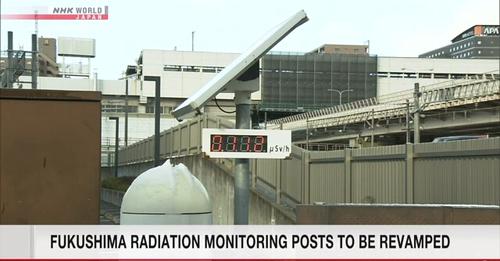
Japan’s nuclear regulators plan to retain radiation monitoring posts in Fukushima Prefecture by replacing old equipment with new.
About 3,000 monitoring posts were set up at schools and other locations across the prefecture following the March 2011 accident at the Fukushima Daiichi nuclear power plant.
The annual test and maintenance cost of the equipment is around 5.5 million dollars.
The Nuclear Regulation Authority decided in 2018 to remove about 80 percent of the monitoring posts, saying that radiation levels had remained low and the posts would likely reach their lifespan of about eight years.
But the authority reversed its decision after it met opposition from local residents.
It decided instead to retain the monitoring posts for the time being to ease local people’s concern about radiation levels and their health.
The authority plans to replace parts in radiation detectors and power supply sources with new ones in the next 10 years. About 300 posts will be renewed annually.
Some 450 monitoring posts containing parts that are hard to obtain will be replaced entirely.
The prefectural government of Fukushima says it wants the authority to continue to measure radiation levels.
New type of fallout from Fukushima Daiichi found a decade after nuclear disaster

15 Mar 2021
New, large and highly radioactive particles have been identified from among the fallout of the 2011 Fukushima Daiichi nuclear disaster in Japan. An international team of researchers has characterized the particles using nuclear forensic techniques and their results shine further light on the nature of the accident while helping to inform clean-up and decommissioning efforts.
This year marks the tenth anniversary of the Fukushima Daiichi disaster, which occurred as a result of a powerful earthquake that struck off of Japan’s east coast, generating a tsunami that reached some 14 m high when it reached the nearby shoreline. Breaching sea defences, the water from the wave shut down emergency generators that were cooling the reactor cores. The result was a series of nuclear meltdowns and hydrogen explosions that released a large amount of radioactive material into the surrounding environment — including microparticles rich in radioactive caesium that reached as far Tokyo, 225 km away.
Recent studies have revealed that the fall-out from reactor unit 1 also included larger caesium-bearing particles, each greater than 300 micron in diameter, which have higher levels of activity in the order of 105 Bq per particle. These particles were found to have been deposited in a narrow zone stretching around 8 km north-northwest from the reactor site.
Surface soil samples
In their study, chemist and environmental scientist Satoshi Utsunomiya of Japan’s Kyushu University and colleagues have analyzed 31 of these particles, which were collected from surface soil taken from roadsides in radiation hotspots.
“[We] discovered a new type of radioactive particle 3.9 km north northwest of the Fukushima Daiichi Nuclear Power Plant, which has the highest caesium-134 and caesium-137 activity yet documented in Fukushima, 105–106 Bq per particle,” Utsunomiya says.
Alongside the record-breaking radioactivity seen in two of the particles (6.1×10⁵ and 2.5×10⁶ Bq, after correction to the date of the accident) the team also found that they had characteristic compositions and textures that differed from those previously seen in the reactor unit 1 fall-out.
Reactor building materials
A combination of techniques including synchrotron-based nano-focus X-ray analysis and transmission electron microscopy indicated that one of the particles was found to be an aggregate of smaller silicate nanoparticles each with a glass-like structure. This is thought to be the remnants of reactor building materials that were first damaged in the explosion and then picked up caesium that had been volatized from the reactor fuel.
The other particle had a glassy carbon core and a surface peppered with other microparticles of various compositions, which are thought to reflect a forensic snapshot of the particles that were airborne within the reactor unit 1 building at the moment of the hydrogen explosion and the physio-chemical phenomena they were subjected to.
“Owing to their large size, the health effects of the new particles are likely limited to external radiation hazards during static contact with skin,” explained Utsunomiya — with the two record-breaking particles thought too large to be inhaled into the respiratory tract.
Impact on wildlife
However, the researchers note that further work is needed to determine the impact on the wildlife living around the Fukushima Daiichi facility — such as, for example, filter feeding marine molluscs which have previously been found susceptible to DNA damage and necrosis on exposure to radioactive particles.
“The half-life of caesium-137 is around 30 years,” Utsunomiya continued, adding: “So, the activity in the newly found highly radioactive particles has not yet decayed significantly. As such, they will remain [radioactive] in the environment for many decades to come, and this type of particle could occasionally still be found in radiation hot spots.”
Nuclear material corrosion expert Claire Corkhill of the University of Sheffield – who was not involved in the study – says that the team have offered new insights into the events that unfurled during the accident. “Although the two particles selected [for analysis] were small, a mighty amount of chemical information was yielded,” she said, noting that some of the boron isotopes the researchers identified could only have come from the nuclear control rods damaged in the accident.
Ongoing clean-up
“This work is important to the ongoing clean-up at Fukushima, not only to the decontamination of the local area, but in defining a baseline understanding of radioactive contamination surrounding the power plant, to ensure that any materials accidentally released during the fuel retrieval operations can be quickly identified and removed,” she adds.
With this study complete, the researchers are now using the particles to better understand the conditions involved in the reactor meltdown, alongside looking quantify the distribution of this fallout across Fukushima, with a focus on identifying resulting radiation hot spots.
“If we can find and remove these particles, we can efficiently lower the radiation dose in the local environment,” Utsunomiya concluded.
Does technology really matter more than the natural landscape?

After we published an article on Beyond Nuclear International about the habitat and ecosystem destruction that would be wrought by the construction of new nuclear power plants on the British coastline, a more serious challenges such as sea-level rise and radioactive contamination.
I understand his sense of urgency. Yet, these don’t seem like either-ors to me.
And I do think that “liking landscapes” is desperately important and their enjoyment a growing deprivation. If we have
never been outside, walked an ancient wood, felt awed by the delicate silvery curl of lichen on a branch, heard the eerie, commanding call of a hawk or the whispered rustlings of a small mammal scurrying through undergrowth to safe cover, why would we strive to save any of it? Who will be left to care, to “like landscapes” and all that fills them? So he
may be right that it sounds like a trivial obsession. But it ought to matter…..
Surely the importance of landscapes and all who live in them must be at least in part why we fight to end the use of nuclear power plants? And also because they will contaminate our world forever; because sea-level rise will subsume them at a terrible price for all of us. And because building, operating and decommissioning them involves making and leaving a pervasive and persistent mess the like of which we have not equalled anywhere else.
At the same time, even if we abandon the energy vices of nuclear power and fossil fuels — an urgent necessity — we recognize that we have not solved our destructive ways. Even renewable energy comes with extractive impacts and environmental justice violations. While we struggle to remediate these, we are all too aware that we have left it far too late. We were Once-lers from the beginning, our greed trumping conservation and efficient use of energy. We didn’t listen to the Lorax or hear the Peregrine’s warning call. Instead, we are in a race against time and our own folly. We are in the time of “UNLESS”.
Beyond Nuclear 5th Sept 2021
A New Online Youth Platform Promotes Nuclear Disarmament
A New Online Youth Platform Promotes Nuclear Disarmament, In Depth News, By Jamshed Baruah, 6 Sept 21,
GENEVA (IDN) — Worldwide youth are standing up for peace and nuclear disarmament and taking a wide range of innovative actions. The Youth Working Group of Abolition 2000 global network to eliminate nuclear weapons builds cooperation amongst these youth actions, brings youth voices into key UN and other disarmament processes. The group has launched a new online platform and youth action plan for a nuclear-weapons-free world: Youth Fusion.
Set up in conjunction with the Universal Declaration of Human Rights (UDHR) in 2020, the networking platform for young individuals and organizations focuses on youth action and intergenerational dialogue, building on the links between disarmament, peace, climate action, sustainable development and building back better from the pandemic. It informs, educates, connects and engages fellow students, activists and enthusiasts.
Against this backdrop, UN Secretary-General António Guterres in a message for International Youth Day, observed on August 12, said: “I urge everyone to guarantee young people a seat at the table as we build a world based on inclusive, fair, and sustainable development for all.” In fact, ‘Youth 2030’ sums up the organisation’s strategy. Ms. Jayathma Wickramanayake, the Secretary-General’s Envoy on Youth, appointed in June 2017 at the age of 26, has been working towards making the UN a home to the youth of the world.
Youth Fusion collaborated with the United Nations Office for Disarmament Affairs‘ (UNODA) #Youth4Disarmament, to mark the International Day against Nuclear Tests on August 29, 1991. The Day was unanimously proclaimed by the United Nations General Assembly at the initiative of the First President of the Republic of Kazakhstan Nursultan Nazarbayev. This historic decision sent a strong political message and contributed to international efforts that led to the adoption of the Comprehensive Nuclear-Test-Ban Treaty (CTBT) in 1996. 2021 marks 30 years of the closure of the Semipalatinsk nuclear test site.
Youth Fusion availed of the occasion to call on young people to #StepUp4Disarmament, by walking or running 8.29 kilometers or the approximate equivalent of 10.9,000 steps.
This campaign sought to raise awareness of the devastating health consequences of nuclear testing through the emphasis on physical activity, while also promoting Sustainable Development Goal 3 on ensuring good health and well-being for all at all ages.
Youth Fusion partnered with Docmine, a Swiss-based creative studio, in promotion of Nuclear Games, an innovative film and online platform addressing nuclear history and the risks and impacts of nuclear weapons and nuclear energy. It was launched together with a coalition of non-governmental organizations (NGOs), anti-nuclear activists and youth leaders with the opening ceremony of the Tokyo Olympics on July 23. [https://www.indepthnews.net/index.php/armaments/nuclear-weapons/4599-nuclear-games-for-the-young-coincides-with-tokyo-olympics]
As part of an ongoing project, Youth Fusion is highlighting the importance of inter-generational dialogue and of youth learning from the experience of those who have been long-time and effective leaders in the peace and disarmament fields. ………. https://www.indepthnews.net/index.php/armaments/nuclear-weapons/4706-a-new-online-youth-platform-promotes-nuclear-disarmament
IAEA team in Japan to help prepare Fukushima water release.

IAEA team in Japan to help prepare Fukushima water release
An International Atomic Energy Agency mission has arrived in Japan to help prepare for a decades-long release into the ocean of treated but still radioactive water from the wrecked Fukushima nuclear plantBy MARI YAMAGUCHI Associated Press7 September 2021 TOKYO — An International Atomic Energy Agency mission arrived in Japan on Monday to help prepare for a decades-long release into the ocean of treated but still radioactive water from the wrecked Fukushima nuclear plant, officials said.
The three-member team will meet with officials in Tokyo and travel to the Fukushima Daiichi plant to discuss technical details with experts until Friday, IAEA and Japanese officials said.
The team, headed by Lydie Evrard, head of the IAEA’s Department of Nuclear Safety and Security, is gathering information to prepare a review of the discharge plans.
The Japanese government and the plant’s operator, Tokyo Electric Power Company Holdings, announced plans in April to start releasing the water in the spring of 2023 so hundreds of storage tanks at the plant can be removed to make room for other facilities needed for its decommissioning.
The idea has been fiercely opposed by fishermen, residents and Japan’s neighbors, including China and South Korea.
The utility plans to send the water through an undersea tunnel and discharge it from a location about 1 kilometer (0.6 mile) away from the coastal power plant after further treating and diluting it with large amounts of seawater…….. https://abcnews.go.com/Technology/wireStory/iaea-team-japan-prepare-fukushima-water-release-79857833
Pacific environmentalists call on Japan not to empty radioactive wastewater into the Pacific
This year marks the 76th anniversary of the first use of nuclear weapons
for the purpose of war. As the world solemnly observes the tragic
anniversary of the bombings of Hiroshima and Nagasaki, we wish to highlight
the Pacific’s own and often overlooked nuclear history that followed.
Asguardians of the world’s largest ocean, we emphasise again our continuing
concern for our region and the irreparably damages on our people and the
environment from 318 nuclear weapons tests undertaken by the United States,
United Kingdom and France.
Today, we acknowledge that our region has still not healed from this trauma and that we did not consent. Given this legacy, we call on Japan to not repeat this brutality through its proposed act of
discharging over a million tonnes of radioactive wastewater from Fukushima.
Pasifika Environews 6th Sept 2021
A Just Recovery Renewable Energy Plan for Africa

Friends of the Earth Africa today launched ‘A Just Recovery Renewable Energy Plan for Africa’ which offers a practical and much-needed opportunity to change the trajectory of energy development, distribution, and access on the African continent.
The report stresses the urgency to democratise energy systems, reduce the power of transnational corporations and enable peoples and communities to access sufficient energy to live a dignified life. The report which was launched during a webinar with key climate justice voices demands a complete shift from current dirty energy systems to achieve 100% Renewable Energy in Africa.
The plan found that it is technically and financially feasible, with an annual investment requirement of around US$130 billion per year. It lays out clear targets for this vision, with over 300GW of new renewable energy by 2030, as agreed
by the African Union, and over 2000GW by 2050. It also shows that the finance and investment needed to achieve the 100% renewable energy goal can be done through public finance from the global North, ending tax dodging and dropping the debt.
All Africa 2nd Sept 2021
Walking the nuclear dog – a South African tale

Walking the nuclear dog – a South African tale, ESI Africa, By Chris Yelland, managing director, EE Business Intelligence, 6 Sept 21
Apparently, in government, there is an activity known as “walking the dog” – a strategy intended to keep self-serving politicians, officials and stakeholders quiet, and to calm them down when they are getting agitated and fidgety for some of the action.
Of course, there is some excitement at the prospect of sniffing out the territory on a brisk walk, with the anticipation that something big is on the cards. But this is inevitably short-lived, and things soon revert back to the normal and more leisurely state of inaction. Mission accomplished.
There are some examples of this in the coal and nuclear energy sectors of South Africa. The media and the public need to be careful not to be bamboozled by the noxious smoke and mirrors, sometimes radioactive, that emanate from these quarters in their excitement.
2,500MW of new nuclear power?
However, in the days following the board meeting, Nersa seemed to be acting very coy – firstly about clarifying exactly what it was that the board had concurred with, and secondly, whether this was even a concurrence by Nersa after all, as opposed to a conditional concurrence that was still subject to a number of suspensive conditions.
Of course, the independent Regulator was treading a very delicate line – to at least give the appearance that the noisy nuclear sector had got its way, while covering all political bases and legal angles, protecting its fragile reputation, and taking care not to become the scapegoat for scuppering the nuclear ambitions of a fractious Minister.
However, on 3 September 2021, Nersa finally succumbed to the growing pressure to release full details of its actual decision on 26 August 2021, with the reasons for the decision (RFD) to follow in due course. In so doing, the tricky game that Nersa was having to play became clearer.
Following a meeting by the board of the National Energy Regulator of South Africa (Nersa) on 26 August 2021, there were breathless public statements to the media by officials at the Department of Mineral Resources and Energy (DMRE) regarding a decision by the Regulator in respect of 2,500MW of new nuclear power in South Africa.
The Regulator was said to have “concurred” with a so-called Section 34 ministerial nuclear determination in terms of the Electricity Regulation Act (ERA). Some in the media fell for this hook, line and sinker. The nuclear energy sector was ecstatic, asserting that the procurement of 2,500MW of new nuclear power in South Africa would now commence.
Suspensive conditions?
Contrary to the public statements and media interviews by DMRE officials, written details of the board decision reveal that Nersa has in fact not yet concurred with the Section 34 determination per se, but that such concurrence is still subject to a number of suspensive conditions which have not yet been met.
The precise wording of Nersa’s decision of 26 August 2021 in respect of the suspensive conditions, indicate that the Energy Regulator has decided:
To concur with the commencement of the process to procure the new nuclear energy generation capacity of 2,500MW as per Decision 8 of the Integrated Resource Plan for Electricity 2019 – 2030 … subject to the following suspensive conditions:
Satisfaction of Decision 8 of IRP 2019 – 2030, which requires that the nuclear build programme must be at an affordable pace and modular scale that the country can afford because it is no regret option in the long term;
- Recognition and taking into account technological developments in the nuclear space; and
- To further establish rationality behind the 2,500MW capacity of nuclear. A demand analysis aimed at matching the envisaged load profile post 2030, with the generation profile that would be needed to match that load profile, is required. This will assist to determine the capacity and the scale at which the country would need to procure nuclear.
It is thus clear that Nersa is only concurring with Decision 8 of the current Integrated Resource Plan for Electricity, IRP 2019 – 2030, to “commence preparations for a nuclear build programme to the extent of 2,500MW”, with this itself being subject to the suspensive conditions listed.
The Regulator is not concurring with the commencement of a request for proposals (RFP) for new nuclear power in South Africa, nor is Nersa giving the green light to any new nuclear construction programme.
Not so fast please!
It goes without saying that any public procurement must still comply with the requirements of the Public Finance Management Act (PFMA) and the Constitution. As such, National Treasury remains a gatekeeper through the requirement for a positive outcome to a detailed cost-benefit analysis, and the requirement for National Treasury to establish the affordability of any such procurement.
It is still far from resolved as to the technology to be used for a nuclear new-build programme in South Africa. Would these be giant pressurised water reactors (PWRs) such as the Rosatom VVER 1200 units? Or small modular nuclear reactors (SMRs) that still have to be developed, piloted, commercialised, licenced and proven elsewhere in the world?
The suspensive conditions even indicate that the very rationality of a 2,500MW nuclear new-build programme still needs to be established through long-term demand forecasting for the period post-2030 in order to determine the mix of the generation capacity required to meet that demand.
Finally, as no new nuclear power is provided for in the current IRP in the years to 2030, it is clear that any new nuclear procurement can only commence, at the earliest, after an updated IRP has been considered by government’s “social partners”, approved by the Cabinet, and promulgated.
1,500MW of new, clean, coal-fired power?
A further example of “walking the dog” may be found in ongoing suggestions by the Minister and his officials at the DMRE that “clean coal” technologies can be deployed……………….
The 9,600MW nuclear fleet?
Yet another case of “walking the dog” was detailed in an article in Daily Maverick on 26 August 2021. In the article, former Deputy Finance Minister Mcebisi Jonas reveals that there was a general understanding in government that the 9600 MW nuclear deal with Russia, being pushed in 2017 by then-President Jacob Zuma and Energy Minister David Mahlobo, would be terrible for South Africa.
| According to Jonas, President Ramaphosa’s instruction was to “walk it” as long as possible. “He [Ramaphosa] said that by the time we have to make a decision, Zuma will be gone. He told us to find everything in the book to delay”.Does a question arise as to whether the upsides of dog walking really outweigh the downsides? It is hard to give a clear answer to this question, but it would seem that our President clearly prefers walking the dog to dealing firmly with self-serving elements within the party circle.However, a poorly-founded but nagging question keeps popping up as to what Vice-President DD Mabuza was really up to during his extended five-week leave of absence in Russia in July 2021?Putin would likely be a big, vicious dog, ready for a fight, and not easily controlled on the walk – actually more of a bear than a dog. And I would hate to be walking a grumpy bear. https://www.esi-africa.com/industry-sectors/generation/op-ed-walking-the-nuclear-dog-a-south-african-tale/ |
Israel’s ‘alarmist claims’ raise the stakes against Iran
Israel’s ‘alarmist claims’ raise the stakes against Iran, Israeli leaders have issued a series of threats against Iran over its nuclear programme, reviving ‘plans’ for action. Aljazeera, By Thomas O Falk, 5 Sept 21
Israeli leaders have revived threats against Iran after warning it is just months away from possessing a nuclear weapon.
The United States and Israel have formed a high-level team to tackle the Iran nuclear issue, Prime Minister Naftali Bennett announced last week after meeting President Joe Biden.
“The immediate follow-up was to form a joint team based on the joint objectives of rolling Iran back into their box and preventing Iran from ever being able to break out a nuclear weapon,” Bennett said
“We set up a joint team with our national security adviser and America’s, and we’re working very hard, and the cooperation is great… The president was very clear about he won’t accept Iran going nuclear, now or in the future.”
In light of the lack of progress on the negotiations with Iran on a return to the Joint Comprehensive Plan of Action (JCPOA), Biden said during his meeting with Bennett at the White House that “other options” would be possible if the diplomatic approach with Tehran failed.
Israel’s Minister of Defense Benny Gantz, meanwhile, urged the international community to develop a “Plan B” to prevent Iran from developing nuclear weapons as prospects of returning to the 2015 nuclear deal dwindle.
“Iran is only two months away from acquiring the materials necessary for a nuclear weapon,” Gantz told dozens of ambassadors and envoys at an August 25 briefing.
“Iran has the intention to destroy Israel and is working on developing the means to do so,” he said. “Israel has the means to act and will not hesitate to do so. I do not rule out the possibility that Israel will have to take action in the future in order to prevent a nuclear Iran.”
‘Not empty words’
While Gantz did not go into specifics, analysts have their own idea of what Plan B could mean.
“What is referred to as Plan B actually appears to be Israel’s Plan A – coercive measures that likely will draw the US and Iran into a broader war that will see the balance in the region shift dramatically in the direction of Israel while forestalling any US-Iran rapprochement for years if not decades,” Trita Parsi, executive vice president of the Quincy Institute for Responsible Statecraft, told Al Jazeera
However, even if Plan B were slightly more subtle than the aforementioned scenario, Gantz’s words should be taken seriously, said Yaniv Voller, senior lecturer in politics of the Middle East at the University of Kent.
“These threats are not merely empty words. Israel and the US have proved that they can carry out operations inside Iran and sabotage Iranian nuclear facilities and infrastructure,” Voller told Al Jazeera.
The choice of words by Gantz is reminiscent of the previous times Israel exaggerated the Iranian threat, security experts said.
“These claims are probably no more valid than the whole series of alarmist claims the Israelis have been making about Iran’s nuclear capability since the 1990s,” Stephen Zunes, professor of politics and chair of the Middle Eastern Studies programme at the University of San Francisco, told Al Jazeera.
“Each and every one of these frightening predictions over the past quarter-century has proven wrong, so there is no reason to take this latest iteration any more seriously.”
Key stumbling block
The dispute over the international nuclear agreement with Iran remains one of the primary reasons for the tensions in the Middle East, which have increased in recent years. Israel continues to feel its very existence is threatened by Iran’s nuclear programme………………….. https://www.aljazeera.com/news/2021/9/5/israels-alarmist-claims-raise-the-stakes-against-iran
Trident: Scots urged to write to UN to demand removal of nuclear weapons
Trident: Scots urged to write to UN to demand removal of nuclear weapons, The National, 5 Sept 21, By Martin Hannan THE Yes activist behind the project for Scots to make a declaration of sovereignty to the United Nations has taken the idea further with a plea for the UN to be told that Scotland doesn’t want nuclear weapons on its soil.
Mike Fenwick started the Declaration of a Sovereign Scot project asking people to send letters to the secretary general of the UN confirming the desire for self-determination, and now he wants letters sent to Antonio Guterres to draw attention to Scotland’s opposition to Trident and all nuclear weapons.
Fenwick says this concept is set against the background of the UN Treaty on the Prohibition of Nuclear Weapons and how that compares with Prime Minister Boris Johnson’s announcement that he intends to increase the stock of such weapons.
He said: “At the beginning of this year at the United Nations, a treaty which had been in discussion for at least four or five years was finally announced and it was open to countries to ratify the Treaty on the Prohibition of Nuclear Weapons.
Straightforward you would think, but it only took a few months before Boris Johnson decided to announce it was not for the UK, and we’re going to increase our warheads despite any treaties prohibiting them.
“We’ve got 180 so far, and now they are to go up by a third to 240. How many people does Boris Johnson want to threaten with annihilation?
“My question is what, if anything, can we do about it?”…………..
Sometimes even the smallest action starts a chain of events where it is only with hindsight that you can tell what caused that event to occur.
“That will be true of how we regain independence for Scotland – lots of small actions which seem insignificant but which produce a chain of events that leads to independence for our country.”
Fenwick also suggested that a petition be submitted to the Petitions Committee at the Scottish Parliament calling for a referendum on the subject of nuclear warheads harboured in Scotland.
He said: “The parliament should allow a referendum in which all of us can voice our opinion on support for the UK’s position, or support for the UN’s position. We should be doing this well in advance of indy.”https://www.thenational.scot/news/19560455.trident-scots-urged-write-un-demand-removal-nuclear-weapons/
Analysts In Iran Pessimistic Over Nuclear Talks, Oppose Further Delays
Analysts In Iran Pessimistic Over Nuclear Talks, Oppose Further Delays, Iran International, 6 Sept 21
Reza Nasri, a senior international relations expert in Iran has warned the Iranian government that delaying the resumption of nuclear talks with world powers would give an opportunity to the deal’s opponents in the West to erect new hurdles to a new agreement.
Nasri told ISNA news website in Iran that some American opponents of the 2015 nuclear agreement known as JCPOA may try to use this opportunity to form alliances against the revival of the deal among members of the US Congress…………………. https://iranintl.com/en/world/analysts-iran-pessimistic-over-nuclear-talks-oppose-further-delays
COP26 – the need to scrutinise hidden climate agendas

there may be a need to recognize the short comings of some of the technical fixes being promoted, for example, by some ‘net zero’ enthusiasts. The NGOs can perhaps help here. For example, Oxfam has produced a useful report, ‘Tightening the Net’, which claims that using land-based techniques alone to remove CO2 from the air and help the world reach net zero by 2050 would require at least 1.6 billion hectares of new forests. That is equivalent to 5 times the size of India, or more than all the farmland on the planet.
The charity’s report, says governments and companies are hiding behind a smokescreen of ‘unreliable, unproven & unrealistic carbon removal’ schemes, so as to ‘continue dirty business-as-usual activities’.
COP26 Agendas https://renewextraweekly.blogspot.com/2021/09/with-intergovernmental-panel-on-climate.html?showComment=1630897750625#c4129514770472857573 September 04, 2021 With the Intergovernmental Panel on Climate Change (IPCC) having produced a new very grim report on climate issues, all eyes are now focused on COP 26, the 26th meeting of the Parties to the UN Framework Convention of Climate Change to be held in Glasgow in November. COP 26 has the obvious formal agenda of continuing with the negotiation process over climate policy, developing on the outline COP21 Paris agreement in terms of national and global emission targets and aid funding. There is a lot to do, with many key countries still dragging their feet and the main focus will be trying to improve on that.
However, there are also underlying policy agendas reflecting different views as to how best to cut carbon, and they may shape what goes on and what is seen as important. Most are backed by specific groups or interests. Most familiar, there are the vested fossil fuel interests- global/local oil, coal & gas companies. Some in the past backed climate change denial, but most are now in defensive mode, seeking to limit damage to their profits/portfolios. Carbon Capture & Storage (CCS) is their fall back option as part of a ‘net zero’ carbon offset concession, with 2050 targets presumably being seen as far enough off to be survivable.
At the other end of the spectrum there are the various green NGO’s, all keen on maximum carbon cuts as soon as possible. Most back renewables as the main plank, along with energy saving and a commitment to reduced energy demand- and even perhaps reduced economic growth. Most greens oppose fossil CCS, but some do back biomass CCS as a negative carbon option. Very few however like nuclear, which, as ever, is trying to get in the act despite its generally poor showing compared with renewables. But you’ll find nuclear lobbyist hard at it, always, for good or ill, keeping the nuclear debate alive – even if nuclear PR displays were apparently blocked from access to the Green Zone at COP26!
Hydrogen has meantime become a new area offering angles for all sides. The fossil lobby looks to allegedly low-carbon blue hydrogen (from fossil gas SMR with CCS), an option that seems increasing challenged. The greens look to zero carbon green hydrogen via electrolysis (using power from renewables), and costs do seem to be falling, while the nuclear lobby (both fission and later fusion) hopes it can also get in on the hydrogen act. That seems a long shot. Especially since there is also a strong showing from the electricity lobby, which wants to see heat pumps used, not hydrogen gas – and certainly not fossil gas!
Some underlying issues
Lobby groups certainly do keep it all alive. Although the fossil and nuclear industry lobby groups are familiar enough, there is less of an obvious renewables industry lobby, apart from some trade associations. The International Renewable Energy Agency (IRENA) doesn’t get involved much direct campaigning. So it’s often left to political pressure groups and NGOs, and their interests transcend energy policy and spread across the whole of field of eco-sustainability.
The renewables v nuclear/ CCS issue has already been noted, and the role of hydrogen. However, there are also issues relating to scale and distribution. Most greens would prefer energy to be generated and used locally at the smaller scale. That can be aided by PV solar, but, even with storage, there may still be a need for top-ups and balancing from outside. That means grids, and some actually see grids as a key thing, with low-loss supergrids allowing for power trading long-distance. ……………
Transport is also obviously a key area. The standard green argument is that flying is very bad, but actually, it is only making a small contribution to CO2 at present- about 2% globally. Cars are vastly worse (they use 45% of global energy) and many more people drive than fly. But, longer-term, flying demand will build up vastly, unless blocked. ………….
What can we expect from COP26?
It will be interesting to see how the various technical fixes & social fixes issues are dealt with in Glasgow. It’s only a week, and that may mostly be taken up with haggling on targets and dodging invoices for aid! But some of the wider issues and social fix options may get an airing. The world is changing, and though issues like meat eating are still on the fringe, wider issue are emerging, with Scotland often being a pioneer. More immediately, Scotland is now getting almost all its power from from renewables, so that technical fix may be an inspiration to many people. . Though perhaps a bit peevishly, Greta Thunberg was not that impressed with Scotland’s progress. However, there may be a need to recognize the short comings of some of the technical fixes being promoted, for example, by some ‘net zero’ enthusiasts. The NGOs can perhaps help here. For example, Oxfam has produced a useful report, ‘Tightening the Net’, which claims that using land-based techniques alone to remove CO2 from the air and help the world reach net zero by 2050 would require at least 1.6 billion hectares of new forests. That is equivalent to 5 times the size of India, or more than all the farmland on the planet. The charity’s report, says governments and companies are hiding behind a smokescreen of ‘unreliable, unproven & unrealistic carbon removal’ schemes, so as to ‘continue dirty business-as-usual activities’.
Well, CCS and the like may not be the main reason, but it certainly is worrying that growth in renewable capacity had slowed in the UK. The latest DUKES statistics indicate a year-by-year fall in new capacity added since 2015, with just a 1GW expansion last year, half of that being for offshore wind. The slow down is arguably mainly due the demise of the Feed in Tariff and the block to CfD access for onshore wind and large PV. That may be reversed in the next CfD round, due to be opened up for bids in December. Let’s hope so, otherwise we could have the odd spectacle of the UK promoting renewables hard at COP26 while its own efforts have been diminishing.
How much energy do we need to achieve a decent life for all?

the amount of energy needed for decent living worldwide is less than half of the total final energy demand projected under most future pathways that keep temperature rise below 1.5° C. This indicates that achieving DLS for all does not have to interfere with climate goals. While this ratio changes in different climate mitigation scenarios and by region, the energy needs for DLS always remain well below the projected energy demands on the level of larger global regions.
How much energy do we need to achieve a decent life for all?, https://www.sciencedaily.com/releases/2021/09/210902125025.htm
September 2, 2021 Source: International Institute for Applied Systems Analysis Summary:
For many, an increase in living standards would require an increase in energy provision. At the same time, meeting current climate goals under the Paris Agreement would benefit from lower energy use. Researchers have assessed how much energy is needed to provide the global poor with a decent life and have found that this can be reconciled with efforts to meet climate targets.
For many, an increase in living standards would require an increase in energy provision. At the same time, meeting current climate goals under the Paris Agreement would benefit from lower energy use. IIASA researchers have assessed how much energy is needed to provide the global poor with a decent life and have found that this can be reconciled with efforts to meet climate targets.
In the fight to eradicate poverty around the world and achieve decent living standards (DLS), having sufficient energy is a key requirement. Despite international commitments such as the UN Sustainable Development Goals, in many areas progress on achieving DLS worldwide has been slow. There are also fears that improving energy access could lead to higher carbon dioxide emissions, which would interfere with goals to alleviate climate change.
In a new study published in the journal Environmental Research Letters, IIASA researchers used a multidimensional approach to poverty to conduct a comprehensive global study on DLS. The researchers identified gaps in DLS by region and estimated how much energy is needed to fill them. They also assessed whether providing everyone with a decent life is compatible with climate goals.
Studies on poverty often use an income-based definition for defining poverty thresholds ($1.90/day or $5.50/day), which obscures that there are other factors contributing to human wellbeing more directly. In contrast, DLS represent a set of material prerequisites to provide the services needed for wellbeing, such as having adequate shelter, nutrition, clean water, sanitation, cooking stoves and refrigeration, and being able to connect physically and socially via transportation and communication technologies. Crucially, this allows for calculation of the resources needed to provide these basic services.
The largest gaps in DLS were found in sub-Saharan Africa, where more than 60% of the population are lacking in at least half of the DLS indicators. The researchers also identified high DLS deprivation in indicators such as sanitation and water access, access to clean cooking, and thermal comfort in South and Pacific Asia, and more moderate gaps in other regions. One of the most striking findings of the study was that the number of people deprived of basic needs according to DLS generally far exceeds the number of people in extreme poverty, meaning that current poverty thresholds are often inconsistent with a decent life.
When looking at which components of DLS require the most investment in energy, the researchers identified shelter and transport as having the largest share.
“The majority of the global population does not currently have decent levels of motorized transport. An important policy lesson for national governments is the large impact of investing in public transit to reduce the use of passenger vehicles, which generally have much higher energy use per person,” says Jarmo Kikstra, lead author of the study and a researcher in the IIASA Energy, Climate, and Environment Program.
The upfront energy required globally to build new houses, roads, and other materials to enable DLS provision for all from 2015 to 2040 is about 12 exajoules per year. This is only a fraction of current total final energy use, which exceeds 400 exajoules per year. The increase in annual energy for operating this increase in services, including maintenance costs, is more substantial, eventually increasing by about 68 exajoules. For some countries, reaching this goal would require robust changes in development, which will be challenging, especially in the Global South.
“For most countries, especially many poor countries in Africa, unprecedented growth in energy use as well as more equitably distributed growth are essential to achieving DLS before mid-century,” Kikstra adds. “Therefore, the biggest challenge for policymakers will be to achieve an equitable distribution of energy access worldwide, which is currently still out of reach.”
According to the study, the amount of energy needed for decent living worldwide is less than half of the total final energy demand projected under most future pathways that keep temperature rise below 1.5° C. This indicates that achieving DLS for all does not have to interfere with climate goals. While this ratio changes in different climate mitigation scenarios and by region, the energy needs for DLS always remain well below the projected energy demands on the level of larger global regions.
“To achieve decent living conditions worldwide, it seems that we do not have to limit energy access to basic services as there is a surplus of total energy. What is perhaps unexpected is that even under very ambitious poverty eradication and climate mitigation scenarios, there is quite a lot of energy still available for affluence,” says study author Alessio Mastrucci.
“Our results support the view that on a global scale, energy for eradicating poverty does not pose a threat for mitigating climate change. However, to provide everyone with a decent life, energy redistribution across the world and unprecedented final energy growth in many poor countries is required,” concludes study author, Jihoon Min.
1 This Month

of the week – Shut Down Drone Warfare!


Tell the Ukrainian Government to Drop Prosecution of Peace Activist Yurii Sheliazhenko

Petition to revoke the licensing of the Near Surface Nuclear Disposal Facility (NSDF) at Chalk River. https://www.ourcommons.ca/petitions/en/Petition/Details?Petition=e-7247
To see nuclear-related stories in greater depth and intensity – go to https://nuclearinformation.wordpress.com
-
Archives
- April 2026 (68)
- March 2026 (251)
- February 2026 (268)
- January 2026 (308)
- December 2025 (358)
- November 2025 (359)
- October 2025 (376)
- September 2025 (257)
- August 2025 (319)
- July 2025 (230)
- June 2025 (348)
- May 2025 (261)
-
Categories
- 1
- 1 NUCLEAR ISSUES
- business and costs
- climate change
- culture and arts
- ENERGY
- environment
- health
- history
- indigenous issues
- Legal
- marketing of nuclear
- media
- opposition to nuclear
- PERSONAL STORIES
- politics
- politics international
- Religion and ethics
- safety
- secrets,lies and civil liberties
- spinbuster
- technology
- Uranium
- wastes
- weapons and war
- Women
- 2 WORLD
- ACTION
- AFRICA
- Atrocities
- AUSTRALIA
- Christina's notes
- Christina's themes
- culture and arts
- Events
- Fuk 2022
- Fuk 2023
- Fukushima 2017
- Fukushima 2018
- fukushima 2019
- Fukushima 2020
- Fukushima 2021
- general
- global warming
- Humour (God we need it)
- Nuclear
- RARE EARTHS
- Reference
- resources – print
- Resources -audiovicual
- Weekly Newsletter
- World
- World Nuclear
- YouTube
-
RSS
Entries RSS
Comments RSS
 nuclear-news