Action on climate change is stalled by unwise spending on small nuclear reactors

So Who Is Advocating For SMRs & Why?
So why are they doing this?
Because it allows them to defer governmental climate action while giving the appearance of climate action. They can pander to their least intelligent and wise supporters by asserting that renewables aren’t fit for purpose, while also not doing anything about the real problem because SMRs don’t exist in a modern, deployable, operable form yet.
the people asserting that SMRs are the primary or only answer to energy generation either don’t know what they are talking about, are actively dissembling or are intentionally delaying climate action.
Small nuclear reactor advocates refuse to learn the lessons of the past, While history doesn’t repeat, merely rhymes, SMRs are rhyming hard, Medium.com Michael Barnard, 12 Aug 21, Like hydrogen, small modular nuclear reactors have been seeing a resurgence of interest lately. Much of that is driven by governmental policies and investments focusing on the technology. Much of it comes from the nuclear industry. And inevitably, some comes from entrepreneurs attempting to build a technology that they hope will take off in a major way, making them and their investors a lot of money.
Small modular reactors won’t achieve economies of manufacturing scale, won’t be faster to construct, forego efficiency of vertical scaling, won’t be cheaper, aren’t suitable for remote or brownfield coal sites, still face very large security costs, will still be costly and slow to decommission, and still require liability insurance caps. They don’t solve any of the problems that they purport to while intentionally choosing to be less efficient than they could be. They’ve existed since the 1950s and they aren’t any better now than they were then.
Most of the attention and funding is misguided at best, and actively hostile to climate action at worst.
There are a handful of differences between them and traditional nuclear generation reactors. The biggest one is that they are smaller, hence the ‘small’ and ‘medium’ in the names. They range from 0.068 MW to 500 MW in capacity, with the International Atomic Energy Association using small for up to 300 MW and medium for up to 700 MW.
Despite the buzz, this is not new technology. The first nuclear generation plant was a Russian 5 MW device that went live in 1954. Hundreds of small reactors have been built for nuclear powered vessels and as neutron sources. This is well trodden ground. Most of the innovations being touted were considered initially decades ago.
Continue readingRenewables are beating nuclear

It’s Not a Competition, But Renewables Are Beating Nuclear Anyway, Bloomberg Green By Nathaniel Bullard19 August 2021, Energy giant BP Plc has been publishing its annual review of global energy statistics for seven decades. (I’ve been reading it — and digesting its data — for about a fifth of that time.)
The latest edition published in July is, understandably, quite focused on the largest year-on-year decline in primary energy consumption since 1945. But there’s another finding worth noting: 2020 was the first year in which renewable power generation (excluding hydro) surpassed nuclear power generation.
……..with nuclear generation basically flat since the turn of the century and renewables continuing to grow, the latter caught the former in 2020.
[on original – graph showing dramatic rise in renewable energy, uneven output of nuclear] Compare the shape of the renewables curve to nuclear’s. The perfectly smooth renewables curve is an aggregate of hundreds of geothermal plants, thousands of biomass turbines, a-third-of-a-million wind turbines, and more than a billion photovoltaic modules, installed across numerous global markets. It shows not a single annual decline in more than 50 years.
Nuclear is basically the opposite: a single technology with a small number of plants in an even smaller number of markets. Many discrete decisions — whether to embark on a massive expansion in one market, say, or to shut down generation for years in the wake of disaster — are visible in this chart. There, in 2011, is the Japanese nuclear fleet response to the Tōhoku earthquake and ensuing tsunami. And we don’t need to squint to see the shutdown of six plants last year in the U.S, Sweden, Russia, and France.
This is what the nuclear fleet’s growth trajectory looks like, according to the International Atomic Energy Agency: basically flat in the 21st century, with only four more plants operational now than in 2001.
Nuclear plants are also pretty old. Most were designed for a 40-year useful life, and a lot of them are approaching that age now—a full 45% are between the ages of 31 and 40. There are more nuclear plants older than 46 than there are those under 6.
………. It takes years, sometimes a decade or more, to bring a nuclear plant into full operation, which means that there’s a significant lag between when construction starts and when the finished facility is connected to the grid. New nuclear construction in the U.S. is also running over schedule and over budget, for many reasons………. https://www.bloomberg.com/news/articles/2021-08-19/it-s-not-a-competition-but-renewables-are-beating-nuclear-anyway
France returns high level nuclear waste to Germany (What happens to it then?)

France signs billion-euro deal to return nuclear waste to Germany, https://www.rfi.fr/en/france/20210820-france-signs-billion-euro-deal-to-return-nuclear-waste-to-germanyThe French nuclear group Orano has signed a contract worth more than 1 billion euros to return high-level nuclear waste processed in France to Germany by the end of 2024.
Orano announced on Thursday that a “package of deals” between electricity companies PreussenElektra, RWE, ENBW and Vattenfall had formalised an in-principle agreement made in June by the French and German governments.
For 44 years German electricity companies have sent spent nuclear fuel to Normandy for recycling.
Train convoys carrying the waste were regularly blocked by environmental activists, some of whom chained themselves to the tracks.
Thorny issue
Under the agreement, which followed years of difficult negotiations, it is not medium-level German waste that will be returned, but high-level French waste from EDF power plants.
Orano said this meant it would take less volume and less time to send the same level of radioactive waste back to Germany.
“In terms of mass and radioactivity, this does not change anything,” Orano said in a statement, describing the deal as a “fairly common practice of equivalence”.
A single train of 100 containers carrying the spent nuclear fuel is to be transported from Orano’s plant in La Hague, Normandy, to Germany within the next three years.
Under French law, nuclear waste that enters France for processing cannot remain in the country.
However Germany does not have a solution for the long-term management and storage of radioactive material.
France’s oldest nuclear reactors allowed to operate for another decade
France’s oldest nuclear reactors allowed to operate for another decade https://www.rfi.fr/en/france/20210225-france-s-oldest-nuclear-reactors-allowed-to-operate-for-another-decade-edf by:Amanda Morrow
France’s Nuclear Safety Authority (ASN) has approved extending the lifetime of the country’s oldest nuclear reactors for a further 10 years. Electricity operator EDF will be in charge of improving the safety of the 900 MWe plants, which were intended to run for 40 years but will now run for 50.
The reactors in question are the oldest of the French fleet, having been commissioned in the early 1980s.
Approval for their continued service comes with several conditions, including that improvements be made to ensure that radioactivity remains confined in the event of an accident.
A first objective is to limit the impact of accidents, including serious ones such as a meltdown of the reactor core,” said ASN’s deputy director general Julien Collet.
Other concerns included protecting the plants against earthquakes, floods and extreme heat, as well as internal fire hazards.
The reactors in question are Bugey (Ain), Blayais (Gironde), Chinon (Indre-et-Loire), Cruas (Ardèche), Dampierre (Loiret), Gravelines (Nord), Saint-Laurent (Loir-et-Cher) and Tricastin (Drôme).
Staunch opposition
Following calls from environmental campaigners to shut down ageing nuclear reactors, France’s oldest plant, Fessenheim, was switched off last year.
However the evacuation of its combustible waste will continue until the summer of 2023, while the demolition of the site lay not be complete until 2040.
France derives nearly 70 percent of its electricity from nuclear power, a world record. It’s hoping to reduce this figure to 50 percent by 2035 to make more room for renewable energy.
The final costly burden of Ontaria’s nuclear decommissioning will fall to the great-grandchildren of babies born in 2021
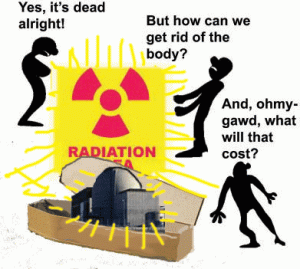
So yes, Ontario’s nuclear program will be a fiscal burden on Ontarians to the tune of around $40 billion CAD which will be spent through roughly 2135, finally being paid off by the great-grandchildren of babies born in 2021.
Ontario’s Unfunded Nuclear Decommissioning Liability Is In The $18-$27 Billion CAD Range eTransport News, 12 Aug 21, Late last year I worked up the likely amount of public money that would have to be thrown at the nuclear industry in order to successfully and safely decommission the 100 operational reactors and the now shut down ones. Unsurprisingly, the nuclear industry had been very optimistic in its estimates of decommissioning costs and timeframes, when the global empirical averages were trending to a billion USD and 100 years per reactor.
Recently I was asked by an Ontario journalist what I thought the likely situation in Ontario would be, and whether the decommissioning trusts were equally underfunded. I was unsurprised to find that Canada is in the same boat as the US, with highly optimistic schedule and cost projections which belie Canadian empirical experience with the CANDU reactor, and that the fund had nowhere near the money necessary for the job. Let’s run the numbers.
Ontario Power Generation (OPG) is the chunk of the provincial utility that was carved apart in the late 1990s by the Mike Harris Conservatives to handle generation alone. It operates 18 aging CANDU reactors across three sites: Bruce, Pickering, and Darlington.
OPG has a nuclear decommissioning fund of about $5 billion CAD or US$4 billion right now. If the experience of other countries on the actual cost of a billion USD per reactor and an actual timeline of decommissioning of a century holds true, and I see no reason why it doesn’t, that means that there is currently a $17.5 billion CAD gap in Ontario, in addition to the existing $19.3 billion CAD in debt still being serviced from their construction. When the government of the era split up the utility, it moved all of the debt off of the components and into general debt. One of the many appropriate and sensible things that the McGuinty Administration did in the 2000s, in addition to shutting down coal generation entirely, was to move the debt back into the utility and set about servicing it from utility bills.
Most of the reactors at Bruce Nuclear are aging out, with several over 40 years old and the remainder approaching 40. Darlington’s are around 30, so they have a bit of runway. Pickering’s reactors are going to be shut down in 2024 and 2025 and start decommissioning in 2028. While refurbishment could bridge Ontario’s for another 20 years in many cases, that’s expensive and typically won’t pass any economic viability assessment compared to alternatives.
The likelihood is that all reactors in Ontario will reach end of life by 2035, and be replaced by some combination of renewable energy and HVDC transmission from neighboring jurisdictions, with both Manitoba and Quebec having excellent, low-carbon hydroelectric to spare……………….
Nuclear decommissioning funding comes from reactors operating revenue. In the US, it’s 0.01 to 0.02 cents per kWh as a set aside. I wasn’t able to find the required set aside for Ontario’s fleet, but obviously they aren’t setting aside sufficient funds now, or have absurdly optimistic fund growth expectations. They only have a decade to set aside more money from operating reactors, and have only set aside $5 billion CAD after 50 years, so the most generous assumption is that they will set aside perhaps $7 billion CAD in the OPG fund by end of life of the reactors, and have a liability for decommissioning of $15.5 to $27 billion CAD. For the next step, let’s assume $20 billion CAD for the sake of round numbers.
Given the likelihood of all of Ontario’s reactors being off of the grid by 2035, with major decommissioning occurring every few years until then, the kWh generated by Ontario’s nuclear fleet from now through 2060 will be in the range of about 1000 TWh assuming there are no lengthy outages at any of the plants, which to be clear is an awful lot of low carbon electricity.
However, $20 billion is a big number too. It turns into about 19 cents per kWh if you only count electricity generated from today through end of life for the reactors. It’s obviously a lot lower if you calculated from beginning of the lifetime of the reactors. However you count it though, that’s only the unfunded Ontario liability, and it’s on top of subsidized security costs Canada and Ontario and municipalities bear, and it’s on top of the outstanding $19.3 billion in debt that has only been receiving servicing on the interest since the McGuinty government brought it back into the utility. It’s likely that the majority of that debt will be outstanding in 2035 still, as it has gone from $20 billion to $19.3 billion in the last 11 years, so expecting it to be gone by 2035 is not realistic.
So yes, Ontario’s nuclear program will be a fiscal burden on Ontarians to the tune of around $40 billion CAD which will be spent through roughly 2135, finally being paid off by the great-grandchildren of babies born in 2021.
Nuclear, the gift that keeps on giving. https://etransportnews.com/2021/08/06/ontarios-unfunded-nuclear-decommissioning-liability-is-in-the-18-27-billion-cad-range/
Canada’s nuclear reactors may not be fit for service
Canada’s nuclear reactors may not be fit for service, Rabble ca, Joyce Nelson, 11 Aug 21, On July 13, Bruce Power announced that two reactors at its Bruce Nuclear Generating Station in Kincardine, Ontario had violated its operating license.
It had “higher than anticipated readings” of hydrogen-equivalent concentration (Heq) in pressure tubes in two units. Pressure tubes must not exceed the allowable limit of 120 parts per million of Heq. Each pressure tube in a reactor contains 12 bundles of uranium, which are the basis for the nuclear reaction, but the pressure tubes also contain the coolant that keeps the fuel from overheating and triggering a meltdown. Pressure tubes with high levels of Heq can develop cracks and fractures, thereby compromising a reactor’s safety.
As The Globe and Mail reported:
“In response to Bruce Power’s contraventions, on July 13, the CNSC [Canadian Nuclear Safety Commission] ordered the company, along with fellow CANDU [Canada Deuterium Uranium] operators Ontario Power Generation (OPG) and New Brunswick Power, to review the fitness for service of their pressure tubes and report back no later than the end of July.”
Aging reactors
Many of Canada’s aging CANDU reactors are older than their design-life for pressure tubes, which originally was designated as 210,000 effective full power hours (EFPH), or about 30 years.
When Hydro Quebec’s Gentilly-2 CANDU reactor reached that limit, it closed the plant.
As The Globe and Mail reported:
“Thierry Vandal, chief executive at the time, testified before Quebec’s national assembly that he considered 210,000 EFPH ‘the extreme limit’ beyond which his management team dared not go. ‘I would no more operate Gentilly-2 beyond 210,000 hours than I would climb onto an airplane that does not have its permits and that does not meet the standards,’ he said, according to a translated transcript.”
Under industry pressure, the Canadian Nuclear Safety Commission subsequently raised the limit to 247,000 EFPH in 2014, and then to 295,000 EFPH in 2018.
In 2018, the CNSC extended OPG’s license for its Pickering Nuclear Generating Station for 10 years. Rather than require that OPG replace aging pressure tubes, the regulator mandated more frequent inspections.
When asked how often pressure tubes are checked, retired nuclear scientist and radioactive chemistry expert Dr. Frank Greening answered by email:
“Pressure tubes are checked for their hydrogen/deuterium concentrations about every two years, but it’s a little more complex than that. Each CANDU unit contains about 400 tubes and each tube is about six meters in length. This means it’s next to impossible to check every tube at every location, so only about 10 tubes are checked at a time. In addition, corrosion and [hydrogen/deuterium] pickup are expected to be most significant at the hot, outlet end of each tube, so samples are usually restricted to this location.”
As a result of such limited inspections, the industry relies on mathematical models to predict how long the untested tubes can safely remain in service. But this modeling is not necessarily accurate, as evidenced by the July 13 “higher than anticipated readings” at Kincardine.
Indeed, in March 2021, The Globe reported:
“Documents obtained under the federal Access to Information Act by Ottawa researcher Ken Rubin, and provided to The Globe, show that since 2017, CNSC staffers had grown increasingly concerned about unreliable data arising from OPG’s inspections of pressure tubes…The whole method by which operators assessed fitness for service of pressure tubes had been called into question.”
Another Fukushima?………………….
Canada’s nuclear reactors may not be fit for service
Bill Gates and the corporates behind the fake solutions to climate change

Gates: the interests behind the fake solutions to climate change, Navdanya International 02/04/2021 In Bill Gates’ vision, technology seems fated to fix every single damage that has been inflicted on our planet and climate change has recently been added to the list. But this is the same mentality that has taken us to the devastating stage we currently find ourselves in, while the only thing improving exponentially is the profits of the corporations taking advantage by selling these very technologies. It is necessary to step out of this technofix hysteria in order to reclaim a holistic vision based on real farmers, healthy and nutritious food, and on an agroecological model that does not impact on climate but, instead, helps to mitigate it. No fake burger can do that. The latest report from Navdanya International, “Bill Gates & his Fake Solutions to Climate Change“, details the reasons behind Bill and Melinda Gates’ attempts to focus the debate on miraculous technologies and the real interests behind its propaganda.
While Gates’ many investments are all seemingly justified by a noble humanitarian and environmental cause, the report shows that they actually allow him to impose his techno-solutionist strategy through direct influence over all types of global development protagonists.
But this game of billionaire profit-making and corporate partnerships is even clearer in one of Gates’ most prominent personal investment funds: Breakthrough Energy Ventures. The companies funded by Breakthrough are riddled with ex DuPont, Monsanto, PepsiCo, and Microsoft executives, revealing how the same corporations which precipitated our health and ecological crisis are now selling us back equally risky solutions to the problems they created in the first place……….. https://navdanyainternational.org/gates-the-interests-behind-the-fake-solutions-to-climate-change/
South Africa’s Organisation Undoing Tax Abuse (Outa) opposes plan for new nuclear power
Nersa gets green light to approve new nuclear power procurement, but Ts & Cs apply, Fin24, 20 Aug 21, A National Energy Regulator of South Africa (Nersa) committee has recommended that the regulator approve a plan to procure 2 500 MW of new nuclear power.
It will now be up to Nersa’s full board to make a decision on whether it agrees with the plan as set out by Mineral Resources and Energy Minister Gwede Mantashe in August last year.
At a meeting on Friday morning, Nersa’s electricity subcommittee was broadly supportive of Mantashe’s plan. This followed public hearings earlier in the year. Liz McDaid, Parliamentary and energy advisor to the Organisation Undoing Tax Abuse (Outa), said that South Africans would now have to wait see what Nersa’s board decides.
If the board decides to concur with Mantahse’s determination, it will have to publish the reasons behind its decision, including the “suspensive conditions” mentioned in the meeting on Friday.
Outa is opposing the new nuclear build, saying it is “not affordable, not appropriate and should not be approved”. No requests for proposal have yet been issued for the new nuclear build. …….. https://www.news24.com/fin24/companies/industrial/nersa-gets-green-light-to-approve-new-nuclear-power-procurement-but-ts-cs-apply-20210820
Covid Defense Act – new Bill to prioritise U.S. health, vaccine spending over weapons spending !

New Bill Proposes Cutting Pentagon Spending to Fund Vaccines for Poor Nations, Common Dreams “We can’t bomb our way out of a global pandemic,” said Rep. Mark Pocan, the sponsor of the legislation, “Shifting funds from weaponry and military contractors to producing Covid vaccines will save hundreds of thousands—if not millions—of lives around the world.”
JAKE JOHNSON, August 20, 2021 Congressman Mark Pocan of Wisconsin introduced legislation this week that would cut billions of dollars from the Pentagon’s massive budget and invest those funds in global coronavirus vaccination efforts, which are badly lagging as rich countries continue to hoard doses and rush ahead with booster shots.
The Covid Defense Act proposes transferring $9.6 billion in U.S. military spending to Covax—a global vaccination initiative led by the World Health Organization—to assist with the procurement of doses for the people of low-income nations. Thus far, just 1.3% of people in poor countries have received at least one vaccine dose.
In a press release, Pocan’s office said that the funding—which represents just 1.3% of the $740.5 billion in U.S. military spending approved for 2021—”could lead to an additional 1.8 billion Covid vaccine doses for lower-income countries in 2021 and early 2022.” If passed, Pocan’s office said, the new legislation could provide vaccine access to another 30% of the world’s poorest and most vulnerable populations……….. https://www.commondreams.org/news/2021/08/20/new-bill-proposes-cutting-pentagon-spending-fund-vaccines-poor-nations
Pentagon Poised To Unveil, Demonstrate Classified Space Weapon

Pentagon Poised To Unveil, Demonstrate Classified Space Weapon
The push to declassify an existing space weapon is being spearheaded by Gen. John Hyten, the vice chairman of the joint chiefs of staff. Breaking Defense, Theresa Hitchens, 20 Aug 21
Directed energy anti-satellite weapons for the future. (Lockheed Martin)
WASHINGTON: For months, top officials at the Defense Department have been working toward declassifying the existence of a secret space weapon program and providing a real-world demonstration of its capabilities, Breaking Defense has learned.
The effort — which sources say is being championed by Gen. John Hyten, the vice-chairman of the joint chiefs of staff — is close enough to completion that there was a belief the anti-satellite technology might have been revealed at this year’s National Space Symposium, which kicks off next week.ampioned
However, the crisis in Afghanistan appears to have put that on hold for now. Pulling the trigger on declassifying such a sensitive technology requires concurrence of the Director of National Intelligence, Avril Haines, and a thumbs up from President Joe Biden, sources explain; with all arms of the national security apparatus pointed towards Kabul, that is almost certainly not going to happen next week. And until POTUS says yes, nothing is for certain, of course.
The system in question long has been cloaked in the blackest of black secrecy veils — developed as a so-called Special Access Program known only to a very few, very senior US government leaders. While exactly what capability could be unveiled is unclear, insiders say the reveal is likely to include a real-world demonstration of an active defense capability to degrade or destroy a target satellite and/or spacecraft.
At least, that is what has been on the table since last year — when officials in the Trump administration viewed revealing the technology as a capstone to the creation of Space Command and Space Force. The plan apparently had been to announce it at the 2020 Space Symposium, which was cancelled due to the COVID-19 pandemic; the arrival of the Biden administration also led to a reevaluation of moving forward with the reveal.
Expert speculation on what could be used for the demonstration ranges from a terrestrially-based mobile laser used for blinding adversary reconnaissance sats to on-board, proximity triggered radio-frequency jammers on certain military satellites, to a high-powered microwave system that can zap electronics carried on maneuverable bodyguard satellites. However, experts and former officials interviewed by Breaking Defense say it probably does not involve a ground-based kinetic interceptor, a capability the US already demonstrated in the 2008 Burnt Frost satellite shoot-down.
Requests for comment to the offices of Hyten, Haines, and SPACECOM were not returned by deadline.
Many military space leaders believe that Space Force and Space Command must publicly demonstrate to Moscow and Beijing not just an ability to take out any space-based counterspace systems they may be developing or deploying, but also to attack the satellites they, like the US, rely upon for communications, positioning, navigation and timing (PNT), and intelligence, surveillance and reconnaissance (ISR).
Notably, the second-in-command of the Space Force recently foreshadowed movement in the long-running debate about declassification of all things related to national security space — a multifaceted and complex debate which has pitted advocates against upholders of the traditional culture of secrecy within DoD and the Intelligence Community.
“It is absolutely a true problem,” Gen. DT Thompson, deputy Space Force commander, responded to a question about over-classification during a July 28 Mitchell Institute event. “I wish we owned our own destiny in that regard, but we don’t — it’s part of a broader activity and we just have to work through that. What I will say is, I think we’re on the verge of a couple of significant steps.”
The Transparency Dilemma
In fact, Thompson’s comments represented only one of several comments, quietly dropped in speeches or interviews, from top military space officials pushing for declassification of high-end systems, following several years of a steadily intensifying drumbeat on the issue. A who’s-who list of top officers, DoD civilian leaders, and key members of Congress have for years been arguing that over-classification is harming the ability to convey the growing threat of foreign counterspace to lawmakers, the public and allied/partner nations — as well as the ability to cooperate with industry and foreign partners to mitigate those threats…………………
The central dilemma isn’t hard to understand, but the devil is in the details of solving it…………………… more https://breakingdefense.com/2021/08/pentagon-posed-to-unveil-classified-space-weapon/?utm_campaign=Breaking%20News&utm_medium=email&_hsmi=151302334&_hsenc=p2ANqtz-_WjJRXNH7oSN8eQo0iMMC52dIbrytHkcSOFjM1_zECxrz5zqaTLiWTN0lmaYIYa35tfuqxon2uOPfvbhS1zFeBwuIlrg&utm_content=151302334&utm_source=hs_email
Why Cosmic Radiation Could Foil Plans for Farming on Mars
Why Cosmic Radiation Could Foil Plans for Farming on Mars, New research suggests gamma rays stunt plant growth. Inside Science , August 20, 2021 – Karen Kwon, Friday, August 20, 2021 – — What would it take for humans to live on Mars? The first step is to successfully get people to the red planet, of course. Once there, the astronauts would face a task that could be even more difficult: figuring out how to survive in an environment that is vastly different from Earth’s. A new study demonstrates one of the challenges — Earth’s plants don’t grow as well when exposed to the level of radiation expected on Mars.
Wieger Wamelink, an ecologist at Wageningen University in the Netherlands who describes himself as a space farmer, has been frustrated by sci-fi depictions of growing plants on Mars. “What you often see is that they do it in a greenhouse,” he said, “but that doesn’t block the cosmic radiation,” which consists of high-energy particles that may alter the plants’ DNA. Mars lacks the same degree of protection from cosmic radiation that the Earth’s atmosphere and magnetic field provide. To prove his suspicion that cosmic radiation could be dangerous to plants, Wamelink decided to test the hypothesis himself.
First, Wamelink and his team had to recreate the cosmic radiation. The team settled on using gamma rays generated by radioactive cobalt, even though the actual cosmic radiation that bombards Mars’ surface consists of various types of radiation, including alpha and beta particles……………..
Four weeks after germination, the scientists compared the two groups and saw that the leaves of the group exposed to gamma rays had abnormal shapes and colors. The weights of the plants also differed; the rye plants in the gamma-ray group weighed 48% less than the regular group, and the weight of the garden cress exposed to gamma rays was 32% lower than their unblasted counterparts. Wamelink suspects the weight difference is due to the gamma rays damaging the plants’ proteins and DNA. The results were published in the journal Frontiers in Astronomy and Space Sciences this month……………. http://insidescience.org/news/why-cosmic-radiation-could-foil-plans-farming-mars
Russia, Germany, hope efforts to save Iran nuclear deal will be continued — Putin
Russia, Germany hope efforts to save Iran nuclear deal will be continued — Putin, Tass, 20 Aug 21, The Russian leader also said he had informed Merkel about his telephone conversation with Iranian President Ebrahim Raisi on August 18 MOSCOW, August 20. /TASS/. Russia and Germany hope that efforts towards saving the Iran nuclear deal will be continued after a new government is formed in Iran, Russian President Vladimir Putin said after talks with visiting German Chancellor Angela Merkel.
“When discussing the situation around the Iran nuclear deal, we with Mrs Chancellor expressed the hope that after a new government is formed in Iran, strenuous efforts will be continued to preserve the Joint Comprehensive Plan of Action,” he said.
Putin also said he had informed Merkel about his telephone conversation with Iranian President Ebrahim Raisi on August 18.
The JCPOA Joint Commission has had several offline meetings in Vienna since April to discuss prospects for the United States’ possible return to the deal and steps needed to ensure full and efficient compliance with the deal’s terms by all its signatories. The commission members continue to discuss ways of restoring the nuclear deal at informal meetings in various formats, including at an expert level. JCPOA participants also hold separate consultations with the US delegation without Iran’s participation. It was originally planned to finish consultations in late May and then – in early June………… https://tass.com/politics/1328453
Biden’s Iran envoy calls nuclear deal’s fate ‘one big question mark
Biden’s Iran envoy calls nuclear deal’s fate ‘one big question mark’, Politico, By ALEXANDER WARD and QUINT FORGEY 08/19/2021 ROBERT MALLEY, the man President JOE BIDEN has tasked with putting the United States back into the Iran nuclear deal, isn’t supremely confident he’ll succeed in his mission.
“It’s just one big question mark,” he told NatSec Daily during an exclusive interview in his State Department office. Rejoining the multinational accord “is not something that we can fully control,” he said, citing a lack of engagement from the Iranians.
Negotiations between the United States, Iran and five world powers have proceeded fruitlessly since April. Tehran’s side won’t even speak directly with Washington’s and instead prefers working through intermediaries while in Vienna. That dance was complicated by the arrival of new Iranian President EBRAHIM RAISI, a hardliner who experts suspect is more skeptical of the diplomatic effort than his pact-signing predecessor. No open bargaining has taken place since Raisi came to power in mid-July.
………….. Should the United States and Iran fail to agree on terms in the coming months, the envoy says his team is preparing some contingencies. One is that Washington and Tehran sign a wholly separate deal, complete with different parameters than the current accord. Another is a suite of punitive responses in coordination with European allies, though Malley didn’t specifically detail what those would be………… https://www.politico.com/newsletters/national-security-daily/2021/08/19/exclusive-bidens-iran-envoy-calls-nuclear-deals-fate-one-big-question-mark-494049
If children are to live with the climate crisis, we must green the curriculum
If children are to live with the climate crisis, we must green the curriculum, Guardian, Meryl Batchelder,
It’s clear to me when I teach that sustainability and the environment should be a thread running through every subject
Thu 19 Aug 2021 ”……………….. With so much focus on children – the ones who will have to live with the coming ecological disaster – the role of education is key. This summer has seen unprecedented wildfires and floods. Pupils see scenes of biblical devastation on the news, but in many schools they are not being given the required information or context and this can lead to misunderstanding or anxiety.
……………. There is still no mention of the climate crisis in the national curriculum for England in primary schools, and in key stage 3 science very little of the curriculum relates to climate education. Incredibly, the last major update to the national geography curriculum for England in 2013 saw the then education secretary, Michael Gove, attempt to drop climate change.
………….. So what needs to change? We need a green curriculum that starts in early years and extends through all key stages. Properly taught, climate change education should be a thread through all subjects – not just science and geography – from the food miles of the ingredients we cook in food technology to debates on humanitarian issues such as mass migration in religious education or personal, social, health and economic (PSHE) education.
Working in a state school means I am duty bound to teach lessons within the confines of the national curriculum. As far as this allows, I have sought to enrich my pupils’ learning with fieldwork, hands-on science, technology, engineering and mathematics (STEM) challenges and even gardening. But not every school has the resources or expertise to bring climate education into the classroom. Earlier this year, the climate education campaign group Teach the Future reported that seven in 10 UK teachers say they have not received adequate training to educate their students on the climate crisis……….. https://www.theguardian.com/commentisfree/2021/aug/19/children-climate-crisis-green-curriculum-sustainability-environment—
August 19 Energy News — geoharvey

Opinion: ¶ “Eight Zero-Emission Transport Items That *Need* To Be In The Next Reconciliation Bill” • There were several provisions in the infrastructure bill that we worked hard to make sure were included (and were as good as possible), but almost none of them go as far as we would have liked or climate needs […]
August 19 Energy News — geoharvey
1 This Month


Pine Ridge Uranium is the real threat, not Tehran- Tell Burgum: Stop the Extraction.
Chernobyl: The Lost Tapes – A good documentary on Chernobyl on SBS available On Demand for the next 3 weeks– https://www.sbs.com.au/ondemand/tv-program/chernobyl-the-lost-tapes/2352741955560
To see nuclear-related stories in greater depth and intensity – go to https://nuclearinformation.wordpress.com
-
Archives
- April 2026 (288)
- March 2026 (251)
- February 2026 (268)
- January 2026 (308)
- December 2025 (358)
- November 2025 (359)
- October 2025 (376)
- September 2025 (257)
- August 2025 (319)
- July 2025 (230)
- June 2025 (348)
- May 2025 (261)
-
Categories
- 1
- 1 NUCLEAR ISSUES
- business and costs
- climate change
- culture and arts
- ENERGY
- environment
- health
- history
- indigenous issues
- Legal
- marketing of nuclear
- media
- opposition to nuclear
- PERSONAL STORIES
- politics
- politics international
- Religion and ethics
- safety
- secrets,lies and civil liberties
- spinbuster
- technology
- Uranium
- wastes
- weapons and war
- Women
- 2 WORLD
- ACTION
- AFRICA
- Atrocities
- AUSTRALIA
- Christina's notes
- Christina's themes
- culture and arts
- Events
- Fuk 2022
- Fuk 2023
- Fukushima 2017
- Fukushima 2018
- fukushima 2019
- Fukushima 2020
- Fukushima 2021
- general
- global warming
- Humour (God we need it)
- Nuclear
- RARE EARTHS
- Reference
- resources – print
- Resources -audiovicual
- Weekly Newsletter
- World
- World Nuclear
- YouTube
-
RSS
Entries RSS
Comments RSS
 nuclear-news