Nuclear and Climate Clash – Russia’s nuclear weapons centre threatened by wildfires.

The fires have reached the closed city of Sarov, which has been a center for nuclear research since the Soviet era and was the site of the first Soviet atomic bomb’s development.
Today, the research center makes nuclear warheads and is believed to be developing Russia’s strategic missiles, including its highly touted hypersonic arsenal.
Wildfires Near Russia’s Nuclear Research Center Spark State of Emergency https://www.themoscowtimes.com/2021/08/24/wildfires-near-russias-nuclear-research-center-spark-state-of-emergency-a74878 Aug. 24, 2021 Russian authorities have declared an interregional state of emergency as tough-to-contain forest fires threaten the country’s top-secret nuclear weapons research center, Interfax reported Tuesday, citing the emergencies ministry.
Wildfires have raged in the Nizhny Novgorod region and the neighboring republic of Mordovia, both roughly 500 kilometers east of Moscow, since early August.
The fires have reached the closed city of Sarov, which has been a center for nuclear research since the Soviet era and was the site of the first Soviet atomic bomb’s development.
Today, the research center makes nuclear warheads and is believed to be developing Russia’s strategic missiles, including its highly touted hypersonic arsenal.
Firefighters have struggled to contain the fires due to hard-to-reach terrain, dead wood that remained after the 2010 wildfires and poor weather conditions.
Several aircraft from the Emergency Situations Ministry and Defense Ministry have been deployed to fight the fires.
The emergencies ministry told Interfax that two helicopters and a Be-200ES aircraft will be deployed to the site of the fires on Wednesday.
Russia has been hit hard by an unprecedented wildfire season fueled by historic heatwaves and drought conditions exacerbated by climate change, particularly in Siberia.
Corporate Media Politicize WHO Investigation on Covid Origins to Vilify China
Corporate Media Politicize WHO Investigation on Covid Origins to Vilify China, JOSHUA CHO FAIR (10/6/20, 6/28/21) has previously critiqued Western news media’s credulous coverage of evidence-free “lab leak” speculations. One key factor in spreading suspicion that the coronavirus might have escaped from the Wuhan Institute of Virology (WIV) is media’s early and ongoing politicization of the World Health Organization’s investigation into the pandemic’s origins. Much of this politicization weaponizes Orientalist tropes about China being especially, perhaps genetically, untrustworthy—the sort of people who would unleash Covid-19 on the world.
While no new evidence has emerged suggesting that the virus emerged from the WIV, many more Americans now believe it did. A Politico/Harvard poll in July, following an increase of uncritical Western media coverage on the lab leak theory, found that 52% of US adults now believe Covid-19 leaked from a lab, up from 29% in March 2020. This is contrary to the assessment of most scientists, who believe, based on available evidence, that a natural origin for the virus is more likely………… https://fair.org/home/corporate-media-politicize-who-investigation-on-covid-origins-to-vilify-china/
Star Wars and America’s Nazis

German Major General Walter Dornberger, who had been in charge of the entire Nazi rocket program, and how he “in 1947 as a consultant to the U.S Air Force and adviser to the Department of Defense … wrote a planning paper for his new employers.
He proposed a system of hundreds of nuclear-armed satellites all orbiting at different altitudes and angles, each capable of re-entering the atmosphere on command from Earth to proceed to its target. The Air Force began early work on Dornberger’s idea under the acronym NABS (Nuclear Armed Bombardment Satellites).”
Insane U.S. Plan to Spend Billions on Weaponizing Space Makes Defense Contractors Jump for Joy—But Rest of World Cowers in Horror at Prospect of New Arms Race Leading to World War III CovertAction Magazine By Karl Grossman – August 25, 2021 ” ……………………………………..Star Wars and America’s Nazis
U.S. interest in militarizing and weaponizing space goes back well before the Vision for 2020 and other bellicose U.S. plans for space in the 1990s, or Ronald Reagan’s Strategic Defense Initiative dubbed “Star Wars,” in the 1980s. Its roots are with the former Nazi rocket scientists and engineers brought to the U.S. from Germany after World War II under the U.S.’s Operation Paperclip, where more than 1,600 German scientists, engineers and technicians were taken from former Nazi Germany to the U.S. for government employment after the end of World War II in Europe, between 1945 and 1959.
They ended up at the U.S. Army’s Redstone Arsenal in Huntsville, Alabama—to use “their technological expertise to help create the U.S. space and weapons program,” writes Jack Manno, a State University of New York professor, in his 1984 book Arming the Heavens: The Hidden Military Agenda for Space, 1945-1995 (1984).
“Many of the early space war schemes were dreamt up by scientists working for the German military, scientists who brought their rockets and their ideas to America after the war,” he writes. Many of these scientists and engineers “later rose to positions of power in the U.S. military, NASA, and the aerospace industry.”

Among them were “Wernher von Braun and his V-2 colleagues,” who began “working on rockets for the U.S. Army” and, at the Redstone Arsenal, “were given the task of producing an intermediate range ballistic missile to carry battlefield atomic weapons up to 200 miles. The Germans produced a modified V-2 renamed the Redstone…. Huntsville became a major center of U.S. space military activities.”
Manno tells the story of former German Major General Walter Dornberger, who had been in charge of the entire Nazi rocket program, and how he “in 1947 as a consultant to the U.S Air Force and adviser to the Department of Defense … wrote a planning paper for his new employers.
He proposed a system of hundreds of nuclear-armed satellites all orbiting at different altitudes and angles, each capable of re-entering the atmosphere on command from Earth to proceed to its target. The Air Force began early work on Dornberger’s idea under the acronym NABS (Nuclear Armed Bombardment Satellites).”
In my subsequent Weapons in Space, Manno tells me that “control over the Earth” was what those who have wanted to weaponize space seek. He said the Nazi scientists are an important “historical and technical link, and also an ideological link…. The aim is to … have the capacity to carry out global warfare, including weapons systems that reside in space.”
Dornberger’s nuclear link continues in various forms throughout the U.S. military space program. The Strategic Defense Initiative scheme of Reagan—although this was barely disclosed at the time—was predicated on orbiting battle platforms with on-board hypervelocity guns, particle beams and laser weapons. They were to be energized by on-board nuclear reactors.
As General James Abrahamson, SDI director, said at a Symposium on Space Nuclear Power and Propulsion, “without reactors in orbit [there is] going to be a long, long light [extension] cord that goes down to the surface of the Earth” to bring up power to energize space weaponry………………….[2] https://covertactionmagazine.com/2021/08/25/insane-u-s-plan-to-spend-billions-on-weaponizing-space-makes-defense-contractors-jump-for-joy-but-rest-of-world-cowers-in-horror-at-prospect-of-new-arms-race-leading-to-world-war-iii/
Updates: Afghanistan, Somalia, Syria, Iraq, by Women Against Military Madness — Rise Up Times

“Unless something changes, military skirmishes will continue between Iraq, Iran, Syria, Lebanon, Hamas in Palestine on the one hand, and the U.S. and its allied client-partners on the other, and may develop into a devastating new war in the Middle East.”
Updates: Afghanistan, Somalia, Syria, Iraq, by Women Against Military Madness — Rise Up Times
German utility aims to expand renewables, rejects keeping nuclear reactors open
RWE CEO rejects keeping nuclear power plants open, Reuters DUESSELDORF, Aug 24 – German utility RWE (RWEG.DE) rejected on Tuesday the idea of letting nuclear power plants stay open for longer due to the fact they produce less carbon dioxide.
“We are not available for this,” CEO Markus Krebber told journalists. The German government is paying four nuclear operators – including RWE – nearly 2.6 billion euros ($3.05 billion) in compensation for forcing them to shut their nuclear plants early in response to the Fukushima disaster.
RWE, which used to rely heavily on nuclear power and coal, has transformed itself into one of the largest green power companies in Europe.
Krebber called for a new federal government to accelerate the pace of the shift to renewable energy by increasing targets, expanding the grid and cutting the approval procedures for wind energy plants.
Krebber, who took over as CEO at the end of April, will present his strategy in the fourth quarter, including a new dividend policy: “We are no longer a dividend stock. We are a growth stock,” he said. https://www.reuters.com/business/energy/rwe-ceo-rejects-keeping-nuclear-power-plants-open-2021-08-24/
Israel accelerates plans for a possible strike on Iran’s nuclear programme
Israel ‘Speeding Up’ Operational Plans Against Iran’s Nuclear Program
by Algemeiner Staff 26 Aug 21, As Israeli Prime Minister Naftali Bennett arrived in Washington, DC ahead of his Thursday meeting with US President Joe Biden, the Israel Defense Forces revealed that it has accelerated its plans for a possible strike on Iran’s nuclear program…….
The military said that Maj. Gen. Tal Kalman, the head of its Iran file, is at work on operational plans to attack Iran’s nuclear program as well as its missile and rocket sites, Walla reported.
The IDF assesses that Iran does not immediately plan to increase its enrichment of uranium beyond the 60% level, but that Tehran is unlikely to compromise in the talks over returning to the deal…….
The IDF also confirmed on Wednesday that Israel had struck some 31 Hezbollah targets in Syria over the last tw https://www.algemeiner.com/2021/08/25/idf-says-israel-speeding-up-operational-plans-against-irans-nuclear-program/
Nuclear power and nuclear weapons together, in a bonanza for a privatised space industry
Insane U.S. Plan to Spend Billions on Weaponizing Space Makes Defense Contractors Jump for Joy—But Rest of World Cowers in Horror at Prospect of New Arms Race Leading to World War III
CovertAction Magazine By Karl Grossman – August 25, 2021 ”……………….New World Vistas
A 1996 U.S. Air Force report, New World Vistas: Air and Space Power for the 21st Century, speaks of how “new technologies will allow the fielding of space-based weapons of devastating effectiveness to be used to deliver energy and mass as force projection in tactical and strategic conflict. These advances will enable lasers with reasonable mass and cost to effect very many kills.”
However, “power limitations impose restrictions” on such space weaponry making them “relatively unfeasible,” but “a natural technology to enable high power is nuclear power in space.” Says the report: “Setting the emotional issues of nuclear power aside, this technology offers a viable alternative for large amounts of power in space.”
This linkage continues.
A 104-page report issued by the National Academies of Sciences, Engineering and Medicine in 2021 entitled Space Nuclear Propulsion for Human Mars Exploration declared: “Space nuclear propulsion and power systems have the potential to provide the United States with military advantages.”
The report’s central focus is the advocacy of rocket propulsion by nuclear power for U.S. missions to Mars and lays out “synergies” in space nuclear activities between NASA and the U.S. military.

On December 19, 2021, just before he was to leave office, Trump signed Space Policy Directive-6, titled “National Strategy for Space Nuclear Power and Propulsion.”
Its provisions include: “DoD [Department of Defense] and NASA, in cooperation with DOE [Department of Energy], and with other agencies and private-sector partners, as appropriate, should evaluate technology options and associated key technical challenges for an NTP [Nuclear Thermal Propulsion] system, including reactor designs, power conversion, and thermal management. DoD and NASA should work with their partners to evaluate and use opportunities for commonality with other SNPP [Space Nuclear Power and Propulsion] needs, terrestrial power needs, and reactor demonstration projects planned by agencies and the private sector.”
It continues: “DoD, in coordination with DOE and other agencies, and with private sector partners, as appropriate, should develop reactor and propulsion system technologies that will resolve the key technical challenges in areas such as reactor design and production, propulsion system and spacecraft design, and SNPP system integration.”
The members of the committee that put together the report for the National Academies included executives of the aerospace and nuclear industry—a key element in U.S. space policy.
For example, as the report states, there were: Jonathan W. Cirtain, president of Advanced Technologies, “a subsidiary of BWX Technologies which is the sole manufacturer of nuclear reactors for the U.S. Navy”; Roger M. Myers, owner of R. Myers Consulting and who previously at Aerojet Rocketdyne “oversaw programs and strategic planning for next-generation in-space missions [that] included nuclear thermal propulsion and nuclear electric power systems; and Joseph A. Sholtis, Jr., “owner and principal of Sholtis Engineering & Safety Consulting, providing expert nuclear, aerospace, and systems engineering services to government, national laboratories, industry, and academia since 1993.”
And so on.
“Rigged Game in Washington”

The Global Network Against Weapons and Nuclear Power in Space was formed in 1992 at a meeting in Washington, D.C., and has been the leading group internationally challenging the weaponization and nuclearization of space.
Its coordinator, Bruce Gagnon, in a 2021 interview with me, said: “The aerospace industry has long proclaimed that ‘Star Wars’ would be the largest industrial project in human history. Add the nuclear industry’s ambition to use space as its ‘new market,’ and one can imagine the money that would be involved. These two industry giants have put their resources together to ensure their ‘control and domination’ of the U.S. Congress. Both political parties are virtually locked down when it comes to appropriating funds to move the arms race into space and to colonize the heavens for corporate profits. Just one example is the recent approval in Congress of the creation of the ‘Space Force’ as a new service branch in the military.”
During the Trump administration (with the Democrats in control of the House of Representatives) the Space Force was ‘stood up’ as they like to say in the biz,” said Gagnon. “The Democrats could have stopped the creation of this new military branch. During the little congressional debate that did occur, the only thing the Democrats requested was to call it the ‘Space Corps’ (like the Marine Corps). It’s a rigged game in Washington when it comes to handing out money to the aerospace industry.”
Gagnon continued: “In his book, The Pentagon’s New Map: War and Peace in the 2lst Century, former Navy War College Professor Thomas Barnett writes that, under globalization of the world economy, every country will have a different role. We won’t produce shoes, cars, phones, washing machines and the like in the U.S. anymore because it is cheaper for industry to exploit labor in the global south.
Our role in the U.S., Barnett says, will be ‘security export.’ That means we will endlessly fight wars in the parts of the world where nations are not yet ‘fully integrated’ into corporate capitalism. Having a dominant military in space would enable the US to see, hear and target everything on the Earth.”
“In order to put together a global ‘Leviathan’ military capability,” Gagnon continued, “space must be militarized and weaponized. The cost of doing so is enormous and requires cuts in social and environmental spending and larger contributions from NATO member nations.”
“In addition to using space technology to control Earth on behalf of corporate capital, the new Space Force will have another key job. They will be tasked with attempting to control the pathway on and off the planet Earth. In the 1989 Congressional Study entitled Military Space Forces: The Next 50 Years, congressional staffer John Collins writes on pages 24 and 25: “Nature reserves decisive advantage for L4 and L5, two allegedly stable [space] libration points that theoretically could dominate Earth and moon, because they look down both gravity wells. No other location is equally commanding…. Armed forces might lie in wait at that location to hijack rival shipments on return.”
Privatized Gold Rush

“The Pentagon is looking to a future where space would be fully privatized and a new gold rush would ensue. Corporations and rich fat-cats like Jeff Bezos, Elon Musk and Richard Branson, while ignoring the UN’s Outer Space and Moon Treaties that call the heavens the ‘province of all mankind,’ would move to control the shipping lanes from Earth into space. The Space Force would be used by these ‘space entrepreneurs’ as their own private pirate forces to ensure they controlled the extraction of resources mined from planetary bodies. This provocative vision would in the end recreate the global war system, which has been deeply embedded into the culture and consciousness here on Earth. Russia, China and other space-faring nations are not going to allow the US to be the ‘Master of Space.’”
Planting Earth’s Toxic Residue in the Heavens and the Fight to Stop It

Says Gagnon: “I call this the bad seed of greed, war and environmental devastation that we are poised to plant into the heavens.”
“It is my hope that the global public would quickly awaken to a deep understanding and not allow corporate oligarchs or the military to encircle our planet with so much space junk that we would be forever entombed on Earth, or continue to punch a hole in the Earth’s delicate ozone layer from toxic rocket exhaust after each of their tens of thousands of coming launches, or ruin the sacred night sky with blinking satellites for 5G that will in the end be used by the Space Force for expanded ‘space situational awareness’ and targeting capabilities.”
“We have reached the point in human history where we need the immediate intervention by the citizen taxpayers of the planet to ensure that our tiny orbiting satellite called Earth remains livable for the future generations,” Gagnon declared. “We can’t fall for the public relations story-line of the cowboy sailing off into space to discover the new world. We know how that movie turns out in the end—just ask the Native American people.”
U.S. Army Colonel John Fairlamb (Ret.), in 2021 wrote in The Hill, the Washington, D.C., news website: “Let’s be clear: Deploying weapons in space crosses a threshold that cannot be walked back.” Fairlamb’s background includes being International Affairs Specialist for the Army Space and Missile Defense Command and Military Assistant to the U.S. Secretary of State for Political Military Affairs.
“Given the implications for strategic stability, and the likelihood that such a decision [to deploy weapons in space] by any nation would set off an expensive space arms race in which any advantage gained would likely be temporary, engaging now to prevent such a debacle seems warranted,” wrote Fairlamb.
His piece was headed: “The U.S. should negotiate a ban on basing weapons in space.”
“It’s time,” Fairlamb wrote, “for arms control planning to address the issues raised by this drift toward militarization of space. Space is a place where billions of defense dollars can evaporate quickly and result in more threats about which to be concerned. Russia and China have been proposing mechanisms for space arms control at the United Nations for years; it’s time for the U.S. to cooperate in this effort.”
As Alice Slater, a member of the boards of both the Global Network Against Weapons and Nuclear Power in Space and the organization World BEYOND War, says: “The U.S. mission to dominate and control the military use of space has been, historically and at present, a major obstacle to achieving nuclear disarmament and a peaceful path to preserve all life on Earth. Reagan rejected Gorbachev’s offer to give up ‘Star Wars’ as a condition for both countries to eliminate all their nuclear weapons … Bush and Obama blocked any discussion in 2008 and 2014 on Russian and Chinese proposals for a space-weapons ban in the consensus-bound Committee on Disarmament in Geneva.”
At this unique time in history when it is imperative that nations of the world join in cooperation to share resources to end the global plague assaulting its inhabitants and to avoid catastrophic climate destruction or Earth-shattering nuclear devastation,” said Slater, “we are instead squandering our treasure and intellectual capacity on weapons and space warfare.”
And yet far worse is to come—unless there is a return to the vision of the Outer Space Treaty of 1967. The latter needs to be expanded, U.S. Space Force dismantled, and a full global commitment made to keep space for peace.
As we go to press, Breaking Defense published an article: “Pentagon Poised To Unveil, Demonstrate Classified Space Weapon.” This was its headline. Above the headline it stated: “Show Coverage: Space Symposium 2021”
The piece begins: “For months, top officials at the Defense Department have been working toward declassifying the existence of a secret space weapon program and providing a real-world demonstration of its capabilities.” It continues: “The system in question long has been cloaked in the blackest of black secrecy veils—developed as a so-called Special Access Program known only to a very few, very senior government leaders.”
The August 20th article features below its headline a large illustration of—as its caption reads—“Directed energy anti-satellite weapons for the future (Lockheed Martin)”
Space Symposium 2021 was to be held in Colorado Springs, Colorado between August 23 and 26. A main speaker was to be General John W. “Jay” Raymond, chief of space operations of the U.S. Space Force.
Breaking Defense describes itself as “the digital magazine on the strategy, politics and technology of defense,” adding: “It’s a new era in defense, where new technologies, new warfare domains and a rapidly shifting military and political landscape have profound implications for national security.”
Nuclear energy is anything but clean, despite the media hype
Nuclear energy is anything but clean https://www.theguardian.com/environment/2021/aug/25/nuclear-energy-is-anything-but-clean
The nuclear power industry has successfully rebranded an appallingly toxic energy industry by never mentioning the terrible legacy of nuclear waste, writes Ann Denise Lanes 26 Aug 21 Re your report (Nuclear storage plans for north of England stir up local opposition, 23 August), it is no surprise that ongoing discussions to choose locations for the dumping of nuclear waste are cloaked in secrecy.
Over the last decade, the nuclear power industry has successfully rebranded an appallingly toxic energy industry as “zero carbon” and even “clean” (Zero-carbon electricity outstrips fossil fuels in Britain across 2019, 1 January 2020) by never mentioning the terrible legacy of nuclear waste. Nuclear energy is neither clean nor zero-carbon when you consider its complete fuel cycle, from uranium mining overseas to the energy-intensive production of fuel rods to the management of highly toxic radioactive waste products such as plutonium.
The nuclear lobby has done a very effective PR job in diverting attention away from everything other than the electricity feed into the National Grid. It knows that there is no safe long-term solution for storing nuclear waste – how could you guarantee safety from the most dangerous chemical element on the planet for 24,000 years (the half-life of plutonium)? The last thing this industry wants is an open discussion. It would reopen the debate on nuclear waste that it has, up to now, successfully buried in millions of pounds’ worth of rebranding. Hence the secrecy.
Humanitarian Impacts of Nuclear Weapons
Humanitarian Impacts of Nuclear Weapons, The personal side of nuclear weapons European Leadership Network Heather Williams |Senior Associate Fellow, 25 August 2021
” ………………………..Nowhere is this emphasis on diversity and inclusivity more noticeable than in the humanitarian impacts of nuclear weapons initiative. Indeed, this movement highlights the personal experience of a wide range of individuals whose lives were directly impacted by nuclear weapons. Thanks in large part to the humanitarian impacts conferences in 2013 and 2014, efforts by civil society organisations, and the Treaty on the Prohibition of Nuclear Weapons, these views are increasingly a part of nuclear policy discussions. As they should be.
I was first introduced to this movement in 2012 and had the privilege of attending the three humanitarian impacts conferences. The conferences included the testimony of survivors of the nuclear bombings and research on the environmental impact of nuclear testing, among other topics. For example, the Vienna conference in 2014 included the testimony of Sue Coleman-Haseldine, from the Koonibba Aboriginal Mission in Australia, that was impacted by nuclear testing in the region: ‘I remember older people talking about Nullabor dust storms. It was the fallout from the Maralinga tests. We weren’t on ground zero, but the dust didn’t stay in one place. It went wherever the winds took it. I noticed people dying of cancer, something that was new to us. There’s a cemetery at Woomera which we call the children’s cemetery. It’s filled with children who died around the time of the tests.’ The testimony of survivors of Hiroshima and Nagasaki, along with groups impacted by nuclear testing, ought to be required reading for anyone working on nuclear weapons issues.
The humanitarian impacts conferences led to the Treaty on the Prohibition of Nuclear Weapons (TPNW), and while the TPNW remains politically contentious, it should not detract from discussions on the historical human costs of nuclear weapons and nuclear testing. When the Treaty was concluded in 2017, nuclear scholars Benjamin Valentino and Scott Sagan pointed to it as a ‘missed opportunity’, because, ‘The energy, organization, and genuine passion that eventually resulted in the ban treaty were assets that might have been used to address dangerous realities about nuclear weapons that are too often ignored: the human costs of clean-up of waste sites and production facilities and the potential for nuclear winter or other environmental effects.’ Nonetheless, these conferences and the humanitarian movement have changed nuclear scholarship and discourse and brought to light an aspect of nuclear weapons policy that is often overlooked.
Since the first humanitarian impacts conference, ELN has provided an important platform for spreading these stories and messages, and putting them in the wider context of nuclear policy. This has included proponents of the TPNW as well as sceptics……………….. https://www.europeanleadershipnetwork.org/commentary/the-personal-side-of-nuclear-weapons/
TEPCO to build new 1km long undersea tunnel to release Fukushima Daiichi radioactive water offshore
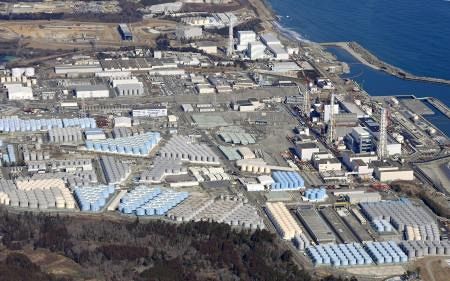
On the 24th, it was learned through interviews with officials that Tokyo Electric Power Company (TEPCO) has decided to build a new submarine tunnel about one kilometer long, run pipes through it, and release the treated water from the Fukushima Daiichi Nuclear Power Plant offshore. The radioactive substance tritium contained in the treated water will be diluted to below the standard value, but by releasing the water offshore, the company hopes to further dilute it and spread it, thereby curbing the reputational damage that the local people are concerned about.
On the same day, the government held a meeting of ministers concerned with the disposal of the treated water. If the release of the water into the ocean causes damage such as a decrease in sales or prices of marine products, the government will purchase the water at its own expense to support the fishermen, and is preparing the environment for the release. On the other hand, there is a deep-rooted opposition from the local community and fishermen, and there are many uncertainties about the future outlook.
Communities react with shock to news they are being considered as locations for nuclear waste facility

Nuclear storage plans for north of England stir up local opposition
Communities react with shock to news they are being considered as locations for underground facility, Guardian, Tommy GreeneTue 24 Aug 2021 The long-running battle to build an underground nuclear waste facility in the north of England has run into fresh problems, as communities reacted with shock to the news that they were being considered as locations.
The north-east port town of Hartlepool is one of the sites in the frame as a potential site for a geological disposal facility (GDF), while a former gas terminal point at Theddlethorpe, near the Lincolnshire coast, is another. Cumbria, where much of the waste is stored above ground, is also being considered.
Victoria Atkins, a government minister and the MP for Louth and Horncastle, said she was “stunned” by the prospect that her constituency could host a GDF, claiming that the Conservative-controlled Lincolnshire county council’s engagement with the government’s radioactive waste management group had been kept hidden from her.
The facility is intended to deal with the long-running problem of nuclear waste storage by providing a safe deposit for approximately 750,000 cubic metres of high-activity waste hundreds of metres underground in areas thought to have suitable geology to securely isolate the radioactive material. The waste would be solidified, packaged and placed into deep subterranean vaults. The vaults would then be backfilled and the surrounding network of tunnels and chambers sealed……….
Between 70% and 75% of the UK’s high-activity radioactive waste, which would be designated for the GDF, is stored at the Sellafield facility in west Cumbria. The sources of the waste include power generation, military, medical and civil uses.
Existing international treaties prohibit countries from exporting the waste overseas, leading some scientists to argue for underground burial that, they say, would require no further human intervention once storage is complete……………
the proposals have stirred up strong local feeling among both community leaders and residents, and accusations of secrecy have been levelled at councils and the RWM in recent weeks.
In north-east England, the political fallout generated by news of the GDF “early stage” discussions triggered the resignation of Hartlepool council’s deputy leader, Mike Young, on Tuesday evening.
“We are making huge strides in Hartlepool and across Teesside and Darlington,” the Tees Valley mayor, Ben Houchen, said following the decision. “And the last thing we need as we sell our region to the world is to be known as the dumping ground for the UK’s nuclear waste.”
Cumbria county council, which resisted the last efforts to site a GDF locally in 2013, has declined to take part in either of the two existing working groups, saying its involvement would give the process “a credibility it doesn’t deserve”.
There is already considerable opposition from local groups. “The vast majority of people here are horrified by the GDF,” said Jane Bright, a Mablethorpe resident and spokesperson for the Guardians of the East Coast campaign. “I should think it’s no more welcome elsewhere. But there’s a lot of pride in this area and we’ll fight this for as long as it takes.”
Marianne Birkby, a Cumbrian resident and founder of the Radiation-Free Lakeland group, said: “We’re seen as the line of least resistance here. In Cumbria, we’ve been there before with this. Now people are now trying to get their heads around it again, in the middle of a pandemic. This dump would essentially make us a sacrifice zone to the nuclear industry.” https://www.theguardian.com/environment/2021/aug/23/nuclear-storage-plans-for-north-of-england-stir-up-local-opposition
How to remember Hiroshima and Nagasaki – Sign the nuclear weapons treaty
How to remember Hiroshima and Nagasaki – Sign the nuclear weapons treaty, https://www.sightmagazine.com.au/21431-essay-how-to-remember-hiroshima-and-nagasaki-sign-the-nuclear-weapons-treaty, DIANE RANDALL, 23 Aug 21,
Every August for the past 76 years we have marked the anniversary of the bombings of Japan’s Hiroshima and Nagasaki. To date, the bombs dropped on the two cities three days apart in 1945, killing and maiming hundreds of thousands (mostly civilians) in the blink of an eye, have been the only use of nuclear weapons in combat. The strike cannot be ignored or overlooked. It should not be forgotten.
But I look forward to another anniversary, one that celebrates something that has not yet happened. I look forward to celebrating, year after year, the complete abolishment of nuclear weapons and to a world free of atomic bombs.
It is a small miracle that nuclear weapons have not been used again, despite being tested extensively, with at least nine nations possessing them. Small miracles, however, are no substitute for sound policy.
As long as nuclear weapons exist, there is a threat of use or the possibility of an accident with these weapons that harbor devastating destruction. These threats can be eliminated by banning all nuclear weapons.
Yes, some may view this as unrealistic wishful thinking. No-one who lived through, witnessed or has any knowledge of the unparalleled destruction wrought upon Hiroshima and Nagasaki could possibly think nuclear weapons should be used again.
As Quakers, we have consistently called for the elimination of nuclear weapons and other weapons of war. Quakers, along with millions of people worldwide, support the 2017 Treaty on the Prohibition of Nuclear Weapons, the first international pact to comprehensively ban nuclear weapons. To date, it’s been signed by 86 countries, offering an aspiration for the complete elimination of these weapons.
However, no nuclear power, including the United States, has signed it.
It is equally true that the world has seen little if any peace since those tragic days in August 1945. Yes, thankfully, nuclear weapons have not been used. But that is no comfort for those on either side who died in Korea, Vietnam, Iraq, Afghanistan and other lethal military confrontations. People who died fighting for their country, or the uncountable civilian casualties we call “collateral damage,” are no less meaningful than those who perished in the nuclear bombings.
What can be done about the mind-numbing amount of death and destruction we willingly unleash across the globe, too often with the intention to dominate others?
Stop funding nuclear weapons and cut the Pentagon budget is the most obvious answer. President Biden has already requested $US753 billion for both the Pentagon and the nuclear weapons budget, and the Senate Committee on Armed Services has offered an extra $US25 billion on top of that request.
Is there no better use for those funds? During a deadly new wave and resurgence of the global COVID-19 pandemic, isn’t the production and distribution of vaccines across the globe a more worthy choice for taxpayer funds? This would be a productive way to make the world a safer place rather than bombs, fighter planes, tanks, drones and guns.
As a faith community with a long tradition of working to prevent nuclear war and the ever-increasing threat of arms proliferation, Quakers know this is about a lot more than money. We are trying to save something much more important than that human life.
Progress has been made in reducing nuclear weapons since the Cold War; however we should continue to lead the way for all nuclear armed nations to ban these weapons forever. Our very existence is at stake. We have a moral obligation to make certain nuclear weapons should never be used again.
When that dream comes to fruition, it will be a day long worth marking.
Diane Randall is the general secretary of the Friends Committee on National Legislation, a national, non-partisan Quaker lobby for peace, justice and the environment.
Russia begins constructing nuclear submarines amid increasing friction with West
Russia begins constructing nuclear submarines amid increasing friction with West, By Guy Taylor– The Washington Times – Monday, August 23, 2021
Russia has begun building new nuclear submarines capable of carrying intercontinental ballistic missiles as part of a wide-reaching military modernization effort amid rising tensions with the United States and other Western powers.
Russian President Vladimir Putin personally announced the new construction, delivering orders via a video call Monday for two ICBM-armed nuclear submarines, as well as two diesel-powered subs and two corvettes at shipyards in Severodvinsk, St. Petersburg and Komsomolsk-on-Amur………..
On a separate front, U.S. military officials sought to draw attention to the increased Russian military activity in the Arctic.
In April, CNN reported that new imagery had revealed a major Russian build-up in the Arctic and claimed Moscow had begun actively testing new weapons in the region, parts of which are freshly ice-free due to changing climate patterns.
Moscow’s apparent goal is to secure its northern coast and dominate a key shipping route from Asia to Europe.
The April CNN report cited weapons experts and Western officials expressing particular concern about one Russian “super-weapon” — the unmanned Poseidon 2M39 torpedo, a stealth projectile powered by a nuclear reactor and intended by Russian designers to sneak past coastal defenses on the seafloor……..
Monday’s ceremony for the new ships was part of the Army-2021 show intended to showcase military might and attract foreign customers for Russia‘s arms industries. The weeklong show features aircraft, tanks, missiles and other weapons.
“Many of our weapons have capabilities that have no analogues in the world, and some will remain unrivaled for a long time to come,” the Russian president said. https://www.washingtontimes.com/news/2021/aug/23/russia-begins-constructing-nuclear-submarines-amid/
Greater powers to be given to UK’s armed Civil Nuclear Constabulary – a threat to peaceful protest?

UK Government plan to give armed nuclear police more powers raises ‘profound concerns The Ferret, ’Billy Briggs
August 23, 2021
A UK Government plan to give an armed police force called the Civil Nuclear Constabulary (CNC) greater powers has raised “profound concerns” and been described as “deeply worrying”.
The CNC is a specialist force tasked with protecting civil nuclear sites in Scotland, England and Wales and nuclear materials in transit both in the UK and internationally.
Counter-terrorism is a major part of its policing and the force employs 1,500 police officers. The CNC guards nuclear sites at Torness, Hunterston and Dounreay in Scotland, among other places across the UK.
It’s remit is set out in the Energy Act 2004 but the UK Government has just held a consultation seeking views on a plan to expand and diversify the force’s role.
Anti-nuclear groups have voiced fears over the proposal, however, arguing that the CNC’s remit should be limited to civil nuclear sites. The Scottish Greens said that centralised control over an armed police force with new powers would be a “very concerning development”…………..
Those responding to the consultation included the UK and Ireland Nuclear Free Local Authorities (NFLA) which submitted a joint response with anti-nuclear groups – Blackwater Against New Nuclear Group, Together Against Sizewell C, CADNO, People Against Wylfa B, Stop Hinkley and Nuclear Waste Advisory Associates.
The NFLA argued that the CNC’s powers should be “limited to civil nuclear sites, as its title implies”. Any expansion to other roles and duties for the CNC, they argued, would “represent an expansion of nuclear police at expense of the civil police force”
Councillor David Blackburn, NFLA steering committee chair, said: “NFLA has joined with these six other campaigning groups to raise its profound concerns that an expansion of the Civil Nuclear Constabulary and an increase in its powers is moving it in the wrong direction. What is required rather is concerted efforts to reduce the risks of the UK’s nuclear legacy and to avoid developing new nuclear reactor sites.”
He argued that by making nuclear sites safer “there will become less of a need for an armed police force”.
“The concerning wider push for new laws which could reduce peaceful protest also greatly concerns us,” Blackburn said. “The proposals in this consultation move the CNC further into being an extensively armed police force, when we should instead be looking at ways to have a democratically controlled and accountable police force protecting the public in a measured way.”……… https://theferret.scot/uk-government-plan-to-give-armed-police-more-powers/
Texas lawmakers oppose high level nuclear waste coming into their State

State lawmakers again try to ban most dangerous nuclear waste as feds consider allowing it at West Texas site, https://www.texastribune.org/2021/08/23/texas-nuclear-waste-storage-site-legislature/A failed regular session bill sought to give a financial break to a West Texas nuclear waste disposal company. Now, lawmakers have removed what opponents called a giveaway and are again trying to pass a bill to stop highly radioactive materials from coming to Texas.
BY ERIN DOUGLAS AUG. 23, 2021 After failing this spring, Texas lawmakers are again trying to ban the most dangerous type of radioactive waste from entering the state — at the same time as a nuclear waste disposal company in West Texas pursues a federal application to store the highly radioactive materials.
Environmental and consumer advocates for years have decried a proposal to build a 332-acre site in West Texas near the New Mexico border to store the riskiest type of nuclear waste: spent fuel rods from nuclear power plants, which can remain radioactive for hundreds of thousands of years. Strong political interests in Texas, from Gov. Greg Abbott to some oil and gas companies operating in the Permian Basin, have opposed the company’s application.
But a bill that sought to ban the highly radioactive material failed during the regular legislative session that ended in May. That bill, filed by State Rep. Brooks Landgraf, R-Odessa, whose district includes Andrews County where the existing nuclear waste company Waste Control Specialists operates, included a big break on fees for the company. Some lawmakers also thought the previous bill’s language wasn’t strong enough to actually ban the materials.
Now, Landgraf has again filed a bill during this year’s second special session that seeks to ban the highly radioactive materials from coming to the company’s facility in his district. The House Environmental Regulation Committee on Monday passed House Bill 7, which does not include any changes to fees for the existing company, one of the key criticisms that killed the proposed legislation earlier this year.
“So in other words, this is designed to be clean and easy so that we can go on record as a state [opposing high-level nuclear waste storage],” Landgraf said.
Waste Control Specialists has been disposing of the nation’s low-level nuclear waste — including tools, building materials and protective clothing exposed to radioactivity — for a decade in Andrews County. The company, with a partner, is pursuing a federal Nuclear Regulatory Commission license to store spent nuclear fuel on a site adjacent to its existing facility.
The Nuclear Regulatory Commission is advancing the company’s license. In July, NRC staff recommended in an environmental review that the site be approved to take the highest level of nuclear waste. The license still needs review by the federal commissioners.
Scientists agree that spent nuclear fuel, which is currently stored at nuclear power plants, should be stored deep underground, but the U.S. still hasn’t located a suitable site. The plan by the WCS joint venture, Interim Storage Partners, proposes storing it in above-ground casks until a permanent location is found.
Landgraf’s HB 7 includes a ban on disposing of high-level radioactive waste in Texas other than former nuclear power reactors and former nuclear research and test reactors on university campuses (nuclear power plants must keep the waste generated from operations on site until a long-term disposal site is created). The bill would also bar state agencies from issuing construction, stormwater or pollution permits for facilities that are licensed to store high-level radioactive waste.
Some opponents of nuclear waste, however, say the bill doesn’t go far enough. Karen Hadden, the executive director of the Sustainable Energy and Economic Development Coalition, an alliance of businesses and organizations that oppose the nuclear waste facility, is opposed to the bill because she said the ban leaves out another type of highly radioactive waste, much of it generated by the decommissioning of nuclear power plants. The material — known as “greater than Class C waste” falls into what experts call a gray area between lower-level categories of radioactive materials and spent nuclear fuel.
“We would support a single, well-written ban on spent nuclear fuel and Greater than Class C reactor waste,” Hadden said in an interview with the Tribune. “We question why the bill isn’t better written.”
1 This Month
23 April – WEBINAR – Why new nuclear reactors are the wrong tools for decarbonization Thursday, April 23 • 1 AM – 2 AM AEST


Pine Ridge Uranium is the real threat, not Tehran- Tell Burgum: Stop the Extraction.
Chernobyl: The Lost Tapes – A good documentary on Chernobyl on SBS available On Demand for the next 3 weeks– https://www.sbs.com.au/ondemand/tv-program/chernobyl-the-lost-tapes/2352741955560
To see nuclear-related stories in greater depth and intensity – go to https://nuclearinformation.wordpress.com
-
Archives
- April 2026 (264)
- March 2026 (251)
- February 2026 (268)
- January 2026 (308)
- December 2025 (358)
- November 2025 (359)
- October 2025 (376)
- September 2025 (257)
- August 2025 (319)
- July 2025 (230)
- June 2025 (348)
- May 2025 (261)
-
Categories
- 1
- 1 NUCLEAR ISSUES
- business and costs
- climate change
- culture and arts
- ENERGY
- environment
- health
- history
- indigenous issues
- Legal
- marketing of nuclear
- media
- opposition to nuclear
- PERSONAL STORIES
- politics
- politics international
- Religion and ethics
- safety
- secrets,lies and civil liberties
- spinbuster
- technology
- Uranium
- wastes
- weapons and war
- Women
- 2 WORLD
- ACTION
- AFRICA
- Atrocities
- AUSTRALIA
- Christina's notes
- Christina's themes
- culture and arts
- Events
- Fuk 2022
- Fuk 2023
- Fukushima 2017
- Fukushima 2018
- fukushima 2019
- Fukushima 2020
- Fukushima 2021
- general
- global warming
- Humour (God we need it)
- Nuclear
- RARE EARTHS
- Reference
- resources – print
- Resources -audiovicual
- Weekly Newsletter
- World
- World Nuclear
- YouTube
-
RSS
Entries RSS
Comments RSS
 nuclear-news