Whitewashing of Fukushima meltdown by United Nations Scientific Committee on the Effects of Atomic Radiation


Note the careful choice of words – no adverse effects ”have been documented‘‘ ‘‘that could be directly attributed‘‘…….
‘No adverse health effects’ detected despite three nuclear reactors being destroyed by an earthquake and tsunami in 2011 Radiation caused by the nuclear meltdown in Fukushima a decade ago has not damaged the health of local people, according to a UN report.Gillian Hirth, chairwoman of the UN’s scientific committee on the effects of atomic radiation (Unscear), said that “no adverse health effects among Fukushima residents have been documented that could be directly attributed to radiation exposure from the accident” in March 2011…….
Concern over the potential health effects of the accident rose after reports of a high incidence of thyroid cancer in children living in Fukushima prefecture at the time of the disaster.
Unscear and other experts have attributed the higher rates to the use of highly sensitive ultrasound equipment and the large number of children who have been examined……..
But in a report released to coincide with the 10th anniversary of the triple disaster, Greenpeace Japan warned that large areas near the plant where evacuation orders have been lifted in recent years had still not been properly decontaminated, leaving returning residents exposed to potentially harmful levels of radiation for decades.
Nuclear education of state energy regulators

With the Department of Energy behind this – can it really offer impartial education?
NARUC, DOE strike five-year deal to allow nuclear education of state energy regulators, Daily Energy Insider, March 10, 2021 by Chris Galford A new partnership between the National Association of Regulatory Utility Commissioners (NARUC) and the U.S. Department of Energy (DOE) will provide opportunities for NARUC to educate state public service commissioners and staff on nuclear issues.
This Nuclear Energy Partnership will last for five years to help regulators better understand the barriers to and potential of what is currently the nation’s largest source of zero carbon power.[ [zero carbon? That’s just not true ] It will officially begin this month and be co-chaired by Anthony O’Donnell of the Maryland Public Service Commission and Tim Echols of the Georgia Public Service Commission, chair and vice chair, respectively, of the NARUC Subcommittee on Nuclear Issues — Waste Disposal.
Estimates put nuclear power’s contributions to U.S. electricity at approximately 20 percent of the total last year. However, among the 94 nuclear reactors pumping out that clean power, many are approaching 40 years in service……. https://dailyenergyinsider.com/featured/29440-naruc-doe-strike-five-year-deal-to-allow-nuclear-education-of-state-energy-regulators/
I hate those Fukushima disaster anniversaries!

March 11, 2021
For the last ten years, every year, we have the same circus. For one or two weeks the mainstream media comes out with their anniversary articles, over and over repeating the same old songs, old facts, avoiding the really important issues. Along with this the antinuclear divas once a year prerorate their polished spiels basking in their little moment of glory, releasing their pieces on their dot.orgs. while asking for more donations.
In the meantime not much has changed. The ‘decommissioning’ work at the Fukushima Daiichi nuclear plant is a neverending story despite all their nice PR technical blablabla, ignoring the fact that the technology necessary to complete the decommissioning has yet to be invented. At 30 Sieverts level of radiation anyone would get fried within 5 minutes, even their costly robots can’t hold their breath very long.
TEPCO is already gradually releasing partially filtered radioactive water, water still containing radioactive material, into our oceans, our environment. Further, it is their intention to dump all the partially contaminated, radioactive water currently stored in over 1,000 tanks into the sea. The only unknown is exactly when they’ll be able to push it thru.
Despite a few court victories, the victims still have not been properly, sufficiently compensated for all their losses and suffering. People on location are still stuck living in an environment with high levels of radiation, levels the government deems acceptable, thresholds higher than the international standards for nuclear plant workers!
The Japanese government and the nuclear lobby are still orchestrating the denial of threats, of facts, the denial of health risks for the population, campaigning for the evacuees to return.
The Fukushima disaster and its tragic consequences are still hurting the local population. Ten years is NOTHING in terms of radioactive contamination. Contamination that is there to stay. Ongoing… every day.
F these anniversaries!
Nuclear technology’s role in the world’s energy supply is shrinking
Nuclear technology’s role in the world’s energy supply is shrinking
Anniversaries of the Fukushima and Chernobyl disasters highlight the challenges of relying on nuclear power to cut net carbon emissions to zero. Nature 10 Mar 21, ……………. With attention focused on nuclear disasters, it’s hard to imagine the enthusiasm with which nuclear energy was once regarded, when it was seen by many as one answer to global energy demand. From the first experimental reactor in 1951, reactors were commissioned at an increasing rate, with 20–30 commissioned almost every year during a peak period between the late 1960s and the end of the 1970s. A fire in 1957 at one of the United Kingdom’s power plants, Windscale — later renamed Sellafield — did not impede the global rate of growth……….
In addition to the deaths and health risks, the cost of the damages caused by Chernobyl is thought to exceed US$200 billion, and the Japan Center for Economic Research estimates the costs of decontaminating the Fukushima site to be between $470 billion and $660 billion. In the wake of the disaster, 12 of Japan’s reactors have been permanently shut; a further 24 remain closed pending ongoing safety reviews, which are adding to the costs.
What all of this means is that, on top of construction costs, any country investing in nuclear power must be prepared to set aside — or must have access to — vast sums that can be released in the event of disasters, whether they occur as a result of human error or natural phenomena.
What all of this means is that, on top of construction costs, any country investing in nuclear power must be prepared to set aside — or must have access to — vast sums that can be released in the event of disasters, whether they occur as a result of human error or natural phenomena.
Considering the barriers to the adoption of nuclear energy, it is not surprising that much of the nuclear energy generated around the world is produced by nuclear-weapons states. Most countries will baulk at the idea of setting up a nuclear power plant if the total bill could run to hundreds of billions of dollars.
By contrast, although renewable-energy technologies are still in their relative infancy, their costs are falling and their regulation is much more straightforward. This is important: the technology used to turn on lights or charge mobile phones shouldn’t need to involve national or international defence apparatus.
Clearly, nuclear energy will be with us for some time. New plants are being built and older ones will take time to decommission. But it is not proving to be the solution it was once seen as for decarbonizing the world’s energy market. Nuclear power has benefits, but its continued low take-up indicates that some countries think these are outweighed by the risks. For others, the development of nuclear energy is unaffordable. If the world is to achieve net zero carbon emissions, the focus must be on renewable energies — and one of their greatest benefits is that their sources are available, freely, to all nations.
Anxieties over Turkey’s new Russian-backed nuclear plants
Turkey’s nuclear power dilemma, Turkey’s first Russia-backed nuclear plant has raised issues around its safety and potential for use in building nuclear weapons. Al Jazeera, By Sinem Koseoglu. 10 Mar 2021
Istanbul, Turkey – Turkish and Russian officials laid the foundation for the third reactor of Turkey’s first nuclear power plant Akkuyu in the southern coastal city of Mersin on Wednesday.
The plant’s first reactor unit is expected to be operational in 2023, the centenary of the Turkish Republic, and the remaining units in 2026.
The co-construction of the Akkuyu plant started in April 2018, eight years after the two countries signed an intergovernmental agreement.
The project is owned by the Russian energy company Rosatom while the Turkish Akkuyu is the license owner and the local operator.
Once completed, the plant is expected to produce 35 billion kilowatt-hours (kWh) of electricity annually, about 10 percent of Turkey’s total electricity supply. The service life will last 50 years.
The facility will launch Turkey into the ”league of nuclear energy countries”, President Recep Tayyip Erdogan said, hailing it as a “symbol of Turkish-Russian cooperation”.
Russian President Vladimir Putin, who spoke at the event via video-conference from Moscow, called it a “truly flagship project”.
Akkuyu is the only nuclear power facility under construction in Turkey but a second project in the Black Sea province of Sinop is expected to kick off this year, reports suggest, if Ankara can find a new partner after Japan’s Mitsubishi pulled out last year.
The project was agreed on by the Japanese and Turkish governments in 2013. A consortium led by Mitsubishi Heavy Industries conducted a feasibility study until March for the construction of a 4,500-megawatt plant in Sinop.
A senior energy official, speaking on condition of anonymity, told Al Jazeera the Turkish government is also considering a third nuclear plant with four reactors in the country’s northwest. Turkey’s ultimate goal is not building a nuclear weapon but diversity in energy resources, he said.
Russian dependency?
Since the Akkuyu project was signed, proponents of nuclear energy in Turkey have argued it would limit Turkey’s dependency on foreign energy suppliers. They also underline it is clean energy. [clean???]
However, some international experts think differently. Henry D Sokolski, executive director of the Nonproliferation Policy Education Center in Washington, DC, said Akkuyu’s financing model could further Ankara’s dependency on Russia, a major energy provider to Turkey. The project is fully financed by Moscow.
Sokolski said it is an intensive capital investment and questioned why Turkey frontloads such debt while alternative and cheaper energy resources are coming down the pipeline.
Could Akkutu be a target?
Turkey is not the only country seeking nuclear energy in the Middle East. Saudi Arabia and Jordan are still considering establishing nuclear power plants. Egypt and the United Arab Emirates (UAE) are in on it, while Israel is long believed to have a stockpile of nuclear weapons and Iran has the capacity to develop them.
Sokolski warned Turkey about the regional challenges of entering the fray. “Your neighbourhood is dangerous. People are fighting. Nuclear reactors in a shooting war can be targets.”
He said missiles and drones could knock out critical electrical supply lines to a reactor and destroy emergency generators, nuclear control rooms, reactor containment buildings, and spent reactor fuel buildings.
“These kinds of strikes can make people more anxious and result in radiological releases, like Chernobyl or worse,” said Sokolski.
Turkey has waged a war against the PKK, the outlawed Kurdistan Workers’ Party listed as a “terrorist” organisation by the United States, the European Union, and Turkey, for decades in a conflict that has killed an estimated 40,000 people.
News reports have suggested the armed group has camps in northern Iraq where armed drones are being developed.
Turkey is also embroiled in conflicts in Syria and the eastern Mediterranean, while the Iran-aligned Houthi rebels in Yemen have targetted Saudi and Emirati targets with its missiles and drones. Armed groups such as the Syrian National Defence Forces, which is supportive of President Bashar al-Assad’s government, could mimic such attacks, said Sokolski.
Turkey has waged a war against the PKK, the outlawed Kurdistan Workers’ Party listed as a “terrorist” organisation by the United States, the European Union, and Turkey, for decades in a conflict that has killed an estimated 40,000 people.
News reports have suggested the armed group has camps in northern Iraq where armed drones are being developed.
Turkey is also embroiled in conflicts in Syria and the eastern Mediterranean, while the Iran-aligned Houthi rebels in Yemen have targetted Saudi and Emirati targets with its missiles and drones. Armed groups such as the Syrian National Defence Forces, which is supportive of President Bashar al-Assad’s government, could mimic such attacks, said Sokolski.
Atomic weapon suspicions
Despite Turkey’s claims the plant will only be used to diversify energy resources, some have suggested Ankara may have plans to enrich uranium.
Turkey and nuclear-armed Pakistan have long had military cooperation agreements that were recently intensified, with some news reports suggesting Islamabad may be covertly supporting a nuclear weapons programme.
Military cooperation deals have been signed earlier this year with Kazakhstan, a country providing at least 35 percent of the world’s uranium…….https://www.aljazeera.com/news/2021/3/10/turkeys-nuclear-dilemma
USA’s new $100billion nuclear missile – a white elephant?
|
‘Cold war-era weapon’: $100bn US plan to build new nuclear missile sparks concern, Guardian, Washington, Wed 10 Mar 2021
Scientists say the GBSD project is outdated and the result of lobbying rather than a clear sense of what it will achieve. The US is building a new $100bn nuclear missile based on a set of flawed and outdated assumptions, a new report by the Federation of American Scientists (FAS) will say.The report, due to be published next week, will argue the planned ground-based strategic deterrent (GBSD) is being driven by intense industry lobbying and politicians from states that will benefit most from it economically, rather than a clear assessment of the purpose of the new intercontinental ballistic missile (ICBM).“It is becoming increasingly clear that there has not been a serious consideration of what role these cold war-era weapons are supposed to play in a post-cold war security environment,” the FAS report, titled Siloed Thinking, will say. According to the FAS, a non-partisan thinktank, the US Air Force price tag for the new GBSD was deliberately framed in such a way as to appear slightly less than the cost of extending the life of the missile it would be replacing, the Minuteman III. An independent assessment by the Rand corporation at about the same time, suggested the cost of a totally new weapon could cost two to three times more. An effort by Congress to mandate an independent study on the comparative costs was blocked in 2019 with the help of the industry lobby. The current estimate is that the basic acquisition costs of the GBSD will be $100bn, while the total cost of building, operating and maintaining it over its projected lifespan to 2075 is projected as $264bn. The report is being published as the Biden administration is preparing its first defence budget which may reveal its intentions towards the GBSD, which is in its early stages. In September 2020, Northrop Grumman was awarded an uncontested bid for the $13.3bn engineering, manufacturing and development phase of the project, just over a year after its only rival, Boeing, pulled out of the race, complaining of a rigged competition. It said Northrop Grumman’s purchase of one of the two companies in the US making solid fuel rocket motors gave it an unfair advantage. There are currently 400 Minuteman missiles spread over five states: Colorado, Montana, Nebraska, North Dakota and Wyoming. Many arms control advocates argue that rather than being replaced, they should be phased out entirely on grounds of their vulnerability and consequent instability…… |
|
Ohio House passes its version of Bill rescinding nuclear subsidies
House Bill 128 passed 86-7 on Wednesday afternoon. The bill also would revoke “decoupling” language in HB6 that guaranteed revenue for FirstEnergy at 2018 levels, and language that likely would have made it easier for FirstEnergy to pass a state test meant to prevent utilities from making excessive profits.
Of note, a House committee before passing the bill earlier this week changed it to add back in language offering $20 million in annual solar subsides to six large-scale solar projects. Developers behind some of the projects, some of which are have been completed or are close to it, told lawmakers that revoking the funding would economically undermine the deals they had made with companies that had agreed to buy the power they generated.
Other portions of HB6 so far have remained untouched, provisions eliminating energy efficiency programs and renewable energy mandates, and subsidizing two coal plants — one in Indiana, one in Ohio — owned by a consortium of Ohio utility companies.
Ohio House and Senate leaders will have to sort out how they line up the competing versions of the bills. Any law change requires approval by both chambers before heading to Gov. Mike DeWine for his signature….. https://www.cleveland.com/open/2021/03/ohio-house-passes-their-version-of-bill-rescinding-nuclear-subsidies.html
Nuclear power not an option for Taiwan,
|
Nuclear power not an option: Su https://www.taipeitimes.com/News/front/archives/2021/03/10/2003753555CHANGING TRENDS: A world report showed that in 2019, non-hydro renewables surpassed nuclear power in global electricity generation, environmentalists said, By Lee I-chia / Staff reporter, 10 Mar21,
Premier Su Tseng-chang (蘇貞昌) yesterday said that reviving the Fourth Nuclear Power Plant project would be impossible, adding that the government has always believed that the power plant should not be started. Su made the remarks in response to questions by Chinese Nationalist Party (KMT) Legislator Lu Yu-ling (呂玉玲) about a campaign by environmentalists to hold a referendum on a government plan to build a liquefied natural gas (LNG) terminal off the coast of Datan Borough (大潭) in Taoyuan’s Guanyin District (觀音) on the grounds that it would damage the algal reefs there. Lu asked if the mothballed Fourth Nuclear Power Plant in New Taipei City’s Gongliao District (貢寮) would be a backup plan if the LNG project is scrapped. The premier said the nuclear power plant project was suspended during the administration of former president Ma Ying-jeou (馬英九), and that the disposal of nuclear waste from the nation’s first and second nuclear power plants remains a problem, so it would be impossible to restart construction of the fourth plant now. In related news, the Green Citizens’ Action Alliance yesterday said the share of non-hydro renewables in global electricity generation exceeded that of nuclear power for the first time in 2019, implying that nuclear energy is a declining industry, and that Taiwan should push its energy transition policy forward. The environmental group cited data from the World Nuclear Industry Status Report 2020, published in September last year, of which it was authorized to release a summary in traditional Chinese. The 361-page report provides an assessment of “the status and trends of the international nuclear industry and analyzes the additional challenges nuclear power is facing in the age of COVID-19,” with contributions by seven interdisciplinary experts from Canada, France, Germany, Japan, Lebanon, the US and the UK, the report’s Web site says. Alliance researcher Chen Shi-ting (陳詩婷) said the contributors included Mycle Schneider, an independent international energy and nuclear analyst and consultant who is also the convening lead author of the report; and Tadahiro Katsuta, an associate professor at Meiji University in Tokyo, Japan. Citing the report, alliance researcher Dennis Wei (魏揚) said the share of nuclear energy in the global electricity generation mix peaked at 17.5 percent in 1996 and dropped to only 10.35 percent in 2019. In 2019, non-hydro renewables, such as solar, wind and biomass, generated 10.39 percent of total global electricity, marking the first time in history that renewable energy sources generated more electricity than nuclear power plants, he said. That year, wind and solar power generation increased by 13 percent and 24 percent respectively, while nuclear energy rose by only 3.7 percent, with China accounting for half of the increase, Wei said. Moreover, the cost of nuclear power has continued to increase, rising by 26 percent from 2009 to 2019, while the cost of natural gas dropped by 33 percent, solar power by 89 percent and wind power by 70 percent, he said. Total investment in renewable energy in 2019 exceeded US$300 billion, while investment in nuclear power was only about US$31 billion, showing that nuclear power is losing competitiveness in the global energy market, and that except for China, building nuclear reactors is not a global trend anymore, Wei said. Additional reporting by CNA |
|
Problem in accepting higher level radioactive wastes in Texas
|
Waste Control Specialists won’t move high level nuclear waste to Permian Basin without state’s approval https://www.cbs7.com/2021/03/10/waste-control-specialists-wont-move-high-level-nuclear-waste-to-permian-basin-without-states-approval/ In a meeting on environmental regulation yesterday, Waste Control Specialists said they would not be moving high-level nuclear waste into the Permian Basin without the state’s approval. By Kate Porter Mar. 10, 2021 ANDREWS, Texas (KOSA) – In a meeting on environmental regulation yesterday, Waste Control Specialists said they would not be moving high-level nuclear waste into the Permian Basin without the state’s approval.Texas lawmakers, such as Representative Brooks Landgraf, have presented legislation that would shut the door on WCS ever bringing high-level nuclear waste to Andrews county. Representative Landgraf tells CBS 7 that the nuclear waste facility here in Andrews houses rubber gloves and hospital gowns. Landgraf says WCS proposed a plan to bring higher-level nuclear waste like rods used at nuclear testing sites. That proposal spurred representative Landgraf into action – he presented a bill to block all high-level waste being stored or disposed of here in Texas. I reached out to WCS several times today for comment but have not heard back as of right now. This thinking isn’t isolated to the Republican party.
Midland County Democrat, David Rosen, agrees that high-level nuclear waste does not have a place in the Permian Basin. The bottom line for Andrews residents: WCS will still store nuclear waste There, but it’s up in the air about the level of radioactivity. |
|
France has consistently underestimated the devastating impact of its nuclear tests in French Polynesia
Guardian 9th March 2021, France has consistently underestimated the devastating impact of its nuclear tests in French Polynesia in the 1960s and 70s, according to
groundbreaking new research that could allow more than 100,000 people to
claim compensation. France conducted 193 nuclear tests from 1966 to 1996 at
Moruroa and Fangataufa atolls in French Polynesia, including 41 atmospheric
tests until 1974 that exposed the local population, site workers and French
soldiers to high levels of radiation. By crunching the data from 2,000
pages of recently declassified French defence ministry documents, analysing
maps, photos and other records, and carrying out dozens of interviews in
France and French Polynesia, researchers have meticulously reconstructed
three key nuclear tests and their fallout.
Part of Tomioka, 6 miles from Fukushima, is still a no-go zone
Daily Mail 10th March 2021, Part of the town of Tomioka, about 10 kilometers (6 miles) from the Fukushima Daiichi nuclear power plant, is still a no-go zone 10 years after
a meltdown sent radioactive fallout over the area. The no-go zone is about
12% of the town, but was home to about one-third of Tomioka´s population
of 16,000. It remains closed after the rest of the town in northeastern
Japan was reopened in 2017. Only those with official permission from the
town office can enter the area for a daytime visit.
Nuclear power faces a wobbly future
Scientific American 9th March 2021,Nuclear power faces a wobbly future 10 years after an earthquake and tsunami triggered a triple reactor meltdown at the Fukushima Daiichi plant
in Japan. But the industry’s unstable footing has less to do with the
Fukushima accident—and more to do with how a natural gas glut and the
rise of renewable power have transformed the global energy landscape.
A dangerous and toxic culture of bullying at Britain’s Sellafield nuclear site
BBC 10th March 2021, A “toxic culture” of bullying and harassment at Sellafield could let
serious safety concerns go unreported, whistleblowers have told the BBC. In
a leaked letter, the nuclear site’s group for ethnic minority staff
described “shocking stories” of racial abuse.
Other workers said sexist and homophobic bullying had become routine. Sellafield said it was committed to eradicating unacceptable behaviour from the workplace.
A BBC investigation found: Multiple claims of serious bullying and sexual harassment among its
10,000-strong workforce. Allegations of racial abuse outlined in a leaked
letter to senior management. Concerns about the working culture at the site
and how it could impact nuclear safety.
“When I started working there, it quickly became apparent there was rampant bullying in the organisation,” said Alison McDermott, a senior consultant hired in 2017 to work on
Sellafield’s equality strategy. She said staff interviews and focus groups
revealed serious allegations of sexual harassment at the sprawling site on
the Cumbrian coast.
The thought of the Olympics – the only hold-up to emptying contaminated water to the ocean.
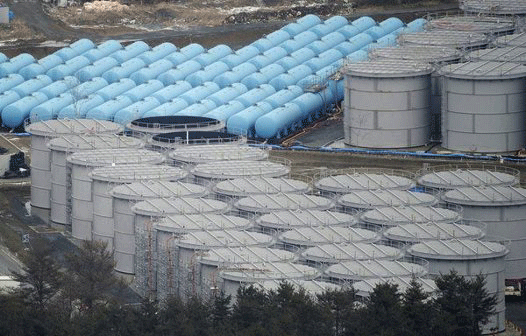
Washington Post 6th March 2021, Beside the ruins of the Fukushima Daiichi nuclear plant, more than 1,000 huge metal tanks loom in silent testament to one of the worst nuclear disasters in history, the meltdown of three nuclear reactors 10 years ago this month. The tanks contain nearly 1.25 million tons of cooling water from the 2011 disaster and groundwater seepage over the years — equivalent to around 500 Olympic-size swimming pools — most of it still dangerously radioactive.
Running out of space to build more tanks, the government wants to gradually release the water into the sea — after it has been decontaminated and diluted — over the next three decades or
more. Even though a formal decision has yet to be announced, the government and Tokyo Electric Power Co. (TEPCO) have insisted that an ocean release is their preferred solution and that it is perfectly safe.
 The only thing holding them back appears to be the Olympics and the bad publicity it could
generate before the Games begin in July, experts say. The idea of releasing the water has infuriated Fukushima’s fishing community, only now getting back on its feet after taking a battering in the wake of the 2011 disaster and the subsequent ocean contamination. Also angry is South Korea, even though it is more than 600 miles away across the sea.
At last! – some media questioning the story that small nuclear reactors combat climate change
 What’s the Role for New Nuclear Power in the Fight Against Climate Change?
Some fear that small modular reactors could rob cash from more proven low-carbon technologies. Greentech Media, JASON DEIGN MARCH 08, 2021 Small modular reactors (SMRs) — nuclear reactors using novel technologies to fit into much smaller and mass-producible packages than the behemoth nuclear power plants of today — are presented as a way of rapidly decarbonizing the grid in the face of an ever more pressing need to meet climate targets. But some opponents claim new nuclear power could have the opposite effect, slowing the fight against human-caused climate change just when things should be speeding up.In September last year, for example, the Sierra Club Canada Foundation harshly criticized Canada’s plans to foster an SMR industry.SMRs “are not the solution to climate change,” said the organization, citing a University of British Columbia study indicating that energy produced by SMRs could cost up to 10 times as much as power from renewable sources such as wind and solar.
“Critics of SMRs say that developing experimental nuclear reactor technologies will take too long to make a difference on climate change and could drain billions of dollars from public coffers,” said the advocacy group.
Similar challenges have been leveled against U.S. utilities such as Duke Energy and Southern Company that include SMRs in the longer-range suite of options to fully decarbonize their power grids by 2050. Critics question whether the SMRs under development today can be commercialized fast enough to drive down emissions over the next decade or two and whether government funding to drive faster deployment might better be spent on other technologies.
That’s not the only criticism facing new nuclear. In 2014, NuScale Power, which looks likely to become the first Western SMR developer to commercialize a reactor, published a paper on the use of its SMRs for oil recovery and refining applications.
The aim of the paper was to show that SMRs could be instrumental in “reducing the overall carbon footprint of these industrial complexes and preserving valuable fossil resources as feedstock for higher-value products,” according to the authors.
Nevertheless, it doesn’t look good for the nuclear industry’s climate-fighting credentials when one of its upcoming stars is apparently touting wares to the oil and gas sector.
In a written statement, Diane Hughes, NuScale Power’s vice president of marketing and communications, told GTM that the SMR developer “does not comment or discuss what companies we may be talking to regarding potential business opportunities.”……
Doubts over government finance for SMRs
Despite this, the question remains whether it makes sense for governments to put money into SMR research and development when other low-carbon generation technologies can be used to combat climate change right away.
Nuclear skeptics such as David Toke, who researches energy politics at the University of Aberdeen in the U.K., don’t think so. SMRs “are a diversion from the development of energy systems that best mitigate climate change,” he said in an interview.
“Small reactors already exist, and they occupy a very niche zone, which is military marine, mainly. That allows very high costs. But that’s the point: They cost an awful lot of money. Just because something reduces carbon emissions doesn’t mean to say the state ought to encourage it.” ….https://www.greentechmedia.com/articles/read/whats-the-role-for-new-nuclear-power-in-the-climate-change-fight
1 This Month
26 April – Chernobyl: Inside the Meltdown airs on National Geographic on Sunday 26th April from 4pm

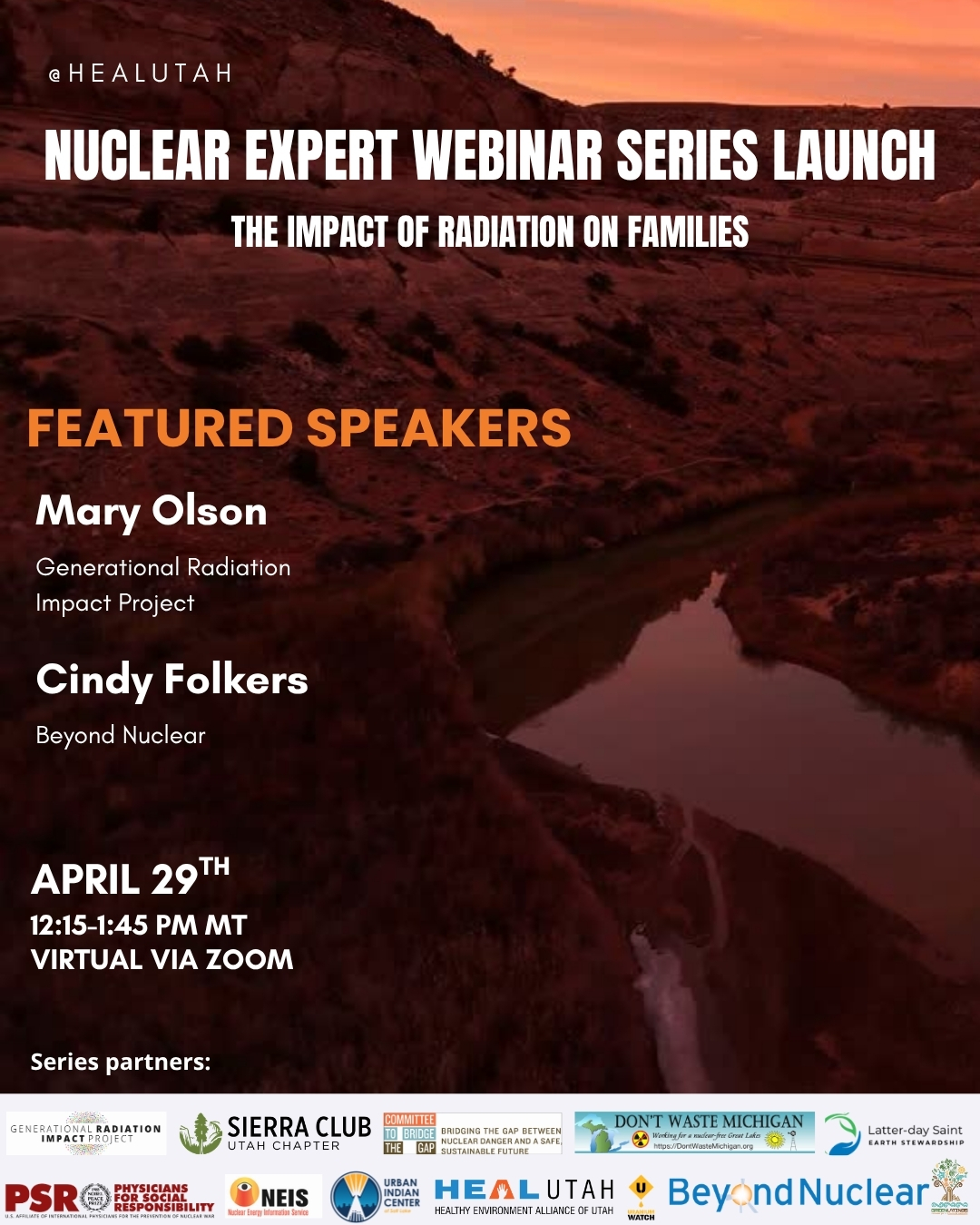
29 April – Nuclear Expert Webinar #1 – Radiation Impacts on Families with Mary Olson and Cindy Folkers
- 12:15 PM MT – 1:45 PM MT
- Location: Virtual – REGISTER TODAY

4 May -West Suburban Peace Coalition to discuss Iran war at May Educational Forum
Monday, May 4, 7:00 – 8:00 PM Central Standard Time
Title: : How Trump’s Narrative Tries to Shape the Reality of the War on Iran.
Contact Walt Zlotow, zlotow@hotmail.com 630 442 3045 for further information
14 May – online event From Bombs to Data Centres: the Face of Nuclear Colonialism

Pine Ridge Uranium is the real threat, not Tehran- Tell Burgum: Stop the Extraction.
Chernobyl: The Lost Tapes – A good documentary on Chernobyl on SBS available On Demand for the next 3 weeks– https://www.sbs.com.au/ondemand/tv-program/chernobyl-the-lost-tapes/2352741955560
To see nuclear-related stories in greater depth and intensity – go to https://nuclearinformation.wordpress.com
-
Archives
- April 2026 (327)
- March 2026 (251)
- February 2026 (268)
- January 2026 (308)
- December 2025 (358)
- November 2025 (359)
- October 2025 (376)
- September 2025 (257)
- August 2025 (319)
- July 2025 (230)
- June 2025 (348)
- May 2025 (261)
-
Categories
- 1
- 1 NUCLEAR ISSUES
- business and costs
- climate change
- culture and arts
- ENERGY
- environment
- health
- history
- indigenous issues
- Legal
- marketing of nuclear
- media
- opposition to nuclear
- PERSONAL STORIES
- politics
- politics international
- Religion and ethics
- safety
- secrets,lies and civil liberties
- spinbuster
- technology
- Uranium
- wastes
- weapons and war
- Women
- 2 WORLD
- ACTION
- AFRICA
- Atrocities
- AUSTRALIA
- Christina's notes
- Christina's themes
- culture and arts
- Events
- Fuk 2022
- Fuk 2023
- Fukushima 2017
- Fukushima 2018
- fukushima 2019
- Fukushima 2020
- Fukushima 2021
- general
- global warming
- Humour (God we need it)
- Nuclear
- RARE EARTHS
- Reference
- resources – print
- Resources -audiovicual
- Weekly Newsletter
- World
- World Nuclear
- YouTube
-
RSS
Entries RSS
Comments RSS
 nuclear-news