The New Arab 12th Feb 2021, President Emmanuel Macron’s recent statement that a “memories and truth” commission will be established to look into the history of the French colonisation of Algeria, has led to much public discussion over this bloody legacy.
And in this context, the absence of apologies or offers of reparations by the French state has not gone unnoticed. One area of particular contention in this process is the ongoing and detrimental effects of France’s nuclear testing in Algeria, conducted throughout the
1960s. France conducted its first nuclear test known as the “Gerboise Bleue” in February 1960 in the Sahara Desert – an atomic bomb that was four times the strength of Hiroshima. A total of 17 tests were carried out, four of them atmospheric detonations, and 13 underground.
People in northeastern Japan remain vigilant as several tremors have followed the magnitude 7.3 earthquake that struck late on Saturday night.
The Meteorological Agency warns that jolts as strong as the initial one could occur over the next week or so.
The initial quake registered six-plus on the Japanese scale of zero to seven in Miyagi and Fukushima prefectures.
The agency estimates that the focus was off the coast of Fukushima Prefecture, at a depth of 55 kilometers. The quake did not trigger any tsunami.
Jolts are continuing off the coast of the prefecture.
As of 6 p.m. on Sunday, the agency had reported one quake with an intensity of four, two with an intensity of three, 10 with an intensity of two, and 22 with an intensity of one.
There are reports of landslides and damaged buildings.
The agency says people in Miyagi and Fukushima prefectures should be on the alert for more landslides, as an approaching low-pressure system off the coast may bring strong winds and heavy rain.
(Slight) leak from the spent fuel pool of the reactor #1 of Fukushima Daini, nothing said about Fukushima Daiichi yet. But as usual Tepco is never very trustworthy to forward vital information.
February 13, 2021
A powerful magnitude 7.3 earthquake, which measured a strong 6 on the Japanese seismic intensity scale — the second-highest level — jolted Miyagi and Fukushima prefectures in the Tohoku region late Saturday night. No tsunami warning was issued.
Local authorities in Miyagi and Fukushima prefectures reported a total of at least 20 people injured.
Nationwide, at least 950,000 homes were without power as of midnight, top government spokesman Katsunobu Kato said at a news conference. Kato added later that several power plants were offline.
The quake, which was also felt in Tokyo, where it registered a 4 on the Japanese scale, struck at around 11:08 p.m., according to the Meteorological Agency. The epicenter was off the coast of Fukushima, about 220 kilometers (135 miles) north of Tokyo. Its focus was estimated to be at a depth of about 60 kilometers.
At a news conference early Sunday morning, a Meteorological Agency official said aftershocks of up to a strong 6 on the Japanese scale could occur for at least a week. The official said Saturday’s quake was believed to be an aftershock of the Great East Japan Earthquake that struck the same region on March 11, 2011.
“Because (the 2011 quake) was an enormous one with a magnitude of 9.0, it’s not surprising to have an aftershock of this scale 10 years later,” said Kenji Satake, a professor at the University of Tokyo’s Earthquake Research Institute.
The quake registered a strong 6 in the southern part of Miyagi, and in the Nakadori central and Hamadori coastal regions of Fukushima, the agency said.
Power outages were reported in parts of Fukushima, Miyagi, Iwate, and Tochigi prefectures, according to media reports. Tokyo Electric Power Company Holdings reported blackouts across several prefectures as of early Sunday morning.
No abnormalities have been found at the Fukushima Nos. 1 and 2 nuclear power plants, according to Tokyo Electric Power. The same was true for Japan Atomic Power Co.’s inactive Tokai No. 2 nuclear power plant in the village of Tokai in Ibaraki Prefecture and Tohoku Electric Power Co.’s Onagawa nuclear plant in Miyagi Prefecture, according to their operators.
Following the quake, JR East temporarily halted operations of its Tohoku, Joetsu and Hokuriku shinkansen lines. Power outages occurred on some sections. A landslide had covered a section of the Joban Expressway in Soma, Fukushima Prefecture, officials said, but no vehicles were found to be trapped.
Horizontal shaking lasted for a few minutes inside a traditional inn in Minamisoma, Fukushima Prefecture, with plates for food scattered in its dining room.
“The initial jolt felt more powerful than the one I experienced in the Great East Japan Earthquake,” said Tomoko Kobayashi, 68, who works at the inn. “I wondered if it would end.”
After the 7.1 quake, many smaller earthquakes with magnitudes between 3 and 5 occurred off Fukushima.
Prime Minister Yoshihide Suga immediately directed government agencies to assess damage, rescue any potential victims, work with municipalities and provide necessary information about any evacuation plans and damage as soon as possible. The government was setting up a task force to examine the quake.
Defense Minister Nobuo Kishi directed the Self-Defense Forces to gather information on the scope of the damage and be prepared to respond immediately.
The quake, which comes less than a month before the 10th anniversary of the Great East Japan Earthquake, registered a 4 on the Japanese scale as far north as Aomori Prefecture and as far west as Shizuoka Prefecture. It was the strongest quake in the region since April 7 that year, the meteorology agency said.
Footage of explosions at the Fukushima Daiichi nuclear power plant reprocessed by Nippon TV using state-of-the-art technology sheds light on the black smoke seen after the explosion at Unit 3.
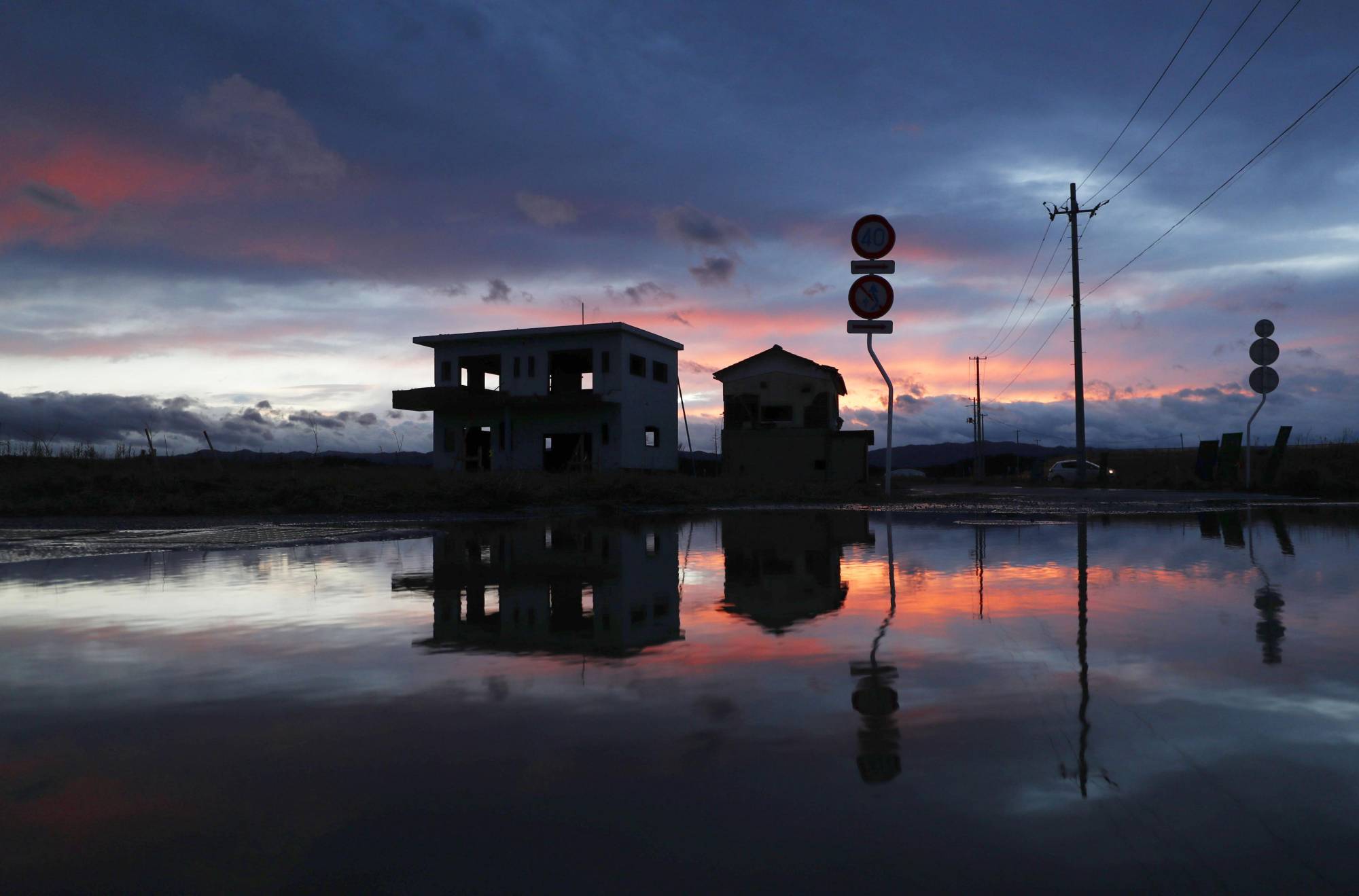
Namie, Fukushima Prefecture, was hit hard by the disaster on March 11, 2011, and an evacuation order remained in place for the subsequent six years
February 11, 2021
While Japan will soon mark the 10th anniversary of the 2011 Great East Japan Earthquake and tsunami, the economy of affected areas is showing signs of faltering.
The prefectures of Fukushima, Miyagi and Iwate have been shored up economically by public investment involving reconstruction projects since being devastated by the disaster on March 11, 2011, and the subsequent nuclear power plant meltdowns.
The three prefectures, however, are seeing reconstruction demand pass its peak.
As the triple meltdown at Tokyo Electric Power Company Holdings Inc.’s Fukushima No. 1 nuclear plant continues to cast a shadow over the coastal areas, the three prefectures now face the challenge of achieving autonomous economic growth orchestrated by firms and others in the private sector.
In the town of Namie, Fukushima Prefecture, an evacuation order issued shortly after the nuclear accident was partially lifted in March 2017. Although industrial complexes have been built and restaurants have opened their doors to customers once again in Namie, there are also many empty plots of land in the town, which shows that some former Namie residents had their houses torn down after giving up on returning from where they had been evacuated.
“Sales halved from before the disaster,” said Yasushi Niizuma, who reopened his restaurant in the town.
Meanwhile, some companies that were not doing business in Namie prior to the disaster have made inroads into the town.
“I don’t expect immediate changes, but I think the situation will be quite different 10 to 30 years from now,” Niizuma said with a sense of hope.
Prefectural gross product data show that the economy has recovered in the three prefectures since the disaster.
In 2011, the year of the disaster, the combined prefectural gross product in Fukushima, Miyagi and Iwate plunged ¥788 billion from a year earlier in nominal terms. But public investment increased sharply from 2012, with many restoration and reconstruction projects being implemented in disaster-affected areas. As a result, the combined gross product in the three prefectures in 2018 increased some ¥3.9 trillion from the 2011 level.
Noting that the region’s economy has been pushed up by public investment over the last 10 years, Yutaro Suzuki, economist at Daiwa Institute of Research Ltd., said, “It was not a self-sustaining growth.”
The three prefectures are seen to have suffered negative economic growth in 2020, chiefly reflecting a decrease in public investments and the spread of the novel coronavirus.
“An industrial recovery is crucial” for further economic growth in the region, Suzuki said.
Coastal areas in the three prefectures hit hard by the disaster are facing a serious population outflow. This is, in areas around the Fukushima No. 1 plant, including the town of Futaba, primarily due to the evacuation order still placed on some locations with high radiation levels.
“There are many areas (within Fukushima) that are nowhere near being restored,” Risa Ueda, head of the Bank of Japan’s Fukushima Branch, said.
While the central government is currently attempting to attract new industries to the region, the effects of such an initiative on the local economy are still unknown.
“Corporate performance has not recovered to the levels prior to the disaster at half of affected businesses,” Sachio Taguchi, president of Bank of Iwate , said. “We are still halfway down the road to reconstruction.”
Hiromi Watanabe, chairman of the federation of chambers of commerce and industry in Fukushima Prefecture, called on the Japanese government to look at the actual state of local economies and introduce precise measures, rather than end its support measures altogether.
As the economy has yet to recover to levels before the disaster in many parts of Fukushima and the coronavirus pandemic is also hitting the prefecture hard, Watanabe said, “What we need the most are job opportunities.”
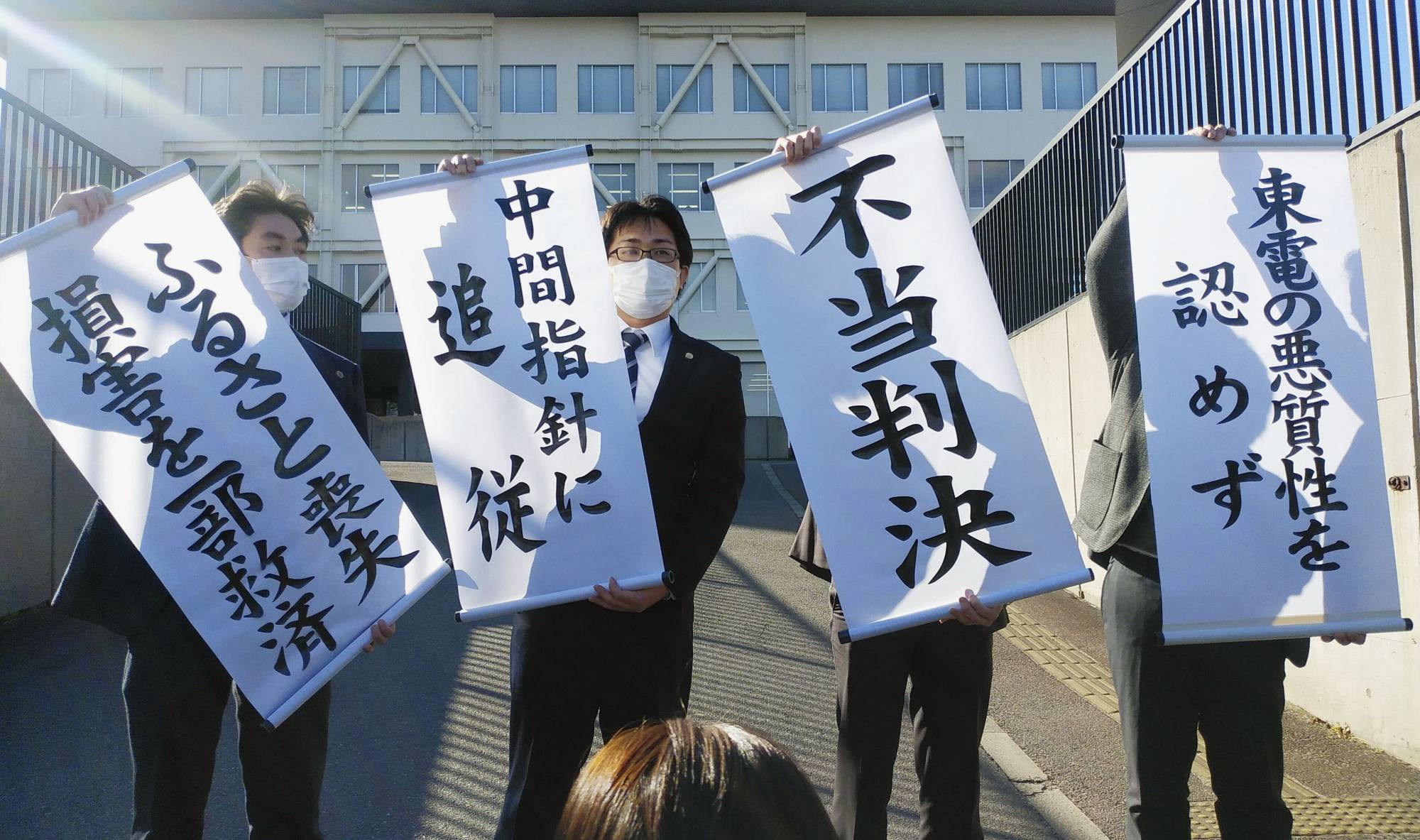
Lawyers representing residents who were forced to evacuate following the 2011 nuclear disaster in Fukushima Prefecture on Tuesday criticize the ruling by the Iwaki branch of Fukushima District Court as unjust, saying that the recognized damage is too small.
Feb 10, 2021
Fukushima – A court has ordered Tokyo Electric Power Company Holdings Inc. to pay a total of some ¥600 million to 271 plaintiffs over an evacuation caused by the 2011 nuclear disaster.
The Iwaki branch of Fukushima District Court reached its conclusion Tuesday in a lawsuit filed by 297 plaintiffs — which included residents of the heavily affected Yamakiya district in the town of Kawamata who were ordered to evacuate — seeking ¥14.7 billion in damages from Tepco.
The plaintiff side expressed its intention to appeal to a higher court.
The suit is the second in a series filed by evacuees who left their homes due to the triple meltdown at Tepco’s Fukushima No. 1 nuclear power plant triggered by the March 2011 earthquake and tsunami.
The plaintiffs excluded the state from the suit as it hoped to achieve an early resolution.
In the first suit, Sendai High Court last year ordered Tepco to pay a total of over ¥700 million to evacuees.
In the latest ruling, presiding Judge Yukitaka Najima said the amount of consolation money already paid to evacuees based on the government’s interim guidelines was reasonable. Najima thus stopped short of ordering additional payments.
The payments were made under the law on compensation for nuclear damage, which obliges the operator of a nuclear facility to compensate for damage arising from it regardless whether there was negligence.
Meanwhile, the Iwaki branch ordered Tepco to pay consolation money worth ¥2 million per person for their loss of hometown.
At the same time, the court rejected the plaintiffs’ claim that Tepco is liable under the Civil Code for failing to prevent the accident, which they believe was foreseeable.
A group of lawyers on the plaintiff side criticized the ruling as unjust, saying that the recognized damage is too small.
Tepco said it will examine the ruling and consider its response.
Dynamics of radiocesium in forests after the Fukushima disaster: Concerns and some hope
80% of the Fukushima prefecture are mountain forests.
February 3, 2021
Considering the massive threat posed by 137Cs to the health of both humans and ecosystems, it is essential to understand how it has distributed and how much of it still lingers.
w/reminder: there’s no such thing as ‘radioactive decontamination’ the correct term would be ‘trans-contamination’
Scientists compile available data and analyses on the flow of radionuclides to gain a more holistic understanding
Forestry and Forest Products Research Institute
After the Chernobyl disaster of 1986, the 2011 Fukushima Daiichi nuclear power plant (FDNPP) disaster was the second worst nuclear incident in history. Its consequences were tremendous for the Japanese people and now, almost a decade later, they can still be felt both there and in the rest of the world. One of the main consequences of the event is the release of large amounts of cesium-137 (137Cs)–a radioactive “isotope” of cesium–into the atmosphere, which spread farther away from the power plant through wind and rainfall.
Considering the massive threat posed by 137Cs to the health of both humans and ecosystems, it is essential to understand how it has distributed and how much of it still lingers. This is why the International Atomic Energy Agency (IAEA) has recently published a technical document on this specific issue. The fifth chapter of this “Technical Document (TECDOC),” titled “Forest ecosystems,” contains an extensive review and analysis of existing data on 137Cs levels in Fukushima prefecture’s forests following the FDNPP disaster.
The chapter is based on an extensive study led by Assoc. Prof. Shoji Hashimoto from the Forestry and Forestry Products Research Institute, Japan, alongside Dr. Hiroaki Kato from the University of Tsukuba, Japan, Kazuya Nishina from the National Institute of Environmental Studies, Japan, Keiko Tagami from the National Institutes for Quantum and Radiological Science and Technology, Japan, George Shaw from the University of Nottingham, UK, and Yves Thiry from the National Agency for Radioactive Waste Management (ANDRA), France, and several other experts in Japan and Europe.
The main objective of the researchers was to gain a better understanding of the dynamics of 137Cs flow in forests. The process is far from straightforward, as there are multiple elements and variables to consider. First, a portion of 137Cs-containing rainfall is intercepted by trees, some of which is absorbed, and the rest eventually washes down onto the forest floor. There, a fraction of the radiocesium absorbs into forest litter and the remainder flows into the various soil and mineral layers below. Finally, trees, other plants, and mushrooms incorporate 137Cs through their roots and mycelia, respectively, ultimately making it both into edible products harvested from Fukushima and wild animals.
Considering the complexity of 137Cs flux dynamics, a huge number of field surveys and gatherings of varied data had to be conducted, as well as subsequent theoretical and statistical analyses. Fortunately, the response from the government and academia was considerably faster and more thorough after the FDNPP disaster than in the Chernobyl disaster, as Hashimoto explains: “After the Chernobyl accidents, studies were very limited due to the scarce information provided by the Soviet Union. In contrast, the timely studies in Fukushima have allowed us to capture the early phases of 137Cs flow dynamics; this allowed us to provide the first wholistic understanding of this process in forests in Fukushima.”
Understanding how long radionuclides like 137Cs can remain in ecosystems and how far they can spread is essential to implement policies to protect people from radiation in Fukushima-sourced food and wood. In addition, the article also explores the effectiveness of using potassium-containing fertilizers to prevent the uptake of 137Cs in plants. “The compilation of data, parameters, and analyses we present in our chapter will be helpful for forest remediation both in Japan and the rest of the world,” remarks Hashimoto.
When preventive measures fail, the only remaining option is trying to fix the damage done–in the case of radiation control, this is only possible with a comprehensive understanding of the interplay of factors involved.
In this manner, this new chapter will hopefully lead to both timely research and more effective solutions should a nuclear disaster happen again.
###
Reference
Title: Environmental Transfer of Radionuclides in Japan following the Accident at the Fukushima Daiichi Nuclear Power Plant, Chapter 5 “Forest ecosystems”
Published in: International Atomic Energy Agency, IAEA TECDOC no. 1927
About the Forestry and Forest Products Research Institute, Japan
Inaugurated as a unit for forest experiments in Tokyo in 1905, the Forestry and Forest Products Research Institute (FFPRI) was largely reorganized in 1988, when it received its current name. During its history of over 110 years, the FFPRI has been conducting interdisciplinary research on forests, forestry, the timber industry, and tree breeding with an agenda based around sustainable development goals. The FFPRI is currently looking to collaborate with more diverse stakeholders, such as international organizations, government agencies, and industry and academic leaders, to conduct much needed forest-related research and make sure we preserve these renewable resources. Website: https://www.ffpri.affrc.go.jp/ffpri/en/index.html
About Dr. Shoji Hashimoto from the Forestry and Forest Products Research Institute, Japan
Shoji Hashimoto obtained Master’s and PhD degrees from The University of Tokyo, Japan, in 2001 and 2004, respectively. In 2005, he joined the Forestry and Forest Products Research Institute, Japan, where he now works as Senior Researcher. He is also Associate Professor at The University of Tokyo. He has published over 50 papers and is a referee for over 30 scientific journals. His main research interests are soil and forest science, environmental dynamics, and climate change, among others. Hashimoto has also been an organizer for various events, including two Symposiums on Fukushima Forests and the Japan?Finland Joint Seminar, and serves as the coordinator of a radioecology unit in International Union of Forest Research Organizations (IUFRO).
The 15 countries and regions maintaining restrictions on Japanese food imports include China, South Korea, and the US.
January 29, 2021
Israel has removed import restrictions on food items from Japan imposed due to the 2011 Fukushima nuclear disaster, reducing the number of countries and regions with such trade policies to 15.
All Fukushima food products and some items such as grain, seafood, and mushrooms from Iwate, Miyagi, Tochigi, Gunma, and Chiba prefectures were subjected to the import restrictions.
The restrictions include submitting radiation inspection certificates and having all the items tested upon entry.
Japan farm minister Kotaro Nogami urged countries and regions retaining import restrictions to ease or eliminate them
Israel is now among 39 countries and regions that have lifted import restrictions.
The 15 countries and regions maintaining restrictions on Japanese food imports include China, South Korea, and the US.
Japan’s Nuclear Regulation Authority unveils another theory concerning an explosion that occurred at Fukushima Daiichi nuclear power plant in March 2011 based on a video reprocessed by Nippon TV using state-of-the-art technology.
An earthquake of 7.1 degrees on the Ritcher scale shook eastern Japan that Saturday (02/13/2021) and was strongly felt in Tokyo, without the Japanese authorities activating the tsunami warning for the moment.
Highest seismic activity before an earthquake occurs, are zero. The radioactivity contained in the pools of water that accumulate is a minor problem within this frame. We also remember that Japan’s nuclear program is a consequence of the unconditional surrender imposed by the U.S. after the Second War, to have control in the fissile material zone and lay its largest base on the island of Okinawa.
It was not an accident.
It’s not an earthquake fault.
It was the deliberate action of a conquest strategy, which made Japan a time bomb for all humanity.
Powerful magnitude 7.3 earthquake jolts Fukushima area, Japan Times 14 Feb 21, A powerful magnitude 7.3 earthquake struck late Saturday off the coast of Tohoku, leaving at least 50 people injured and knocking multiple power plants offline.
The quake, which measured a strong 6 on the Japanese seismic intensity scale — the second-highest level — jolted Miyagi and Fukushima prefectures in the Tohoku region. No tsunami warning was issued.
The injuries were reported in Miyagi and Fukushima prefectures, but it was not immediately clear if anyone was seriously hurt.
Nationwide, at least 950,000 homes were without power as of midnight, top government spokesman Katsunobu Kato said at a news conference. Kato later said that multiple power plants in the nation were offline.
A government source said the power outage situation was expected to improve through the early hours of Sunday but that more time would be needed in the Tohoku region.
The quake, which was also felt in Tokyo, where it registered a 4 on the Japanese scale, struck at around 11:07 p.m., according to the Meteorological Agency. The epicenter was off the coast of Fukushima, about 220 kilometers (135 miles) north of Tokyo. Its focus was estimated to be at a depth of about 55 kilometers.
At a news conference early Sunday morning, a Meteorological Agency official said aftershocks of up to a strong 6 on the Japanese scale could occur for at least a week. The official said Saturday’s quake was believed to be an aftershock of the Great East Japan Earthquake that struck the same region on March 11, 2011.
“Because (the 2011 quake) was an enormous one with a magnitude of 9.0, it’s not surprising to have an aftershock of this scale 10 years later,” said Kenji Satake, a professor at the University of Tokyo’s Earthquake Research Institute.
The quake registered a strong 6 in the southern part of Miyagi, and in the Nakadori central and Hamadori coastal regions of Fukushima, the agency said…….
No abnormalities have been found at the Fukushima Nos. 1 and 2 nuclear power plants, according to Tokyo Electric Power. The same was true for Japan Atomic Power Co.’s inactive Tokai No. 2 nuclear power plant in the village of Tokai in Ibaraki Prefecture and Tohoku Electric Power Co.’s Onagawa nuclear plant in Miyagi Prefecture, according to their operators……….
Prime Minister Yoshihide Suga immediately directed government agencies to assess damage, rescue any potential victims, work with municipalities and provide necessary information about any evacuation plans and damage as soon as possible. The government was setting up a task force to examine the quake.
Defense Minister Nobuo Kishi directed the Self-Defense Forces to gather information on the scope of the damage and be prepared to respond immediately.
The quake, which comes less than a month before the 10th anniversary of the Great East Japan Earthquake, registered a 4 on the Japanese scale as far north as Aomori Prefecture and as far west as Shizuoka Prefecture. It was the strongest quake in the region since April 7 that year, the meteorology agency said.
Big money, nuclear subsidies, and systemic corruption, Bulletin of the Atomic Scientists, By Cassandra Jeffery, M. V. Ramana | February 12, 2021
The “largest bribery, money-laundering scheme ever perpetrated against the people and the state of Ohio” came to light during an unexpected press conference in July 2020 in Columbus. Speaking haltingly and carefully, US Attorney for the Southern District of Ohio David DeVillers announced “the arrest of Larry Householder, Speaker of the House of the state of Ohio and four other defendants for racketeering. The conspiracy was to pass and maintain a $1.5 billion bailout in return for $61 million in dark money.”
Unravelling an intricate web of alleged illegal activities used to launder money, DeVillers broke down the complicated modus operandi of “Company A.” With a gentle smile on his face, he said, “everyone in this room knows who Company A is, but I will not be mentioning the name of Company A because of our regulations and rules. They have not, and no one from that company has as of yet, been charged”.
Company A is FirstEnergy Solutions, a fact most Ohians had been aware of long before the July 2020 press conference. FirstEnergy, now called Energy Harbour, is one of Ohio’s largest utility corporations. For years, the firm lobbied to get a subsidy to continue operating its unprofitable nuclear plants and maintain its revenue flow. When lobbying efforts failed to produce subsidies, it resorted to bribery to gain legislative support for House Bill 6, 2019 legislation that forces state consumers to pay into something called “the Ohio Clean Air Fund.” The green language is a smoke screen for the real purpose: to siphon nearly $150 million annually to FirstEnergy to keep its Perry and Davis-Besse nuclear power plants and two coal-fired power plants operating, while simultaneously gutting Ohio’s renewable energy standards. Also gone were the state’s energy efficiency programs, which had saved consumers and corporations millions of dollars. When citizens tried to organize a referendum to repeal the bill, FirstEnergy indulged in various dirty tactics to thwart this democratic opposition.
Ohio is not alone in its nuclear energy corruption. Also in July 2020, Commonwealth Edison (ComEd), a subsidiary of Exelon, was charged with bribery to “Public Official A” in Illinois. Though not named, the filing makes it clear that “Public Official A” is Illinois House Speaker Michael Madigan, who has denied wrongdoing. ComEd has agreed to pay a $200 million fine to resolve this case. Exelon also finds itself at the centre of another ongoing investigation by the United States Securities and Exchange Commission. The focus of the investigation is reportedly Anne Pramaggiore, a former Exelon CEO who stepped down from the company and from his post chair of the Federal Reserve Bank of Chicago. As in Ohio, the corruption charges relate to lobbying for state subsidies and special treatment of nuclear power plants.
Three other states—New Jersey, Connecticut, and New York—have implemented similar subsidies (although, to date, no allegations of wrongdoing related to them have been made public). Changes in the economics of electricity markets are threatening the profitability of nuclear power plants, a shifting reality driving a demand for these financial bailouts. As the New Jersey-based energy company Public Service Enterprise Group (PSEG) explained in October 2020, across the nation “nuclear plants continue to struggle economically to survive. Since 2018, three nuclear plants have closed in the eastern US, all for economic reasons, and the impact has had a ripple effect.”
Changing economics of electricity generation. These “economic reasons” have to do with an ongoing massive transformation of the energy sector. Over the last decade, the cost of renewables like solar and wind have dropped substantially; these renewables can generate electricity at much lower costs than fossil fuels and, especially, nuclear power. In the United States, unsubsidized wind power costs fell by 71 percent between 2009 and 2020, whereas unsubsidized utility scale solar energy costs declined by 90 percent during the same period. Nuclear energy costs increased by 33 percent between 2009 and 2020. The International Energy Agency has dubbed solar energy “the new king of electricity” and foresees it dominating future deployment in the electricity sector for decades.
The major beneficiaries of the subsidies for nuclear plants are large corporations: PSEG in New Jersey and Dominion in Connecticut, besides Exelon and FirstEnergy. These, and other electrical utility companies in the United States, have historically invested primarily in nuclear reactors and fossil fuel plants. Thanks to the changing economics of electricity, these companies are finding it harder to maintain their profits while operating the older power plants that are now more expensive as sources of electricity.
These companies and various associated organizations have engaged in extensive lobbying and large-scale propaganda campaigns to get governments pass legislation that makes consumers pay more for the electricity they use. In that sense, what has resulted would be better described as corporate welfare than as subsidies. The subsidies have improved these companies’ financial situation, which in turn contributes to their clout in state and national policy making and their ability to fund advocacy efforts—and even to pay politicians tidy sums of money. The larger significance of the political power these large utilities have amassed is their ability to block transition to a fully renewable and more environmentally sustainable energy system.
Financial subsidies. Subsidies take different forms in different states. In New York and Illinois, utility companies are required to purchase a specific amount of zero-emission credits from authorized nuclear generating stations, all of which are owned and operated by Exelon Corporation. Purchasing contracts in both states will be in effect for 10 to 12 years, and utility companies are mandated to tack on the cost to consumer bills. Over in New Jersey, “each electric public utility” is required to purchase “Nuclear Diversity Certificates” from nuclear power plants, with consumers paying for these programs through higher utility bills.
The deal that Dominion Energy struck in Connecticut was different, taking the form of a contract that requires the state’s two electric distribution utilities to purchase about 50 percent of the electricity output of Dominion’s Millstone nuclear generating plant for 10 years. Millstone houses two operational nuclear reactors. In all of these cases, the annual financial benefits to these large corporations run in to the hundreds of millions of dollars.
The modus operandi was developed by multiple stakeholders and publicly released in 2016 in the form of a toolkit by the American Nuclear Society (ANS). Produced by a special committee consisting of senior nuclear officials, the toolkit outlined “a variety of policy pathways to support the current nuclear fleet and prevent early retirement.” The states mentioned above have implemented polices that incorporate one or more of the strategies outlined in the ANS toolkit, including amalgamations of low-carbon portfolio standards and mandated purchase of nuclear energy. The toolkit even went so far as to suggest that state government entities could acquire nuclear power plants or suspend collecting taxes, but these suggestions have not been implemented so far.
Building political support. While the American Nuclear Society led the policy-development charge, the Nuclear Energy Institute (NEI)—the nuclear industry’s lobbying arm—reinforced the advocacy message on the ground. The NEI’s 2017 report outlined specific plans and efforts instituted around the same time as many of these nuclear bailouts were pushed through state legislatures. Substantial resources were funnelled toward lobbying efforts aimed at key political and public actors. NEI’s deliberate intention, as outlined in the 2017 report, was to build political support to “avoid placing additional financial burden on US nuclear plants.”
Large-scale media dissemination, educational campaigns, relationship-building with regulatory bodies, think tanks, and policy institutions, and direct political lobbying are some of the tactics outlined in the report. Not all of the tactics aimed at subsidies; some were aimed at lowering expenses for nuclear companies by finding ways to lessen their environmental obligations. For example, the NEI managed to terminate annual fees charged to nuclear generating plants for hazardous material cleanup, which made taxpayers liable for these costs. The NEI took full credit for this shift: “After targeting the House and Senate Appropriations Committees, NEI successfully prevented reimplementation of a $200 million annual fee placed on the industry.”
The NEI also tried to influence the appointment of officials to oversight bodies, including the Nuclear Regulatory Commission (NRC), declaring that it “shared names of potential candidates with the Trump administration and worked with member companies to urge Congress to communicate with the White House the need to nominate and confirm commissioners.” The NRC is the agency tasked with overseeing safety, and in 2017, the NEI proudly announced that it had “worked with the House Appropriations Committee to again reduce the NRC’s budget.”
The power game. Many energy companies are actively involved in local or state-level lobbying. In recent years, Illinois has been a site of intense lobbying by Exelon and its subsidiary, Commonwealth Edison (ComEd), primarily to get more and more subsidies from the state. “At least two dozen former Illinois state lawmakers have lobbied on behalf of ComEd or Exelon since 2000,” according to Illinois Policy, an independent public policy organization. Exelon’s hold on Illinois decision-making has been characterized by David Kraft of the Nuclear Energy Information Service as “nuclear blackmail,” a result of politics that “forced environmentalists wanting to see new legislation pass that would expand renewables, into a reluctant and grudging alliance with Exelon, but on Exelon’s terms.”
The process works as follows. Every so often, Exelon or ComEd would declare that one or more of their nuclear plants are no longer profitable and threaten to shut the plants down within a year. The threats have tended to be successful; lobbyists can argue, with some truth on their side, that a shutdown will lead to job losses and a cut in tax revenue, also leaving Illinois with an energy shortage that may increase reliance on carbon-based sources.
Money begets money. The effects of enacting laws that favor nuclear energy firms are clear from the financial status of these corporations. Exelon share prices increased from $34.63 on April 1, 2017 to a high of $50.95 exactly two years later, while Dominion’s stock price grew from $64.19 on May 1, 2018 to $83.70, as of November 6, 2020. Similar increases have been recorded by FirstEnergy and PSEG.
Apart from stock owners, the other major beneficiaries from the utility business are, of course, executives in these companies. CEOs like Dominion’s Thomas Farrell and Exelon’s Christopher Crane are among the highest paid executives in the electrical generation and utility industry………..
Dealing with corruption, legal and illegal. The crimes that people like Larry Householder and Michael Madigan are accused of committing are shameful; they are, however, just examples of the apparent systemic corruption that seems to permeate the nuclear industry.
While the actions taken against these individuals have captured headlines, the picture painted in the media still misses the mark on less egregious, everyday forms of political action. Lobbying by deep-pocketed industries and other efforts to capture regulators are pernicious but often go unremarked, in part because under the rules that govern politics in the United States, such actions are often legal. Addressing these problems with the urgency they require will necessarily involve confronting the economic and political system that privileges profits and capital over people and the environment.https://thebulletin.org/2021/02/big-money-nuclear-subsidies-and-systemic-corruption/
How Close Did the Capitol Rioters Get to the Nuclear “Football”?
The video of Mike Pence shown during the impeachment revealed something startling about the nuclear chain of command. Slate, BY FRED KAPLAN, FEB 11, 2021 Among the many startling videos shown at Wednesday’s impeachment trial documenting the Jan. 6 insurrection at the Capitol, there was one clip that was so brief, subtle, and beside the immediate point that the House managers didn’t highlight it—but it was nevertheless hugely enlightening.
It revealed that, like the president, the vice president is routinely escorted by a military aide who carries a satchel containing the codes that allow him to launch a nuclear attack.The pertinent clip shows Vice President Mike Pence and his family being rushed out of the Capitol to escape the rioters, who, it turns out, were determined to kill him for certifying the Electoral College votes and thus betraying Donald Trump. Following Pence was an Air Force officer carrying two bags, one of which looked a lot like the nuclear satchel, also known as the Football or the Black Bag…………..
During some administrations, a military aide with a Football accompanied the vice president only on out-of-town trips. But a former White House official told me that a military aide with a satchel was always close to Joe Biden when he was Barack Obama’s vice president. Presumably (though nobody has told me this), a military aide carries a satchel close to Kamala Harris too……………
As for the prospect of a rogue veep, there’s probably nothing to worry about. It’s worth noting what’s in the satchel. Contrary to popular culture, there is no “button” to push, nor is there an indented surface that matches the president’s (or vice president’s) palm. What’s actually in the satchel—which is said to weigh 45 pounds—is a card (sometimes called the “biscuit”) citing phone numbers to call and a passcode that authenticates the identity of the caller, some encrypted communication gear to make the call, and a book describing all of the preapproved nuclear attack options and how the president would go about ordering each one. This book used to be a rather heavy tome called the SIOP Execution Handbook (the SIOP, standing for Single Integrated Operational Plan, is the nuclear war plan) or, at various times, the Gold Book or the Black Book. When Carter first leafed through the book, he told the officers who supplied it, “I’m pretty smart, and I don’t understand any of this.” So the operations division of the Pentagon’s Joint Staff condensed the complicated book into a stack of laminated cards (“like a menu at Wendy’s,” as one officer described them) inscribed in very clear language.
To launch a nuclear attack, the president (or the vice president) would transmit the coded message to a one-star general and his staff in the National Military Command Center, located on the Pentagon’s ground floor, who would in turn pass the order on to the missile and bomber crews, who would launch the attack. That’s it. There is no red button, but there are also no other officials involved in the chain of command. (Other officials are supposed to consult and confer, but they don’t have the ultimate say.)
If the vice president ordered an attack (something that the officer carrying the Football would have to allow), the officers in the Pentagon would know whether the authentication code belonged to the president or the vice president. They would also know whether the president was still alive and in command. If he was, they would know that the vice president’s order was not legitimate.
What about the mob? What could they do, had they grabbed the Football? First, it’s very unlikely that they could have grabbed it. The Secret Service agents around Pence would almost certainly meet any such attempt with deadly force. There would have been a dozen or more dead rioters scattered on the bloodied floor near the staircase where Pence, his family, and his entourage had gathered. If the mob’s survivors kept mauling and overpowering Pence and the others, they might not have thought to grab the Football, which is locked in a metal case tucked inside an ordinary-looking satchel. Even if they had grabbed the satchel, bashed the lock, and opened the case, they wouldn’t have known what to do with the stuff inside. Had they figured it out, the officers in the Pentagon would have known the signals were coming from an unauthorized source.
Could the mob have taken the Football and sold it to the Russians or some other adversary? It would be worth millions of dollars. Despite the militias’ self-image as “patriots,” it’s not out of would be worth millions of dollars. Despite the militias’ self-image as “patriots,” it’s not out of the question. According to a U.S. District Court affidavit, Riley June Williams, the Pennsylvania woman accused of breaching the Capitol and stealing Pelosi’s laptop on Jan. 6, intended to give the computer “to a friend in Russia, who then planned to sell the device to SVR, Russia’s foreign intelligence service.”……….
Big money, nuclear subsidies, and systemic corruption, Bulletin of the Atomic Scientists, By Cassandra Jeffery, M. V. Ramana | February 12, 2021 ”………..Material interests and policy interests.
The most common argument used by these companies and those who support nuclear subsidies is the need to fight climate change. There are two problems with this argument.
The second problem is the assumption that corporations owning nuclear plants are primarily interested in rapidly reducing emissions. Many utilities have large fossil fuel investments— investments that suggest a shutdown won’t be happening anytime soon. This suggestion seems especially true with natural gas plants. Although utilities often describe natural gas as clean (for example, Exelon describes its fleet as powered by “clean burning natural gas”), the climate implications of continued natural gas use are substantial. Exelon, the company with the most nuclear plants in the country, also owns and operates, along with its subsidiaries, 11 oil-fired power plants, five dual-fuel (natural gas and oil-powered) power stations, and 10 natural gas-based power plants throughout North America. In addition to its four nuclear power plants, Dominion owns 17 power plants fueled by natural gas and 14 power plants fueled by coal or oil. The company’s estimate of carbon dioxide emissions from its power plants is around 40 million metric tons in 2018, roughly the same level as in 2012. Likewise, PSEG owns just two nuclear power plants, but the company owns or has a stake in 10 fossil fuel generating plants with one more natural gas powered plant under construction.
With such large stakes in fossil fuel-based power plants, it is clear that these utilities are not about to switch immediately to renewables—or even to nuclear power—and give up on years and years of future profits that they and their shareholders are hoping for. In all of the states that offered nuclear subsidies, and elsewhere, the utilities have tried to hold back the deployment of renewables in more or less obvious ways. US utilities are not alone. Studies show that electric utilities around the world have “hindered the transition of the global electricity sector towards renewables, which has to date mostly relied on non-utility actors (such as independent power producers) for expanding the use of renewables.”
Rather than adapting to the necessity of building up renewables, these utilities resort to tactics that have been used in the past to justify nuclear power plant construction. As former Nuclear Regulatory Commission member Peter Bradford listed at the beginning of the so-called nuclear renaissance, these include “subsidy, tax breaks, licensing shortcuts, guaranteed purchases with risks borne by customers, political muscle, ballyhoo, and pointing to other countries (once the Soviet Union, now China) to indicate that the US is ‘falling behind.’”…. https://thebulletin.org/2021/02/big-money-nuclear-subsidies-and-systemic-corruption/
ALBUQUERQUE, N.M. (AP) — One of the nation’s premier nuclear laboratories isn’t taking the necessary precautions to guard against wildfires, according to an audit by the U.S. Energy Department’s inspector general.
The report comes as wildfire risks intensify across the drought-stricken U.S. West. Climatologists and environmentalists have been warning about worsening conditions across the region, particularly in New Mexico, which is home to Los Alamos National Laboratory and where summer rains failed to materialize last year and winter precipitation has been spotty at best.
The birthplace of the atomic bomb, Los Alamos has experienced hundreds of millions of dollars in losses and damage from major wildfires over the last two decades. That includes a blaze in 2000 that forced the lab to close for about two weeks, ruined scientific projects, destroyed a portion of the town and threatened tens of thousands of barrels of radioactive waste stored on lab property.
Watchdog groups say the federal government needs to take note of the latest findings and conduct a comprehensive review before the lab ramps up production of key plutonium parts used in the nation’s nuclear arsenal.
“The threat and risks of wildfire to the lab and northern New Mexico will continue to increase because of climate warming, drought and expanded nuclear weapons production,” said Jay Coghlan, director of the group Nuclear Watch New Mexico.
The audit released this month found that cutting back vegetation along power lines and other measures to reduce the risk of catastrophic fires were not always done, increasing the potential for another devastating fire like the Cerro Grande Fire in 2000.
Federal auditors said not all fire roads were maintained to ensure safe passage for firefighters and equipment responding to blazes on lab property.
The audit also cited federal policy that requires a comprehensive, risk-based approach to wildfire management — something the inspector general’s office said had not been developed by the contractor that manages the lab for the U.S. government. It also pointed to a lack of oversight by Energy Department field staff.
“Without documenting planning and preparedness activities, there was no assurance that all prevention and mitigation options were considered and that the site was fully prepared for wildland fire events,” the audit says.
The report included photos that depicted overgrown areas. In Los Alamos Canyon, for example, specialists indicated there were about 400 to 500 trees per acre. Auditors said the ideal number should be 40 to 50 trees per acre.
Lab spokesman Peter Alden Hyde said that since the audit was conducted in late 2018 and early 2019, the lab has adopted “an aggressive approach” to wildfire management on its 39-square-mile (101-square-kilometer) campus. That has included thinning vegetation along access routes, improving fire roads and recently removing thousands of trees downed by wind storms.
“We continue to review our wildfire and forest health plans and have already implemented most of the recommendations the Department of Energy offered to improve our efforts to protect the public, the environment and the laboratory,” he said.
It was not immediately clear how many acres were thinned during the last year or whether the lab had any major projects planned for 2021.






 nuclear-news