Biden nominates Iran nuclear deal negotiator to State Department
Biden nominates Iran nuclear deal negotiator to State Department
Wendy Sherman, Joe Biden’s nominee for deputy secretary of state, was key US negotiator of 2015 Iran nuclear accord.
United States President-elect Joe Biden has nominated a key negotiator of the 2015 Iran nuclear agreement to be the US’s next deputy secretary of state, the second-highest position at the State Department.
In a statement on Saturday, Biden unveiled a string of State Department nominees, including longstanding diplomat Wendy Sherman to be deputy secretary of state……https://www.aljazeera.com/news/2021/1/16/biden-nominates-iran-nuclear-deal-negotiator-to-state-department
Profound questions raised by the employment tribunal case; bullying at Sellafield nuclear site?

 Byline Times 15th Jan 2021, An employment tribunal case that has been running for more than two yearshas started to raise profound questions over management at Europe’s
largest nuclear reprocessing plant, the ability of the employment tribunal
system to defend the rights of whistleblowers, ethical conduct by major law firms, and a conflict of interest at the Equality and Human Rights Commission.
The case of McDermott versus Sellafield, the Nuclear
Decommissioning Authority and former Sellafield HR director Heather Roberts
has been brought under the Public Interest Disclosure Act 1998 – also
known as the Whistleblowers’ Act. Alison McDermott, an HR professional
and diversity specialist, claims that the sudden termination of her
freelance contract in October 2018 by Sellafield was linked to her
protected disclosures containing evidence of systemic bullying, and racist
and sexist incidents at the Sellafield site in Cumbria.
Hydrogen from wind and solar systems could be the ultimate solution to the planet’s pollution problem.
latest claim to fame, two spinoffs of German tech conglomerate Siemens are
joining forces to advance green hydrogen technology by building
wind-to-hydrogen systems to help decarbonize the global economy.
element can be an energy carrier, it can be used to store energy and it can
be used in fuel cells to power vehicles. Green hydrogen is a particularly
attractive option because its production comes from hydrolyzing water using
electricity produced by renewable systems, meaning it has a much lower
carbon footprint than gas- or coal-sourced hydrogen.
pollution problem.
https://oilprice.com/Energy/Energy-General/German-Tech-Giant-Places-Major-Bet-On-Green-Hydrogen.html
January 17 Energy News — geoharvey

Opinion: ¶ “Worried About Earth’s Future? Well, The Outlook Is Worse Than Even Scientists Can Grasp” • A research paper published this week reviews over 150 studies to produce a stark summary of the state of the natural world. It says that future environmental conditions will be far more dangerous than experts currently believe. [Red, […]
January 17 Energy News — geoharvey
Thyroid cancer at ages 0 and 2 at the time of the nuclear accident-Health survey in Fukushima Prefecture January 2021
Thyroid cancer at ages 0 and 2 at the time of the nuclear accident-Health survey in Fukushima  Prefecture Posted by: ourplanet Posted on: Thu, 01/14/2021 –00:46 http://ourplanet-tv.org/?q=node/2537 (Japanese only)
(Translated from Google) The “Prefectural Health Survey” Review Committee was held in Fukushima City on the 15th to discuss the health survey of Fukushima citizens following the accident at the Fukushima Daiichi Nuclear Power Plant. For the first time, it was discovered that two infants, a 0-year-old girl and a 2-year-old girl at the time of the accident, were diagnosed with thyroid cancer.
Material https://www.pref.fukushima.lg.jp/site/portal/kenkocyosa-kentoiinkai-40.html

This time, the result of the fourth round of thyroid examination until June last year was newly announced. The number of children diagnosed with suspected thyroid cancer by fine needle cytology increased by 6 from the previous time to 27, and the number of children who underwent thyroidectomy increased by 3 from the previous time to 16 children. Up to now, 252 patients have been diagnosed with thyroid cancer or suspected thyroid cancer from prior examination, of which 203 have undergone thyroid surgery. 202 people, excluding one, were confirmed to have thyroid cancer.
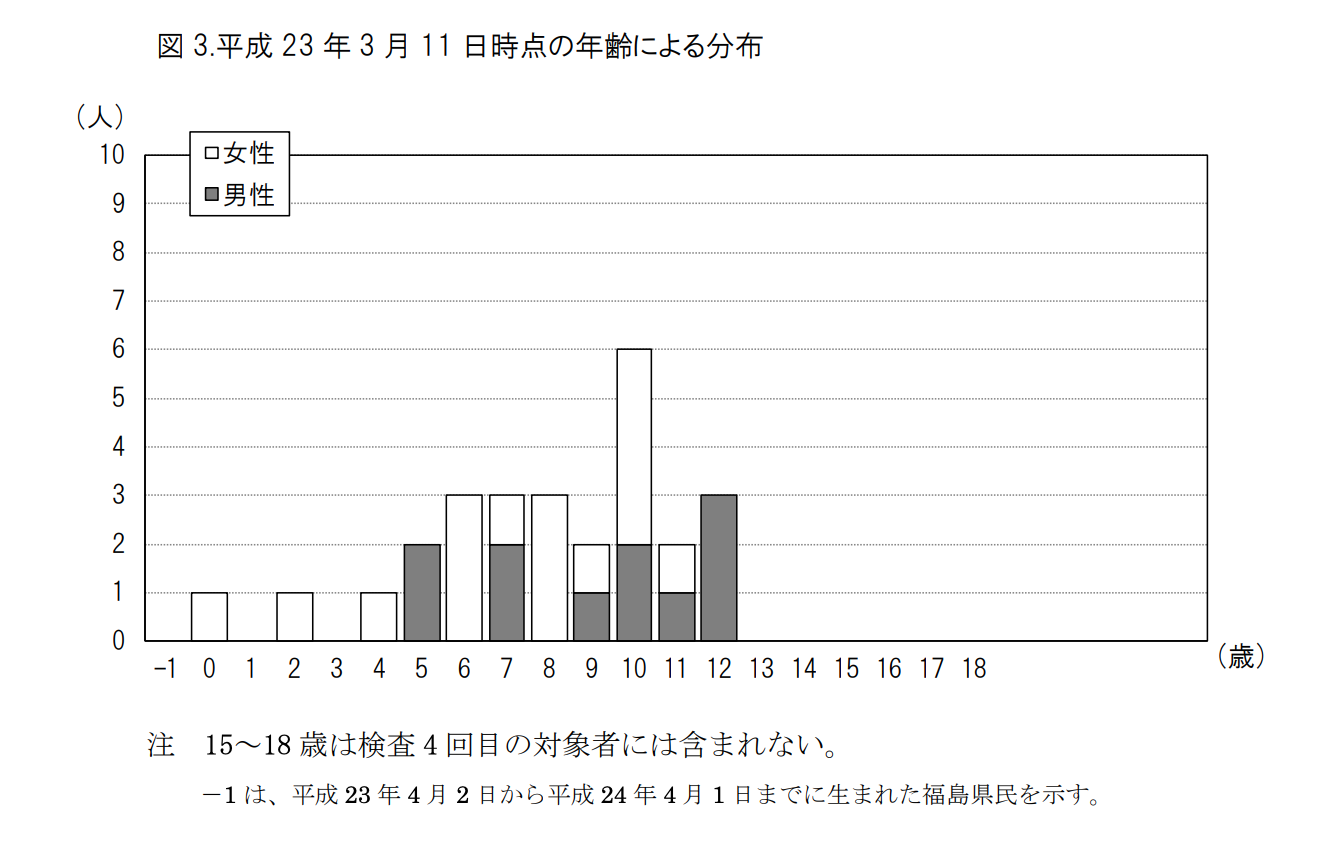
In the fourth round of examination, it was found for the first time that a girl who was 0 years old and a girl who was 2 years old at the time of the accident were diagnosed with thyroid cancer. Since the age of the examination is not the actual age but the grade, the ages at the time of the examination are 9 years old (3rd grade of elementary school) and 11 years old (5th grade of elementary school), respectively. According to the previous test results of 27 patients, 5 patients had “A1 judgement” without nodules or tumors, and 16 people had “A2 judgement” with nodules of 5 mm or less or cysts of 2 cm or less, 5 mm or more. 5 people had a “B-judgement” with nodules or cysts of 2 cm or more, and 1 had not been examined. He had the smallest tumor size of 6.1 mm and the largest tumor was 29.4 mm.
What stands out in the results of the fourth round of examination is the high dose of radiation for people diagnosed with thyroid cancer. Of the 27 patients diagnosed as suspected of being malignant by fine needle cytology, 11 patients (40.7%) who submitted the basic survey questionnaire had an exposure dose of less than 1 mSv in 2 patients (18.1%) 4 months after the accident. The number of children exposed to 2mSv or more was the highest, with 4 (36.3%) from 1mSv to 2mSv and 5 (45.5%) from 2mSv to 5mSv. In particular, the two boys who were five years old at the time of the accident were both over 2mSv.
According to the results of the basic survey of all Fukushima residents, 62.2% are less than 1mSv, 31.6% are from 1mSv to 2mSv, and 5.5% are from 2mSv to 3mSv. Very different.

To review the mass examination at school At this review committee, a major shift was made to reviewing simultaneous examinations at schools. The test, which has found more than 200 people with thyroid cancer, raises the theory of “overdiagnosis” among experts who deny the effects of radiation exposure, saying that they are finding thyroid cancer that they do not have to find. There is a growing opinion that the mass examination at school should be reviewed.
Based on these opinions, the review committee decided to conduct an interview survey at schools in the prefecture on August 31st last time. This time, there was a report on the results of a survey conducted by the prefecture at 26 elementary and junior high schools and high schools in the prefecture.
At many schools, thyroid examinations were performed during class hours, criticized by Shoichiro Tsugane, a member of the National Cancer Center, saying, “You can’t take this without a strong will.” “The benefits of the test are not except that you can be reassured when you get negative. The discovery of thyroid cancer has little benefit in avoiding death or poor quality of life, especially when you are diagnosed with thyroid cancer. “I think it will be a huge disadvantage for those who do,” he said. “Thyroid examination in a group of asymptomatic healthy people is not desirable. I asked him to stop the mass examination at school. ..
In addition, Professor Toshiya Inaba of Hiroshima University also cut out at the school examination that “they are left behind” and said, “Parents are not worried. The school rents the venue. The prefectural medical college has an inspection. I understand each position well, but in the end, it is the people who are left unattended. ” He emphasized that the prefectures and medical colleges that are the subjects of the survey should explain more to children and students the significance of the test and the fact that it can be rejected.

In response, Professor Satoshi Tomita of Fukushima University argued head-on. He criticized that “many Fukushima residents have anxiety about their health” and that members of the Prefectural Health Investigation Committee, especially members outside Fukushima Prefecture, are calling for the cancellation or reduction of examinations. He said that thyroid examination is a way to relieve the anxiety of Fukushima residents, “the anxiety of Fukushima residents, especially those with children, is left behind.” “It is dangerous to go in the direction of reduction easily.” “Thinking” was pointed out.
Ikuko Abe, chairman of the Fukushima Clinical Psychologists Association, who also lives in Fukushima Prefecture and has a close relationship with schools, agrees with this, saying, “I agree with Professor Tomita’s opinion.” “Given the anxiety about radiation that Fukushima residents have, thyroid examinations are very reassuring,” she said. “Reducing or eliminating the examinations still takes the opposite position. I want you to do it. “
What caught my eye in the discussion was the presence of Katsushi Tahara, director of the Ministry of the Environment’s Health and Welfare Department. The members of the review committee from the Ministry of the Environment have not said much, but have played a role in important aspects of policy change. This time too, Mr. Tahara considers the fact that the school is cooperating with the implementation of the examination, such as encouraging households whose delivery to Fukushima Medical University is delayed to submit again when the deadline has passed. About 30% of the children undergoing medical examinations at school were asked intensively about this point, such as confirming that the school side took over the collection of consent forms.
To conduct hearings with the person to be inspected Following a survey of the school, the prefecture proposed to have a place to hear directly from the children and students who had been inspected. Questions were raised about the representativeness of the interviewees, and there was an opinion requesting a quantitative survey such as a questionnaire, but the prefecture’s proposal was approved because the survey took too long.
Regarding this “interview survey,” there was a harsh debate over the neutrality of the content, such as the opinion that a pilot study was unavoidable and that the voices of patients diagnosed with thyroid cancer should also be heard. With the strong push back of the constellation chairman, it was decided that the selection of the target audience and the holding method would be left to the chairperson and the prefecture. The results will be reported at the next meeting.
In response to the further shift to reviewing mass screening at school in this “interview,” Chiba parent and child of the “thyroid cancer support group Hydrangea Association” that supports families with thyroid cancer said, “Accident Among the 0-year-old and 2-year-old children at that time, a child with thyroid cancer appeared and my chest hurts. Thyroid cancer also has recurrence and metastasis, and early detection and early treatment are beneficial for the child. Given that the cancer was found in a school test, there can be no argument to eliminate the school test. ” The group has made offers to the prefecture three times in the past and opposes the reduction of inspections.
”Small Modular Reactors”’- governments are being sucked in by the ”billionaires’ nuclear club”

SNC-Lavalin Scandal-ridden SNC-Lavalin is playing a major role in the push for SMRs.
Terrestrial Energy….. Terrestrial Energy’s advisory board includes Dr. Ernest Moniz, the former US Secretary of the Dept. of Energy (2013-2017) who provided more than $12 billion in loan guarantees to the nuclear industry. Moniz has been a key advisor to the Biden-Harris transition team, which has come out in favour of SMRs.
The “billionaires’ nuclear club” …“As long as Bill Gates is wasting his own money or that of other billionaires, it is not so much of an issue. The problem is that he is lobbying hard for government investment.”
Going after the public purse
Bill Gates was apparently very busy during the 2015 Paris climate talks. He also went on stage during the talks to announce a collaboration among 24 countries and the EU on something called Mission Innovation – an attempt to “accelerate global clean energy innovation” and “increase government support” for the technologies.
Gates’ PR tactic is effective: provide a bit of capital to create an SMR “bandwagon,” with governments fearing their economies would be left behind unless they massively fund such innovations.
governments “are being suckers. Because if Wall Street and the banks will not finance this, why should it be the role of the government to engage in venture capitalism of this kind?”
It will take a Herculean effort from the public to defeat this NICE Future, but along with the Assembly of First Nations, three political parties – the NDP, the Bloc Quebecois, and the Green Party – have now come out against SMRs.
|
Mini-Nukes, Big Bucks: The Interests Behind the SMR Push https://watershedsentinel.ca/articles/mini-nukes-big-bucks-the-money-behind-small-modular-reactors/
It’s remarkable that only five years ago, the National Energy Board predicted: “No new nuclear units are anticipated to be built in any province” by 2040.So what happened? The answer involves looking at some of the key influencers at work behind the scenes, lobbying for government funding for SMRs. |

13.7 million sign petition urging all nations to ban nuclear weapons

 13 million sign petition urging all nations to ban nuclear weapons, http://www.asahi.com/ajw/articles/14106594, By RYO SASAKI/ Staff Writer, January 14, 2021 A petition by an organization of survivors of the 1945 atomic bombings of Hiroshima and Nagasaki urging all nations to sign the U.N. treaty banning nuclear weapons has garnered a whopping 13.7 million signatures.
The Appeal of the Hibakusha association made the announcement during an online news conference on Jan. 13 after submitting the petition to the United Nations on Jan. 8.
The treaty goes into effect on Jan. 22.
The association collected the signatures on the streets, internet and elsewhere before finishing the effort at the end of December.
A total of 1,497 incumbent and former prefectural governors and mayors in Japan added their names to the petition. The petition also drew support from numerous people in countries other than Japan.
The campaign association, comprised of members of Nihon Hidankyo (Japan Confederation of A- and H-Bomb Sufferers Organizations) and other organizations, began their activities to achieve a nuclear-free world “while we still live” in April 2016.
The Treaty on the Prohibition of Nuclear Weapons was adopted in July 2017. Since then, the campaign has been asking all nations to join the treaty and advocating for it to take effect as early as possible.
The campaign to collect signatures was initially to end by September 2020, but was extended after it appeared that the treaty was likely to go into effect in the near future.
The association collected more than 1 million signatures over the additional three months, mainly online.
Far-right extremists and nuclear terrorism
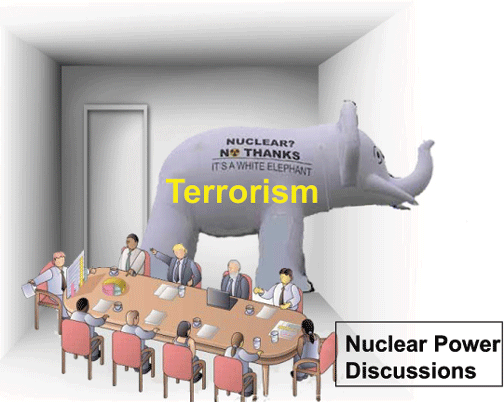
 A threat to confront: far-right extremists and nuclear terrorism, Bulletin of the Atomic Scientists By Rebecca L. Earnhardt, Brendan Hyatt, Nickolas Roth | January 14, 2021 Last March, neo-Nazi Timothy Wilson was killed during a shootout as he was planning to bomb a hospital treating COVID-19 patients. Like other neo-Nazis, Wilson viewed the pandemic and increased unrest among the American public as an opportunity to popularize Nazi ideas, spark further chaos, and accelerate societal collapse.[1] This past week, Ashli Babbitt was shot and killed while storming the US Capitol as part of a right-wing uprising; several years earlier, she was an employee of the Calvert Cliffs nuclear plant, exhibiting violent behavior during this period. [2] Acts of violence by far-right extremists are on the rise in the United States. Until now, most of these incidents have lacked sophistication, but a critical question for national security experts is whether US far-right extremist groups that espouse violence can carry out something catastrophic. A threat to confront: far-right extremists and nuclear terrorism, Bulletin of the Atomic Scientists By Rebecca L. Earnhardt, Brendan Hyatt, Nickolas Roth | January 14, 2021 Last March, neo-Nazi Timothy Wilson was killed during a shootout as he was planning to bomb a hospital treating COVID-19 patients. Like other neo-Nazis, Wilson viewed the pandemic and increased unrest among the American public as an opportunity to popularize Nazi ideas, spark further chaos, and accelerate societal collapse.[1] This past week, Ashli Babbitt was shot and killed while storming the US Capitol as part of a right-wing uprising; several years earlier, she was an employee of the Calvert Cliffs nuclear plant, exhibiting violent behavior during this period. [2] Acts of violence by far-right extremists are on the rise in the United States. Until now, most of these incidents have lacked sophistication, but a critical question for national security experts is whether US far-right extremist groups that espouse violence can carry out something catastrophic.
Every president serving in the last two decades has said that nuclear terrorism is a significant national security threat. Analysis of this threat has been, for good reason, mostly focused on foreign extremist groups, but recent events raise questions of whether there should be greater focus in the United States on far-right, domestic extremist threats. These extremists represent a unique danger because of their prevalence in federal institutions such as the military and the potential that they might infiltrate nuclear facilities, where they could access sensitive information and nuclear materials. The far-right extremist nuclear terrorism threat, which has some history, is amplified today by an ideology focused on accelerating the collapse of society and a documented interest in pursuing nuclear terrorism. Officials need to act decisively to better understand and mitigate this threat. Far-right narratives of nuclear terror. The intersection between violent far-right extremist ideology and catastrophic terrorism goes back decades. In The Turner Diaries, a 1978 novel labeled the “bible of the racist right,” the protagonists use acts of nuclear terror in service of the creation of a “white world.” Protagonists bomb nuclear installations, seize nuclear weapons, target missiles at New York City and Tel Aviv, and ultimately destroy the Pentagon in a suicidal nuclear attack.[3] The International Centre for Counterterrorism ties the Diaries to “at least 200 murders and at least 40 terrorist attacks/hate crimes” in the last 40 years.[4] This includes Timothy McVeigh’s 1995 bombing of the Alfred P. Murrah Federal Building in Oklahoma City, resulting in the deaths of 168 people.[5] McVeigh, however, is not the only far-right terrorist to be inspired by the Diaries. In 2011, violent far-right extremist Anders Breivik’s terror attacks killed 77 people in Norway. Dozens of pages in his 1,500-page “manifesto” discuss the execution of different acts of nuclear terrorism.[6] An increasingly active generation of violent far-right extremist groups and actors have adopted an especially dangerous ideology that is compatible with an act of nuclear terror: accelerationism.[7] Violent far-right extremists who adopt accelerationism view societal collapse as inevitable and seek to hasten that collapse in service of “total revolution”—the complete destruction of the existing system of governance.[8] Violent far-right extremists who adopt accelerationism hope to set off a series of violent chain events, with violence begetting more violence, destabilizing society.[9] Indiscriminate, highly destructive acts of terror—like a nuclear attack—are therefore perfect tools to sow chaos and accelerate this societal collapse. In Siege, one of the defining theoretical works of violent far-right accelerationism, author and accelerationist leader James Mason writes that, “[White supremacists] will be the single survivor in a war against the System, a TOTAL WAR against the System.”[10] In a recent act of violent far-right extremist terrorism, Brenton Tarrant, the Australian perpetrator of the 2019 terrorist attack on Christchurch masjidain in New Zealand, wrote about accelerationism in his manifesto.[11] Groups with nuclear interests. Inspired by the ideas of accelerationism, the modern breed of violent far-right extremism is becoming more destructive, and nuclear weapons certainly fit into this profile of catastrophic violence. The intention to bring about a cataclysmic clash of civilizations bears resemblance to better known terrorist organizations like Al Qaeda and Aum Shinrikyo, both of which have pursued nuclear weapons. As director of intelligence and counterintelligence at the US Department of Energy, Rolf Mowatt-Larssen, once observed, “Osama bin Ladin has signaled a specific purpose for using WMD in al Qaeda’s quest to destroy the global status quo, and to create conditions more conducive to the overthrow of apostate regimes throughout the Islamic world.”[12] Like Al-Qaeda, violent far-right extremists support the creation of a new society that is in line with their own ideology. One of the most notable and violent far-right extremist groups that have adopted accelerationism and operate in the United States is the Atomwaffen Division (AWD).[13] The organization’s name translates from German to “the nuclear weapons division,” indicating that its members have an explicit interest in nuclear terrorism. Brandon Russel, a former Florida National Guard member and an AWD co-founder, is one case of an aspiring nuclear terrorist. A heavily armed Russel and a fellow AWD member were recently arrested while in route to the Turkey Point nuclear power plant. During the investigation officials found that Russel lived in an apartment with two AWD co-conspirators; in the apartment was a prominently placed copy of the Turner Diaries and a framed photo of Oklahoma City Bomber Timothy McVeigh. The trio stockpiled weapons and explosives with the intent to blow up, among other targets, a nuclear power plant. In their apartment, police found pipe bomb components, traces of the explosive hexamethylene triperoxide diamine, and detonators. Police also detected two radioactive materials—thorium and americium—in his bedroom.[14] AWD was not the first far-right extremist in America to consider using radioactive or nuclear materials in a terrorist attack. Several previously documented attempts by violent far-right extremists to commit acts of radiological terror indicate a longstanding interest among far-right actors in highly destructive, non-conventional acts of terror.[15] In 2004, National Socialist Movement member Demetrius Van Crocker attempted to build a dirty bomb to blow up a courthouse.[16] In 2008, James Cummings, a white supremacist, obtained four 1-gallon containers of a mix of depleted uranium and thorium-232. He planned to use these materials to assemble a dirty bomb.[17] In 2013, a member of the Ku Klux Klan who worked at General Electric carried out research on radiation dispersal devices, learning what level of emission was required to kill humans.[18] Could they really pull it off? While some violent far-right extremists are clearly motivated to carry out catastrophic terrorist attacks, a question remains: Do they possess the means and opportunity to conduct an act of nuclear terrorism? There is no public evidence violent far-right extremist groups have obtained the resources or exhibited the requisite operational sophistication to carry out an act of nuclear terrorism. Many of the plots involving far-right extremists and nuclear terrorism have been poorly conceived and were unlikely to succeed. These incidents, however, likely do not provide a complete picture of the threat, because publicly accessible information on the capability of these groups is limited, creating ambiguity about their general capabilities………. The most concerning evidence that violent far-right extremists might have access to nuclear weapons or weapons-useable material lies in their presence in the US military and other parts of the federal government. The presence of white supremacists in the military is well-known and well-documented. ……….. https://thebulletin.org/2021/01/a-threat-to-confront-far-right-extremists-and-nuclear-terrorism/
|
|
Why Japanese people should say ‘Sayonara’ to nuclear energy- a nun’s voice for nuclear victims

Sister Reiley, who has served as a missioner in Japan since 1968, was referring to the accident at Fukushima-Daichi Nuclear plant, which occurred on March 11, 2011. The accident was triggered by a devastating tsunami that followed a powerful 9.0 earthquake that hit a large part of Japan’s northern coast.
The quake and tsunami left more than 18,000 people dead or missing and hundreds of thousands of houses and businesses destroyed, according to Japan’s National Police Agency. More than 160,000 people fled the region near the nuclear plant because of the meltdown and more than 40,000 are still unable to return home due to radiation contamination.
Last June, Sister Reiley took the 3.5-hour train ride from Tokyo, where she lives, to Fukushima to give this Maryknoll reporter a tour around Haramachi, a town near where the Fukushima-Daichi nuclear accident happened.
The area had the feeling of a sci-fi apocalyptic movie: A ghost town with abandoned farmlands that could not be used; streets blocked with fences and no-trespassing signs; decaying houses damaged by the earthquake that cannot be repaired because they are contaminated; Geiger counter boxes under the street signs to measure the level of radioactivity; thousands of huge black vinyl bags filled with radioactive dirt; security guards wearing masks and radioactive protective gear at checkpoints, only allowing entrance to radioactive waste cleaning crews—many of them immigrants who are temporarily hired to do a job that could harm their health. …….
Sister Reiley has striven to show God’s love for the people by speaking out against nuclear energy in a country whose 52 nuclear plants, she believes, pose an enormous threat to human life.
After the triple disaster in 2011, Sister Reiley responded to the Japanese Catholic Church’s call for volunteers. “Initially I went several times a year to several different Japan Caritas bases wherever the need was at the time,” says Sister Reiley. “But gradually towns far away from the reactor returned to normal, (except) Haramachi where the need is still great for the elderly, differently abled and those people in a low economic bracket. They don’t have the means to move away from the reactor area.”
…….. Her concern about nuclear energy began in 1979 in her native Schuylkill County, Pa. She was visiting home from her mission in Japan when there was a reactor meltdown at the Three Mile Island nuclear plant in nearby Dauphin County. It is considered the most serious nuclear accident in U.S. history, according to the U.S. Nuclear Regulatory Commission.
“We’re poisoning our earth,” Sister Reiley remembers her father saying shortly after the nuclear accident.
“In 1999, there was a nuclear accident at the Tokaimura [nuclear facility] in Ibaraki Prefecture,” Sister Reiley says. “About two years after that accident happened, I asked the families [at the cancer hospital], ‘Where are you from?’ ‘Ibaraki.’ ‘Where are you from?’ ‘Ibaraki.’”
Out of the 24 beds for children with cancer at the hospital, at the time, seven children were from Ibaraki, explains the missioner. “But nobody can document that and say absolutely, ‘that’s why [the nuclear accident] they got cancer’.”
Still, the missioner works tirelessly to raise awareness about the dangers in nuclear energy Nearly 25 years after the 1986 nuclear accident in Chernobyl, in the former Soviet Union, Sister Reiley read an article, in a Japanese newspaper, about the high incidences of cancer linked to the nuclear accident. The report cited a study conducted by an international team of researchers led by the National Cancer Institute. That gave the Maryknoll sister an opportunity to question what happened at the nuclear facility in Japan. She visited the newspaper headquarters to speak to the editors.
“Won’t you please do some research about Tokaimura? About the accident that happened in Ibaraki?” she asked. The paper did not respond to her request. She was undaunted.
That sombre day in June in Haramachi, as we drove back to the train station, we saw a farm with cattle and stopped for a lesson from Sister Reiley. She explained that the government had asked the owner to kill the cattle. The cows’ milk could not be sold nor could the cows be slaughtered to sell their meat because they were contaminated. The cows, she continued, were innocent victims of problems caused by human beings.
“But this wonderful man asked the government to let the cows live a natural life and die a natural death,” says Sister Reiley.
Then she translated a sign at the cattle ranch. “We lived here with no fear of nuclear energy and now we realise that we lost something that can never be returned to us and we want people to understand that we have to say sayonara, goodbye, to nuclear energy.” https://catholicoutlook.org/jana-voice-for-nuclear-victims/
Big doubts on small nuclear reactors – on economics, on waste problems
 Former U.S. regulator questions small nuclear reactor technology, Business case for small reactors ‘doesn’t fly,’ says expert on nuclear waste, Jacques Poitras · CBC News Jan 15, 2021 A former head of the United States’ nuclear regulator is raising questions about the molten-salt technology that would be used in one model of proposed New Brunswick-made nuclear reactors.
The technology pitched by Saint John’s Moltex Energy is key to its business case because, the company argues, it would reuse some of the nuclear waste from Point Lepreau and lower the long-term cost and radioactivity of storing the remainder.
But Allison Macfarlane, the former chairperson of the U.S. Nuclear Regulatory Commission and a specialist in the storage of nuclear waste, said no one has yet proven that it’s possible or viable to reprocess nuclear waste and lower the cost and risks of storage.
“Nobody knows what the numbers are, and anybody who gives you numbers is selling you a bridge to nowhere because they don’t know,” said Macfarlane, now the director of the School of Public Policy and Global Affairs at the University of British Columbia.
“Nobody’s really doing this right now. … Nobody has ever set up a molten salt reactor and used it to produce electricity.”
Macfarlane said she couldn’t comment specifically on Moltex, calling information about the company’s technology “very vague.”
But she said the general selling point for molten-salt technology is dubious.
“Nobody’s been able to answer my questions yet on what all these wastes are and how much of them there are, and how heat-producing they are and what their compositions are,” she said.
“My sense is that all of these reactor folks have not really paid a lot of attention to the back end of these fuel cycles,” she said, referring to the long-term risks and costs of securely storing nuclear waste.
Moltex is one of two Saint John-based companies pitching small nuclear reactors as the next step for nuclear power in the province and as a non-carbon-dioxide emitting alternative to fossil fuel electricity generation.
Moltex North America CEO Rory O’Sullivan said the company’s technology will allow it to affordably extract the most radioactive parts of the existing nuclear waste from the Point Lepreau Generating Station.
The waste is now stored in pellet form in silos near the plant and is inspected regularly.
The process would remove less than one per cent of the material to fuel the Moltex reactor and O’Sullivan said that would make the remainder less radioactive for a much shorter amount of time.
Existing plans for nuclear waste in Canada are to store it in an eventual permanent repository deep underground, where it would be secure for the hundreds of thousands of years it remained radioactive………..
Shorter-term radioactivity complicates storage
Macfarlane said a shorter-term radioactivity life for waste would actually complicate its storage underground because it might lead to a facility that has to be funded and secured rather than sealed up and abandoned.
“That means that you believe that the institutions that exist to keep monitoring that … will exist for hundreds of years, and I think that is a ridiculous assumption,” she said.
“I’m looking at the United States, I’m seeing institutions crumbling in a matter of a few years. I have no faith that institutions can last that long and that there will be streams of money to maintain the safety and security of these facilities. That’s why you will need a deep geologic repository for this material.”
And she said that’s assuming the technology will successfully extract all of the most radioactive material.
“They are assuming that they remove one hundred per cent of the difficult, radionuclides, the difficult isotopes, that complicate the waste,” she said.
“My response is: prove it. Because if you leave five per cent, you have high-level waste that you’re going to be dealing with. If you leave one per cent, you’re going to have high-level waste that you’re going to be dealing with. So sorry, that one doesn’t fly with me.”
Macfarlane, a geologist by training, raised doubts about molten-salt technology and waste issues in a 2018 paper she co-authored for the Bulletin of the Atomic Scientists………. https://www.cbc.ca/news/canada/new-brunswick/nuclear-waste-reactors-new-brunswick-allison-macfarlane-moltex-arc-1.5873542
Trump’s behavior demonstrates that Biden must change US nuclear policy
|
Trump’s behavior demonstrates that Biden must change US nuclear policy,
|
While this arrangement appears especially risky now, giving any one person the authority to order the use of nuclear weapons is inherently risky and completely unnecessary. Any use of nuclear weapons would be devastating and should require both a presidential order and the agreement of two other officials.
Unlike decades ago, when sole authority was first established, there is a straightforward way to include other officials in a launch decision. President-elect Joe Biden should make this long-overdue change once in office by limiting his own authority to order a nuclear attack……………….
President Biden should move quickly to implement these two policy changes — requiring the assent of two other officials to any nuclear launch order and eliminating the option of using nuclear weapons first. Doing so would make the world safer and demonstrate that the United States is committed to reducing the risk of nuclear use and to moving away from its reliance on nuclear weapons. https://www.defensenews.com/opinion/commentary/2021/01/14/trumps-behavior-demonstrates-that-biden-must-change-us-nuclear-policy/
Russia eager to salvage nuclear weapons treaty, once Biden is USA president
 For Russia, nuclear arms curbs with Biden are a ‘no brainer’ https://www.thejakartapost.com/news/2021/01/15/for-russia-nuclear-arms-curbs-with-biden-are-a-no-brainer-.html Jonathan Brown Agence France-Presse Moscow / Fri, January 15, 2021 Russian President Vladimir Putin holds a video conference call with Mikhail Degtyarev, an LDPR party lawmaker, in Kerch, Crimea, on July 20, 2020. (Sputnik/AFP/Alexey Druzhinin ) For Russia, nuclear arms curbs with Biden are a ‘no brainer’ https://www.thejakartapost.com/news/2021/01/15/for-russia-nuclear-arms-curbs-with-biden-are-a-no-brainer-.html Jonathan Brown Agence France-Presse Moscow / Fri, January 15, 2021 Russian President Vladimir Putin holds a video conference call with Mikhail Degtyarev, an LDPR party lawmaker, in Kerch, Crimea, on July 20, 2020. (Sputnik/AFP/Alexey Druzhinin )
When US President-elect Joe Biden enters the White House next week his administration will be in a race against time to salvage a landmark nuclear arms accord with Russia. The New START treaty, which expires just 16 days after Biden’s inauguration, is the last major arms reduction pact between old foes whose bulging nuclear stockpiles dominated fears for global security during the Cold War.
But the fast-approaching deadline to find compromise comes as tensions between Moscow and Washington are at fever pitch over recent hacking allegations, and after Biden vowed to take a firm stand against Russia. The stakes of reaching an agreement are high, says Elena Chernenko, a foreign editor at Russia’s Kommersant newspaper who has closely followed negotiations. “The treaty limits the chances of one side miscalculating the intentions or plans of the other, which we saw happen several times leading to very dangerous moments during the Cold War,” she told AFP.
Any agreement is also likely to define spending priorities for both governments, said Russian political columnist Vladimir Frolov. Extending New START could determine both in Moscow and Washington whether “more money than necessary would have to be spent on nuclear toys as opposed to health care,” he told AFP.
New START was signed in 2010 between then-US president Barack Obama and former Russian leader Dmitry Medvedev, curbing warheads to 1,550 each and restricting numbers of launchers and bombers.
Biden will be eager to score a big diplomatic win early in his term, but he is also under pressure to tread a fine line and make good on a campaign promise to be tough on Russia. Lawmakers in the US demanded punishment for Russia last year after concluding that Kremlin-backed hackers were behind a sweeping cyber intrusion into government institutions.
That standoff is just the latest in a litany of disagreements over conflicts in Ukraine and Syria and allegations of Russian election meddling. Still, rhetoric from Moscow and Washington as the New START expiration deadline approaches has raised hopes that arms control could offer a rare area of compromise. Biden’s incoming national security advisory Jake Sullivan said this month that the president-elect had tasked officials with looking at extending New START “right out of the gates”.
In Moscow, Putin recently proposed a one-year extension without preconditions and tasked Foreign Minister Sergei Lavrov with getting a “coherent” US response to the offer. Former Soviet leader Mikhail Gorbachev, a champion of Soviet-era arms accords with the United States, said this week he expects Biden to prolong the accord and urged both sides “to negotiate further reductions”.
“Russia is on record at the highest level that it wants to extend the treaty for five years without any preconditions,” said Frolov, the columnist. Moscow is in favor of an extension, he said, because it would allow Russia to modernize its own nuclear forces at an affordable and measured pace, without rushing into an arms race. Frolov added that Russia was unlikely to sabotage negotiations just to make Biden appear weak at the onset of his tenure, saying the Kremlin “does not care about Biden’s wins”.
For Putin, extending New START is “a no brainer,” Frolov said. Negotiations under US President Donald Trump stumbled over an American demand that China become party to the agreement – Beijing having shown no interest in joining. That demand was highlighted in an embarrassing episode last June, when a US negotiator at arms control talks in Vienna tweeted a picture of China’s flag next to empty chair. “China is a no-show,” US Special Presidential Envoy for Arms Control Marshall Billingslea wrote, even though Beijing was never expected to attend.
With the dawn of the Biden era, that tone of negotiation has likely come to an end, analysts believe. “There are now adults in the room in the United States, so even with these areas of confrontation, maybe this is the one avenue where Moscow and Washington will be able to compromise to make the world a little bit safer,” Chernenko said.
While both Washington and Moscow have signaled a positive outcome for Feb. 5 – the New START expiration date – what comes next is a different question. “That’s the moment when Russia will come to the table with a big portfolio of grievances and demands,” Chernenko cautioned.
|
|
Church leaders call on UK to sign nuclear weapons ban treaty
 UK is urged to sign UN nuclear-weapons treaty https://www.churchtimes.co.uk/articles/2021/15-january/news/uk/uk-is-urged-to-sign-un-nuclear-weapons-treaty by PAT ASHWORTH, 15 JANUARY 2021 But there is resistance to change, say peace campaigners.
CAMPAIGNERS are urging the UK to sign the United Nations Treaty on the Prohibition of Nuclear Weapons, which will come into effect on 22 January.
The Archbishops of Canterbury and York, with more than 30 Church of England bishops, called on the Government in November to accept the treaty, which, they said, would “give hope to all people of goodwill who seek a peaceful future” (News, 20 November 2020).
It has been signed by 51 states. They will now be required to stop producing, developing, testing, or stationing nuclear weapons, and will be required to help any victims of their testing and use. Their financial institutions will be expected to stop investing in companies that produce nuclear weapons.
The UK, the United States, France, and Russia have not signed the treaty. Clergy and church leaders were reminded in a briefing by the Network of Christian Peace Organisations (NCPO), on Tuesday, of the overwhelming support given to a Lambeth Conference resolution in 1998, which called on the Government and the UN to press for an international mandate for all member states to prohibit nuclear warfare.
Now was the time to fulfil that, Rebecca Johnson, one of the architects of the treaty and a founder member of the International Campaign to Abolish Nuclear Weapons (ICAN), said. Nuclear weapons must be known for what they really were — weapons of mass destruction — and the phrase “nuclear powers” must be replaced with “nuclear-armed states”.
The treaty was a legal one, but it would work by persuasion and not by coercion; it was normative in taking away any status attached to hanging on to nuclear weapons, and in labelling as pariahs those who did. “We all need to think about what we can do to bring this treaty into force in our own countries. There is an important job here for faith leaders to do,” she said.
Although the C of E had a blanket policy of not investing in companies with an interest in nuclear weapons, everyone should examine investment practice in their churches, the policy adviser on international affairs for the ecumenical Joint Public Issues Team, Steve Hucklesby, said.
The treaty brought “a very real possibility of a new norm on nuclear weapons across the whole finance and business sectors; but be clear: there is resistance to change,” he continued. Pressure could be applied to banks and pension providers if individuals saw this as something relating to their own lives. “The issue now becomes compliance with an international treaty, to be applied across the whole of an institution’s business.”
An international meeting to be held in Vienna later this year will establish mechanisms for compliance. It will be open to observers from nuclear-armed states, who will not be able to vote but who should be urged to “attend, listen, and learn,” Ms Johnson said. “It is so important for the UK to join sooner rather than later . . . to be at the table.”
Russell Whiting, who chairs Christian CND, described a world in which President Trump, or even Joe Biden, had their finger on the nuclear button, as “an incredibly dangerous place”. The treaty has been declared dangerous by the Prime Minister, and by the former Foreign Secretary Philip Hammond. These governments had “misrepresented” the treaty wherever they went, saying that it would undermine the existing non-proliferation treaty, Ms Johnson said.
The General Synod called for the elimination of nuclear weapons in July 2018, but it stopped short of urging the Government to sign the treaty. The Government’s refusal to do so was described by the Archbishop of York, the Most Revd Stephen Cotrrell, then Bishop of Chelmsford, as “hugely disappointing” and “a decision that looks like complacency”. He questioned the billions of pounds spent on Trident (News, 13 July 2018).
The general secretary of the Roman Catholic peace movement Pax Christi, Pat Gaffney, said on Tuesday that RC bishops had issued a statement asking the Government to support the treaty — a move that she described as “a huge step forward, because they have habitually said it undermined the existing non-proliferation treaty. Catholics need to write to their bishops affirming what they are doing.”
The NCPO is holding a service online at 11.30 a.m. on 22 January, to mark the treaty. It will conclude with the ringing of the peace bell at Coventry Cathedral.
Global nuclear policy is stuck in colonialist thinking. The ban treaty offers a way out.
|
Global nuclear policy is stuck in colonialist thinking. The ban treaty offers a way out.
 Bulletin of the Atomic Scientists By Molly Hurley | January 15, 2021 The world recently reached a significant milestone on international nuclear weapons policy: The Treaty on the Prohibition of Nuclear Weapons—commonly called the nuclear ban treaty—hit 50 ratifications, triggering its entry in force on January 22, 2021. None of the 50 ratifications comes from a country with an actual nuclear arsenal. Nevertheless, as the name suggests, the ban treaty prohibits states party to it from developing, testing, producing, manufacturing, otherwise acquiring, possessing, or stockpiling nuclear weapons or other nuclear explosive devices. The treaty is a step in the right direction for those in the disarmament camp, but it is much more than that. While the current system regulating nuclear weapons is unstable, dangerous, and unfair to much of the world because it grew out of a colonial system, the ban treaty can help the world move in a less dangerous, post-colonial direction. Bulletin of the Atomic Scientists By Molly Hurley | January 15, 2021 The world recently reached a significant milestone on international nuclear weapons policy: The Treaty on the Prohibition of Nuclear Weapons—commonly called the nuclear ban treaty—hit 50 ratifications, triggering its entry in force on January 22, 2021. None of the 50 ratifications comes from a country with an actual nuclear arsenal. Nevertheless, as the name suggests, the ban treaty prohibits states party to it from developing, testing, producing, manufacturing, otherwise acquiring, possessing, or stockpiling nuclear weapons or other nuclear explosive devices. The treaty is a step in the right direction for those in the disarmament camp, but it is much more than that. While the current system regulating nuclear weapons is unstable, dangerous, and unfair to much of the world because it grew out of a colonial system, the ban treaty can help the world move in a less dangerous, post-colonial direction.
A post-colonial perspective on national security begins by overturning a number of currently held assumptions within the mainstream nuclear policy regime—one that is solely dedicated to nonproliferation and deterrence and lacks a genuine commitment to eventual disarmament. These assumptions are that exporting a Western values system, especially through military intervention, builds democracy and brings “civility” to Global South countries; that “might makes right,” and one country can impose its arms control demands on the rest of the world; that the West rightfully serves as the primary guardian and custodian of arms control and disarmament; and that nuclear weapons make the world safer, but only when certain countries possess them. One of the principal benefits of the ban treaty is that it can help subvert these assumptions, opening a pathway toward a new, post-colonial conception of security. “Civilizing” the Global South. The current system implicitly gives the United States the right to determine the validity of Global South countries’ form of government. For example, when the United States invaded Iraq in 2003, the George W. Bush administration posited that the necessity of this action stemmed not only from a concern for Iraq’s development of weapons of mass destruction, including nuclear weapons development, but also a concern for overthrowing Saddam Hussein and bringing democracy to the country. Intelligence on the accusation of a nuclear weapons program was revealed to be murky at best and a complete lie at worst. As for the democracy pursuit, deeper analysis shows this to also be a cover. In reality, a primary motivator for the US invasion of Iraq was to demonstrate superiority as a world power. Secretary of Defense Donald Rumsfeld said in 2001 that taking down Saddam would “enhance US credibility and influence through the region” and “demonstrate what US policy is all about.” The sentiment grew particularly strong after 9/11, an event that President Bush felt was a humiliation on the part of US power and security. Although the claim for this underlying motivation is contested by some, Under Secretary of Defense for Policy Douglas Feith admitted in 2006 that “the rationale for the war didn’t hinge on the details of this intelligence, even though the details of the intelligence at times became elements of the public presentation.” The misleading of the public aside, the very premise of the United States holding a responsibility to lead in the development of spreading “democracy” around the world is inherently racist……….. Bringing it back to the ban treaty, the treaty shows that Global South does not need “civilizing,” since it was Global South countries that led the way in its negotiation and adoption. If anything, it’s the opposite: Article 12 of the treaty obligates state parties encourage other countries to join on, with the goal of universal adherence. So leaders like Nigeria, Mexico, and Bangladesh will now be working diplomatically to “civilize” the nuclear powers. Might makes right. The second assumption of the current nuclear policy regime is that military aggression or interference is a critical centerpiece in bringing about peace and stability. Just look at deterrence theory at its essence. Nuclear-armed countries have built the foundations of their security policies around nuclear arsenals and the principle of deterrence. Mutual assured destruction dominated the Cold War understanding of nuclear weapons and still underpins the concept of deterrence today. It’s a game of Russian roulette, but with all guns loaded and fingers on the trigger. Deterrence is built on the idea that with enough nuclear weapons no one will dare attack. Yet this belief is deeply flawed because it ignores the potential for misperception, accidents, and leaders who follow different decision-making calculuses. Deterrence theory is also a belief in the right of the five officially recognized nuclear weapon states under the Nuclear Non-Proliferation Treaty (China, France, Russia, the United States, and the United Kingdom) to have the power to threaten nuclear annihilation to force “peace” on the rest of the world. How is the Treaty on the Prohibition of Nuclear Weapons different? Simply look at the course of the ban treaty from its early stages of development, to its adoption in 2017, and up to today. The ban treaty came about from the Humanitarian Initiative, a series of discussions held by non-nuclear weapons states about the humanitarian consequences of nuclear possession and nuclear war. Participants also included members of civil society. All nuclear weapons states, most NATO members, and many military allies of nuclear weapon states boycotted the negotiations, which were chaired by Costa Rican Ambassador Elayne Whyte Gomez. Even in the lead up the treaty’s creation and adoption, the severe humanitarian consequences of nuclear weapons and their possible use was the focus, rather than their strategic capabilities as tools of war, and the discussions were led not by the UN Security Council but by those historically overlooked or ignored in nuclear policy discussions. Currently, 50 countries have ratified (and 86 countries have signed) the treaty. Its entry into force in this month will signal a large shift in the international dialogue on the path to disarmament, giving a voice to the countries who have become party to the treaty and who would otherwise have been given small, if any, roles to play in the global affairs of nuclear policy. The custodians of arms control. Following this, should the United States and other recognized nuclear weapons states just by virtue of possessing nuclear weapons get to be the sole decision makers in international nuclear policy and disarmament and nonproliferation efforts?…….. Movement toward dedicated, deliberative diplomacy, negotiation, and multilateralism not only runs counter to the current assumption of “might equals right” and US primacy but also leads to the creation of more nuanced, culturally-appropriate, and indigenous decision-making processes, in line with a post-colonial approach to national and international security. A return to multilateralism is a return to confidence-building and international cooperation toward a safer world. Instead of the few nuclear “haves” dictating nonproliferation and disarmament policy to the rest of the world as they tried to do in their boycott of the meetings leading up the treaty’s adoption, the rest of the world can be the arbiters of our nuclear future. Adoption of the treaty by each country is an independent decision under each country’s sovereignty and right to freedom from nuclear threat and devastation. The treaty de-centers the historically Eurocentric idea of security by instead focusing on the development and defense of the “weak,” and not of Western great powers………….. If Western policy makers can acknowledge the destabilizing effects of nuclear weapons possession by the East, then surely they can realize the destabilizing effects of their own arsenals. The ban treaty does this. It doesn’t call out just the Eastern countries for the role they play in nuclear hegemony and the oppression the world’s population faces, but all nuclear powers, both recognized and unrecognized. A step in a post-colonial direction. Given this fallacy in the safety of nuclear weapons possession, whose security do these weapons actually prioritize? Whatever the answer, they certainly do not prioritize global security. A post-colonial security, by contrast, would do just that. It would focus on the humanitarian consequences of such policies and be sensitive to the multiplicity of different cultural conceptualizations of “humanity” and “security.” It would protect all humans, natures, and cultures from destruction………https://thebulletin.org/2021/01/global-nuclear-policy-is-stuck-in-colonialist-thinking-the-ban-treaty-offers-a-way-out/ |
|
How will Entry Into Force of the Nuclear Weapons Ban Treaty impact non weapons states parties, including Australia?
 How will EIF impact non states parties, including Australia? https://icanw.org.au/wp-content/uploads/Australia-EIF-of-the-TPNW.pdf How will EIF impact non states parties, including Australia? https://icanw.org.au/wp-content/uploads/Australia-EIF-of-the-TPNW.pdf16 Jan 21, While non states parties are not legally bound to the terms of the treaty, the norms set out and strengthened by the treaty can shape their behaviour and build pressure for them to join. The entry into force of the treaty puts Australia out of step with international law. While Australia has joined every other treaty that prohibits indiscriminate or inhumane weapons, the Nuclear Non-Proliferation Treaty and the South Pacific Nuclear Free Zone Treaty, it has not yet signed or ratified the ban on nuclear weapons. This position is contested by a growing nationwide movement and at all levels of government. The treaty reveals Australia’s complicity in the problem by including nuclear weapons in its defence posture.
***
As a country with a devastating history of nuclear testing, Australia will be obliged to take action as a state party to assist survivors of nuclear testing and take steps towards remediating contaminated environments. These obligations should be informed by and developed in collaboration with impacted First Nations people, nuclear test veterans, civil society, public health and other experts.
***
Entry into force of previous ban treaties has led to a substantial decrease in the production and deployment of prohibited weapons such as cluster munitions and landmines, both by states parties and non states parties. EIF will also impact the flow of funds to nuclear arms producing companies. Financial institutions often choose not to invest in “controversial weapons,” which are typically weapons prohibited by international law. The entry into force of the TPNW clearly puts nuclear weapons in this category and will likely trigger additional divestment, including by Australian banks and superannuation funds.
***
EIF of the treaty will further stigmatise nuclear weapons, including in Australia, by: Prompting further debate: more than 250 federal, state and territory parliamentarians have declared their support for the treaty and the federal Opposition, the Australian Labor Party, has committed to sign and ratify the treaty in government. Decision-makers will continue to be asked to engage with this new piece of international law.
***
Institutionalisation: entry into force will entrench the treaty’s place in the international legal architecture for nuclear weapons. It is already referenced in international fora as signatories and states parties proudly declare their commitment to nuclear disarmament.
***
Impacting alliances: all states parties in alliances with nuclear-armed states will be required to renounce the use of nuclear weapons on their behalf, and ensure they are not assisting with the use or threat of use of the weapons. Once a state party, Australia will need to cease any policy that countenances and supports the use of nuclear weapons. Other US allies, including New Zealand and Thailand, have already joined the treaty.
***
It will take years to build the necessary political will for some states to join the nuclear weapon ban treaty. Shifting nuclear weapons from a symbol of status to a liability of shame is slow, yet crucial, work. As the signatures and ratifications of the treaty continue beyond entry into force, non states parties will face increasing criticism from their citizens, international organisations and other states. Almost all of Australia’s neighbours in the Pacific and Southeast Asia support the treaty. It is only a matter of time before Australia joins the treaty and thereby becomes part of the solution to these abhorrent weapons.
|
|
-
Archives
- February 2026 (228)
- January 2026 (308)
- December 2025 (358)
- November 2025 (359)
- October 2025 (376)
- September 2025 (258)
- August 2025 (319)
- July 2025 (230)
- June 2025 (348)
- May 2025 (261)
- April 2025 (305)
- March 2025 (319)
-
Categories
- 1
- 1 NUCLEAR ISSUES
- business and costs
- climate change
- culture and arts
- ENERGY
- environment
- health
- history
- indigenous issues
- Legal
- marketing of nuclear
- media
- opposition to nuclear
- PERSONAL STORIES
- politics
- politics international
- Religion and ethics
- safety
- secrets,lies and civil liberties
- spinbuster
- technology
- Uranium
- wastes
- weapons and war
- Women
- 2 WORLD
- ACTION
- AFRICA
- Atrocities
- AUSTRALIA
- Christina's notes
- Christina's themes
- culture and arts
- Events
- Fuk 2022
- Fuk 2023
- Fukushima 2017
- Fukushima 2018
- fukushima 2019
- Fukushima 2020
- Fukushima 2021
- general
- global warming
- Humour (God we need it)
- Nuclear
- RARE EARTHS
- Reference
- resources – print
- Resources -audiovicual
- Weekly Newsletter
- World
- World Nuclear
- YouTube
-
RSS
Entries RSS
Comments RSS
 nuclear-news