Former SCANA CEO to plead guilty on another charge for failed nuclear plant project

 Former SCANA CEO to plead guilty on another charge for failed nuclear plant project, https://abcnews4.com/news/local/former-scana-ceo-to-plead-guilty-on-another-charge-for-failed-nuclear-plant-project by Tony Fortier-Bensen, Thursday, December 24th 2020, COLUMBIA, SC (WCIV)
The former CEO of SCANA will plead guilty to a third charge on Tuesday related to fraud charges for the failed V.C. Summer project in Fairfield County.
S.C. Attorney Peter McCoy Jr. announced in a press release that Kevin Marsh would plead guilty on Tuesday, Dec. 29 in federal court to conspiracy to commit mail and wire fraud.
In late November, Marsh pleaded guilty to one count of conspiracy and one count of obtaining false property by false pretenses.
According to that plea agreement, Marsh could serve 18 to 36 months and must pay $5 million in restitution.
His plea agreement for the third charge has not been announced.
Marsh has a hearing scheduled for 10:00 a.m. in federal court, and following that plea, he is scheduled for another hearing on a state charge at noon on the same day.
In June, retired SCANA chief operating officer Steve Byrne entered a guilty plea for his actions in relation to the failed nuclear power plant.
The U.S Attorney’s office alleges Byrne and Marsh conspired with other SCANA executives to deceive state and federal government overseers, stock holders and power customers in order to keep funding coming in to build two nuclear reactors at the V.C. Summer Nuclear Station.
The expansion project cost Santee-Cooper and the defunct South Carolina Electric & Gas over $9 billion before the two entities abandoned the project in July 2017.
Chinese demands on nuclear power investment complicate EU talks
Chinese demands on nuclear power investment complicate EU talks – WiWo, Reuters Staff BERLIN (Reuters) 23 De 20, – Negotiations between the European Union and China on an investment agreement have stoche reported on Wednesday.
The issue of nuclear power is controversial among EU countries because such invealled at the last stretch because China is raising additional demands on nuclear energy, German magazine WirtschaftsWstments could put sensitive infrastructure under Chinese control.
“China wants to invest in European nuclear power plants and use Chinese technology in this area,” WirtschaftsWoche cited EU sources as saying.
During the negotiations, China had indicated to its European counterparts that it viewed its own technology in this field as more advanced, the report said
|
Several EU member states reject nuclear energy or have decided to withdraw from the technology within the next few years.
The EU and China aim to reach an investment accord by the end of the year that would grant European companies greater access to the Chinese market, according to German and EU officials.
The EU-China Comprehensive Agreement on Investment would put most EU companies on an equal footing in China, potentially a big step in repairing Sino-European ties after the coronavirus outbreak in China and Beijing’s crackdown on dissent in the former British colony of Hong
|
|
|
USA’s Dept of Energy pouring $millions into gimmicky new untested nuclear projects
The US Department of Energy (DOE) has announced USD20 million in awards for the third of three programmes under its new Advanced Reactor Demonstration Program (ARDP). DOE’s Office of Nuclear Energy has selected three teams to receive FY2020 funding for the ARDP’s Advanced Reactor Concepts-20 (ARC-20) programme.
DOE expects to invest about USD600 million over the next seven years in ARDP, which aims to help domestic private industry demonstrate advanced nuclear reactors in the USA.
The department issued an ARDP funding opportunity announcement in May this year, which included the ARC-20 awards, the Advanced Reactor Demonstration awards, and the Risk Reduction for Future Demonstration awards. For the ARC-20 projects, DOE expects to invest a total of about USD56 million over four years with its industry partners providing at least 20% in matching funds. The goal of the ARC-20 programme is to assist the progression of advanced reactor designs in their earliest phases.
DOE yesterday announced the selection of three US-based teams to receive ARC-20 funding. These are:
- Inherently Safe Advanced SMR for American Nuclear Leadership. Advanced Reactor Concepts will deliver a conceptual design of a seismically isolated advanced sodium-cooled reactor facility that builds upon the initial pre-conceptual design of a 100 MWe reactor facility. The total award value over three-and-a-half years is USD34.4 million, with the DOE’s share being USD27.5 million.
- Fast Modular Reactor Conceptual Design. General Atomics will develop a fast modular reactor conceptual design with verifications of key metrics in fuel, safety and operational performance. The design will be for a 50 MWe fast modular reactor. Total award value over three years is USD31.1 million (DOE share is USD24.8 million).
- Horizontal Compact High Temperature Gas Reactor. Massachusetts Institute of Technology will mature the Modular Integrated Gas-Cooled High-Temperature Reactor (MIGHTR) concept from a pre-conceptual stage to a conceptual stage to support commercialisation. The total award value over three years is USD4.9 million (DOE cost share is USD3.9 million).
“ARDP is significant because it will enable a market for commercial reactors that are safe and affordable to both construct and operate in the near- and mid-term,” said Secretary of Energy Dan Brouillette. “All three programmes under ARDP pave the way for the United States to be highly competitive globally.”
On 16 December, DOE selected five teams to receive USD30 million in initial funding for risk reduction projects under its ARDP programme. All five of the selected designs have the potential to compete globally once deployed, DOE said. The five projects are: the BWXT Advanced Nuclear Reactor; Westinghouse’s eVinci Microreactor; Kairos Power’s Hermes Reduced-Scale Test Reactor; the Holtec SMR-160 light-water small modular reactor; and the Molten Chloride Reactor Experiment, a project led by Southern Company Services Inc.
Two projects led by TerraPower and X-energy were selected in October to receive USD160 million in initial funding for under the DOE’s Demonstration projects pathway to develop and construct two advanced nuclear reactors that can be operational within seven years.
“Funding for ARDP beyond the near term is contingent on additional future appropriations, evaluations of satisfactory progress, and DOE approval of continuation applications,” DOE noted.
Draft EIS on Versatile Test Reactor (VTR); Lacking Justification and Due to Proliferation Risks, VTR Project Must Not Go Forward.
SRS 21st Dec 2020, DOE Announces Release of Draft EIS on Versatile Test Reactor (VTR); Lacking
Justification and Due to Proliferation Risks, VTR Project Must Not Go
Forward. Option to Fabricate Plutonium Fuel in Old K-Reactor at Savannah
River Site would Bring Risks and Up to an Additional 30 Metric Tons of
Plutonium to South Carolina – Must be Rejected.
EIN Presswire 21st Dec 2020
Dredging of the Pripyat river poses danger of Chernobyl radioactivity to drinking water of 8 million people.
Guardian 23rd Dec 2020, The river running past the Chernobyl nuclear reactor is being dredged to
create an inland shipping route, potentially resurfacing radioactive sludge
from the 1986 disaster that could contaminate drinking water for 8 million
people in Ukraine, scientists and conservationists have warned.
The dredging of the Pripyat began in July and is part of an international
project to create the 2,000km (1,240-mile) long E40 waterway linking the
Baltic and Black seas, passing through Poland, Belarus and Ukraine. The
river – which snakes within 2.5km of the reactor responsible for the
world’s worst nuclear disaster – has already been dredged in at least
seven different places, five of which are within 10km of the reactor,
according to the Save Polesia coalition.
Are forest fires unlocking radiation in Chernobyl?
The firefighters sent in to tackle the blazes in the radioactive forests agreed to speak to BBC anonymously, scared of losing their jobs.
Their accounts expose a month of chaos in which fires almost reached the nuclear reactors.
Journalism: Zhanna Bezpiatchuk and Charlotte Pamment
Unacceptable secrecy by the nuclear industry in Sizewell documentation
|
Sizewell C documentation secrecy just a continuation of lack of transparency by the nuclear industry http://drdavidlowry.blogspot.com/2020/12/sizewell-c-documentation-secrecy-just.html Dr David Lowry, 22 Dec 20, Between 18 November and 18 December 2020, NNB Generation Company (SZC Co.) carried out a public consultation on the proposed changes (dated 23 October 2020) for an Order Granting Development Consent for The Sizewell C Project. The document launching this supplementary consultation noted: “In January 2021, SZC Co. will submit a formal application to change the Sizewell C DCO application, as well as some Additional Information (i.e. information that has been developed in response to continuing engagement with stakeholders and which adds to the detail available within the application (but does not change it)).”
One of the supplemental documents submitted by SZC co. was on “Main Development Site Flood Risk Assessment,” a not inconsequential matter, in the context of climate change –induced sea-level rise, and greater perturbations in extreme weather ( storms, rainfall increase etc) over the time period SZC would operate, if ever built. (https://infrastructure.planninginspectorate.gov.uk/wp-content/ipc/uploads/projects/EN010012/EN010012-001715-SZC_Bk5_5.2_Appx1_7_MDS_Flood_Risk_Assessment_Part_1_of_14.pdf) The new mini-consultation letter then added under the headline Information Redacted or Marked as Confidential, the following: “The Procedural Decision requested clarification on the reasons for redactions and confidential marking on a number of the application documents. A summary of reasons is provided in Table 2. SZC observes in these reasons for redaction that “comprehension of the report is not affected by this redaction.”
The Planning inspectorate was not convinced by this assertion, and responded in a rejoinder letter on 22 December stating it was dissatisfied with “the extent and nature of the commercially sensitive aspect of these documents” and pointedly asked “why this could not be redacted without rendering them incomprehensible?”
Here is the full section outlining the Planning Inspectorate’s disquiet with SZC Co’s secrecy. Request for further clarification and documents from the Applicant Confidential documents “The Applicant’s response letter dated 16 November 2020 [AS-006] to the ExA’s procedural decision [PD-005] sets out at Table 2 a summary of its reasons for redactions and confidential markings. For certain documents [APP-292 to APP-295], the Applicant states that: “As these reports are not required in order for the Examining Authority to examine the application, we therefore request that these reports are withdrawn from the application.”
However, the commercial sensitivity of the investigations and data set out in these Environmental Statement (ES) Appendices is not immediately apparent. Furthermore, they comprise part of the ES which was submitted as part of the application and considered as such when the decision [PD-001] to accept the application was made. The Applicant is therefore requested to provide a further explanation in relation to:
(i) The extent and nature of the commercially sensitive aspect of these documents and why this could not be redacted without rendering them incomprehensible;
(ii) The justification for them not being required in order for the ExA [Examining Authority] to satisfactorily examine the application and to properly assess the basis for the related conclusions and findings in the main parts of the ES.” It adds: The additional information that is sought in respect of these confidential documents will assist the ExA to assess the potential implications of that course of action and reach an informed decision on the question of their withdrawal.” (National Infrastructure Planning, Planning Inspectorate, Document Reference: EN010012, 22 December 2020; https://infrastructure.planninginspectorate.gov.uk/wp-content/ipc/uploads/projects/EN010012/EN010012-002699-Sizewell%20PD4%20-%20Rule%2017%20VE%20Q.pdf)
This is just the latest of a very, very long line of unacceptable secrecy incidents by nuclear power plant operators, and demonstrates that notwithstanding their protestations as to transparency, they remain in fact addicted to secrecy.
|
|
USA’s $128 billion next-generation submarine program at risk of cost overruns
|
Next-Generation U.S. Nuclear Sub Facing Cost Overruns, Delays, Bloomberg, Anthony Capaccio December 24 2020, — The U.S. Navy’s plan to deliver the first vessel in its $128 billion next-generation submarine program on time is at risk by a dependence on inexperienced contractors with spotty quality control track records, according to a congressional watchdog.
The Government Accountability Office, in a restricted Nov. 6 report to the Pentagon and congressional defense committees, said the design contract for the first vessel in the Columbia-class sub fleet being built by General Dynamics Corp. could have a cost overrun of as much as 14%, or $384 million.
The GAO report outlines in detail the myriad challenges facing contractors and the Navy in the design and construction of a 12-vessel program that advocates say is most survivable leg of the U.S. nuclear triad, comprising land, air and sea-based warheads. Trump’s 5-Year Budget Plan for Navy Would Add 82 New Vessels (2) As an example, the report says that General Dynamics “continues to identify problems with non-destructive testing and welding across the supplier base, including suppliers responsible for piping, valves and large mechanical equipment.” More broadly, the report signals the difficulties the Navy will face in trying to carry out the Trump administration’s vision for a 355-to-500 vessel fleet by 2045 up from 297 today.
Those difficulties will be one of the first defense-procurement challenges confronting the Biden administration when it takes office next month amid a U.S. economy hobbled by the Covid-19 pandemic. The Columbia’s five-year plan envisions $30 billion being spent on the program through 2026, increasing from $4.7 billion planned for next year to $8.2 billion in 2026.
But first, several quality-control issues have to be addressed………….. https://www.bloombergquint.com/business/next-generation-u-s-nuclear-sub-facing-cost-overruns-delays : https://www.bloombergquint.com/business/next-generation-u-s-nuclear-sub-facing-cost-overruns-delays
|
|
Ohio House Fails To Take Any Action On Nuclear Bailout Law.
Ohio House Fails To Take Any Action On Nuclear Bailout Law, WOSU Radio, By ANDY CHOW 24 Dec 20, • Ohio House Republican leadership says 2020 will end without a vote on any proposal to change HB6. With no delays or repeal, the law stays in place despite being connected to the largest alleged bribery scandal in Ohio history.
When it comes to HB6, the nuclear bailout law connected to a racketeering investigation, House Speaker Bob Cupp (R-Lima) has gone from saying the House will find a way to repeal and/or replace the law, to wanting more discussion on the issue, to saying the House ran out of time to come to a consensus.
That was in the span of five months. Now it appears the House will finish the legislative session without making a single change to HB6……….
In their lawsuit, the cities of Columbus and Cincinnati argued that HB6 amounted to an unconstitutional lending of state credit to a private entity. https://radio.wosu.org/post/ohio-house-fails-take-any-action-nuclear-bailout-law#stream/0
Iran nuclear deal: ‘Heated rhetoric and the heightened risk of miscalculation’ widen differences
The JCPOA was signed by Iran alongside the European Union and five permanent members of the Security Council: China, France, Russia, the United Kingdom, and the United States. However, Washington withdrew in May 2018.
Ms. DiCarlo noted that recent years have been characterized by “attacks on critical infrastructure, heated rhetoric and heightened risk of miscalculation.
“Such actions deepen the differences related to the Plan and render efforts to address other regional conflicts more difficult”, she said. “We call on all concerned to avoid any actions that may result in further escalation of tensions.”
Withdrawal and reduced commitments
Ms. DiCarlo described the move as contrary to the goals of the JCPOA and Security Council Resolution 2231 on its implementation.
“We regret the steps taken by the United States when it withdrew from the Plan, as well as the steps taken by Iran to reduce some of its nuclear-related commitments under the Plan”, she told ambassadors.
The JCPOA guarantees that the UN-backed international nuclear watchdog, the International Atomic Energy Agency (IAEA), will have regular access to sites in Iran and information about its nuclear programme.
While the country had complied with some provisions, the IAEA reported it had surpassed stipulated limits for enriched uranium, a critical component in nuclear power generation.
Iran nuclear deal: a summary
- What is the Iran nuclear deal? The 2015 “Joint Comprehensive Plan of Action” (JCPOA), sets out rules for monitoring Iran’s nuclear programme, and paves the way for the lifting of UN sanctions.
- Which countries are involved? Iran, the five members of the Security Council (China, France, Russia, UK, US), plus Germany, together with the European Union.
- What is the UN’s involvement? A UN Security Council resolution to ensure the enforcement of the JCPOA, and guarantee that the UN’s atomic energy agency, the IAEA, continues to have regular access to and more information on Iran’s nuclear programme, was adopted in 2015.
- Why is the deal at risk? The current US Administration pulled out of the deal in 2018 and re-imposed sanctions. In July 2019, Iran reportedly breached its uranium stockpile limit, and announced its intention to continue enriching uranium, posing a more serious proliferation risk. https://news.un.org/en/story/2020/12/1080592
EU visit to Belarus nuclear plant called off, deepening safety concerns
EU visit to Belarus nuclear plant called off, deepening safety concerns
A visit by European experts to the controversial and newly-operational Belarusian nuclear plant was cancelled after local officials failed to participate in an organizational meeting, Bloomberg reported, citing the European Union energy commissioner. Bellona, December 23, 2020 by Charles Digges
The Belarusian nuclear power plant.Credit: Rosatom
A visit by European experts to the controversial and newly-operational Belarusian nuclear plant was cancelled after local officials failed to participate in an organizational meeting, Bloomberg reported, citing the European Union energy commissioner.
Belarus’s nuclear energy regulator responded by saying it was willing to hold the meeting at a later date, the agency said.
The plant, located in Ostrovets, was expected to be visited by the European delegates after neighboring Lithuania alleged safety issues while the first reactor was coming into service in November. During a summit earlier this month, EU leaders emphasized the importance of ensuring safety at the site, Bloomberg said.
Among the alleged safety violations at the plant, Lithuania said in a memo circulated ahead of the summit, was cooling system malfunction that occurred on November 30. That was preceded on November 8 by a breakdown of four voltage transformers, which forced the plant to go offline shortly after it was started.
Lithuania also complained that the plant had come online without implementing the vast majority of EU or International Atomic Energy Agency recommendations, the EU Observer reported, citing the memo.
Warning that the plant could pose “significant risks” to the EU, the Lithuanian memo said that the nuclear plant’s “hasty commissioning and growing incidents indicate a real risk, which is amplified by limited management and competence abilities.” The memo went on to urge EU nations to boycott electricity produced by the Belarusian plant………….
In comments reported by Bloomberg last week, EU Energy Commissioner Kadri Simson called the delay “very regrettable.”
Commenting at a European Parliament committee meeting last Wednesday, she said, “The Belarusian regulator didn’t participate in the necessary preparatory technical meeting” to prepare the visit and “in these circumstances the physical visit to the Ostravets site would have no value.” As a result, the team called off the visit.
“The mission continues to call on Belarus to act responsibly and cooperate so that the peer-review exercise can be completed safely and in full transparency,” she said. The EU Commission aims to reschedule the visit as soon as possible and complete the review before the station begins commercial operations, she said…….https://bellona.org/news/nuclear-issues/2020-12-eu-visit-to-belarus-nuclear-plant-called-off-deepening-safety-concerns
Nuclear weapons agency updates Congress on hacking attempt
|
Nuclear weapons agency updates Congress on hacking attempt
Officials from the Department of Energy told Hill staffers this week that they don’t believe their systems were compromised. Politico, By NATASHA BERTRAND, 12/22/2020 The Department of Energy and the National Nuclear Security Administration, which maintains the U.S. nuclear weapons stockpile, told congressional staffers in several briefings this week that there is currently no known impact to its classified systems from a massive hack that targeted its networks, according to an official with direct knowledge of the briefings. The officials told staffers, however, that the incident has proven how difficult it is to monitor the Energy Department’s unclassified systems, and acknowledged that an issue with a network extension within the Office of Secure Transportation — which specializes in the secure transportation of nuclear weapons and materials — had been discovered………. The internal investigation has been complex and time-consuming because the compromised SolarWinds software was used widely throughout the nuclear security administration, officials told the staffers — including at the Los Alamos, Lawrence Livermore, and Sandia national labs; NNSA headquarters; NNSA’s Emergency Communication Network; NNSA’s Mixed Oxide Fuel Fabrication Facility, where fuel is made for reactors; the Nevada National Security Site, a disposal site; and Naval Reactors, which provides propulsion plants for nuclear powered ships. …….https://www.politico.com/news/2020/12/22/nuclear-weapons-agency-congress-hacking-450184 |
|
The Madness of Nuclear Deterrence
The Madness of Nuclear Deterrence, The dangers have only become more acute in the decades since I tried to convince Thatcher. WSJ, Mikhail Gorbachev, April 29, 2019
‘Deterrence cannot protect the world from a nuclear blunder or nuclear terrorism,” George Shultz, William Perry and Sam Nunn recently wrote. “Both become more likely when there is no sustained, meaningful dialogue between Washington and Moscow.” I agree with them about the urgent need for strategic engagement between the U.S. and Russia. I am also convinced that nuclear deterrence, instead of protecting the world, is keeping it in constant jeopardy.
I recall my heated discussions of this issue with Margaret Thatcher. We argued about many things and often found common ground, but on this question she fought to the last. Nuclear weapons, she insisted, prevented World War III.
I asked her: “Are you really comfortable sitting on a nuclear powder keg?” I showed her a diagram representing the world’s nuclear arsenals, grouped into hundreds of squares. Each square, I told her, is enough to eliminate human civilization as we know it. I was unable to persuade Margaret Thatcher. We hear the same arguments today, including in the U.S. and Russia.
Yet nuclear weapons are like a rifle hanging on the wall in a play written and staged by a person unknown. We do not know the playwright’s intent. Nuclear weapons could go off because of a technical failure, human error or computer error. The last alarms me the most. Computer systems are now used everywhere. And how many times have computers and electronics failed—in aviation, in industry, in various control systems?
Nuclear weapons might also be launched in response to a false alarm. If the flight time of the missiles is reduced, leaving less time to detect a false alarm, the probability of a mistaken retaliatory launch is bound to rise……. (subscribers only) https://www.wsj.com/articles/the-madness-of-nuclear-deterrence-11556577762
Nuclear news – week to 22 December
‘Tis the season to be jolly. But, honestly, I can’t. If you want to know what’s really going on in this human-species-afflicted planet, I recommend Radio Ecoshock. Here you will learn about Climate Collapse & The Plastic Plague
It’s not about some distant future problem. It’s about now, and how we are living on a trashed planet. And we’re and adding more to this with all our festive junk and unnecessary gifts.
Having said that – there are so many good people trying to clean up, and keep clean, our fragile planet. For some examples – I recommend 99 Good News Stories From 2020 You Probably Didn’t Hear About.
Also, I am reading “The Good Germans – resisting the NAZIs 1933 – 1945“, by Catrine Clay. I find this book a very timely reminder that in very worst of modern times, there were so many people who saw evil being done, and resisted it, and also helped the persecuted, as best they could.
Sleepwalking Toward the Nuclear Precipice.
The insanity of nuclear power in space.
About writing about the nuclear crisis. We’re in a storytelling crisis”: Advice for writing on nuclear issues, from the author of “Fallout”.
Unveiling New Billboards: “Nukes Are Now Illegal!” (Nuclear Weapons) .
AUSTRALIA. 2020 in Australia – a successful year for resistance to nuclear pollution.
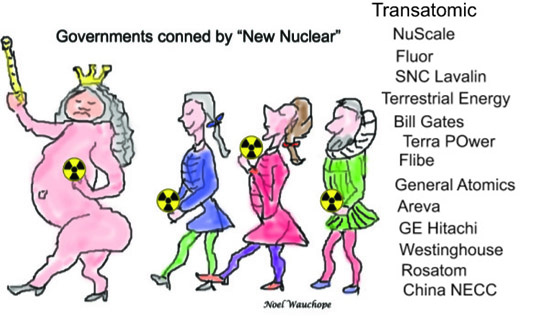
CANADA. Canada’s Small Modular Nuclear Reactor ‘Action Plan’ banks on private sector nuclear pipe dreams. NuScale exultant that their scam small nuclear reactors have conned the Canadian government. Many Canadian organisations dispute the government’s plan for small nuclear reactors.
JAPAN.
75% of the Japanese public want Japan to join the Treaty on the Prohibition of Nuclear Weapons. Major Japan life insurers shun investing in nuclear weapons-linked firms.
Uninhabitable: Booklet by citizen scientists uncovers true extent of radioactive contamination in Japan’s soil and food.
2 million yen ($19,300) incentive for families to move to near crippled Fukushima No. 1 nuclear power plant.
Investigation of mass alterations of data on nuclear safety by Japanese company.
Mutsu Mayor Soichiro Miyashita made it clear that spent nuclear fuel facility will not go ahead. 44 year old Mihama nuclear station, with waste disposal problem may be allowed to restart. Nuclear waste plan spells doom for a Hokkaido fishing community.
UK.
- Law and Disorder: The case of Julian Assange.
- Disabled Russian nuclear-powered feighter to pass through UK and European waters.
- Sizewell C nuclear project. No “green light” for £20bn Sizewell nuclear project, but the UK govt “in talks” with EDF. UK’s Sizewell nuclear project could be a costly fiasco like Hinkley Point C. Controversial funding arrangements for unnecessary Sizewell C nuclear project? Why is UK govt taking the financial and flooding risk of Sizewell nuclear, when renewables are clearly safer and cheaper?. Ipswich Council raises fresh worries about Sizewell nuclear power plan. Sizewell C nuclear plan – a disastrous and expensive mistake. EDF did a small survey of Suffolk community opinion –weighted to favour nuclear industry?
- Doubts about planned Berkshire ”garden town”, because it’s too close to AWE nuclear weapons factory.
USA.
- Investigative journalism – A Legacy of Contamination, How the Kingston coal ash spill unearthed a nuclear nightmare.
- Investigative journalism – USA government resists paying compensation to nuclear workers made ill by ionising radiation.
- For the USA, despite the “Green Nuclear Deal” propaganda, solar power is looking a whole lot better.
- David and Goliath fight to repeal crooked nuclear plant bailouts in Ohio. Following huge bribery scandal, Energy Harbor still manipulating to keep nuclear bailout law.
- Is Energy Harbor cutting nuclear plant workers’ benefits in violation of labor deal?
- USA House Armed Servcies Chairman very sceptical of New Plutonium “Pit” Plans for Nuclear Warheads.
- Russian hackers evaded layers of U.S. security to attack America’s military and intelligence agencies. In a massive cyber-attack, U.S. nuclear agency has been hacked. Hacking of U.S. nuclear weapons agency went undetected for 9 months. 6 Things to Know about the 2020 Cyberattack and Nuclear Power Plants.
- In midst of pandemic crisis, more U.S. tax-payer money to go to nuclear power in space. USA to turn the moon into a nuclear weapons site.
CHINA. China has 350 nuclear warheads, compared to USA and Russia’s many thousands of them.
RUSSIA. Russian environmental defenders under attack.
IRAN. World powers renew commitment to preserve Iran nuclear deal. Iran’s Rouhani: No conditions or negotiations on nuclear deal. Iran builds at underground nuclear plant. Iran Rejects New UN Report over Nuclear Violations. West yet to condemn Iranian nuclear scientist’s assassination.
US Navy nuclear-powered guided-missile submarine and 2 warships sail through Strait of Hormuz, (Persian Gulf-Gulf of Oman).
EUROPE. European Leadership Network appeals to nuclear weapons States to reduce nuclear risks.
UKRAINE. 34 years later, food crops near Chernobyl still contain ionising radiation.
TURKEY. Turkey’s unfinished nuclear plant already redundant.
DENMARK. Big boasts for small nuclear reactors on ships – but are they a recipe for disaster?
JORDAN. Did a research reactor in Jordan leak?
Small Nuclear Reactor unicorns for Canada

Canada’s SMR ‘Action Plan’ banks on private sector nuclear pipe dreams, Burgess Langshaw-Power / December 21, 2020 For many kids who grew up in the 1980s and 1990s, Star Trek was a big part of our childhoods. The series is filled with strange new worlds, futurist politics, and advanced technology that is almost indistinguishable from magic. Yet even as a child I knew the show was a work of science fiction. Warp speed, transporters and phasers were all gadgets I could comprehend, but in my rational mind I knew they would never exist within my lifetime.
Unfortunately, recent announcements by Canada’s Natural Resources Minister Seamus O’Regan—a self-professed fan of science fiction—demonstrate that the government has yet to arrive at the same conclusion I did as a kid watching Star Trek.
On December 18, the Trudeau government launched Canada’s Small Modular Reactor (SMR) Action Plan, to great fanfare. This new action plan builds on the 2018 SMR Roadmap, which made the promise that, “SMRs are a re-scaling and repurposing of nuclear technology for wider markets. They represent a paradigm shift for nuclear reactor technology—analogous to the shift of steam engines from mineshafts into ships and vehicles, or the movement of computers from mainframe to desktop and then to laptop.”
This idea of a paradigm shift channels Star Trek-level aspirations, yet the new Action Plan is significantly more hesitant: “Small modular reactors (SMRs) could be a source of clean, safe and affordable energy, opening opportunities for a resilient, low-carbon future and capturing benefits for Canada and Canadians while supporting reconciliation with Indigenous peoples as essential enabling partners.”
In just two years, from the launch of the Roadmap to the announcement of the Action Plan, the government has gone from a paradigm shift to the possibility that SMRs could be a source of clean energy. It’s as though there is something else about SMRs that the government doesn’t want us to consider in more depth.
Before we go any further, what are SMRs, anyway? Well, it turns out that’s a very good question. In fact, the Globe and Mail notes that “SMR lacks a universally agreed definition, and the Canadian Nuclear Safety Commission regards it as a marketing rather than a technical term.” In other words, SMRs are a group of many different technologies, none of which have actually been proven or tested, with only one project proposed and no timeframe for its realization. None of the technologies currently under consideration have solved any major issues with nuclear energy, including the problem of high-level radioactive waste management, however some are less likely to have meltdown-like events and cannot produce isotopes for creating weapons.
The Statement of Principles section of the Action Plan notes that, “Markets around the globe are signalling a need for smaller, simpler, and cheaper nuclear energy.” However, there is simply no evidence to support this claim. In fact, the polar opposite is true, with many major governments and large corporations exiting the nuclear sector entirely. Meanwhile, German experts have stated that, “SMRs are always going to be more expensive than bigger reactors due to lower power output at constant fixed costs, as safety measures and staffing requirements do not vary greatly compared to conventional reactors.”
The British press is even more blunt about the prospects of a more ‘tactile’ nuclear future: “There is no commercial case for giant new reactors in any developed country. They cannot meet post-Chernobyl and post-Fukushima safety demands at viable cost and have been priced out of the global energy market. Precipitous falls in renewable costs over the last five years have rendered the technology effectively obsolete in the West.”
This doesn’t sound like a bold future to me………..
The theory is that SMRs will be cheaper and safer than conventional nuclear reactors. Again, German experts disagree on the cost front. In terms of levelized energy costs, says Nicolas Wendler of industry association Nuclear Technology Germany (KernD), SMRs will always be more expensive than big plants. Moreover, he says, “nuclear power plant owners have repeatedly rejected the idea that the nuclear exit be reversed, arguing the technology is no longer economically viable anyway.”
In the United States, some nuclear plants are being decommissioned early, while other projects are being cancelled at a huge financial loss. Why? They aren’t competitive. This does not even account for the fact that we have yet to successfully build even a single SMR. Yet, if we were to, how much would they cost? The record for delays and cost overruns in Canada is not positive, and nuclear facilities have an unusually poor record in this regard. After 1970, the average nuclear facility saw cost overruns exceed 241 percent (not including the added burden of construction delays).
This does not even begin to address the costs and hazards associated with cleaning up nuclear sites, such as expensive remediation projects now underway in the US and the UK. Perhaps unsurprisingly, these failures and cost overruns sound a lot like the last major federal investment in the energy sector—the Trans Mountain pipeline fiasco.
There is no doubt Canada will need new energy sources for our clean energy transition to address the climate crisis. The Government of Canada claims, “At the same time, international experts are telling us that new nuclear energy, together with the full range of low-carbon technologies, are needed to combat global climate change and meet federal, provincial and territorial emissions targets for 2030 and 2050.”
However, international examples do not inspire confidence that nuclear needs to be a part of this solution. Germany is close to achieving half its energy supply from renewables excluding nuclear. In the UK, some estimates show that not including nuclear energy in the mix will save hundreds of millions of pounds and that the only justification for pursuing nuclear energy in the UK or France is to support a nuclear military strategy (which Canada obviously does not have).
At least the UK is putting its money where its mouth is, with over half a billion pounds invested into nuclear, while Canada’s new SMR Action plan includes precisely $0 of investment, as opposed to our new federal hydrogen strategy, which received $1.5 billion.
Why would we choose nuclear over other cheaper and readily available renewable technologies? It is true that there are still major flaws with renewables, but given that most SMRs are a decade away (at least), and the cost of solar has already dropped 89 percent in the last decade, it seems unlikely that SMRs—whenever they are ready—will be competitive.
One of the theoretical selling points is the deployment of SMRs in rural and remote communities to replace diesel. Yet, many Indigenous and northern communities have expressed trepidation towards SMRs dotting their territory, and are building solar arrays instead. Another argument is that SMRs could be used for industrial facilities such as those in the mining sector, or the Alberta oil sands (this was a terrible idea in the past, and its terrible idea now). However, others suggest that SMRs are only capable of, “ticking off the Financial and Consumer Services Commission’s checklist on how to spot a scam.”
Canada’s SMR Action Plan is nothing more than science fiction: idle dreams of an indefinite group of technologies which may be ready in a decade, with no financial support or investment by the government. In the meantime, renewable energy continues to leap ahead, mostly without any federal support.
One can only imagine how government investment, if effectively pursued, could push our renewable energy potential by the time the first SMRs are ready for deployment. Given these considerations, perhaps the reason this “Action Plan” is so empty, is that the federal government is in fact aware of how little potential SMRs hold. Like nuclear fusion, maybe SMRs will always be just around the corner. In which case, why bother launching this plan at all? Let’s save our time and investment for renewable energy projects that have viability today, not somewhere down the road.
Burgess Langshaw-Power is a former policy analyst currently completing his PhD in Global Governance at the Balsillie School, University of Waterloo. His policy expertise includes energy technologies, regulatory approvals, climate change, and energy infrastructure. Views expressed here are his own and not necessarily those of his employer. https://canadiandimension.com/articles/view/canadas-smr-action-plan-banks-on-private-sector-nuclear-pipe-dreams
1 This Month

Chernobyl: The Lost Tapes – A good documentary on Chernobyl on SBS available On Demand for the next 3 weeks– https://www.sbs.com.au/ondemand/tv-program/chernobyl-the-lost-tapes/2352741955560

of the week–London Campaign for Nuclear Disarmament

Tell the Ukrainian Government to Drop Prosecution of Peace Activist Yurii Sheliazhenko
To see nuclear-related stories in greater depth and intensity – go to https://nuclearinformation.wordpress.com
-
Archives
- April 2026 (173)
- March 2026 (251)
- February 2026 (268)
- January 2026 (308)
- December 2025 (358)
- November 2025 (359)
- October 2025 (376)
- September 2025 (257)
- August 2025 (319)
- July 2025 (230)
- June 2025 (348)
- May 2025 (261)
-
Categories
- 1
- 1 NUCLEAR ISSUES
- business and costs
- climate change
- culture and arts
- ENERGY
- environment
- health
- history
- indigenous issues
- Legal
- marketing of nuclear
- media
- opposition to nuclear
- PERSONAL STORIES
- politics
- politics international
- Religion and ethics
- safety
- secrets,lies and civil liberties
- spinbuster
- technology
- Uranium
- wastes
- weapons and war
- Women
- 2 WORLD
- ACTION
- AFRICA
- Atrocities
- AUSTRALIA
- Christina's notes
- Christina's themes
- culture and arts
- Events
- Fuk 2022
- Fuk 2023
- Fukushima 2017
- Fukushima 2018
- fukushima 2019
- Fukushima 2020
- Fukushima 2021
- general
- global warming
- Humour (God we need it)
- Nuclear
- RARE EARTHS
- Reference
- resources – print
- Resources -audiovicual
- Weekly Newsletter
- World
- World Nuclear
- YouTube
-
RSS
Entries RSS
Comments RSS
 nuclear-news