“Mutual admiration society” -between civilian and military nuclear experts
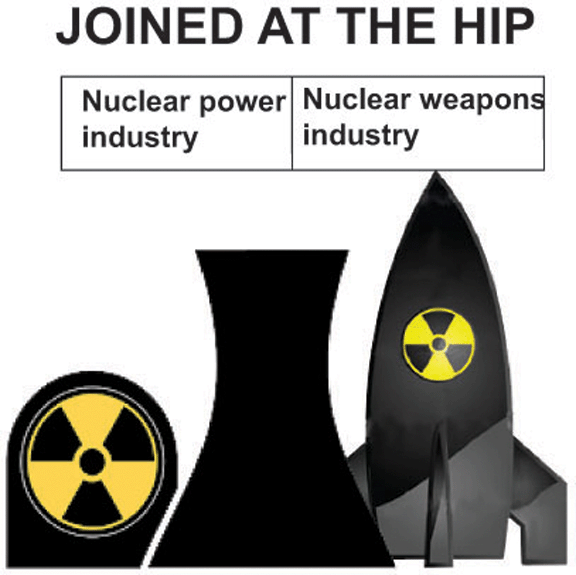 Civilian nuclear and military nuclear members of a “mutual admiration society” ~
  Dr. Gordon Edwards, https://concernedcitizens.net/2020/12/19/civilian-nuclear-and-military-nuclear-members-of-a-mutual-admiration-society/ Dr. Gordon Edwards, President of the Canadian Coalition for Nuclear Responsibility, December 19, 2020
Civilian nuclear and military nuclear have always been friendly room-mates, members of a “mutual admiration” society. In today’s announcement of an SMR Action Plan, Natural Resources Minister Seamus O’Regan said that nuclear power in Canada is a “home-grown” technology and referred to C. D. Howe’s role in this connection. In fact C.D. Howe arranged for all Canadian uranium extracted from Canadian mines to be sold to the US military for use in tens of thousands of nuclear weapons from 1945 to 1965. C D Howe was also on the Committee that met in Washington DC in 1944 to approve the first nuclear reactors to be built in Canada (at Chalk River) as part of the ongoing effort to produce plutonium for use as a nuclear explosive. Mr. Howe approved of the policy of selling plutonium produced at Chalk River to the US military for weapons use, a practice that continued until 1975 and beyond. Plutonium from Chalk River was sent to Britain (it was the first sample of plutonium that Britain had ever obtained) just a few months before Britain detonated its first A-Bomb in the Monte Bello Islands off Australia.
To the best of my knowledge, no civilian nuclear power agency – not the Canadian Nuclear Association, nor the Canadian Nuclear Society, nor the Canadian Nuclear Safety Commission, nor Atomic Energy of Canada Limited, nor Canadian Nuclear Laboratories, NOBODY – has ever issued a clear statement denouncing nuclear weapons or even calling for a nuclear weapons free world. Most nuclear scientists and engineers feel a strong kinship and camaraderie with those who are in the nuclear weapons business. The same goes for those in the nuclear division of Natural Resources Canada. I remember on one occasion (prior to the exchange of nuclear tests between India and Pakistan) I expressed alarm at the fact that both neighbours are developing a nuclear war-fighting capability and a couple of senior civil servants said “Would that be so bad? Maybe that’s just what the world needs. More deterrence. Creates stability”
Despite regular denials from our puppet masters that civilian nuclear has nothing to do with military nuclear, it is clear that civilian nuclear (including the frankly discriminatory provisions of the NPT) has adopted an appeasement policy that will never succeed in bringing about a nuclear weapons free world. Why does Canada continue to sell uranium to countries that are in the process of investing hundreds of billions to improve and modernize the nuclear arsenals in utter defiance of the NPT, knowing that the vast bulk of Canadian uranium that is rejected from enrichment plants as DU end up as the raw material for producing plutonium for Bombs, and that the lion’s share of the explosive power – and the overwhelming share of the radioactive fallout – of every H-bomb comes from the fissioning of DU atoms that are freely accessed by the military even if they are the leftovers of “peaceful” fuel production for nuclear power plants?
“See ‘The Nuclear Fudge’ at https://www.youtube.com/watch?v=0lK65S5eHRQ&feature=youtu.be“. This 16-minute W5 segment from the Regan era is very informative.
75% of the Japanese public want Japan to join the Treaty on the Prohibition of Nuclear Weapons
 Japanese Public Opinion, Political Persuasion, and the Treaty on the Prohibition of Nuclear Weapons, Taylor Francis Online, Jonathon Baronb,Rebecca Davis Gibbons &Stephen Herzog– 21 Dec 20, Japanese Public Opinion, Political Persuasion, and the Treaty on the Prohibition of Nuclear Weapons, Taylor Francis Online, Jonathon Baronb,Rebecca Davis Gibbons &Stephen Herzog– 21 Dec 20, ABSTRACT
The Treaty on the Prohibition of Nuclear Weapons (TPNW) poses a challenge to decades of Japanese nuclear policy. While Japan has relied on the US nuclear umbrella since the aftermath of World War II, numerous pro-disarmament groups – including the Hibakusha – are calling for Tokyo to join the Treaty. We contribute to these discussions with commentary on a new national survey we conducted in Japan (N = 1,333). Our results indicate that baseline support for the Prime Minister signing and the Diet ratifying the TPNW stands at approximately 75% of the Japanese public. Only 17.7% of the population is opposed, and 7.3% is undecided. Moreover, this support is cross-cutting, with a wide majority of every demographic group in the country favoring nuclear disarmament. Most strikingly, an embedded survey experiment demonstrates that the Japanese government cannot shift public opinion to oppose the Ban through the use of policy arguments or social pressure. Such broad support for the TPNW indicates that the Japanese government will not be able to hide from the Treaty and must take action to restore its credibility as a leader on nuclear disarmament………… https://www.tandfonline.com/doi/full/10.1080/25751654.2020.1834961?src=& |
|
US Navy nuclear-powered guided-missile submarine and 2 warships sail through Strait of Hormuz, (Persian Gulf-Gulf of Oman)
|
“The nuclear-power Ohio-class guided-missile submarine USS Georgia (SSGN 729), along with the guided-missile cruisers USS Port Royal (CG 73) and USS Philippine Sea (CG 58), transited the Strait of Hormuz entering the Arabian Gulf, Dec. 21,” the Navy said in a statement using an alternative name for the Persian Gulf.
The vessels’ entrance into the area comes amid heightened tensions with Iran, with Secretary of State Mike Pompeo blaming Iranian backed militias for a rocket attack on the US Embassy compound in Baghdad, on Sunday.
Some US officials have expressed concern that Iran may use the anniversary of the killing of General Qasem Solemani to carry out a strike on the US.
The US Navy rarely discusses the movement of its submarines, but Monday’s announcement also included details on the vessel’s capabilities, including its “ability to carry up to 154 Tomahawk land-attack cruise missiles.”……………… https://edition.cnn.com/2020/12/21/politics/us-nuclear-sub-hormuz/index.html
|
|

Following huge bribery scandal, Energy Harbor still manipulating to keep nuclear bailout law
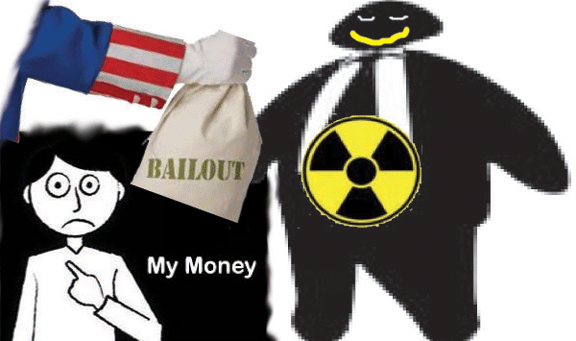 Energy Harbor seeks option of turning down HB6 nuclear bailout money, Cleveland.com Dec 21, 2020; Ohio. Energy Harbor is lobbying for Ohio lawmakers to let it choose whether it should be eligible for House Bill 6 nuclear bailout money,
COLUMBUS, Ohio—Energy Harbor is lobbying for state lawmakers to allow it to decide whether to accept more than $1 billion in House Bill 6 bailout money for its two nuclear power plants because a federal regulatory ruling might otherwise make the subsidies a liability, according to a top lawmaker.
It’s still unclear whether legislators will agree to the proposal, which is being crafted by House Majority Leader Bill Seitz, or whether they will pass any reforms to HB6 at all on Tuesday, expected to be the final day of the current legislative session.But it shows that Energy Harbor, a former subsidiary of FirstEnergy, is working behind the scenes to influence what reforms might be made to HB6, which is at the center of what authorities say is the largest bribery scheme in Ohio history. Federal authorities say $60 million in FirstEnergy bribery money was used to pass the law and keep it on the books.
Under the 2019 law, Energy Harbor’s Davis-Besse and Perry nuclear power plants are set to get $150 million per year from ratepayers from 2021 until 2027. Energy Harbor officials have said without the bailout, they will have to close the plants, though they’ve offered no financial data to back their claims.
But after the HB6 scandal broke last summer, GOP lawmakers have been working on possible changes to the law — including requiring yearly audits to see how much money the nuclear plants need to break even, then adjusting accordingly the amount of subsidies paid to Energy Harbor.
House and Senate leaders are still working to craft an HB6 reform plan that has the votes to pass both chambers. The main reform plan, House Bill 798, would delay the start of the bailout until 2022 to provide time for an audit to be conducted.
When asked whether lawmakers were close to a deal, Seitz said, “That’s kind of above my pay grade.”
“Energy Harbor is a corporation under investigation for orchestrating the largest bribery scandal in Ohio history,” Leland said, “and now Republicans want to let it decide whether to take $1.3 billion straight out of the pockets of everyday Ohioans.” https://www.cleveland.com/open/2020/12/energy-harbor-seeks-option-of-turning-down-hb6-nuclear-bailout-money.html
Major Japan life insurers shun investing in nuclear weapons-linked firms
 Major Japan life insurers shun investing in nuclear weapons-linked firms, https://www.japantimes.co.jp/news/2020/12/14/national/major-japan-life-insurers-investing-nuclear-weapons-linked-firms/ 14 Dec 20, Four major Japanese life insurers do not invest in or extend loans to producers of nuclear weapons or companies related to them, Kyodo News learned Saturday, as part of their efforts toward socially responsible investing.The revelation comes as various lenders in Japan, Europe and the United States have refrained from investing in companies involved in the nuclear weapons industry.It also precedes the entry into force in January of a United Nations treaty that will ban such weapons. Major Japan life insurers shun investing in nuclear weapons-linked firms, https://www.japantimes.co.jp/news/2020/12/14/national/major-japan-life-insurers-investing-nuclear-weapons-linked-firms/ 14 Dec 20, Four major Japanese life insurers do not invest in or extend loans to producers of nuclear weapons or companies related to them, Kyodo News learned Saturday, as part of their efforts toward socially responsible investing.The revelation comes as various lenders in Japan, Europe and the United States have refrained from investing in companies involved in the nuclear weapons industry.It also precedes the entry into force in January of a United Nations treaty that will ban such weapons.
The four life insurers which managed a combined ¥151 trillion in assets in fiscal 2019 — Nippon Life Insurance Co., Dai-ichi Life Insurance Co., Meiji Yasuda Life Insurance Co. and Fukoku Mutual Life Insurance Co. — did not disclose lists of targeted companies. The restraint shown by the life insurers reflects a growing trend toward valuing environmental, social and governance (ESG) factors in making investment decisions. It is believed that such investing strategies will give a boost to the advancement of green technologies while cutting funding for developing nuclear weapons. Three of the insurers, with Nippon Life being an exception, say they do not invest in companies involved in the maintenance of nuclear warheads or manufacturing of ballistic missiles, in addition to those making nuclear weapons. According to PAX, an international nongovernmental organization for peace, U.S. Lockheed Martin Corp., which develops the long-range Minuteman intercontinental ballistic missile, is among such companies. More than 300 lenders including major Japanese banks invested a total of $748 billion in companies involved in the nuclear weapons industry between January 2017 and January 2019, according to the NGO. In April, Dai-ichi Life published a basic policy that excludes weapons producers from its portfolio. The company told Kyodo News that companies linked to nuclear weapons raise concerns from the viewpoint of ESG. Meiji Yasuda said it does not invest in or extend loans to companies that are found to have links to nuclear and other inhumane weapons based on undisclosed internal rules. Categorizing companies related to nuclear weapons as “socially problematic,” Fukoku has excluded them from its investible universe in line with its own guidelines adopted in February 2019. Nippon Life, meanwhile, said it does not invest in shares or bonds of nuclear weapons producers. The Treaty on the Prohibition of Nuclear Weapons will become the first international pact outlawing the development, testing, possession and use of nuclear weapons, though the world’s major nuclear powers have not joined it. Japan, the only country to have suffered a nuclear attack, has not taken part, to the disappointment of many atomic bomb survivors in Hiroshima and Nagasaki, as it is protected under the U.S. nuclear umbrella. Sumitomo Life Insurance Co., which does not have guidelines on investing in nuclear weapons companies, said it will consider exercising restraint as investing in such companies would hurt its reputation once the nuclear ban treaty takes effect. |
|
World powers renew commitment to preserve Iran nuclear deal
Remaining parties to landmark 2015 deal reaffirm commitment as Iran’s nuclear programme’s chief slams a Parliament bill. Aljazeera, Maziar Motamedi, 21 Dec 2020, Tehran, Iran – The remaining parties to a landmark nuclear deal they signed with Iran in 2015 have renewed their commitment to preserving the accord in an online meeting.
The foreign ministers of Iran, Germany, France, the United Kingdom, China and Russia participated in a two-hour meeting chaired by the European Union’s foreign policy chief, Josep Borrell, on Monday.
In a tweet before the meeting, Borrell said the aim is to “re-emphasise our commitment to preserve” the Joint Comprehensive Plan of Action (JCPOA), as the nuclear deal is formally known.
A joint statement following the meeting said the ministers “discussed that full and effective implementation of the JCPOA by all remains crucial and discussed the need to address ongoing implementation challenges, including on nuclear non-proliferation and sanctions lifting commitments”.
The foreign ministers recognised the deal, enshrined in Resolution 2231 of the United Nations Security Council, as a “key element” in the global non-proliferation regime and a diplomatic achievement contributing to regional and international peace……..
US President-elect Joe Biden has promised to bring his country back into the deal and lift sanctions but has hinted that more negotiations are needed on Iran’s missiles programme and regional influence.
The European signatories of the nuclear deal have also made similar remarks, but Iran has categorically rejected any further negotiations, saying the nuclear deal must be implemented as negotiated and signed in 2015…………….. https://www.aljazeera.com/news/2020/12/21/world-powers-renew-commitment-to-preserve-iran-nuclear-deal
Unveiling New Billboards: “Nukes Are Now Illegal!” — limitless life
Unveiling New Peace Billboards We’re thrilled to announce a new series of billboards to be unveiled across multiple cities. Launched on or around January 22, 2021, the billboards based on the images below will celebrate and amplify the historic importance of the UN Treaty on the Prohibition of Nuclear Weapons entering into force. Here’s one going […]
Unveiling New Billboards: “Nukes Are Now Illegal!” — limitless life
The real reason for “civil” Small Nuclear Reactors- to supply expertise and technology for the nuclear weapons industry
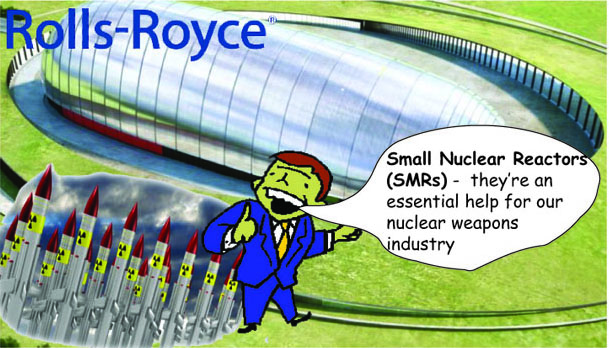
 How investment in SMRs supports “defense nuclear programs” https://concernedcitizens.net/2020/12/19/how-investment-in-smrs-supports-defense-nuclear-programs/comment-page-1/?unapproved=2198&moderation-hash=3219adce054494626a5ee71e323fef71#comment-2198 How investment in SMRs supports “defense nuclear programs” https://concernedcitizens.net/2020/12/19/how-investment-in-smrs-supports-defense-nuclear-programs/comment-page-1/?unapproved=2198&moderation-hash=3219adce054494626a5ee71e323fef71#comment-2198
1. Rolls-Royce, 2017, ‘UK SMR: A National Endeavour’, https://www.uknuclearsmr.org/wp-content/uploads/2017/09/V2088-Rolls-Royc… “The indigenous UK supply chain that supports defence nuclear programmes requires significant ongoing support to retain talent and develop and maintain capability between major programmes. Opportunities for the supply chain to invest in new capability are restricted by the limited size and scope of the defence nuclear programme. A UK SMR programme would increase the security, size and scope of opportunities for the UK supply chain significantly, enabling long-term sustainable investment in people, technology and capability. “Expanding the talent pool from which defence nuclear programmes can draw from would bring a double benefit. First, additional talent means more competition for senior technical and managerial positions, driving excellence and performance. Second, the expansion of a nuclear-capable skilled workforce through a civil nuclear UK SMR programme would relieve the Ministry of Defence of the burden of developing and retaining skills and capability. This would free up valuable resources for other investments.” |
|
Russian environmental defenders under attack
For future updates follow RSEU on facebook.
For more information contact:
Vitaly Servetnik,
Russian Social-Ecological Union / Friends of the Earth Russia
Email: vitservetnik@gmail.com
Program Area: Environmental Human Rights Defenders
Member Group: Russian Social Ecological Union (RSEU)
USA to turn the moon into a nuclear weapons site
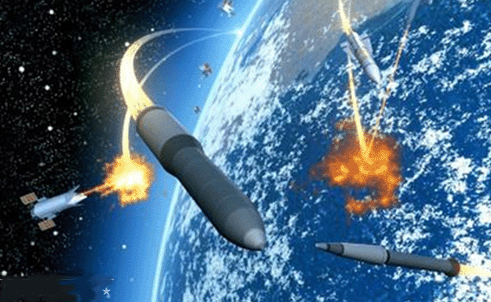 US to turn moon into ‘nuclear weapons site’ US to turn moon into ‘nuclear weapons site’
By Huang Lanlan Source: Global Times: 2020/12/18, The US ambition to build a nuclear power plant on the moon by 2027, which may contribute to future lunar military projects, shows it seeks space supremacy regardless of the damage and dangers it may cause to people, Chinese experts on military and international relations said.
Establishing a nuclear power plant on the moon by the end of 2027 was included in a number of specific goals in a memorandum signed by US President Donald Trump on Wednesday, which is known as Space Policy Directive 6 (SPD-6). The plant would “support a sustained lunar presence and exploration of Mars,” SPD-6 said. Military purposes are likely to be behind the establishment, Chinese military expert and commentator Song Zhongping said. By setting up a nuclear power plant, which includes exploiting nuclear materials and building equipment like nuclear reactors and uranium enrichment facilities, the US can theoretically turn the moon “into a production site of nuclear weapons,” Song told the Global Times Friday. The moon is rich in helium-3, a material that could be used as fuel to produce energy by nuclear fusion, Song said. In the name of building a nuclear power plant, the US may directly exploit this material on the moon and then construct nuclear fuel-processing plants there, he said. The plan once again shows American unilateralism in space, which runs counter to the will of the international community in terms of lunar issues, Li Haidong, a professor at the Institute of International Relations of the China Foreign Affairs University, said………. As Chang’e-5 successfully completed its lunar trip on Thursday, the signing of SPD-6 also shows the US’ intention of dragging China into a space race, trying to divert China’s attention to an endless consumption of national resources for the race from improving its economy and people’s livelihood, Li said. This is similar to what the US did to the Soviet Union in the 1980s under Ronald Reagan’s “Star Wars” program, he noted.
Its goal of building a lunar nuclear power plant, nonetheless, may hardly be achieved on time by 2027 as the US is stuck in domestic trouble and chaos, such as the ongoing COVID-19 pandemic, Li said. https://www.globaltimes.cn/content/1210357.shtml |
|
Uninhabitable — Beyond Nuclear International

Citizens’ radioactivity measurements reveal true extent of contamination in Japan
Uninhabitable — Beyond Nuclear International
Did a research reactor in Jordan leak? — Beyond Nuclear International

A simple Facebook reposting could cost one man his freedom
Did a research reactor in Jordan leak? — Beyond Nuclear International
Many Canadian organisations dispute the government’s plan for small nuclear reactors
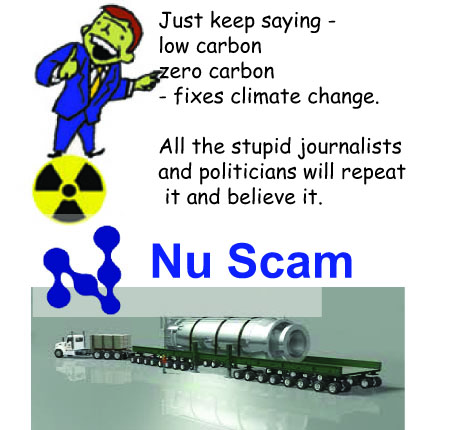 Feds throw support behind development of mini nuclear reactors; action plan released, Saskatoon / 650 CKOM Feds throw support behind development of mini nuclear reactors; action plan released, Saskatoon / 650 CKOMThe Canadian PressDec 18, 2020 “……. Among steps in the plan is developing prototypes and demonstration models.,,,,,
Dozens of groups, including opposition parties, some Indigenous organizations and environmentalists, want the government to fight climate change by investing more in renewable energy and energy efficiency rather than in the new reactors. They argue nuclear energy costs far too much money and is far from clean given the growing mound of radioactive waste it generates. O’Regan said the government is actively trying to figure out what do with the dangerous material….. The federal government estimates the global market for SMRs will be worth between $150 billion and $300 billion a year by 2040 but critics question the validity of the estimate. They also wonder who exactly might want one. …https://www.ckom.com/2020/12/18/feds-throw-support-behind-development-of-mini-nuclear-reactors/ |
|
2 million yen ($19,300) incentive for families to move to near crippled Fukushima No. 1 nuclear power plant
|
Under the program that will start in fiscal 2021, the Reconstruction Agency will provide an additional amount of up to 4 million yen to those who start new businesses in 12 cities, towns and villages where residents had been ordered to evacuate from after the triple meltdown at the plant. Eleven of those municipalities had come under the central government’s evacuation order, while in the remaining municipality, Hironomachi, residents were ordered to leave by the town government. Katsuei Hirasawa, the reconstruction minister, said on Dec. 17 that his agency is focused on repopulating those areas because only around 20 percent of residents have returned there even after the evacuation orders were lifted. One requirement is that the families must live in the locations for at least five years. The agency will provide 1.2 million yen to families that relocate to the 12 areas from other parts of Fukushima Prefecture and 2 million yen to those from other prefectures. The amount is 800,000 yen for single-person households that relocate from other areas of the prefecture and 1.2 million yen for those from outside the prefecture. …….. http://www.asahi.com/ajw/articles/14031389 |
|


For the USA, despite the “Green Nuclear Deal” propaganda, solar power islooking a whole lot better.
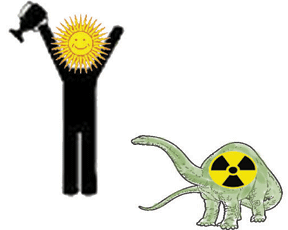 Nuclear vs Solar: The Race For Renewable Dominance , Oil Price By Alex Kimani – Nov 11, 2020
“……….. the main sticking point to the promotion of thorium as a cleaner nuclear fuel is that it remains unproven on a commercial scale. Thorium MSRs (Molten Salt Reactors) have been in development since the 1960s by the United States, China, Russia, and France, yet nothing much ever came of them. Further, only about 50 of the world’s 440 reactors can currently be configured to run on thorium.
…… Unfortunately, practical nuclear fusion remains a long-shot and could be decades away from becoming a commercial reality.
We simply don’t have the luxury of time.
Further, nuclear power in the U.S. faces an uncertain future. ……………
Solar rising
Whereas the nuclear sector comeback has its work cut out for it, solar power has clearly been on the ascendancy thanks in large part to falling costs.
Nuclear advocates have pointed to rising electricity costs in California as the reason why other states should think twice before adopting its model. Environmental Progress has reported that between 2011 and 2018, power costs in the Golden State increased by 27.9% compared to a 4% national average. This period coincided with a period when California has been aggressively ramping up its renewable generation capacity. Renewable sources currently account for ~30% of California’s electricity generation with an aim to double that by 2030 and hit 100% by 2045.
But that’s being a bit disingenuous because it fails to capture just how much solar costs have fallen over the timeframe.
According to the Solar Energy Industries Association (SEIA), solar installation costs have dropped by more than 70% over the past decade, opening up vast new markets and systems nationwide. The organization says prices as of Q2 2020 dropped to their lowest levels in history across all market segments, with utility-scale prices ranging from $16/MWh – $35/MWh, thus making it competitive with all other forms of generation. Meanwhile, costs for the average-sized residential system were cut in half from a pre-incentive price of $40,000 in 2010 to roughly $20,000 today.
And no, renewables are not to blame for California’s blackouts.
……………..Strongly Bullish
Despite these challenges, the solar sector remains strongly bullish.
Indeed, S&P Platts says that the shift to renewable energy is likely to continue full steam ahead regardless of fed policies noting that the energy transition has “clearly been moving forward on a regional basis,” despite lacking clear endorsement at the federal level under Trump.
It remains to be seen whether nuclear energy can command the same level of support. https://oilprice.com/Alternative-Energy/Nuclear-Power/Nuclear-vs-Solar-The-Race-For-Renewable-Dominance.html
1 This Month
Chernobyl: The Lost Tapes – A good documentary on Chernobyl on SBS available On Demand for the next 3 weeks– https://www.sbs.com.au/ondemand/tv-program/chernobyl-the-lost-tapes/2352741955560

of the week–London Campaign for Nuclear Disarmament

Tell the Ukrainian Government to Drop Prosecution of Peace Activist Yurii Sheliazhenko
To see nuclear-related stories in greater depth and intensity – go to https://nuclearinformation.wordpress.com
-
Archives
- April 2026 (173)
- March 2026 (251)
- February 2026 (268)
- January 2026 (308)
- December 2025 (358)
- November 2025 (359)
- October 2025 (376)
- September 2025 (257)
- August 2025 (319)
- July 2025 (230)
- June 2025 (348)
- May 2025 (261)
-
Categories
- 1
- 1 NUCLEAR ISSUES
- business and costs
- climate change
- culture and arts
- ENERGY
- environment
- health
- history
- indigenous issues
- Legal
- marketing of nuclear
- media
- opposition to nuclear
- PERSONAL STORIES
- politics
- politics international
- Religion and ethics
- safety
- secrets,lies and civil liberties
- spinbuster
- technology
- Uranium
- wastes
- weapons and war
- Women
- 2 WORLD
- ACTION
- AFRICA
- Atrocities
- AUSTRALIA
- Christina's notes
- Christina's themes
- culture and arts
- Events
- Fuk 2022
- Fuk 2023
- Fukushima 2017
- Fukushima 2018
- fukushima 2019
- Fukushima 2020
- Fukushima 2021
- general
- global warming
- Humour (God we need it)
- Nuclear
- RARE EARTHS
- Reference
- resources – print
- Resources -audiovicual
- Weekly Newsletter
- World
- World Nuclear
- YouTube
-
RSS
Entries RSS
Comments RSS
 nuclear-news