U.S. Dept of Energy pouring $millions into new nuclear gimmicks
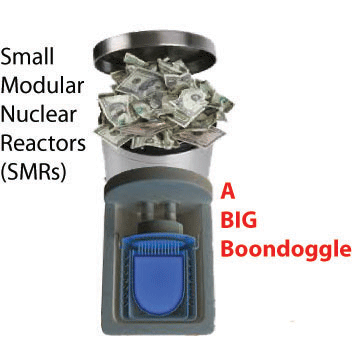 DOE selects advanced reactor concepts for funding https://www.world-nuclear-news.org/Articles/DOE-selects-advanced-reactor-concepts-for-funding, 23 December 2020
DOE expects to invest about USD600 million over the next seven years in ARDP, which aims to help domestic private industry demonstrate advanced nuclear reactors in the USA.
The department issued an ARDP funding opportunity announcement in May this year, which included the ARC-20 awards, the Advanced Reactor Demonstration awards, and the Risk Reduction for Future Demonstration awards. For the ARC-20 projects, DOE expects to invest a total of about USD56 million over four years with its industry partners providing at least 20% in matching funds. The goal of the ARC-20 programme is to assist the progression of advanced reactor designs in their earliest phases.
DOE yesterday announced the selection of three US-based teams to receive ARC-20 funding. These are:
- Inherently Safe Advanced SMR for American Nuclear Leadership. Advanced Reactor Concepts will deliver a conceptual design of a seismically isolated advanced sodium-cooled reactor facility that builds upon the initial pre-conceptual design of a 100 MWe reactor facility. The total award value over three-and-a-half years is USD34.4 million, with the DOE’s share being USD27.5 million.
- Fast Modular Reactor Conceptual Design. General Atomics will develop a fast modular reactor conceptual design with verifications of key metrics in fuel, safety and operational performance. The design will be for a 50 MWe fast modular reactor. Total award value over three years is USD31.1 million (DOE share is USD24.8 million).
- Horizontal Compact High Temperature Gas Reactor. Massachusetts Institute of Technology will mature the Modular Integrated Gas-Cooled High-Temperature Reactor (MIGHTR) concept from a pre-conceptual stage to a conceptual stage to support commercialisation. The total award value over three years is USD4.9 million (DOE cost share is USD3.9 million)………..
On 16 December, DOE selected five teams to receive USD30 million in initial funding for risk reduction projects under its ARDP programme. All five of the selected designs have the potential to compete globally once deployed, DOE said. The five projects are: the BWXT Advanced Nuclear Reactor; Westinghouse’s eVinci Microreactor; Kairos Power’s Hermes Reduced-Scale Test Reactor; the Holtec SMR-160 light-water small modular reactor; and the Molten Chloride Reactor Experiment, a project led by Southern Company Services Inc.
Two projects led by TerraPower and X-energy were selected in October to receive USD160 million in initial funding for under the DOE’s Demonstration projects pathway to develop and construct two advanced nuclear reactors that can be operational within seven years……https://www.world-nuclear-news.org/Articles/DOE-selects-advanced-reactor-concepts-for-funding
UK’s quest for nuclear fusion.
|
he science of nuclear fusion was proven in the early 1930s, after fusion of hydrogen isotopes was achieved in a laboratory. And we see fusion in action every day. The stars, including our Sun, are giant self-sustaining fusion reactors. ……..
Unlike nuclear fission, which breaks heavy atoms apart, nuclear fusion compresses light atoms together. This means there is far less harmful waste created by fusion. Neutron bombardment causes a fusion plant to become slightly radioactive, however these radioactive products are short-lived. Fusion therefore offers the tantalising potential for near-limitless, climate-friendly energy production that doesn’t come with a shadow of radioactive waste. Test reactors, such as the Joint European Torus (Jet) at Culham in England, have proved fusion is possible, albeit for short periods of time. The challenge is turning these experimental reactors into an ongoing process that is commercially viable. For this, it would need to generate more power than is needed to keep the fusion reaction going.
For decades, we have been promised that commercial fusion power plants will exist within 30 years. As far back as 1955, the physicist Homi J Bhabha claimed we would have fusion power within two decades. This claim, and many others since, have repeatedly failed to be achieved. The promise is eternal, but fusion always seems that same distance away………. https://www.bbc.com/future/article/20201214-the-uks-quest-for-affordable-fusion-by-2040
|
|

U.S. Congress approves nuclear energy funding for Financial Year 2021

|
Congress approves nuclear energy funding for FY2021, WNN, 23 December 2020The US Congress voted to approve appropriations for fiscal year 2021 that includes USD1.5 billion for the Department of Energy’s Office of Nuclear Energy. The appropriations also include USD150 million to initiate the uranium reserve programme to address challenges to the production of domestic uranium…….
The total appropriation for the Department of Energy (DOE) is USD42.04 billion, which is USD3.45 billion above the FY2020-enacted level and USD6.31 billion above the budget request. This includes USD1.5 billion allocated for nuclear energy research, development and demonstration activities, including USD280 million for the Advanced Reactors Demonstration Program, which was announced in May. The appropriation also includes USD27.5 million for DOE expenses necessary for nuclear waste disposal activities to carry out the purposes of the Nuclear Waste Policy Act of 1982, including interim storage activities. Of this, USD7.5 million will come from the Nuclear Waste Fund. Congress’ approval of the FY2021 appropriations was welcomed by the Nuclear Energy Institute. …………… https://www.world-nuclear-news.org/Articles/Congress-approves-nuclear-energy-funding-for-FY202 |
|
Marketing nuclear technology to Slovakia
 Mochovce new-build project receives loan boost, WNN, 24 December 2020
Italy’s Enel has announced that its subsidiary Enel Produzione and the Czech company Energetický a Průmyslový Holding (EPH) have agreed to a provide additional loans for the completion of Mochovce 3 and 4 in the Slovak Republic, and altered the terms for EPH to eventually buy out Enel’s stake in Slovenské elektrárne. They and EP Slovakia BV have signed a new agreement that modifies some of the terms and conditions of the 2015 contract concerning the sale of the stake held by Enel Produzione in the Slovak utility…….
Construction on the two Mochovce units was restarted in 2008 and aimed at having both units in operation by 2013, at a total cost of EUR2.8 billion. This was increased at the start of this month to about EUR6.2 billion. Fuel loading at unit 3 is expected by April 2021 and at unit 4 in 2023. ………. https://www.world-nuclear-news.org/Articles/Mochovce-new-build-project-receives-loan-boost
Economic crisis forces North Korea to put new nuclear parade facilities on ice.
Kim Jong Un forced to put new nuclear parade facilities on ice. Satellite images show economic crisis is delaying North Korean leader’s vanity projects, Edward White in Seoul, DECEMBER 24 2020 “…….”…….The delays are the latest indications of the financial crisis unfolding in the secretive state, where the economy has been buffeted by sanctions, pandemic-linked border closures and damage from extreme flooding and typhoons this year. Rapid construction previously observed at Wonsan, as well as a new hospital in Pyongyang and facilities at a training ground for the regime’s theatrical nuclear weapons parades continue to “lose steam”, according to analysis of images published on Wednesday by 38 North, a programme run by the Stimson Center, a US think-tank. ……. https://www.ft.com/content/68dd3c40-5add-4ce7-979c-63cbb945aa58
Russia keenly marketing nuclear technology to Bolivia
|
Rosatom may put stages I, II of nuclear center in Bolivia into operation in 2021, TASS, 25 Dec 20, On March 6, 2016, Russia and Bolivia concluded an inter-governmental agreement on cooperation in the peaceful use of nuclear energy and construction of a nuclear research center in El Alto MOSCOW, December 25. /TASS/. The Rosatom State Nuclear Energy Corporation is continuing the construction of the Center for Nuclear Research and Technologies in Bolivia, despite the difficult political situation in that country. Next year the company plans to commission the first and second stages of the facility, Head of Rosatom Alexey Likhachev said on Friday.”Despite two revolutions, work continues in Bolivia. Next year we will start commissioning facilities of the first and second stages of the Center for Nuclear Research and Technologies,” he said…….. Nuclear project in BoliviaOn March 6, 2016, Russia and Bolivia concluded an inter-governmental agreement on cooperation in the peaceful use of nuclear energy and construction of a nuclear research center in El Alto, at an altitude of 4,100 meters above sea level. The Bolivian government-funded $300-million project will be implemented jointly with Russia’s nuclear power corporation Rosatom………. https://tass.com/economy/1239807 |
|
China rejects reports of hitch in investment pact talks with EU
Negotiations have stalled at the last stretch because China is raising additional demands on nuclear energy, German magazine WirtschaftsWoche reported on Wednesday.
“As I understand, talks are goings smoothly,” Chinese foreign ministry spokesman Wang Wenbin told a news briefing on Thursday.
“The news about talks being stuck because China has put up more requests about nuclear energy is fake,” Wang said.
He did not deny or confirm that China had made fresh demands on nuclear energy investment.
Safe alternatives to nuclear fission
Letter Safe alternatives to nuclear fission, https://www.sltrib.com/opinion/letters/2020/12/24/letter-safe-alternatives/ Scot Morgan | The Public Forum, Dec. 25, 2020,
It is irresponsible for Don to bring up nuclear fission without mentioning the seriousness of its radioactive byproducts, some of which have a half-life of 200,000 years. Radioactive reactor garbage is an environmental catastrophe that has no solution. Chernobyl accidents will always happen.
Our leaders let the rooftop solar industry become stillborn by allowing the demise of net metering. There are no wind turbines in our canyons.
A scary reality, Trump still has the nuclear codes

Former Reagan aide: Trump still has the nuclear codes. And that’s genuinely  scary. https://www.nj.com/opinion/2020/12/former-reagan-aide-trump-still-has-the-nuclear-codes-and-thats-genuinely-scary-opinion.html By Star-Ledger Guest Columnist By Mark Weinberg, 24 Dec 20
Almost anything Donald Trump does in his last weeks as president can be undone by Joe Biden. Executive Orders can be reversed, regulations can be changed, unnecessary commissions can be disbanded, and (some) political appointees can be removed from their positions. Unfortunately, a few will remain after Trump leaves because of how terms are structured, but their ability and probably their willingness to cause mischief will be severely limited when their man is out of the White House. At least one hopes so.
That’s the good news.
The bad news is that until noon on January 20th Trump will have access to the codes necessary to authorize a nuclear war. That is genuinely scary.
The size, scale and influence of the United States’ economy notwithstanding, what makes the president of the United States the most powerful person in the world is control of our nuclear weapons.
Our two most threatening adversaries, Russia and China, both have significant nuclear arsenals. Vladimir Putin and Xi Jinping are aware that Trump is a wounded and weakened president and will be so until he leaves office next month. Whether they sense that translates into an opening for them to outright attack us — or at least threaten to — is an open question. No doubt they are watching closely for opportunities to enhance their world domination campaigns at our expense, which means we must be super-vigilant. Nuclear war is no joke. It is as serious as it gets. What animated Ronald Reagan most in his efforts to engage the Soviet Union to reduce both country’s nuclear stockpiles was that each nation had the ability to destroy each other. Reagan called this the “MAD” – Mutually Assured Destruction – policy, which he rightly thought was unacceptably dangerous and worked hard to eliminate. He famously said: “a nuclear war cannot be won and must never be fought.” Contrary to opponents’ depictions, Reagan was not a trigger-happy warmonger. Indeed, he was the opposite. A World War II veteran, he knew well of, and worried about, the indescribably deadly potential of nuclear weapons and took very seriously his duties as president in either responding to — or initiating — a nuclear strike.
As with all modern-day presidents, elaborate steps were taken to make certain Reagan always had access to the nuclear codes wherever he was. There was never a time during Reagan’s presidency when his stability or suitability to have the nuclear codes was in question.
So what to do until he is replaced by a more stable, sensible, and sane president?
Tempting and legitimate as it may be, invoking the 25th Amendment to declare Trump “unable to discharge the powers and duties of his office” is not a realistic possibility at this point. For reasons they will have to explain later, most members of Trump’s Cabinet, including Vice President Michael Pence, are either unable or unwilling to recognize Trump’s instability and unsuitability for office and fear that doing anything to upset him could be professional suicide.
In USA’s economic and health crisis – nuclear weapons spending is booming
Roughly 50,000 Americans are now involved in making nuclear warheads at eight principal sites stretching from California to South Carolina. And the three principal U.S. nuclear weapons laboratories — located in Los Alamos and Albuquerque, N.M., and Livermore, Calif. — have said they are adding thousands of new workers at a time when the overall federal workforce is shrinking.
“the insane idea that after a pandemic and dealing with climate change and in an economic crisis in which people are struggling with massive inequality that we are going to spend this much money modernizing every last piece of our nuclear infrastructure — that would be a failure, a failure of policy and a failure of imagination.”
But major defense contractors and their employees — including many of those making nuclear weapons or running the national laboratories where they are designed — have long influenced budget choices by helping to finance elections of the members of Congress who approve spending for that work. The industry’s donations in the current election cycle to members of the House and Senate Armed Services committees alone had reached $9.4 million as of mid-October; of that amount, the two chairmen took in a total of at least $802,000, according to the Center for Responsive Politics, a nonpartisan research group. These tallies don’t include separate donations by lawyers or lobbyists.
|
While the country has been preoccupied with the COVID-19 pandemic, economic decline and the election, President Trump’s administration quietly and steadily steered America’s nuclear weapons industry to its largest expansion since the end of the Cold War, increasing spending on such arms by billions of dollars with bipartisan congressional support.
President-elect Joe Biden may embrace other priorities as he confronts the pandemic, tries to steer the country out of a recession, and is pressured to address social programs neglected under the Trump administration, as well as a ballooning deficit created by the 2017 Trump tax cuts and COVID-19 stimulus spending. But the creation of a larger and more modern nuclear warhead complex of factories, laboratories and related businesses is already playing out around the country, despite slowdowns in other federal projects due to the pandemic Four factories in Texas, South Carolina, Tennessee and New Mexico dedicated to producing warheads are being modernized. Four existing warheads are being substantially rebuilt with modern parts, on top of another such upgrade — costing $3.5 billion — that was completed last year. This pace compares with an average modernization of one type of warhead at a time during the Obama administration. “Over the next five years, the [nuclear weapons-related] costs start going up dramatically,” Continue reading |


Fukushima nuclear debris removal to be delayed due to pandemic
|
Fukushima nuclear debris removal to be delayed due to pandemic, https://www.japantimes.co.jp/news/2020/12/23/national/fukushima-nuclear-debris-delay/ The operator of the Fukushima No. 1 nuclear power plant, which suffered core meltdowns in 2011, has decided to delay the removal of nuclear debris by about one year from 2021 due to the coronavirus pandemic, sources said Wednesday.The process of removing the melted fuel, the most difficult part of cleaning up the facility, was to begin at the No. 2 reactor in 2021, but the virus spread has stalled tests in the U.K. of a robot arm that is to be used for the removal, the sources said.
Of the Nos. 1 to 3 reactors that experienced meltdowns following a massive earthquake and tsunami, the removal procedure was to start at the No. 2 unit because the operator, Tokyo Electric Power Company Holdings Inc., had the best grasp of its internal condition, they said. Tepco had planned to insert a robot arm into the unit’s containment vessel, from which it would initially extract around 1 gram of the debris at a time, then gradually expand the amount as it works toward removing several kilograms a day. The company was originally scheduled to verify in August the viability of the robot arm in the U.K. and transfer the equipment to Japan in February 2021 so that workers could start training with it. However, the spread of COVID-19 in the U.K. has caused delays, as precautionary measures were taken to limit the number of workers at factories, according to the sources. Tepco is considering doing part of the testing in Japan. The removal process is expected to take several years for the No. 2 unit, which according to one estimate contains 237 tons of debris. Together, the three units are estimated to house around 880 tons of debris. The government and Tepco have said they expect the plant’s decommissioning to be completed between 2041 and 2051. |
|
South Korea: mayors and governors of all 17 major cities and provinces call on Japan not to dump Fukushima radioactive water into the ocean
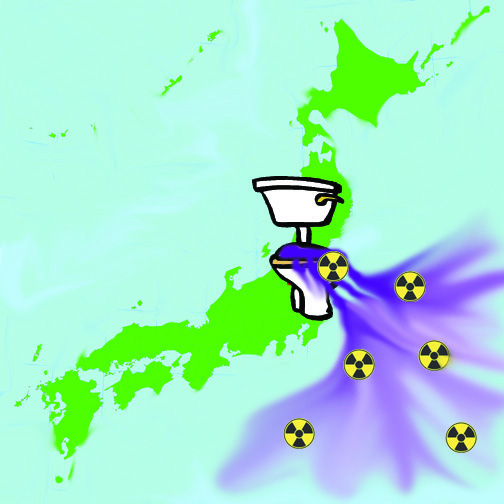
Korea JoongAng Daily 22nd Dec 2020, The mayors and governors of all 17 major cities and provinces in Korea adopted a joint statement warning against Japan releasing contaminated water into the ocean from its crippled Fukushima nuclear power plant. In a joint statement Tuesday, the Governors Association of Korea, which includes cities that are administered as provinces, called on the Japanese government to “immediately halt discussions to release the radioactive water from Fukushima” and to “share information to the public in a transparent manner.”
The governors’ statement comes as Japan is nearing a decision on plans to release over 1.2 million tons of contaminated water
from the Fukushima Daiichi nuclear plant into the Pacific Ocean.
https://koreajoongangdaily.joins.com/2020/12/22/national/socialAffairs/Fukushima-nuclear-plant-radioactive-water/20201222180600475.html
Biden flirts with the fantasy of small nuclear reactors as the cure for climate change
if the nuclear revolution doesn’t happen in the next four years, it’s probably not going to happen
The Green Fantasy and Messy Reality of Nuclear Power. TNR, 23 Dec 20, Biden is flirting with the idea of rejuvenating the industry to help decarbonize the economy—and there are skeptics in spades. Joe Biden will have to do more about climate change than any president before him. He has no choice. Already, close U.S. allies are openly expressing their relief about the end of the ecologically disastrous Trump era while a coalition of left-wing politicians and organizations are demanding sweeping emissions reductions.
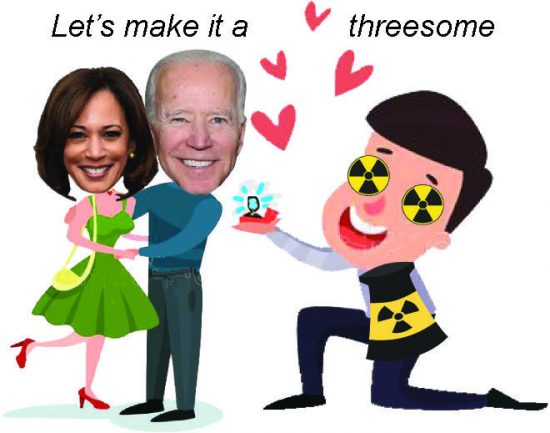 Biden’s campaign climate promises were extensive. But one of the more interesting promises in the plan—and one of the ones key to determining how he approaches emissions reduction—was his promise to “identify the future of nuclear energy.” That means reopening discussion of a technology many environmentalists once thought would be rotting in the dustbin of history by now.
Part of the reason nuclear energy construction remains difficult and expensive in the U.S. is that in polls Americans are split down the middle on their approval of nuclear energy, and opponents make a big stink when construction of a nuclear plant is being discussed. These are rational worries, according to Mark Delucchi, a research scientist affiliated with UC Berkeley and Lawrence Berkeley National Laboratory, which operates on behalf of the U.S. Department of Energy. In addition to the risk of meltdowns—which are, admittedly, rare—we have to also consider the disposal of caches of spent nuclear fuel, the risks of which “are potentially much more abroad in time and space,” Delucchi said. “They affect people. They affect other ecosystems. They affect different generations. And they’re unknown.”
“It kinda boggles my mind how anyone who has any clue about solving problems related to climate or energy still considers nuclear power,” said Mark Jacobson, professor of civil and environmental engineering at Stanford University and a frequent collaborator with Delucchi. As Jacobson pointed out, there’s next to no active construction of nuclear power plants currently going on in the U.S. All of the U.S. nuclear energy construction happening right now consists of two reactors in Georgia that Jacobson says “may never even be finished.”
A project in Utah set to break ground soon was set in motion by politicians accused of conflicts of interest, and construction of that plant has faced opposition from activists since its inception. In 2017, two U.S. nuclear reactor projects were canceled after construction had begun, leaving investors on the hook for billions of dollars. “So people are trying to say that we should build lots of these things that you can’t even build one of?” Jacobson said.
Despite the near impossibility of constructing one of these plants, greater federal investment in nuclear energy appears to be on the table. Biden’s transition team includes Rachel Slaybaugh, a Berkeley nuclear engineer. The Senate Committee on Energy and Public Works earlier this month approved a bipartisan bill aimed at protecting existing nuclear infrastructure, developing new nuclear technology, and supporting uranium mining.
 America’s pro-nuclear voices tend to hail from the aggressively moderate part of the political spectrum. The centrist think tank Third Way says on its website that “advanced nuclear is shaping up to be a key component in our race to zero emissions.” House Minority Leader Kevin McCarthy conceded in February that climate change is real—a step not all Republicans have taken—but claimed that the Democrats are going about trying to fix it all wrong. We should be, McCarthy wrote on his website, “investing in clean energy technology that will lead to less emissions, lower costs, and produce as much or more power. Chief among them is advanced nuclear technology.”
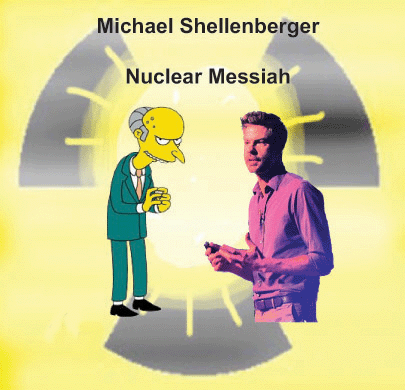
Rather predictably for anyone who follows this issue, McCarthy’s statement about clean energy (which doesn’t mention wind or solar) includes several citations of rockstar nuclear activist Michael Shellenberger, a guy who doesn’t think climate change is that bad and who has given not one, but two blockbuster TED talks attempting to bodyslam wind and solar, one of which is bluntly named “Why renewables can’t save the planet.” Over 2 million people have watched it on YouTube alone.
The notion that nuclear power is necessary and inevitable is far from a fringe viewpoint. Last year, The New York Times ran an op-ed called “Nuclear Power Can Save the World,” written by three Ph.D.-holders, including cognitive neuroscientist and radical optimist Steven Pinker.
According to this brand of eco-contrarianism, nuclear is not just viable, but the only pragmatic plan for decarbonizing the U.S. energy grid. Built into this message is invariably the idea that plans outlined by environmentalists, activists, and alternative energy proponents are actually doing more harm than good. It’s not that these folks want nuclear to have a seat at the table as humanity negotiates its energy future; they want to nuke-pill the whole climate movement.
But inevitably, this rhetoric has to address the chief problem of nuclear power, which is that it is extremely time-consuming and expensive to build new reactors. The solution, nuclear supporters argue, is to take a modular approach to our nuclear construction. Modularity means minimal  variation at each new site, a streamlined design process, and less of the sort of worksite entropy that slows things down. In other words, cookie-cutter them into the energy landscape as quickly as possible.
There’s reason to be skeptical of this approach. “Claims about the technical and economic attractiveness of modular or small scale nuclear reactors, I think, are potentially especially problematic on the political side of things,” Delucchi said. “A lot of the costs associated with nuclear power are based on technologies that are not commercialized, or even particularly close.”
Plans based on 100 percent renewable energy are routinely criticized for relying on technology not yet available or cost-effective. Clearly, though, that’s also true for nuclear power. Nuclear fans, then, are asking the country to bet on a successful nuclear expansion at a time when we have less than ten years—roughly the time it takes to carry out the relatively smooth construction of a single nuclear power plant—to cut our greenhouse gas emissions by 40–50 percent from 2010, or else we’ll blow past the ugly 1.5 degree warming threshold, according to the Intergovernmental Panel on Climate Change (IPCC), and plunge ourselves into climate chaos. That’s quite a bet.
In practical terms, all Biden has promised to do with regard to nuclear energy is form a research agency, dubbed ARPA-C, and churn out some government reports about it and other energy possibilities. And it won’t be at all surprising if, like Trump, Biden also gives a little boost to uranium mining companies that are desperate to expand their operations.
If ARPA-C’s research into modular reactors produces breakthroughs, more uranium gets mined, regulations fall away, public outcry dies down, and nuclear really turns out to be the answer to climate change, that should become clear by the end of Biden’s first term. If the U.S. is going to come anywhere close to meeting the IPCC’s recommendations for avoiding catastrophic warming through nuclear power, modular nuclear plants will be going up all over the place by January of 2025. We should see ribbons being cut, foundations being poured, and uranium ore well on its way to being enriched. “Small-scale modular” will have to become one of those eye-rollingly overused cliches, like “OK Boomer” or “social distancing.”
None of this seems particularly likely. And if the nuclear revolution doesn’t happen in the next four years, it’s probably not going to happen, given the slow pace of nuclear power construction. All those pragmatic arguments for nuclear energy will probably end up looking as fantastical as a three-eyed fish. https://newrepublic.com/article/160712/green-fantasy-messy-reality-nuclear-power
Trump Signs Directive to Bolster Nuclear Power in Space Exploration

|
Trump Signs Directive to Bolster Nuclear Power in Space Exploration, One goal laid out in the new policy is the testing of a fission power system on the moon by the mid- to late 2020s, Scientific American By Mike Wall, SPACE.com on December 21, 2020 Nuclear power will be a big part of the United States’ space exploration efforts going forward, a new policy document affirms. President Donald Trump on Wednesday (Dec. 16) issued Space Policy Directive-6 (SPD-6), which lays out a national strategy for the responsible and effective use of space nuclear power and propulsion (SNPP) systems. “Space nuclear power and propulsion is a fundamentally enabling technology for American deep-space missions to Mars and beyond,” Scott Pace, deputy assistant to the president and executive secretary of the National Space Council, said in an emailed statement Wednesday. “The United States intends to remain the leader among spacefaring nations, applying nuclear power technology safely, securely and sustainably in space.”…….. NASA and the U.S. Department of Energy are working together on a fission-reactor project called Kilopower, which could provide juice for crewed outposts on the moon and Mars. …….. SPD-6 is the sixth space policy directive signed by President Trump, as its name suggests. SPD-1 officially instructed NASA to return astronauts to the moon to help prepare for crewed Mars missions; SPD-2 eased regulations on the private spaceflight industry; SPD-3 aimed to help with space-traffic management; SPD-4 directed the Department of Defense to establish the U.S. Space Force; and SPD-5 laid out a cybersecurity policy for U.S. space systems. As that list indicates, President Trump has been quite active in the space-policy domain. He also resurrected the National Space Council, which had been dormant since the early 1990s. And just last week, he issued a new national space policy, which aims to bolster national security and American leadership in space, among other goals. https://www.scientificamerican.com/article/trump-signs-directive-to-bolster-nuclear-power-in-space-exploration/ |
|
USS Calhoun County sailors dumped thousands of tons of radioactive waste into ocean

|
They asked the dying Pasco County man about his Navy service a half-century before. He kept talking about the steel barrels. They haunted him, sea monsters plaguing an old sailor.”We turned off all the lights,” George Albernaz testified at a 2005 Department of Veterans Affairs hearing, “and … pretend that we were broken down and … we would take these barrels and having only steel-toed shoes … no protection gear, and proceed to roll these barrels into the ocean, 300 barrels at a trip.”
Not all of them sank. A few pushed back against the frothing ocean, bobbing in the waves like a drowning man. Then shots would ring out from a sailor with a rifle at the fantail. And the sea would claim the bullet-riddled drum.
Back inside the ship, Albernaz marked in his diary what the sailors dumped into the Atlantic Ocean. He knew he wasn’t supposed to keep such a record, but it was important to Albernaz that people know he had spoken the truth, even when the truth sounded crazy. For up to 15 years after World War II, the crew of Albernaz’s ship, the USS Calhoun County, dumped thousands of tons of radioactive waste into the Atlantic Ocean, often without heeding the simplest health precautions, according to Navy documents and Tampa Bay Times interviews with more than 50 former crewmen. Albernaz began a battle for his life in 1988 when part of his brain began to die, mystifying doctors who eventually concluded the rare ailment might be linked to radiation. He filed a VA claim for benefits in 2001 that was repeatedly rejected, often with tortured government reasoning.
The VA and Navy told Albernaz he was not exposed to radiation on the Calhoun County, a vessel the Navy ordered sunk in 1963 because it was radioactive. The VA ignored Navy documents discovered by a former congressional aide proving the ship’s radioactivity, telling Albernaz they were “unsubstantiated.” And the Navy today points to Cold War records that are incomplete and unreliable as proof crewmen were not exposed to dangerous radiation. The Navy and VA’s insistence that atomic waste on the Calhoun County was not dangerous comes 15 years after the VA linked the death of a crewman who served with Albernaz to radiation…….
Up to 1,000 men served on the Calhoun County in the years it dumped radioactive waste, a practice that continued until about 1960 — two years before the ship’s decommissioning. It’s impossible to know how many suffered unusual health problems after they left the ship. The VA and Navy never followed up on their health. Some got sick and never filed VA claims. And after more than a half-century, much of the crew has died………
The opening of the Atomic Age brought a vexing problem — how to dispose of radioactive waste. The Atomic Energy Commission, which then managed most aspects of U.S. atomic energy policy, settled on a cheap, convenient fix: ocean dumping. The Calhoun County soon became the only Navy ship on the East Coast dumping radioactive waste. The containers looked like ordinary 55-gallon steel drums. Nobody on the ship was quite sure what was in them.
They arrived by the hundreds by train and truck at the ship’s home port at Sandy Hook Bay, N.J. or the ship picked them up at Floyd Bennett Field on Long Island. Less often, waste was picked up at other ports, including Boston. The hottest waste came from Floyd Bennett. At times, the barrels were marked with color-coded dots or a painted X. The “red dot” barrels were said to be the most dangerous.
Not that it mattered. Few if any of the crewmen, according to interviews, received any special training on handling the waste. They said they handled the “red dot” barrels the same as all the rest. Much of the waste, which was packed in concrete, came from Brookhaven National Laboratory, a government research facility on Long Island that had a reactor and generated radioactive material. Several shipments emitted 17 rems per hour of radioactivity even after the waste was encased in concrete, Calhoun County‘s deck logs show. That is the equivalent of about 1,700 typical chest X-rays. Two sailors would place each barrel on its side and roll it to the edge of the ship. The Calhoun County, with its flat, shallow bottom, always shifted crazily in the waves, back and forth, a metronome marking time for a dangerous waltz.
As the ship tilted in their direction, the men released their barrel with a push and let gravity help take it overboard. The ship carried the waste out off the continental shelf several times a year to waters of varying depths, usually 6,000 to 12,000 feet. The designated dumping areas were a full day’s trip up to 200 miles out to sea, though several men said in interviews that the ship would dump much closer to the coast when the weather was bad. After they handled the barrels, the men went below deck to drink coffee or eat.
No documents appear to exist showing what exactly the Navy dumped. Deck logs list dumping coordinates, tonnage handled and drum radiation levels — but often, even that information is missing. And from 1946 to 1953, the Calhoun County‘s officers were not recording any dumps in deck logs at all………
On the Calhoun County, according to documents and interviews, radiation was neither feared nor respected. “We had no supervision,” said Bob Berwick, 82, of Laguna Niguel, Calif., an officer on the ship in 1952 and 1953. “We were on our own.”…….
None of the crew interviewed for this story recall getting special clothing or gear during dumping operations. An exception were the cotton gloves provided to the crew in the early to mid-1950s. “We threw the gloves overboard into the ocean when we were done with them,” said Richard Tkaczyk, 85, of Buffalo, N.Y., who served on the ship from 1949 to 1951. Several men said they were told to shower and take off clothing for washing after dumps. But for much of the ship’s history, this was not done, according to crewmen.
Albernaz told the VA in 2007 he recalled a trip when an AEC worker came through the crew quarters with a Geiger counter. “It would go off like a machine-gun and he would say to us, ‘Okay. Get your pillow, blanket and mattress. We’re moving you to the tank deck,’ ” Albernaz said. But the tank deck was under barrels, too. “So actually, there was really no place on that ship that was safe,” Albernaz said……….
the ship was radioactive. On June 5, 1956, according to Navy memos, Naval Research Laboratory technicians took radiation readings on the Calhoun County before barrels were loaded on its deck. Parts of the ship were radioactive, a memo to the Third Naval District commandant said. The ship’s captain, Herbert Hern, was ordered to “decontaminate affected areas” as soon as possible. The discovery prompted a more thorough examination of dumping operations. Navy brass did not like what they found. The ship’s handling of this dangerous waste was sloppy, haphazard………..
George Albernaz, then 22, was excited to be on the Calhoun County as its newest quartermaster. He was born in Fall River, Mass., and had hardly been away from home. He thought he was going to be part of the Navy’s storied amphibious force. He took a diary with him and recounted his adventure in the words of a wide-eyed sailor. “This is the story of the most fascinating experience of my life … doing a job I never dreamed existed, serving on a ship whose days as a man of war are but a story in the past but today she is engaged in a service equally important as any fighting ship in the Navy,” he wrote. It wasn’t long before Albernaz began keeping a different kind of diary. He titled this new log “Nuclear Waste Dumping Diary.”
Jan. 20 1957: “371 tons atomic waste.” Feb. 7, 1957: “368 tons atom waste.” Nov. 13, 1957: “299 (tons) poison gas (and) A.W.” One of Albernaz’s last entries was on June 12, 1958: “200 tons. Spec. weapons,” or special weapons. That was the day, Albernaz later told his wife, that he helped dispose of an atomic bomb. The Calhoun County sailed out of Norfolk, Va. with two giant crates. The ship’s log noted it dumped “confidential material” at 2:31 a.m.
Albernaz’s wife said he told her about that trip. He said the crew was told the crates contained two atomic bombs. Other sailors interviewed said the occasional dumping of disassembled atomic bombs occurred several times in its history. • • •…….. On March 10, 1958, one of the Calhoun County‘s crew, Harvey Lucas, was ordered to a Navy hospital. He was in pain and vomiting a brownish liquid, hospital records show. Two months later, the ship’s muster rolls show, Albernaz was hospitalized for two weeks. His wife said he later told her he had severe nausea. The two men were among a handful that year with long hospitalizations, records show. Albernaz later said doctor’s diagnosed them with stomach ulcers………..
A Dec. 13 memo by the chief of the Navy’s Bureau of Ships doubted radiation on the Calhoun County could ever be reduced to levels then considered safe. The memo noted the Navy had never been able to decontaminate a radioactive ship. “Complete paint stripping and sandblasting have failed to accomplish this (on the Calhoun County) and in the cases of ships contaminated in nuclear weapons tests,” the memo said. So the Navy ordered the Calhoun County sunk……….
Navy officer George Self, 83, of Pahrump, Nev., got the job to ready the Calhoun County for sinking. …………
Self did not go out on the second trip, so he is unsunsure how the ship met its end. The Navy said demolition charges sent the old LST to the bottom.
The years after his 1960 Navy discharge were cruel to Calhoun County crewman Harvey Lucas.
Lucas, a Denver man who spent more than three years on the ship, had always been suspicious of the Calhoun County‘s mission even while still a deckhand. Like Albernaz, Lucas tried to document the ship’s work. He stole a radiation badge and took pictures of the barrels. “He documented everything,” said daughter Jeanine Lucas. His family said he wondered if the work had been far more dangerous than the Navy let on. Those concerns could only have been stoked when his uncle, George Dutcher, who served on the ship with Lucas, died of cancer in the late 1960s still in his 40s. Lucas left the Navy and developed osteoporosis. It was so severe that a doctor said he had the bones of a 95-year-old, his family told the VA. He and his wife had five children born with birth defects or health problems. Cancer took Lucas, too. He died on June 17, 1985, at age 47 of leiomyosarcoma, an aggressive soft-tissue cancer. It has been documented in women who in the 1950s and 1960s received radiation treatment for excessive menstrual bleeding. Damage from the disease was so bad a funeral home couldn’t embalm him. Lucas was buried in a body bag. Lucas, and then his wife after his death, battled the VA for benefits, arguing the radiation caused his cancer and brittle bones. The VA repeatedly denied a link, at first saying the ship hadn’t carried radioactive waste………….. William Kemper, a retired Naval physicist, estimated Lucas had been exposed to radiation five times greater than the legal limit when he served. Kemper told the VA, “it seems most likely that he had ingested some cobalt 90 or other (radioactive) waste in . . . his duties.” In 1998, the VA finally ruled Lucas’s death was caused by radiation he was exposed to on the Calhoun County and approved benefits for his widow………… Civilian workers at Brookhaven, the lab that packaged much of the waste dumped by the Calhoun County, found it difficult to prove their on-the-job exposure to radiation in the Cold War led to cancers some of them suffered. Records were too incomplete. Some workers were never monitored. o in 2010, the federal government decided they would no longer have to prove their specific radiation exposure to get financial compensation and medical care. If they worked at the lab at least 250 days from 1947 to 1979 and were diagnosed with one of 22 radiation-related cancers, they qualified. Congress protects military personnel in much the same way. But none of the men who served on the Calhoun County are eligible for automatic VA benefits for radiation illnesses because they did not participate in underwater or atmospheric atomic tests and related activities, the government says. Thus, the crewmen do not meet their country’s definition of “Atomic Veteran.” https://www.tampabay.com/news/military/veterans/the-atomic-sailors/2157927/?fbclid=IwAR2LJbkpgGf3wFer8x96o_60n2EMtJ8hS-JREmkbBp_EkER9sl_iAxJuDkA |
|
1 This Month

Chernobyl: The Lost Tapes – A good documentary on Chernobyl on SBS available On Demand for the next 3 weeks– https://www.sbs.com.au/ondemand/tv-program/chernobyl-the-lost-tapes/2352741955560

of the week–London Campaign for Nuclear Disarmament

Tell the Ukrainian Government to Drop Prosecution of Peace Activist Yurii Sheliazhenko
To see nuclear-related stories in greater depth and intensity – go to https://nuclearinformation.wordpress.com
-
Archives
- April 2026 (173)
- March 2026 (251)
- February 2026 (268)
- January 2026 (308)
- December 2025 (358)
- November 2025 (359)
- October 2025 (376)
- September 2025 (257)
- August 2025 (319)
- July 2025 (230)
- June 2025 (348)
- May 2025 (261)
-
Categories
- 1
- 1 NUCLEAR ISSUES
- business and costs
- climate change
- culture and arts
- ENERGY
- environment
- health
- history
- indigenous issues
- Legal
- marketing of nuclear
- media
- opposition to nuclear
- PERSONAL STORIES
- politics
- politics international
- Religion and ethics
- safety
- secrets,lies and civil liberties
- spinbuster
- technology
- Uranium
- wastes
- weapons and war
- Women
- 2 WORLD
- ACTION
- AFRICA
- Atrocities
- AUSTRALIA
- Christina's notes
- Christina's themes
- culture and arts
- Events
- Fuk 2022
- Fuk 2023
- Fukushima 2017
- Fukushima 2018
- fukushima 2019
- Fukushima 2020
- Fukushima 2021
- general
- global warming
- Humour (God we need it)
- Nuclear
- RARE EARTHS
- Reference
- resources – print
- Resources -audiovicual
- Weekly Newsletter
- World
- World Nuclear
- YouTube
-
RSS
Entries RSS
Comments RSS
 nuclear-news