SOUTH KOREA’S CORRUPT AND DANGEROUS NUCLEAR INDUSTRY
 “During the eighteen months from the beginning of 2012 to mid- 2013, major corruption incidents occurred in the nuclear power industry in every country currently seeking to export nuclear reactors: the United States, Canada, Japan, South Korea, Russia, France, and China….. “In the Korean case, systemic nuclear industry corruption was found
Supplementary Submission to the Victorian Parliament’s Standing Committee on Environment and Planning
Inquiry into Nuclear Prohibition Friends of the Earth Australia www.nuclear.foe.org.au
June 2020 – Extract
SOUTH KOREA’S CORRUPT AND DANGEROUS NUCLEAR INDUSTRY
South Korea’s reactor project in the UAE is years behind schedule: the start-up of the first reactor has not yet occurred despite initially being scheduled for 2017. The project has been promoted as a US$20 billion (A$29 billion) contract but costs have undoubtedly increased. The World Nuclear Industry Status Report gives a figure of €24.4 billion (A$40 billion).[1]
[1] https://www.worldnuclearreport.org/The-World-Nuclear-Industry-Status-Report-2017-HTML.html
[2] KBS, 8 May 2020, ‘S. Korea Unveils Energy Plan to Reduce Coal-powered, Nuclear Power Plants’, http://world.kbs.co.kr/service/news_view.htm
The following articles discuss:
- The endemic corruption in South Korea’s nuclear industry.
- The business model which sacrifices safety in order to improve economics (the CEO of French nuclear utility Areva likened Korea’s AP1400 reactor design to ‘a car without airbags and safety belts.'[1])
- The level of state-sponsored skullduggery associated with South Korea’s nuclear industry is almost beyond belief, even extending to a secret military side-agreement to the UAE reactor contract which was agreed without the knowledge or agreement of South Korea’s parliament
Nuclear corruption and the partial reform of South Korea’s nuclear mafia
Jim Green, Nuclear Monitor #887, 17 June 2020, https://wiseinternational.org/nuclear-monitor/887/nuclear-monitor-887-17-june-2020
The corrupt behavior of Japan’s ‘nuclear village’ ‒ and the very existence of the nuclear village ‒ were root causes of the March 2011 Fukushima disaster and a string of earlier accidents.1 In the aftermath of the Fukushima disaster, academic Richard Tanter identified a worldwide pattern of nuclear corruption:2
“During the eighteen months from the beginning of 2012 to mid- 2013, major corruption incidents occurred in the nuclear power industry in every country currently seeking to export nuclear reactors: the United States, Canada, Japan, South Korea, Russia, France, and China. A number of other countries that operate or plan to have nuclear power plants also had major corruption cases, including Lithuania, Bulgaria, and Pakistan; moreover, serious allegations of corruption were raised in Egypt, India, Jordan, Nigeria, Slovakia, South Africa, and Taiwan.
“In the Korean case, systemic nuclear industry corruption was found; in Canada, deep corporate corruption within the largest nuclear engineering corporation was one matter, and bribery of nuclear technology consuming countries’ senior ministers was another. In Russia, the issue was persistent, deep seated, and widespread corruption in state-owned and private nuclear industry companies, with profound implications for the safety of Russian nuclear industry exports.
South Korea is slowly phasing out its nuclear power industry. In the late 2000s, it was anticipated that South Korea’s nuclear capacity would rise from 18 gigawatts (GW) to 43 GW by 2030. The current plan is to reduce the number of reactors from a peak of 26 in 2024 to 17 reactors (approx. 17 GW) in 2034.[2] Thus the ambitions have been more than halved. In recent years the South Korean government has shut down the Kori-1 and Wolsong-1 reactors, and suspended or cancelled plans for six further reactors.
“Two cases in nuclear technology importing countries, Lithuania and Bulgaria, revealed large-scale bribery involving government, the nuclear industry, and foreign (US and Russian) companies.
“Post-Soviet bloc geostrategic energy interests are central to both stories. The profound influence of organized crime in national energy policy, and on a transnational basis, is revealed in the Bulgarian and Russian cases. Suspicions are widespread and allegations common in the cases of India, Taiwan, and Bangladesh, but confirmed evidence remains weak.”
Since Tanter’s 2013 article, more information has surfaced regarding corruption in Russia’s nuclear industry3-4 and Russia’s nuclear dealings with India.5-7 The corruption associated with the abandoned Westinghouse nuclear power project in South Carolina is gradually coming to light.8 Corruption has been uncovered in the nuclear programs of South Africa9-15, Brazil16, Ukraine17 and, no doubt, elsewhere.
The International Atomic Energy Agency (IAEA) noted in its 2015 Nuclear Technology Review that counterfeit, fraudulent and suspect items (CFSIs) “are becoming an increasing concern for operating organizations and regulators”18 And again in 2019, an IAEA report noted that CFSIs “are of increasing concern in the nuclear industry and generally throughout the industrial and commercial supply chains.”19 The 2019 report noted that CFSIs “can pose immediate and potential threats to worker safety, facility performance, the public and the environment, and they can negatively impact facility costs.”
“Post-Soviet bloc geostrategic energy interests are central to both stories. The profound influence of organized crime in national energy policy, and on a transnational basis, is revealed in the Bulgarian and Russian cases. Suspicions are widespread and allegations common in the cases of India, Taiwan, and Bangladesh, but confirmed evidence remains weak.”
“The sequence of events that led to the station blackout began on 4 February 2012 when the management carried out a planned shutdown of the reactor for refuelling. On 9 February, the plant suffered a loss of power due to human error during a test of the main generator. After this, one of the two emergency diesel generators failed to start. The other generator was undergoing maintenance. In addition, the connection to one of the offsite auxiliary transformers failed to work as it had not been properly set up after maintenance; and the other offsite transformer was just entering maintenance. This caused a station blackout lasting 11 minutes 43 seconds. Cooling was lost for 11 minutes. The plant manager only reported the event to the Nuclear Safety and Security Commission on 12 March, more than one month later. … The plant manager justified the decision not to report the blackout on the risk of loss of public confidence and of credibility of the plant with the management of the operating company.”
Not long after, a much broader pattern of corruption began to come to light:
“Investigations of 101 companies revealed a wide range of illegal activities including bribery, overpaying, preferential treatment and favouritism, limiting competition in bidding, accepting parts with fraudulent or even no certificate, and collusion by parties in the falsification of testing reports.”
An investigation by the Korea Institute for Nuclear Safety showed that 2,114 test reports had been falsified by material suppliers and equipment manufacturers; that a further 62 equipment qualification documents (environmental and seismic qualification) were falsified between 1996 and 2012; and that a further 3,408 test reports and 53 qualification reports could not be verified or were unclear.22,23 Over 7,000 reactor parts were replaced in the aftermath of the scandal.23
Andrews-Speed details the corruption that probably had the greatest consequences for reactor safety:22
[1] Nucleonics Week (2010) : No core catcher, double containment for UAE reactors, South Koreans say, April 22, 2010.
“A very special case of systematic counterfeiting came to light in May 2013 when it was revealed that safety-grade control cable installed in four reactors had been falsely certified. The supplier of the cable was a Korean company, JS Cable. In 2004, KHNP decided for the first time to purchase cable from a domestic rather than foreign supplier. JS Cable submitted a bid to KEPCO E&C, despite not having the capability to make cable to the required specifications. KHNP awarded the contract to JS Cable with the first delivery due in 2017, on the condition that the cable met the required standards.
An investigation by the Korea Institute for Nuclear Safety showed that 2,114 test reports had been falsified by material suppliers and equipment manufacturers; that a further 62 equipment qualification documents (environmental and seismic qualification) were falsified between 1996 and 2012; and that a further 3,408 test reports and 53 qualification reports could not be verified or were unclear.22,23 Over 7,000 reactor parts were replaced in the aftermath of the scandal.23
“JS Cable chose Saehan TEP to test the cable, but this firm lacked the capacity to undertake the required loss of coolant testing. So Saehan TEP outsourced the process to the Canadian testing firm, RCM Technologies (RCMT). RCMT tested six samples, but only one passed. JS Cable sent six further samples. Only two passed, but these two samples were illegitimate as they had not been exposed to radiation before testing. In response, KHNP instructed KEPCO E&C to make the test results acceptable. So KEPCO E&C, Saehan TEP and JS cable agreed together to modify the test reports from RCMT to show that all the samples met the required standards.”
The corruption also affected South Korea’s reactor construction project in the UAE. Hyundai Heavy Industries employees offered bribes to KHNP officials in charge of the supply of parts for reactors to be exported to the UAE.24 And ‒ incredibly ‒ the reactor contract was underpinned by a secret military side-agreement, signed without the knowledge or approval of South Korea’s National Assembly, and containing a clause that does not require approval from the National Assembly to engage in conflict, should there be a request for military assistance from the UAE.25-28 The pact includes a clause that would obligate South Korea to intervene militarily to protect the UAE in the event of a crisis, in addition to the deployment of South Korean special forces and the ongoing supply of military equipment.25
Structural problems
Andrews-Speed describes the interlinking elements of South Korea’s ‘nuclear mafia’ involving nuclear power companies, research centers, regulators, government, and educational institutions. He notes that the country’s nuclear industry possesses some special features that make it particularly prone to corruption, relating to the structure and governance of the industry, and its close links with the government.
Both KHNP and KEPCO E&C are monopolists in their fields, and both suffer from poor corporate governance and weak internal management:22
“The poor corporate governance has its roots in the way in which the Ministry of Trade, Industry and Energy is directly involved in the management of KEPCO and its subsidiaries and in the political nature of appointments of many board members and senior managers. The weak internal management was particularly pertinent to safety because, before it was amended in 2014, the Act on Nuclear Safety and Security did not address the safety standards of parts and equipment. Thus, the selling of sub-standard components was not illegal and the task of supply chain oversight was left to KHNP to manage.”
Improvements and lingering problems
Andrews-Speed notes that the Kori-1 blackout and the systemic supply-chain corruption led to efforts to curb corruption. These included revisions to the Nuclear Safety Act giving greater powers to the newly created Nuclear Safety and Security Commission; placing new reporting obligations on all actors in the nuclear supply chain; and broader legislation and regulations governing public procurement, the conduct of public officials and corruption.
But it is doubtful whether these reforms are sufficient:22
“The principal obstacles to progress relate to power and structure. The Nuclear Safety and Security Commission lacks the authority of nuclear regulators in some other countries for a number of reasons
First, after 2013 the status of the Commission Chair was reduced from Ministerial to Vice-Ministerial level and their reporting line was changed from the President to the Prime Minister. The reason for this change of status related more to the career mobility of civil servants than to the governance of nuclear safety. Nevertheless, the consequences for the authority of the Commission have been significant. It cannot now issue any regulations without the approval of the Ministry of Justice and other Ministries. This results in delay and occasional suppression of new regulations. In addition, it has been alleged that the Nuclear Safety and Security Commission redacts and sanitizes the safety reports of the Korea Institute Nuclear Safety. The consequences of this practice on safety are exacerbated by the ability of ministries, politicians and KEPCO subsidiaries to block the tough enforcement of safety standards.
“Second, the National Assembly provides little oversight of the Commission. Instead, authority lies solely with the government. Finally, the term of the Commission Chair is just three years which is shorter than that of the nation’s president which is five years. This contrasts with the situation in the USA, for example, where the Chair of the Nuclear Regulatory Commission is appointed for a five-year term, one year longer than that of the US President. As a result, Korean Presidents have significant influence over the nuclear regulator given their remit to appoint all nine members of the Commission. Taken together, these three factors enhance the power of the executive over the Nuclear Safety and Security Commission.
“The structural weaknesses within Korea’s nuclear industry are multiple. The Ministries of Finance and Strategy and of Trade, Industry and Energy exert excessive influence over state-owned enterprises, including KHNP and KEPCO E&C. These two corporations not only have strong monopolistic positions but KHNP combines the roles of constructor, owner and operator of nuclear power plants. In addition, KHNP exerts undue influence over KEPCO E&C. This strong triangular relationship between government and two monopolists persists today and forms the core of Korea’s ‘nuclear mafia’. Only radical structural and governance reform can address this fundamental weakness.
“Further compounding factors include: the corporate culture of KEPCO and its subsidiaries that emphasizes the need for conformity; the weak culture of accountability that arises in part from the absence of a strong law providing for punitive damages; and the general standard of personal and corporate ethics in Korea.”
One indication of ongoing problems ‒ and efforts to resolve them ‒ was the awarding of ‘prize money’ to 14 whistleblowers in 2019 for reporting violations of nuclear or radiation safety laws to the Nuclear Safety and Security Committee.29
There were another six arrests related to nuclear corruption in 2018 ‒ an outcome that only scratched the surface of the problems according to a whistleblower.30
A recent example of violations of safety regulations occurred at the Hanbit-1 reactor on 10 May 2019. The reactor’s thermal output exceeded safety limits but was kept running for nearly 12 hours when it should have been shut down manually at once.31 In addition, the control rods were operated by a person who does not hold a Reactor Operator’s license.32
References: Continue reading
Ohio a clear example of corporate power and dark money shaping public policy

What happened in Ohio is a clear example of corporate power combined with the growth of “dark money” organizations following the  2010 Citizens United Supreme Court decision to shape public policy decisions. The reasons why FirstEnergy engaged in such activities are not hard to guess. Any entity that invests so heavily in these dark money organizations, media strategies, lobbyists, and political contributions will be expecting a sizeable return on its investments. And indeed, it has been rewarded handsomely. The irony is that an industry that acknowledges that it is not economically competitive is spending massively on lobbying. It is the ratepayers and taxpayers who bear the cost of these twisted priorities.
 A dirty battle for a nuclear bailout in Ohio https://thebulletin.org/2020/04/a-dirty-battle-for-a-nuclear-bailout-in-ohio/# By Shakiba Fadaie, M. V. Ramana,
  April 21, 2020 Last July, Ohio’s governor signed House Bill 6 (HB6) to provide FirstEnergy (now Energy Harbor), a large electric utility, with subsidies of nearly $150 million per year to keep its Perry and Davis-Besse nuclear power plants operating. Ohio is only the fifth US state to offer such subsidies; other states include New York, Illinois, New Jersey, and Connecticut. Although the subsidies are justified by some as necessary for climate mitigation, in the latter four states, electricity generation from natural gas, which results in greenhouse gas emissions, has increased since 2017, when these subsidy programs started kicking in. Moreover, in Ohio, subsidies are also being extended to coal power plants, providing the clearest illustration that what underlies the push for subsidies to nuclear plants is not a result of a real commitment to climate mitigation but a way to use climate concerns to bolster the profits of some energy corporations.
The enormous lobbying effort that won the subsidies used dark money–backed organizations that spent millions of dollars to sway voters and politicians. But it didn’t stop with the bill being signed into law—the lobbying also thwarted the ability of citizens to put the proposal to a democratic vote through a referendum, including by funding television advertisements that falsely claimed that China was “intertwining themselves financially in our energy infrastructure” and threatening “national security,” implying that not going through with the nuclear bailout would somehow lead to Chinese control of Ohio’s power grid. As confronting climate change gets in the way of corporate profits, such dirty battles are sure to emerge more often.
Electricity economics. It has been known since the late 1970s that the cost of constructing nuclear plants in the United States is very high, but the cost gap between nuclear electricity and other alternatives has increased dramatically in the last decade. In its most recent estimate, the Wall Street firm Lazard estimated that a new nuclear plant will generate electricity at an average cost of $155 per megawatt hour, nearly four times the corresponding estimates of around $40 per megawatt hour each for new wind and solar energy plants. The average cost for natural gas plants is $56 per megawatt hour.
The gap will only grow larger. While the costs of nuclear power have been increasing, the costs of wind and solar power have declined by around 70 to 90 percent in the last decade. Even solar projects that offer some amount of storage to meet demand when the sun no longer shines are becoming cheaper. Last year, the city of Los Angeles signed such a contract at $33 per megawatt hour. So new nuclear power plants are simply not competitive in the US electricity market.
But what about already operating nuclear plants, those that don’t have to worry about borrowing money for construction or repaying the money they have already borrowed? Herein lies the real cost problem for electric utilities that own nuclear plants. For each megawatt hour of electricity generated in 2019, the average nuclear power plant in the United States spent $30.42 on fuel, repairs and maintenance, and wages; some spent much more. Those costs are comparable to the overall generation costs (including the cost of construction) of solar and wind power listed above.
Renewable energy plants, of course, cost very little to operate since they don’t need any fuel. Thus, already existing renewable plants will remain far cheaper than nuclear plants. With natural gas plants, the comparison with nuclear plants depends on the cost of natural gas; thanks to fracking, for the last many years, natural gas plants have also lowered their operational costs to way below that of nuclear reactors.
The net result is that nuclear electricity is no longer competitive, and that is a problem for utilities that operate in states where electricity is traded on the market. (Other states, where a state regulator approves electricity projects, allow utilities to pass on the high costs of nuclear power to rate payers.) The number of nuclear plants this trend affects is quite large. In 2018, Bloomberg analysts estimated that “more than one quarter of all nuclear plants don’t make enough money to cover their operating costs.”
Political games. This state of affairs has led electric utilities in various states to try and get taxpayers and ratepayers to pay more to keep up their profits. Ohio’s FirstEnergy started early, in 2014, when it asked Ohio regulators to allow its distribution utilities to enter into agreements to purchase the outputs of its coal and nuclear plants at a set price that significantly exceeded wholesale electricity market prices. Ohio ratepayers would end up paying for electricity from these plants even if the distribution companies could have purchased electricity from other providers at cheaper prices. The proposal was approved in 2016, but the Federal Energy Regulatory Commission blocked the deal because it would have been unfair to consumers.
Since then, FirstEnergy has regularly tried to get subsidies in one form or another—until it succeeded in 2019 with HB6. In summary, that bill forces electricity consumers in Ohio to pay a surcharge on their monthly bills, and the resulting amounts go to subsidizing two nuclear power plants owned by FirstEnergy—Perry and Davis-Besse—and two coal-fired plants owned by Ohio Valley Electricity Corporation. The bill also weakens (and will eventually gut) Ohio’s requirements for a minimum amount of electricity to be provided by renewable sources and reduces its targets for improving energy efficiency.
There has been a recent history of growth of renewables in Ohio, albeit from a pitifully low base. According to the US Energy Information Administration, between 2011 and 2017, Ohio’s wind and solar production grew by factors of 7.6 and 4.3 respectively. The reasons for this growth presumably have to do with the economic factors mentioned earlier. Likewise, energy efficiency programs saved twice as much as was spent on implementing them, and were projected to save $4 billion over 10 years. An increase in renewable energy production combined with energy efficiency improvements was shown to be the most economical way to reduce Ohio’s emissions by over 30 percent between 2012 and 2030 as part of the 2014 proposed Clean Power Plan of the US Environmental Protection Agency.
What do those in favor of the bill say? The arguments being used by pro-nuclear groups can be categorized into two sets of claims: economic and environmental. The environmental argument is that nuclear power is a clean power source and a source of “clean air,” a claim made by, for example, Judd Gregg, former governor and senator from the state of New Hampshire and a member of the advocacy council of Nuclear Matters. The problem with that argument is two-fold. First, it does not explain why the bill would support the continued operation of old coal power plants. Second, it doesn’t fit well with the fact that renewables and energy efficiency are far cheaper sources of clean air, and this bill guts both of those.
The economic argument has to do with the fact that nuclear power plants are a source of employment among those communities living near the facilities. When they are shut down, those jobs would obviously disappear. Naturally, some labor unions, those with many members working in the nuclear industry, supported the bill. The International Brotherhood of Electrical Workers website, for example, proudly announced that its “activists have been hard at work, pressing representatives from both political parties to support this job-saving bill and urging all of their Buckeye State brothers and sisters to do the same,” with a union official going on to offer the tip: “No form letters or petitions, but one-on-one contact with the people that vote for them… It’s the personal touch that works.”
But, as with the environmental argument, the economic argument is dubious. The Perry and Davis-Besse nuclear power plants employ an estimated 700 workers each. Even generous estimates that include “additional jobs … that result from the overall economic boost associated with lower electricity prices and more in-state production” assert that the two plants create a combined 4,270 jobs. While these claims don’t square with the higher electricity costs that drive the need for subsidies, even these figures are just a fraction of the “over 81,000 workers” employed in the energy efficiency sector in the state.
More to the point, the number of jobs at these nuclear plants is very small when viewed in the context of the millions of dollars offered as subsidies to FirstEnergy, which, if invested in other energy resources, would create work for many more people. Per unit of electricity generated, nuclear power creates somewhere between one-half and one-sixth the number of jobs created by solar photovoltaic electricity. Because solar energy costs much less to install or generate, nuclear power employs even fewer on a per dollar basis.
The big fight. None of these arguments is exactly rocket science, and the fact that HB6 amounted to a corporate bailout was clear to many. Coalitions of Ohio companies, the state’s manufacturers’ association, environmental groups, and economists testified against the bill. A consumer group ran targeted radio advertisements pointing out how the bill was intended “to subsidize FirstEnergy’s failing investments.” All to no avail.
FirstEnergy’s lobbying power was overwhelming. Politicians were targeted directly and were offered campaign contributions. FirstEnergy and a political action committee they created contributed millions to political candidates and parties in Ohio. Although the details remain murky, much of the funding is documented by two main sources: state and federal campaign-finance filings and records from bankruptcy proceedings that FirstEnergy had entered into. Among the more egregious examples of this funding was the use of payroll deductions from FirstEnergy’s roughly 15,000 employees to raise and pay nearly a million dollars in political contributions between 2017 and 2019, most of it going to Republicans. The effort also included at least $9.5 million in television advertisements, much of which came from a dark money group. There is evidence, however, that FirstEnergy paid at least $1.9 million to this group.
Although Republicans received the majority of the financial contributions, Democrats were also recipients, and therefore support for (and opposition to) the bill was not strictly along party lines. On the Democratic side, those who supported the bill typically cited “a desire to retain union jobs at the endangered plants.” On the other side of the aisle, those Republicans who opposed it invoked problems with subsidies in general.
The raw political and economic power of the industry was on display even after the bill was passed. Having been defeated within the legislature, grassroots organizations such as Ohioans Against Corporate Bailouts and Ohio Consumers Power Alliance took to the streets and tried to collect signatures on a petition calling for a referendum question about HB6 to be included in the 2020 elections. It was a tough task, since those opposing the bailout had less than two months to gather over a quarter of a million valid signatures.
FirstEnergy tried to stop them with a two-pronged approach. The first was a legal trick. It went to the state’s supreme court and argued that the monthly charges on customers “should be considered tax increases, which cannot be challenged by a referendum.” But the court dismissed the case, saying there was “no ‘justiciable controversy’ for it to decide.” For the main part, though, the response from FirstEnergy and other beneficiaries was more of the same: dark money–backed organizations spending millions to undo the grassroots efforts by urging voters to refuse signing the petition.

Among these organizations was one called Ohioans for Energy Security, which sponsored television advertisements that falsely claimed that China is “intertwining themselves financially in our energy infrastructure,” threatening “national security,” and implying that not going through with the bailout campaign would lead to Chinese control of Ohio’s power grid. The watchdog organization Energy and Policy Institute quickly identified that some of the people featured in the TV advertisement were in fact FirstEnergy employees. In other words, there was reason to suspect that FirstEnergy was behind the advertisement. Ohioans for Energy Security also mailed thousands of letters to state residents with bold lettering behind a Chinese flag imploring, “Don’t give the Chinese government your personal information.” The hyperbolic allegations about China apparently are connected to natural gas-fired power plants in Ohio that were partially financed by a Chinese government-owned bank, although FirstEnergy has itself borrowed money from the same bank.
There were also accusations that the law’s supporters were trying to buy off circulators and take their petitions. Another front group, Protect Ohio Clean Energy Jobs, whose spokesperson was registered as a lobbyist for FirstEnergy Solutions, used “targeted ads on social media” to urge people who had already signed the referendum petition to withdraw their names.
The point of all these actions by FirstEnergy and its front or allied organizations was to dissuade voters from participating—and they succeeded. In October of last year, Ohioans Against Corporate Bailouts announced that it would not file the referendum petition, and HB6 went into effect.
Lessons. What happened in Ohio is a clear example of corporate power combined with the growth of “dark money” organizations following the 2010 Citizens United Supreme Court decision to shape public policy decisions. The reasons why FirstEnergy engaged in such activities are not hard to guess. Any entity that invests so heavily in these dark money organizations, media strategies, lobbyists, and political contributions will be expecting a sizeable return on its investments. And indeed, it has been rewarded handsomely. The irony is that an industry that acknowledges that it is not economically competitive is spending massively on lobbying. It is the ratepayers and taxpayers who bear the cost of these twisted priorities.
Although they have not been so egregious in their strategies and the energy and environmental policy outcomes have not been so detrimental, electricity utilities in New York, Illinois, New Jersey, and Connecticut have also pursued profits at a financial cost to customers. As in the case of Ohio, the concerned electricity utilities all have investments in fossil fueled plants as well, and they have a vested interest in maintaining those plants for as long as possible.
Adding up all the bailouts to utilities with nuclear plants in the five aforementioned states would result in roughly $15 billion going from consumers to these corporations over the next several years. Although such a sum might seem small when compared to the much larger bailouts that have been paid out in the aftermath of the economic crashes in 2008 and 2020, it is nevertheless a large amount of money within the electricity sector. More important, the funds go to maintaining the profits of large energy corporations, often under the guise of climate mitigation, but without delivering the real and rapid reductions of emissions that are urgently needed.
Climate change is a serious concern, and finding ways of rewarding electric utilities for maintaining the status quo is not the way to tackle it. Even worse, by diverting much-needed resources and investment away from renewables and related technologies, these subsidies undermine efforts to decarbonize the electricity sector and further entrench companies that invest in high-risk energy sources, be they nuclear or fossil-fueled.
The Mayak nuclear reprocessing plant: Rosatom’s dirty face- and the courageous opposition
 problems, protests, reprisals” Produced by RSEU’s program “Against nuclear and radioaсtive threats”
In the city of Krasnoyarsk, Rosatom plans to build a national repository for high–level radioactive waste. A site has been selected on the banks of Siberia’s largest river, the Yenisei, only 40 km from the city. Environmental activists consider this project, if implemented,to be a crime against future generations and violates numerous Russian laws. Activists are also concerned that waste from Ukraine,Hungary, Bulgaria (and in the future from Belarus, Turkey, Bangladesh, and other countries) could be transported there as well. (47)
NuScale’s nuclear reactor looks suspiciously like an old design, (that melted down)
 Why Does NuScale SMR Look Like a 1964 Drawing of Swiss Lucens Nuclear Reactor (which suffered a major meltdown in 1969)?
https://miningawareness.wordpress.com/2015/08/31/why-does-nuscale-smr-look-like-a-1964-drawing-of-swiss-lucens-nuclear-reactor-which-suffered-a-major-meltdown-in-1969/
Whatever NuScale is, or is not, it clearly isn’t “new”. The Bible must have foreseen the nuclear industry when it said that there was no new thing under the sun. While there might be something new about it, certainly its scale is not. And, it seems mostly a remake of old military reactors, perhaps with influence from swimming pool reactors.
The main ancestor seems to be the US Army’s SM-1, made by the American Locomotive Company, making its most distant ancestor the steam locomotive.
Government subsidizes for NuScale are a deadly taxpayer rip rip-off. Even without an accident, nuclear reactors legally leak deadly radionuclides into the environment during the entire nuclear fuel chain, as well as when they are operating. Then, the nuclear waste is also allowed to leak for perpetuity.
The 1964 Lucens Design certainly looks like the one unit NuScale. Did MSLWR, now NuScale, take from Lucens or from an earlier common design ancestor?
NuScale 12 years ago when it was called MASLWR and still an official government project, 2003, INEEL/EXT-04-01626.

This is for single reactors. They want to clump them together.
Is there a common ancestor in either the US nuclear power station in Greenland or Antarctica? Actually, the main “parent” for the underground concept, according to the Swiss documentation, is underground hydroelectric power stations, dating from the 1800s. These caverns have been known to collapse, which, along with the WIPP collapse, points to another risk associated with underground nuclear reactors, besides leakage and corrosion.
being mostly in an underground cavern proved to be a liability rather than an asset for Lucens. The cavern leaked water and contributed to corrosion issues that ultimately led to nuclear meltdown.
Despite its tiny size, tinier than NuScale, it still is classified as a major nuclear accident. Furthermore, the cavern did not keep the nuclear fallout from escaping into the environment. There was 1 Sv (1000 mSv) per hour of
radiation in the cavern. Radiation was measured in the nearby village, and the cavern still leaks radiation. Continue reading
Briefly, nuclear news this week
The good news from 2020: 10 sunny stories from an otherwise dark year.
In ‘Huge Victory for Polar Bears’, Court Rejects Arctic Offshore Drilling Project. U.S. “climate mayors” are hopeful that a Biden administration will help cities accelerate progress toward climate goals.
The Madness of Nuclear Deterrence.
Nuclear power ridiculously expensive and uncompetitive – the market has spoken.
ARCTIC. Russia marketing small nuclear reactors to the Arctic , (who cares about the toxic wastes?).
JAPAN. Fukushima nuclear debris removal to be delayed due to pandemic.
USA.
- A scary reality, Trump still has the nuclear codes. Donald Trump’s dangerous nuclear legacy. In USA’s economic and health crisis – nuclear weapons spending is booming. $128 billion next-generation submarine program at risk of cost overruns. Joe Biden administration might consider cutting nuclear weapons spending.
- Nuclear weapons agency updates Congress on hacking attempt.
- Draft EIS on Versatile Test Reactor (VTR); Lacking Justification and Due to Proliferation Risks, VTR Project Must Not Go Forward.. USA’s Dept of Energy pouring $millions into gimmicky new untested nuclear projects. U.S. Congress approves nuclear energy funding for Financial Year 2021. Trump Signs Directive to Bolster Nuclear Power in Space . Biden flirts with the fantasy of small nuclear reactors as the cure for climate change.
- Exploration.
- Former SCANA CEO to plead guilty on another charge for failed nuclear plant project. Ohio House Fails To Take Any Action On Nuclear Bailout Law.
- USS Calhoun County sailors dumped thousands of tons of radioactive waste into ocean.
UK. Unacceptable secrecy by the nuclear industry in Sizewell documentation. UK’s quest for nuclear fusion. No acknowledgment, no compensation, for a British nuclear test hero.
EUROPE. Chinese demands on nuclear power investment complicate EU talks. Marketing nuclear technology to Slovakia.
UKRAINE. Are forest fires unlocking radiation in Chernobyl? Dredging of the Pripyat river poses danger of Chernobyl radioactivity to drinking water of 8 million people. Storage of Chernobyl nuclear waste – in reality unsafe for 1000s of years.
SOUTH KOREA. South Korea: mayors and governors of all 17 major cities and provinces call on Japan not to dump Fukushima radioactive water into the ocean.
NORTH KOREA. Economic crisis forces North Korea to put new nuclear parade facilities on ice..
BELARUS. EU visit to Belarus nuclear plant called off, deepening safety concerns.
IRAN. Iran nuclear deal: ‘Heated rhetoric and the heightened risk of miscalculation’ widen differences.
CHINA. China rejects reports of hitch in investment pact talks with EU.
RUSSIA. Russia keenly marketing nuclear technology to Bolivia. Russian Army Chief Warns of Nuclear Risks in Cyber Hacks, Space . Russia’s nuclear-powered ice-breaker in trouble.
AUSTRALIA. Curiouser and curiouser – the dishonest acrobatics of the Australian Nuclear Science and Technology Organisation (ANSTO)
Donald Trump’s dangerous nuclear legacy
 Donald Trump Is A Nuclear President—His Legacy Is More Nukes, Fewer Controls https://www.forbes.com/sites/davidaxe/2020/12/24/donald-trump-is-a-nuclear-president-his-legacy-is-more-nukes-fewer-controls/?sh=4d5b0d4abd47
David Axe, Forbes Staff In his single term in the White House, Donald Trump expanded America’s nuclear arsenal and undermined decades of arms-control efforts. While President-elect Joe Biden could reverse some of Trump’s atomic initiatives, it’s highly unlikely he can undo all of them.And it’s impossible for Biden to travel back in time and seize opportunities for nuclear arms-reduction that Trump squandered—with North Korea, in particular.
Kingston Reif, a missile expert at the Arms Control Association in Washington, D.C., neatly summarized Trump’s nuclear initiatives on Twitter in mid-December. To paraphrase:
1. Trump nudged the Pentagon to double the number of low-yield nuclear weapons, which according to experts raise the risk of nuclear war by making nukes seemingly more “useable” in an armed clash between major powers. At the same time, Trump’s nuclear doctrine expanded the list of external threats that officially justify nuclear retaliation. Perhaps most notably, the list of threats now includes a major hacking event. The U.S. Navy subsequently deployed the low-yield W76-2 variant of its Trident II submarine-launched ballistic missile.
2. At the opposite end of the yield spectrum, the billionaire president accelerated development of high-yield SLBMs and canceled a Pentagon plan to decommission the megaton-class B83-1 gravity bomb.
3. To arm these new weapons, Trump took steps to restart production of plutonium cores for nuclear warheads, despite arguments that the United States already possesses plenty of cores. The core-production falls under a roughly $9-billion budgetary boost that Trump helped push through for the U.S. National Nuclear Security Agency, which oversees America’s nukes.
4. Citing Russian development of banned weapons, Trump withdrew the United States from the 1987 Intermediate-Range Nuclear Forces, which limited ground-launched nukes in Europe. The former reality TV star also pulled America out of the 1992 Open Skies Treaty, which allows the United States, Russia and many European states to monitor each other’s atomic arsenals via photographic-reconnaissance flights. Finally, Trump has been reluctant to approve an extension—due in February—of the 2010 New START, a U.S.-Russian accord that puts a cap on nuclear weapons and helped both countries reduce their atomic arsenals in the years prior to Trump’s presidency. It’s possible Biden could bring the USA back into Open Skies while also scrambling to extend New START, but the INF Treaty almost certainly is dead, as both the United States and Russia now openly are developing intermediate-range nukes.
5. After failing several times to negotiate any kind of enforceable arms limitations with North Korea, Trump became the first president since the 1960s not to negotiate any new nuclear arms-control agreement. Instead, he did the very opposite—loosened controls, encouraged proliferation and, as a result, is “the first post-Cold War president not to reduce the size of the nuclear warhead stockpile,” according to Reif.
“The Trump administration’s nuclear legacy is one of failure,” Reif said. “The administration inherited several nuclear challenges, to be sure, but it has made nearly all of them worse.”
Nuclear power ridiculously expensive and uncompetitive – the market has spoken
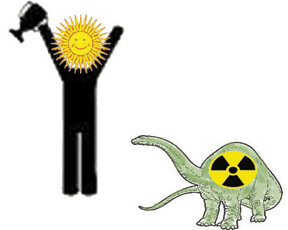 “nuclear is ridiculously expensive and uncompetitive”. So, nothing really needs to happen for renewable energy investment to grow. The reality is that the market has said “no” to nuclear and “yes” to renewables.
The Reality Is that the Market Has Said “No” to Nuclear and “Yes” to Renewables, RIAC, Paul Dorfman PhD, Honorary Senior Research Associate at the UCL Energy Institute University College London; Chair of the Nuclear Consulting Group; Member of the Irish Govt. Environment Protection Agency Radiation Protection Advisory Committee, and Tatyana Kanunnikova– 27 Dec 20,
“………. As for nuclear energy, can it be used to help mitigate climate change? What are the problems associated with nuclear energy?
 With mounting public concern and policy recognition over the speed and pace of the low carbon energy transition needed to mitigate climate change, nuclear power has been reframed as a response to the threat of global warming. However, at the heart of the question of nuclear power, there are differing views on how to apply foresight, precaution, and responsibility in the context of the poor economics of nuclear, the possibility of accidents, the consequences of those accidents, and indeed whether there exists a place for nuclear at all within the swiftly expanding renewable evolution.
When one considers nuclear, it is absolutely important to consider its life cycle in terms of carbon emissions. A study by Prof Benjamin Sovacool looked at 103 different studies and concluded that the average value for nuclear in terms of life cycle emissions was about 66 grams of carbon dioxide for every kilowatt-hour produced. This compares to about 9 grams per kilowatt-hour for wind and 32 grams per kilowatt-hour for solar. This puts nuclear as the third-highest carbon emitter after coal-fired plants and natural gas.
So, in terms of carbon emissions, nuclear is lower than fossil fuel but produces significantly more carbon dioxide in terms of its life 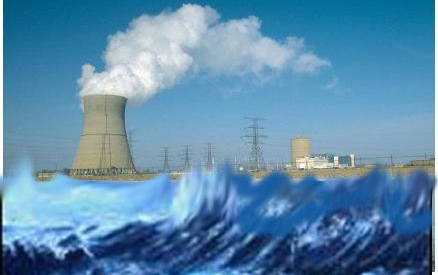 cycle than renewable power. And perhaps more importantly, with ramping predictions for sea level rise and climate disturbance, nuclear will be an important risk, since climate change will impact coastal nuclear plants earlier and harder than is currently expected. Proposed new reactors, together with radioactive waste stores, including spent fuel located on the coasts, will be vulnerable to sea level rise, flooding, and storm surge. These coastal sites will need considerable investment just to protect them against sea level rise, and in the medium term, they will even be subject to abandonment or relocation.
Adapting coastal nuclear power to climate change will entail significantly increased expense for construction, operation, waste storage, and decommissioning. Inland nuclear power plants will do no better. This is because they must be cooled by significant amounts of water and they have to shut down if that cooling water is either too warm or the river flow is reduced. These are two factors that will  absolutely happen with increased climate change. We are seeing this already in France where their reactors stationed by rivers, reliant on river water for cooling, have both diminished river flow and increased water temperatures in the summertime. That implies that there will be a significant inland nuclear station nuclear power shutdown in the future.
The other problem is one of economics, since nuclear is so hugely expensive. Carrying on constructing and prolonging the life of current nuclear plants is enormously costly. New construction is eye-wateringly expensive, which means that if we continue to build nuclear plants, we have much less resource, money, to put into the real solution to climate change, which is renewable power, demand-side management, and storage.
What are the advantages of solar and wind power?
A recent report by Standard and Poor, the key market analyst, found that renewable energy technology global investment has been running at about 350 billion dollars per year for the last few years. But for nuclear, it fell to about 17 billion for last year.
Standard and Poor say that they see “little economic rationale for new nuclear build in the US or Western Europe owing to massive cost escalations and renewables cost-competitiveness, which should lead to a material decline in nuclear generation”. Similarly, Lazard—the world’s leading financial advisory and asset management firm—has just compared the cost of new nuclear, which runs at about $119 to $192 per megawatt-hour, compared to $32 to $42 for utility-scale solar and between $20 and $54 for onshore wind per megawatt-hour. So there is a huge cost difference between nuclear and renewable technologies. Lazard go on to say that the unsubsidized, levelized cost of energy of large-scale wind and solar are at a fraction of the cost of new nuclear or even coal generators, even if the very great cost of nuclear decommissioning and ongoing maintenance is excluded.
Bloomberg New Energy Finance agrees with Lazard’s analysis. The key disadvantage to nuclear power is that it is just too expensive. For renewables, the cost is far lower and continues to fall, which is why what we see is the majority of new nuclear only being constructed with the support of vast state and public subsidy. So, given the reality that funding is limited, we need to make a choice between very expensive nuclear and very inexpensive renewables.
What hinders investments in renewable energy?
In fact, all of the markets are putting all of the money into renewable energy and none of the markets are putting their money into nuclear. There is no market investment in new nuclear. All the investment is going into renewable energy, as I have just discussed. The only problem is, of course, is that if governments via state subsidy put enormous amounts of the low carbon energy budgets into nuclear, they will have less money to invest properly in real low carbon energy technologies such as renewables, storage, and demand-side management.
What initiatives could help promote investments in renewable energy?
I do not think renewable energy needs pushing. The cost of renewables is a fraction of the cost of new nuclear. As Mr. Tanaka, a former director of the International Energy Agency and a former long-standing nuclear advocate, says, “nuclear is ridiculously expensive and uncompetitive”. So, nothing really needs to happen for renewable energy investment to grow. The reality is that the market has said “no” to nuclear and “yes” to renewables……………..
In the journey to manage the decline of fossil fuels, not all low carbon technologies are equal. The reality is that nuclear is far less benign, far more expensive, and far more carbon-intensive than other renewable options. Nuclear will struggle to compete with the technological, economic, and security advantages of the coming renewable evolution. In bidding goodbye to fossil fuels, we should also say goodbye to nuclear. And given the ramping costs and risks that cling to this, essentially late 20th-century technology, it is not before time.
Interviewed by Tatyana Kanunnikova. https://russiancouncil.ru/en/analytics-and-comments/interview/the-reality-is-that-the-market-has-said-no-to-nuclear-and-yes-to-renewables/
Russia’s nuclear-powered ice-breaker in trouble
 Strategy Page 25th Dec 2020 , The world’s only nuclear-powered non-military ships are operated by Russia. These include five nuclear powered icebreakers and one cargo ship,nthe Sevmorput.
oldest Russian nuclear-powered ship, the Sevmorput was stranded off thewest coast of Africa as emergency repairs are undertaken so it can continuenits trip to Antarctica where it will deliver 5,000 tons of supplies and construction materials for a new Russian research base in Antarctica.
https://www.strategypage.com/htmw/htseamo/articles/20201225.aspx
Moscow Times 16th Dec 2020, A Russian nuclear-powered cargo ship bound for Antarctica has been forced to turn back after sustaining damage, and will bypass Europe before undergoing repairs, state nuclear agency Rosatom said Wednesday. Green activists have expressed concern that the vessel will be sailing past several European countries on its way home during the winter storm season.
Storage of Chernobyl nuclear waste – in reality unsafe for 1000s of years

Tsunami-crippled Tokyo Electric Power Co. (TEPCO)’s Fukushima Daiichi nuclear power plant No.4 (R) and No.3 reactor buildings are seen in Fukushima prefecture February 28, 2012. Members of the foreign media were allowed into the plant on Tuesday ahead of the first anniversary of the March 11, 2011 tsunami and earthquake which triggered the world’s worst nuclear crisis since Chernobyl. REUTERS/Kimimasa Mayama/Pool (JAPAN – Tags: DISASTER ENVIRONMENT ENERGY) – RTR2YKOE
Paul Waldon Fight to Stop a Nuclear Waste Dump in South Australia, 28 Dec 20,
No acknowledgment, no compensation, for a British nuclear test hero
Nuclear veteran who died alone is buried with honour by pals days after he was refused medal
A Cold War hero, who believed he was rendered infertile by radiation experiments, got the send-off he deserved, Mirror UK By Susie Boniface, 27 DEC 2020
Ken Miller’s death went almost unnoticed, but his funeral was conducted with the pomp and ceremony due a war hero, Ken had died alone and childless, aged 82, after taking part in three radiation experiments which he believed left him infertile. He had hoped for at least a medal to acknowledge his service. But just days before he died the government refused, saying men like him had faced no risks.
But after the Mirror publicised his story, his fellow veterans pulled out all the stops to honour him at a humanist ceremony on Christmas Eve.
Ken’s coffin, draped in the flag of the British Nuclear Test Veterans Association, was carried into the crematorium by six ex-military pallbearers to the theme tune from A Bridge Too Far, a film that exemplifies the courage of servicemen and the madness of their generals.
The chapel at Morriston Crematorium in Swansea had expected no mourners, and planned a brief ceremony attended only by local officials.
Instead, the seats were as packed as they could be under pandemic rules for social distancing after Ken’s fellow veterans rallied to give him a proper send-off.
The service heard Billie Holiday’s version of Blue Moon, which was released in 1952, the year of Britain’s first nuclear test. And as the Gerry & The Pacemakers classic You’ll Never Walk Alone was played, the standard of the Soldiers, Sailors and Airmen’s Families Association was dipped over Ken’s coffin.
Then a veteran played a poignant Last Post on the bugle and, after a two minutes’ silence, the Reveille………
Ken was one of 22,000 men, many on National Service, who were ordered to take part in Britain’s Cold War bomb tests. Fewer than 1,500 are still alive, and one of them dies, on average, every week.
Born in Oxford, Ken ran away to join the navy and was a junior rating on HMS Warrior when he was ordered to watch three atomic explosions as part of Operation Grapple, at Malden Island in the South Pacific, in 1957.
The biggest, at 720 kilotons, was 35 times more powerful than the blast which levelled the Japanese city of Nagasaki at the end of the Second World War. It was still ruled a failure by scientists, who went on to detonate much larger H-bombs the following year.
Fellow nuke vet David Taunt, 78, of Swindon, began talking to Ken on the phone during the first lockdown as a BNTVA project to help its members.
He said: “He was one of the guys who stood on the deck with his back to it and then turned round and watched the mushroom cloud rise. He said the ship they were on sailed a lot closer to the blast zone than they should have done. And of course, like all the sailors, he used distilled seawater to drink and wash in.”………
on their regular talks, he discussed memories of the nuclear tests with David, who never met him in person and was unable to attend the funeral in Wales because of travel restrictions.
David said: “I was at Operation Dominic in 1961, when the Americans used British troops to help test close to 30 nuclear bombs at Christmas Island………
David was able to get compensation from the US government due to his cancer, because that nation agrees that service at their tests was the most likely cause. But the UK still refuses payouts or any other recognition, and fights every bid for a small war pension.
He said: “Ken would have been quite happy with a medal. It would be confirmation something happened. He appreciated what the BNTVA and the Mirror were doing for us.”
The medal decision is to be reviewed in the New Year, and 10 Tory MPs, including former ministers and influential backbenchers, have written to Boris Johnson demanding he personally intervene. https://www.mirror.co.uk/news/uk-news/nuclear-veteran-who-died-alone-23226173
Delay in removal of melted nuclear fuel from Fukushima No 1 Power plant, because of the pandemic
|
Pandemic delays melted nuclear fuel removal at Fukushima http://www.asahi.com/ajw/articles/14059716, By YU KOTSUBO/ Staff Writer, December 25, 2020 The government and operator of the Fukushima No. 1 nuclear power plant announced they had abandoned plans to start removing melted nuclear fuel and other contaminated debris from the stricken facility within 2021, citing delayed development in Britain of a robotic arm crucial for the purpose.They explained that the novel coronavirus pandemic was chiefly to blame for the delay.
The government and Tokyo Electric Power Co. had planned to start the hazardous task in 2021 but said Dec. 24 that is no longer feasible. In December 2011, nine months after the triple meltdown triggered by the March earthquake and tsunami disaster, the two parties set a goal of starting to retrieve the melted fuel “within 10 years” so reactor decommissioning could start. Since then, they have had to downsize the scale of debris that can be realistically be retrieved, mainly because the technology does not exist to accomplish such dangerous work. The No. 2 reactor, along with the No. 1 and No. 3 reactors, went into meltdown after tsunami generated by the 2011 Great East Japan Earthquake knocked out cooling systems at the plant. Debris retrieval constitutes the biggest obstacles to deciding how reactor decommissioning will progress in the years ahead. The debris is emitting extremely high levels of radiation, making it difficult to access the site even with robots. Little is known about the state of the debris or its composition. The government and TEPCO revised the timetable last December with the aim of retrieving a few grams of debris on an experimental basis in 2021 from the No. 2 reactor. The No. 2 reactor was chosen because the state of the containment housing is better understood than for the other reactors. Japan approached Britain to develop a special robotic arm because it has more experience in this field. But the work has experienced significant delays because of the COVID-19 pandemic. Trial tests for the robotic arm are planned to be held in Japan next spring or later with retrieval work postponed to 2022 or later. However, many questions remain about the reactor decommissioning of the Fukushima No. 1 nuclear power plant as a whole due to a number of factors such as wrecked equipment at the site. For example, initial projections to complete the removal of used nuclear fuel from a fuel pool were delayed for 10 years. However, the government and TEPCO are sticking to their schedule to complete reactor decommissioning between 2041 and 2051. With regard to debris retrieval, this is to be done on a “step-by-step” basis. The two parties on Dec. 24 also announced they will postpone the start of probing the interior of the No.1 reactor’s containment vessel from the second half of fiscal 2020 to fiscal 2021. They have been working to secure a route that will allow robotic equipment to explore the interior but experienced huge hurdles because their current method caused radioactive substances to spread. The accumulated debris in the three reactors is estimated to total about 880 tons. Tentative plans call for increasing the amount of debris to be retrieved gradually after a few grams are collected with a metallic brush attached to the top of the robotic arm and analyzed. |
|
Ohio lawmakers make no attempt to stop the corruptly set up nuclear power bailout
|
Ohio lawmakers ended their 2020 legislative session late Tuesday without repealing or replacing House Bill 6. The scandal-tainted bill will provide a $1 billion dollar bailout for two Ohio nuclear power plants. Customers across Ohio were to begin paying a monthly fee starting in January to subsidize the plants. A judge in Columbus gave the legislature a temporary reprieve Monday by issuing a preliminary injunction to stop fees from being collected. In July, the former speaker of the Ohio House Larry Householder and four others are facing federal charges in a bribery scheme to get the bill pass. Governor Mike DeWine says it up to the Ohio House and Senate to get something done.
“The legislature is a separate branch of government. They are working their will. We will see what they send me. I have made it clear that my preferences is total repeal and replace. Because I think when we look behind the curtain and saw how this bill became law it looks unseemly and was unseemly and this kind of stinks up the whole room,” says Gov. Mike DeWine. “And so we are better off starting over again.”
A new company acquired the nuclear plants and other first energy assets in February in a bankruptcy court deal.
|
|

Russia marketing small nuclear reactors to the Arctic , (who cares about the toxic wastes?)

Rosatom to build small-scale land-based Arctic nuclear plant by 2028
Rosatom said it has reached an agreement with the government of the Republic of Sakha (Yakutia) setting out parameters for pricing energy that will be produced by the nuclear plant, which is expected to be completed by 2028……….
“I am convinced that a small-scale nuclear power plant will give a qualitative impetus to the development of the Arctic regions of Yakutia, stimulate the development of industry in Ust-Yansky ulus and improve the living standards of local residents,” said in a statement Head of the Sakha Republic Aysen Nikolayev.
The nuclear plant is expected to operate for 60 years but the press release did not specify how Rosatom plans to deal with the nuclear waste produced by it.
Rosatom officials said the small-scale nuclear plant is based on a proven technology that has already been tested in Arctic conditions.
RITM-200 reactors are already being used on the recently commissioned Arktika nuclear-powered icebreaker and six other 22220 design heavy Russian icebreakers that are being built, Rosatom officials said…….
“The implementation of this project strengthens the leading position of Rosatom in the world market of small nuclear power plants.”…….
Rosatom is also actively marketing the technology for export overseas, Likhachev said. https://thebarentsobserver.com/en/nuclear-safety/2020/12/rosatom-build-small-scale-land-based-arctic-nuclear-plant-2028
Russian Army Chief Warns of Nuclear Risks in Cyber Hacks, Space
 Russian Army Chief Warns of Nuclear Risks in Cyber Hacks, Space https://www.bloombergquint.com/politics/russia-general-warns-cyber-attacks-pose-nuclear-risks-tass-says Stepan Kravchenko December 25 2020, (Bloomberg) — The extension of military confrontation into the cyber sphere and space raises the risks of incidents involving nuclear weapons, Russia’s top general warned Thursday, highlighting concerns about growing tensions.
Read more at: https://www.bloombergquint.com/politics/russia-general-warns-cyber-attacks-pose-nuclear-risks-tass-says
Copyright © BloombergQuint
Joe Biden administration might consider cutting nuclear weapons spending

 Biden to Review U.S. Nuclear-Weapons Programs, With Eye Toward Cuts
President-elect promised to reduce ‘excessive’ spending on nuclear arsenal and shrink its role in strategy, but critics say updates are overdue, WSJ, By Michael R. Gordon, Dec. 24, 2020 WASHINGTON—The incoming Biden administration is planning a review of the nation’s $1.2 trillion nuclear-modernization program with an eye toward trimming funding for nuclear weapons and reducing their role in Pentagon strategy
President-elect Joe Biden promised during the campaign to reduce the U.S.’s “excessive expenditure” on nuclear arms and criticized President Trump’s decision to develop new sea-based weapons, including a submarine-launched cruise missile.
The new administration is also likely to review the Pentagon’s decision to develop a new land-based intercontinental ballistic missile, which is estimated to cost more than $100 billion when its warhead is included, some former officials said.
“We have to modernize our deterrent,” said one former official. “But we cannot spend the amount of money that is currently being allocated.”
The expectation that Mr. Biden will take a fresh look at the modernization programs has spurred a debate over the future of the U.S. nuclear deterrent……. (subscribers only) https://www.wsj.com/articles/biden-to-review-u-s-nuclear-weapons-programs-with-eye-toward-cuts-11608805800
1 This Month

Chernobyl: The Lost Tapes – A good documentary on Chernobyl on SBS available On Demand for the next 3 weeks– https://www.sbs.com.au/ondemand/tv-program/chernobyl-the-lost-tapes/2352741955560

of the week–London Campaign for Nuclear Disarmament

Tell the Ukrainian Government to Drop Prosecution of Peace Activist Yurii Sheliazhenko
To see nuclear-related stories in greater depth and intensity – go to https://nuclearinformation.wordpress.com
-
Archives
- April 2026 (173)
- March 2026 (251)
- February 2026 (268)
- January 2026 (308)
- December 2025 (358)
- November 2025 (359)
- October 2025 (376)
- September 2025 (257)
- August 2025 (319)
- July 2025 (230)
- June 2025 (348)
- May 2025 (261)
-
Categories
- 1
- 1 NUCLEAR ISSUES
- business and costs
- climate change
- culture and arts
- ENERGY
- environment
- health
- history
- indigenous issues
- Legal
- marketing of nuclear
- media
- opposition to nuclear
- PERSONAL STORIES
- politics
- politics international
- Religion and ethics
- safety
- secrets,lies and civil liberties
- spinbuster
- technology
- Uranium
- wastes
- weapons and war
- Women
- 2 WORLD
- ACTION
- AFRICA
- Atrocities
- AUSTRALIA
- Christina's notes
- Christina's themes
- culture and arts
- Events
- Fuk 2022
- Fuk 2023
- Fukushima 2017
- Fukushima 2018
- fukushima 2019
- Fukushima 2020
- Fukushima 2021
- general
- global warming
- Humour (God we need it)
- Nuclear
- RARE EARTHS
- Reference
- resources – print
- Resources -audiovicual
- Weekly Newsletter
- World
- World Nuclear
- YouTube
-
RSS
Entries RSS
Comments RSS
 nuclear-news