Terrorism risks in Pakistan’s upgraded nuclear weapons
Pakistan’s Nuclear Weapons Get a Longer Range and Greater Precision
Pakistan successfully test-fired a new version of its Ra’ad ii nuclear-capable air-launched cruise missile on February 16, in the latest sign of the nation’s thermonuclear weapons advancement.
The Pakistan military’s Inter-Services Public Relations (ispr) said in a statement that the new version of the Ra’ad ii can travel up to 375 miles, nearly twice the range of the earlier model. It noted that the missile is “equipped with state-of-the-art guidance and navigation systems ensuring engagement of targets with high precision.” The combination of the longer range and the precision navigation “significantly enhances” the military’s “air delivered strategic standoff capability on land and at sea,” the ispr said…….
Pakistan has steadily developed more powerful, more compact and more numerous nuclear warheads—and, as evidenced by the new Ra’ad ii variant, more deft systems to deliver them.
Meanwhile, parts of Pakistan have become hotbeds of intensifying Islamic radicalism, which calls the security of these unfathomably destructive weapons into question. “Pakistan is the most dangerous country in the world,” Michael Morell, a former acting Central Intelligence Agency director, told Axios in 2018. “[A]nti-state jihadist extremism is growing in Pakistan, creating the nightmare society down the road: an extremist government in Islamabad with nuclear weapons.”
The Pakistani military has control over the nation’s 70 to 90 nuclear weapons. But the military routinely works with some of the most dangerous terrorist groups on the planet, including the ruthless Haqqani branch of the Afghan Taliban. The Brookings Institution noted, “Pakistan has provided direct military and intelligence aid” to the Haqqani, which has resulted in “the deaths of U.S. soldiers, Afghan security personnel and civilians, plus significant destabilization of Afghanistan.” …….. https://www.thetrumpet.com/21979-pakistans-nuclear-weapons-get-a-longer-range-and-greater-precision
Question USA’s need for a New Nuclear Sea-Launched Cruise Missile
Does the US Need a New Nuclear Sea-Launched Cruise Missile?
The case for a new sea-launched cruise missile raises worrying questions.The Diplomat By Robert Farley, February 24, 2020 According to a new report from Defense News, the United States is moving forward on development of a dangerous new nuclear capability. Aaron Mehta of Defense News reported on February 21 that the Department of Defense intends to create a program of record for a submarine launched cruise missile (SLCM) equipped with a nuclear warhead. The request comes in response to Trump administration preferences set forth in the 2018 Nuclear Posture Review, which also called for the deployment of low-yield nuclear warheads on submarine launched ballistic missiles.
The United States has not deployed a nuclear armed SLCM since the retirement of the TLAM-N in 2013. ……..
The deployment of a newer, more survivable SLCM would not exactly create a new problem so much as reintroduce an old one. Nuclear cruise missiles take up space on a ship and require different kinds of crew expertise. Their storage alongside conventional missiles creates an obvious potential for accidents. Discrimination would also become a problem. The United States has launched a great many cruise missiles from submarines as part of the War on Terror and associated conflicts. China, Russia, and other nuclear powers can credibly recognize such launches as carrying conventional munitions. If attack submarines reacquire the capability to launch nuclear weapons, then Beijing and Moscow need to worry about every missile launch within range of their territory.
This would become more, not less, problematic in context of a direct conflict between the United States and China. The U.S. has promised to hold targets within China at risk during a general conflict, presumably with cruise missiles. Heretofore China has not needed to account for the possibility that these missiles might carry nuclear warheads, but if the U.S. deployed nuclear SLCMs then any strike might be interpreted as a nuclear attack…….https://thediplomat.com/2020/02/does-the-us-need-a-new-nuclear-sea-launched-cruise-missile/

Poor quality nuclear spent fuel casks at Pilgrim Nuclear Power Station
 Push for better storage of spent Pilgrim Nuclear Power Station fuel, Cape Cod Times, Christine Legere Feb 23, 2020
Citizen activists in Barnstable County communities will ask voters at spring town meetings, or via local election ballots, to support an advisory question that would direct Gov. Charlie Baker and state legislators to require that the radioactive waste is stored in “better quality” dry casks than those planned for use, and that the casks are protected by earthen berms or within enclosures with heightened security.,
The Cape Downwinders wrote the advisory question.
“Fifty percent of Americans live within 50 miles of a nuclear power plant,” Turco said. “Safety is a right. Our petition is to raise consciousness: educate the public about ongoing issues at Pilgrim.”
The selectmen in Orleans and Brewster voted to put the advisory question on their respective spring election ballots, Turco said. In Bourne, the question will go on the town meeting warrant.
Other Barnstable County communities will be presented with the advisory in the coming weeks.
Entergy Corp., Pilgrim’s longtime owner, sold the plant to Holtec International, a New Jersey-based company that will handle decommissioning, spent fuel management and site cleanup.
Turco and other Pilgrim critics have complained that Holtec has a conflict of interest since the company uses dry casks that it manufactures. The Holtec Hi-Storm 100s the company uses are concrete-encased stainless steel canisters that are a little over a half-inch thick.
“That’s just three-eighths of an inch thicker than a Yeti cup,” Turco said.
There is no way to monitor the steel canisters once they are sealed, critics say, and there is no aging management plan.
Concern also has been expressed over Holtec’s plan to store spent fuel on a concrete pad just a short distance from a well-traveled road. A vanity fence, rather than earth berms or enclosures, will block the view from the street.
“In this day and age, Pilgrim is an open door for any bad actors who want to cause serious damage to our country,” Turco said. “Nuclear waste is a predeployed nuclear weapon. Its safe storage is being ignored.”………
tate Attorney General Maura Healey filed a motion to intervene in the license transfer several months ago, but the motion remains under review by the Nuclear Regulatory Commission.
Frustrated by the lack of action, Healey sued the NRC last fall in U.S. District Court for approving the transfer of Pilgrim’s license from Entergy Corp. to Holtec International without first listening to what state officials and the public had to say about it. The case is pending.
Healey contends that Holtec is inexperienced in decommissioning and will likely run out of money before the job is done. Holtec will use the plant’s decommissioning trust fund, which contains $1.1 billion in ratepayer money.
The Nuclear Decommissioning Citizens Advisory Panel, which is made up of local officials, representatives from state agencies and members of the public, has been frustrated by Holtec’s lack of response during monthly meetings regarding decommissioning and spent fuel.
Holtec’s continuing refusal to answer the advisory panel and the public’s questions about the safety and expected longevity of the company’s dry cask storage technology is not only disturbing, it’s outrageous,” Sean Mullin, chairman of the advisory panel, wrote in an email. “The citizens of the Commonwealth have a right to know how, for example, Holtec can accurately monitor the sealed casks for problems and, if detected, how these can be repaired.”
The NRC director of the Division of Nuclear Materials Safety, a senior health physicist, senior materials engineer and chief of the NRC’s Storage and Transportation Licensing Branch will attend an advisory panel meeting set for 6:30 p.m. Monday in Plymouth Town Hall to discuss the region’s concerns.
Follow Christine Legere on Twitter: @ChrisLegereCCT. https://www.capecodtimes.com/news/20200223/push-for-better-storage-of-spent-pilgrim-nuclear-power-station-fuel
New tech takes radiation out of cancer screening
 New tech takes radiation out of cancer screening, Science Daily, February 24, 2020, University of Waterloo
- Summary:
- Researchers have developed a new, inexpensive technology that could save lives and money by routinely screening women for breast cancer without exposure to radiation. The system uses harmless microwaves and artificial intelligence (AI) software to detect even small, early-stage tumors within minutes.
-
Researchers have developed a new, inexpensive technology that could save lives and money by routinely screening women for breast cancer without exposure to radiation.
The system, developed by researchers at the University of Waterloo, uses harmless microwaves and artificial intelligence (AI) software to detect even small, early-stage tumors within minutes.
“Our top priorities were to make this detection-based modality fast and inexpensive,” said Omar Ramahi, a professor of electrical and computer engineering at Waterloo. “We have incredibly encouraging results and we believe that is because of its simplicity.”
A prototype device — the culmination of 15 years of work on the use of microwaves for tumor detection, not imaging — cost less than $5,000 to build.
It consists of a small sensor in an adjustable box about 15 centimetres square that is situated under an opening in a padded examination table………
- In addition to reducing patient wait times and enabling earlier diagnosis, Ramahi said, the device would eliminate radiation exposure, improve patient comfort and work on particularly dense breasts, a problem with mammograms.
It would also save health-care systems enormous amounts of money and, because of its low cost and ease of use, dramatically increase access to screening in the developing world.
Researchers have applied for a patent and started a company, Wave Intelligence Inc. of Waterloo, to commercialize the system and hope to begin trials on patients within six months. Three rounds of preliminary testing included the use of artificial human torsos known as phantoms. https://www.sciencedaily.com/releases/2020/02/200224111415.htm
President Trump, eyeing the election campaign contradicts his administration on Nevada nuclear waste dump
 One Side of a Nuclear Waste Fight: Trump. The Other: His Administration.
The president, eyeing the battleground state of Nevada, has made clear he opposes a nuclear waste site at Yucca Mountain, reversing a policy that was made in his name.
-
Mr. Trump, who in recent weeks seemed to end his administration’s support for moving nuclear waste to Yucca Mountain, a proposal that had been embraced by his appointees for three years despite his own lack of interest
- “Why should you have nuclear waste in your backyard?” Mr. Trump asked the crowd at a rally in Las Vegas on Friday, to applause, noting that his recently released budget proposal did not include funding to license the site, as previous ones had. applause, noting that his recently released budget proposal did not include funding to license the site, as previous ones had.
|
The story of the muddled and shifting position on Yucca Mountain is partly one of an administration focused on Mr. Trump’s re-election chances in a battleground state that he lost to Hillary Clinton by two percentage points in 2016. But it is also emblematic of a White House where the president has strong impulses on only a narrow set of issues, and policy is sometimes made in his name regardless of whether he approves of it. ………..
The president made his latest move after a monthslong policy debate inside the White House over finally breaking with support for Yucca, officials said…….
Nationally, Republicans have long favored the proposal, which was developed in the late 1980s and signed into law by President George W. Bush in 2002. But Nevada politicians of both parties have remained steadfastly opposed to the policy, which is deeply unpopular in the state…….
most Republican leaders outside of the state remained supportive. While the plans for Yucca remain law as set under Mr. Bush, Congress has never moved to fund it since…..
previous energy secretary, Rick Perry, supported the measure, and as the Office of Management and Budget listed $120 million in the president’s budget to restart the licensing process of the site. It was listed as one of the administration’s priorities. ……..
At a House energy subcommittee hearing two weeks ago, Mark W. Menezes, the president’s nominee for deputy energy secretary, prompted alarm at the White House when he said, “What we’re trying to do is to put together a process that will give us a path to permanent storage at Yucca.” After White House officials expressed concern, Mr. Menezes put out a statement saying that he fully supported Mr. Trump’s decision.
Whether that will be enough to reassure Nevadans about Mr. Trump’s intentions remains to be seen. “Nevadans aren’t going to just forget that Trump spent the first three years of his administration trying to treat the state as a dumping site,” said Rebecca Kirszner Katz, a former adviser to Mr. Reid. “Donald Trump had an opportunity to be on the right side of a major issue in a huge battleground state, and he bungled it.” https://www.nytimes.com/2020/02/23/us/politics/trump-yucca-mountain-nevada.html
AT THE BEGINNING Before the 2018 midterm elections, Senator Dean Heller stood with President Trump in the glittering Trump International Hotel near the Las Vegas Strip, looking out from the top floor, and pointed.
“I said, ‘See those railroad tracks?’” Mr. Heller, a Nevada Republican who lost his seat later that year, recalled in an interview. Nuclear waste to be carted to Yucca Mountain for permanent storage would have to travel along the tracks, within a half-mile of the hotel, Mr. Heller said.
I think he calculated pretty quickly what that meant,” Mr. Heller said. “I think it all made sense. There was a moment of reflection, of, ‘Oh, OK.’” Whether the waste would have traveled along those particular tracks is a subject of debate. But the conversation appears to have helped focus Mr. Trump, who in recent weeks seemed to end his administration’s support for moving nuclear waste to Yucca Mountain, a proposal that had been embraced by his appointees for three years despite his own lack of interest. bungled it.” https://www.nytimes.com/2020/02/23/us/politics/trump-yucca-mountain-nevada.html
|
|
Nuclear station Sizewell C will cause environmental damage on an unprecedented scale
Telegraph 23rd Feb 2020 Suffolk Wildlife Trust: We have serious concerns over the effect upon wildlife of Sizewell C and, despite years of working closely with EDF, we are far from convinced that the electricity giant is taking the impacts seriously.
We also believe that it will be impossible wholly to mitigate or
compensate for much of the negative impact on wildlife. The current plans
suggest that we will lose between 20 and 30 acres of nationally important
land that is supposedly protected by its Site of Special Scientific
Interest status. This equates to covering roughly 10 football pitches of
rare fen habitat in concrete. Invariably there will be devastating habitat
loss for birds such as kingfisher and for rare mammals such as water vole
and otters. EDF has made little attempt to minimise these losses.
Suffolk Preservation Society: The proposed nuclear power plant at
Sizewell C will cause environmental damage on an unprecedented scale in a
highly sensitive location, much of which is designated an Area of
Outstanding Natural Beauty. The construction phase will bring massive
disruption to communities in East Suffolk over many years and will
permanently change our landscapes. Suffolk’s environment is remarkably
undeveloped and is characterised by a sense of remote wildness. The
tranquillity provides a high quality of life for residents and is a major
draw for tourists. However, this isolation is fragile and could easily be
lost forever. The impact of a development such as Sizewell C upon heritage
sites – including an abbey, churches, farmhouses and other vernacular
buildings that contribute to the special qualities of Suffolk – will be
considerable. The intrusion of new roads to cope with a massive increase in
HGV traffic, spoil heaps, borrow pits, and accommodation for up to 3,000
workers will be felt across numerous locations. Development of the Sizewell
site cannot be at unlimited cost to the quality and character of our county
and its communities.
Safety check records falsified at SC nuclear plant,
|
Workers falsified fire inspection records at SC nuclear plant, feds say, The State, BY SAMMY FRETWELL, FEBRUARY 24, 2020 Two contract workers at the V.C. Summer atomic power plant falsified records last year to show that they were making fire safety checks, even though they had not done so, according to a federal nuclear oversight agency. In a Feb. 13 letter to plant owner Dominion Energy, the U.S. Nuclear Regulatory Commission said the utility violated federal rules by failing to ensure fire safety checks were done as required. Dominion did not respond to questions about whether the two contract employees still worked at the power plant near Columbia. But a federal official said they didn’t get the job done. “They provided inaccurate information,’’ NRC spokesman Roger Hannah said. An inspection report accompanying the agency’s Feb. 13 letter says federal inspectors found problems with records used to document that workers had made fire safety checks inside an auxiliary building at the Summer nuclear site in Fairfield County. Workers were supposed to conduct regular fire watch checks every 20 minutes while fire suppression systems in a section of the plant were shut down for repairs. “Inspectors reviewed the completed logs for Sept. 26, 2019, and discovered multiple discrepancies when compared to the observations that the inspectors made’’ in the auxiliary building, the inspection report said. “The fire watch log readings were recorded as being completed at times and locations when the NRC inspectors observed that fire watches had not been conducted.’’……… The agency’s Level 4 violation notice follows a radioactive water leak in 2019 that prompted Dominion to shut the plant down while repairs were made. The company said the water came in contact with reactor fuel, but never escaped the plant’s containment building. The leak occurred in piping that connects the nuclear reactor with steam generators, The State reported last year. ….. https://www.thestate.com/news/local/environment/article240486456.html |
|
No vote on high level nuclear waste storage in New Mexico, despite Memorial opposing the dump
 New Mexico lawmakers unopposed to high-level nuclear waste storage as House kills memorial. Adrian Hedden, Carlsbad Current-Argus Feb. 24, 2020 A measure that would have called on the New Mexico Legislature to formally oppose the transportation and storage of high-level nuclear waste, as a project was ongoing to do so the southeast corner of the state, died while in committee as the 2020 session closed without a vote.
House Memorial 21 did pass the House Energy and Natural Resources Committee on a 8-5 vote during a Feb. 1 hearing, but was never brought to a vote on the House floor and thus did not proceed to be signed into law.
HM 21, sponsored by Matthew McQueen (D-50) cited an “unacceptable risk” created by the storage of high-level waste from the eastern United States, which the memorial cited as holding “90 percent” of nuclear reactors.
The memorial also said the risk would be spread to “40 other state” through the transportation of spent nuclear fuel by rail.
The facility that the memorial blamed for creating such as risk was proposed by Holtec International, which applied for a license to build a consolidated interim storage facility (CISF) for spent nuclear fuel rods in a remote location between Carlsbad and Hobbs.
New Mexico Gov. Michelle Lujan Grisham and State Land Commissioner Stephanie Garcia Richard both voiced opposition to the project last year, with the Lujan Grisham calling it “economic malpractice” as it could disrupt nearby oil and gas agriculture industries.
“The creation of a high-level radioactive waste storage facility in New Mexico jeopardizes the state’s existing industrial, agricultural and ranching businesses, runs counter to the promotion of tourism and the diversification of New Mexico’s economy and threatens the health and safety of New Mexico residents,” read the memorial….
McQueen worried the facility, although it was proposed as a temporary or “interim” facility could become permanent as a permanent repository was unlikely to be opened during the 40-year term of Holtec’s license application.
“I also believe this is a temporary benefit for really long-term or permanent liability for Mew Mexico. The facility threatens our existing economic activity, not only in the area but statewide,” he said during the Committee hearing.
“It’s amazing how something that temporary pretty much becomes permanent. I believe New Mexico should not be the nation’s nuclear waste dumping ground.”
A New Mexico Senate bill aimed at expanding the State’s oversight to include privately-owned storage for high-level waste also died after it was voted down last week on the Senate floor…… . https://www.currentargus.com/story/news/local/2020/02/24/new-mexico-lawmakers-unopposed-high-level-nuclear-waste-storage/4856468002/
Outage’s at EDF’s Hinkley nuclear station extended until June
 EDF Energy extends outages at Hinkley Point B nuclear plant https://www.reuters.com/article/edf-energy-nuclear/update-1-edf-energy-extends-outages-at-hinkley-point-b-nuclear-plant-idUSL5N2AO3DT
LONDON, Feb 24 (Reuters) – EDF Energy has extended two planned outages at Britain’s Hinkley Point B nuclear plant to June to complete further inspections of the reactor cores, the company said on Monday.|
A planned outage at Britain’s Hinkley Point B-8 nuclear reactor has been extended by three months, data from EDF Energy shows. The 480 megawatt reactor went offline on Friday night and was originally due to return to service on March 17. The restart date has now been extended to June 5.
An upcoming outage from April at Hinkley Point B-7 reactor has been extended to June 20 from May 19.“We have decided to take more time to complete the forthcoming inspection outages at Hinkley Point B to allow for additional analysis and review of the core inspection findings which as always we will share with our regulator, ONR,” a company spokesman said, referring to the Office for Nuclear Regulation. The reactors have to undergo such inspections after cracks developed faster than expected in graphite bricks in the reactor core at another of the company’s nuclear fleet in Britain. Reporting by Nina Chestney; Editing by Edmund Blair and Jane Merriman
|
|
|
Plans to remove Lewiston nuclear waste
Corps of Engineers seeks design planners for removal of Lewiston nuclear waste, https://buffalonews.com/2020/02/24/corps-of-engineers-seeks-design-planners-for-removal-of-lewiston-nuclear-waste/By Thomas J. ProhaskaFebruary 25, 2020 The Army Corps of Engineers announced Friday that it will compile a list of companies qualified to design the removal of 278,000 cubic yards of nuclear and chemical waste stored in Lewiston. The actual bidding for the design plan is anticipated later this year.
The Niagara Falls Storage Site at 1397 Pletcher Road features a 10-acre containment structure that holds waste from the World War II atomic bomb project and postwar nuclear work by Niagara Falls-area industries. The structure is 990 feet long, 450 feet wide and a maximum of 34 feet high.
The Corps of Engineers decided in 2018 that everything in it will be removed, treated and shipped elsewhere for disposal. The Corps’ notice to potential bidders said a decision is expected in 2023 on what remediation the rest of the 191-acre storage site may need after the waste is removed.
Engineering firms have until March 18 to submit their qualifications to join the bidding list.
February 24 Energy News — geoharvey

Opinion: ¶ “Is Gothenburg Europe’s Greenest City?” • In the mid-1980s, Sweden’s minister of the environment, Birgitta Dahl, toured Gothenburg and declared the decaying and dirty blue-collar city “a courtyard to hell.” Properly chastened, political and business leaders vowed to transform the gritty 17th-Century city into a beacon of urban sustainability. And they did. [BBC] […]
Climate and Nuclear news for the past week
When their finances are affected by climate change, the guys at the top at last start to pay attention. G20 finance ministers and central bank governors met in Saudi Arabia, and sounded the alarm over the climate emergency, despite U.S. objections. Leaked report for world’s major fossil fuel financier says Earth is on unsustainable trajectory.
Of course, nuclear weapons tensions are always there, particularly as regards USA and Iran. However, when it comes to the so-called “peaceful nukes”, things are very quiet. All that continues is an endless stream of “journalism” promoting Small Modular Reactors (they leave out that unpopular word ‘Nuclear’). This hype resembles the early 2000s hype about the “nuclear renaissance’ and is sounding more and more hollow.
A bit of good news – All Australian Bushfires in NSW Have Officially Been Contained Thanks to Week of Heavy Rain. Australian Soldiers Are Using Their Time Off to Care for Koalas Displaced by the Fires.
Immoral and illegal spying on Julian Assange and his lawyers Investigative journalism – How will Julian Assange’s extradition case proceed in court?
All the world is betraying the world’s children, the World Health Organisation has found.
A war correspondent turns to today’s war on climate change, as he studies Antarctica.
Scientists warn on the seriousness of the collapse of many insect species.
Climate denialists using bots on Twitter to get their message across.
Reprocessing is NOT a solution to the nuclear waste problem. Small nuclear reactors are no better than large ones.
UK. Britain buying new nuclear warheads from USA: Pentagon knew about it. Nuclear Energy Agency’s “pretend transparency“. UK Parliament did not. Chinese-led nuclear company pretending that Sizewell project is a ‘fait accompli’ – no, it is far from it. Huge rise predicted for Britain’s seas and tidal rivers.
JAPAN. Survey finds most Japanese do not want to attend live Olympic or Paralympic events. Replace Tokyo by London as Host of 2020 Olympics. Time running out on Tokyo Olympics. South Korean activists and professors sign petition against Japan’s push to dump radioactive water into the ocean. Japan’s paralysis over what to do with the nuclear industry’s plutonium wastes.
USA.
- Trump jumping into Nevada’s nuclear waste dilemma. Confusion and contradiction in Trump’s policy on nuclear waste and Yucca Mountain. New Energy Deputy Secretary nominee (?unwisely) contradicts Trump on Yucca Mountain and nuclear wastes.
- USA’s Energy Dept’s failure to monitor Hanford nuclear site, parts not inspected for 50 years.
- Karen Silk remembered – nuclear unsafety whistleblower.
- Danger of nuclear catastrophe in USA’s New “Low-Yield” Nuclear Warhead. Pentagon wary about morale of staff at nuclear bases.
- Desperate nuclear industry hypes up unlikely new gimmick, HALEU nuclear fuel.
- Secret research by U.S. Navy revealed effects of nuclear radiation on animals.
- Al Gore’s goal to beat climate change – get Trump out of office!
FRANCE. Anti Nuclear activists break into France’s Tricastin nuclear station. France starts out on the path to withdraw from nuclear energy. France shuts down Fessenheim reactor in first phase of retreat from nuclear power.
INDIA. Trump to visit India as salesman for Westinghouse nuclear reactors.– Large U.S. nuclear delegation to India to con Indians into buying Small Modular Nuclear Reactors. Why India is not defined as a “Nuclear Power”, though it has nuclear bombs.
INDONESIA. Indonesian authorities investigate suspected nuclear waste dumping at housing estate. Positive tests for Caesium-137 in some South Tangerang residents. Indonesia eases import limits on processed foods from Japan imposed after Fukushima nuclear disaster.
BAVARIA (GERMANY). Bavaria’s renewable capacity growing as nuclear plant shutdown boosts power imports.
CANADA. Bruce County, Ontario, protest against nuclear waste dump plan.
ALGERIA. Algeria and French Polynesia suffer from France’s 30 years of nuclear bomb testing.
TAIWAN. Taiwan searches for a solution to its nuclear waste problem.
AUSTRALIA. Australia the ‘poster child’ for climate change inaction.
Unjustified hype over non existent Small Nuclear Reactors
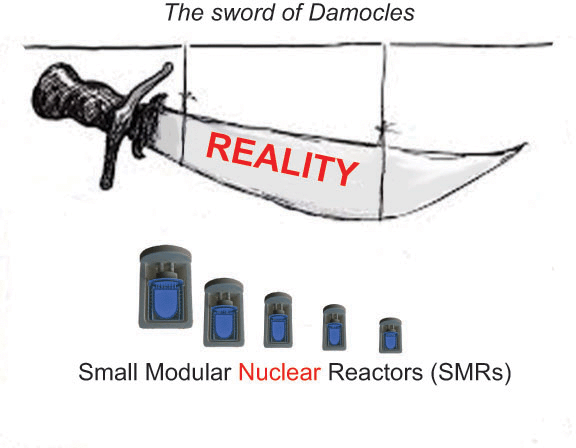 Let’s call SMRs what they are, Leaving out “nuclear” doesn’t minimize the danger, or the cost https://beyondnuclearinternational.org/2020/02/23/lets-call-smrs-what-they-are/By Gordon Edwards, Michel
  Duguay and Pierre Jasmin, February 23, 2020, On Friday the 13th, September 2019, the St John Telegraph-Journal’s front page was dominated by what many gullible readers hoped will be a good luck story for New Brunswick – making the province a booming and prosperous Nuclear Energy powerhouse for the entire world.
After many months of behind-the-scenes meetings throughout New Brunswick with utility company executives, provincial politicians, federal government representatives, township mayors and First Nations, two nuclear entrepreneurial companies laid out a dazzling dream promising thousands of jobs – nay, tens of thousands! – in New Brunswick, achieved by mass-producing and selling components for hitherto untested nuclear reactors called SMNRs (Small Modular Nuclear Reactors) which, it is hoped, will be installed around the world by the hundreds or thousands!
On December 1, the Saskatchewan and Ontario premiers hitched their hopes to the same nuclear dream machine through a dramatic tripartite Sunday press conference in Ottawa featuring the premiers of the provinces. The three amigos announced their desire to promote and deploy some version of Small Modular Nuclear Reactors in their respective provinces. All three claimed it as a strategy to fight climate change, and they want the federal government to pledge federal tax money to pay for the R&D. Perhaps it is a way of paying lip service to the climate crisis without actually achieving anything substantial; prior to the recent election, all three men were opposed to even putting a price on carbon emissions.
Motives other than climate protection may apply. Saskatchewan’s uranium is in desperate need of new markets, as some of the province’s most productive mines have been mothballed and over a thousand uranium workers have been laid off, due to the global decline in nuclear power. Meanwhile, Ontario has cancelled all investments in over 800 renewable energy projects – at a financial penalty of over 200 million dollars – while investing tens of billions of dollars to rebuild many of its geriatric nuclear reactors. This, instead of purchasing surplus water-based hydropower from Quebec at less than half the cost.
Three previous “small reactor” failures in Canada so far
These new nuclear reactors are so far perfectly safe, because they exist only on paper and are cooled only by ink. But declaring them a success before they are even built is quite a leap of faith, especially in light of the three previous Canadian failures in this field of “small reactors”. Two 10-megawatt MAPLE reactors were built at Chalk River and never operated because of insuperable safety concerns, and the 10-megawatt “Mega-Slowpoke” district heating reactor never earned a licence to operate, again because of safety concerns. The Mega-Slowpoke was offered free of charge to two universities – Sherbrooke and Saskatchewan – and several communities, all of whom refused the gift. And a good thing too, as the only Mega-Slowpoke ever built (at Pinawa, in Manitoba) is now being dismantled without ever producing a single useful megawatt of heat.
This current media hype about modular reactors is very reminiscent of the drumbeat of grandiose expectations that began around 2000, announcing the advent of a Nuclear Renaissance that envisaged thousands of new reactors — huge ones! — being built all over the planet. That initiative turned out to be a complete flop. Only a few large reactors were launched under this banner, and they were plagued with enormous cost-over-runs and extraordinarily long delays, resulting in the bankruptcy or near bankruptcy of some of the largest nuclear companies in the world – such as Areva and Westinghouse – and causing other companies to retire from the nuclear field altogether – such as Siemens.
 Speculation about that promised Nuclear Renaissance also led to a massive (and totally unrealistic) spike in uranium prices, spurring uranium exploration activities on an unprecedented scale. It ended in a near-catastrophic collapse of uranium prices when the bubble burst. Cameco was forced to close down several mines. They are still closed. The price of uranium has still not recovered from the plunge.
Large nuclear reactors have essentially priced themselves out of the market. Only Russia, China and India have managed to defy those market forces with their monopoly state involvements. Nevertheless, the nuclear contribution to world electricity production has plummeted from 17 percent in 1997 to about 10 percent in 2018. In North America and Western Europe, the prospects for new large reactor projects are virtually nil, and many of the older reactors are shutting down permanently without being replaced.
During long construction times nuclear makes the climate problem worse
Many people concerned about climate change want to know more about the moral and ethical choices regarding low-carbon technologies: “Don’t we have a responsibility to use nuclear?” The short reply is: nuclear is too slow and too expensive. The ranking of options should be based on what is cheapest and fastest — beginning with energy efficiency, then on to off-the-shelf renewables like wind and solar energy.
As a case in point, Germany installed over 30,000 megawatts of wind energy capacity in only 8 years, after deciding to close down all of its nuclear reactors by 2022. That is an impressive achievement – more than twice the total installed nuclear capacity of Canada. It would be impossible to build 30,000 megawatts of nuclear in only 8 years.
By building wind generators, Germany obtained some carbon relief in the very first year of construction, then got more benefit in the second year, even more benefit in the third, and so on, building up to a cumulative capacity of 30,000 MWe after 8 years. With nuclear, even if you could manage to build 30,000 megawatts in 8 years, you would get absolutely no benefit during that entire 8-year construction period.
In fact you would be making the problem worse by mining uranium, fabricating fuel, pouring concrete and building the reactor core and components, all adding to greenhouse gas emissions – earning no benefit until (and IF) everything is finally ready to function.
In the meantime (10 to 20 years), you will have starved the efficiency and renewable alternatives of the funds and political will needed to implement technologies that can really make an immediate and substantial difference.
In Saskatchewan, professor Jim Harding, who was director for Prairie Justice Research at University of Regina where he headed up the Uranium Inquiries Project, has offered his own reflection. Here is the conclusion of his December 2, 2019 comment:
“In short, small reactors are another distraction from Saskatchewan having the highest levels of GHGs on the planet – nearly 70 metric tonnes per capita. While the rest of Canada has been lowering emissions, those here, along with Alberta with its high-carbon tar sands, have continued to rise. Saskatchewan and Alberta’s emissions are now almost equal to all the rest of Canada. Shame on us!”
In the USA, engineers and even CEO’s of some of the leading nuclear companies are admitting that the age of nuclear energy is virtually over in North America. This negative judgment is not coming from people who are opposed to nuclear power, quite the opposite — from people lamenting the decline. See, for example, one major report from the Engineering faculty at Carnegie-Mellon University.
The SMR order book is filled with blank pages; there are no customers
That Carnegie-Mellon report includes Small Modular Nuclear Reactors in its analysis, without being any more hopeful for a nuclear revival on that account. The reason? It is mainly because a new generation of smaller reactors, such as those promised for New Brunswick, will necessarily be more expensive per unit of energy produced, if manufactured individually. The sharply increased price can be partially offset by mass production of prefabricated components; hence the need for selling hundreds or even thousands of these smaller units in order to break even and make a profit. However, the order book is filled with blank pages — there are no customers. This being the case, finding investors is not easy. So entrepreneurs are courting governments to pony up with taxpayers’ money, in the hopes that this second attempt at a Nuclear Renaissance will not be the total debacle that the first one turned out to be.
Over 150 designs and none built, tested, licensed or deployed
Chances are very slim however. There are over 150 different designs of “Small Modular Reactors”. None of them have been built, tested, licensed or deployed. At Chalk River, Ontario, a consortium of private multinational corporations, comprised of SNC-Lavalin and two corporate partners, operating under the name “Canadian Nuclear Laboratories” (CNL), is prepared to host six or seven different designs of Small Modular Nuclear Reactors — none of them being identical to the two proposed for New Brunswick – and all of these designs will be in competition with each other. The Project Description of the first Chalk River prototype Small Modular Reactor has already received over 40 responses that are posted on the CNSC web site, and virtually all of them are negative comments.
The chances that any one design will corner enough of the market to become financially viable in the long run is unlikely. So the second Nuclear Renaissance may carry the seeds of its own destruction right from the outset. Unfortunately, governments are not well equipped to do a serious independent investigation of the validity of the intoxicating claims made by the promoters, who of course conveniently overlook the persistent problem of long-lived nuclear waste and of decommissioning the radioactive structures. These wastes pose a huge ecological and human health problem for countless generations to come.
Finally, in the list of projects being investigated, one finds a scaled-down “breeder reactor” fuelled with plutonium and cooled by liquid sodium metal, a material that reacts violently or explodes on contact with air or water. The breeder reactor is an old project abandoned by Jimmy Carter and discredited by the failure of the ill-fated French SuperPhénix because of its extremely dangerous nature. In the event of a nuclear accident, the Tennessee Clinch River Breeder Reactor was judged capable of poisoning twelve American states and the SuperPhénix half of France.
One suspects that our three premiers are only willing to revisit these bygone reactor designs in order to obtain funding from the federal government while avoiding responsibility for their inaction on more sensible strategies for combatting climate changes – cheaper, faster and safer alternatives, based on investments in energy efficiency and renewable sources.
Gordon Edwards PhD, is President of the Canadian Coalition for Nuclear Responsibility. Michel Duguay, PhD, is a professor at Laval University. Pierre Jasmin, UQAM, is with Quebec Movement for Peace and Artiste pour la Paix.
Extradition case for Julian Assange – how it will proceed
 Julian Assange’s extradition case is finally heading to
  court – here’s what to expect more https://www.sbs.com.au/news/julian-assange-s-extradition-case-is-finally-heading-to-court-here-s-what-to-expe
February 24, 2020 Holly Cullen, Adjunct professor, University of Western AustraliaThe extradition hearing to decide whether to send Julian Assange to the United States to be tried for publishing classified military documents on Wikileaks is expected to finally begin today in London.Assange is charged with 17 counts under the Espionage Act, involving receipt, obtaining and disclosing national security information. He has also been charged with one count of conspiracy to assist Chelsea Manning to crack a US Department of Defense password to enable her to access classified information.
Assange has been in Belmarsh prison since his arrest in April 2019. He had been in solitary confinement in a prison medical unit, but was recently moved into a less isolated section of the prison due to concerns about his mental health.
From May to September of last year, Assange served a sentence for bail absconding, but since then has been waiting for the extradition hearing.
How will the process play out? Continue reading
Britain buying new nuclear warheads from USA: Pentagon knew about it, UK Parliament did not
|
The revelation has dismayed MPs and experts who question why they have learned of the move – which will cost the UK billions of pounds – only after the decision has apparently been made. It has also raised questions about the UK’s commitment to staunching nuclear proliferation and the country’s reliance on the US for a central plank of its defence strategy. Earlier this month, Pentagon officials confirmed that its proposed W93 sea-launched warhead, the nuclear tip of the next generation of submarine-launched ballistic missiles, would share technology with the UK’s next nuclear weapon, implying that a decision had been taken between the two countries to work on the programme. In public, the UK has not confirmed whether it intends to commission a new nuclear warhead. The Ministry of Defence’s annual update to parliament, published just before Christmas, says only: “Work also continues to develop the evidence to support a government decision when replacing the warhead.” But last week Admiral Charles Richard, commander of the US strategic command, told the Senate defence committee that there was a requirement for a new warhead, which would be called the W93 or Mk7. Richard said: “This effort will also support a parallel replacement warhead programme in the United Kingdom, whose nuclear deterrent plays an absolutely vital role in Nato’s overall defence posture.” Ed Davey, acting leader of the Liberal Democrats, said: “It is totally unacceptable that the government seems to have given the green light to the development of new nuclear weapon technologies with zero consultation and zero scrutiny. Britain under Johnson increasingly looks like putty in Trump’s hands. That Britain’s major defence decisions are being debated in the United States, but not in the UK, is a scandal. Under Johnson, it seems that where Trump leads, we must follow.” ………. https://www.theguardian.com/uk-news/2020/feb/22/pentagon-gaffe-reveals-uk-deal-replace-trident-nuclear-weapon |
|

1 This Month
26 April – Chernobyl: Inside the Meltdown airs on National Geographic on Sunday 26th April from 4pm

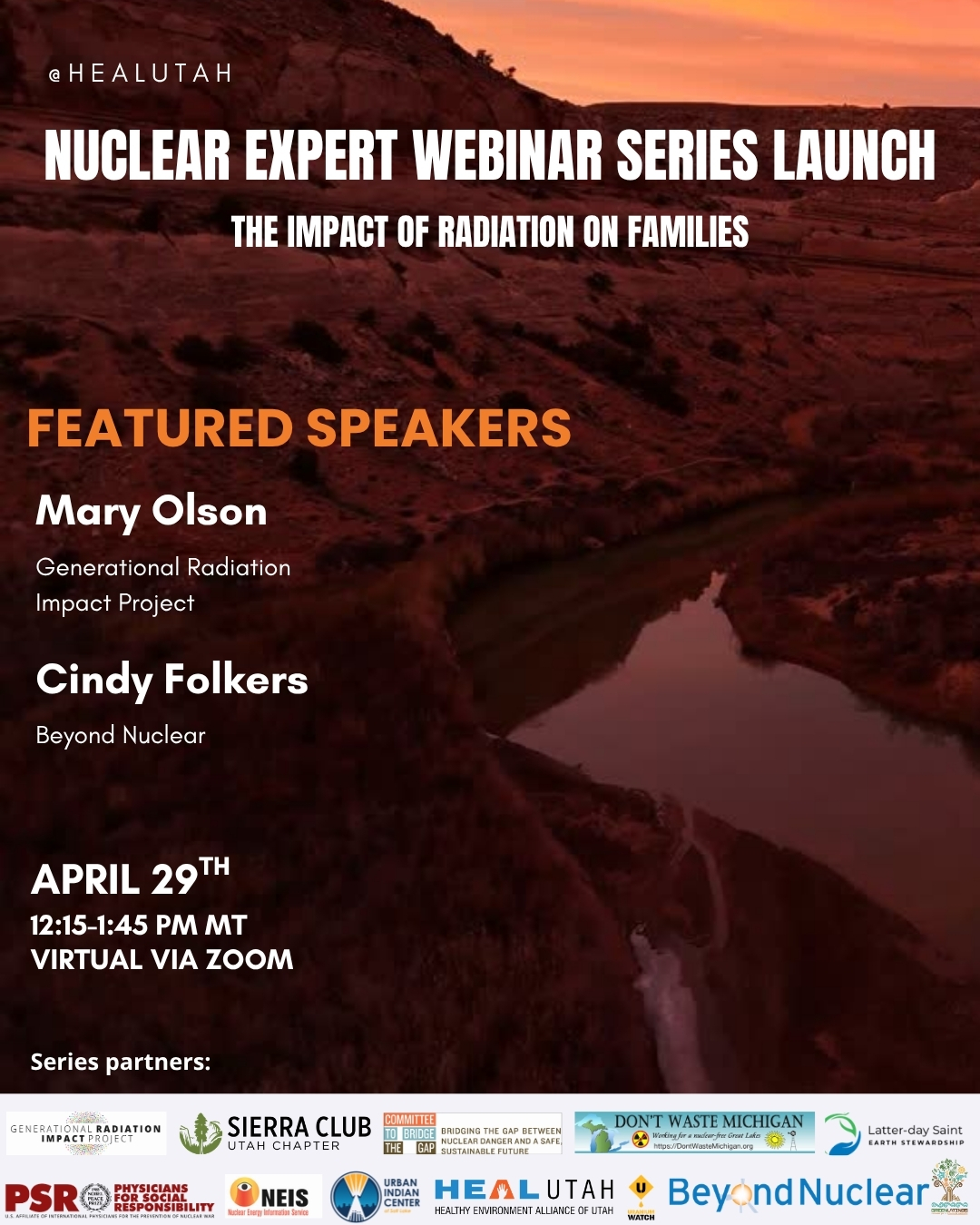
29 April – Nuclear Expert Webinar #1 – Radiation Impacts on Families with Mary Olson and Cindy Folkers
- 12:15 PM MT – 1:45 PM MT
- Location: Virtual – REGISTER TODAY

4 May -West Suburban Peace Coalition to discuss Iran war at May Educational Forum
Monday, May 4, 7:00 – 8:00 PM Central Standard Time
Title: : How Trump’s Narrative Tries to Shape the Reality of the War on Iran.
Contact Walt Zlotow, zlotow@hotmail.com 630 442 3045 for further information
14 May – online event From Bombs to Data Centres: the Face of Nuclear Colonialism

Pine Ridge Uranium is the real threat, not Tehran- Tell Burgum: Stop the Extraction.
Chernobyl: The Lost Tapes – A good documentary on Chernobyl on SBS available On Demand for the next 3 weeks– https://www.sbs.com.au/ondemand/tv-program/chernobyl-the-lost-tapes/2352741955560
To see nuclear-related stories in greater depth and intensity – go to https://nuclearinformation.wordpress.com
-
Archives
- April 2026 (288)
- March 2026 (251)
- February 2026 (268)
- January 2026 (308)
- December 2025 (358)
- November 2025 (359)
- October 2025 (376)
- September 2025 (257)
- August 2025 (319)
- July 2025 (230)
- June 2025 (348)
- May 2025 (261)
-
Categories
- 1
- 1 NUCLEAR ISSUES
- business and costs
- climate change
- culture and arts
- ENERGY
- environment
- health
- history
- indigenous issues
- Legal
- marketing of nuclear
- media
- opposition to nuclear
- PERSONAL STORIES
- politics
- politics international
- Religion and ethics
- safety
- secrets,lies and civil liberties
- spinbuster
- technology
- Uranium
- wastes
- weapons and war
- Women
- 2 WORLD
- ACTION
- AFRICA
- Atrocities
- AUSTRALIA
- Christina's notes
- Christina's themes
- culture and arts
- Events
- Fuk 2022
- Fuk 2023
- Fukushima 2017
- Fukushima 2018
- fukushima 2019
- Fukushima 2020
- Fukushima 2021
- general
- global warming
- Humour (God we need it)
- Nuclear
- RARE EARTHS
- Reference
- resources – print
- Resources -audiovicual
- Weekly Newsletter
- World
- World Nuclear
- YouTube
-
RSS
Entries RSS
Comments RSS
 nuclear-news