Wildlife charities unite to oppose Sizewell C nuclear power station
it must not go ahead. The RSPB and Suffolk Wildlife Trust (SWT) say they
have not seen evidence that the £14billion project can be built without
detrimentally impacting internationally and nationally important
landscapes, habitats, animals and plants on the Suffolk coast.
direct loss of nationally important and protected land on Sizewell Belts, a
Site of Special Scientific Interest (SSSI). An area between 10-12 hectares
– or roughly ten football pitches – will be covered in concrete. The
loss of this nationally rare fen habitat would be devastating and
irreplaceable.”
build will bring the Sizewell Estate adjacent to the internationally famous
wildlife haven. It is feared the building work may increase erosion,
upsetting the delicate balance of the reserve. It could affect the water
levels in Minsmere’s ditches, impacting its rare wetland wildlife, which
includes bitterns, water voles, otters and ducks.
https://www.eadt.co.uk/news/swt-rspb-unite-to-oppose-sizewell-c-nuclear-power-station-1-6674364
‘The Triumph of Doubt’ – corporations’ war on science
 Inside corporations’ war on science . A new book explains how corporations create a climate of doubt around science and expertise. Vox, By Sean Illing@seanillingsean.illing@vox.com May 26, 2020
Johnson & Johnson announced this week that it will stop putting talc, a mineral linked to asbestos, in its baby powder products. The move comes after years of lawsuits alleging that the powder causes various cancers.
It’s also a surprising turnaround. Johnson & Johnson has spent decades funding biased science and lobbying the government to avoid regulating its products or labeling them as cancer-causing. It’s a tactic deployed by many other industries that have a stake in stifling regulation and the science behind it.
The history of this practice is documented in a new book by David Michaels, the former assistant secretary of labor for the Occupational Safety and Health Administration (OSHA) under the Obama administration. It’s a close look at how powerful corporations fund junk science and misinformation campaigns in order to obscure evidence and undercut regulatory efforts.
Big Tobacco and the fossil fuels industry are obvious examples, but the problem goes well beyond that. From cancer-causing hair products and apparel to diabetes-linked food and sugary drinks, corporations have realized that you don’t have to convince the public or government officials of anything — all you have to do is create the illusion of doubt.
And they do that by piloting bogus studies, organizing partisan think tanks, supplying dubious congressional witnesses, and anything else they can think of to give regulators enough cover to plausibly look the other way. If you’ve ever heard a politician say “The science is still unclear” or “We need to keep researching the issue,” there’s a good chance that was made possible by industry-funded pseudo-science.
I spoke to Michaels about what this process looks like, why journalists and civic actors have been unable to stop it, and how the practice has become more pervasive in recent years. We also discussed the coronavirus pandemic and how the tactics he describes in this book helped lay the groundwork for the extreme skepticism of scientific expertise we’re seeing from conservatives.
“The Republican base,” Michaels told me, “has been acclimatized to be skeptical of mainstream science, and easily believe accusations that they are being manipulated by the deep state, the liberal media, and pointy-headed scientists.”
A lightly edited transcript of our conversation follows.
Sean Illing
When you say that big corporations like DuPont or Exxon manufacture doubt around their products, what do you mean?
David Michaels
I mean that they hire scientists who appear to be reputable to produce or obscure evidence about the products they make. If there are studies or even suggestions that their product is dangerous, you can hire a scientist who will say, “The evidence is in question,” or, “The study is wrong.”
Corporations make sure those scientists get their opinions into what look like credible peer-reviewed journals, then they get picked up by newspapers, then they have the sound bites that commentators repeat, and that’s enough to convince people that there’s uncertainty. Not necessarily that the product is safe, but that the scientific evidence isn’t there.
That’s basically how it works.
Sean Illing
You used the phrase “appear to be reputable.” What does that mean?
David Michaels
They are credentialed people, but they typically work for consulting firms whose business model is to provide any result their client needs……..
One of the things the Trump administration has done is essentially take the same mercenary scientists who have been working for corporations trying to influence the agencies to do the wrong thing and then given them high-level positions in these same agencies – [EPA , the FDA and other public institutions]…….
The example that I find most striking is a fellow named Tony Cox, who was appointed chairman of the Clean Air Scientific Advisory Committee by former EPA Administrator Scott Pruitt, who is himself a longtime lobbyist for the oil and coal industries……..
Sean Illing
So we’ve just made the process more efficient. Industry doesn’t even need middlemen to muddy the waters on their behalf now because they just have their own people appointed to run the agencies charged with regulating them…….
David Michaels
As the abject and enormously tragic failure of the Trump administration’s response to the Covid-19 pandemic becomes increasingly clear, the president and his supporters are taking the tobacco road, applying the same strategy used by cigarette manufacturers, fossil fuel corporations, and a host of other industries whose products and activities damage public health.
Not only is it the same strategy, it features the same cast of characters, and it is promoted in the same social media and cable TV venues, especially Fox News. Right-wing pundits, Trump administration officials, and scientists with long histories of discredited studies first declared the epidemic a hoax and then asserted the numbers of cases and deaths are wildly inflated. They have been eventually shown to be wildly wrong, but it has no impact on their credibility or their willingness to offer outrageous claims.
When the Trump administration is finally evicted from power, we will need to rebuild our system of public health protections, not simply by pouring more funding into federal agencies that were weak and flawed even before Trump, but by reimagining how they can be far more effective and inclusive, and are able to apply the best available science. And we must do this in a way that overcomes the anti-science culture fed by the current administration and the Republican party.
If we are unable to accomplish these goals, I fear that the nation’s disastrous response to Covid-19 is likely to be a preview of a very troubling future. https://www.vox.com/policy-and-politics/21137717/johnson-and-johnson-triumph-of-doubt-david-michaels
Chinese involvement in Sizewell nuclear plant the ‘next Huawei
 Telegraph 27th May 2020, Chinese involvement in Sizewell nuclear plant the ‘next Huawei’, MPs warn.
Call for energy policy and how the UK interacts with China to be reviewed.
Chinese involvement in the Sizewell C nuclear power station will be the
“next Huawei,” MPs have warned, as they called for an entire overhaul
of the energy policy.
It comes after EDF, the French energy company on
Wednesday submitted an application to build the next nuclear power plant in
Suffolk, which it intends to develop with the state-owned energy company,
China General Nuclear Power Group (CGN).
However Sir Iain Duncan Smith, the
former Conservative leader, warned the power plant was “the next
Huawei”. “It is another major manifestation of the problem we face
having set out on the wrong path with China years ago,” Sir Iain told The
Daily Telegraph.
Is it in the national interest? Chinese nuclear reactors for Bradwell, UK
BANNG 26th May 2020, The ‘golden era’ in relations between Britain and China which gave
birth to the prospect of a Chinese nuclear power station on the Blackwater
appears to be foundering less than five years after its triumphant
proclamation at the State Visit of the Chinese President Xi Jinping, in
October 2015.
The Blackwater Against New Nuclear Group (BANNG) has long
voiced its concerns about the potential security risks from Chinese control
of strategic UK infrastructure, such as the proposed Bradwell B nuclear
power station. These fears have been echoed by Dr. Robert Ford, the US
State Department’s Assistant Secretary for Non-Proliferation and
International Security, who has warned that the Chinese developer, China
General Nuclear Power Corporation, (CGN), ‘is closely linked to the
Communist regime’s military’ and urged Britain not to hand China
control of its electricity (Daily Mail, 16 May, 2020).
It is worth noting that the United states, with whom the UK is seeking a free trade deal, is
opposed to issuing a nuclear license to ‘an alien or any other
entity……it knows or has reason to believe is owned, controlled or
dominated by an alien, a foreign corporation, or a foreign government’
(Statement from US Nuclear Regulatory Commission).
Meanwhile, in the UK,
the ‘golden relationship’ is being questioned by Tory MPs, the Labour
Party and the Foreign Affairs and Defence Select Committees of MPs. Moves
are being made to toughen up company takeover laws, to strengthen security
and to assert the UK’s strategic independence. The Government has
recently set up ‘Project Defend’ to ‘identify, the country’s main
economic vulnerabilities to potentially hostile foreign governments as part
of a broader approach to national security’ (Reuters, 22 May, 2020).
BANNG’s Chair, Andy Blowers, has written to Nadhim Zahawi, the Energy
Minister, pointing to concerns about the Chinese threat to British
industry, trade and security and urging him to consider whether having
Chinese-designed and built reactors on a vulnerable site in Eastern England
is in the national interest.
Opposition to unnecessary, environmentally destructive Sizewell nuclear project
after the Covid-19 lockdown restrictions are lifted. Community leaders
believe people need to be able to attend public meetings and other events
as part of the process for the Sizewell C planning application submitted
yesterday.
earliest – and a final decision on the project late next year. The
leaders of East Suffolk Council and Suffolk County Council have been
supportive of EDF Energy making the Development Consent Order submission
for permission for the project but are continuing to call on the company to
ensure they talk to the two local authorities before triggering the formal
Section 56 process and timescale which includes a period of formal public
engagement.
Energy asking them to delay the Section 56 process given the current
Government guidance on social distancing, social isolation and public
gatherings. We believe all parties must be satisfied that appropriate
public engagement can take place. “We would like EDF Energy to continue
its discussions with both councils so we can work together to find a
suitable solution that works for all our communities.”
Suffolk county councillors calling on them to let their hearts rule their
heads and reject the project, which he claims will “irreparably alter
that unique Suffolk character and nature of this tranquil and welcoming
county, transforming it into just another over-developed, car-dominated,
road-centred, urbanised area of the UK like so many others – bland,
conformist and uniform”.
the national planning inspectorate for permission to build two huge nuclear
reactors on a site which is barely big enough to contain them. It requires
the destruction of the 100 year old Coronation Wood for its overspill
facilities. The construction is designed to house two European Pressurised
Reactors generating 3.2 gigawatts of electricity at full power. The
Sizewell B plant has recently reduced its output by 50% at a reported cost
of £50million due to over-supply. This over-supply is not just a
consequence of the covid-19 pandemic. In 2005, the government made plans to
meet a predicted 15% increase in electricity demand by 2020. In fact,
demand has dropped over those 15 years by 16%, an overestimation of demand
by more than 30%. It is axiomatic that Sizewell C is not needed to ‘keep
the lights on’ nor is it an essential infrastructure project.”
https://www.eadt.co.uk/news/edf-delay-on-sizewell-c-consultation-1-6672349
Fiji ratifies the TREATY ON THE PROHIBITION OF NUCLEAR WEAPONS.
Prohibition of Nuclear weapons treaty ratified https://www.fbcnews.com.fj/news/parliament/prohibition-of-nuclear-weapons-treaty-ratified/
|
|

Opposition in Canada to nuclear waste dump on agricultural land
Opposition gathering to nuclear fuel disposal vault in South Bruce, The Sun Times, 29 May 20
|
NWMO’s other preferred site is also in Ontario, in the Ignace area, northwest of Lake Superior, and feasibility studies are underway for both sites.It would take 10 years to undertake the environmental regulatory approval process. Plans call for construction to begin in 2033 and take about 10 years, with operation starting in 2043, according to the NWMO. South Bruce Mayor Bob Buckle said in January it seemed to him there was little opposition to the project, but that has changed. At an online South Bruce council meeting Tuesday, Teeswater-area beef and sheep farmer Michelle Stein spoke on behalf of a citizen’s group, Nuclear Tanks, No Thanks, which loosely formed in February. Her farm is next to one purchased by NWMO for the project northwest of Teeswater, part of the parcel of land where metal-encased spent fuel rods could be buried for thousands of years. She told council “there’s way too many risks involved with this project and they need to have a referendum to let the community decide. Like we have over 1,500 signatures that were collected before COVID,” before the virus stopped door-knocking, she said by phone Thursday. “Council just it seemed turned to ignore us and do their own thing.” She noted Buckle was elected with 1,380 votes. The group has an information website www.protectsouthbruce-nodgr.org, which includes an online petition with some 1,800 signatures, which prior to the pandemic was intended for people who aren’t local to sign……. Becky Smith, a NWMO spokeswoman said “We’re a farming community. I don’t understand why they’d want to turn us into a mining community, and then bury the world’s most radioactive waste underneath our water table,” A four-week comment period opened Wednesday and ends June 30 about whether a draft report accurately summarizes public concerns and wishes expressed during workshops held between December and February…….. n January, SON held a community vote which turned down a separate nuclear waste vault proposal, for lower- and mid-level nuclear waste, championed by Ontario Power Generation. It was to be built in Bruce County too, near the Bruce Power nuclear plant close to Kincardine. Saugeen First Nation Chief Lester Anoquot said Wednesday he has a letter from NWMO confirming the high-level nuclear waste vault requires First Nation consent. “We’re continuing dialogue. It’s kind of difficult right now, working remotely,” given the COVID-19 pandemic, he said. “It will probably go to a community vote again for acceptance or not. I think the process will mirror the one that was just conducted with the last DGR (deep geological repository) proposal.” The site falls within Saugeen Ojibway Nation’s traditional territory and its support is required for the project to proceed, Belfadhel has said.https://www.owensoundsuntimes.com/news/local-news/opposition-gathering-to-nuclear-fuel-disposal-vault-in-south-bruce |
|

Bankrupt French company AREVA, now resuscitated as Framatome to engineer UK’s nuclear fleet
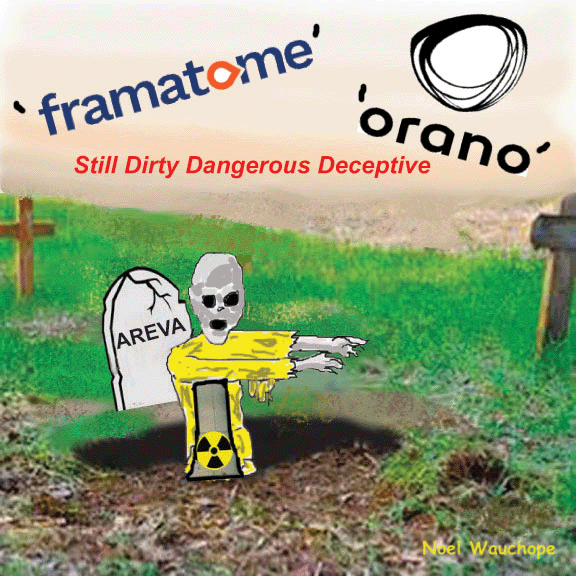
Framatome to provide engineering services to UK nuclear fleet, 29 May 2020 French company Framatome has signed a framework agreement with EDF in the UK to provide engineering services to support ongoing nuclear power plant operations…… EDF in the UK operates a fleet of eight nuclear power stations: Sizewell B, Hinkley Point B, Dungeness B, Hartlepool, Heysham 1 and 2, Hunterston, and Torness. https://www.neimagazine.com/news/newsframatome-to-provide-engineering-services-to-uk-nuclear-fleet-7944809
Huge task of carting 770-ton nuclear reactor from Southern California to Utah
The train carrying a decommissioned nuclear reactor vessel from Southern California is passing through Las Vegas on Thursday afternoon.
The vessel from the San Onofre Nuclear Generating Station is headed for a burial ground in Utah. It will be transferred starting either Friday or Saturday at Apex Industrial Park, according to Nevada Department of Transportation spokesman Tony Illia.
Cranes will be used to lift the heaviest load to ever travel a Nevada road onto a 45-axle, 180-tire trailer. It will take a couple of weeks to complete the transfer.
4 tractors to push and pull, The 300-foot-long shipment will consist of two tractors to pull and another two tractors to push the over 1.5-million pound load.
It will travel at 5 to 10 mph on the highway for the 400-mile trip to Clive, Utah, where it will be buried at EnergySolutions, the contractor that is dismantling the plant.
NDOT has to issue an overdimensional permit, which won’t occur until 24 hours before hitting the highway, Illia said.
Nevada State Patrol troopers will escort the shipment to the Utah border……… https://www.reviewjournal.com/local/local-las-vegas/downtown/2-weeks-needed-to-switch-770-ton-nuclear-reactor-from-train-to-truck-2037931/
Safety lapses at France’s nuclear reactors, newv delays at EDF’s Flamanville 3 nuclear reactor
Regulator unaware of fresh delays at EDF’s Flamanville 3 nuclear reactor https://www.reuters.com/article/france-nuclearpower/regulator-unaware-of-fresh-delays-at-edfs-flamanville-3-nuclear-reactor-idUSL8N2DA3O9 PARIS, May 28 (Reuters) – French nuclear regulator ASN said on Thursday it was not aware of fresh delays in the construction of EDF’s Flamanville 3 EPR nuclear reactor, despite the coronavirus outbreak disrupting works.
State-controlled utility EDF, which operates France’s 57 nuclear reactors, had previously said that the pandemic had slowed construction work at the reactor in the north of France, but it did not say if it would lead to further delays.
The project is running more than a decade behind schedule and it is now expected to start around 2023 after the regulator demanded EDF repair defective welds.
ASN’s head Bernard Doroszczuk, told a French Senate hearing on Thursday that some hundreds of welds, and eight other difficult-to-reach enclosure crossing welds, are still expected to be redone before the reactor is commissioned.
Overall, the process of repairing, refurbishing or checking the reactor seems to be going smoothly compared to the schedule that was announced, but obviously I can’t predict what will happen next,” Doroszczuk said.
He said safety levels at French nuclear facilities remained “acceptable” but operational rigor at EDF’s nuclear power plants declined in 2019, citing several safety lapses.
European Union’s recovery plan promotes renewable energy, omits nuclear
 European recovery plan omits nuclear, WNN 27 May 2020 .……. the Commission’s announcement of a two-fold recovery plan from the coronavirus pandemic – Next Generation EU – to boost the EU budget with new financing raised on the financial markets for 2021-2024, and a reinforced long-term budget of the European Union for 2021-2027……..
The Commission said the policy fundamentals of the recovery include the European Green Deal, meaning “a massive renovation wave” of buildings and infrastructure and a more circular economy, bringing local jobs; rolling out renewable energy projects, especially wind, solar and kick-starting a clean hydrogen economy in Europe; cleaner transport and logistics, including the installation of one million charging points for electric vehicles and a boost for rail travel and clean mobility in cities and regions; and strengthening the Just Transition Fund to support re-skilling, helping businesses create new economic opportunities.
Resuming Nuclear Testing a Slap in the Face to Survivors
Resuming Nuclear Testing a Slap in the Face to Survivors HTTPS://ALLTHINGSNUCLEAR.ORG/GUEST-COMMENTARY/RESUMING-NUCLEAR-TESTING-A-SLAP-IN-THE-FACE-TO-SURVIVORS LILLY ADAMS , UCS | MAY 26, 2020, The news that the Trump administration is considering resuming nuclear weapons testing is morally abhorrent. The current US moratorium on nuclear testing was put in place for many reasons, but we must not forget one crucial reason: In conducting explosive nuclear tests, the US government killed thousands of innocent people and sickened untold thousands more.
The very suggestion of resuming nuclear testing is shocking and a slap in the face to testing survivors who have spent decades watching their loved ones pass away—survivors like Sandra Walsh, of Salt Lake City, who grew up in Parowan in southern Utah, which received high levels of fallout from the Nevada Test Site.
“My family and I are Downwinders,” said Walsh. “I have had thyroid cancer and I have lost three of my children, three little girls, a mother should die before her children. My family, three sisters and my mom and dad all have had cancer. I have helped over 5000 downwinders get the help they need from the government. That is just a small amount of the people that have been affected by the bomb testing. My hope is that it will never happen again.”
Millions of Americans exposed to radioactive fallout
By treaty, the United States is barred from conducting above-ground nuclear tests, the type that created the mushroom clouds that regularly spread radiation across much of the country in the 1950s and 1960s. But underground testing has its own deadly risks, as well as severe environmental and health consequences. In fact the second most fallout-intensive nuclear weapons test in the continental US was an underground test in Nevada, exposing millions of Americans to radioactive fallout as far away as Iowa and Illinois. Another test—one that was intended to be fully contained underground—accidentally released 80,000 curies of radioactive iodine-131 into the atmosphere.
In addition, any resumption of explosive testing could quickly lead other nuclear weapons states to resume testing as well, further accelerating the arms race that is already building around the world. The kind of nuclear posturing we are seeing today led to massive above-ground testing and resulting deaths during the Cold War. We should do everything possible to avoid heading down this path again.
To do this, we must understand the history and the consequences of testing. The United States conducted over 1,000 nuclear weapons tests between 1945 and 1992, and 216 of them were above ground. The US conducted far more tests than any other country, with Russia conducting just over 700 tests and China only 45.
The scope of death and illnesses that resulted from this testing is hard to quantify, but it was devastating no matter how you look at it. A 1997 study from National Cancer Institute, which only examined thyroid cancers that may have resulted from exposure to I-131 estimated that up to 75,000 cancers could be connected to the testing. That study did not look at other illnesses that might have resulted from exposure to additional radioactive contaminants.
Meanwhile, in 2008, Arjun Makhijani, President of the Institute for Energy and Environmental Research, estimated deaths from nuclear testing at around 200,000. A recent study from the University of Arizona put the number higher, at 340,000 to 460,000 likely deaths. A study from International Physicians for the Prevention of Nuclear War estimated that ultimately, global cancer deaths from nuclear testing could reach 2.4 million.
Radioactive fallout from nuclear weapons testing spread across the United States, including Arizona, Colorado, Idaho, Montana, Nevada, New Mexico, Utah and Guam. In 1953, radiochemistry students in Troy, New York, 2,500 miles from the Nevada Test Site, measured radiation levels many times above normal, which were later connected to a nuclear weapons test in Nevada two days earlier. In the Marshall Islands, the US tested 67 nuclear weapons. The total explosive yield of those tests is equal to one Hiroshima-sized bomb detonated every single day for 20 years. The Defense Threat Reduction Agency admits that in the course of nuclear weapons testing, 550,000 military service members were exposed to radiation.
Seventy-five years after the first above-ground nuclear weapons test, the victims of nuclear weapons testing are in many cases still fighting for basic recognition of harm, as well as compensation for their often staggering health concerns. Downwinders of tests and uranium workers are fighting for equitable compensation through the Radiation Exposure Compensation Act, which currently has gaping holes in coverage and is set to expire in 2022.
Nuclear test survivors still owed billions
Tona Henderson, head of Idaho Downwinders, which has been fighting since 2004 for compensation for downwinders in Idaho, stated:
“It is unbelievable that anyone would think it was alright to start nuclear testing again! The government has not even compensated the Downwinders from the first 100 tests. We don’t need to kill and maim our own citizens again. On Memorial weekend we honored our fallen soldiers. Downwinders have suffered losses through no fault of their own, yet there will be no parades or flag draped coffins for us. Would you do these tests if your children or grandchildren were in the fallout path?”
Largely because of the impact of nuclear testing, Marshallese people living in the United States were promised Medicaid under an agreement called the Compact of Free Association, but this was stripped from them in 1996. In addition, the US owes billions of dollars to the Marshall Islands for unpaid health and environmental claims due to testing.
Shamanda Hanerg, Lani Kramer, Desmond Doulatram with REACH-MI, a non-profit in the Marshall Islands focused on their nuclear legacy, shared the following statement in response to the news:
“With outstanding human rights claims, one should pay no surprise as to why the Marshall Islands has been aggressive in the international scene in climate change and nuclear disarmament.
Our grandparents and parents suffered tremendously from the horrific effects of the nuclear testing (by the U.S. Government) on our beautiful islands. That was 74 years ago. We haven’t returned to our home, our ancestral heritage, because our land is contaminated by the many toxins and poisons we can’t even pronounce. Some of our islands were vaporized instantly from the nuclear testing.
We suffered severe burns from being in the direct fallout of the bombs. We continue to have miscarriages, still births, birth defects, various cancers, genetic disorders, and many more illnesses.
The enormity of the devastation of damages done by the nuclear testing is unfathomable, unthinkable, and inhumane. The mass destruction of the bombs on our islands have left us nuclear nomads…emotionally, mentally, and physically scarred forever.
More than ever we need to be emboldened and united in our quest to fight for justice and nuclear disarmament. For the U.S. Government to even consider continuing with nuclear testing would be an injustice to the People of the Marshall Islands.”
As a country, we have so much work left to do to right the wrongs of nuclear testing. It is unconscionable that the Trump administration is now considering resuming testing while these people are still fighting for justice.
Heavy problems in transporting dead nuclear reactor, especially in hot weather

When it does arrive, the 770-ton nuclear reactor vessel will be unloaded from the world’s largest rail car at Apex Industrial Park to be trucked north on eastern Nevada roads before eventually being buried at Clive, Utah, about 75 miles west of Salt Lake City.
But before that leg of the journey, Nevada needs to shore up some drainage structures along the undisclosed route to Wendover, Utah.
“We anticipate that the vessel will get shipped to Apex sometime in early June,” Department of Transportation spokesman Tony Illia said in an email Tuesday. “However, the drainage structures along the transport route through Southern Nevada need reinforcing in order to handle the load. The structures would get crushed like a soda can because the load is so heavy.”
The company hired to deliver the reactor to Utah is Emmert International, which is among the world’s biggest movers of heavy equipment. Workers plan to use heavy-duty hydraulic jacks to support the culverts when the vehicle hauling the reactor passes over, Illia said.
“It would be, by far, the biggest object ever moved on a road in the state,” he said. “Our people have been scratching their heads for months to figure out a route that could work.”………
Security will be making the trip as well.
Any asphalt or road surface could buckle under the 1.5 million-plus pounds of the reactor, plus a shipping skid that adds 7 tons to the total. Making such a shipment during warmer months is a bigger issue than it would be in colder weather…….. https://www.reviewjournal.com/local/decommissioned-nuclear-reactor-will-be-heavy-load-for-nevada-roads-2036202/
Nuclear deregulation threatens workers at Pennsylvania plants and nationwide
|
Nuclear deregulation threatens workers at Pennsylvania plants and nationwide https://www.inquirer.com/opinion/commentary/nuclear-plants-coronavirus-regulatory-commission-pennsylvania-20200526.html May 26, 2020 ,Paul Gunter and Linda Pentz Gunter, For the Inquirer Workers at nuclear power plants, just like everywhere else, are falling ill with the highly contagious Covid-19. Pennsylvania’s Susquehanna and Limerick power plants are among those that have so far identified infections among their staff, with incidences soaring at some plants.
One might hope that, at a time of such crisis, the nuclear power industry and its regulator would take every possible step to ensure the health and safety of nuclear workers and their families, as well as the surrounding communities where they live. Unfortunately, the opposite is happening. Instead, the U.S. Nuclear Regulatory Commission (NRC) is relaxing nuclear power plant safety inspections and maintenance while allowing essential staff, including control room operators, security forces and fire brigades, to work longer and exhausting shifts. The extended permitted hours — up to 86-hour work weeks for two weeks straight — are justified, the NRC says, due to absenteeism, workers in quarantine, and Centers for Disease Control (CDC) guidelines for the Covid-19 pandemic, which recommend social distancing, necessitating fewer staff on site. Yet at the same time, the NRC is allowing nuclear power plants to proceed with refueling operations, which can bring in as many as 1,800 workers from across the country. While the nuclear industry was among those in the energy sector demanding priority testing for Covid-19, it is not clear whether testing for the coronavirus was conducted on workers before they arrived at the plants, given the scale of the outbreaks. More recent positive cases have been discovered through testing, with some tests conducted by workers’ personal physicians. The Limerick nuclear power plant in Pennsylvania, which has now completed refueling, saw a level of overcrowding during refueling that alarmed workers. They described sitting “elbow to elbow” in canteens and computer labs, terrified that the coronavirus would rapidly spread among them. One told the Pottsdown Mercury he was “in a constant state of paranoia.” Such a “wildfire” spread of Infection became a reality at the Fermi 2 reactor in Michigan, which was forced to halt refueling. Close to 200 workers tested positive for Covid-19 at the Vogtle nuclear power plant in Georgia, where work has not been stopped, although the workforce has been cut back. Asking workers to put in exhausting shifts not only weakens their immune systems, making them more susceptible to the coronavirus, but could also lead to fatigue-driven errors. Investigators found that sleep deprivation played a part in the March 1979 nuclear accident at the Three Mile Island reactor near Harrisburg. Compounding these risks is the request by reactor operators to postpone inspections of critical safety components, such as steam generators and reactor emergency core cooling systems, for an additional 18 months. The NRC is now allowing for these delays. But skipping over essential safety checks could come at a high price. Steam generators are critical to power operations and reactor safety. The reactors’ harsh operational environment places extreme stresses on the heat transfer component, causing tube degradation from vibration, heat, radiation, corrosion, and cracking that must be guarded against through routine inspection and maintenance. Arguing for a reduction in nuclear power plant staff to avoid unnecessary contact might sound reasonable if it were not contradicted by the overcrowding brought on by the influx of large refueling crews. This suggests that the shared priority of the nuclear industry and its captured regulator is production, putting financial interests ahead of the wellbeing and safety of workers and surrounding communities. Mandatory testing of refueling crews and maintenance crews could prioritize both production and safety agendas. Overextending exhausted workers could be also avoided by allowing reactors closed for refueling to delay restart and remain shuttered, especially given that electricity demand has fallen with most of the country in lockdown. Instead, those stay-at-home workers could supplement the crews at operating plants, ensuring worker safety and site security and reducing the likelihood of an accident due to exhaustion or human error. The prospect of a serious nuclear power accident under the current pandemic conditions would set up an impossible choice for entire communities surrounding the affected reactor, already sheltering in place from the viral threat: whether to evacuate with potentially tens of thousands of others, or stay, instead risking radiation exposure. The disastrous flooding last week in Michigan, necessitating mass evacuations, has now given us a preview of this conundrum, without the added danger of radiation exposure. Japan faced such a confluence of crises in March 2011, when the country was struck with an earthquake and tsunami, followed by widespread radiation contamination from the Fukushima nuclear meltdowns. This resulted in rescue attempts of some survivors of the tsunami and earthquake being abandoned due to the high levels of radioactivity in areas too contaminated for first responders to enter. Now is not a time to increase the likelihood of a serious nuclear accident here at home. Instead, the NRC should be taking this opportunity to fulfill its stated mandate of “protecting the people and environment,” rather than bowing to the craven financial interests of the nuclear power industry.
Paul Gunter is Director of the Reactor Oversight Project at Beyond Nuclear, a national non-profit anti-nuclear watchdog organization based in Takoma Park, Maryland. Linda Pentz Gunter is Beyond Nuclear’s international specialist and edits and writes for its online magazine, Beyond Nuclear International. |
|
During pandemic, U.S. military runs the largest maritime war games in the world
COVID-19: US Military Pursues War Games Amid Contagion, Consortium News, May 26, 2020 A robust schedule of military maneuvers and exercises is either underway or planned for Europe and the Pacific this year, with more in store for 2021, Ann Wright reports. During the pandemic the U.S. military is running the largest maritime military maneuvers in the world, with Rim of the Pacific (RIMPAC) coming to the waters off Hawaii Aug. 17-31, bringing 26 nations, 25,000 military personnel, up to 50 ships and submarines and hundreds of aircraft.Hawaii hasstringent measures to combat the spread of Covid-19, with a mandatory 14-day quarantine for all persons arriving in the state; returning residents as well as visitors. This quarantine is required until at least June 30, 2020.
The U.S. Army is also pursuing a 6,000-person war game in Poland, June 5-19, with a Polish airborne operation and a U.S.-Polish division-size river crossing.
If these weren’t too many military operations during an epidemic in which personnel on 40 U.S. Navy ships have come down with the hyper-contagious virus and during which military personnel and their families have been told not to travel, plans are also underway for a U.S. Army division-sized exercise in the Indo-Pacific region in less than a year. Known as Defender 2021, the U.S. Army has requested $364 million to conduct the war exercises throughout Asian and Pacific countries.
The pivot to the Pacific, begun under the Obama administration, and maintained by the Trump administration, is reflected in a U.S. National Defense Strategy (NDS) that sees the world as “a great power competition rather than counterterrorism and has formulated its strategy to confront China as a long-term, strategic competitor.”
Earlier in May, the U.S. Navy sent at least seven submarines, including all four Guam-based attack submarines, several Hawaii-based ships and the San Diego-based USS Alexandria to the western Pacific in what the Pacific Fleet Submarine Force announced as simultaneous “contingency response operations” for all of its forward-deployed subs. This was all in support of the Pentagon’s “free and open Indo-Pacific ” policy — aimed at countering China’s expansionism in the South China Sea — and as a show of force to counter ideas that the capabilities of U.S. Navy forces have been reduced by Covid-19…….
In May, 2020, the Australian government announced that a delayed six-month rotation of 2,500 U.S. Marines to a military base in Australia’s northern city of Darwin will go ahead based on strict adherence to Covid-19 measures including a 14-day quarantine. The Marines had been scheduled to arrive in April but their arrival was postponed in March because of the pandemic.
The remote Northern Territory, which had recorded just 30 Covid-19 cases, closed its borders to international and interstate visitors in March, and any arrivals must now undergo mandatory quarantine for 14 days. U.S. Marine deployments to Australia began in 2012 with 250 personnel and have grown to 2,500. The Joint U.S. Defense facility Pine Gap— the U.S. Department of Defense, Five Eyes and CIA surveillance facility that pinpoints airstrikes around the world and targets nuclear weapons, among other military and intelligence tasks — was also adapting its policy and procedures to comply with Australian government COVID restrictions.
As the U.S. military expands its presence in Asia and the Pacific, one place it will NOT be returning to is Wuhan, China. In October 2019, the Pentagon sent 17 teams with more than 280 athletes and other staff members to the Military World Games in Wuhan. Over 100 nations sent a total of 10,000 military personnel to the games in Wuhan last October.
The presence of a large U.S. military contingent in Wuhan just months before the outbreak of the Covid-19 in Wuhan in December 2019, fueled a theory by some Chinese officials that the U.S. military was somehow involved in the outbreak, which now has been used by the Trump administration and its allies in Congress and the media that the Chinese deliberately used the virus to infect the world and adding justification for the U.S. military build-up in the Pacific region.
Ann Wright served 29 years in the U.S. Army/Army Reserves and retired as a colonel. She was a U.S. diplomat for 16 years and served in U.S. Embassies in Nicaragua, Grenada, Somalia, Uzbekistan, Kyrgyzstan, Micronesia, Afghanistan and Mongolia. She resigned from the U.S. government in March 2003 in opposition to President George W. Bush’s war on Iraq. She is co-author of “Dissent: Voices of Conscience.” https://consortiumnews.com/2020/05/26/covid-19-military-pursues-war-exercises-amid-contagion/
1 This Month
23 April – WEBINAR – Why new nuclear reactors are the wrong tools for decarbonization Thursday, April 23 • 1 AM – 2 AM AEST

Pine Ridge Uranium is the real threat, not Tehran- Tell Burgum: Stop the Extraction.
Chernobyl: The Lost Tapes – A good documentary on Chernobyl on SBS available On Demand for the next 3 weeks– https://www.sbs.com.au/ondemand/tv-program/chernobyl-the-lost-tapes/2352741955560
To see nuclear-related stories in greater depth and intensity – go to https://nuclearinformation.wordpress.com
-
Archives
- April 2026 (241)
- March 2026 (251)
- February 2026 (268)
- January 2026 (308)
- December 2025 (358)
- November 2025 (359)
- October 2025 (376)
- September 2025 (257)
- August 2025 (319)
- July 2025 (230)
- June 2025 (348)
- May 2025 (261)
-
Categories
- 1
- 1 NUCLEAR ISSUES
- business and costs
- climate change
- culture and arts
- ENERGY
- environment
- health
- history
- indigenous issues
- Legal
- marketing of nuclear
- media
- opposition to nuclear
- PERSONAL STORIES
- politics
- politics international
- Religion and ethics
- safety
- secrets,lies and civil liberties
- spinbuster
- technology
- Uranium
- wastes
- weapons and war
- Women
- 2 WORLD
- ACTION
- AFRICA
- Atrocities
- AUSTRALIA
- Christina's notes
- Christina's themes
- culture and arts
- Events
- Fuk 2022
- Fuk 2023
- Fukushima 2017
- Fukushima 2018
- fukushima 2019
- Fukushima 2020
- Fukushima 2021
- general
- global warming
- Humour (God we need it)
- Nuclear
- RARE EARTHS
- Reference
- resources – print
- Resources -audiovicual
- Weekly Newsletter
- World
- World Nuclear
- YouTube
-
RSS
Entries RSS
Comments RSS
 nuclear-news