Eminent Persons Warn Against Any Demonstration Nuclear Test Explosion
Eminent Persons Warn Against Any Demonstration Nuclear Test Explosion InDepth News, By Reinhard Jacobsen VIENNA (IDN) 30 May 20– Members of the CTBTO Group of Eminent Persons (GEM) have expressed “deep concern about credible press reports” that senior U.S. officials have discussed the possibility of conducting “a demonstration nuclear test explosion”.
They warn that if carried out, it would break the global moratorium on nuclear weapon test explosions and severely undermine the Comprehensive Nuclear Test Ban (CTBT) regime, established to help detect and deter nuclear weapon test explosions anywhere in the world.
“Nuclear weapon test explosions, for any purpose, are a vestige of a bygone era,” the Group maintains. “Only one state this century has detonated nuclear weapon tests, and today all of the world’s nuclear armed states are observing nuclear test moratoria,” it adds.
The CTBT bans all nuclear explosions, thus hampering both the initial development of nuclear weapons as well as significant enhancements. The Treaty also helps prevent harmful radioactive releases from nuclear testing.
The U.S. is among eight ‘Annex 2’ States that must sign and ratify before the Treaty comes into force. Along with China, Egypt, Iran and Israel, the U.S. has signed but not ratified the Treaty. However, the other three Annex 2 countries – India, North Korea and Pakistan – have not even signed.
The CTBT has so far been signed by 184 States, of which 168 have ratified the Treaty.
The GEM, launched on September 26, 2013 at the United Nations Headquarters in New York, supports and complements the CTBTO’s efforts to promote the CTBT entry into force, as well as reinvigorating international endeavours to achieve this goal. The group comprises eminent personalities and internationally recognized experts.
The CTBTO, with Dr Lassina Zerbo as Executive Secretary since August 2013, is the Preparatory Commission for the Comprehensive Nuclear-Test-Ban Treaty Organization. It is an international organization established by the States Signatories to the Treaty on November 19, 1996, and has its headquarters in Vienna, Austria. An Agreement (A/RES/54/28) to regulate the relationship between the United Nations and the CTBTO was adopted in 2000 by the General Assembly.
The GEM members are calling on eight hold-out Annex 2 countries to ratify the CTBT. “The most effective way to resolve possible concerns about very low-yield nuclear explosions and enforce compliance” with the Treaty, is to bring it into force. “When it does enter into force, States have the option to demand intrusive, short-notice on-site inspections to investigate suspicious activities,” they maintain……… https://www.indepthnews.net/index.php/global-governance/ctbto/3579-eminent-persons-warn-against-any-demonstration-nuclear-test-explosion
Britain, France, Germany not happy that USA will end waivers for Iran civilian nuclear projects
“We deeply regret the decision by the United States to end the three exemptions for key nuclear projects of the Joint Comprehensive Plan of Action (JCPOA), including the Arak reactor modernization project,” the statement said.
“These projects, including the Arak reactor modernization project, endorsed by U.N. Security Council Resolution 2231, have served the non-proliferation interests of all and provide the international community with assurances of the exclusively peaceful and safe nature of Iranian nuclear activities,” the three counties said.
Wednesday the United States announced the end of the waivers, which had allowed the continuation of projects related to Iran’s civil nuclear program, even though the Trump administration abandoned the 2015 international plan of action in 2018.
Under the waivers Russian, Chinese and European companies worked on the conversion of Iran’s Arak heavy water reactor to civilian purposes and on the transfer of nuclear fuel abroad.
Childhood cancers near nuclear facilities
have told us that the high incidence of childhood cancer in the North West
should be the subject of a government inquiry – suspect it is the same
tale wherever people are downwind of nuclear installations and transports
of nuclear materials.
Sellafield’s radioactive cats
Carlisle News & Star 30th May 2020, Claims that cats from West Cumbria’s nuclear site given out for adoption were found to have plutonium in their system have been challenged by
Sellafield. Radiation Free Lakeland claims samples analysed from two cats
showed plutonium and cesium in the poop of one of them. Marianne Birkby, of
the campaign group, said: “For Sellafield to be handing out cats to the
public is rather at odds with their policy of culling wildlife on site to
contain radioactive contamination.
https://www.newsandstar.co.uk/news/18476222.sellafield-challenges-claim-plutonium-sites-cats/
Ex-president Kravchuk estimates compensation for Ukraine’s nuclear weapons at US$250 bln.
Ex-president Kravchuk estimates compensation for Ukraine’s nuclear weapons at US$250 bln. UNIAN Information Agency 30 May 20 No negotiations were held with the United States on the compensation.Leonid Kravchuk, the first president of independent Ukraine, estimates compensation for scrapping the country’s nuclear weapons after signing the Budapest memorandum at US$250 billion. “The nuclear weapons were tactical, they also went to Russia. There were Backfire carriers, these are legendary aircraft. They also were transferred to Russia. If one counts everything – it’s somewhere about US$250 billion,” Kravchuk told Ukrainian TV host and journalist Alesia Batsman during the Batsman program.
Here’s a supremely unaffordable nuclear fantasy – reactors on the moon and Mars
 NASA Wants to Go Nuclear on the Moon and Mars for Astronaut Settlement, SciTech Daily By AMERICAN CHEMICAL SOCIETY MAY 31, 2020 m It might sound like science fiction, but scientists are preparing to build colonies on the moon and, eventually, Mars.
  With NASA planning its next human mission to the moon in 2024, researchers are looking for options to power settlements on the lunar surface. According to a new article in Chemical & Engineering News, the weekly newsmagazine of the American Chemical Society, nuclear fission reactors have emerged as top candidates to generate electricity in space.
Huge dead nuclear reactor is a tough haul on Nevada’s roads
Decommissioned nuclear reactor heavy haul for Nevada roads, https://www.thenewstribune.com/news/business/article243115931.html, BY MARVIN CLEMONS LAS VEGAS REVIEW-JOURNAL MAY 30, 2020 A nuclear reactor vessel from Southern California’s decommissioned San Onofre Nuclear Generating Station made its way through Las Vegas by rail this week, headed to a transfer site and placement on a truck to become the heaviest object ever moved on a Nevada highway.
“By far, the biggest object ever moved on a road in the state,” Nevada Department of Transportation spokesman Tony Illia told the Las Vegas Review-Journal . “Our people have been scratching their heads for months to figure out a route that could work.”
The vessel is bound for burial at Clive, Utah, a remote site about 75 miles (121 kilometers) west of Salt Lake City. Movers and Nevada transportation crews were working to ensure it won’t damage state roads on the way.
The 770-ton nuclear reactor vessel was at the Apex Industrial Park in North Las Vegas, a transportation department heavy transport site adjacent to Interstate 15, where Illia said it will take a couple of weeks for cranes to lift it from the train car and deposit it on a 45-axle, 180-tire trailer for the trip toward Wendover, Utah.
The 300-foot-long (91.4-meter) shipment will also consist of two tractors to pull and another two tractors to push the more than 1.5-million pound load some 400 miles (643.7 kilometers) at no more than 10 mph (16.1 kph) .
It won’t move until the transportation department issues a permit 24 hours before hitting the highway, Illia said.
The Environmental Legacy of Nuclear Weapons Production: Five Case Studies — HUMAN WRONGS WATCH

Human Wrongs Watch By ICAN-International Campaign to Abolish Nuclear Weapons* Nuclear weapons production leaves a nasty legacy both for people and the environment. Around the world, nuclear weapons facilities have contaminated land and water with radioactive waste lasting at least 100,000 years. Efforts to clean up the sites have cost billions of dollars over decades […]
via The Environmental Legacy of Nuclear Weapons Production: Five Case Studies — HUMAN WRONGS WATCH
Nuclear industry brazenly exploiting Pandemic to get tax-payer funding
 The Nuclear Industry at the Feeding Trough https://www.the-american-interest.com/2020/05/15/the-nuclear-industry-at-the-feeding-trough/ VICTOR GILINSKY & HENRY SOKOLSKI, 15 May, 20
The nuclear lobby is playing the national security card in trying to justify Federal handouts. It’s a con.
We are getting used to brazen coronavirus claims for federal largess, but it’s hard to beat the claims coming from the nuclear industry. Even before the pandemic hit, it had for the most part given up competing for new power plant sales in the domestic and international energy marketplace and instead was wrapping itself in the flag and declaring itself essential to U.S. national security, and therefore deserving of generous federal support.
This approach has the full backing of the Trump Energy Department, and has been dutifully rolled out as part of the broader scramble for federal relief funds unleashed by the coronavirus crisis. As Energy Secretary Danny Ray Brouillette made clear to radio talk show host Hugh Hewitt in an April 28 interview:
We’ve lost our leadership both on the technology side and on the market side… to the Russians and the Chinese. And why does that matter? Well, obviously it matters, because we are, we were the world leader not only in the development of nuclear technology, but in the export of this technology around the world. And we lost that, and it leads to a national defense issue.
And, indeed, DOE’s web site announces: “Nuclear power is intrinsically tied to National Security.” Among the ways DOE plans to restore American nuclear energy leadership are “minimizing commercial fleet fiscal vulnerabilities [DOE-speak for subsidizing],” and “leveling the playing field against state-owned enterprises.”
The implication is that other countries are not competing fairly, as if they snuck around us to jump the line. Now, to cope with this, we have to sweeten the deals we offer to get the sales. And as a thriving nuclear sector is supposedly a necessary condition for gaining foreign sales, we have to prop up domestic nuclear plants, too.
If nothing else, there is a stunning lack of self-awareness in this view. Yes, the United States pioneered the light water reactor technology used around the world. But, as a result of U.S. business decisions, in part reflecting the unfavorable economics of nuclear power in the United States but also poor management, we effectively no longer have any reactor manufacturers.
Combustion Engineering, a company with 28,000 employees, a pressurized water reactor manufacturer, sold itself in 1989 to the European firm ABB Asea Brown Boveri Ltd. The great Westinghouse firm, once the world leader on pressurized water reactors, blundered financially into becoming a subsidiary of the CBS Corporation. In 1995, CBS sold it to British Nuclear Fuels Limited. BNFL in turn sold Westinghouse nuclear activities to Toshiba in 2006.
Westinghouse, by then a shell of its former self, performed so miserably in constructing the last large reactors to be built in the United States in South Carolina and Georgia that it went bankrupt and almost took Toshiba down, too. The South Carolina owners canceled their two plants, and the remaining two in Georgia will cost nearly $30 billion, double the original contract price. After this experience, it is hard to see any future sales of large reactors in the United States.
General Electric used to build boiling water reactors, but it only offers sales abroad as a junior partner to Japan’s Hitachi Corporation. Its reputation is anyway tarnished because it designed the plants that failed during the 2011 Fukushima accident. In short, U.S. nuclear plant manufacturing capabilities are much diminished, and the domestic market just isn’t there. And it isn’t there because nuclear economics are extremely unfavorable.
Currently, the US still has 95 power reactors online, supplying a bit less than 20 percent of America’s electrical demand. They are on average 39 years old. Only two plants, the ones in Georgia, are now under construction and they are expected to be the last large ones to be built for some time.
That hasn’t fazed the nuclear faithful both in and out of government. They still think, as their predecessors thought sixty years ago, that nuclear power is the technology of the future. They paint a picture of our putative arch-enemies, Russia and China, selling nuclear power plants and locking up nuclear relationships with numerous states, including important friendly states such as Saudi Arabia and Turkey, relationships that will last for the rest of the century. We will be frozen out and will thereby lose influence throughout the world. But it’s still not too late if we follow the advice of the Energy Department, the nuclear industry, and a gaggle of consultants looking to cash in.
What is it we have to do? The battles in Washington turn on so-called agreements for cooperation with potential customers that are prerequisites for sales of major reactors and components. The main issue concerns whether we will accept customers that also want to acquire acquires auxiliary facilities that can be used to produce plutonium and highly enriched uranium, the fuels that are also the explosives used in nuclear weapons. The only position consistent with non-proliferation, halting the spread of nuclear weapons, is “no.”
But the nuclear enthusiasts say that’s too strict, that others have more accommodating terms, and that if we sell with looser terms, we’ll have more influence. They have their eye especially on Saudi Arabia, a country that at one point said, implausibly, it was going to build 16 nuclear power plants. They don’t seem to pay attention to the other thing the Saudis said—the crown prince’s statement that if Iran was going to get a bomb, he was going to get one, too, and fast.
It’s not just the Trump crowd that opposes tightening security rules over nuclear exports (in the name, they say, of security). President Obama’s Energy Secretary, Ernest Moniz, has been arguing that subsidizing domestic nuclear power and encouraging nuclear sales without especially tight security restrictions—restrictions that go by the rubric of “gold standard”—are in the interests of U.S. nuclear security, and even support the deterrence value of our nuclear weapons.
All this is a bit much. Do we really think that Russia, with a GNP below that of Italy, is capable of freezing us out of the world? Does it have the financial capacity to offer generous terms on many projects? Will they ever be completed?
Nuclear power is just one U.S. export technology, and not exactly the most promising. For example, the U.S. exported $136 billion in aircraft last year; U.S. nuclear exports for the same period could only be measured in millions of dollars. China is building a comparatively large number of nuclear plants but nuclear power supplies less than five percent of its electrical demand and is only projected to account for seven percent by 2040. Any large accident will turn this program off.
There are many more exciting technologies to share with others. We don’t have to sell out our nonproliferation policies. If anything, we should be strengthening them, and convincing Russia and China to conform to them, as well.
As for the DOE and industry sales pitch, we should see it for what it is: a con to get at the federal trough. May 15, 2020
Extreme heat, humidity, air pollution – combined threat to South Asia

|
South Asia’s twin threat: extreme heat and foul air https://climatenewsnetwork.net/south-asias-twin-threat-extreme-heat-and-foul-air/
|
|
|

Sizewell C nuclear project now becoming prohibitively expensive?
 NS Energy 27th May 2020, EDF has predicted the
  cost of Sizewell C will be 20% lower than Hinkley Point C – which is set to cost about £20bn ($26bn) – because of the similarities between the stations and established infrastructure. But in an interview with The Times in April 2018, the company’s UK chief executive Simone Rossi questioned whether the project would remain “feasible” without faster progress being made at the Hinkley Point C site – which has suffered from rising costs and delays – and a government guarantee.
The firm is still talking with the government about workable funding models that can convince it to stay at the table. Speaking about the possibility of no functional funding model appearing, Mr Rossi said: “This is the year where we need to understand whether this whole thing is really
feasible or not. “If we were to conclude that maybe it’s not feasible, then at that point maybe we say we are not in a position to continue the project.” In January 2020, it was reported that EDF was running out of time to secure a funding deal before the project became prohibitively expensive.
https://www.nsenergybusiness.com/features/sizewell-c-nuclear-power-station/
Ontario’s nuclear re-build postponed due to pandemic
Pandemic leads to moratorium on Ontario’s nuclear re-build programs, https://www.cleanairalliance.org/pan/ 29 May 20, In response to the Covid-19 pandemic, on March 25th Bruce Power suspended work on the re-building of its Unit 6 nuclear reactor. One day later, Ontario Power Generation (OPG) announced that it will not proceed with the re-building of its Unit 3 nuclear reactor at this time.
Bruce Power’s and OPG’s actions provide Premier Ford with the opportunity to reconsider whether it makes sense to continue with the previous Government’s high-cost plan to re-build 10 aging nuclear reactors and to continue to subsidize our electricity rates to the tune of $5.6 billion per year.
By investing in energy efficiency instead we can keep our lights on at less than one-quarter of the price of nuclear power and create good jobs in every community in Ontario.
In New York State, giant utility Consolidated Edison announced on May 18th that it is tripling its energy efficiency budget. Ontario should too. According to Consolidated Edison’s Chairman and CEO, John McAvoy: “I believe one of the keys to rebuilding our communities and boosting the economy is maintaining our focus on clean energy. We’re building tomorrow’s grid so that it stands up to climate change and so it can integrate renewable energy sources like solar and wind.”
Please email Premier Ford here and tell him you support getting Ontario back to work by launching an energy retrofit program for our homes and businesses that will also lower our electricity bills.
Research is needed into health effects of 4G and 5G radiation
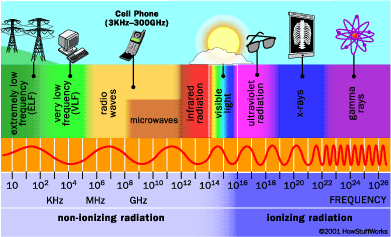
Professor Kromhout: ‘Research into future exposure to 4G and 5G radiation is warranted’ https://innovationorigins.com/professor-kromhout-research-into-future-exposure-to-4g-and-5g-radiation-is-warranted/ This week and next week, Innovation Origins is looking at the growing influence of wireless communication within today’s society and in particular at data transmission via electromagnetic with ever-higher frequencies, such as 5G.
Research is needed to map out exactly what the exposure to electromagnetic fields is as soon as the new frequencies come into effect for communicating data wirelessly with 5G. In the interim, 4G will coexist with 5G. This means that levels of electromagnetic fields might experience an overall increase. So says Professor Hans Kromhout, who is chair of the Exposure Assessment and Occupational Hygiene group at the University of Utrecht in the Netherlands. Kromhout is also chair of the Committee Electromagnetic Fields (EMF) Health Council of the Netherlands. This committee is investigating the possible health risks associated with 5G at the request of the Dutch House of Representatives. The advisory report is due by the end of July, as stipulated by the Health Council of the Netherlands.
“The level of expected exposure to radiofrequency fields can be easily mapped out. The people who devised the technology for 5G are very smart physicists. They should be able to do this.”
Resistance to 5G
Several individuals and groups in The Netherlands are actively opposing the introduction of 5G because they are convinced that radiofrequency waves are harmful. Some claim that there is a conspiracy to harm the population. Over the past few months, it has frequently been reported in the news that activists had set fire to telecom companies’ masts. Some of these new 5G antennas will have to be placed on the same masts that are currently used for 4G.
Another group has filed a preliminary injunction against the government which is to auction off the new frequencies starting this summer.
Several documents circulate among activists, such as a pamphlet written by Martin Pallan, an American emeritus professor of biochemistry at the University of Washington. The pamphlet claims that electromagnetic fields used for 5G can lead to, among other things, damage to DNA, increased risk of infertility, cancer, ADHD, and Alzheimer’s disease.
No scientific evidence linked to cancer
According to Kromhout, there isn’t any substantiated evidence-based scientific research that proves that such diseases are caused by the use of mobile phones and exposure to radiofrequency fields from transmission masts. Kromhout himself participated in research into the effect that mobile phone usage might have on the onset of headaches, tinnitus (a hearing disorder whereby you constantly hear peeping sounds in your ear when in reality there’s no sound), hearing impairment and insomnia. This study did not show a connection between the radiofrequency fields and the health complaints that were studied. Although it did show a connection with the (excessive) use of a mobile phone.
Kromhout also took part in a study into the effect of electromagnetic fields on people who consider themselves to be ‘electrohypersensitive.’ This experimental double-blind study showed that the test subjects were unable to perceive whether or not they were exposed to electromagnetic fields. This made the claim that their complaints were related to these fields far more improbable.
Research into the effect of static magnetic fields from MRI scanners on nurses and workers in the production of MRI scanners showed that after prolonged exposure, they are more likely to suffer from dizziness, abnormal bleeding in the uterus, and an increased risk of developing high blood pressure. “The levels of radiation to which these people are exposed are significantly higher than those of people using a mobile phone,” Kromhout adds. “You cannot use those tests to determine any potential effects of 4G or 5G on health.”
Absence of test procedures for determining health effects stemming from 5G
In spite of this, Kromhout thinks it is appropriate to carry out research into any eventual effects. “When a company introduces a new medicine, it has to go through all kinds of test procedures to be certain that they are safe to public health. This hasn’t taken place at all here.”
It is difficult to establish with 100% certainty that there is no damage to health without scientific research because you just don’t know exactly what the influence of 4G and 5G is. “But I don’t think it’s likely that the damage could be more severe as a result of the use of these higher frequencies. Electromagnetic fields with lower frequencies are able to penetrate deeper into your head. These seem to me to be more dangerous than high frequencies like 5G. Research should, therefore, focus more on the skin. Skin is what is most likely to come into contact with electromagnetic fields at higher frequencies.”
The fact that there will be more transmission masts as a result of 5G does not necessarily lead to more exposure, Kromhout believes that as the increasingly higher frequencies that will come into use have a shorter range than existing lower frequencies. “Exposure to radiation in the times of 1G and 2G was many times higher than it is now.”
Yet as 5G will become active alongside 4G, and in light of the fact that there will be a greater number of applications, the total amount of exposure to radiation is still likely to increase for today’s user.
Read other IO articles about 5G via this link.
Iran envoy says that Trump has pulled the final plug in violating nuclear deal
“Two yrs ago @realDonaldTrump ceased participation in #JCPOA. Now, in further violation of JCPOA & UNSCR 2231 @SecPompeo pulls final plug, imposing penalties for compliance EVEN w/nuclear provisions of 2231,” Takht-Ravanchi tweeted on Thursday.
He added, “Claiming US is STILL ‘Participant’ is not just preposterous; it’s FALSE.”
U.S. President Donald Trump quit the agreement, negotiated under his predecessor Barack Obama, in May 2018.
But the Trump administration until now had issued waivers to allow companies, primarily from Russia, to keep carrying out the work of the agreement without risking legal ramifications.
However, Washington announced on Wednesday that it was ending the waivers.
Russian Foreign ministry spokeswoman Maria Zakharova said on Thursday the U.S. is acting in a dangerous and unpredictable way.
“Washington’s actions are becoming more and more dangerous and unpredictable,” Zakharova told reporters.
“The nature of this behavior is clearly disruptive,” Zakharova said, accusing Washington of undermining international security.
“grave challenge to global peace and security” – Nuclear watchdog on potential U.S. nuclear test
 Nuclear watchdog says any US test would be ‘grave challenge to peace’
Lassina Zerbo, head of body monitoring test ban treaty, responds to White House discussions about potential first US test for 28 years, Guardian, Julian Borger in Washington, Fri 29 May 2020 The head of the international watchdog monitoring nuclear tests has warned that a US return to testing being contemplated by the Trump administration would present a “grave challenge to global peace and security”.
The idea was shelved for the time being, but appears not to have been rejected outright. Drew Walter, acting deputy assistant secretary of defence for nuclear matters, said this week that an underground nuclear test could be carried out within months “if the president directed”.
Arms control advocates said that the fact such a step was contemplated was disturbing, as it would be likely to lead to a return to nuclear testing by the world’s other nuclear weapons powers, and the demise of the 1996 Comprehensive Nuclear-Test-Ban treaty (CTBT)……
The US signed the CTBT in 1996 but the Senate voted against ratifying it. The treaty has been signed and ratified by 168 states but it will not come into force until the US, China, Israel and Egypt have ratified it, and it is signed and ratified by India, Pakistan and North Korea.
Meanwhile, the US has observed a voluntary moratorium on tests, as have the UK, France, Russia and China, and the CTBTO preparatory commission was established to set up a network of 300 seismic, hydroacoustic, infrasound and radionuclide sensors around the world, that helped identify nuclear tests by India, Pakistan and North Korea.
Zerbo noted that the US is the biggest financial contributor to the CTBTO and its verification regime.
Over the past year, the US has accused Russia and China of secretly conducting very low-yield tests, an accusation that both countries have denied, and for which the US has yet to provide evidence.
“The CTBTO’s international monitoring system [IMS] has been operating as normal and has not detected any unusual event,” Zerbo said. The IMS, complemented by the national technical means of the states signatories themselves, provides full confidence that the system can detect nuclear test explosions according to the provisions of the treaty.”
He added that the only way to remove all doubts was to bring the CTBT into force.
“At that point, the provisions for on-site inspections would come into effect, allowing for on-site visits at short notice if requested by any state party.” https://www.theguardian.com/world/2020/may/28/nuclear-watchdog-us-underground-test-challenge-to-peace
1 This Month
23 April – WEBINAR – Why new nuclear reactors are the wrong tools for decarbonization Thursday, April 23 • 1 AM – 2 AM AEST

Pine Ridge Uranium is the real threat, not Tehran- Tell Burgum: Stop the Extraction.
Chernobyl: The Lost Tapes – A good documentary on Chernobyl on SBS available On Demand for the next 3 weeks– https://www.sbs.com.au/ondemand/tv-program/chernobyl-the-lost-tapes/2352741955560
To see nuclear-related stories in greater depth and intensity – go to https://nuclearinformation.wordpress.com
-
Archives
- April 2026 (231)
- March 2026 (251)
- February 2026 (268)
- January 2026 (308)
- December 2025 (358)
- November 2025 (359)
- October 2025 (376)
- September 2025 (257)
- August 2025 (319)
- July 2025 (230)
- June 2025 (348)
- May 2025 (261)
-
Categories
- 1
- 1 NUCLEAR ISSUES
- business and costs
- climate change
- culture and arts
- ENERGY
- environment
- health
- history
- indigenous issues
- Legal
- marketing of nuclear
- media
- opposition to nuclear
- PERSONAL STORIES
- politics
- politics international
- Religion and ethics
- safety
- secrets,lies and civil liberties
- spinbuster
- technology
- Uranium
- wastes
- weapons and war
- Women
- 2 WORLD
- ACTION
- AFRICA
- Atrocities
- AUSTRALIA
- Christina's notes
- Christina's themes
- culture and arts
- Events
- Fuk 2022
- Fuk 2023
- Fukushima 2017
- Fukushima 2018
- fukushima 2019
- Fukushima 2020
- Fukushima 2021
- general
- global warming
- Humour (God we need it)
- Nuclear
- RARE EARTHS
- Reference
- resources – print
- Resources -audiovicual
- Weekly Newsletter
- World
- World Nuclear
- YouTube
-
RSS
Entries RSS
Comments RSS
 nuclear-news