The human impact of ”Trinity” and a thousand other nuuclear bomb tests on American soil

|
75 Years Later, Victims of Nuclear Bomb Tests on U.S. Soil Still Seek Justice, https://truthout.org/articles/75-years-later-victims-of-nuclear-bomb-tests-on-u-s-soil-still-seek-justice/, BY Satya Vatti, Globetrotter / Independent Media Institute, November 15, 2020 They thought the world was coming to an end,” Genoveva Peralta Purcella explains.
On July 16, 1945, the first-ever nuclear bomb was tested in New Mexico, in the Southwestern United States. The detonation was code-named “Trinity.” It is the day that would seal the fate of many Americans living in the surrounding areas for generations to come. Seventy miles from what became known as ground zero—the Trinity test site—Genoveva’s family lived on a ranch just outside the village of Capitan in New Mexico. Genoveva was born the year after the blast. Now 74 years old, she solemnly recalls how her family remembers the day that would change their lives forever. Genoveva’s sisters had come to visit their father and pregnant mother at the ranch. At precisely 5:30 a.m., as dawn broke, the sky suddenly went pitch dark. Having no other point of reference, they mistook the abnormally loud roaring and rumbling in the sky for thunder. The entire house began to shake. Fear-stricken, the family huddled together in a corner. When the sky cleared, her father stepped outside the house and found himself being showered with a white powder. The powder was everywhere and covered everything around them. Nothing escaped it, not the cows the family had raised, or the vegetables in the garden, or the rainwater they stored in the absence of running water. Like other families who went through this experience, Genoveva’s family also dusted off the powder and consumed their vegetables and the stored water. The blast produced so much energy that it incinerated everything it touched and formed a fireball that rose to more than 12 kilometers into the atmosphere. The fireball created ash that snowed over the communities surrounding the blast site. The people did not know it then, but this ash that covered thousands of square miles was the radioactive fallout from the explosion. Dread gripped the communities in Tularosa Basin who either witnessed or experienced the phenomenon they could not make sense of. Meanwhile, the immediate reaction of the staff of the Manhattan Project, which created the bomb, was of “surprise, joy, and relief.” Paul Pino, Genoveva’s cousin, who was born nine years after the Trinity blast, says that his family, which lived 33 miles from the blast site, was one of many who were unaware of what had transpired on that day. In the days and months leading up to the blast, U.S. government officials did not notify anyone who lived in the region about the imminent nuclear bomb test. Nobody in the Tularosa Basin was evacuated to safety. In the aftermath of the nuclear test, officials began to cement a false narrative into the consciousness of the nation; the region was remote and uninhabited. Tens of thousands of people, in fact, lived in the Tularosa Basin in 1945. For a long time, the people of the basin believed that the blast was an ammunition explosion. “We were lied to by the government,” said Pino. It takes 24,000 years for half of the radioactive plutonium used in the Trinity bomb to decay. The people of the region have inhaled and ingested radioactive particles for 75 years because of environmental contamination. Those in power refuse to accept responsibility and take any corrective action. To this day, there have been no cleanup efforts. Radiation exposure has caused high rates of aggressive cancers, thyroid disease, infant mortality, and other health abnormalities in generations of families in the Tularosa Basin region. The scale of the health impact cannot be determined accurately as long-term epidemiological studies have only been undertaken recently. The findings of the latest research studies by the National Cancer Institute were published in September 2020 in the journal Health Physics. “There were 10 of us; now only one is surviving,” Genoveva says, speaking of herself. She has lost everyone in her family to cancer. In a country without universal health care, debt from medical expenses has brought economic ruin to the communities near the Trinity site. “All the pain and suffering we have had to endure, and not a speck of help from the government,” Pino says. “Meanwhile, it has spent trillions on thousands of nuclear weapons.” Genoveva’s story is not an exceptional one. It is the story of tens of thousands of families in the United States. More than 1,000 nuclear bomb tests have been conducted in the U.S. between 1945 and 1992. A total of 100 above-ground tests were conducted at the Nevada test site from 1951 to 1962. The winds carried radioactive fallout for thousands of kilometers. Hundreds of millions of people living in the U.S. have been exposed to varying levels of radiation over the years, unknown to them. New Mexico was downwind of the Nevada test site, and the people living there continued to be exposed to radioactivity for decades after the initial exposure during the Trinity nuclear test. People from the impacted communities founded the Tularosa Basin Downwinders Consortium in 2005 to fight for justice for the survivors and their descendants. Tina Cordova, one of the group’s cofounders, was shocked to find out that a few of the impacted states neighboring New Mexico were receiving financial compensation under the Radiation Exposure Compensation Act since 1990. The communities in New Mexico, however, were left out of the act. When asked why, Cordova responds with, “It is the billion-dollar question. I think we are being left out because we are mainly Mexican Hispanics, Natives, and Latinos. We are minorities and we are poor.” Cordova herself is the fourth generation in her family to have cancer. She has joined with others like her to educate and organize the affected communities, to fight to establish the truth. “In their [the government’s] rush to bomb Japan, we were sacrificed in the process. We were enlisted in the service of our country, unknowing, unwilling, and remain uncompensated.” |
|
The nuclear perils of Trump’s last days
“The air tonight is as heavy as the sum of human sorrows.”-Albert Camus, Caligula
It is no longer just hyperbole. Still armed with nuclear weapons, a conspicuously deranged American president may be willing to do anything to cling to power. And if that willingness should appear futile, Donald J. Trump could conceivably prefer apocalypse to “surrender.”[1]
Credo quia absurdum, said the ancient philosophers. “I believe because it is absurd.” In these presumptively final days of the Trump presidency, an impaired or irrational nuclear command decision remains possible. Though nothing can be determined about the true mathematical probability of any such once unimaginable scenario,[2] there are increasingly compelling reasons for concern. One of these reasons is Mr. Trump’s bizarre eleventh-hour shakeup at the Department of Defense.
 Americans have let these urgent matters drift too long. Nonetheless, despite evident lateness of the hour, a summarizing query must finally be raised: Should this visibly impaired president still be allowed to decide when and where to launch American nuclear weapons? This is not a silly or trivial question.
In the early days of the Nuclear Age, when strategic weapon-survivability was still uncertain, granting presidential authority for immediate firing command was necessary to ensure credible nuclear deterrence. Today, however, when there no longer exists any reasonable basis to doubt America’s durable second-strike nuclear capability (sometimes also called an “assured destruction” or undiminished retaliatory capability), there remains no good argument for continuing to grant the president (any president) such potentially problematic decisional authority.
More general questions should now also be raised.
In our expansively imperiled democracy, ought any American president be permitted to hold such precarious life or death power over the entire country?
Inter alia, could such an allowance still be consistent with a Constitutional “separation of powers?”
Can anyone reasonably believe that such existential power could ever have been favored by America’s Founding Fathers?
The correct answers are apparent, obvious and starkly uncomplicated.
We can readily extrapolate from Articles I and II of the Constitution that the Founders had profound concern about Presidential power long before the advent of nuclear weapons. This concern predates even any imagination of apocalyptic warfare possibilities.[3] So what next?…………………..
At this grievous point in America’s Trump-created declension, anything seems possible.
History deserves pride of place. Soon, any such disregard for plausible national harms could prove unconscionable. In the chaotic 1st century CE, long before political democracy could ever seem sustainable[12] and long before nuclear weapons, Roman Emperor Caligula revealed the overwhelmingly lethal costs of barbarous governance.
Today, a democratically defeated American president, clinging wrongfully to political power and expressing this egregious dereliction during a period of “plague,” could produce even less bearable costs. At that nation-destroying point, the “air would be as heavy as the sum of human sorrows.”
History may not repeat itself, observed Mark Twain, “but it often rhymes.” Donald J. Trump may not be quite as decadent or depraved as Caligula, but he may not be that far removed either. Credo quia absurdum, warned the ancient Romans. “I believe because it is absurd.”
Donald J. Trump is not Caligula, but he is a sinister stain upon the integrity and survival of the United States. https://moderndiplomacy.eu/2020/11/15/caligula-goes-covid-nuclear-perils-of-trumps-last-days/
We should require a second voice when it comes to ordering first use of nuclear arms
A Nuclear Strike Should Require More than One Person’s Order. We should require a second voice when it comes to ordering  first use of nuclear arms. Defense One, BY STEVEN PIFER FELLOW, STANFORD UNIVERSITY, NOVEMBER 12, 2020. Donald Trump has proven to be volatile, erratic, vengeful and prone to angry outbursts. Last week, as the vote count pushed his reelection bid out of sight, he reportedly fell into a dark mood. At the time, Mr. Trump had—and now has—sole authority to order the launch of U.S. nuclear weapons, just as he had in October, when his medications for COVID had side effects including mania, euphoria and a sense of invulnerability.
Do we want Mr. Trump, or any president, alone making the most consequential decision that an American president likely would ever make?
As a Foreign Service officer working on arms control, I had the opportunity to get close to nuclear weapons on three occasions. One involved viewing, through a thick, shatter-proof window, two technicians working on a warhead for a Trident ballistic missile. Our escort noted that, should one leave the room, the other would also have to leave. A “two-man” rule applied around nuclear weapons.
Another time, on a Los Angeles-class attack submarine, our group saw a nuclear-armed cruise missile in its canister with an attached cable. Ship’s officers explained that, if the canister moved slightly, alarms would sound and other sailors would quickly arrive, some with weapons. A “two- (or more) man” rule applied.
The third time, on board an Ohio-class ballistic missile submarine at sea, I was offered the chance to climb into a Trident missile (yes, that is possible, and yes, I did). When the hatch to the missile was open, standard protocol provided for the presence of two armed sailors. Again, the “two-man” rule.
As a Foreign Service officer working on arms control, I had the opportunity to get close to nuclear weapons on three occasions. One involved viewing, through a thick, shatter-proof window, two technicians working on a warhead for a Trident ballistic missile. Our escort noted that, should one leave the room, the other would also have to leave. A “two-man” rule applied around nuclear weapons.
Another time, on a Los Angeles-class attack submarine, our group saw a nuclear-armed cruise missile in its canister with an attached cable. Ship’s officers explained that, if the canister moved slightly, alarms would sound and other sailors would quickly arrive, some with weapons. A “two- (or more) man” rule applied.
The third time, on board an Ohio-class ballistic missile submarine at sea, I was offered the chance to climb into a Trident missile (yes, that is possible, and yes, I did). When the hatch to the missile was open, standard protocol provided for the presence of two armed sailors. Again, the “two-man” rule.
At only one level does the “two-man” rule not apply: the president, as commander-in-chief, has sole authority to order the use of U.S. nuclear arms. There is not even a requirement that the president consult someone. The always nearby “football” carries the briefing materials, codes and communications allowing the president to launch nuclear weapons. Were the president give the order, the system would rapidly transmit it. Intercontinental ballistic missiles could blast out of their silos within minutes.
If nuclear weapons are used first against America or its allies, it makes sense to allow the president sole authority to order a nuclear response. However, current U.S. policy envisages the possibility that the United States would use nuclear weapons first, perhaps in a conventional conflict that goes badly or in response to a non-nuclear strategic attack. (Whether U.S. first use makes sense is a separate question.)
When President-elect Biden takes office, we can breathe easier. Nothing guarantees, however, that a future president might not have something more like Mr. Trump’s temperament—and he reportedly is mulling a 2024 run.
We should require a second voice when it comes to ordering first use of nuclear arms……….. https://www.defenseone.com/ideas/2020/11/nuclear-strike-should-require-more-one-persons-orders/170004/
Quite a lot of hurdles for NuScam’s Utah project, and only 27 of UAMPS members signed up

|
|
UAMPS Mulls Downsizing Nuclear Project, Power, 11 Nov 20“…………..So far, the company has marked key regulatory milestones. On Aug. 28, notably, NuScale’s 50-MW (160 MWth) module became the first SMR to receive a final safety evaluation report (FSER) from the NRC as part of a Phase 6 review—the last and final phase—of NuScale’s Design Certification Application (DCA).
The latest power uprate will be reviewed by the NRC as part of a Standard Design Approval (SDA) application, which NuScale on Tuesday said it is schedule to submit in 2022. However, Hughes said that while NuScale has not yet made a final decision on the size or configuration that will be reflected in the SDA application, it will seek approval of 250 MWth modules. “Our final decision will be announced soon,” she said. So far, the company has marked key regulatory milestones. On Aug. 28, notably, NuScale’s 50-MW (160 MWth) module became the first SMR to receive a final safety evaluation report (FSER) from the NRC as part of a Phase 6 review—the last and final phase—of NuScale’s Design Certification Application (DCA). The latest power uprate will be reviewed by the NRC as part of a Standard Design Approval (SDA) application, which NuScale on Tuesday said it is schedule to submit in 2022. However, Hughes said that while NuScale has not yet made a final decision on the size or configuration that will be reflected in the SDA application, it will seek approval of 250 MWth modules. “Our final decision will be announced soon,” she said. NuScale’s Announcement Gives UAMPS’ Options to Downsize Carbon-Free Power Project When UAMPS will submit a COLA for its Carbon Free Power Project (CFPP), a 12-module NuScale power plant that is developing for a site at an Idaho National Laboratory (INL) site in Idaho Falls, Idaho, is not clear. UAMPS has so far developed the much-watched project as a 720-MWe plant, and it has said it expects the first of the 12 proposed NuScale modules could be operational in 2029 with the other 11 modules operational in 2030. But NuScale’s new power increase and its launch of smaller plant sizes now gives the project much-needed flexibility that could affect it current timetable. The newly announced uprate is significant because it “facilitates plant downsizing,” UAMPS told POWER in a statement on Tuesday. “An important early task in the UAMPS [CFPP’s] next phase will be evaluating these new options in plant size and configuration. UAMPS will evaluate the possibilities of building a [308-MWe] 4-module or [462-MWe] 6-module plant instead of a 12-module plant,” it said. UAMPS, notably, just wrapped up the first phase of the CFPP on Oct. 31, securing financial commitments for a potential 720-MW plant from 27 of its 48 members, which are mostly cities in Utah but also scattered across California, Idaho, Nevada, New Mexico, and Wyoming. During the tumultuous first phase, at least eight cities—Lehi, Logan, Murray, Kaysville, Bountiful, Beaver, Heber, and Salmon River Electric—dropped out of the the project, and at least one, Idaho Falls halved its share. The withdrawing cities cited a long list of reasons for their reluctance to commit to the project, but costs—which could increase for remaining subscribers—and uncertainty led their concerns. ….. The next off-ramp will likely be in April 2023, when UAMPS is expected to submit the application to the NRC. The final off-ramp would be in December 2025, before the start of the construction period. As POWER has reported, the 720-MWe CFPP is currently estimated to cost $6.1 billion, and UAMPS is expected to shoulder $4.76 billion of that figure, which is based on a Class 4 estimate (and could decrease by about 10% or increase by 30%). The Department of Energy (DOE) will fund the remaining $1.355 billion through an award announced on Oct. 16. The award, which will be subject to yearly Congressional appropriations, replaces the DOE’s Joint Use Module Plant (JUMP) program. ……. On Tuesday, UAMPS again stressed that the project’s LCOE (Levelised Cost Of Energy )will play a crucial factor in any decisions it makes. Before it can agree to a change in plant size or configuration—including to move forward with NuScale’s newly launched smaller power plant solutions—“UAMPS would have to be assured that the [LCOE] of $55/MWh (or lower) would be preserved. UAMPS would also want assurance that the current schedule/timeline would be followed,” the agency said. ……. |
|
Putin and officials discuss huge new underground bunker almost completed
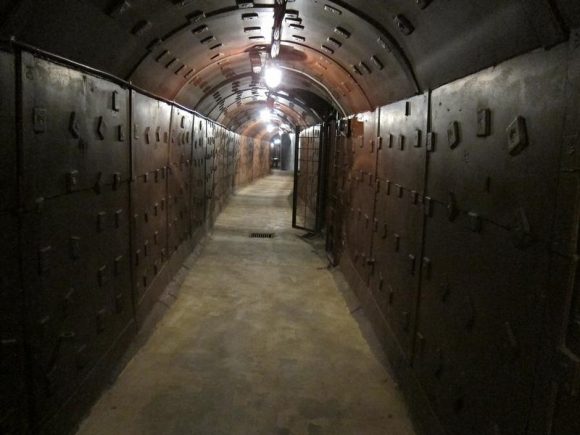
Putin Reveals Existence Of New Nuclear Command Bunker
Russia already has two very large bunker complexes built underneath mountains, including one housing a key nuclear doomsday command system. The Drive, BYJOSEPH TREVITHICK NOVEMBER 11, 2020, The Kremlin has released an unusual transcript of a meeting between Russian President Vladimir Putin and senior defense and other government officials, as well as representatives of Russia’s defense industries, regarding the modernization of the country’s nuclear command and control infrastructure. In it, among other things, Putin disclosed that work on a new hardened strategic command post, possibly a deeply buried underground bunker, is nearing completion.
Putin held the meeting in Sochi on Nov. 11, 2020. Russian Minister of Defense Sergei Shoigu and Russian Army General Valery Gerasimov, Chief of the General Staff of the country’s military, were also in attendance, among others. The day before, the Russian President had held another meeting, which touched on the country’s general nuclear deterrence policy, where he indicated that he would only authorize a nuclear strike in response to one against Russia. This apparent declaration of a so-called “no first use” policy would seem to conflict with previous official statements in recent years.
“It is absolutely clear that the combat capability of the nuclear triad, and the capability of the army and navy on the whole to adequately and quickly respond to potential military challenges directly depend on the stability, effectiveness and reliability of these systems under any circumstances,” Putin said at the Nov. 11 gathering. “I would like to point out that a great deal has been done during the past few years to maintain all the command elements of our strategic nuclear forces at the highest possible level.”……..
It’s not completely clear from these comments whether Putin was talking about an entirely new facility or the refurbishment, improvement, and/or expansion of an existing one. His remarks about the need to protect the overall command and control infrastructure against any threats, including a nuclear attack, strongly point to the site he’s talking about being deeply buried underground bunker of some kind. Russia already understood to have two sites that would match this general description, one at Kosvinsky Kamen in the Northern Ural Mountains and another under Mount Yamantau in the Southern Ural Mountains.
The construction of both sites reportedly began in the late 1970s. It’s worth noting that no facility on earth is totally survivable in the face of strikes by modern nuclear weapons, but deeply buried sites offer probably the best possible defense. As such, the Soviets and the United States both, among others, invested heavily in such bunker complexes during the Cold War, ………
Kosvinsky Kamen, at least some portions of which are believed to be buried under around 1,000 feet of solid granite, is probably the better known of the two, due to its connection to a semi-automated nuclear command and control system first developed under the Soviet Union called Perimeter. This system was long described as a “dead hand” doomsday machine akin to the fictional one in Stanley Kubrick’s famous Cold War black comedy film Dr. Strangelove that could carry out an entirely automatic retaliatory launch of Russian nuclear-tipped intercontinental ballistic missiles (ICBM) after an attack.
More recent reporting has indicated that actual humans, who could be pre-authorized in a crisis to launch nuclear strikes if certain conditions were met, were still very much involved in the operation of Perimeter and operated its central components from within the Kosvinsky Kamen complex. That being said, reports still indicate that this main Perimeter bunker was like something you’d find in a villain’s lair in a James Bond movie………
Less is known about the facility at Mount Yamantau, which reportedly lies, at least in part, under some 3,000 feet of rock, primarily made up of quartz, and has been said to be absolutely massive, encompassing an area “as big as the Washington area inside the Beltway,” or around 400 square miles. The complex is situated within Mezhgorye, which is what is known in Russia as a closed town, where only authorized individuals are allowed to live and work………
President Donald Trump’s Administration also announced in 2018 that it had decided to maintain an operational stockpile of B83-1 nuclear gravity bombs, which have very large yields, reported to be around 1.2 megatons, as an alternative nuclear means of striking at especially hardened facilities. These weapons had previously been slated for retirement……..
It is worth noting that there are understood to be at least two underground bunker complexes in Moscow, one under the Kremlin and another nearby, similar to ones in Washington, D.C., plus to more nearby in the Russian capital’s suburbs, but these are nowhere near as deeply buried as the ones at Kosvinsky Kamen and Mount Yamantau. In 2016, there was also a report that Russia was building “dozens” of new bunkers under the Kremlin and elsewhere to support its nuclear command and control infrastructure…… https://www.thedrive.com/the-war-zone/37569/putin-reveals-existence-of-new-nuclear-command-bunker-and-says-its-almost-complete
International leading experts opt for 100 per cent renewables and reject nuclear power
Leading experts opt for 100 per cent renewables and reject nuclear power https://100percentrenewableuk.org/leading-experts-opt-for-100-per-cent-renewables-and-reject-nuclear-power
The undersigned believe that a future based on 100 per cent renewable energy underpinned by traditional and advanced energy efficiency and storage techniques is not only practicable, affordable, but immensely preferable to one that involves nuclear power. Renewable energy offers us a rapid path to net zero carbon transition that, unlike nuclear power, does not involve the need for decommissioning of radioactive plant, nuclear waste or concerns about safety or security threats. With this in mind we regard the prospect of the Government effectively offering unlimited sources of funding to EDF to build Sizewell C nuclear power plant with dismay and urge people to send in their objections to their MPs at this prospect.
- Dr David Toke, Director, 100percentrenewableuk,
also Reader in Energy Politics, University of Aberdeen.
- Jonathon Porritt,
Founder, Director and Trustee, Forum for the Future
Co-Director of the Prince of Wales’s Business & Sustainability Programme
- Professor Tom Burke
- Founding Director of E3G
- Professor Peter Strachan
The Robert Gordon University
Aberdeen Business School- Dr Paul Dorfman
Founder and Chair Nuclear Consulting Group
Honorary Senior Research Associate UCL Energy Institute- Professor Bryan Wynne,
- Professor of Science Studies and Research Director of the Centre for the Study of Environmental Change
- Professor Andrew Stirling,
Professor of Science and Technology Policy,
University of Sussex
- Professor David Elliott,
Technology Policy Group
- The Open University
- Professor Stephen Thomas,
Public Services International Research Unit (PSIRU)
University of Greenwich
- Professor Mark Jacobson,
Director of Atmosphere/Energy Program,
- Stanford University (USA)
- Professor Christian Breyer,
Lappeenranta University of Technology (Finland)
- Shaun Burnie
Independent Nuclear Consultant
- Dr Ian Fairlie,
- Vice President CND
- Pete Wilkinson
Chairman, Together Against Sizewell C (TASC)
- Dr Philip Johnstone
Research Fellow
Science Policy Research Unit (SPRU)- Dr Mark Diesendorf
- Associate Professor and Deputy Director
Institute of Environmental Studies
UNSW Australia- Dr Stephen Connelly
Department of Town and Regional Planning
University of Sheffield- Dr Gavin Mudd
- School of EngineeringRMIT University
- Dr Monica Oliphant
Past President International Solar Energy Society
Register for FREE webinar on December 3rd on how Scotland can get ALL of its energy from renewables
Julian Assange ‘targeted as a political opponent of Trump administration and threatened with the death penalty’
Julian Assange ‘targeted as a political opponent of Trump administration and threatened with the death penalty’ Evening Standard. By Tristan Kirk. @kirkkorner
Professor Paul Rogers, a lecturer in peace studies at Bradford University and specialist on the ‘War on Terror’, said Assange’s opinions put him “in the crosshairs” of Trump’s top team.
Giving evidence to Assange’s extradition hearing this morning, he said he believes the prosecution case is part of a drive in the United States to target “dissenters”.
“In my opinion Mr Assange’s expressed views, opinions and activities demonstrate very clearly ‘political opinions’”, he told the court.
Professor Rogers, in his witness statement, said Assange’s work involved exposing secrets that the US government wanted to keep hidden, he had been in conflict with the Obama administration, but there was “no question” that Assange had been targeted as a political opponent by Trump’s officials.
“The opinions and views of Mr Assange, demonstrated in his words and actions with the organisation WikiLeaks over many years, can be seen as very clearly placing him in the crosshairs of dispute with the philosophy of the Trump administration”, he said.
Assange’s legal team argue that a decision was taken under President Obama not to prosecute the Wikileaks activist, but that move was overturned under Trump. https://www.standard.co.uk/news/uk/julian-assange-donald-trump-administration-old-bailey-hearing-a4543656.html?fbclid=IwAR3Rj4n0Lzlt5GmE1lXZXoMVDsOS5BdT9sEKgj82SCmMnpNLFQ6ZfEzVUOI
The USA devised an apocalyptic nuclear weapon – the Supersonic Low Altitude Missile or SLAM
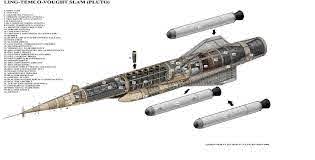
PROJECT PLUTO: THE CRAZIEST NUCLEAR WEAPON IN HISTORY SOFREP, by Sandboxx 15 Nov 20, “…………. Although the destructive force of the atom bombs dropped on Hiroshima and Nagasaki had been so monstrous that they changed the geopolitical landscape of the world forever, both the U.S. and Soviet Union immediately set about developing newer, even more powerful thermonuclear weapons. Other programs sought new and dynamic delivery methods for these powerful nukes, ranging from ballistic missiles to unguided bombs.Project Pluto and the SLAM Missile
One such effort under the supervision of the U.S. Air Force was a weapon dubbed the Supersonic Low Altitude Missile or SLAM (not to be mistaken for the later AGM-84E Standoff Land Attack Missile). The SLAM missile program was to utilize a ramjet nuclear propulsion system being developed under the name Project Pluto. Today, Russia is developing the 9M730 Burevestnik, or Skyfall missile, to leverage the same nuclear propulsion concept.
As Russian President Vladimir Putin recently pointed out, nuclear propulsion offers practically endless range, and estimates at the time suggested the American SLAM Missile would likely fly for 113,000 miles or more before its fuel was expended. Based on those figures, the missile could fly around the entire globe at the equator at least four and a half times without breaking a sweat.
The unshielded nuclear reactor powering the missile would practically rain radiation onto the ground as it flew, offering the first of at least three separate means of destruction the SLAM missile provided. In order to more effectively leverage the unending range of the nuclear ramjet, the SLAM missile was designed to literally drop hydrogen bombs on targets as it flew. Finally, with its bevy of bombs expended, the SLAM missile would fly itself into one final target, detonating its own thermonuclear warhead as it did. That final strike could feasibly be days or even weeks after the missile was first launched.
Over time, the SLAM missile came to be known as Pluto to many who worked on it, due to the missile’s development through the project with the same name.
The onboard nuclear reactor produced more than 500-megawatts of power and operated at a scorching 2,500 degrees — hot enough to compromise the structural integrity of metal alloys designed specifically to withstand high amounts of heat. Ultimately, the decision was made to forgo metal internal parts in favor of specially developed ceramics sourced from the Coors Porcelain Company, based in Colorado.
The downside to ramjet propulsion is that it can only function when traveling at high speeds. In order to reach those speeds, the SLAM would be carried aloft and accelerated by rocket boosters until the missile was moving fast enough for the nuclear ramjet to engage. Once the nuclear ramjet system was operating, the missile could remain aloft practically indefinitely, which would allow it to engage multiple targets and even avoid intercept.
The nuclear-powered ramjet was so loud that the missile’s designers theorized that the shock wave of the missile flying overhead on its own would likely kill anyone in its path, and if not, the gamma and neutron radiation from the unshielded reactor sputtering fission fragments out the back probably would. While this effectively made the missile’s engine a weapon in its own right, it also made flying the SLAM over friendly territory impossible.
While the doctrine of Mutually Assured Destruction has since made the launch of just one nuclear weapon the start of a cascade that could feasibly end life on Earth as we know it, Project Pluto’s SLAM Missile was practically apocalyptic in its own right. The nuclear powerplant that would grant the missile effectively unlimited range would also potentially kill anyone it passed over, but the real destructive power of the SLAM missile came from its payload.
Unlike most cruise missiles, which are designed with a propulsion system meant to carry a warhead to its target, Project Pluto’s SLAM carried not only a nuclear warhead, but 16 additional hydrogen bombs that it could drop along its path to the final target. Some even suggested flying the missile in a zig-zagging course across the Soviet Union, irradiating massive swaths of territory and delivering it’s 16 hydrogen bombs to different targets around the country.
Doing so would not only offer the ability to engage multiple targets, but would almost certainly also leave the Soviet populace in a state of terror. A low-flying missile spewing radiation as it passed over towns, shattering windows and deafening bystanders as it delivered nuclear hellfire to targets spanning the massive Soviet Union, would likely have far-reaching effects on morale.
How Do You Test an Apocalyptic Weapon?
Project Pluto’s nuclear propulsion system made testing the platform a difficult enterprise. Once the nuclear reactor onboard was engaged, it would continue to function until it hit its target or expended all of its fuel. Any territory the weapon passed over during flight would be exposed to dangerous levels of radiation, limiting the ways and the places in which the weapon’s engine could even be tested.
On May 14, 1961, engineers powered up the Project Pluto propulsion system on a train car for just a few seconds, and a week later a second test saw the system run for a full five minutes. The engine produced 513 megawatts of power, which equated to around 35,000 pounds of thrust — 6,000 pounds more than an F-16’s Pratt & Whitney F100-PW-229 afterburning turbofan engine with its afterburner engaged.
However, those engine tests were the only large scale tests Project Pluto would ultimately see, in part, because a fully assembled SLAM missile would irradiate so much territory that it was difficult to imagine any safe way of actually testing it.
A weapon That’s Too Destructive to Use
Ultimately, Project Pluto and its SLAM missile were canceled before ever leaving the ground. The cancellation came for a litany of reasons, including the development of intercontinental ballistic missiles and the introduction of global strike heavy payload bombers like the B-52 Stratofortress. There were, however, some other considerations that led to the program’s downfall.
Because the SLAM would irradiate, destroy, or deafen anyone and anything it flew over, the missile could not be launched from U.S. soil or be allowed to fly over any territory other than its target nation. That meant the missile could really only be used from just over the Soviet border, whereas ICBMs could be launched from the American midwest and reach their targets in the Soviet Union without trouble.
There was also a pressing concern that developing such a terrible weapon would likely motivate the Soviet Union to respond in kind. Each time the United States unveiled a new weapon or strategic capability, the Soviet Union saw to it that they could match and deter that development. As a result, it stood to reason that America’s nuclear-spewing apocalypse missile would prompt the Soviets to build their own if one entered into service.
Project Pluto and its SLAM missile program were canceled on July 1, 1964 https://sofrep.com/news/project-pluto-the-craziest-nuclear-weapon-in-history/
Iran moderates hail Biden win, but any nuclear talks expected to be fraught
|
Iran moderates hail Biden win, but any nuclear talks expected to be fraught, France24, Bahar MAKOOI, 16 Nov 20,
Six months before the Iranian presidential election, Joe Biden’s victory in the US could influence the vote in Iran, where hopes to resume negotiations on the nuclear deal have prompted enthusiasm from moderates and even some hardliners. However, analysts expect that any future talks would be vexed.
Iranians eagerly awaited the presidential results on November 3. After four years of the Trump administration’s “maximum pressure” policies, Biden’s victory could pave the way for more emollient approach on both sides. In theory, that would put the lifting of US sanctions on the cards.
Biden has promised a “credible path back to diplomacy” with Tehran once he enters the White House in January. He said he wanted to return to the 2015 deal signed by his then boss, Barack Obama, but as a “starting point for follow-on negotiations” and on the condition that Iran follows its strictures closely. In Iran, many believe that Biden’s win will have consequences for the future of their country, which will elect a new president in May as incumbent Hassan Rouhani reaches his term limit. Analysts conjecture that a less hawkish US president could benefit the moderate camp in Iranian politics, which favours diplomatic engagement with Washington. ……. https://www.france24.com/en/middle-east/20201114-iran-moderates-hail-biden-win-but-any-nuclear-talks-expected-to-be-fraught
|
|
Federal utility fined $900K for nuclear violations, coverup
Howard Hall, director of the University of Tennessee’s Institute for Nuclear Security, said the notice of violation to TVA points to “a systemic problem in management.”
“As someone who has worked in this field essentially my entire life, I would have been appalled to receive such a letter,” Hall said.
In a notice dated Nov. 6, regulators noted a “substantial safety culture issue” at Watts Bar at the time of the incident. They also found that “TVA senior management and staff failed to communicate with candor, clarity, and integrity during several interactions with the NRC during the course of the inspection and investigation.”
According to NRC documents, on Nov. 11, 2015, a shift manager at Watts Bar directed the control room to begin heating up a reactor even though the plant’s usual pressurizer system, which keeps the reactor water from turning to steam, was out of service. When trying to heat up with an alternate system, the pressurizer rapidly began to fill with water. Staff then had to “take actions outside of proper operating procedures” to bring the water level down.
The incident wasn’t recorded in the plant’s logbook and managers later misled NRC investigators about what had happened. ……… https://www.startribune.com/federal-utility-fined-900k-for-nuclear-violations-coverup/573069392/
Japan’s nuclear regulator maintains view on Fukushima Daiichi’s No.3 reactor blasts
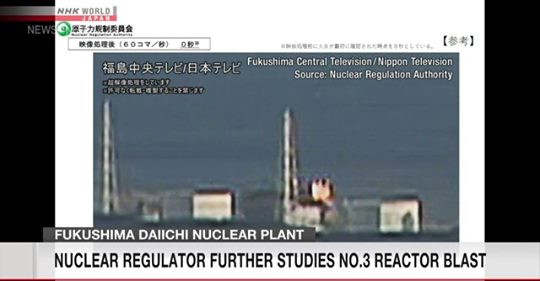
November 13, 2020
Japan’s nuclear regulator has maintained its view that multiple blasts occurred at the Fukushima Daiichi nuclear power plant’s No.3 reactor following the earthquake and tsunami in 2011.
The plant suffered meltdowns from the accident. Three reactor buildings were severely damaged by hydrogen explosions.
On Thursday, the Nuclear Regulation Authority along with experts analyzed images taken at the No.3 reactor.
Officials say the state of buckled beams on the third floor indicates an instantaneous wind pressure of up to 5 atmospheres. The officials say such force can damage concrete structures and collapse wooden buildings.
They also studied the only footage of the No.3 reactor in the explosion, which was captured by a TV station in Fukushima Prefecture.
The officials say an analysis of image processing shows the first blast damaged the fourth floor. They say an ensuing fire on the uppermost fifth floor caused the remaining hydrogen to explode, which caused black smoke to emerge.
The regulator resumed its probe into the cause of the accident last year. It plans to draw up a report as early as next month.
Cabinet minister rules out new nuclear reactors for 10 years
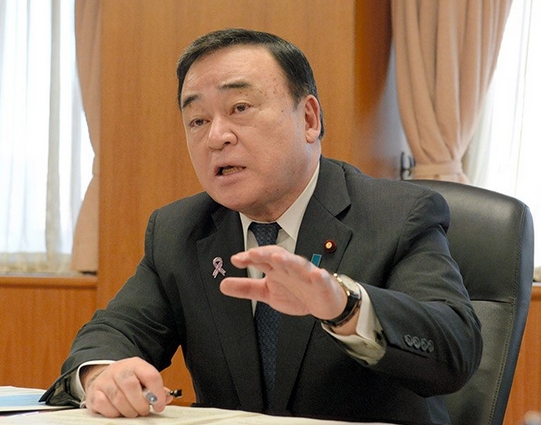
Industry minister Hiroshi Kajiyama during an interview with The Asahi Shimbun on Nov. 10
November 12, 2020
Industry minister Hiroshi Kajiyama is signaling that the government will not allow for the construction of new nuclear reactors to replace aging ones or to be installed additionally at nuclear plants for the next decade.
His position suggests the Ministry of Economy, Trade and Industry, which oversees the nuclear industry, is unlikely to discuss the option of building new reactors in the new Basic Energy Plan it has been developing.
The plan has been revised twice since the 2011 Fukushima nuclear disaster.
Heeding a national sentiment exceedingly anxious of nuclear energy, the government has passed up discussing building new reactors in past revisions of the plan.
In an interview with The Asahi Shimbun on Nov. 10, Kajiyama acknowledged it is still premature to discuss the issue now.
“Public faith has yet to be restored,” he said of public sentiment toward nuclear energy after the triple meltdown at the Fukushima plant. “How can we proceed (without it) in constructing new reactors to replace aging ones or to make additions? We are simply not at the stage where we can talk about the next move.”
Kajiyama said the government’s priority over the next 10 years will be regaining public faith in the nuclear industry, rather than pushing for the construction of new reactors.
But he defended nuclear energy as a “necessary energy” source that the country will still need to rely on.
He said the nation’s 36 nuclear reactors, including three that were under construction before the Fukushima accident occurred, “should be fully utilized.”
The minister said the number of nuclear reactors that will be reactivated over the coming decade will be a point that the government will take into account as an indication of the public’s acceptance of nuclear energy when it comes to mulling over constructing new reactors.
“It is also related to the government’s goal of achieving carbon neutrality in 2050,” he said.
His comments suggest the government may begin considering constructing new reactors if more local governments approve restarting nuclear plants that were idled after the Fukushima accident.
Currently, only one reactor at the Genkai nuclear plant in Saga Prefecture is operating in Japan after a reactor at the Oi nuclear plant in Fukui Prefecture was shut down for maintenance earlier this month.
Kajiyama underlined the need to develop small modular reactors, which are smaller than conventional reactors.
He said engaging in a modular reactor project would be meaningful when it comes to maintaining the nation’s technology for safeguarding nuclear power and nurturing scientists in the field–not to mention the potential for spinoffs.
“It could lead to the development of new materials and other technologies,” he said.
Last month, Prime Minster Yoshihide Suga laid out Japan’s plan to achieve net zero greenhouse gas emissions by 2050.
That may prompt a possible review of Japan’s current energy target for fiscal 2030, with nuclear power and renewables accounting for 20-22 percent and 22-24 percent of total power generation, respectively.
But Kajiyama said whether the 2030 target will be revised is up in the air, as more consultation with energy experts is needed.
The industry minister also doused hopes for the early introduction of carbon taxes and the emission trading system, both of which are initiatives aimed at spurring businesses to cut their carbon dioxide emissions.
“They may eventually be introduced but doing so in the early stages will prove extremely costly,” he said.
(This story was written by Hiroki Ito and Rintaro Sakurai.)
Radioactive Isotopes Measured at Olympic and Paralympic Venues in Fukushima Prefecture and Tokyo, Japan
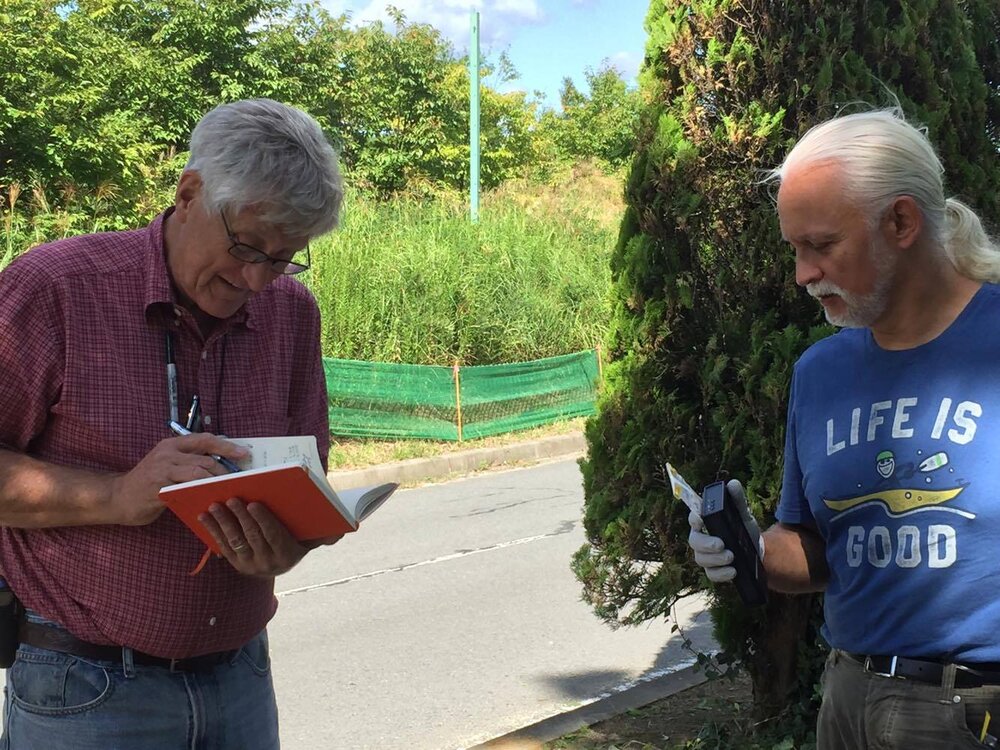
November 12, 2020
“This newly reviewed study of Radioactive Dusts and Dirt at Japanese Olympic sites and throughout Northern Japan by Fairewinds and Marco Kaltofen has four significant conclusions:
Different types of alpha and beta radioactive micro-particles were released at other times and landed in various locations throughout Japan. “The exclusive use of cesium-137 beta activity levels as a proxy for total internal and external exposure, therefore, introduces dose assessment errors.”
“Rooftops previously decontaminated in Minamisoma are recontaminated by airborne atmospheric dust containing radionuclides … from the Fukushima meltdowns. The data show a need for continuing reassessment and potentially, additional remedial work on many sites in Fukushima Prefecture.”
The greater Tokyo Olympic venues had activities similar to sample sites in the US. In contrast, Olympic sites in Northern Japan near Fukushima contained an average of about twice as much radioactivity as Tokyo, with Plutonium identified at the J-Village National Training Center.
Non-Olympic sites throughout Japan averaged 7.0 times greater beta activity than the Tokyo Olympic venues. These data show that remediation emphasized the Olympic venues over cleaning other contaminated parts of Japan.”
Miyagi’s Onagawa NPP reactor’s final approval to restart

Miyagi Gov. Yoshihiro Murai (center) hold talks Wednesday in the city of Ishinomaki, Miyagi Prefecture, with Yoshiaki Suda (left), mayor of the town of Onagawa in the prefecture and Hiroshi Kameyama, mayor of Ishinomaki
Tsunami-hit Onagawa reactor in northeast Japan gets final approval to restart
November 12, 2020
Sendai – A nuclear reactor in Miyagi Prefecture damaged by the Great East Japan Earthquake and tsunami disaster in 2011 has cleared the last hurdle to resume operations, getting the green light Wednesday from local officials.
The No. 2 unit of Tohoku Electric Power Co.’s Onagawa plant is the first of the reactors damaged in the disaster to win final approval with local consent to restart.
Miyagi Gov. Yoshihiro Murai and the mayors of Onagawa and Ishinomaki, the two municipalities that host the unit, gave their consent at a meeting after the plant cleared national safety screening in February.
“There is an excellent, stable supply of electricity in a nuclear plant, and the plant can also contribute to the local economy,” Murai said during a news conference after the meeting in Ishinomaki.
A Tohoku Electric official said the utility will “continue to do its best to ensure safety” in plant operations.
Tohoku Electric says it plans to restart the No. 2 reactor in fiscal 2022 at the earliest after work on safety and disaster prevention measures is completed, such as the construction of an 800-meter-long seawall at the plant.
The Onagawa plant is the closest nuclear plant to the epicenter of the magnitude-9.0 earthquake that struck nine years ago.
The central government has been pushing for the reactor to be reactivated so as to ensure a stable power supply, with trade minister Hiroshi Kajiyama seeking Murai’s consent in March.
In Tokyo, Chief Cabinet Secretary Katsunobu Kato said during a news conference that gaining local consent marks an “important” step.
The municipal assemblies for Onagawa and Ishinomaki had already given their consent, as had the prefectural assembly. On Monday, the leaders of most of Miyagi’s 35 municipalities agreed at a meeting to support the decisions of Onagawa and Ishinomaki.
Part of the reason for local approval is the money generated by hosting the reactor, with Onagawa having received from the central government around ¥27 billion ($256 million) in grants in the past, as well as hefty property taxes from Tohoku Electric.
Masanori Takahashi, chairman of the town’s chamber of commerce lobbying local leaders to support the restart, said, “We are getting closer to the end of disaster-linked infrastructure development projects,” adding it is now “absolutely necessary to restart the reactor to get the town’s economy going.”
Some local residents, however, believe the approval was rushed, saying concerns linger over whether evacuation plans can actually be implemented in the event of a nuclear accident.
The 825,000-kilowatt boiling water reactor won approval to restart from the Nuclear Regulation Authority earlier this year, becoming the second disaster-damaged reactor to pass stricter safety standards put in place after the Fukushima nuclear disaster.
A massive earthquake and subsequent tsunami hit northeastern Japan on March 11, 2011, triggering one of the worst nuclear disasters since the 1986 Chernobyl accident in Fukushima Prefecture, which is adjacent to Miyagi.
At one point, the disaster caused all of Japan’s 54 reactors to be brought to a halt. So far, nine units at five plants in the country have restarted following regulatory and local approval.
At the Onagawa complex, all three reactors — the same boiling water reactors as were used at the Fukushima No. 1 plant run by Tokyo Electric Power Company Holdings Inc. — shut down but the underground floors of the No. 2 unit were flooded, after the facility was hit by a tsunami of up to 13 meters.
In Onagawa, more than 800 people were listed as killed or missing.
As the plant’s emergency cooling system functioned normally, there was no meltdown of the type that occurred at three of the six reactors at the Fukushima No. 1 plant.
The utility has decided to decommission the reactor’s No. 1 unit, and is considering whether to request a review by the authority to restart the No. 3 unit.
Other boiling water reactors at sites including the Tokai No. 2 plant of Japan Atomic Power Co. in Ibaraki Prefecture have also won the regulator’s approval to resume operations, but have yet to obtain local consent.
https://www.japantimes.co.jp/news/2020/11/12/national/onagawa-reactor-restart/
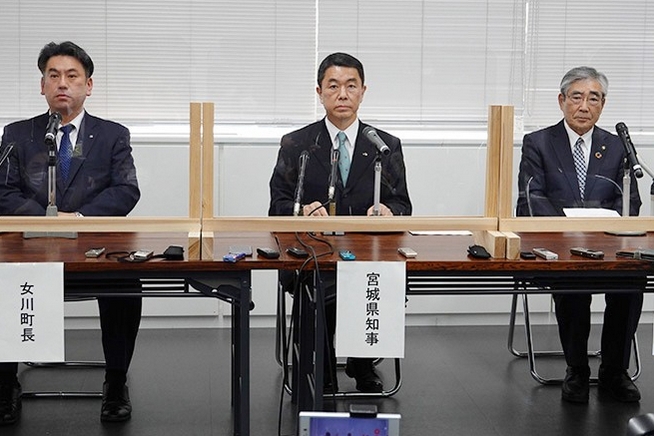
From left: Yoshiaki Suda, mayor of Onagawa, Miyagi Governor Yoshihiro Murai and Hiroshi Kameyama, mayor of Ishinomaki, hold a news conference in Ishinomaki, Miyagi Prefecture, on Nov. 11.
Approval given for 1st restart of nuclear plant damaged in 3/11
November 12, 2020
SENDAI, Miyagi Prefecture–Citing expected economic benefits, local governments approved the first restart of a nuclear power plant damaged in the 2011 Great East Japan Earthquake and tsunami.
Miyagi Governor Yoshihiro Murai on Nov. 11 said the decision on resuming operations of the No. 2 reactor at the Onagawa nuclear plant was “not an easy one.”
Required safety measures must still be completed at the plant, and questions remain about the evacuation route that will be used in the event of a disaster at the plant, which straddles the municipalities of Onagawa and Ishinomaki on the Pacific coast.
However, residents near the nuclear plant have requested a resumption of nuclear power operations to revive their depleted communities.
“We can expect many jobs to be created if the nuclear plant resumes operations,” Murai said. “Municipalities hosting the plant will also have increased tax revenues through the restart of the plant in terms of fixed property tax and nuclear fuel tax.”
His announcement followed a meeting with the mayors of Onagawa and Ishinomaki earlier in the day, in which the governor confirmed their approval of the planned restart.
Tohoku Electric Power Co., operator of the Onagawa plant, needed the consent from the host communities as well as Miyagi Prefecture although it is not a legal mandate.
The utility expects the reactor, with an output capacity of 825 megawatts, to be brought online as early as in 2023, when it plans to complete an array of projects designed to strengthen the safety of the plant.
“A critical decision was made as we are aiming at a restart,” the utility said in a statement about Murai’s announcement. “We are determined to strive in full force to enhance safety features of the facility.”
If restarted, the No. 2 unit will be the first boiling water reactor in Japan brought online since the 2011 nuclear disaster. The reactors at the Fukushima No. 1 nuclear plant, which suffered a triple meltdown after being swamped by the tsunami, are also boiling water types.
All reactors in Japan were shut down after the Fukushima nuclear disaster. Since then, nine reactors at five nuclear plants have resumed operations. They were all pressurized water reactors located in western Japan.
When the 13.0-meter tsunami hit the Onagawa plant after the Great East Japan Earthquake, the No. 2 reactor building was just high enough to escape the water.
Still, part of the equipment to cool the reactor failed, and more than 1,000 cracks were discovered in the reactor building.
The Onagawa plant has two other reactors. Tohoku Electric decided to retire the No. 1 reactor, but it is preparing to apply for a restart of the No. 3 reactor.
The utility compiled a set of safeguards for resuming operations of the No. 2 reactor, including construction of a 29-meter-high sea wall as protection against tsunami.
In February, the Nuclear Regulation Authority, the government nuclear watchdog, certified the No. 2 reactor as meeting the more stringent reactor regulations put in place after the Fukushima disaster.
The following month, industry minister Hiroshi Kajiyama urged Murai to agree to the restart of the Onagawa plant.
Japan had 54 nuclear reactors before the disaster struck in the Tohoku region.
Since the Fukushima accident, the number has fallen to 33, as other reactors were retired.
The central government needs to bring around 30 reactors online to achieve its target of nuclear energy representing 20 to 22 percent of the nation’s overall energy output in fiscal 2030.
The government hopes the restart of the Onagawa nuclear plant will prompt other municipalities that host boiling water reactors to accept a resumption of their operations.
(This story was written by Shinya Tokushima and Susumu Okamoto.)
Japan now has 16 reactors that meet requirements
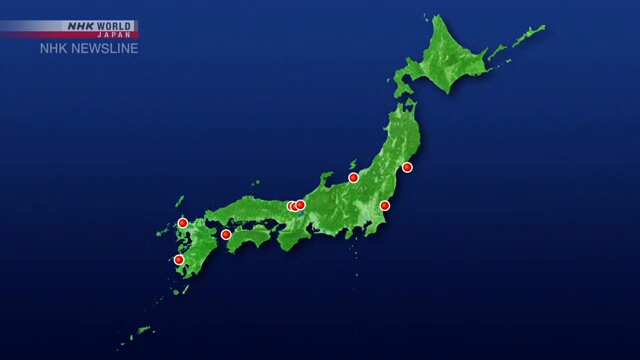
November 11, 2020
Japan now has 16 reactors at nine nuclear power plants that have cleared government requirements adopted after the 2011 Fukushima accident.
The No.2 reactor at Tohoku Electric Power Company’s Onagawa plant in Miyagi Prefecture, and the reactor at Japan Atomic Power Company’s Tokai No.2 plant in Ibaraki Prefecture were affected by the 2011 earthquake and tsunami. Tokai No.2 has yet to win local consent to restart.
Tohoku Electric’s Higashidori plant in Aomori Prefecture, also a part of the Fukushima disaster zone, is undergoing screening by the Nuclear Regulation Authority.
Reactors at Tokyo Electric Power Company’s Fukushima Daiichi and Daini nuclear plants are set to be scrapped.
Reactors that have already been put back online are: the No.1 and No.2 units at the Sendai plant in Kagoshima Prefecture; the No.3 and No.4 units at the Genkai plant in Saga Prefecture; the No.3 and No.4 units at the Takahama plant in Fukui Prefecture; the No.3 and No.4 units at the Ohi plant, also in Fukui Prefecture; and the No.3 unit at the Ikata plant in Ehime Prefecture.
The Sendai and Genkai plants are operated by Kyushu Electric Power Company, the Takahama and Ohi plants by Kansai Electric Power Company and the Ikata plant by Shikoku Electric Power Company.
1 This Month
23 April – WEBINAR – Why new nuclear reactors are the wrong tools for decarbonization Thursday, April 23 • 1 AM – 2 AM AEST

Pine Ridge Uranium is the real threat, not Tehran- Tell Burgum: Stop the Extraction.
Chernobyl: The Lost Tapes – A good documentary on Chernobyl on SBS available On Demand for the next 3 weeks– https://www.sbs.com.au/ondemand/tv-program/chernobyl-the-lost-tapes/2352741955560
To see nuclear-related stories in greater depth and intensity – go to https://nuclearinformation.wordpress.com
-
Archives
- April 2026 (275)
- March 2026 (251)
- February 2026 (268)
- January 2026 (308)
- December 2025 (358)
- November 2025 (359)
- October 2025 (376)
- September 2025 (257)
- August 2025 (319)
- July 2025 (230)
- June 2025 (348)
- May 2025 (261)
-
Categories
- 1
- 1 NUCLEAR ISSUES
- business and costs
- climate change
- culture and arts
- ENERGY
- environment
- health
- history
- indigenous issues
- Legal
- marketing of nuclear
- media
- opposition to nuclear
- PERSONAL STORIES
- politics
- politics international
- Religion and ethics
- safety
- secrets,lies and civil liberties
- spinbuster
- technology
- Uranium
- wastes
- weapons and war
- Women
- 2 WORLD
- ACTION
- AFRICA
- Atrocities
- AUSTRALIA
- Christina's notes
- Christina's themes
- culture and arts
- Events
- Fuk 2022
- Fuk 2023
- Fukushima 2017
- Fukushima 2018
- fukushima 2019
- Fukushima 2020
- Fukushima 2021
- general
- global warming
- Humour (God we need it)
- Nuclear
- RARE EARTHS
- Reference
- resources – print
- Resources -audiovicual
- Weekly Newsletter
- World
- World Nuclear
- YouTube
-
RSS
Entries RSS
Comments RSS
 nuclear-news