Japan PM vows swift decision on release of Fukushima radioactive water
October 21, 2020
Jakarta – Japanese Prime Minister Yoshihide Suga said Wednesday the government will swiftly decide what to do with treated radioactive water at the crisis-hit Fukushima nuclear power plant following reports of a plan to release the water into the sea.
“We cannot postpone the issue forever. We would like to make a decision responsibly as soon as possible,” Suga told a press conference in Jakarta as he wrapped up his first foreign trip since taking office in mid-September. The premier visited Indonesia and Vietnam.

Photo taken Aug. 26, 2020, at the crippled Fukushima Daiichi nuclear power plant in northeastern Japan, shows tanks for storing treated water from which most of the radioactive contamination has been removed.
“There has been no decision on when or how to deal with the water,” Suga said. The government plans to deepen discussions on the matter and work on measures to prevent reputational damage linked to radiation, he added.
Local fishermen have expressed worries while China and South Korea have cast a wary eye on the issue after it was reported that an official decision on the discharge of water from the Fukushima Daiichi nuclear plant, crippled by the 2011 devastating earthquake and tsunami, may be made by the end of this month.
The Fukushima plant operated by Tokyo Electric Power Company Holdings Inc. has been generating massive amounts of radiation-tainted water since the accident as it needs water to cool the reactors, which suffered core meltdowns.
The water has been treated using an advanced liquid processing system, or ALPS, to remove most contaminants other than the relatively less toxic tritium. It is stored in tanks on the facility’s premises.
But space is expected to run out by the summer of 2022, with contaminated water increasing by about 170 tons per day. As of September this year, the stored water totaled 1.23 million tons and continues to grow.
Seoul mulls response to Fukushima water release

Demonstrators protest the Japanese government’s plan to discharge contaminated water into the ocean in front of the old Japanese Embassy in Seoul on Monday.
October 20, 2020
Seoul authorities are mulling how to respond to Japan’s impending decision on discharging radioactive water from the devastated Fukushima nuclear plant into the sea, which could heighten concerns on public safety and environment here.
Tokyo is set to formally decide on Oct. 27 as to what to do with the more than 1 million tons of contaminated water it has collected since the Fukushima Daiichi nuclear plant was damaged by an earthquake and tsunami in 2011. Japanese media outlets said Tokyo has already made up its mind to dispose of the treated water that has been filtered to reduce radioactivity into the ocean, as the most “realistic option.”
As of Tuesday, the South Korean Foreign Ministry had not decided how to respond if its neighbor to the east presses ahead with the discharge. The government is handling the issue at a vice-ministerial meeting of related agencies to monitor Tokyo’s activities and come up with measures.
“The government has continued to call for Japan to share transparent information in regards to the disposal of the contaminated water of the Fukushima nuclear plant and has stressed the need to communicate with the international community,” Lee Jae-woong, the ministry’s deputy spokesman, said during a regular press briefing. “The government, with the foremost priority placed on the protection of our citizens’ health and safety, will devise measures in cooperation with the international community.”
The main concern for Korea is that the water, which has been filtered but is still slightly radioactive, could reach South Korea and threaten the safety of the waters and environment here, as well as of other neighboring nations that share the Pacific Ocean. Environmental activists have expressed strong opposition to the discharge, while fishermen and farmers in Japan have voiced concerns that consumers would shun seafood and produce from the region.
For years Japan has been debating how to dispose of the contaminated water, which has been stored in thousands of tanks inside the plant. But Tokyo Electric Power, the state-run operator of the plant, said the storage space is expected to run out in the summer of 2022.
Earlier this year, a panel of experts advising the Japanese government said that disposing of the water in the sea or vaporizing and releasing it into the air are the most “realistic options.” The International Atomic Energy Agency said that both of Japan’s options are technically feasible and have been used by other nuclear power plants around the world.
If Japan decides to discharge it, the water could be dumped as early as 2022, given the time needed for preparations.
The discharging of the water, regardless of what impact it will have on the environment and health, could further deal a blow to bilateral ties between Seoul and Tokyo, which is already frayed over issues of wartime history and trade.
Jeju Island Gov. Won Hee-ryong on Tuesday warned that his government will lodge a lawsuit against Japan both domestically and at the international court should Tokyo decide to discharge the water into the ocean. Research says the wastewater could reach the coastal areas of the southern resort island before any other location outside of Japan.
He also called Japan to disclose all information transparently regarding the contaminated water, and to discuss the issue with other neighboring countries.
By Ahn Sung-mi
Half of Japanese against releasing radioactive water from Fukushima plant; Seoul, Beijing also concerned

October 20, 2020
A recent survey conducted by the Japanese daily Yomiuri Shimbun shows about 50 percent of citizens in Japan are against their government’s plan to discharge radioactive water from the tsunami-wrecked Fukushima nuclear plant into the sea.
The survey was conducted on over one-thousand eligible voters from across Japan.
Media reports say the fishing industry in Fukushima Prefecture is also opposed to the idea.
The governor of South Korea’s southern island of Jeju, Won Hee-ryong held a press conference on Tuesday, saying he will bring the case to both local and international courts if Japan goes ahead with its plan.
Seoul’s foreign ministry has also repeatedly voiced its concerns over the planned discharge.
“The South Korean government has been constantly emphasizing transparent information sharing and communication with the international community on the issue. We will prioritize our people’s health and safety, and continue efforts based on international cooperation.”
Beijing has also called on Tokyo to make a decision carefully after negotiating with its neighbors.
It pointed out that radioactive material from the 2011 tsunami and earthquake has already been discharged, posing a grave threat to the marine environment and human health.
The Japanese government is likely to officially announce its discharge plan early next week.
“We would like to deepen the discussion within the government and want to make a decision responsibly at an appropriate time.”
Experts warn of the danger from a radioactive substance called tritium, which will not be completely eliminated despite a purifying process.
But some say there aren’t many realistic measures to prevent Japan from discharging the contaminated water.
Sources say the South Korean government is currently focused on pressuring Japan to discharge it transparently and safely so the international community can, at the least, feel less concerned.
Yoon Jung-min, Arirang News.
Jeju Governor Vows to Take Legal Action against Japan’s Fukushima Water Release

October 20, 2020
Jeju Province Governor Won Hee-ryong says he will launch both domestic and international lawsuits against Japan should it release radioactive water from its disabled Fukushima nuclear plant into the ocean.
At a press conference on Tuesday, Won urged Tokyo to halt preparations for the release, be transparent in providing all relevant information and data and begin consultations on the water disposal.
Stressing that he, as Jeju governor, has the duty to protect the safety of South Korean waters and people, Won said he will work with all those affected to mobilize all means in countering the move.
The governor added that the Japanese people, especially those living in coastal regions, are opposed to the water release as well.
Won suggested forming a group representing coastal area residents in both South Korea and Japan to take the Japanese government to criminal and civil courts in both countries, as well as to an international tribunal.
Tokyo is set to make a final decision on the water release on October 27.
S. Korean demonstrators ramp up protests against Japan’s plans to dump radioactive water into the ocean

October 19, 2020
On Oct. 16, Japanese media outlets reported that the Japanese government will decide on whether or not to dump radioactive water from the Fukushima Daiichi Nuclear Power Plant into the Pacific Ocean. On Oct. 19, demonstrators organized in front of the former Japanese Embassy in Seoul to voice their vehement opposition to the ocean release. The demonstrators held up placards reading “Is the ocean a dump site for radioactive waste?” and “Complete opposition to the ocean release of radioactive water from Fukushima!” and demanded that the Japanese government withdraw its plans for getting rid of its radioactive water. They also demanded that the South Korean government move to proactively oppose and prevent the ocean release.

Demonstrators protest the Japanese government’s plan to dump radioactive water into the ocean in front of the old Japanese Embassy in Seoul on Oct. 16.

Demonstrators demand that the Japanese government withdraw its plans for the ocean release.

A demonstrator mocks Japanese Prime Minister Yoshihide Suga.
By Kim Hye-yun, staff photographer (all photos by Kim Hye-yun)
http://www.hani.co.kr/arti/english_edition/e_national/966364.html
World worries about release of Fukushima nuclear water
Neighboring countries oppose ‘irresponsible’ plan

A security guard stands on an empty main street at dusk in Namie, north of Fukushima Daiichi Nuclear Power Plant, Fukushima Prefecture, Japan on March 9, 2016.
October 18, 2020
The world public, especially those in Japan’s neighbors such as China and South Korea, have expressed deep concerns over environmental pollution and human health, and opposition to the Japanese government’s plan to dump radioactive water from the disabled Fukushima nuclear plant into the ocean.
Analysts said that Japan should think twice before making the decision as the move would have disastrous consequences for the marine environment and human health, which could lead to criticism by related international organizations, countermeasures by affected countries including cessation of imports of Japanese seafood, and harm to the country’s image.
Japanese media said that the country’s government will hold a related cabinet meeting as early as this month to make the final decision on the plan to release more than 1 million tons of radioactive water from the Fukushima Daiichi nuclear power plant into the Pacific Ocean after reducing the level of radioactivity.
The plan has not gotten much rolling coverage in Japan, but there are still many Japanese netizens expressing their disagreement. According to a poll on Yahoo Japan, 41.5 percent of the 31,035 respondents disagreed with the plan.
Local fishermen in Fukushima publicly announced their opposition, saying the plan will undo years of work rebuilding their industry’s reputation since the plant was wrecked by a huge tsunami in March 2011.
The public of South Korea has repeatedly voiced concern, claiming that discharging the water represents a “grave threat” to the marine environment.
A South Korean Foreign Ministry official told reporters that a meeting of related ministries regarding this issue was elevated to vice-ministerial status last month to step up the response to Japan’s move, reported South Korea’s KBS News on Friday. The official said the government will continue to closely monitor Tokyo’s activities and take measures based on cooperation with the international community.
Japan’s plan also sparked outrage among Chinese netizens, many of whom criticized Japan’s practice, saying it is throwing its responsibility onto the world to share.
Sun Yuliang, a nuclear expert at Tsinghua University in Beijing, told the Global Times on Sunday that whether to dump the waste water should depend on an authoritative scientific assessment to determine whether the processed radioactive water meets international standards for release.
Sun called on the Japanese government to invite professional teams from related international organizations such as the International Atomic Energy Agency to conduct a complete field investigation.
Liu Junhong, a research fellow at the China Institutes of Contemporary International Relations, urged Japan to further communicate with the international community and share information transparently.
Liu said that the Japanese government should give priority to safeguarding public health and safety and the environment, rather than the cost of the rehabilitation work after the 2011 Fukushima disaster.
Liu noted that the seas in Asia are mostly connected and many of them are semi-closed, so that the contaminants from the Fukushima water could subside and then rise, which would severely affect the local marine and coastal environment and the health of people nearby.
Therefore, Japan’s neighboring countries including China and South Korea would be the first to react to the plan, Liu said.
He noted that if the Japanese government releases the water, these countries are likely to stop imports of seafood from Japan, and foreigners could be reluctant to visit the country and enjoy its food, which would harm Japan’s economy.
Other analysts noted that the plan goes against Japan’s long-established image of being friendly to the marine environment.
Another expert on nuclear safety, who requested anonymity, said that the issues is not only one of Japan’s own business but also relates to the interests of the global community, so countries and related organizations in the international community should cooperate and assist Japan to deal with the contamination.
The Daiichi Nuclear Power Plant in Fukushima went into meltdown and released radioactive material in the aftermath of a tsunami in March 2011.
The disaster cast doubts over the safety of nuclear power worldwide, leading China to launch a campaign to review and upgrade the safety systems of all its nuclear power stations.
Google headline nuclear articles today – the main topic was the Nuclear Ban Treaty
 26 Oct 20, In the 95 nuclear news items listed as headlines in Google Search today, the most notable recent topic was nuclear weapons, and, significantly, the ratifications of the U.N Treaty on the Prohition of Nuclear Weapons . These now number 50, the required number to bring this Treaty into international law. Generally articles on nuclear weapons were critical of, or opposed to them, with some articles ‘neutral’, simply reporting facts and numbers. A smaller number of articles had the theme of valuing the nuclear weapons industry.
Apart from articles about nuclear weapons and the weapons ban treaty, the majority of articles about the nuclear industry were clearly promotions of that industry. the major theme being that the world ‘needs nuclear power’, especially small nuclear reactors, to provide ‘clean’, climate ‘-friendly’ energy. Another big theme was the development of nuclear fusion. Other articles enthused about space research, nuclear medicine, and safety of ionising radiation.
Roughly half as many articles opposed the nuclear industry. The main themes were waste disposal problems, small reactors costly and useless, and safety issues.
A smaller number again were even-handed or ‘neutral’ articles – the main topic being international diplomacy, then safety concerns, and decommissioning of nuclear stations.
Joe Biden calls climate change the ‘number one issue facing humanity
 Joe Biden calls climate change the ‘number one issue facing humanity’, CNBC, OCT 24 2020
-
- Joe Biden declared climate change the “number one issue facing humanity” and vowed a national transition from fossil fuels to renewable energy that he says will create millions of new jobs.
- Biden has a $2 trillion plan that puts the U.S. on a path to zero carbon pollution from the electricity sector by 2035 and net-zero emissions by 2050.
- Scientists say that Biden’s transition plan is required to avoid the most catastrophic consequences of climate change.
- Climate change has fueled record-setting wildfires in the U.S. West and one of the most active Atlantic hurricane seasons this year………
- “Climate change is the existential threat to humanity,” the former vice president said. “Unchecked, it is going to actually bake this planet. This is not hyperbole. It’s real. And we have a moral obligation.” ……
Biden, the Democratic presidential nominee, has boasted a $2 trillion plan that invests significantly in clean energy in the transportation, electricity and building industry, cuts fossil fuel emissions and improves infrastructure.
Biden’s plan also puts the U.S. on a path to zero carbon pollution from the electricity sector by 2035 and net-zero emissions by 2050. Coal and natural gas comprise more than 60% of the electricity sector, according to the Energy Information Association.
“It’s going to create millions of jobs … We can’t be cavalier about the impact it’s going to have on how we’re going to transition to do all this,” Biden said of his plan on the podcast. “But I just think it’s a gigantic opportunity, a gigantic opportunity to create really good jobs.”
Scientists say that Biden’s transition plan is required to avoid the most catastrophic consequences of climate change. …..
Trump has denied the science of climate change and reversed more than 70 major environmental regulations during his four years in office, with nearly 30 more in progress.
But climate change has been a top issue of the 2020 presidential election, especially among younger voters…….
Biden leads on climate change by an enormous margin, with 58% to 19% of registered voters saying the former vice president would address the problem better than President Trump, according to an NBC News/Wall Street Journal poll. …..
-
-
- September 2020
-
-
- and this year is set to be one of the five hottest in recorded history.
https://www.cnbc.com/2020/10/24/joe-biden-climate-change-is-number-one-issue-facing-humanity.html
495 local assemblies demand Japan government ratify the Treaty on the Prohibition of Nuclear Weapons
 495 local assemblies demand Japan gov’t ratify nuclear ban treaty in written statement, October 24, 2020 Mainichi Japan
 The nuclear arms prohibition treaty was adopted in July 2017 by 122 countries and regions — over 60% of the United Nation’s membership. The treaty bans the development, test, manufacture, possession or use of atomic weapons, as well as the threat of their use — the basis of nuclear deterrent. Japan did not participate in negotiations nor signed the pact, along with the five nuclear powers of the United States, Russia, Britain, France and China. Tokyo stayed out of the pact for fear of appearing to denounce nuclear deterrence and thereby deepening conflict between nuclear have and have-not nations.
According to Gensuikyo, the prefectural assemblies of Iwate, Nagano, Mie, Tottori, and Okinawa, as well as 490 municipal assemblies — 28% of all local assemblies nationwide — had adopted the written statement as of Oct. 23, 2020. The tally includes assemblies that have adopted the objective of the written statement, as they agree with it but are uncertain of its feasibility. A total of 34 assemblies in Iwate, including the prefectural assembly, adopted the statement. The statement was initially turned down twice in the municipal assembly of Ofunato, Iwate Prefecture, but finally gathered a majority in March 2020 after Gensuikyo explained persistently about damage resulting from nuclear weapons.
Sixteen municipal assemblies in Hiroshima Prefecture, including the Hiroshima city assembly, have adopted the statement, with authorities saying, “Our country, the only nation that has experienced atomic bombing, has a special role and responsibility to strive to abolish nuclear weapons.” However, Hiroshima Prefectural Assembly lawmakers did not even submit a proposal to adopt the statement.
There are also local assemblies that reject adopting the statement as it is not legally binding, and by claiming that national defense and security are exclusively under central government jurisdiction. Soji Kanno, deputy secretariat head at Gensuikyo’s Iwate branch, who approached Iwate Prefecture assemblies with the statement, commented, “Abolishing nuclear weapons is not a political request, but the wish of the Japanese public. I’d like for all local assemblies to raise their voices towards the Japanese government.”
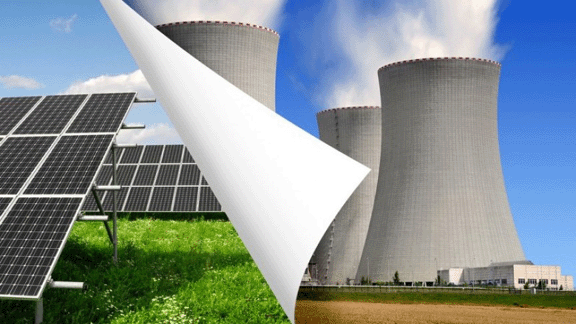
Every dollar wasted on nuclear power is a dollar not invested in clean energy
|
Every dollar wasted on nuclear is a dollar not invested in renewables, https://wordpress.com/read/feeds/72759838/posts/2985336306 By Tim Judson and Luis Hestres, 25 Oct 20, We’ve known for a long time that nuclear energy is a false solution to climate change. Not only are the health and environmental impacts of nuclear power intolerable, but it also gobbles up investments we should be making in clean and safe renewable energy. Now, a new study by researchers at the University of Sussex in the UK brings us the latest and most robust evidence of these facts. The study, published last week in Nature Energy, considers three hypotheses: Firstly, that emissions decline the more a country adopts nuclear power; secondly, that emissions decline the more a country adopts renewables; and thirdly, that nuclear and renewables are ‘mutually exclusive’ options that tend to crowd each other out at an energy system level. The hypotheses were tested against 25 years’ worth of electricity-production and emissions data from 123 countries. The result? Investment in nuclear is mostly negatively correlated with decreases in carbon emissions, while investment in renewables was positively correlated with such decreases across the board. In other words, countries that invested in nuclear didn’t see emission reductions but countries that invested in renewables did. The only exceptions were higher per-capita GDP countries, which saw some decreases in emissions while investing in nuclear—but countries with lower per-capita GDP didn’t. But this last finding didn’t take into account the costs associated with nuclear waste storage and cleanup, the dangers of nuclear accidents, or the fact that those reductions might have been deeper if renewables had been chosen. The finding that investments in nuclear and renewables tend to crowd each other out means that countries that invest more in nuclear tend to invest less in renewables, and vice versa. This refutes the ‘all of the above’ option, or what we call ‘refuse to choose’. Every dollar that a country wastes in nuclear is a dollar it doesn’t invest in renewable energy, which has a better chance of achieving deeper emission reductions at a lower cost and without the dangers associated with nuclear energy. To refuse to choose is to choose nuclear, to the detriment of the fight against climate change and the health and safety of people and the environment. This study has major implications for climate and energy policy in the US and around the world. In June 2020, the USCAN Climate Action Network made a big splash by publishing the Vision for Equitable Climate Action. Not only is VECA the most comprehensive and detailed policy agenda put out by the climate movement, it is rooted in principles of racial and economic equity and justice, developed by more than 170 people from over 100 organizations. It is also the first major climate movement agenda to explicitly call for a phaseout of nuclear power. Along with other recent climate justice agendas, from the Equitable and Just National Climate Platform and the People’s Orientation to a Regenerative Economy to the THRIVE Agenda and the Feminist Green New Deal, VECA is part of a broad shift toward transformative solutions to the climate crisis, calling for a rapid, just and equitable transition to 100% renewable energy. Moderate climate organizations have reacted with hesitation and resistance, skeptical that transformative change is too risky, or not supported by the science. And nuclear power has been one of the central sticking points, with some insisting that it plays too big a role in our energy supply. But now the science is in, and it shows nuclear is out. And the Vision for Equitable Climate Action and the anti-nuclear and climate justice movements have it right. The Sussex study confirms what NIRS, Beyond Nuclear and others have been saying for a long time: on top of being too dirty and too dangerous, nuclear power is simply too expensive and too time-consuming to compete with renewables as an alternative to decarbonize the global economy. So, what about the Green New Deal? While opponents of the GND complain about its potential $2 trillion cost, this year has proven that’s just playing politics. With the $2.5 trillion COVID-19 relief bill Congress passed in April, it’s clear that, when the country truly knows we are facing a crisis and our elected officials are forced to deal with it, we can find the political will and the money to do what is needed. If we can find $2.5 trillion in a few weeks to bootstrap our economy and support people through the pandemic for a few months, the Green New Deal is a bargain. For $2 trillion over 10 years, we can not only literally save the world, but build a just, equitable, sustainable new economy with healthy communities, good, union jobs, and real economic security. But at the same time, as with COVID, we don’t have time to waste on things that aren’t going to work, and nuclear power is now exhibit #1. It would be better to spend our money on creating thousands of jobs cleaning up and revitalizing the hundreds of communities impacted by nuclear power, and coming up with environmentally just and scientifically proven ways to isolate radioactive waste. When it comes to the climate crisis, we have to be bold, visionary, and ambitious, and we have to put equity and justice first. That alone is reason enough to make sure the Green New Deal prioritizes a phaseout of nuclear power through a just transition for workers and communities. Tim Judson is the Executive Director of Nuclear Information and Resource Service. Luis Hestres, PhD., is the Digital Strategist at Nuclear Information and Resource Service. |
|
Dear “President-elect Biden” — Beyond Nuclear International

Your first job is to turn back the Doomsday Clock
Dear “President-elect Biden” — Beyond Nuclear International
Trump government’s dangerous plan to deregulate disposal of radioactive trash
 Trump team pushes nuke dumping http://njtoday.net/2020/10/25/trump-team-pushes-nuke-dumping/, by Staff Report • October 25, 2020 Many Americans alarmed over the deadly coronavirus pandemic, a worsening climate crisis, an economic disaster on par with the Great Depression, or the White House’s surrender of Afghanistan to the Taliban would sleep better if they had assurances the radioactive waste disposal is as secure as it could possibly be… but President Donald Trump is still in charge so there’s no such luck.
The Nuclear Regulatory Commission is finalizing a year-long drive to functionally deregulate disposal of massive amounts of radioactive waste.
NRC’s plan would allow commercial nuclear reactors to dump virtually all their radioactive waste, except spent fuel, in local garbage landfills, which are designed for household trash not rad-waste, according to comments filed by Public Employees for Environmental Responsibility (PEER).
Friday marked the end of public comments for an NRC “interpretative rulemaking” that would, in effect, abrogate longstanding requirements that virtually all such waste must be disposed of in licensed radioactive waste sites meeting detailed safety standards and subject to NRC inspection and enforcement.
Instead, the Trump administration wants to allow the NRC to grant generic exemptions for unlicensed waste handlers.
NRC declares its “intent” that these newly exempt disposal sites would be limited to “very low-level radioactive wastes” – a term undefined by statute – which NRC considers to be “below 25 millirem per year.”
“NRC’s definition would allow public exposure to the equivalent to more than 900 chest X-rays over a lifetime,” explained Lisa McCormick. “This new approach creates a cancer risk twenty times higher than the Environmental Protection Agency’s acceptable risk range, thousands of times the risk goal for Superfund sites, or enough radiation to cause every 500th person exposed to get cancer.”
McCormick, a progressive Democratic activist in New Jersey, says the rule change is “the worst thing to do as dozens of America’s 104 nuclear power plants come to the end of their operation.”
“Once an exempt entity accepts radioactive waste, it enters a regulatory black hole, with no one accountable for it,” stated PEER Pacific Director Jeff Ruch, pointing out that NRC’s plan eliminates the need for radiation monitoring, health physics personnel, design standards, and NRC inspections – all now required of licensed operators. “Unlicensed radioactive waste dumps could operate in ways that endanger communities free from any NRC oversight.”
NRC’s cryptic justification merely indicates that the plan “would provide an efficient means by which the NRC may issue specific exemptions for disposal” but ignores impacts that would –
- Transform many municipal dumps into radioactive repositories, with no safeguards for workers, nearby residents, or adjoining water tables;
-
- Allow unlicensed radioactive waste dumps to expose the public to 2.5 times higher levels of radiation than the NRC now allows for licensed low-level radioactive waste sites, thus creating a strong incentive to send all the radioactive waste to unlicensed dumps; and
- Eliminate the public’s ability to find out radioactive waste is being dumped near them.
At present, the U.S. has 104 commercial nuclear power plants, many of which are beginning, or will soon start, the decommissioning process.
Removing the need for licensed sites to handle the staggering amounts of debris from old reactors would be a major cost savings for that industry.
“One of New Jersey’s oldest nuclear power plants just came off line and it poses a drastic problem for the people and environment” said McCormick.
“NRC’s deregulation will make it nearly impossible to trace recycled radioactive waste flowing through the stream of American commerce,” added Ruch, noting that it may also create a market for the U.S. to import radioactive waste for cheaper disposal. “This plan would plunge the U.S. into the wild, wild West of radioactive waste disposal, on a par with a Third World natio
Angry reactions to Japanese government’s plan to release Fukushima nuclearwaste water into the Pacific
 Plan to release Fukushima water into Pacific provokes furious reaction https://www.dw.com/en/tepco-fukushima-contaminated-water/a-55334567– 25 Oct 20, The Japanese government has reportedly decided to pump highly radioactive cooling water from the Fukushima plant into the Pacific Ocean. The plan has been slammed by environmental groups, locals and neighboring nations.Environmental groups have reacted furiously to reports that the Japanese government is set to approve plans to dump more than 1 million tons of highly radioactive water stored at the Fukushima nuclear plant into the Pacific Ocean, with their concerns shared by the governments of neighboring countries and people living in northeastern Japan.
A government panel set up to determine the best way of disposing the radioactively contaminated water is scheduled to announce its decision by the end of the month.
Three Fukushima reactors suffered meltdowns following a 2011 tsunami that destroyed wide swaths of the coastline in northern Japan’s Miyagi prefecture.
According to reports leaked to Japanese media, the panel will recommend releasing the approximately 1.23 million tons of water currently stored in tanks in the grounds of the nuclear plant.
The alternatives that have been considered are to evaporate the water into the atmosphere or to mix it into concrete and store it underground.
According to reports from national broadcaster NHK and other news outlets, the panel will call for the water to be again put through a process designed to reduce the radioactivity to below “regulatory standards” and dilute it with sea water before it is pumped into the ocean.
The three damaged reactors require constant cooling with water, which becomes highly radioactive, and mixes with around 170 tons of groundwater that seeps into the subterranean levels of the reactor buildings every day.
That water is pumped into hundreds of huge tanks on the site every day, with Tokyo Electric Power Co. (Tepco), the operator of the power plant, estimating that even with more waste tanks being constructed, storage capacity will be reached fully in the summer of 2022.
Environmental groups insist that there is no reason why more storage tanks cannot be constructed outside the perimeter of the plant. They accuse the government of seeking the cheapest and quickest solution to the problem, as authorities have promised the site will be safe in 40 years.
And that deadline, they say, is completely unrealistic. Complications include recovering the molten fuel that escaped from the reactor chambers. This kind of recovery has never before been attempted and the technology required does not yet exist.
They also accuse the Japanese authorities of playing down the radiation levels in the water planned for release.
Environmental groups insist that there is no reason why more storage tanks cannot be constructed outside the perimeter of the plant. They accuse the government of seeking the cheapest and quickest solution to the problem, as authorities have promised the site will be safe in 40 years.
And that deadline, they say, is completely unrealistic. Complications include recovering the molten fuel that escaped from the reactor chambers. This kind of recovery has never before been attempted and the technology required does not yet exist.
They also accuse the Japanese authorities of playing down the radiation levels in the water planned for release.
Elevated levels of radiation
A study by the Kahoko Shinpo newspaper confirmed that levels of iodine 129 and ruthenium 106 exceeded acceptable levels in 45 out of 84 samples collected in 2017.
Iodine has a half-life of 15.7 million years and can cause cancer of the thyroid, while ruthenium 106 is produced by nuclear fission and high doses can be toxic or carcinogenic when ingested.
Tepco subsequently confirmed that levels of strontium 90 were more than 100 times above legally permitted levels in nearly 65,000 tons of water that had already been treated,
They were 20,000 times above safety levels set by the government in several storage tanks at the Fukushima site.
Fish industry worried
Precisely what is in the water that is due to be released into the ocean cannot be confirmed, however, as Tepco and the government have refused to permit independent testing on samples.
Residents of Fukushima Prefecture are also against the plan, with 42 of the 59 local authorities in the prefecture passing resolutions either expressing outright opposition to the plan or deep concern.
The fishing industry — which was devastated by the original natural disaster and has since struggled to reestablish itself — is also hostile to the proposals, with representatives of fishing cooperatives meeting with government officials last week to express their concerns.
“We are terrified that if even one fish is found to have exceeded the [radiation] safety standards after the treated water is released, people’s trust in us will plummet,” a fisherman from the city of Soma told Kyodo News. “Our efforts to fight false information and address other challenges could be wasted.”
Hideyuki Ban, co-director of the Citizens Nuclear Information Center, echoed those calls.
“Release of the contaminated water into the ocean should not be allowed when fishing unions from Fukushima and neighboring Ibaraki and Iwate prefectures are opposed,” he told DW.
“If it is dumped in the ocean, it will become an international problem and it is possible that bans on exports from this area will continue or that new export restrictions may be introduced.”
Read more: Japan: Environmentalists say Fukushima water too radioactive to release
“It is highly unlikely that the highly radioactive waste can be removed from the site of the nuclear plant, so instead of rushing to remove the fuel debris, the overall decommissioning schedule should be reviewed and measures taken so that the contaminated water can be stored on land,” he said.
In a statement issued to DW, Tepco said it is “not in a position to make a decision on this matter.”
“The government has been listening to the opinions of various stakeholders, including local municipalities and those involved in the agriculture, forestry and fisheries industries, and it is the government that will make a decision on the disposal method,” the company said, adding Tepco will follow the disposal guidelines as instructed following the official decision.
Neighbors’ concerns
The residents of Japan’s neighboring countries and their governments are equally concerned, with an editorial in the Korea Times on Monday warning of an “environmental disaster” that could “destroy the marine ecosystem.”
The South Korean government has also demanded that Japan provide a full accounting of its plans for the contaminated water, including an accurate accounting of the different radionuclides that it contains.
In a statement released by the Foreign Ministry, Seoul said it places the highest priority on protecting the environment and the Korean public’s health.
Scientists and academics in China are demanding independent testing and verification of radiation levels in the water, while environmental and citizens’ groups in Taiwan have previously expressed concerns about the impact of any large-scale release of contaminated water on their health and well-being.
Hokkaido municipalities gamble on a nuclear future, but at what cost?
Hokkaido municipalities gamble on a nuclear future, but at what cost? https://www.japantimes.co.jp/news/2020/10/24/national/media-national/hokkaido-gambling-casinos/ BY PHILIP BRASOR Since August, two local governments on the western shore of Hokkaido have said they will apply to the central government for a survey that could eventually lead to their municipalities hosting a permanent underground repository for high-level radioactive waste. The fact that these two localities made their announcements about a month apart and are situated not far from each other was enough to attract more than the usual media attention, which revealed not only the straitened financial situations of the two areas, but also the muddled official policy regarding waste produced by the country’s nuclear power plants.
Then again, neither Suttsu nor Kamoenai may make it past the first stage. Yugo Ono, an honorary geology professor at Hokkaido University, told the magazine Aera that Suttsu is located relatively close to a convergence of faults that caused a major earthquake in 2018. And Kamoenai is already considered inappropriate for a repository on a map drawn up by the trade ministry in 2017.
If the Nuclear Waste Management Organization’s process for selecting a site sounds arbitrary, it could reflect the government’s general attitude toward future plans for nuclear power, which is still considered national policy, despite the fact that only three reactors nationwide are online. Presently, spent fuel is being stored in cooling pools at 17 nuclear plants comprising a storage capacity of 21,400 tons. As of March, 75 percent of that capacity was being used, so there is still some time to find a final resting place for the waste. Some of this spent fuel was supposed to be recycled at the Rokkasho Reprocessing Plant in Aomori Prefecture, but, due to numerous setbacks, it doesn’t look as if it’s ever going to open, so the fuel will just become hazardous garbage.
Ono tells Aera that the individual private nuclear plants should, in line with product liability laws, be required to manage their own waste themselves. If they don’t have the capacity, then they should create more. It’s wrong to bury the waste 300 meters underground, which is the plan, because many things can happen over the course of future millennia. The waste should be in a safe place on the surface, where it can be readily monitored.
However, that would require lots of money virtually forever, something the government would prefer not to think about, much less explain. Instead, they’ve made plans that allow them to kick the can down the road for as long as possible.
Safety of SanOnofre nuclear waste storage is disputed
Dust-UPS Continue Over Radioactive Waste Storage at San Onofre https://goodmenproject.com/featured-content/dust-ups-continue-over-radioactive-waste-storage-at-san-onofre/ The most recent dispute centers on the green light the California Coastal Commission gave Edison on July 16 to remove the cooling pools where spent fuel rods were submerged for several years to begin cooling down. October 25, 2020 by EarthTalk By Sarah Mosko
The decommissioning of San Onofre Nuclear Generating Station (SONGS) has been riddled with controversies since it was shuttered in 2013, undermining public confidence in Southern California Edison’s management of highly radioactive nuclear waste which will be stored on-site for the foreseeable future.
In 2018 for example, a whistleblower exposed how a 54-ton canister loaded with radioactive waste nearly plummeted 18 feet because of a design flaw and human error, prompting the Nuclear Regulatory Commission (NRC) to cite Edison with the most serious violation ever imposed on a spent fuel licensee.
The most recent dispute centers on the green light the California Coastal Commission gave Edison on July 16 to remove the cooling pools where spent fuel rods were submerged for several years to begin cooling down. Edison argued the pools aren’t needed anymore because the rods have all been transferred into dry storage canisters.
Each of SONGS’s 123 canisters holds roughly the same amount of Cesium-137 as released during the 1986 Chernobyl disaster.
At issue is this: If a canister were to begin degrading, creating risk of radiation release, returning it to the cooling pools is the only means whereby the contents could be repackaged into a new canister. Nonetheless, Edison convinced the Coastal Commission that an untested, unapproved nickel “cold spray” overlay technology could be applied to patch degrading canisters, making the cooling pools unnecessary.
NRC spokesperson David McIntyre confirmed that NRC has neither evaluated nor approved any method for fixing a canister. The only sure solution is to replace the canister. Many nuclear safety advocates in Orange and San Diego counties are outraged, believing Edison, the Coastal Commission, and NRC are gambling public safety on unproven repair methodology piggy-backed on already inferior dry storage canisters that need to last far longer than originally intended.
This situation is only partly due to the federal government’s failure to construct a mandated permanent national repository for storing the country’s highly radioactive nuclear waste, leaving U.S. nuclear plants saddled with storing spent fuel on-site indefinitely.
Objections to eliminating the pools revolve around this specter of stranded radioactive waste remaining on-site for the foreseeable future, with no means to repackage it, together with concerns about the canisters Edison chose and SONGS’s beachfront location.
Inferior Storage Canisters
SONGS uses two models of thin-walled (5/8 inch thick), welded shut, stainless steel canisters (Holtec and Areva). They are warranted only for manufacturing defects and for just 10-25 years. Thick-walled casks (10-19 inch) with bolted lids, as survived the Fukushima earthquake and tsunami, are standard throughout most of the world.
Nuclear safety advocates point to evidence thin-walled canisters are vulnerable to cracking yet can’t be inspected for tiny cracks which can grow through the canister wall. They are critical of NRC for ignoring established safety codes for nuclear pressure vessels used for storage and transport of nuclear waste (American Society of Mechanical Engineers, ASME N3) when they approved SONGS’s canisters which can’t be inspected by proven methodology (liquid penetrant).
Instead, Edison applied a robotic camera in 2019 to eight Holtec canisters to characterize the extent of canister scraping/gouging incurred during downloading into their holes in the in-ground concrete storage pad. Because of the small clearance between a canister and the guide ring at the mouth of the hole, canisters are routinely scraped/gouged, potentially initiating cracking.
Edison admitted their improvised camera technique doesn’t qualify as a formal inspection, yet the NRC accepted Edison’s conclusion that damage to the canisters during downloading poses no current credible threat.
Thin-walled canisters also fail to block gamma or neutron radiation so require additional individual thick concrete containers for storage and thick metal containers for transport. The unsealed steel lined concrete containers require air vents for convection cooling.
Marine Environment
SONGS is situated within 50 miles of 8 million people, sandwiched between the ocean and the I5 Freeway, and accessible to terrorist attack from either side. A mysterious two-night swarm of drones over the Palo Verde nuclear plant in Arizona last September highlights vulnerability to malfeasance.
SONGS sits 108 feet from shore in a known earthquake zone, creating risks of flooding from sea level rise and shaking and tsunamis from earthquakes. The in-ground pad holding the Holtec canisters already sits just 18 inches above the water table.
-
Archives
- February 2026 (228)
- January 2026 (308)
- December 2025 (358)
- November 2025 (359)
- October 2025 (376)
- September 2025 (258)
- August 2025 (319)
- July 2025 (230)
- June 2025 (348)
- May 2025 (261)
- April 2025 (305)
- March 2025 (319)
-
Categories
- 1
- 1 NUCLEAR ISSUES
- business and costs
- climate change
- culture and arts
- ENERGY
- environment
- health
- history
- indigenous issues
- Legal
- marketing of nuclear
- media
- opposition to nuclear
- PERSONAL STORIES
- politics
- politics international
- Religion and ethics
- safety
- secrets,lies and civil liberties
- spinbuster
- technology
- Uranium
- wastes
- weapons and war
- Women
- 2 WORLD
- ACTION
- AFRICA
- Atrocities
- AUSTRALIA
- Christina's notes
- Christina's themes
- culture and arts
- Events
- Fuk 2022
- Fuk 2023
- Fukushima 2017
- Fukushima 2018
- fukushima 2019
- Fukushima 2020
- Fukushima 2021
- general
- global warming
- Humour (God we need it)
- Nuclear
- RARE EARTHS
- Reference
- resources – print
- Resources -audiovicual
- Weekly Newsletter
- World
- World Nuclear
- YouTube
-
RSS
Entries RSS
Comments RSS
 nuclear-news