Remembering Hiroshima and Nagasaki – time for the global Nuclear Ban Treaty – theme for August 20

August 6th and August 9th are the days that remind us of the horror of nuclear weapons. The failing and desperate nuclear industry would like us to forget about Hiroshima and Nagasaki. They’d like us to swallow their spin about new small nuclear reactors. (But new small nuclear reactors are just the latest gimmick to support the nuclear weapons industry, and put a friendly mask on it. They really have no other purpose.)
 In this time of pandemic and global heating, Trump’s USA, Putin’s Russia, and other nations, are putting obscene amounts of money into nuclear weapons. The U.N.’s Treaty on the Prohibition of Nuclear Weapons (passed by a vote of 122-1-1 at the United Nations in 2017) is looking ever more rational and necessary. It will enter into force when 50 nations have ratified it. It’s now up to 43 ratifications.
“The pandemic has taught us that all the world’s great needs and threats are linked. By reallocating bloated military spending and reorienting nations to resolve conflict through peaceful negotiation, people and governments throughout the world can more easily tackle the enormous economic and civil injustices that give rise to conflict and fuel the fire of climate change. Each victory in each arena must be used to feed progress elsewhere if humanity is to survive this century.
As we remember the victims of the atomic bombings 75 years ago and hear the stories of the survivors, we realize more than ever: we are all in this together. ” – Michael Christ, Executive Director, International Physicians for the Prevention of Nuclear War
Banning weapons of mass destruction, including nuclear ones – theme for August 2020

You might think that it’s naive to be talking about banning nuclear weapons, in this present climate of international tension. Yes, an international agreement to ban them is not going to get rid of nuclear weapons overnight, or indeed, anytime soon.
BUT – as things stand now, nuclear weapons, held by all the so virtuous States – USA, Britain, France, India, China Pakistan, Israel, (- and now North Korea) – are accepted as respectable , defensive, necessary.
The idea of the world recognising weapons of mass destruction as unacceptable is not new. It’s been done before.
Human beings, after all, are social animals, and their greatest successes have been achieved by co-operation. Years of co-operative effort by intelligent and thoughtful people have shed light on the humanitarian horror of mass killings, and mass sufferings of those who survived such attacks.
Under the auspices of he United Nations, the concerted efforts of so many have brought about the recognition that mass murder is unacceptable, and has been judged to be illegal. No, these threats have not been completely eliminated. But they have been vastly diminished, and no leader can get away with pronouncing them to be acceptable or necessary.

The United Nations Ban on the use of chemical and biological weapons in warfare was signed in 1925, and strengthened in 1997 in the the Chemical Weapons Convention (CWC)
The United Nations Biological Weapons Convention (BWC) came into force in 1975.
In both cases, these agreements outlawed the development, stockpiling, acquisition, retention, and production of these inhumane weapons, and reaffirmed the 1925 ban on their use.
These bans, agreed on by 178 nations (the BWC), 192 (the CWC) have been further developed over many years of successive conventions, the most recent being in November 2016.
There’s a wealth of information on the effects of nuclear weapons production and use – not just the immediate effects on victim communities, but the pervasive global effect on climate, agriculture and teh world’ s food supply.
Right now, we all live under a terrible threat of nuclear war. It is surely time to make a start on removing that threat. The United Nations Nuclear Weapons Ban Treaty is that start. The Treaty on the Prohibition of Nuclear Weapons is close to the number of 50 ratifications , required to make it international law.
America’s nuclear attack on itself ? The fallout from nuclear testing
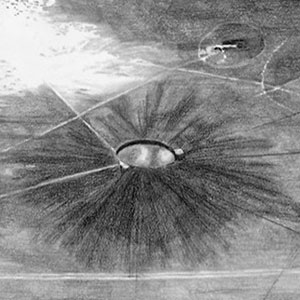
Above – Trinity nuclear test site crater 1945
It’s Been 75 Years, and America Still Won’t Admit a Nuclear Disaster. Remember when we blew radioactive ash over New Mexico? Now the Trump administration is talking about testing bombs again. https://www.nytimes.com/2020/07/15/opinion/75-anniversary-trinity-nuclear-testing.html, By Joshua Wheeler, Mr. Wheeler is the author of “Acid West.” July 15, 2020 When America detonated the world’s first atomic bomb at 0529 hours on July 16, 1945, it was an attack on American soil.
The blast melted the sand of southern New Mexico and infused it with the bomb’s plutonium core — 80 percent of which failed to fission — scattering radioactive material across the desert. The first atomic bomb was both a feat of engineering and, by today’s standards, a crude dirty bomb.
An Army doctor later wrote about Trinity: “A few people were probably overexposed, but they couldn’t prove it and we couldn’t prove it. So we just assumed we got away with it.”
Aboveground nuclear testing was halted in 1963. Underground testing, which is comparably safer but still terrifying, was stopped in 1992. But today the Trump administration is floating the idea of resuming such testing — despite the fact that America is, after more than 1,000 tests, already the most nuclear-bombed country in the world.
Any explosive nuclear test is an escalation toward global annihilation.
But the decision to resume explosive nuclear tests should never be made at all. We can and do perform successful tests in virtual-reality chambers using advanced supercomputers. Explosives tests of any kind carry magnitudes more risk, and the consequence of that risk has historically fallen on the most vulnerable Americans.
It should come as no surprise that the downwinders of Trinity were largely impoverished agricultural families, mostly Hispanic and Native. New Mexico, one of the poorest states in the nation, is the only one with a cradle-to-grave nuclear industry, where weapons are designed, uranium mined, and waste stored. After a recent study from the Nuclear Regulatory Commission raised no concerns, the federal government looks poised to finalize Holtec International’s bid to store nuclear waste between the New Mexico towns of Hobbs and Carlsbad, despite vehement objections from the governor and many residents of the area. And any resumed nuclear testing would add more radioactive waste to the controversial storage site already in existence near Carlsbad.
This is further evidence of what’s been called radioactive colonialism, where minority and impoverished communities are forced to suffer the costs of the nuclear industry.
Henry Herrera, whose family’s drying linens were stained by the fallout on that July morning in 1945, told me: “We were lab rats. That ought to make us hero patriots or something. Which we are. But nobody gives a damn.” Mr. Herrera, his brother and his two sisters all had cancer.
If Congress truly wants to awaken Americans to the dangers of nuclear testing, it should start by finally telling the truth about the disaster at Trinity. Bills to acknowledge and compensate Mr. Herrera and other Trinity downwinders have lingered in legislative purgatory for over a decade. Passing them would help establish what should be obvious: The shameful legacy of nuclear weapons testing is something we should never attempt to revive.
Joshua Wheeler is the author of the essay collection “Acid West.” He teaches in the creative writing program at Louisiana State University.
The Times is committed to publishing a diversity of letters to the editor. We’d like to hear what you think about this or any of our articles. Here are some tips. And here’s our email: letters@nytimes.com.
Follow The New York Times Opinion section on Facebook, Twitter (@NYTopinion) and Instagram.
Azerbaijani Defense Ministry spokesman suggests bombing Armenian nuclear power station
 Idle Threat? Azerbaijan’s Hint Of Missile Strike On Armenian Nuclear Plant Increases Tensions, Radio Free Europe July 17, 2020 By Andy Heil Idle Threat? Azerbaijan’s Hint Of Missile Strike On Armenian Nuclear Plant Increases Tensions, Radio Free Europe July 17, 2020 By Andy Heil
Azerbaijan dramatically escalated tensions amid its border battle with Armenia this week with an implicit threat to bomb the region’s only nuclear power plant and unleash “great catastrophe” on Armenians. The July 16 warning drew outrage from Yerevan and deepened concerns that the worst violence in four years between Azerbaijan and Armenia, who are technically still in a war begun in the late 1980s, could quickly spiral out of control. At least 16 Azerbaijanis and Armenians have died in the fighting near a northern section of their internationally recognized border that has included heavy artillery, tank, and drone attacks since it began on July 12. Yerevan and Baku routinely threaten and accuse the other of provocations that have killed dozens of people in recent years, many of them civilians, with neither side willing to back down publicly for fear of being viewed as weak in the more than 30-year-long standoff. The strategic or tactical aim of either side in contributing to this week’s violence is unclear. But the reframing of the current flareup to include a missile attack on a Soviet-built nuclear plant — a move that could massively increase the death toll and set off a Chernobyl-like fallout in the region and beyond — took many people by surprise. “The Armenian side must not forget that our army’s state-of-the-art missile systems allow us to strike the Metsamor nuclear plant with precision, which could lead to a great catastrophe for Armenia,” Vagif Dargahli, the Azerbaijani Defense Ministry spokesman, said on July 16, hours after hostilities had resumed following a one-day lull. ……. There are some 3 million people living in Armenia. The Metsamor Nuclear Power Plant lies just a few kilometers from cities with tens of thousands of people and 35 kilometers from the Armenian capital, Yerevan, and its 1 million inhabitants………… Emil Sanamyan, a blogger and fellow at the University of Southern California’s Dornsife Institute of Armenian Studies, said Baku’s threat involved its possession of a missile system it purchased from Israel. “Just to be clear: With this statement issued yesterday, [the] Azerbaijani Defense Ministry is threatening to use the LORA surface-to-surface missile it bought from Israel…to attack Armenia’s nuclear power plant to cause a leak of radiation.”………….. |
|
Japanese municipal assemblies oppose dumping radioactive water in sea

Storage tanks for radioactive water are seen at Tokyo Electric Power Co’s (TEPCO) tsunami-crippled Fukushima Daiichi nuclear power plant in Okuma town, Fukushima prefecture, Japan February 18, 2019. Picture taken February 18, 2019. REUTERS/Issei Kato
Fukushima Minpo conducted a survey of assemblies in the prefecture’s 59 cities, towns and villages from June 18 to June 24. The assembly for the town of Namie, close to where the nuclear power plant is located, adopted a resolution that opposed the release of the radioactive water into the sea, while assemblies from the town of Miharu and village of Nishigo both issued statements opposing both sea discharge and evaporation as methods for disposing of the water.
Many municipal assemblies have urged the central government to instead come up with measures involving long-term storage of the contaminated water in tanks ……….https://www.japantimes.co.jp/news/2020/07/17/national/fukushima-assemblies-radioactive-water/
Too many near misses – get UK’s nuclear submarines out of Scotland

 End the nuclear risk to Scotland Herald Scotland, Margaret Forbes, 17 Jul 20, Kilmacolm. I NOTE your article regarding the near miss between between the ferry crossing between Scotland and Northern Ireland and the nuclear submarine (“Ferry was forced to change course to avoid nuclear submarine, inquiry told”, The Herald, July 16). CND has been warning about the dangers of nuclear submarines in busy sea lanes for years – this latest incident was the third such incident in four years. If there is any accident with these nuclear vessels the whole of the Central Belt of Scotland would have to be evacuated. Where would the population be evacuated to? The nuclear convoys travelling the length of Britain from the south of England pose a similar threat.
British nuclear sub narrowly missed passenger ferry near Belfast
 British nuclear sub narrowly missed passenger ferry near Belfast, By BRIAN NIEMIETZ, NEW YORK DAILY NEWS |JUL 16, 2020 An Irish passenger ship avoided colliding with a British nuclear sub when the ferry’s crew spotted the sub’s periscope sticking out of the water and quickly changed course.
The vessels came as close as 164 feet from each other, according to a report released Thursday that all aboard both vessels were “in immediate danger.”
Great Britain’s Marine Accident Investigation Branch found that the November 2018 incident was a result of the submarine crew miscalculating the speed of the Stena Superfast VII ferry, which was carrying 215 passengers and 67 crew members, according to the Belfast Telegraph.
The investigation found the ferry ship’s captain clear-headed decision making offset a “serious risk of collision.”…. https://www.nydailynews.com/news/world/ny-british-nuclear-sub-narrowly-missed-passenger-ferry-near-belfast-20200716-mxckhhhxw5gwnm4h57qbh3ureu-story.html
Why did over 90 nuclear safety scientists resign en masse from an institute under the Chinese Academy of Sciences (CAS)?

 90 CAS nuclear scientists who resigned were allegedly ‘poached’
Source: Global Times 2020/7 More than 90 nuclear safety scientists with an institute under the Chinese Academy of Sciences (CAS) resigned enmasse according to media reports, with the unusual high number of resignation drawing public attention, considering the essential service the scientists provide.
An employee at the Institute of Nuclear Energy Safety Technology (INEST) under The Hefei Institutes of Physical Science (CASHIPS) of CAS said the more than 90 researchers who voluntarily left their jobs were “poached” and the resignations were part of “normal staff turnover,” the Shanghai-based news website thepaper.cn reported Thursday.
The employee didn’t identify which company or institute may have recruited the researchers.
INEST, located in Hefei, capital of Central China’s Anhui Province, a hub of China’s scientists, has about 600 members and 80 percent of researchers have PhD degrees, according to the institute’s website………Earlier media reports show the resignations were triggered by a conflict with new security staff hired in mid-June at INEST.
According to the official website, INEST was established in September 2011. It is devoted to the design and R&D of advanced nuclear energy and safety technology, and also an independent nuclear safety assessment center with the aim of promoting the sustainable development of nuclear science and technology.
The employee said the 90-plus researchers submitted their resignations in June. https://www.globaltimes.cn/content/1194812.shtml
Greta Thunberg calls for immediate action on ‘existential crisis’ of climate emergency
INTERVIEW-Greta Thunberg demands ‘crisis’ response to climate change, https://in.reuters.com/article/climate-change-greta/interview-greta-thunberg-demands-crisis-response-to-climate-change-idINL5N2EN3E3
* Thunberg says people in power have practically ‘given up’
* Signed letter to European leaders with other activists
* ‘We need to treat this crisis as a crisis’ (Add quotes from Thunberg to Reuters television)
In an interview with Reuters television, the 17-year-old said governments would only be able to mount a meaningful response once they accepted they needed to transform the whole economic system.
“We need to see it as, above all, an existential crisis. And as long as it’s not being treated as a crisis, we can have as many of these climate change negotiations and talks, conferences as possible. It won’t change a thing,” Thunberg said, speaking via video from her home in Stockholm.
“Above all, we are demanding that we need to treat this crisis as a crisis, because if we don’t do that, then we won’t be able to do anything,” Thunberg said.
Thunberg joined several thousand people, including climate scientists, economists, actors and activists in signing an open letter climateemergencyeu.org urging European leaders to start treating climate change like an “emergency.”
The letter was made public on Thursday, a day before a European Council summit where countries in the 27-member EU will try to reach a deal on the bloc’s next budget and a recovery package to respond to the economic shock of the coronavirus pandemic.
Demands in the letter included an immediate halt to all investments in fossil fuel exploration and extraction, in parallel with a rapid ending of fossil fuel subsidies.
It also called for binding annual “carbon budgets” to limit how much greenhouse gas countries can emit to maximise the chances of capping the rise in average global temperatures at 1.5C, a goal enshrined in the 2015 Paris climate accord.
“We understand and know very well that the world is complicated and that what we are asking for may not be easy. The changes necessary to safeguard humanity may seem very unrealistic,” the letter said.
“But it is much more unrealistic to believe that our society would be able to survive the global heating we’re heading for, as well as other disastrous ecological consequences of today’s business as usual.”
The letter called for climate policies to be designed to protect workers and the most vulnerable and reduce economic, racial and gender inequalities, as well as moves to “safeguard and protect” democracy. (Reporting by Matthew Green; Editing by Andrew Heavens)
The ever-increasing threat of coronavirus, but the global heating threat is even worse
 Climate change is the greatest threat, The Canberra Times, 18 Jul 20 While the world
  was preoccupied with an ever increasing number of coronavirus cases this week, a hugely significant scientific report was allowed to pass under-reported and unremarked.
This was the study of the 2020 Siberian heatwave by World Weather Attribution, a group of scientists who have been monitoring extreme weather events for years.
The heatwave had contributed to raising the world’s average temperature to the second highest on record for the period from January to May this year.
WWA said Siberia had experienced “unusually high temperatures”, including a record-breaking 38 degrees celsius in the town of Verkhoyansk on June 20, causing wide-scale impacts including “wildfires, loss of permafrost, and invasion of pests”.
While all of this, and reports food supplies are being affected with fish swimming deeper in search of cooler water, is alarming, the real cause for concern is the finding the prolonged heatwave had been made “600 times more likely as a result of human-induced climate change”……….
while it is a given that the climate deniers will dismiss the report as “bunkum” and “fake news”, those who actually know what they are talking about have no such doubts.
Michael Wehner, a senior scientist at Lawrence Berkeley National Laboratory – who was not involved in the study – said the methodology was “state of the art” and that the findings were, if anything, “conservative”.
If, as many believe, temperatures in Arctic and Antarctic regions are “canaries in the coal mine”, this latest report is a warning that should not be ignored. Given it comes on top of linkages between Australia’s spring and summer bushfires and man-made global heating, it is yet another argument for this country to do much more to reduce to carbon dioxide emissions as a matter of urgency.
And let’s not forget, if 2019 was anything to go by, our next bushfire season is just around the corner.
While the federal government has done a commendable job in seeking the best possible expert advice on the coronavirus and then following it, it has yet to do the same with climate and energy policy. That has to change. Coronavirus is a crisis, climate change is an existential threat. https://www.canberratimes.com.au/story/6838483/climate-change-is-the-existential-crisis/?cs=14245
Global heating is turning cities into death traps
|
Cities Are Becoming Climate Death Traps https://newrepublic.com/article/158537/cities-becoming-climate-death-traps 17 July 20 A new era of heat waves is here. We aren’t ready. As the coronavirus pandemic continues throughout the United States, another deadly pandemic comes out to strike in the summer: extreme heat. Year after year, more people are dying because it’s simply too hot. As of right now, both this country and others lack even an accurate way of counting those deaths—let alone a comprehensive plan to reduce them. Thanks to climate change, it’s about to get much worse.
For the past week, the American South and Southwest have been experiencing record-breaking temperatures. The National Oceanic and Atmospheric Administration has predicted above-average heat for nearly the entire U.S. this summer. Unprecedented, early-summer heat waves roasted the Middle East in May and Siberia in June, setting the latter on fire. Arizona had its earliest-ever hundred-degree heat wave in April—and another 110 degree heat wave in May. Spain endured 105 degree heat this month. When the heat index, a “feels-like” combination of temperature and humidity, reaches 104 degrees Fahrenheit indoors or out, human body temperature risks rising above the typical roughly 99 degrees Fahrenheit. When body temperature rises above 104 degrees, the consequences can be fatal within 30 to 60 minutes. “Heat-related deaths are notoriously difficult to track because the role of heat isn’t always obvious. One 2017 study found that extreme heat can kill people in 27 different ways,” Juanita Constible, senior advocate, climate and health at the National Resources Defense Council, told me. “If someone dies of a heart attack during a heat wave, there’s a good chance that’s how their death will be recorded by officials, even if high temperatures were the trigger.” Many scientists argue that official heat-death counts underestimate substantially. According to the World Health Organization, 166,000 people died due to heat waves between 1998 and 2017, but the true figure may be far higher. In the U.S., the Centers for Disease Control and Prevention only count deaths where heat illness is explicitly noted, so the official CDC count of heat-triggered deaths sits at just around 600 per year. Epidemiologists estimate that the real figure may be closer to 12,000—20 times higher than the official count. Climate change is making heat waves longer, hotter, and more deadly. Scientists estimate that 80 percent of record-breaking heat waves would not have occurred without human-caused warming due to greenhouse gas emissions. And urban areas, in particular, face special risk of heat deaths because of the heat island effect, in which dark pavement, roofs, and concrete absorb additional heat, making temperatures much hotter than the reported weather in any given city. In the U.S., heat deaths have more than doubled in Arizona in the last 10 years. Last year, a dangerous heat wave hit while storms left residents in the D.C. and New York City metro areas without power. Power outages can be deadly in a heat wave because without air conditioning, many people can’t cool off. In two heat deaths in a 2018 Arizona heat wave, the deceased were found indoors with a broken air conditioning unit that they couldn’t afford to fix. “Some people won’t use their air conditioning because they’re afraid of the bills,” Patricia Solís, executive director of the Knowledge Exchange for Resilience at Arizona State University, told National Geographic. “They think they’re OK without it, but that’s how people die.” “There are huge policy gaps in the U.S. with respect to extreme heat protections,” Rachel Licker, a senior climate scientist at the Union of Concerned Scientists, told me. “We found that without real action on climate change, by midcentury more than 250 cities across the U.S. are projected to experience 30 or more days with a heat index above 100 degrees Fahrenheit. This includes many cities that historically haven’t experienced this level of extreme heat.” |
|
Forest fires raging over wide areas of the Brazilian Amazon
|
Dramatic footage fuels fears Amazon fires could be worse than last year
As dry season starts campaigners sound alarm over ‘shocking’ scale of fires, as Bolsonaro doubles down on denials, Guardian, Dom Phillips in Rio de Janeiro, Sat 18 Jul 2020 Dramatic new images have shown fires raging over wide areas of the Brazilian Amazon nearly a year after blazes across the region sparked an international crisis for the far-right government of President Jair Bolsonaro. The video images and photographs were filmed during a flight by Greenpeace over a wide area of forest in Mato Grosso state in the south of the Amazon on 9 July. Filmed just as the Amazon dry season was beginning, they raise fears that this year’s fires could be as devastating and perhaps worse than 2019’s. “It was shocking to see the size of this deforestation and fires, at a time when the government is dismantling environment protection,” said Rômulo Batista, senior Amazon campaigner for Greenpeace, who spent days flying over a wide area. “It is the beginning of the dry season and we saw fires and areas being prepared for deforestation.”………. official data shows the Brazilian government’s efforts so far this year have failed to bring results. Brazil saw more fires in the Amazon this June than in any year since 2007. Brazil’s space research agency INPE spotted 2,248, compared with 1,880 in June last year. Preliminary data showed deforestation from January to June, at 3,069 sq km, was 25% up on the same period last year. ……… https://www.theguardian.com/environment/2020/jul/17/dramatic-footage-fuels-fears-amazon-fires-could-be-worse-than-last-year |
|
|
Wildfire out of control in Greece?

 Homes under threat as wildfire burns southeast of Athens, https://www.sbs.com.au/news/homes-under-threat-as-wildfire-burns-southeast-of-athens Homes and camps were evacuated as a precaution around the coastal town of Laviro in Greece while firefighters worked to contain a wildfire.
Additional resources requested for Siberian forest fire; state of emergency

 Additional resources requested for Siberian forest fire, https://www.sbs.com.au/news/additional-resources-requested-for-siberian-forest-fire 17 Jul 20, A state of emergency has been declared in the Khanti-Mansi Autonomous District as 25 fires continue to burn across 12,000 hectares.
Massive wildfire in rural central California

 Massive wildfire in rural central California, https://www.sbs.com.au/news/massive-wildfire-in-rural-central-california 17 Jul 20 More than 900 firefighters aided by helicopters and air tankers battled a wildfire in a rural area of central California.
1 This Month
Chernobyl: The Lost Tapes – A good documentary on Chernobyl on SBS available On Demand for the next 3 weeks– https://www.sbs.com.au/ondemand/tv-program/chernobyl-the-lost-tapes/2352741955560

of the week–London Campaign for Nuclear Disarmament

Tell the Ukrainian Government to Drop Prosecution of Peace Activist Yurii Sheliazhenko
To see nuclear-related stories in greater depth and intensity – go to https://nuclearinformation.wordpress.com
-
Archives
- April 2026 (152)
- March 2026 (251)
- February 2026 (268)
- January 2026 (308)
- December 2025 (358)
- November 2025 (359)
- October 2025 (376)
- September 2025 (257)
- August 2025 (319)
- July 2025 (230)
- June 2025 (348)
- May 2025 (261)
-
Categories
- 1
- 1 NUCLEAR ISSUES
- business and costs
- climate change
- culture and arts
- ENERGY
- environment
- health
- history
- indigenous issues
- Legal
- marketing of nuclear
- media
- opposition to nuclear
- PERSONAL STORIES
- politics
- politics international
- Religion and ethics
- safety
- secrets,lies and civil liberties
- spinbuster
- technology
- Uranium
- wastes
- weapons and war
- Women
- 2 WORLD
- ACTION
- AFRICA
- Atrocities
- AUSTRALIA
- Christina's notes
- Christina's themes
- culture and arts
- Events
- Fuk 2022
- Fuk 2023
- Fukushima 2017
- Fukushima 2018
- fukushima 2019
- Fukushima 2020
- Fukushima 2021
- general
- global warming
- Humour (God we need it)
- Nuclear
- RARE EARTHS
- Reference
- resources – print
- Resources -audiovicual
- Weekly Newsletter
- World
- World Nuclear
- YouTube
-
RSS
Entries RSS
Comments RSS
 nuclear-news