Taiwan green groups urge Japan not to discharge radioactive water
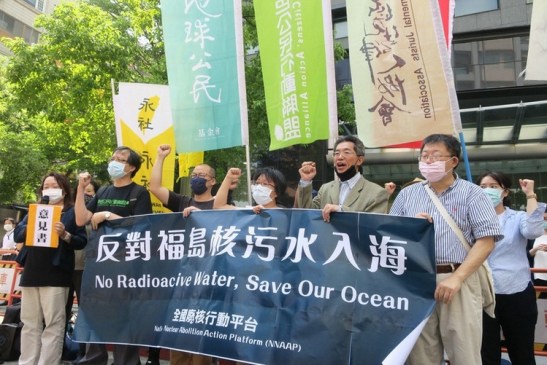 A coalition of environmental protection groups chants slogan in front of the Taipei office of Japan’s de facto embassy in Taiwan, the Japan-Taiwan Exchange Association, on May 13, 2020
May 14, 2020
TAIPEI (Kyodo) — A coalition of environmental protection groups in Taiwan on Wednesday urged the Japanese government to refrain from releasing radioactive water from the wrecked Fukushima nuclear plant into the ocean.
Chanting the slogan “No to dumping radioactive water into the ocean,” representatives of the organization presented a petition to the Taipei office of Japan’s de facto embassy in Taiwan, the Japan-Taiwan Exchange Association, in the morning.
National Nuclear Abolition Action Platform spokeswoman Tsuei Su-hsin emphasized that they did not come to protest, but rather to urge the Japanese government to refrain from making decisions to cut costs at the expense of the environment.
“There are safer and more sustainable alternatives,” Tsuei said.
The Japanese government and the operator of the Fukushima Daiichi nuclear power plant at the time are currently considering ways to safely dispose of the more than 1 million tons of water contaminated with radioactive materials after being used to cool the melted fuel cores at the plant.
A decision needs to be made soon as space for storing the water, which has been treated but is still contaminated with low-toxicity radioactive tritium, is fast running out.
Methods being discussed include releasing the water into the Pacific Ocean and evaporating it, both of which the government says will have minimal effect on human health.
A panel of experts advising the government on a disposal method has recommended releasing it into the ocean. The government is soliciting opinions from the public before it makes a decision in the summer. Based on past practice, it is likely to accept the recommendation.
Tsai Ya-ying, an activist and lawyer of the Wild at Heart Legal Defense Association, said as Japan is a signatory of the U.N. Convention on the Law of the Sea, it is obligated to take all measures within the Convention that are necessary to prevent, reduce and control pollution of the marine environment from any source.
Discharging the water into the ocean could amount to a violation of the Convention, she said.
Liu Jyh-jian, president of the Taiwan Environmental Protection Union, urged the Japanese government to make a decision that is friendly to both the environment and to mankind.
He added that if the tritium enters the food chain, it is bound to cause harm to humans in the long run.
Tsai Chung-yueh, deputy secretary general of Citizen of the Earth, voiced concern that the Japanese government may be too preoccupied with fighting COVID-19 to make a decision that is environmentally sustainable.
The contaminated water is increasing by about 170 tons per day. Space is expected to run out by summer 2022.
Local Japanese fishermen and residents have expressed concerns about releasing the water on food and the environment.
Widespread concerns remain as well, with many countries and regions still restricting imports of Japanese agricultural and fishery products in the wake of the 2011 disaster that was triggered by a major earthquake and tsunami.
https://mainichi.jp/english/articles/20200513/p2g/00m/0in/112000c
No comments yet.
1 This Month

of the week – Shut Down Drone Warfare!


Tell the Ukrainian Government to Drop Prosecution of Peace Activist Yurii Sheliazhenko

Petition to revoke the licensing of the Near Surface Nuclear Disposal Facility (NSDF) at Chalk River. https://www.ourcommons.ca/petitions/en/Petition/Details?Petition=e-7247
To see nuclear-related stories in greater depth and intensity – go to https://nuclearinformation.wordpress.com
-
Archives
- April 2026 (68)
- March 2026 (251)
- February 2026 (268)
- January 2026 (308)
- December 2025 (358)
- November 2025 (359)
- October 2025 (376)
- September 2025 (257)
- August 2025 (319)
- July 2025 (230)
- June 2025 (348)
- May 2025 (261)
-
Categories
- 1
- 1 NUCLEAR ISSUES
- business and costs
- climate change
- culture and arts
- ENERGY
- environment
- health
- history
- indigenous issues
- Legal
- marketing of nuclear
- media
- opposition to nuclear
- PERSONAL STORIES
- politics
- politics international
- Religion and ethics
- safety
- secrets,lies and civil liberties
- spinbuster
- technology
- Uranium
- wastes
- weapons and war
- Women
- 2 WORLD
- ACTION
- AFRICA
- Atrocities
- AUSTRALIA
- Christina's notes
- Christina's themes
- culture and arts
- Events
- Fuk 2022
- Fuk 2023
- Fukushima 2017
- Fukushima 2018
- fukushima 2019
- Fukushima 2020
- Fukushima 2021
- general
- global warming
- Humour (God we need it)
- Nuclear
- RARE EARTHS
- Reference
- resources – print
- Resources -audiovicual
- Weekly Newsletter
- World
- World Nuclear
- YouTube
-
RSS
Entries RSS
Comments RSS
 nuclear-news
Leave a comment