Belarus to get a new nuclear reactor along with $10 billion debt to Russia
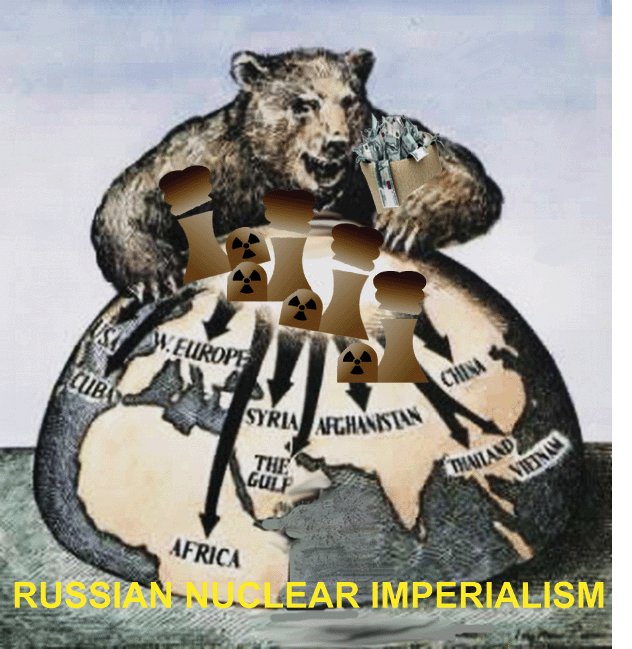
In January, Lithuanian Energy Minister Zygimantas Vaiciunas told RFE/RL that the Belarusian plant is “a threat to our national security, public health, and environment.”
“The key question is the site selection, which was done politically — geopolitically,” Vaiciunas told RFE/RL.
Plans for the nuclear plant were unveiled by Belarusian President Alyaksandr Lukashenka in 2008 when Minsk received a $10 billion loan from Moscow for the project.
The general contractor for the Belarusian nuclear power plant building is Atomstroiexport, an affiliate of Russia’s state-owned Rosatom. Based on reporting by TASS, ONT, and RFE/RL correspondent Matthew Luxmoore
Environmental rules governing radioactive waste, fish farming, recycling and other sectors are being weakened due to Covid 19
 Radioactive Waste Regulations – Scotland

The Ferret 12th April 2020, More than 5,000 business sites across Scotland are going to escape
judgement on their environmental breaches in 2020 because of the coronavirus pandemic. Environmental rules governing radioactive waste, fish farming, recycling and other sectors are also being relaxed by the Scottish
Environment Protection Agency (Sepa) to help companies cope with Covid-19.
The Faslane nuclear base and nuclear power plants have been given the green light to break safety limits on radioactive waste. Sepa has relaxed environmental rules for specific sectors, notably the military and civil
nuclear industry. A “temporary regulatory position statement” posted on its website offered radioactive waste exemptions to the Faslane navel base on the Clyde, as well as nuclear plants at Hunterston in North Ayrshire,
Torness in East Lothian and Dounreay in Caithness.
“During a significant outbreak of Covid-19 the ability of operators to run their operations may be compromised by a lack of available staff,” the statement said. “We expect operators to be ensuring that the impacts of Covid-19 on the environment are minimised. We recognise, however, that in some cases operators may be unable to comply for reasons beyond their control.” It added: “Any failure by the operator to comply with the conditions of their authorisation will not be treated as a non-compliance”. This only applied “where non-compliance with authorisation conditions is unavoidable and a direct result of emergency resulting from Covid-19 outbreak and will not lead to significant environmental harm,” Sepa said.
The Scottish Campaign for Nuclear Disarmament warned that more dangerous radioactivity could be discharged into the environment. “It is outrageous to suggest that the pandemic is a reason for relaxation of the regulatory
requirements,” said campaign chair, Lynn Jamieson. “Willingness to tolerate possible breaches of regulations by civil or military nuclear facilities demonstrates shocking inadequacy on the part of the Scottish Environment Protection Agency. Whose environment are they in place to protect?”
The nuclear-free group of local authorities also expressed concern. “These new rules from Sepa seem to allow further leeway on nuclear sites over the handling of radioactive waste,” said the group’s vice convenor in Scotland, Renfrewshire SNP councillor Audrey Doig. “Sepa should be very wary of relaxing rules and find ways of continuing to
regulate the industry in the robust, safe and secure way the public expects.”
https://theferret.scot/pollution-checks-coronavirus-crisis-sepa/
The National 12th April 2020
https://www.thenational.scot/news/18374483.polluters-given-free-pass-coronavirus-crisis/
Artificial Intelligence in nuclear weapons and military systems

Inside the grave new world of Atomic AI While AI is shifting Asia’s nuclear battle space, it has the potential not only to destroy humanity – but also to shield it, Asia Times, By ANDREW SALMON, APRIL 13, 2020 Stand by. Terminator-style nuclear weapons and systems are coming to a military near you.
Unmanned aerial vehicles, unmanned underwater vehicles and space planes are likely to be “the AI-enabled weapons of choice for future nuclear delivery,” a leading military think tank revealed during a recent seminar in Seoul.
AI, or artificial intelligence, enables faster decision-making than humans and can replace humans in the decision matrix at a time when leadership reacts too slowly – or is dead.
The Stockholm International Peace Research Institute, or SIPRI, released its report The Impact of Artificial Intelligence on Strategic Stability and Nuclear Risk Volume II; East Asian Perspectives in a forum hosted by the Swedish Embassy in Seoul.
|
The question is whether weaponized AI, through its deterrent or defensive purposes, is a risk ameliorator or whether by either bringing new or enhanced capabilities to new theaters of combat, and by obviating existing systems and weapons, it generates yet steeper risks. Lora Saalman, the report’s editor, notted that AI is “a suite of technologies, not a technology.”………. The development and deployment of AI-enhanced platforms “have both been shaped by and have contributed to an interlocking series of national biases and assumptions that are driving AI integration and decision-making,” SIPRI noted. One area where these biases and assumptions interlock is in “Dead Hand” – the autonomous capability of a state to retaliate even when its leadership has been wiped out……… other assets are downright alarming. Underwater atomic drones On the offensive front, strategic bombers and missile-armed submarines may be replaced by robots. Platforms such as unmanned underwater vehicles (UUVs), unmanned aerial vehicles (UAVs) and spaceplanes “… provide resiliency and survivability,” SIPRI noted. “These two aims indicate why such vehicles are likely to be the AI-enabled platforms of choice for future nuclear delivery.” One such asset is a Russian nuclear-powered, nuclear-capable underwater drone “Poseidon.” Torpedo-shaped, 25-meters long, with a modular nuclear reactor, it can move at more than 100km/h at a depth of 1000 meters and is armed with cobalt weapons. Though not yet in service, in 2019 the Russian Navy ordered 30. “Poseidon is a fantastic machine, but its consequences could be catastrophic,” said South Korean Hwang Il-soon, a nuclear engineer at the School of Mechanical Aerospace and Nuclear Engineering. “It is a kind of dirty bomb – it creates very strong alpha radiation.” “Weapons like Poseidon should be banned not just for their environmental impact but for their negative impact on strategic stability,” said Michiru Nishida, Special Assistant for Arms Control, Disarmament and Non-Proliferation Policy at Japan’s Ministry of Foreign Affairs. “But it is different for a country like Russia that sees it as a stabilizing factor.” Space robot missile killersSome A1-enabled weapons, while defensive in nature, could obviate current weapons and take the arms race into new fields. Russian Vadim Kozyulin, of Moscow’s Pir Center, noted that there is little transparency about the US X-38B orbital test vehicle, a re-entry spacecraft that can land horizontally on runways, but “… it is a Pentagon project … so is designed for military purposes.”……. The Pentagon is developing a new strategy of deploying “ghost fleets” of surface and undersea drones – a doctrine is expected to appear in September, Kozyulin said. With these weapons posing a risk to nuclear submarines, “the Russian and Chinese navies will no longer be sure of their nuclear weapons’ reliability,” he said. ……. In East Asia, remote sensing via reconnaissance satellite networks has already undermined nuclear deterrence. It can also threaten the survivability of nuclear assets, so undermining confidence in deterrence, which “forces parties to rely on more survivable, but less controlled, platforms,” Saalman noted. She noted that in the region, “the AI-enhanced arms race can become more prominent …India, China and the US all working on this.”……. Human vs AI The ultimate fear – one widely featured in science fiction – is whether weaponized AI could supplant or overrule humans……..all depends on the algorithms installed in the machines; once approved by a human leader, those algorithms can enable an autonomous, decision-making machine. ……. Kozyulin suggested that if an appropriate international treaty could be crafted, AI could be embedded in competing nations’ early warning systems, providing autonomous monitoring, fail-safe and de-escalation mechanisms. https://asiatimes.com/2020/04/inside-the-grave-new-world-of-atomic-ai/ |
|
A win-win for USA and North Korea? Helping to fight coronavirus
|
Why Helping North Korea Fight Coronavirus Could Lessen the Chance of a Nuclear War https://nationalinterest.org/blog/korea-watch/why-helping-north-korea-fight-coronavirus-could-lessen-chance-nuclear-war-143697
A necessary win-win for Washington and Pyongyang?
by Cynthia Lazaroff Follow @CynthiaLazaroff on Twitter 13 Apr 20, Amidst the existential nightmare unfolding with the coronavirus, comes the news that North Korea has ramped up its missile testing and lost all interest in a dialogue with the United States. At a March meeting with G-7 Foreign Ministers, Secretary of State Pompeo called on all nations to maintain diplomatic and economic pressure on North Korea over its nuclear and ballistic missile programs. Pompeo’s ill-timed call to uphold sanctions even during the global pandemic escalated tensions and triggered Pyongyang’s chilling response: North Korea has become “more zealous for our important planned projects aimed to repay the U.S. with actual horror and unrest for the sufferings it has inflicted upon our people.”
While some may call this mere bluster, Pyongyang’s warning serves as a grim reminder that the existential nuclear threat is not going on lockdown during this pandemic. It is a clear and present danger like COVID-19, invisible but very much alive. And like the virus, it has been ignored for perilously too long. Former U.S. Secretary of Defense William J. Perry has sounded the alarm: “Today, the danger of some sort of a nuclear catastrophe is greater than it was during the Cold War and most people are blissfully unaware of this danger.”
We are now awake to the COVID-19 catastrophe, the enormity of the pain and suffering, the staggering human and economic costs. Worst case projections estimate that COVID-19 deaths could be in the millions globally, with variable forecasts over the past month for America. Estimates show Americans could lose anywhere from 60,000 to 2.2 million or more of their loved ones to the virus because Washington ignored repeated warnings and failed to act before it was too late. This is the price of sleepwalking in the face of this existential threat, which is horrific, but these numbers nonetheless pale in comparison to the estimated tens of millions in North and South Korea, Japan, Guam, Hawaii and beyond who could die in the mass carnage if nuclear weapons were to be launched by Kim or Trump in a moment of anger, accident, miscalculation or mistake.
Existential threats by nature do not discriminate. Like nuclear weapons, COVID-19 attacks human beings indiscriminately, oblivious to race, religion, gender, ideology or country of origin. Like radioactive fallout, the virus does not recognize borders, and like nuclear war, it spares no one—whether rich, poor, Korean, American, sanctioned or unsanctioned.
If Washington doesn’t take emergency measures to stop the spread of COVID-19 in the human population as a whole, America fails to do so at its own peril. Outbreaks in other countries increase the risk of outbreaks around the world. This is why it makes no sense to uphold sanctions that in any way hinder a country’s capacity to combat the virus. U.N. High Commissioner for Human Rights Michelle Bachelet has called for humanitarian exemptions to sanctions because “in a context of global pandemic, impeding medical efforts in one country heightens the risk for all of us.” In other words, what America does to the people of North Korea, Iran, Venezuela, Russia, Cuba and other sanctioned countries, America does to itself.
If Washington doesn’t take emergency measures to stop the spread of COVID-19 in the human population as a whole, America fails to do so at its own peril. Outbreaks in other countries increase the risk of outbreaks around the world. This is why it makes no sense to uphold sanctions that in any way hinder a country’s capacity to combat the virus. U.N. High Commissioner for Human Rights Michelle Bachelet has called for humanitarian exemptions to sanctions because “in a context of global pandemic, impeding medical efforts in one country heightens the risk for all of us.” In other words, what America does to the people of North Korea, Iran, Venezuela, Russia, Cuba and other sanctioned countries, America does to itself.
Guterres calls on Americans further to unite now in solidarity to protect the most vulnerable and susceptible to COVID-19 everywhere—those ravaged by war, women, children, the elderly, homeless and displaced populations, along with those living in the poorest countries with weak health care infrastructures like North Korea. During this global existential crisis, Bachelet and Guterres are inviting Americans to rise to the better angels of our nature, transcend our differences and get our priorities straight: to stop wasting precious time and resources on conflict and war and mobilize as a “human family” to give it everything we’ve got to save lives.
If the United States applies Bachelet and Guterres’ recommendations to North Korea, Washington can make progress on the existential threat of COVID-19 and the existential threat of a nuclear exchange with Pyongyang. America and North Korea can work together to halt the spread of COVID-19, thereby create goodwill and de-escalate tensions. Washington can and should take further steps to reduce tensions and the risk of a nuclear missile launch due to anger, accident, miscalculation or mistake.
Here are five steps the United States should take right now:
Americans wake up every morning to soaring death tolls, the tragic cost of waiting too long to act to contain COVID-19. It is already late—for the United States, for North Korea, for the world. Millions of lives are at stake. The time to act on these existential threats is now. Cynthia Lazaroff is an expert on U.S.-Russia relations, a documentary film producer, and environmental activist. She has been engaged in Track II and 1.5 dialogue for the past forty years and has directed several films on the Soviet Union and nuclear proliferation. You can follow her on Twitter @CynthiaLazaroff. |
|
Climate and nuclear news – week to 13 April
With the whole world in the grip of anxiety about coronavirus, and preoccupied with responding to the pandemic, climate scientists and activists ponder the opportunity to develop a green economy when it is over. And indeed, the global climate, and the world’s biodiversity are right now benefiting from the lockdown response. But, alas, the signs are already there, that, in recovering from the health crisis, governments are more likely to promote polluting industries and consumer spending, and to relax environmental safeguards. https://www.youtube.com/watch?v=0XhzBSMBpuY It’s too early to tell.
As for the nuclear lobby, it continues to battle bravely on, with propaganda about nuclear’s role in diagnosing COVID 19, and with promoting small nuclear reactors. Despite the nuclear industry’s present urgent problem with Coronavirus and staffing– or perhaps because of this, it is heavily promoting “clean”, “safe”, “cheap” nuclear power to Africa.
A bit of good news – Reports Find Social Restrictions Are Working to Curb New COVID-19 Cases From Italy to Seattle
The coronavirus pandemic, like other global catastrophes, reveals the limitations of nationalism.
Climate change could cause sudden biodiversity losses worldwide.
Ordinary people can beat the nuclear establishment: it’s been done before.
New START treaty must be extended, a U.S. – Russia nuclear arms race an intolerable threat to the whole world.
Nuclear Non-Proliferation in a Deadlock.
Nuclear fusion, too hot, too costly? And not ready before 2050.
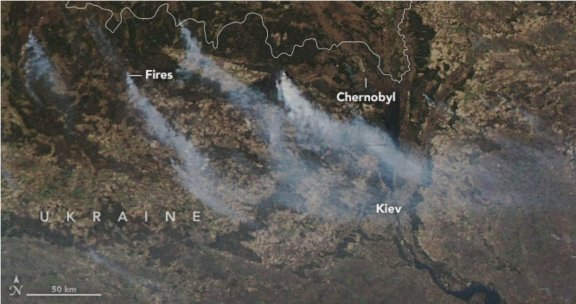
UKRAINE. Chernobyl wildfires now ‘close’ to exploded nuclear reactor. What is causing the Chernobyl Wildfires? Year on Year, mostly in the Summer. Fukushima forests future? CRIIRAD monitoring Kiev nuclear risk of Chernobyl radioactive plumes #Strontium90 #Plutonium #Cesium137/134. Satellite Imagery of Chernobyl Fires April 8 and 9 2020 – NASA. Ukrainian firefighters continue to struggle with Chernobyl are fires, amid radiation fears. As at 5 April, radiation levels in Chernobyl area were 16 times above normal, due to forest fires. The unsafety of Ukraine’s nuclear reactors: Ukrainian Association of Veterans of Atomic Energy and Industry fear “another Chernobyl”.
USA.
- Denial, Defunding, Downplaying — First COVID-19 Leadership Failures. Trump uses the pandemic, to decimate environmental restrictions. Nuclear waste to landfill decision is just one example.
- Pandemic makes a nuclear disaster more likely than ever.
- . More workers infected with coronavirus at Georgia Power’s Vogtle nuclear project. Georgia’s Vogtle nuclear project way over budget, way behind time, and now Coronavirus hits.
- Refuelling continues at Limerick nuclear plant, but three more workers test positive for Covid19. Coronavirus complicates refuelling of nuclear reactors, Fermi 2 has undisclosed number of Covid19 workers.
- Bankrupt FirstEnergy Solutions is resuscitated as ‘Energy Harbor’: House Bill 6 subsidises Perry and Davis-Besse Nuclear Power plants. Massive subsidies to aging nuclear reactors – a recipe for disaster.
- NuScam and other nuclear companies weasel their way into University of Tennessee. U.S. Nuclear
- Regulatory Commission proposing dumping some nuclear wastes in landfills – a huge public health danger. Idaho lawmakers want nuclear waste ready to get trucked away.
- Confusion over which American military satellites are “nuclear” and which are “nonnuclear.”
- Finally, they might investigate America’s most fatal nuclear submarine disaster.
- Gamma radiation found ineffective in sterilizing N95 masks.
- Critical comments on the claim that “Nuclear Energy Could Power The Trillion-Dollar Space Race”.
UK. Who has the UK nuclear button while Johnson is ill? No comment. David Lowry: Covid-19 spread shows up vulnerability at heart of nuclear programmes. With coronavirus problem, Hinkley Point C nuclear project should be paused. Sellafield nuclear construction stalled – pause in construction extended to April 27. Call to stop construction at Hinkley Point C nuclear project, due to coronavirus risk.
More delay in planning application for UK’s Wylfa Newydd nuclear project. Nuclear Free Local Authorities (NFLA) call for more stringent safety measures, and the closure of EDF’s old nuclear reactors. Microbes in nuclear fuel ponds slow down the decommissioning process. University boffins discuss the eternal problem of nuclear wastes. U.S. taxpayers might cough up for a private company’s new “Small Nuclear” space travel gimmick.
JAPAN. To help future generations, Fukushima mothers have become radiation scientists’.
SOUTH KOREA. The Carbon Brief Profile: South Korea.
INDIA. India’s dangerous nuclear triad.
BOSNIA. Bosnia might need international arbitration over Croatia’s nuclear waste dump plan near the border.
PAKISTAN. Pakistan’s tactical nuclear weapons, even defensively used, could usher in a larger nuclear war.
RUSSIA. Russia wants to extend New START nuclear weapons treaty, but the U.S. has not revealed its plans. Russia gambles on safety and cost, in extending life of fast breeder reactor.
BANGLADESH. Russia evacuates some employees from Bangladesh nuclear site.
VIETNAM. 277,700 Vietnamese support “Appeal of the Hibakusha “ – call to eliminate nuclear weapons.
SWEDEN. Sweden’s wind power on the way to putting nuclear out of business.
ISRAEL. USA has helped Israel to develop a mighty armory of nuclear missiles.
Nuclear Power Industry Must Not Use Covid-19 Pandemic to Neglect Safety,
|
TACOMA PARK, Maryland – The nuclear power industry should not be allowed to significantly increase nuclear safety risks while jeopardizing the health and wellbeing of power plant workers and entire communities within emergency planning zones already sheltering in place under a viral threat, says a safety expert at Beyond Nuclear, a national anti-nuclear watchdog organization. As the incidences of the novel coronavirus (Covid-19) among nuclear power plant workers spread across the U.S. nuclear power fleet, the U.S. Nuclear Regulatory Commission (NRC) is poised to relax nuclear power plant safety inspections and maintenance required by reactor operating licenses. The NRC will also allow nuclear utilities to require their control room operators, onsite security forces, fire brigades and other critical site personnel to work substantially longer fatiguing shifts. The deferral of the safety-related tasks and relaxation of work hour controls are needed, they say, to comply with “social distancing” recommendations from the Centers for Disease Control (CDC) and to respond to the anticipated attrition of a workforce stricken by the highly contagious and debilitating pandemic. Yet at the same time, the industry and the NRC are crowding nuclear power plants with as many as 1,600 workers, brought in from across the country, to conduct reactor refueling operations. Fourteen reactors are presently shut down, primarily for refueling, and more reactors are scheduled to halt for refueling through the end of May. “The nuclear industry and its regulator, the NRC, are maximizing the industry’s power production by pressing onward with scheduled reactor refueling outages,” said Paul Gunter, Director of Reactor Oversight at Beyond Nuclear. “Yet at the same time, they are using CDC Covid-19 guidelines to defer scheduled and required inspections and maintenance of critical safety components until the next refueling cycle eighteen months away,” he said. “The regulator and the industry know full well that they are rolling in a Covid-19 Trojan Horse with these refueling crews travelling from one reactor site and community to the next,” said Gunter. Workers at plants that are refueling, such as Limerick in Pennsylvania, have publicly expressed alarm at the overcrowded conditions, describing workers sitting “elbow to elbow” in canteens and computer labs, and saying they are “terrified” that this will lead to widespread infections of the novel coronavirus. Despite this, the industry is also requesting that the NRC defer inspections and delay maintenance required under reactor operating licenses of critical safety components and systems, including steam generators and reactor emergency core cooling systems, until the next refueling cycle eighteen months away. It says this is in order to observe the CDC guidelines for slowing the growth of the pandemic, while maintaining a minimum onsite workforce still fit for duty at operating reactors. In anticipation of more and more workers falling ill to the debilitating virus, the NRC and industry are collaborating to relax “fitness for duty” licensing requirements meant to prevent the over-fatigue of operators and other critical plant workers including security. “Nuclear plant operators on extended 12-hour shifts, who can now be assigned to work two consecutive 84-hour weeks, will suffer excessive fatigue,” Gunter said. “This not only compromises their immune systems, but makes catastrophic mistakes more likely.” The infamous nuclear accident at the Three Mile Island Unit 2 nuclear power station near Harrisburg, PA in the early morning hours of March 28, 1979, was attributed to mechanical failure worsened by operator fatigue and error. In response to the public health emergency brought on by Covid-19, which mandates social distancing, the operators at Braidwood 2 in Illinois, Comanche Peak 2 in Texas, and Turkey Point 3 in Florida have all requested an 18-month delay on inspections and maintenance of the thousands of steam generator tubes that are required to be examined during the current refueling outage in April and May 2020. Steam generators are critical to both power operations and reactor safety, as the tubes represent 50% of the reactor pressure boundary and recirculate vital cooling water through the reactor core. The reactors’ harsh operational environment places extreme stresses on the heat transfer component, causing tube degradation from vibration, heat, radiation, corrosion and cracking that must be guarded against through routine inspection and maintenance. The price for ignoring the condition of steam generator tubes can be high, as was demonstrated in February 2000 when a similarly deferred inspection was attributed to a steam generator tube rupture at the Indian Point Unit 2 nuclear reactor just 30 miles from New York City. The single steam tube rupture released radioactivity into the environment and could have been severe had the high pressure rupture caused a cascading guillotine effect on neighboring tubes and a loss of coolant accident. “It is a reckless contradiction that the nuclear industry is using social distancing restrictions to defer inspections of steam generator tubes while threatening the spread of the virus through thousands of workers moving around the country to refuel reactors,” Gunter said. “Once again, the nuclear industry and a captured regulator are putting financial interests ahead of the wellbeing and safety of workers and the surrounding communities,” he said. “The NRC should suspend these refueling outages and delay the restart of reactors currently down for refueling until a Disaster Initiated Review of the pandemic’s impact on emergency preparedness can be completed, something that the Federal Emergency Management Agency should already be doing with the NRC,” Gunter added. “It is not hard to imagine the level of chaos that would ensue should a nuclear accident occur during the current coronavirus crisis,” Gunter continued. “Emergency preparedness plans are already inadequate, but the prospect of a mandatory mass evacuation at a time like this is an impossible choice,” he said. “It is the duty of the NRC and FEMA to ensure workable emergency preparedness plans and procedures are in place before restarting any of the reactors currently refueling,” Gunter concluded. Beyond Nuclear also recommends strategically powering down some reactors in areas where there is reduced demand induced by the pandemic and pre-pandemic excess regional generating capacity. The workforces at shuttered reactors could then supplement those over-stretched at reactors still operating.“It is not hard to imagine the level of chaos that would ensue should a nuclear accident occur during the current coronavirus crisis,” Gunter continued. “Emergency preparedness plans are already inadequate, but the prospect of a mandatory mass evacuation at a time like this is an impossible choice,” he said. “It is the duty of the NRC and FEMA to ensure workable emergency preparedness plans and procedures are in place before restarting any of the reactors currently refueling,” Gunter concluded. Beyond Nuclear also recommends strategically powering down some reactors in areas where there is reduced demand induced by the pandemic and pre-pandemic excess regional generating capacity. The workforces at shuttered reactors could then supplement those over-stretched at reactors still operating.“It is not hard to imagine the level of chaos that would ensue should a nuclear accident occur during the current coronavirus crisis,” Gunter continued. “Emergency preparedness plans are already inadequate, but the prospect of a mandatory mass evacuation at a time like this is an impossible choice,” he said. “It is the duty of the NRC and FEMA to ensure workable emergency preparedness plans and procedures are in place before restarting any of the reactors currently refueling,” Gunter concluded. Beyond Nuclear also recommends strategically powering down some reactors in areas where there is reduced demand induced by the pandemic and pre-pandemic excess regional generating capacity. The workforces at shuttered reactors could then supplement those over-stretched at reactors still operating. |
|
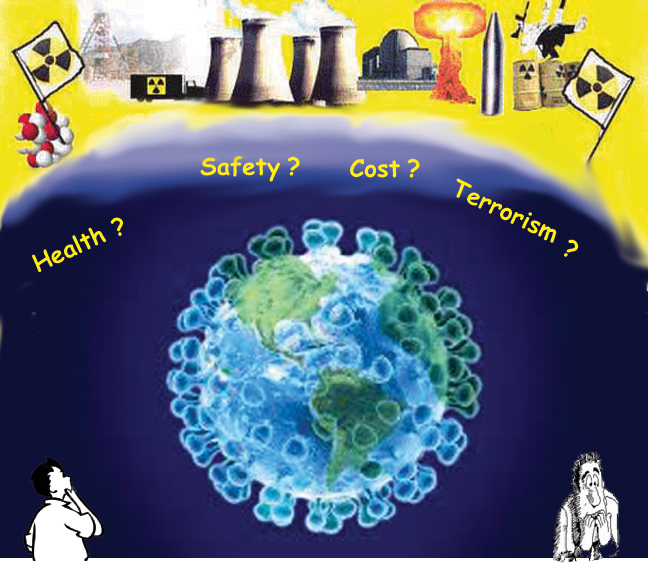
If we can tackle corona, why not climate?


If we can tackle corona, why not climate? April 12, 2020 by beyondnuclearinternational
What the pandemic can teach us about changing our ways, By Alex Kirby, Climate News Network
Societies worldwide are changing overnight to meet the coronavirus threat. The climate crisis should match the rapid pandemic response.
If you want to know how fast a modern society can change, go to most British town centres and see the pandemic response. They will be unrecognisable from what they were 10 days ago.
You’ll see far fewer pedestrians, now sheltering from coronavirus infection at home, far fewer vehicles, hardly an aircraft in the skies above. The familiar levels of urban noise have faded to a murmur. The usual air pollution is dropping fast, with reports of significant falls from not just the UK but China and northern Italy as well.
So we can change when we decide to, and a pandemic demands change that’s both radical and rapid. But pandemics are not unique in that respect: there’s something else on the world’s agenda that’s crying out for action to match what’s happening today .
Dieter Helm is professor of economic policy at New College, University of Oxford. He writes in the latest entry on his site: “The coronavirus crisis will come to an end even if coronavirus does not … What will not be forgotten by future historians is climate change and the destruction of the natural environment.” What can we learn from this crisis that will help us when it’s over?
The Rapid Transition Alliance (RTA) is a UK-based organisation which argues that humankind must undertake “widespread behaviour change to sustainable lifestyles … to live within planetary ecological boundaries and to limit global warming to below 1.5°C”.
It says pandemics show how good governments are at responding fast and effectively, and at changing economic priorities in the public interest. But one vital element is to ensure that people clearly understand the risks involved, as this can lead to much faster, co-ordinated responses to an emergency, explaining and justifying policy changes that otherwise might lack support.
People can change their daily habits very quickly. Where behaviour changes show that more sustainable behaviour is possible – such as avoiding unnecessary travel – many could be encouraged to adopt them as a new norm.
Reactions to COVID-19 in China have improved urban air quality, leading to emissions reductions in different industrial sectors ranging from 15% – 40%. If plummeting levels of air pollution gave people a lasting taste for cleaner air, the Alliance suggests, this might shift expectations and open up new possibilities for change.
We can very quickly change our expectations about how we travel, work and entertain ourselves in a pandemic, it believes, and how we learn to behave, so as to minimise transmission risks.
There have been previous successes in overcoming pandemics, although they happened in different eras, using different technologies and living with different customs and systems of belief, so we cannot always learn directly from them.
One recent success has been the international effort to subdue HIV/AIDS. First identified in the Democratic Republic of the Congo in 1976, the disease has killed more than 32 million people, yet since 1995 death rates from it have dropped by 80%.
Not profit alone….
There have been previous successes in overcoming pandemics, although they happened in different eras, using different technologies and living with different customs and systems of belief, so we cannot always learn directly from them.
One recent success has been the international effort to subdue HIV/AIDS. First identified in the Democratic Republic of the Congo in 1976, the disease has killed more than 32 million people, yet since 1995 death rates from it have dropped by 80%……..
The RTA argues that inadequate action on climate heating is like knowing the cure to COVID-19 and yet failing to manufacture and distribute it and treat people affected by it.
Action trails promises
Some of the latest climate research points to a growing gap between the commitments on the climate emergency which nations have made, and the action which scientists say is needed, and the RTA says three lessons on rapid transition stand out from global pandemic responses:
- A clear understanding of risk can lead to much faster, co-ordinated responses to an emergency
- The rapid, physical mobilisation of resources can happen alongside behaviour change. People can change their daily habits very quickly and adapt to new social norms
- Where adaptations and behaviour changes reveal possibilities for more sustainable behaviour – such as avoiding unnecessary travel – they should be encouraged to become the new norm, and part of the broader climate emergency response.
Professor Helm agrees that there are lessons to be learnt about the climate crisis from the world’s reaction to pandemics, but he doesn’t think they will all necessarily be welcome.
For a start, he says, “the virus has created an economic crisis, and people will be less willing to pay for saving future generations. There are more immediate pressing problems.”
Warning that history will remember climate change, biodiversity loss and our ravaging of the Earth, he concludes: “It remains to be seen whether this particular crisis leads to a broader and a more fundamental rethink. We have not paid enough to support the health service, preferring lower taxes.
“There is a broader lesson here too, and a really great legacy of this crisis would be that we learn it. Prevention and resilience are what we need, to mitigate not just viruses, but also the destruction of the wider natural environment.” − Climate News Network https://beyondnuclearinternational.org/2020/04/12/if-we-can-tackle-corona-why-not-climate/
Chernobyl wildfires now ‘close’ to exploded nuclear reactor
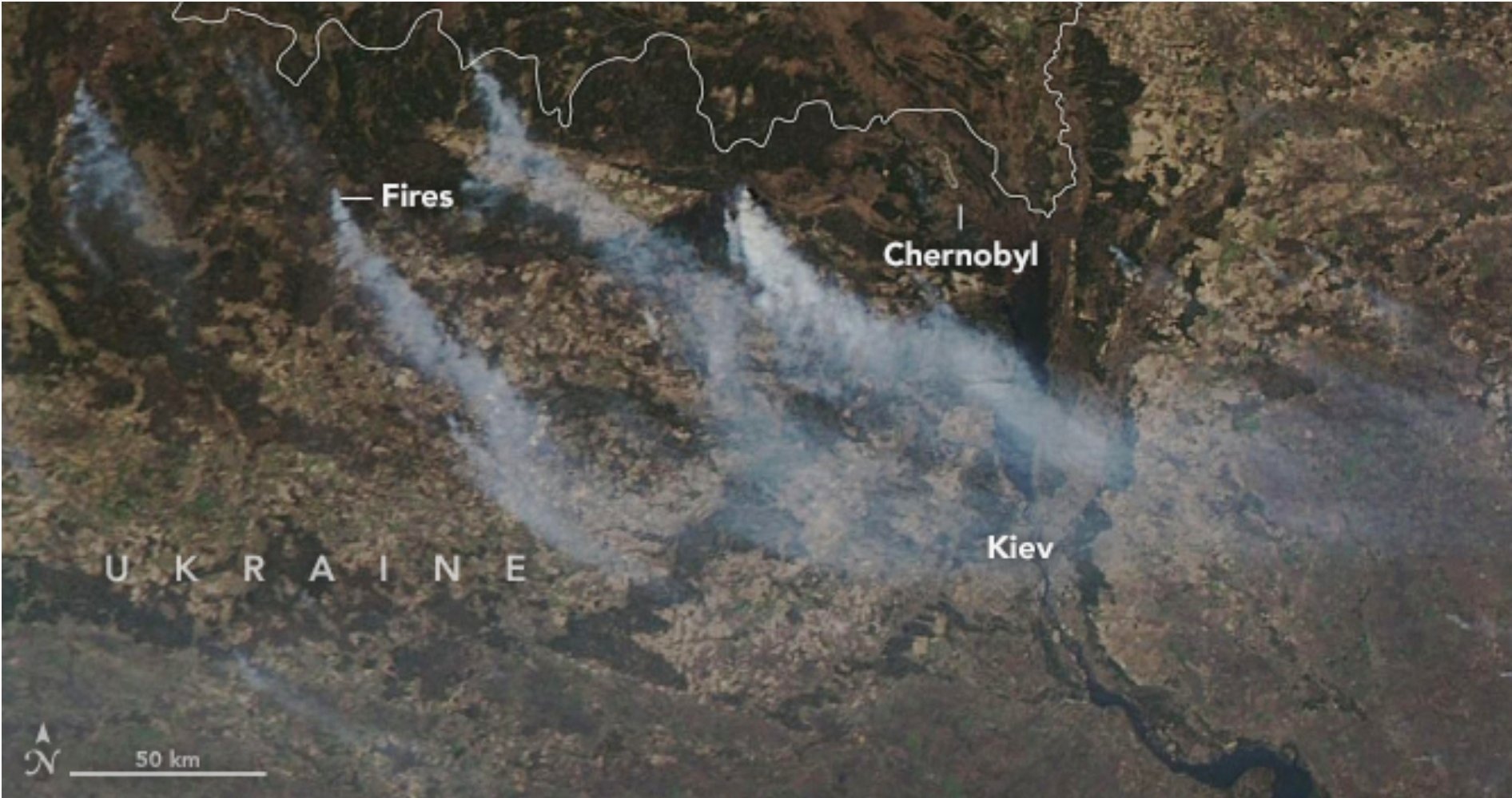
Raging forest infernos in Chernobyl Exclusion Zone burning for eight days are now ‘close’ to exploded nuclear reactor amid new fears of radiation contamination
- Wildfires burning through Chernobyl forests are nearing the nuclear reactor
- There are fears that flames could reach radioactive trucks and vehicles abandoned after the notorious 1986 power station explosion
- Kiev has deployed more than 300 people and 85 pieces of equipment By JACK WRIGHT FOR MAILONLINE, 13 April 2020
- Wildfires burning through radioactive forests in the Chernobyl Exclusion Zone are getting ever closer to the exploded nuclear reactor.Firefighters are rushing to build firebreaks around the sarcophagus covering the ruined plant in Ukraine amid swirling winds.
There are fears that flames could reach abandoned trucks and other vehicles contaminated from the disastrous 1986 explosion.
An extraordinary video from firefighter Andrei Kukib shows an emergency vehicle driving through the raging fire and smoke laying waste to the polluted ‘dead zone’.
Fires have been blazing for nine days in the almost uninhabited 1,000-square-mile exclusion zone surrounding the disused plant. On Tuesday, the fire covered some 87 acres, having tripled in size due to strong winds, the emergencies service said in a statement.
- There are fears of radiation in the ground unleashed by the infernos can reach nearest city Kyiv, the Ukrainian capital, and other populated areas.This could be worse if the flames reach the Chernobyl reactors.
Kateryna Pavlova, a senior official involved in the firefighting, said: ‘We have been working all night digging firebreaks around the plant to protect it from fire.’
She told The New York Times: ‘At the moment, we cannot say the fire is contained.’
More than 300 people and 85 pieces of equipment have been deployed daily in the fight to extinguish the flames which comes as Ukraine – one of Europe’s poorest countries – is also battling against coronavirus.
- The State Agency for Management of the Exclusion Zone – which Pavlova heads – has ordered in three Antonov planes (AN-32P) and two MI-8 helicopters which have air dropped more than 250 tonnes of water in the wildfires.Police said the blaze broke out after a man set fire to dry grass near the exclusion zone. The man was detained by Ukrainian police. Ukrainian authorities rejected the warnings of the acting head of the country’s state ecological inspection service, Yehor Firsov, who withdrew remarks made this week that ‘radioactivity is higher than normal at the heart of the blaze’.
Initially covered up by the USSR, the 1986 explosion sent radioactive fallout across Europe exposing millions to dangerous levels of radiation. People are not allowed to live within 18 miles of the power station, which is some 62 miles north of Ukraine’s capital city Kiev.
The three other reactors at Chernobyl continued to generate electricity until the power station finally closed in 2000.
A giant protective dome was put in place over the fourth reactor in 2016.
Fires occur regularly in the forests near the Chernobyl power plant.
- Wildfires burning through radioactive forests in the Chernobyl Exclusion Zone are getting ever closer to the exploded nuclear reactor.Firefighters are rushing to build firebreaks around the sarcophagus covering the ruined plant in Ukraine amid swirling winds.
Massive subsidies to aging nuclear reactors – a recipe for disaster
|
A perverse invitation to nuclear disasters https://www.record-eagle.com/opinion/opinion-a-perverse-invitation-to-nuclear-disasters/article_f4d38e32-6534-11ea-8db3-0732b08237c0.html, BY M.V. RAMANA and CASSANDRA JEFFERY Mar 15, 2020
The anniversary of the Fukushima nuclear reactor accident in Japan was March 11, a disaster that led to widespread radioactive contamination and health impacts to hundreds of thousands. Emerging evidence suggests radiation from contamination is associated with increased incidence of thyroid cancers. The health impacts would’ve been worse if not for the evacuation of nearly 150,000 people from Fukushima. The accident must remind us what could happen with nuclear power plants in America, something worth attention in a time when states subsidize aging nuclear power plants through expensive bailouts to private utility companies.
The U.S. suffered severe accidents and close encounters with disaster, most notably the Three Mile Island reactor meltdown in March 1979. In March 2002, the Davis-Besse nuclear power plant in Ohio, owned by the electricity company FirstEnergy, almost experienced a meltdown. A routine but delayed reactor inspection found a “football sized” hole in the carbon-steel pressure vessel, which contains all the highly- radioactive fuel in the reactor. Boric acid leaked and corroded part of the structure, leaving all but a 3/8-inch-thick lining of stainless steel, which was never designed to contain the high-pressure water that cooled the reactor. If the damage wasn’t discovered, the reactor could have experienced a serious accident, according to the Government Accountability Office. FirstEnergy also ignored numerous warnings from the Nuclear Regulatory Commission. The parallels with Japan are unnerving. In February 2011, Japan’s Nuclear and Industrial Safety Agency extended Fukushima Daiichi’s operating license by 10 years. The regulatory agency kept the reactor operating despite knowledge of problems and warning signs, resulting in the March 2011 accident and subsequent health, environment, and economic consequences. Clean-up costs were estimated at $200 billion to over $600 billion (USD). Fast forward to 2019, the Ohio governor signed House Bill 6, allowing FirstEnergy to extract $150 million annually from ratepayers. The massive subsidy aims to finance operations of the aging Davis-Besse nuclear plant, the Perry nuclear plant and two coal-based power plants. (There is no pretense of justifying the subsidy by claiming climate benefits.) Ohio electricity customers will pay a monthly surcharge to fund FirstEnergy’s profits New York, New Jersey, Illinois and Connecticut have also introduced legislation to bail out aging nuclear power plants. Subsidies from consumers go toward profits of the electric utilities owning nuclear plants that were built decades ago. All of these are at risk of a severe accident. Despite assurances about safety, nuclear reactors can undergo major accidents, albeit infrequently. No reactor design is immune to such accidents. There is always a residual risk that could lead to vast tracts of land being contaminated with radioactive substances that affect human health for long periods of time. No matter which way you spin it, continuing to operate old reactors is inviting disaster. About the authors: M. V. Ramana is the Simons chair in Disarmament, Global and Human Security and director of the Liu Institute for Global Issues at the University of British Columbia School of Public Policy and Global Affairs. Cassandra Jeffery is a graduate student of public policy and global affairs at the University of British Columbia. She is the recipient of a Simons Award in Nuclear Disarmament and Global Security and conducts research on energy policies in Asia and North America. |
|
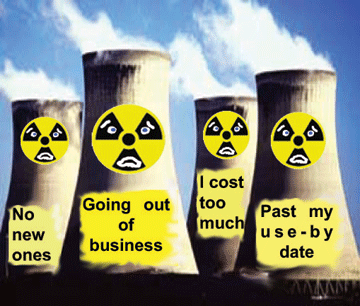
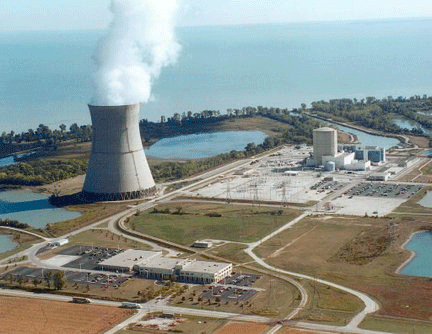
Increased Strontium in Sardines since Fukushima Accident?
As the Chernobyl forest fires seem to be releasing Strontium 90 into the atmosphere, I thought I would remind people of the little known story of Strontium 90 in JAPAN.. READ ON

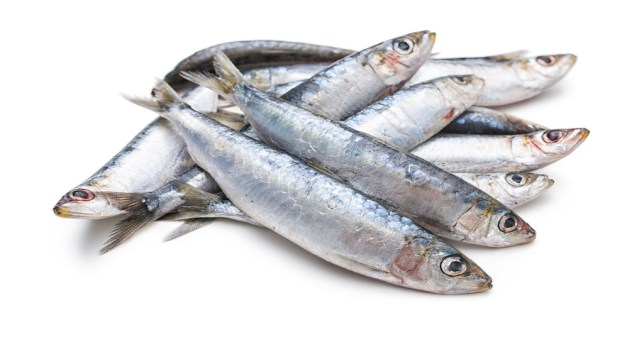
Dogs fed sardines show high Strontium levels
by Dr. Peter Dobias, DVM
Why you might want to cut out small fish from your dog’s diet
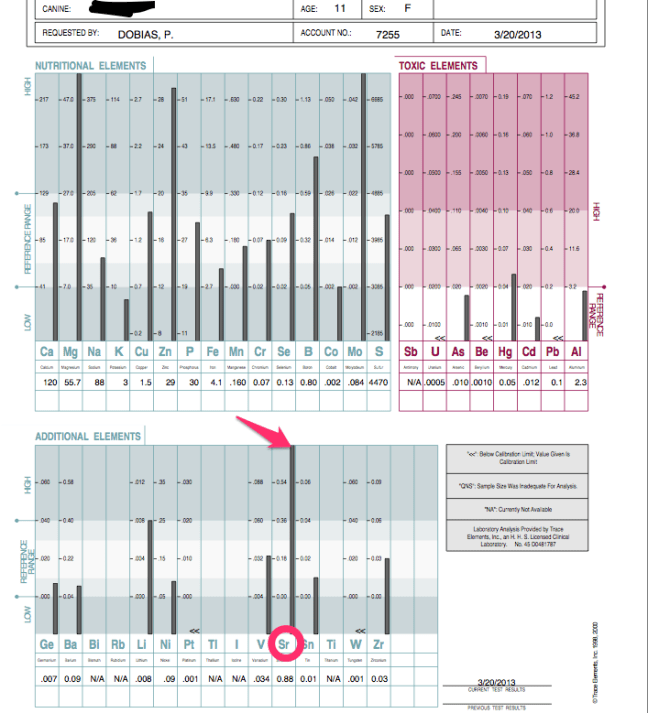
I have had two dog patients with severely elevated levels of the element strontium. The interesting part is that these two dogs were fed a high amount of sardines and I highly suspect that strontium is coming from this source.
Strontium acts in the body the same way as calcium and deposits in bones. Sardines and other small fish are eaten whole with the bones and that is why they are more likely a source of this toxic element.
The reason why I am concerned is that the radioactive isotope strontium 90 is a toxic carcinogen and it has been released in Japan’s Fukushima disaster.
Here is an example of the results:
As a veterinarian, I source from almost three decades of experience, but still I like…
View original post 130 more words
What is causing the Chernobyl Wildfires? Year on Year, mostly in the Summer. Fukushima forests future?
Hint….
- Global change ecology – Original research
- Published:
Highly reduced mass loss rates and increased litter layer in radioactively contaminated areas
Oecologia volume 175, pages429–437(2014)
Abstract
The effects of radioactive contamination from Chernobyl on decomposition of plant material still remain unknown. We predicted that decomposition rate would be reduced in the most contaminated sites due to an absence or reduced densities of soil invertebrates. If microorganisms were the main agents responsible for decomposition, exclusion of large soil invertebrates should not affect decomposition. In September 2007 we deposited 572 bags with uncontaminated dry leaf litter from four species of trees in the leaf litter layer at 20 forest sites around Chernobyl that varied in background radiation by more than a factor 2,600. Approximately one quarter of these bags were made of a fine mesh that prevented access to litter by soil invertebrates. These bags were retrieved in June 2008, dried and weighed to estimate litter mass loss. Litter mass loss was 40 % lower in the most contaminated sites relative to sites with a normal background radiation level for Ukraine. Similar reductions in litter mass loss were estimated for individual litter bags, litter bags at different sites, and differences between litter bags at pairs of neighboring sites differing in level of radioactive contamination. Litter mass loss was slightly greater in the presence of large soil invertebrates than in their absence. The thickness of the forest floor increased with the level of radiation and decreased with proportional loss of mass from all litter bags. These findings suggest that radioactive contamination has reduced the rate of litter mass loss, increased accumulation of litter, and affected growth conditions for plants.
Source ; https://link.springer.com/article/10.1007/s00442-014-2908-8
Will this happen in the forests of Fukushima as well?
More Independent analysis from a French NGO that is monitoring the situation in Ukraine with an unbiased and with authoritative risk assessment for the public. Link to CRIIRAD report here;
David Lowry: Covid-19 spread shows up vulnerability at heart of nuclear programmes


programmes, with resilience of UK critical national infrastructures undermined. The coronavirus’ effects act as threat multiplier, as David Lowry explains.
regulatory oversight to continue effectively across the UK? And, if this situation arose, what executive regulatory decision would be required if all operating nuclear facilities could no longer be simultaneously regulated to a legal standard?
plans should they fall below these levels, to enable them to remain in control of activities that could impact on nuclear safety under all foreseeable circumstances throughout the life cycle of the facility. In addition, licensees need minimum staffing levels to comply with their on-site and off-site emergency plans.
https://energytransition.org/2020/04/corona-crisis-hits-nuclear-sector/
The Coronavirus and Climate Change: How We’re Making the Same Mistakes

The Coronavirus and Climate Change: How We’re Making the Same Mistakes, medium.com Charles Kutscher 12 Apr 20, We Americans are now experiencing the tragic consequences of our slow, uncoordinated response to the coronavirus pandemic. While this experience will surely help us respond better to future health crises, it’s important we apply the hard lessons learned to even greater disasters. In particular, there are many parallels between the coronavirus pandemic and the climate change crisis. We need to recognize that we’re making the same mistakes with climate change and correct them before it’s too late. Below are some of these key blunders.
Failure to heed the warnings
Scientific experts warned us for months about COVID-19, just as they have warned us for decades about climate change. The rapid spread and deadly impact of the disease in other countries, especially in Italy, should have given us plenty of advance warning that we were headed down a similar path. In the case of climate change, we have witnessed countless warnings. As the result of a 1°C temperature rise to date, we have seen unprecedented wildfires in California and Australia, record heat waves and drought across the globe, more powerful storms, and more frequent major floods, to list but a few. In fact, while no direct connection has been made between COVID-19 and climate change, the changing climate is accelerating the incidence of other deadly diseases, such as the West Nile virus. Within the next 50 years, climate change could subject a billion more people to serious vector-borne diseases. It’s critical that we recognize the enormous impacts climate change is already having and heed the warnings of climate scientists who have painted a clear picture of what the future holds if we don’t act aggressively.
Failure to comprehend the delay between the problem and its consequences……..
Being misled by disinformation
With both the coronavirus and climate change, our sluggish response is largely the result of human denial. Both the Chinese and U.S. governments downplayed the threat of the virus. In the case of climate change, the oil and gas industry has a strong financial motive to discount the impact of fossil fuel emissions, and it has long funded an extensive campaign to make light of the effects of climate change. …….
Lack of federal leadership
In the absence of federal action, the governors of states such as Washington and California have had to play leadership roles in limiting the spread of the virus and expanding hospital capability to care for the victims. But relying on individual states has resulted in a competitive, patchwork approach that has proven to be a costly, inefficient means to address a national crisis……
Moreover, with both crises, the federal government has actually been moving in exactly the opposite direction from what is needed. In 2018 the current administration weakened the White House pandemic response capability, leaving us less prepared to face the coronavirus. In the case of climate change, the administration is simultaneously withdrawing from the Paris climate agreement and scaling back automobile fuel efficiency standards, as just two examples. Furthermore, the federal government continues to provide generous subsidies for fossil fuels — the very cause of climate change.
Looking ahead
It’s important we recognize that the blunders we’ve made in addressing the coronavirus are the same ones we’re making in addressing the much bigger climate change crisis. Climate change impacts have greatly worsened over time, but we have continued to ignore the warnings. The delay between our burning of fossil fuels and the environmental consequences has lulled us into a state of inaction, and this has been exacerbated by an ongoing disinformation campaign. We’ve been scaling back — and even reversing — federal action at the exact time we should be accelerating it.
Our experience with COVID-19 will almost certainly prepare us better for the next pandemic. But there is no second chance when it comes to climate change. It’s not as if we can let the ice sheets melt this time and protect them better when they return in the future. With climate change, we’ve got one shot at thinking ahead and addressing this crisis — one shot at understanding what scientists have long been telling us about how bad a 3°C or 4°C temperature rise will be. As with the coronavirus pandemic, climate change is an international crisis that calls for a comprehensive federal commitment to address it. Let’s stop making the same mistakes we’ve made with COVID-19. https://medium.com/@chuck.kutscher/the-coronavirus-and-climate-change-how-were-making-the-same-mistakes-2cd01cce2295
More workers infected with coronavirus at Georgia Power’s Vogtle nuclear project
Coronavirus expands foothold at Georgia Power’s Vogtle nuclear project, AJC, By Matt Kempner, The Atlanta Journal-Constitution 10 Apr 20 The new coronavirus has infected several more workers on Georgia Power’s nuclear expansion of Plant Vogtle, described as the largest construction project in the state.
Georgia Power said Friday that a total of six of the roughly 9,000 workers assigned to the project have been confirmed to have COVID-19. It had reported the first confirmed case there less than a week ago.
Nearly 170 other workers are under quarantine because they were in close proximity to workers who had pending COVID-19 tests, company spokesman John Kraft wrote in an email to The Atlanta Journal-Constitution…….
The company did not disclose what parts of the project the workers were assigned to. Nor did it say whether any of the infected workers have been hospitalized……https://www.ajc.com/news/state–regional/coronavirus-expands-foothold-georgia-power-vogtle-nuclear-project/Ly2Ua2dOBn9mzxb7XwHlBL/
Julian Assange family finally speak out!
During Julian Assanges trial the threat of publishing Julians private family details for public scrutiny was used (and could yet be upheld) in the UK courtroom.

Now his family decide to break their privacy to let us all know more of the full ramifications of the persecution of Julian Assange. Watch this video, it is now part of our shared history.
-
Archives
- February 2026 (228)
- January 2026 (308)
- December 2025 (358)
- November 2025 (359)
- October 2025 (376)
- September 2025 (258)
- August 2025 (319)
- July 2025 (230)
- June 2025 (348)
- May 2025 (261)
- April 2025 (305)
- March 2025 (319)
-
Categories
- 1
- 1 NUCLEAR ISSUES
- business and costs
- climate change
- culture and arts
- ENERGY
- environment
- health
- history
- indigenous issues
- Legal
- marketing of nuclear
- media
- opposition to nuclear
- PERSONAL STORIES
- politics
- politics international
- Religion and ethics
- safety
- secrets,lies and civil liberties
- spinbuster
- technology
- Uranium
- wastes
- weapons and war
- Women
- 2 WORLD
- ACTION
- AFRICA
- Atrocities
- AUSTRALIA
- Christina's notes
- Christina's themes
- culture and arts
- Events
- Fuk 2022
- Fuk 2023
- Fukushima 2017
- Fukushima 2018
- fukushima 2019
- Fukushima 2020
- Fukushima 2021
- general
- global warming
- Humour (God we need it)
- Nuclear
- RARE EARTHS
- Reference
- resources – print
- Resources -audiovicual
- Weekly Newsletter
- World
- World Nuclear
- YouTube
-
RSS
Entries RSS
Comments RSS
 nuclear-news