TEPCO plans to take 30 years to release Fukushima nuke plant water into sea or air
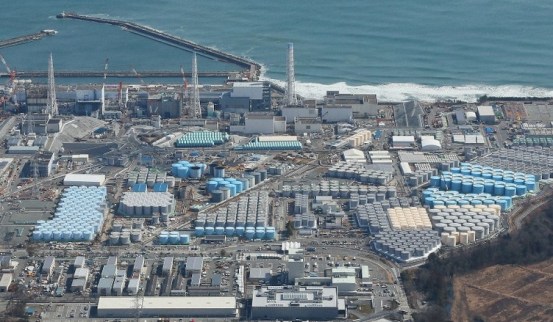 Tanks holding treated radioactively contaminated water are seen on the premises of the tsunami-ravaged Fukushima Daiichi Nuclear Power Station in Okuma, Fukushima Prefecture, in this file photo taken from a Mainichi Shimbun helicopter on March 3, 2017
March 25, 2020
TOKYO — Tokyo Electric Power Company Holdings Inc. (TEPCO) is planning to take about 30 years to release treated radioactively contaminated water accumulating at its crippled Fukushima nuclear plant into the sea or air if the government chooses that option.
According to a draft plan, TEPCO will complete the disposal of radioactively contaminated water at its Fukushima Daiichi Nuclear Power Station, which was hit by the 2011 Great East Japan Earthquake and tsunami, sometime between 2041 and 2051. By that time, the government plans to end work to decommission the plant.
If the state decides to release the water into the sea, TEPCO will aim to lower the density of radioactive tritium to around one-fortieth the upper limit set by the government at 60,000 becquerels per liter, while lowering the levels of other radioactive substances as much as possible. The World Health Organization sets the upper limit of radioactive tritium in water for human consumption at 10,000 becquerels per liter. Tritium cannot be removed from contaminated water even if an advanced liquid processing system (ALPS) is used to treat the water.
TEPCO will pay compensation if the release of such water gives rise to harmful rumors and causes damage to local industries.
If the government chooses to release treated water into the atmosphere, TEPCO will also strive to lower the levels of tritium well below the upper limit set by the government.
The government’s subcommittee comprising experts released a report this past February proposing to release radioactively contaminated water at the Fukushima nuclear plant into either the sea or air. The report then emphasizes the advantages of the plan to release the water into the sea.
Junichi Matsumoto, head of TEPCO’s division promoting the decommissioning of the crippled power plant, said the utility remains undecided over the way to dispose of the treated water.
While agreeing that releasing the water into the sea is a better option, Matsumoto said “it’s not true that we can’t technically explore the possibility” of releasing the water into the air.
“We haven’t decided whether to release the water into the sea or atmosphere,” he added.
Tanks on the premises of the nuclear complex are currently holding some 1.19 million metric tons of treated radioactively contaminated water. Since the water contains not only tritium but also other radioactive substances, TEPCO has indicated a plan to begin in the business year of 2020 to conduct experiments using an ALPS and other devices to lower the levels of radioactive substances in treated water.
The government is scheduled to hold hearings to listen to opinions from local communities about the disposal of radioactively contaminated water at the plant, starting in the city of Fukushima on April 6. While explaining the subcommittee’s report and TEPCO’s draft plan in these meetings, the government will make a final decision on the disposal method.
No comments yet.
1 This Month

of the week – Shut Down Drone Warfare!


Tell the Ukrainian Government to Drop Prosecution of Peace Activist Yurii Sheliazhenko

Petition to revoke the licensing of the Near Surface Nuclear Disposal Facility (NSDF) at Chalk River. https://www.ourcommons.ca/petitions/en/Petition/Details?Petition=e-7247
To see nuclear-related stories in greater depth and intensity – go to https://nuclearinformation.wordpress.com
-
Archives
- March 2026 (244)
- February 2026 (268)
- January 2026 (308)
- December 2025 (358)
- November 2025 (359)
- October 2025 (376)
- September 2025 (257)
- August 2025 (319)
- July 2025 (230)
- June 2025 (348)
- May 2025 (261)
- April 2025 (305)
-
Categories
- 1
- 1 NUCLEAR ISSUES
- business and costs
- climate change
- culture and arts
- ENERGY
- environment
- health
- history
- indigenous issues
- Legal
- marketing of nuclear
- media
- opposition to nuclear
- PERSONAL STORIES
- politics
- politics international
- Religion and ethics
- safety
- secrets,lies and civil liberties
- spinbuster
- technology
- Uranium
- wastes
- weapons and war
- Women
- 2 WORLD
- ACTION
- AFRICA
- Atrocities
- AUSTRALIA
- Christina's notes
- Christina's themes
- culture and arts
- Events
- Fuk 2022
- Fuk 2023
- Fukushima 2017
- Fukushima 2018
- fukushima 2019
- Fukushima 2020
- Fukushima 2021
- general
- global warming
- Humour (God we need it)
- Nuclear
- RARE EARTHS
- Reference
- resources – print
- Resources -audiovicual
- Weekly Newsletter
- World
- World Nuclear
- YouTube
-
RSS
Entries RSS
Comments RSS
 nuclear-news
Leave a comment