Fukushima Reactor Cleanup Delayed by Five Years as Japanese Public Demands End to Nuclear Energy
After proposing dumping radioactive water from Fukushima reactors into sea, Japan’s government now adds the idea of allowing the treated but still contaminated water to evaporate into the air. Breathe deep
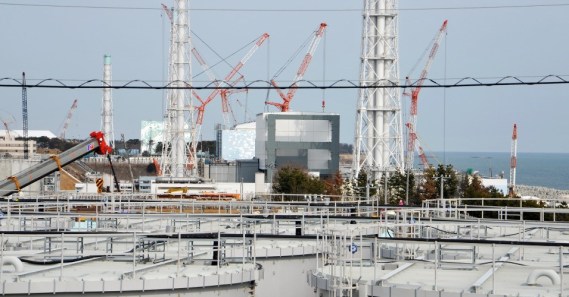 Water tanks holding contaminated water in front of the reactor buildings at Fukushima Daiichi.
December 30, 2019
The delay comes days after Japan’s government proposed releasing contaminated water from the plant into the ocean.
The Japanese government said Friday it would delay for a fourth time the removal of spent fuel from two of the reactors at the Fukushima Daichii nuclear power plant, causing concern that the cleanup of one of the worst nuclear disasters in history is happening at a dangerously slow pace.
The removal of the spent fuel was planned to begin in 2023, but the process was bumped back to 2024 at the earliest for the plant’s No. 1 reactor and 2027 or later for the No. 2 reactor.
According to the Japan Times, the government claims this aspect of the clean-up is being delayed due to safety concerns and that it plans to construct barriers around the reactors to prevent the spread of radioactive dust.
Reporting on the delay comes days after the Ministry of Economy, Trade, and Industry proposed releasing contaminated water from the plant into the ocean or allowing it to evaporate, and weeks after the ministry said the water contained higher levels of radioactive material than previously thought.
The most recent news about the cleanup process—which is under a 30-40 year plan following the 2011 earthquake and tsunami which forced more than 100,000 residents to evacuate the rural Fukushima region to avoid nuclear contamination from the plant—raised alarm among critics of nuclear power.
The Japanese public has reportedly grown increasingly anti-nuclear power since the Fukushima disaster, according to an Al Jazeera report earlier this month.
“Japanese people’s sentiment changed after Fukushima Daiichi and it is continuing until now,” Hajime Matsukubo, secretary-general of the Citizens’ Nuclear Information Center, told Al Jazeera. “They say no.”
In a 2015 poll by the Japan Atomic Energy Relations Organization, only 10 percent of Japanese respondents said the country should maintain its use of nuclear energy.
https://www.commondreams.org/news/2019/12/30/fukushima-reactor-cleanup-delayed-five-years-japanese-public-demands-end-nuclear?fbclid=IwAR0cWj8VpXce8X8kXt4Lzg2YlFL3PBZDeuEMtGCTHWD1jpQnzpYpdPwGP9I
No comments yet.
1 This Month


Tell the Ukrainian Government to Drop Prosecution of Peace Activist Yurii Sheliazhenko

Petition to revoke the licensing of the Near Surface Nuclear Disposal Facility (NSDF) at Chalk River. https://www.ourcommons.ca/petitions/en/Petition/Details?Petition=e-7247


of the week – STOP SMALL MODULAR REACTORS IN CANADA
To see nuclear-related stories in greater depth and intensity – go to https://nuclearinformation.wordpress.com
-
Archives
- March 2026 (176)
- February 2026 (268)
- January 2026 (308)
- December 2025 (358)
- November 2025 (359)
- October 2025 (376)
- September 2025 (258)
- August 2025 (319)
- July 2025 (230)
- June 2025 (348)
- May 2025 (261)
- April 2025 (305)
-
Categories
- 1
- 1 NUCLEAR ISSUES
- business and costs
- climate change
- culture and arts
- ENERGY
- environment
- health
- history
- indigenous issues
- Legal
- marketing of nuclear
- media
- opposition to nuclear
- PERSONAL STORIES
- politics
- politics international
- Religion and ethics
- safety
- secrets,lies and civil liberties
- spinbuster
- technology
- Uranium
- wastes
- weapons and war
- Women
- 2 WORLD
- ACTION
- AFRICA
- Atrocities
- AUSTRALIA
- Christina's notes
- Christina's themes
- culture and arts
- Events
- Fuk 2022
- Fuk 2023
- Fukushima 2017
- Fukushima 2018
- fukushima 2019
- Fukushima 2020
- Fukushima 2021
- general
- global warming
- Humour (God we need it)
- Nuclear
- RARE EARTHS
- Reference
- resources – print
- Resources -audiovicual
- Weekly Newsletter
- World
- World Nuclear
- YouTube
-
RSS
Entries RSS
Comments RSS
 nuclear-news
Leave a comment