 Le Monde 16th Sept 2018 [Machine Translation] Can EDF’s finances support such a trajectory? The company’s chief financial officer, Thomas Piquemal, slammed the door in 2015, worried that the UK’s Hinkley Point EPR would weigh heavily on the company. According to him, the need for the nuclear company to finance alone two thirds of the project creates a situation too risky. ”
Who would bet 60% to 70% of its heritage on a technology that we still do not know if it works, while it’s been ten years that we try to build it? “, He launches in front of the deputies in 2016. This is the heart of the problem for EDF: how to finance new reactors? For Hinkley Point, it took considerable resources, even though EDF won a gold contract with the British state: for thirty years, the French group will sell its electricity at a guaranteed rate, twice the current price electricity!
In other words, British consumers will see their bill increase. In fact, most countries that continue to build nuclear power can only do so with a strong commitment from the state and a guaranteed income for private investors.
But the France of 2018 is no longer that of Pierre Messmer and the Commissariat au plan in 1974, when the French nuclear plan was launched. The impossible equation But the atom requires long time. “When we talk about the EPR, we
are talking about an investment over a century. We are in a period in which people want shorter-term returns, even in infrastructure, “says Emmanuel Autier of Bearing Point.
“We are not going to scramble to finance a project that has not yet proved its worth while it is much more profitable and less risky to finance renewable energy,” notes an investment fund manager. Especially since EDF’s current structure, subject to stock market fluctuations, does not encourage long-term commitment. “Finance costs are a
very important part of construction. A listed company can not wear that on its balance sheet in a massive way, “agrees Valérie Faudon, SFEN.
“It will be necessary for the state to play its full role by creating a new regulatory framework,” admits Xavier Ursat. In other words: to sustain the EPR – and make survive EDF – it will be up to the state to guarantee the investments and consumers to bear the burden on their electricity bill.
This is the impossible equation in which EDF is: to survive in its current form, it must.
https://abonnes.lemonde.fr/economie/article/2018/09/16/l-epr-le-cauchemar-d-edf_5355883_3234.html
Les Echos 17th Sept 2018 Nuclear: the amazing schedule for the extension of reactors. The first reactor of the Tricastin plant will stop in June 2019 to start the extension work after 40 years. But ASN will not give its generic opinion on
the subject until the end of 2020.
https://www.lesechos.fr/industrie-services/energie-environnement/0302222113379-nucleaire-letonnant-calendrier-de-la-prolongation-des-reacteurs-2205709.php
September 18, 2018
Posted by Christina Macpherson |
business and costs, France |
Leave a comment
 Activists, villagers raise concern over proposed nuclear plant in MP https://www.business-standard.com/article/pti-stories/activists-villagers-raise-concern-over-proposed-nuclear-plant-in-mp-118091801368_1.html
Press Trust of India | New Delhi September 18, 2018 Activists and villagers raised their concerns over a proposed nuclear power plant in Chutka in Madhya Pradesh on Tuesday, saying it would destroy nature and take away their homeland.
In 2009, Nuclear Power Corporation of India Ltd. (NPCIL) has decided to set up the atomic station in Mandla district of Madhya Pradesh to generate 1,400 MW power.
Madhya Pradesh Power Generating Company Limited (MPPGCL) is the nodal agency to facilitate the execution of the project.
The villagers claimed they have been protesting for the past nine years over the atomic power plant and when they did not relent, compensation was put into their accounts forcefully. “MPPGCL forcefully put the compensation amount in our bank accounts and took our Aadhaar copies from the bank. We have written to the bank to remove their money,” said Meera Bai, a resident of Chutka.
Another resident, Dadu Lal Kudape, said they visited other villages where nuclear plants would be coming up and they found contaminated water and polluted environment.
“We do not want the same things to happen to us,” he said.
Padmini Ghosh, Women’s Regional Network India Coordinator, said if European countries are dismantling nuclear power plants, India is building them. “We need to review nuclear policy and install renewable energy plants,” Ghosh said.
Raj Kumar Sinha, activist working with the villagers, said they are being exploited and no amount of money could compensate for their land.
“These people are nature lovers. They can’t be bought with money,” he said.
The Women’s Regional Network said a total of 17,000 people would be displaced if the plant comes up.
September 18, 2018
Posted by Christina Macpherson |
India, opposition to nuclear |
Leave a comment
The Tip of the Radiation Disaster Iceberghttps://www.counterpunch.org/2018/08/31/the-tip-of-the-radiation-disaster-iceberg/ by JOHN LAFORGE The World Nuclear Association says its goal is “to increase global support for nuclear energy” and it repeatedly claims on its website: “There have only been three major accidents across 16,000 cumulative reactor-years of operation in 32 countries.” The WNA and other nuclear power supporters acknowledge Three Mile Island in 1979 (US), Chernobyl in 1986 (USSR), and Fukushima in 2011 (Japan) as “major” disasters. ¶ But claiming that these radiation gushers were the worst ignores the frightening series of large-scale disasters that have been caused by uranium mining, reactors, nuclear weapons, and radioactive waste. Some of the world’s other major accidental radiation releases indicate that the Big Three are just the tip of the iceberg.
CHALK RIVER (Ontario), Dec. 2, 1952: The first major commercial reactor disaster occurred at this Canadian reactor on the Ottawa River when it caused a loss-of-coolant, a hydrogen explosion and a meltdown, releasing 100,000 curies of radioactivity to the air. In comparison, the official government position is that Three Mile Island released about 15 curies, although radiation monitors failed or went off-scale.
ROCKY FLATS (Colorado), Sept. 11, 1957: This Cold War factory produced plutonium triggers for nuclear weapons 16 miles from Denver. It caused 30 to 44 pounds of breathable plutonium-239 and plutonium-240 to catch fire in what would come to be known as the second largest industrial fire in US history. Filters used to trap the plutonium were destroyed and it escaped through chimneys, contaminating parts of Denver. Nothing was done to warn or protect downwind residents.
WINDSCALE/SELLAFIELD (Britain), Oct. 7, 1957: The worst of many fires burned through one reactor igniting three tons of uranium and dispersed radionuclides over parts of England and northern Europe. The site was hastily renamed Sellafield. Another large radiation leak occurs in 1981and leukemia rates soared to triple the national average.
KYSHTYM/CHELYABINSK-65 (Russia), Sept. 29, 1957: A tank holding 70 to 80 metric tons of highly radioactive liquid waste exploded, contaminating an estimated 250,000 people, and permanently depopulating 30 towns which were leveled and removed from Russian maps. Covered up by Moscow (and the CIA) until 1989, Russia finally revealed that 20 million curies of long-lived isotopes like cesium were released, and the release was later declared a Level 6 disaster on the International Nuclear Event Scale. The long covered-up explosion contaminated up to 10,000 square miles making it the third- or 4th-most serious radiation accident ever recorded.
SANTA SUSANA (Simi Valley, Calif.), July 12, 1959: The meltdown of the Sodium Reactor Experiment just outside Los Angeles caused “the third largest release of iodine-131 in the history of nuclear power,” according to Arjun Makhajani, President of the Institute for Energy & Environmental Research. Released radioactive materials were never authoritatively measured because “the monitors went clear off the scale,” according to an employee. The accident was kept secret for 20 years.
CHURCH ROCK (New Mexico), July 16, 1979: Ninety-three million gallons of liquid uranium mine wastes and 1,000 tons of solid wastes spilled onto the Navajo Nation and into Little Puerco River, and nuclear officials called it “the worst incident of radiation contamination in the history of the United States.” The Little Puerco feeds the Little Colorado River, which drains to the Colorado River, which feeds Lake Mead—a source of drinking water for Los Angeles.
TOMSK-7 (Russia), April 7, 1993: In “the worst radiation disaster since Chernobyl,” Russian and foreign experts said a tank of radioactive waste exploded at the Tomsk nuclear weapons complex and that wind blew its plume of radiation toward the Yenisei River and 11 Siberian villages, none of which were evacuated.
MONJU (Japan), Dec. 8, 1995: This sodium-cooled “breeder reactor” caused a fire and a large leak of sodium coolant into the Pacific. Liquid sodium coolant catches fire on contact with air and explodes on contact with water. Costly efforts to engineer commercial models have failed. Japan’s Monju experiment was halted in 2018 after over 24 years of false starts, accidents and cover-ups.
TOKAI-MURA (Japan), Sept. 30, 1999: A uranium “criticality” which is an uncontrolled nuclear chain reaction caused a “neutron burst” that killed three workers and dispersed neutron radiation throughout the densely populated urban area surrounding the factory.
Not to be slighted, deliberate contamination has also been enormous: Five metric tons of plutonium was dispersed over the earth by nuclear bomb testing, and other nuclear weapons processes; Over 210 billion gallons of radioactive liquids were poured into the ground at the Hanford reactor complex in Washington State; and 16 billion gallons of liquid waste holding 70,000 curies of radioactivity were injected directly into Idaho’s Snake River Aquifer at the Idaho National Lab.
September 18, 2018
Posted by Christina Macpherson |
2 WORLD, incidents |
Leave a comment
 Guardian 17th Sept 2018 Britain’s energy regulator has been fighting to keep secret the claims of
two whistleblowers who independently raised concerns about potentially
serious irregularities in projects worth billions of pounds, the Guardian
can reveal. The two men say Ofgem threatened them with an obscure but
sweeping gagging clause that can lead to criminal prosecutions and possible
jail terms for those who defy it.
https://www.theguardian.com/law/2018/sep/17/ofgem-made-my-life-hell-whistleblowers-say-they-were-threatened-by-regulator
September 18, 2018
Posted by Christina Macpherson |
civil liberties, UK |
Leave a comment

The U.S. Nuclear Regulatory Commission has declared a state of emergency for both units of the Brunswick nuclear power facilities in North Carolina. An “unusual event” has occurred which is interfering with the ongoing “hot shutdown” of the nuclear power plants (a process which takes several weeks to complete).
Full details of the event are found at this NRC.gov nuclear power plant alert page, which states:
UNUSUAL EVENT DUE TO SITE CONDITIONS PREVENTING PLANT ACCESS
“A hazardous event has resulted in on-site conditions sufficient to prohibit the plant staff from accessing the site via personal vehicles due to flooding of local roads by Tropical Storm Florence.”
Notified DHS SWO, FEMA OPS, and DHS NICC. Notified FEMA NWC, NuclearSSA, and FEMA NRCC via email.
In other words, the Brunswick power facilities can no longer be accessed by workers and technicians even as they are running a “hot shutdown” which requires…
View original post 235 more words
September 18, 2018
Posted by Christina Macpherson |
Uncategorized |
Leave a comment
 BBC 17th Sept 2018
 , Developers must clarify whether dumping mud from near a nuclear plant is
covered by an environmental impact assessment (EIA), a judge has said.
Judge Milwyn Jarman said EDF’s evidence was “not accurate on a very
important point” on whether material dredged from the seabed near Hinkley
Point C site in Somerset was included in the EIA. Campaigners want an injunction to halt the dumping that began last week. A High Court hearing
in Cardiff has been adjourned for seven days.
About 300,000 tonnes is to be
dredged from the seabed near the building site and deposited in the Cardiff
Grounds, a mile off the coast of the Welsh capital. Energy firm EDF, which
is behind the £19.6bn plan to build the nuclear plant, argued the mud dump
was addressed in a main environment statement that formed part of the main
planning application for Hinkley Point C and was approved by the UK
Government.
But the judge said that was not clear from a witness statement
the company had submitted to court. The firm’s barrister James McClelland
accepted the wording could have been made clearer. Legal action is being
brought by the Campaign Against Hinkley Mud Dumping, which includes Super
Furry Animals keyboard player Cian Ciaran. Campaigners asked for a
temporary injunction to be imposed until the next hearing, but the request
was turned down. Neil McEvoy AM said campaigners were planning to organise
a blockade in an effort to halt the dumping.
https://www.bbc.co.uk/news/uk-wales-45546550
September 18, 2018
Posted by Christina Macpherson |
Legal, UK |
Leave a comment
Le Monde 16th Sept 2018 , Le Monde 16th Sept 2018 [Machine Translation] The EPR, EDF’s nightmare. The European pressurized
reactor was to be the flagship of the French nuclear industry. For the
company it is now its survival and that of a whole sector that is at
stake, while the group is heavily indebted and its income is dwindling. 74
billion of debt … and with nuclear,that is not finished!
At the headquarters of EDF, avenue de Wagram, in Paris, the gigantic banner of
Greenpeace shows the color: we see the CEO of EDF, Jean-Bernard Lévy,
making two fingers of honor to passersby, under the mention “Thank you
Jean-Bernard”. This action of December 2016 marked a new stage in the
argument of nuclear opponents: it is not only to explain the risk of
accidents, but also the financial risk that would weigh on EDF.
NGOs are no longer alone in this field. In June, the then minister responsible for EDF
Nicolas Hulot, took up the argument. “One of the reasons why EDF finds itself
in difficulty is that the nuclear industry, sorry to say, leads us into a
drift. In a clear allusion to the expensive shipyard Flamanville (Channel),
he said: “It is clear that economically, there is a kind of golden rule
that is being established in this sector, it’s that in reality, we never
keep our promises. The minister is picking up a criticism that is becoming
more and more common: not only has nuclear become too expensive, but it
would also be a major strategic mistake for EDF.
https://abonnes.lemonde.fr/economie/article/2018/09/16/l-epr-le-cauchemar-d-edf_5355883_3234.html
September 18, 2018
Posted by Christina Macpherson |
business and costs, France |
Leave a comment
Ars Technica 16thSept 2018 , Though economics might not favor nuclear power in the US, policy makers do.
Last week, the House passed a bipartisan bill that originated in the Senate
called the Nuclear Energy Innovation Capabilities Act (S. 97), which will
allow the private sector to partner with US National Laboratories to vet
advanced nuclear technologies.
The bill also directs the Department of
Energy (DOE) to lay the ground work for establishing “a versatile,
reactor-based fast neutron source.” The Senate also introduced a second
bill called the Nuclear Energy Leadership Act (S. 3422) last Thursday,
which would direct the DOE actually establish that fast neutron reactor.
That bill also directs the DOE to “make available high-assay, low-enriched
uranium” for research purposes. The Nuclear Energy Leadership Act has not
yet made it past a Senate vote.
https://arstechnica.com/tech-policy/2018/09/us-congress-passes-bill-to-help-advanced-nuclear-power/
September 18, 2018
Posted by Christina Macpherson |
politics, USA |
Leave a comment
Toshiba in talks with Brookfield for U.K. nuclear unit sale: sources, Globe and Mail , REUTER, SEPTEMBER 18, 2018 Toshiba Corp is in talks with Canada’s Brookfield Asset Management Inc for the potential sale of its UK nuclear unit NuGen, a source familiar with the matter said on Tuesday.
Brookfield has emerged as one of several new candidates since Korea Electric Power Corp (KEPCO) lost its preferred bidder status in July, said the source, who declined to be identified as the talks are private.
The talks, first reported by the Financial Times, are at an early stage, the source said. ………
The NuGen project in Moorside, northwest England, was expected to provide around 7 per cent of Britain’s electricity, but faced setbacks after Toshiba’s nuclear arm Westinghouse went bankrupt last year.
NuGen said last week it has cut the team working on its project, to fewer than 40 people from more than 100 as a sale of the project is taking longer than expected. https://www.theglobeandmail.com/business/article-toshiba-in-talks-with-brookfield-for-sale-of-uk-nuclear-unit-report/
September 18, 2018
Posted by Christina Macpherson |
business and costs, Canada |
Leave a comment
Some nuclear blocks temporarily out of operation https://spectator.sme.sk/c/20916677/some-nuclear-blocks-temporarily-out-of-operation.html, 17 Sept 18
Several repairs and checks are expected to be carried out Slovenské Elektrárne (SE), the country’s main energy generator, has temporarily shut down the operation of several blocks of its nuclear power plants.
The second block of the Mochovce nuclear power plant was put out of operation on September 15. It is the last general temporary shutdown planned for this year, and will last until the end of October, the TASR newswire reported.
Moreover, SE temporarily shut down the fourth block of the Jaslovské Bohunice nuclear power plant due to plans to repair one of the steam generators. The work is expected to be finished by the end of this week, TASR wrote. SE’s spokesperson Miroslav Šarišský confirmed for the Sme daily that the work in Jaslovské Bohunice does not endanger anybody’s health.
What work is planned?
In the case of Mochovce, a substantial amount of work is planned during the interruption of operation, including checks, exchanges and repairs of various components at selected devices of the nuclear block. A similar shutdown takes place every eight years.
The plan is also to remove the nuclear fuel from the reactor and the checking of the reactor’s pressure vessel and other components. Similarly to previous years, SE will replace part of the used nuclear fuels with a new one, TASR reported.
The work in both Mochovce and Jaslovské Bohunice is carried out by hundreds of employees and more than 700 people from supplying organisations.
After the planned maintenance and the replacement of nuclear fuel, the testing of the containment and primary circuit will be carried out, TASR wrote
September 18, 2018
Posted by Christina Macpherson |
EUROPE |
Leave a comment
 Congress looking for money for cities hit by nuclear plant closures — including Diablo Canyon,The Tribune BY KAYTLYN LESLIE, kleslie@thetribunenews.com, September 17, 2018
Congress wants to find money to support communities where nuclear power plants are being decommissioned — which could mean some funding for San Luis Obispo County once Diablo Canyon starts the process itself in the coming years.
Congressman Salud Carbajal announced Monday that Congress directed the U.S. Department of Energy to study public and private funding sources available to help those communities, as part of its Fiscal Year 2019 Energy and Water, Legislative Branch and Military Construction and Veterans Affairs Appropriations Act (HR 5895).
“With the impending Diablo Canyon Power Plant closure, I am working to secure all available federal resources to help offset the economic impact of this decommissioning,” Carbajal said in a news release. Carbajal, a Democrat, represents California’s 24th Congressional District, which spans between San Luis Obispo and Ventura counties.
The Department of Energy study will focus on identifying public and private funds to support municipalities where a nuclear power plant is decommissioned, in the process of decommissioning or plans to shut down within three years of the act’s enactment, and contains nuclear waste within its boundaries, according to the news release.
The bill passed both the House of Representatives and the Senate and is set to be signed into law by President Donald Trump sometime before the end of the fiscal year, Sept. 30……. https://www.sanluisobispo.com/news/local/article218563600.html
September 18, 2018
Posted by Christina Macpherson |
decommission reactor, USA |
Leave a comment
Army Corps of Engineers Dismantles Former Floating Nuclear Plant in Galveston https://www.houstonpublicmedia.org/articles/news/2018/09/18/304524/corps-of-engineers-dismantles-former-floating-nuclear-plant-in-galveston/More than 1.5 million pounds of radioactive waste have been safely removed from the USS Sturgis’ nuclear reactor
SEPTEMBER 18, 2018, HE
U.S. ARMY CORPS OF ENGINEERS HAS ANNOUNCED THAT A FORMER FLOATING NUCLEAR PLANT IN GALVESTON HAS BEEN DISMANTLED.
More than 1.5 million pounds of radioactive waste have been safely removed from the USS Sturgis’ nuclear reactor. Additionally, more than 600,000 pounds of lead from the vessel have been recycled.
The removal process has taken three years and the Corps said decommissioning the Army’s first and only floating nuclear reactor prototype is now complete.
The World War II vessel was converted into a barge-mounted nuclear reactor in the 1960s.
The Galveston Daily News reported the ship will be towed to Brownsville later this month, where it will be scrapped.
September 18, 2018
Posted by Christina Macpherson |
decommission reactor |
Leave a comment
 Ken Raskin, FOUR OF THE BIGGEST THINGS NUCLEOAPES AND THEIR APOLOGISTS CONSTANTLY LIE ABOUT ARE…
1. THE ACTUAL MORTALITY AND MORBIDITY OF RADIONUCLDES AND THEIR EFFECTS
2. THE HIGH TOXIICITY AND RADIOTOXICITY OF TRITIUM
3. THE BIG LIE OF HORMESIS
4. THAT RADIOACTIVE WASTE CAN BE SAFELY STORED – WE ARE ALL LIVING ON THE BEACH NOW! (see https://nuclear-news.net/2018/09/14/no-way-to-store-nuclear-waste-safely-we-are-living-on-the-beach-in-the-usa-in-japan-it-is-much-worse/)
In this post, Ken Raskin covers 1. THE ACTUAL MORTALITY AND MORBIDITY OF RADIONUCLDES AND THEIR EFFECTS
Radionuclides In Industry In Pharmaceuticals (the other items will be published in later posts.)
I have seen first hand, THE RESULTS OF RADIOPHARMACEUTICAL OVEREXPOSURES AND industrial ACCIDENTS with things like cesium 137.
I am constantly amazed, at how willingly, experts are so quick to lowball morbidity and mortality calculations and effects, in the face of Chernobyl and Fukushima. There is no such thing as low-level radioactive waste. Any ingested radionuclide, does its damage and then some. Even in microscopic amounts!
The dose of I131, used for thyroid ablation is about 30 billionths of a gram. It is not necessary to do any radiation modeling for that. I131 is used as a pharmaceutical drug, to destroy thyroid tissue in place of surgery. There is little need for complicated individual dose calculations. There is certainly, no need for any bs radiation modeling. If a bolus of radiopharmaceutical I131 is administered via oral solution, it will find its way to the thyroid to do its dirty deed.
I131 is also a fission product . An acute dose of I131 in the environment, rarely reaches the saturation level of a radiopharmaceutical administered, in a hospital for a thyroidectomy. Global thyroid damage will be observed, for those who are unlucky enough to absorb higher boluses of I131, in an exposure. Thyroid cancer may occur. I saw a case of Iridium Exposure, where a man died in an industrial accident. How many of us have seen bad results of gamma knife therapy or readiopharmaceutical therapy. A lot. Then the rotten frikin nucleoapes have the gall to stand around ans say there were minimal casualties from chernobyl or fukushima.
There is the fella I knew, who worked a brief time in an Uranium complex. Fifteen of his coworkers died before age 50, of cancer. The chickenshits will turn around and tell you, THAT only one worker has died, from radionuclide related causes at fukushima. They will say the Mclatchy study that showed 33,000 or so, nuclear workers died over 2 years, is wrong. They will say it because they are liars, propagandists, professional shills, or unrepentant-ignorant fools.

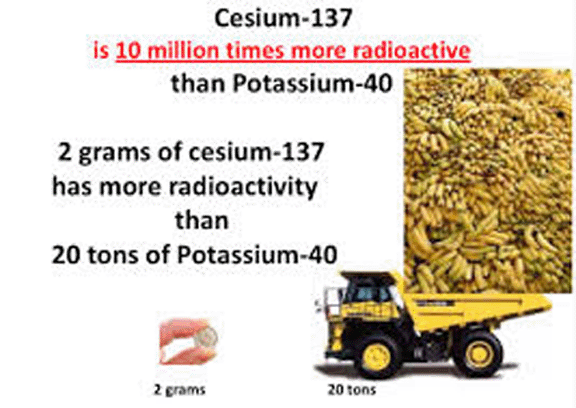
Similar to Iodine131 in it’s incredible toxicity, is Cesium 137 . It is a gamma and beta emmiter. CESIUM 137 Is acutely toxic to heart tissue, at 100 billionths of a gram. Remember chernobyl heart. No radiation modelling is necessary to establish this fact. The observation of heart effects from cesium 137/134 exposure to cesium 137, effects on the heart quite discernable. From the many studies from chernobyl and belarussian victims of chernobyl, observed by Bandhechevsky, Yablokov, and Miller.
September 17, 2018
Posted by Christina Macpherson |
2 WORLD, radiation |
1 Comment

The country doesn’t need “parking lot dumps for interim storage,”
 “We as communities want it out of here. We want it to be in safe place where its never moved again. We think it’s lunacy to move it twice.”
Waste Control Specialists has been lobbying federal officials to establish an interim high-level waste repository
Anti-nuclear groups urge action against national waste dump https://www.recorder.com/CAN-plans-nuclear-waste-speaking-tour-20148074 By RICHIE DAVIS
Staff Writer, September 15, 2018
With closure and dismantling of the Yankee Atomic plant in Rowe and now Vermont Yankee and other New England nuclear sites pretty much a fait accompli, watchdog groups like Citizens Awareness Network are focused on the one tremendous remaining issue: the high-level nuclear waste remaining on the reactor sites.
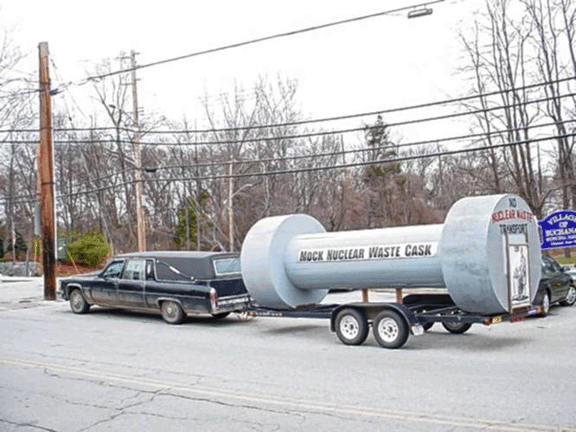
CAN is planning a tour with a giant can — a 32-foot-long wooden mock-up of a radioactive waste cask — and an array of speakers to speak about what the organization calls “the abdication by the federal government and the nuclear industry” to deal with high-level nuclear waste “stranded” at nuclear sites around. Continue reading →
September 17, 2018
Posted by Christina Macpherson |
USA, wastes |
Leave a comment
 Typhoon Mangkhut: Two nuclear power plants on China’s Guangdong coast in path of storm Workers batten down the hatches at Yangjiang and Taishan facilities as superstorm set to make landfall nearby, South China Morning Post Sarah Zheng, 16 September, 2018,
Two nuclear power plants stand on the projected path of Typhoon Mangkhut, which is expected to make landfall in mainland China as early as Sunday afternoon. Taishan Nuclear Power Plant and Yangjiang Nuclear Power Station, both in Guangdong province, said they were “in combat readiness” mode as the superstorm approached.
The Taishan plant, which is about 135km from Hong Kong, said via WeChat that officials had discussed how best to deal with the approaching storm and specialist workers had conducted safety investigations.
Mangkhut LIVE blog: signal No 10 raised as typhoon batters Hong Kong
Emergency response teams had also been briefed and were prepared for the typhoon’s arrival………
The Yangjiang power plant, which went into commercial operation in 2014, has been in the news before.
In 2016, four members of its staff were punished for breaching operational guidelines and covering up an incident in which a residual heat-removal pump on one of the reactors stopped functioning for six minutes.
Last year, component supplier Dalian Teikoku Canned Motor Pump Company was fined for violating operating rules regarding welding at the plant……..https://www.scmp.com/news/china/society/article/2164363/chinese-nuclear-power-plant-path-super-typhoon-mangkhut
September 17, 2018
Posted by Christina Macpherson |
China, climate change |
Leave a comment






 nuclear-news