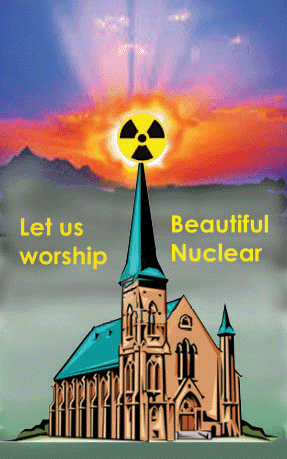
Change public view of nuclear from “acceptance” to “DEMAND” – the new spin from International Atomic Energy Agency (IAEA)
|
Mikhail Chudakov , deputy director general of the International Atomic Energy Agency (IAEA) told delegates at the World Nuclear Association Symposium 2018 held in London last week, said the industry needs to change public acceptance of nuclear power to public demand . WNN 14 Sept 18
“……Referring to the nuclear industry’s Harmony goal to add 1000 GWe of new installed capacity by 2050, with nuclear accounting for 25% of global electricity consumption, he said: “Last year’s high case was 700 GWe. Where is the 1000 GWe plus of new capacity? We can’t see it. Where is our 25% of electricity production by 2050? We are already losing the battle and we will be responsible for this.” He added: “This should be a big wake up call for all of us.” In notes that accompanied his presentation, Chudakov said the decline compared to previous projections is mainly owing to “the early retirement or lack of interest in extending the operating life of nuclear power plants in some countries, due to the reduced competitiveness of nuclear power in the short run and nuclear policies in several countries following the accident at Fukushima Daiichi in 2011”. His notes added: “We are still looking into a heavy new build schedule to replace the large figure of capacity that will go away due to retiring reactors.” Chudakov outlined the seven influences he sees on the future of nuclear power: safety; funding and financing; electricity markets and nuclear policies; innovation (advanced reactors and fuel cycles); waste management; capacity building; and public acceptance. ……… “Of course, we can stop talking about safety, but we can’t prevent people asking us about safety and they have the right to. The safety performance of nuclear installations is crucial to the future of nuclear power, as a strong safety record is essential for its public acceptance,” he said. ……… , financing new nuclear build is challenging, but new ways of thinking have produced new ways of finding money. We see this in Turkey, in Finland, in the UAE, in the UK. But the underlying question is: How can governments create more enabling conditions so that nuclear can be more affordable? The answer to this question is closely linked to electricity markets and nuclear policies, he said. Support needs to be given to newcomers to nuclear power and harmonised support to new operators, he said……… Radioactive waste management practice must provide public reassurance that the industry has managed programmes for the whole lifecycle, he said. Demand for nuclearPublic acceptance remains a key factor for the future of nuclear power, he said, and largely depends on public perception of the benefits and risks associated with this form of power generation, but also of the benefits and risks of non-nuclear alternatives. All stakeholders ought to reinforce the social and economic benefits of nuclear power. “We need to explain and to start education at all levels, from kindergarten, school and university, to parliament and ministers. We should not be ashamed to talk about nuclear energy; we are always defending ourselves, but it’s time to start attacking – to actively explain and promote nuclear power,” he said………We will greatly improve our chances for success if our efforts can shift the paradigm from gaining public acceptance of nuclear power to generating well-informed public demand for nuclear power. We must reinforce the benefits of nuclear power. This is a big, but a vitally important task and it will require enhanced international cooperation…….http://www.world-nuclear-news.org/Articles/Nuclear-industry-faces-wake-up-call,-says-IAEAs-Ch?feed=feed |
|
2 Comments »
Leave a comment
1 This Month

of the week – Shut Down Drone Warfare!


Tell the Ukrainian Government to Drop Prosecution of Peace Activist Yurii Sheliazhenko

Petition to revoke the licensing of the Near Surface Nuclear Disposal Facility (NSDF) at Chalk River. https://www.ourcommons.ca/petitions/en/Petition/Details?Petition=e-7247
To see nuclear-related stories in greater depth and intensity – go to https://nuclearinformation.wordpress.com
-
Archives
- April 2026 (114)
- March 2026 (251)
- February 2026 (268)
- January 2026 (308)
- December 2025 (358)
- November 2025 (359)
- October 2025 (376)
- September 2025 (257)
- August 2025 (319)
- July 2025 (230)
- June 2025 (348)
- May 2025 (261)
-
Categories
- 1
- 1 NUCLEAR ISSUES
- business and costs
- climate change
- culture and arts
- ENERGY
- environment
- health
- history
- indigenous issues
- Legal
- marketing of nuclear
- media
- opposition to nuclear
- PERSONAL STORIES
- politics
- politics international
- Religion and ethics
- safety
- secrets,lies and civil liberties
- spinbuster
- technology
- Uranium
- wastes
- weapons and war
- Women
- 2 WORLD
- ACTION
- AFRICA
- Atrocities
- AUSTRALIA
- Christina's notes
- Christina's themes
- culture and arts
- Events
- Fuk 2022
- Fuk 2023
- Fukushima 2017
- Fukushima 2018
- fukushima 2019
- Fukushima 2020
- Fukushima 2021
- general
- global warming
- Humour (God we need it)
- Nuclear
- RARE EARTHS
- Reference
- resources – print
- Resources -audiovicual
- Weekly Newsletter
- World
- World Nuclear
- YouTube
-
RSS
Entries RSS
Comments RSS
 nuclear-news
It is hard to know how far the nuke nuts will go in promoting nuclear power, especially since public skepticism has grown, not decreased, in recent years as a result of Fukushima. There is also the economic factor and how eager governments are to subsidize the “new generation” of reactors, especially since doing so would take funding away from renewables which are cheaper and come on line sooner. If I thought all these obstacles were going to be ignored, I’d be on the road again talking against nukes. But I suspect that much of the pro nuke propganda is whistling in the dark. The nuke nuts know full well what the obstacles are, hence their desperate attempts to promote it! But it is an uphill battle, at least in the USA and western Europe. Most of the discussion and promotion come from within the nuclear industry itself and mainly from scientists, not necessarily engineers, who can find jobs in other sectors. It’s not surprising that nuclear scientists are scared. You would be too if your profession and your entire intellectual and professional life depended on it! So for now let’s take their cheerleading shouts with a grain of salt, though we should not let our guard down and we should absolutely respond to and rebut their optimistic views. Without government assistance, nukes are dead in the water. That’s why no new ones have been built here in the US. Whether old ones will be relicensed is an open question, given their age and the incursion of renewable energy, but in any case they must be resisted.
Oh dear! Lorna, I appreciate your logical and well informed comment. BUT, I can’t agree with you. I fear that the global nuclear industry, with all its government, financial world, and employment entanglements is indeed TOO BIG TO FAIL. Firstly the ballooning nuclear weapons industry depends utterly on the “peaceful” commercial nuclear industry – to provide resources, trained staff, and these days, even tritium for weapons fuel. Entangled in that are banks, investment funds, pension funds, and massive employment.
While Fukushima did put the brakes on quite severely with safety costs increased, that doesn’t apply so much to Russia and China, who are able to go gangbusters with “new nukes” funded by the government. The memory of Fukushima is fading from public consciousness. The normalisation of Fukushima will be completed with the 2020 Olympics.
What about what is happening now, in Quandong Privinve, China, and in N and S Carolina? Do we really think that no radioactive waste dumps have been affected? At best, governments must be spending a fortune trying to keep them safe. But we hear little about that. Whitewash of the nuclear industry continues – as long as there’s no dramatic visually startling nuclear accident, the steady radioactive poisoning of communities will be tolerated. So, as tax-payers in China , Russia, and soon, the Western world cop the costs of the uneconomic “new nukes” – the nuclear weapons industry will continue to expand, and the story about nuclear power needed for climate change action will be pushed. Sadly, so many families of scientists, academics, politicians, journalists depend on swallowing and perpetrating this lie, in order to maintain their livelihood.