Japan touts completion of Fukushima cleanup at tripartite environment meeting in China

Japanese firms shift to clean energy despite state’s cling to nuclear power

‘Green Lawn’: Pundit Suggests Fukushima Prefecture May Remain Without NPP

Rokkasho Election Results


TEPCO to gauge radiation in reactor building
Iran expects Europe’s package to save nuclear deal by end of June: Araqchi

 Press TV, Jun 23, 2018 A senior Iranian nuclear negotiator says the Islamic Republic expects the European Union to put forward by the end of June its package of proposals to save a multilateral nuclear agreement between Tehran and the P5+1 group of countries from which the US has withdrawn.
Iranian Deputy Foreign Minister Abbas Araqchi said on Saturday that the three European signatories of the nuclear agreement, officially known as the Joint Comprehensive Plan of Action (JCPOA), and the EU had promised to offer a package of practical steps that would fulfill Iran’s demands, including on oil sales, payments for its oil and transportation………
Since the US president pulled Washington out of the historic nuclear deal, European countries have been scrambling to ensure that Iran gets enough economic benefits to persuade it to stay in the deal. The remaining parties have vowed to stay in the accord.http://www.presstv.com/Detail/2018/06/23/565876/Araqchi-Europe-JCPOA-package
With climate change, it’s unwise for UK to build Hinkley Point C, as sea levels are rising
 Weatherwatch: the nuclear option and rising levels of anxiety Danger of coastal flooding might make sensible people think twice about building houses in vulnerable places, let alone nuclear power stations, Guardian, https://www.theguardian.com/news/2018/jun/22/weatherwatch-the-nuclear-option-and-rising-levels-of-anxiety Paul Brown,
Back in 2012 a document obtained under the Freedom of Information Act showed that the Environment Agency was warning that 12 out of the UK’s 19 nuclear sites were in danger of coastal flooding and erosion because of climate change. Among them was Hinkley Point in Somerset, one of the eight proposed sites for new nuclear power stations around the coasts.That was before the increasing volume of melting of the Greenland ice capwas properly understood and when most experts thought there was no net melting in the Antarctic.
Melting ice sheets are hastening sea level rise, satellite data confirms
Satellite measurements released earlier this month and other recent observations of how warmer seas are eroding ice shelves and glaciers have removed uncertainty.
Estimates of sea level rise in the next 50 years have gone up from less than 30cm to more than a metre, well within the lifespan of the nuclear stations the UK government has planned.
The extra coastal erosion and threat of storm surges that this increase in sea level will bring to our shores might make sensible people think twice about siting any buildings in vulnerable places, let alone nuclear power stations.
So far, however, the government has yet to respond and is pressing ahead with its plans.
Scrap Trident or risk a “nuclear annihilation abyss”- former nuclear sub commander warns UK govt
 Former nuclear sub commander pleads with Government to scrap Trident or risk a “nuclear annihilation abyss”, Sunday Herald, Rob Edwards, 24 June 18
How the British government struck such a terrible deal as Hinkley Point C nuclear power project

 Hinkley Point: the ‘dreadful deal’ behind the world’s most expensive power plant Building Britain’s first new nuclear reactor since 1995 will cost twice as much as the 2012 Olympics – and by the time it is finished, nuclear power could be a thing of the past. How could the government strike such a bad deal? Guardian, By Holly Watt, 21 Dec 17, Hinkley Point, on the Somerset coast, is the biggest building site in Europe. ……
the irony of Hinkley Point C is that by the time it eventually starts working, it may have become obsolete. Nuclear power is facing existential problems around the world, as the cost of renewable energies fall and their popularity grows. “The maths doesn’t work,” says Tom Burke, former environmental policy adviser to BP and visiting professor at both Imperial and University Colleges. “Nuclear simply doesn’t make sense any more.”
The story of Hinkley Point C is that of a chain of decisions, taken by dozens of people over almost four decades, which might have made sense in isolation, but today result in an almost unfathomable scramble of policies and ambitions. Promises have been made and broken, policies have been adopted then dropped then adopted again. The one thing that has been consistent is the projected cost, which has rocketed ever upwards. But if so many people have come to believe that Hinkley Point C is fundamentally flawed, the question remains: how did we get to this point, where billions of pounds have been sunk into a project that seems less and less appealing with every year that passes?
……… By the end of 2003, all government policy indicated that Hinkley Point C would never be built, and there was no prospect of any other new nuclear power plants. It seemed certain that nuclear had no future in Britain – which is why, when the government performed a volte-face three years later, so many onlookers were astonished. “Without any obvious change in the world, by 2006, the position in government had been completely reversed,” MacKerron told me. “Nuclear power had become extremely beneficial, important and not uneconomic.”
One thing that had happened in the intervening years was a PR blitz by the nuclear industry, which had deployed scores of lobbyists, including former politicians such as the former energy minister Brian Wilson, to push the idea of a “nuclear renaissance” in the UK. Between 2003 and 2006, says Andrew Stirling, professor of science and technology policy at Sussex University, “Britain saw the beginnings of a massive pro-nuclear lobbying and PR campaign that continues to this day.”
Through the media and advertising campaigns, key messages were hammered home. Renewables were intermittent and unreliable. Overseas gas imports were politically vulnerable. “Green” nuclear was the only plausible way to hit carbon dioxide reduction targets. Keith Parker, who was then chief executive of the Nuclear Industry Association (NIA), told the New Statesman that the 2005 election became a particular focus for swaying opinions. “It gave us a good chance to raise the profile of nuclear power,” he said. In the months leading up to the election, a series of talks was organised at exclusive venues such as the Army & Navy Club on Pall Mall and St Stephen’s Club in Queen Anne’s Gate. Industry leaders and experts came together to explain the benefits of nuclear to politicians and energy journalists. The NIA (which is now chaired by John Hutton) took on the role of managing the influential all-party parliamentary group – an informal grouping of politicians – on nuclear energy.
In July 2006, the government U-turn arrived in the form of a new policy paper, The Energy Challenge, which declared that new nuclear power stations would be necessary to help Britain reduce its carbon emissions and to ensure an uninterrupted, affordable supply of energy well into the future.
Greenpeace launched a legal challenge, claiming that the consultation process behind the government’s recommendation had been totally inadequate. The judge presiding over the case agreed, and in February 2007 ruled that the process had been “misleading”, “very seriously flawed” and “procedurally unfair”. Blair accepted the ruling, but stated that “this won’t affect the policy at all”.
Andrew Stirling believes that there was a crucial, largely unspoken, reason for the government’s rediscovered passion for nuclear: without a civil nuclear industry, a nation cannot sustain military nuclear capabilities. In other words, no new nuclear power plants would spell the end of Trident. “The only countries in the world that are currently looking at large-scale civil power newbuild programmes are countries that have nuclear submarines, or have an expressed aim of acquiring them,” Stirling told me.
In May 2007, the government published a paper titled “Meeting the energy challenge: a White Paper on energy”, which reaffirmed its enthusiasm for nuclear and declared that there had been “significant changes in the economics of nuclear power”. In contrast to the late 1980s, the government claimed it was now being approached by “some energy companies expressing a strong interest in investing in new nuclear power stations”.
When Gordon Brown took over from Blair in June 2007, the shift to nuclear proceeded apace. As it happened, the new prime minister’s brother, Andrew, was then the communications director for EDF, though a spokesman for Gordon Brown told me that at no point while he was prime minister “did he ever discuss energy policy with Andrew Brown”.
In January 2008, the announcement came. A new generation of nuclear power stations in the UK was given formal backing by the government. “It was one of the most exciting days in my ministerial life,” says Hutton. “Ministers do lots of important things all the time, but there are probably those moments in your ministerial career when you sit back and think: ‘Actually, this is going to have an intergenerational effect. This is going to affect the country 50, 60, 70 years after I’ve gone.’”
The development at the top of the list was Hinkley Point C……….
With no real plan B after the private sector had lost interest in Hinkley Point, the government suddenly found itself in a weak negotiating position. “They perhaps didn’t foresee that only one developer, EDF, was prepared to go ahead,” said MacKerron. “So by definition, they were a bit over a barrel.”
In September 2008, British Energy was sold to EDF. After months of long and difficult negotiations between EDF and a team of civil servants representing the UK’s interests in British Energy, and an earlier failed bid, the French company paid £12.5bn to take over eight UK nuclear power plants. It also announced its plan to develop four new power stations.
These days, EDF looks like an unlikely white knight. The market value of the company has collapsed, from more than €150bn (£132bn) in 2008 to roughly €30bn (£26bn) today, and the French nuclear industry is facing an existential crisis.
…….. The financial deal that EDF struck with the British in October 2013 to fund the project – which, in Magnin’s words, amounts to the British taxpayer funding France’s energy needs – remains one of the most controversial elements of the Hinkley deal.
Given its commitment to building Hinkley Point C, the government had no choice but to make EDF an offer that was too good to resist. It offered to guarantee EDF a fixed price for each unit of energy produced at Hinkley for its first 35 years of operation. In 2012, the guaranteed price – known as the “strike price” – was set at £92.50 per megawatt hour (MWh), which would then rise with inflation. (One MWh is roughly equivalent to the electricity used by around 330 homes in one hour.)
This means that if the wholesale price of electricity across the country falls below £92.50, EDF will receive an extra payment from the consumer as a “top-up” to fill the gap. This will be added to electricity bills around the country – even if you aren’t receiving electricity from Hinkley Point C, you will still be making a payment to EDF. ……..
In short, instead of using taxpayers’ money to fund a state subsidy for EDF, the government negotiated a deal whereby the electricity consumer foots the bill. Given that almost every taxpayer in the UK is an electricity consumer, the distinction is largely academic. …….
The deal looks particularly bad when compared with the current cost of renewable energy. As Hinkley’s pricetag keeps rising, the cost of energy keeps falling. And, as a recent report from the public accounts committee pointed out, although energy costs are falling, this just drives up the top-up payment to EDF. “No one was protecting the interests of energy consumers in doing the deal,” the report noted.
In December 2013, the European commission decided that the payments to EDF were so big that they could distort the electricity price across the whole of Europe, and launched an investigation into the deal. The resulting document, published in 2014, can be read as a 33,000-word attempt by the EU to save the UK from its own poor negotiating.
The commission raised several issues………
In 2012, as it was preparing to negotiate the strike price with EDF, the government hired the consultancy firm LeighFisher to assess construction costs for Hinkley. The higher the cost estimated by LeighFisher, the higher the strike price for EDF.
However, as the National Audit Office pointed out in June 2017, LeighFisher is owned by Jacobs Engineering Group. And at the same time that LeighFisher was assessing Hinkley Point construction costs, Jacobs was working for EDF, with some of its staff seconded to the French company. The National Audit Office points out that Jacobs staff were having “input” into LeighFisher’s cost verification exercise.
In short, a division of a company employed by EDF was advising the UK government how much to pay EDF.
……. Hinkley Point C will be the third nuclear reactor to be built on this site. These days, its oldest brother, Hinkley Point A, which began operating in 1965 and was decommissioned in 2000, is dilapidated, with large holes gaping in its blue walls. Hinkley Point B, which began operating in 1976 and is scheduled to be decommissioned in 2023, stands 300 metres to its right – an anonymous grey hulk, disappearing against the sky, as steam from its huge chimneys floods into the clouds………
“My grandchildren will be paying for this,” Allan Jeffery from Stop Hinkley told me, as we walked around the outer boundary of the site earlier this year.
The government estimates that the Hinkley top-up payments will cost consumers around £30bn over the course of the 35-year contract. One of the few figures on a comparable scale is the Brexit divorce bill.
The story of Hinkley point contains another echo of – or perhaps a warning for – the Brexit negotiations. With Hinkley, even though the UK’s position got steadily worse, at no point did the government seriously try to force the terms of the deal. It simply couldn’t, because it had backed itself into a corner.
……. The stakes of the Hinkley deal were also high for both China and France, and neither country gave an inch. When it came to the crunch, the UK’s negotiators had to take the deal they were offered. “The issue now is that nobody has a good exit strategy,” says Prof Steve Thomas. “I think everyone wants out. But there are penalties to pay now, and there is the humiliation of 10 wasted years.”……..https://www.theguardian.com/news/2017/dec/21/hinkley-point-c-dreadful-deal-behind-worlds-most-expensive-power-plant
Why is nobody blaming Trump for the obscene level of bombing, and the runaway extravagance of the Pentagon’s spending?
 Trump’s Military Drops a Bomb Every 12 Minutes, and No One Is Talking About It, TruthDig, Lee Camp, 24 June 18 We live in a state of perpetual war, and we never feel it. While you get your gelato at the hip place where they put those cute little mint leaves on the side, someone is being bombed in your name. While you argue with the 17-year-old at the movie theater who gave you a small popcorn when you paid for a large, someone is being obliterated in your name. While we sleep and eat and make love and shield our eyes on a sunny day, someone’s home, family, life and body are being blown into a thousand pieces in our names.
Once every 12 minutes.
The United States military drops an explosive with a strength you can hardly comprehend once every 12 minutes. And that’s odd, because we’re technically at war with—let me think—zero countries. So that should mean zero bombs are being dropped, right?
Hell no! You’ve made the common mistake of confusing our world with some sort of rational, cogent world in which our military-industrial complex is under control, the music industry is based on merit and talent, Legos have gently rounded edges (so when you step on them barefoot, it doesn’t feel like an armor-piercing bullet just shot straight up your sphincter), and humans are dealing with climate change like adults rather than burying our heads in the sand while trying to convince ourselves that the sand around our heads isn’t getting really, really hot.
You’re thinking of a rational world. We do not live there.
Instead, we live in a world where the Pentagon is completely and utterly out of control. A few weeks ago, I wrote about the $21 trillion (that’s not a typo) that has gone unaccounted for at the Pentagon. But I didn’t get into the number of bombs that ridiculous amount of money buys us. President George W. Bush’s military dropped 70,000 bombs on five countries. But of that outrageous number, only 57 of those bombs really upset the international community.
Because there were 57 strikes in Pakistan, Somalia and Yemen—countries the U.S. was neither at war with nor had ongoing conflicts with. And the world was kind of horrified. There was a lot of talk that went something like, “Wait a second. We’re bombing in countries outside of war zones? Is it possible that’s a slippery slope ending in us just bombing all the goddamn time? (Awkward pause.) … Nah. Whichever president follows Bush will be a normal adult person (with a functional brain stem of some sort) and will therefore stop this madness.”
We were so cute and naive back then, like a kitten when it’s first waking up in the morning.
The Bureau of Investigative Journalism reported that under President Barack Obama there were “563 strikes, largely by drones, that targeted Pakistan, Somalia and Yemen.”
It’s not just the fact that bombing outside of a war zone is a horrific violation of international law and global norms. It’s also the morally reprehensible targeting of people for pre-crime, which is what we’re doing and what the Tom Cruise movie “Minority Report” warned us about. (Humans are very bad at taking the advice of sci-fi dystopias. If we’d listened to “1984,” we wouldn’t have allowed the existence of the National Security Agency. If we listened to “The Terminator,” we wouldn’t have allowed the existence of drone warfare. And if we’d listened to “The Matrix,” we wouldn’t have allowed the vast majority of humans to get lost in a virtual reality of spectacle and vapid nonsense while the oceans die in a swamp of plastic waste. … But you know, who’s counting?)
There was basically a media blackout while Obama was president.
……. we now know that Donald Trump’s administration puts all previous presidents to shame. The Pentagon’s numbers show that during George W. Bush’s eight years he averaged 24 bombs dropped per day, which is 8,750 per year. Over the course of Obama’s time in office, his military dropped 34 bombs per day, 12,500 per year. And in Trump’s first year in office, he averaged 121 bombs dropped per day, for an annual total of 44,096.
Trump’s military dropped 44,000 bombs in his first year in office.
He has basically taken the gloves off the Pentagon, taken the leash off an already rabid dog………
Under Trump, five bombs are dropped per hour—every hour of every day. That averages out to a bomb every 12 minutes.
And which is more outrageous—the crazy amount of death and destruction we are creating around the world, or the fact that your mainstream corporate media basically NEVER investigates it? They talk about Trump’s flaws. They say he’s a racist, bulbous-headed, self-centered idiot (which is totally accurate)—but they don’t criticize the perpetual Amityville massacre our military perpetrates by dropping a bomb every 12 minutes, most of them killing 98 percent non-targets.
When you have a Department of War with a completely unaccountable budget—as we saw with the $21 trillion—and you have a president with no interest in overseeing how much death the Department of War is responsible for, then you end up dropping so many bombs that the Pentagon has reported we are running out of bombs.
……….This is about a runaway military-industrial complex that our ruling elite are more than happy to let loose. Almost no one in Congress or the presidency tries to restrain our 121 bombs a day. Almost no one in a mainstream outlet tries to get people to care about this.
Recently, the hashtag #21Trillion for the unaccounted Pentagon money has gained some traction. Let’s get another one started: #121BombsADay.
One every 12 minutes…….. We are a rogue nation with a rogue military and a completely unaccountable ruling elite. The government and military you and I support by being a part of this society are murdering people every 12 minutes, and in response, there’s nothing but a ghostly silence. It is beneath us as a people and a species to give this topic nothing but silence. It is a crime against humanity. https://www.truthdig.com/articles/trumps-military-drops-a-bomb-every-12-minutes-and-no-one-is-talking-about-it/
Why do democracies elect sociopaths?
Ken commented on Nuclear news to 24 June 18
The Mass Psychology of Fascism by Wilhelm Reich. It is what is happening. He wrote it in 1933, and most of the book tries to answer the question why democracies continually elect psychopaths to rule them. I think you would really like it.
Here’s a free link to the PDF: http://www.wilhelmreichtrust.org/mass_psychology_of_fascism.pdf
You know Trump is a narcissist– a malignant narcissist. Every psychopath is also a narcissist and it’s clear that Trump is also a psychopath. You probably knew that too.
The question is, how did a malignant narcissist psychopath become president– not just president but a horrific monster who is intentionally destroying the protections that have made Americans and America save from the predations of the worst corporations and his fellow billionaire psychopaths? And what should we do about it.
It’s a long story. Before civilization, humans evolved, over at least seven million years, to live in small hunter-gather bands where they were bottom-up beings– empathic, kind, cooperative, sharing, interdependent, living with bottom-up connection consciousness– awareness of how decisions and actions affected all the people around them– and the natural ecosystems they depended upon. Anyone who tried to take more than their share of the bands resources would be seen as insane, or would banished or killed. for example, one expert on psychopaths told me that in the far north, a psychopath living amongst the indigenous peoples would be put on an chunk of ice and pushed off into the ocean to float away.
The creeping opening of vulnerability to the depredations of narcissists and psychopaths started with the onset of civilization, when food surpluses and possession of domesticated animals led to the creation of police and soldiers to protect them. That led to hierarchy, centralization, authoritarianism and domination. Narcissists and psychopaths began to flourish because there was no band of people to stop them.
Most of history (as opposed to prehistory)has been, until the past 3040 years, the top-down history of generals and rulers, i.e., despots, monarchs and worse. Civilization, while bringing some wonderful good advances came with a high price– slavery, serfdom, feudalism, privatization of the commons and brutal exploitation of the people at the bottom.
The narcissistic, top-down ideas of privatization and exploitation have been framed and celebrated by the right as aspects of “liberty” and individualism, as described by Ayn Rand. These narcissistic behaviors have become values that are supported and encouraged by religious and political leaders
Today, some businesses actually seek out psychopaths as employees. That gives them increasing access to wealth and power. Trump is a born-on-third-base child of wealth. These people are, I believe more at risk for developing the characteristics of psychopaths– particularly callousness, hard-heartedness, absence of empathy, propensity towards lying and disrespecting laws and morals. Of course, Donald Trump fits this profile perfectly.
His massive scale child abuse is a clear sign of his having all the signs– callousness, hard-heartedness, absence of empathy, propensity towards lying and disrespecting laws and morals. Worse, his deranged behavior is contagious, as evidenced by the many supporters and flunkies who defend this depraved policy. Even worse, ripping away children from their loving parents will permanently traumatize them and make them, the victims more at risk of becoming narcissists and psychopaths themselves. We have to take serious, aggressive action.
I’ve written many articles, in my article series, Psychopaths, Sociopaths and Narcissists, on the challenge narcissists and psychopaths present to a decent society. Trump and his enablers have made my message even more urgent. We need to develop a science and culture that reject the “values,” really, pathological behaviors and thinking, as the vile, evil things they are. People who engage in such behaviors, people with strong narcissistic and psychopathic tendencies and characteristics should be identified, just as sexual predators are. This is not bigotry, not separating out any particular religion, race, or culture. This is what is done with sexual predators and carriers of highly contagious diseases.
We need to deal with the reality that these people are dangerous, malignant, destructive people. At one level, they are predators who take life savings from innocent victims who love them. But they are also the same people who gave us the multi-trillion dollar economic collapse of 2008, and the people who profit from war and drugs– addictive and pharmaceutical.
These are the people who set examples of the worse kind, so we see massive increases in hate, bigotry, intolerance and discrimination. We need to identify them and protect the whole, healthy people who are not narcissists and psychopaths. This should be a conversation that is on the table. It will not be easy. There are billionaire narcissists and psychopaths who will fight it and they will fight dirty, attacking the messengers, attacking the idea. But we’ve gone far too long without doing this necessary work.
https://www.opednews.com/articles/How
From Paul Street article on Trump
“There have been many tyranny tests under the monstrous orange-tinted white nationalist Twitter clown Donald Trump. Where to begin:
+ The opening day trip to CIA headquarters, where he half-jokingly rambled about the US going back to Iraq to “get the oil”?
+ The repeated attempts to repeal even Obama’s inadequate health insurance measure and thereby remove tens of millions of U.S. citizens from health coverage?
+ The insane claim to have won the popular vote but for the votes of illegal immigrants?
+ The idiotic call for a southern border wall combined with the asinine call for Mexico to “pay for it”?
+ The noxious description of Mexican and other Central American immigrants and asylum-seekers as rapists and murderers?
+ The praise and dog-whistling cover he offered to murderous fascist racists in Charlottesville in the summer of 2017?
+ The giant tax cut that the racist real estate mogul trailblazed for the already obscenely super-opulent Few last Christmas season – a socioeconomic atrocity in a nation where the top 10thof the upper 1 percent already owned as much wealth as the bottom 90 percent?
+ The advance pardon that the Tangerine Satan offered to the sickening racist and nativist tent-camp murderer Sheriff Joe Arpaio in Arizona last year?
+ The racist shaming of federal judges who happen not to rule his way?
+ The repeated transparent attempts to place himself above the rule of law?
+ The open assault on basic environmental protections and the eco-exterminist determination to advance the extraction and burning of every last fossil fuel in U.S. reach?
+ The clear and transparent affection he shows for blood-drenched authoritarians the world over?
+ The snap approvals of the planet-cooking Dakota Access and Keystone XL pipelines?
+ The open embrace of Saudi Arabia’s practically genocidal war on Yemen?
+ The repeated ugly embrace of the National Rifle Association after yet another and then another mass shooting that amounts to homeland terrorism sponsored by the proto-fascistic and white supremacist gun lobby?
+ The open advance of prison privatization and mass incarceration combined with clear disinterest in curbing the ongoing epidemic of racist police shootings?
That’s just a short list.
What would it take to send millions of U.S.-Americans into the streets to confront the total evil of “their” government in the age of Trump? How about this: “Dragging young children kicking and crying and screaming from their parents, separating those children from their parents indefinitely, locking those children up in cages (‘dog kennels’) like animals, and subjecting them to the predators of the American police state”? Would that be enough? Could that do the trick?”
Despite the Outer Space Treaty to prevent this, USA has a long history of planning for nuclear weapons in space
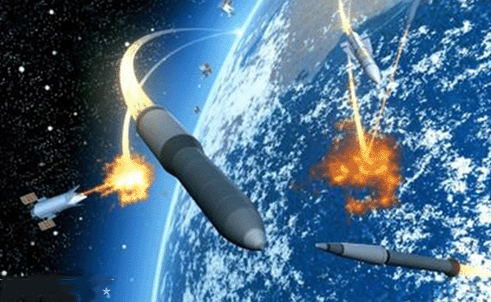 Star Wars Redux: Trump’s Space Force, Counter Punch Craig Eisendrath, who had been a U.S. State Department officer involved in its creation, notes that the Soviet Union launched the first space satellite, Sputnik, in 1957 and “we sought to de-weaponize space before it got weaponized…to keep war out of space.”
Adopted by the UN General Assembly in 1966, The Outer Space Treaty entered into force in 1967. It has been ratified or signed by 123 nations.
It provides that nations “undertake not to place in orbit around the Earth any objects carrying nuclear weapons or any other kinds of weapons of mass destruction, install such weapons on celestial bodies, or station such weapons in space in any other manner.”
Atomic physicist Edward Teller, the main figure in developing the hydrogen bomb and instrumental in founding Lawrence Livermore National Laboratory in California, pitched to Ronald Reagan, when he was governor of California visiting the lab, a plan of orbiting hydrogen bombs which became the initial basis for Reagan’s “Star Wars.” The bombs were to energize X-ray lasers. “As the bomb at the core of an X-ray battle station exploded, multiple beams would flash out to strike multiple targets before the entire station consumed itself in in a ball of nuclear fire,” explained New York Times journalist William Broad in his 1986 book Star Warriors.
Subsequently there was a shift in “Star Wars” to orbiting battle platforms with nuclear reactors or “super” plutonium-fueled radioisotope thermoelectric generators on board that would provide the power for hypervelocity guns, particle beams and laser weapons.
The rapid boil of “Star Wars” under Reagan picked up again under the administrations George H. W. Bush and son George W. Bush. And all along the U.S. military has been gung-ho on space warfare.
A U.S. Space Command was formed in 1982.
“US Space Command—dominating the space dimension of military operations to protect US interests and investment. Integrating Space Forces into war-fighting capabilities across the full spectrum of conflict,” it trumpeted in its 1998 report Vision for 2020. It laid out these words to resemble the crawl at the start of the Star Warsmovies. The U.S. Space Command was set up by the Pentagon to “help institutionalize the use of space.” Or, as the motto of one of its units declares, to be “Master of Space.”
Vision for 2020states, “Historically, military forces have evolved to protect national interests and investments-both military and economic.” Nations built navies “to protect and enhance their commercial interests” and during “the westward expansion of the United States, military outposts and the cavalry emerged to protect our wagon trains, settlements and railroads. The emergence of space power follows both of these models. During the early portion of the 2lst Century, space power will also evolve into a separate and equal medium of warfare.”
“It’s politically sensitive, but it’s going to happen,” remarked U.S. Space Command Commander-in-Chief Joseph W. Ashy in Aviation Week and Space Technology (8/9/96):
“Some people don’t want to hear this, and it sure isn’t in vogue, but—absolutely—we’re going to fight in space. We’re going to fight fromspace and we’re going to fight intospace…. We will engage terrestrial targets someday—ships, airplanes, land targets—from space.”
Or as Assistant Secretary of the Air Force for Space Keith R. Hall told the National Space Club in 1997: “With regard to space dominance, we have it, we like it and we’re going to keep it.”
The basic concept of the Pentagon’s approach to space is contained in The Future of War: Power, Technology & American World Dominance in the 2lst Century. Written by “arms experts” George and Meredith Friedman, the 1996 book concludes: “Just as by the year 1500 it was apparent that the European experience of power would be its domination of the global seas, it does not take much to see that the American experience of power will rest on the domination of space. Just as Europe expanded war and its power to the global oceans, the United States is expanding war and its power into space and to the planets. Just as Europe shaped the world for a half a millennium [by dominating the oceans with fleets], so too the United States will shape the world for at least that length of time.”
Or as a 2001 report of the U.S. Space Commission led by then U.S. Secretary of Defense Donald Rumsfeld asserted: “In the coming period the U.S. will conduct operations to, from, in and through space in support of its national interests both on the earth and in space.”……. https://www.counterpunch.org/2018/06/22/star-wars-redux-trumps-space-force/
A deadly serious French farce — Beyond Nuclear International

The French nuclear fiasco at Flamanville
via A deadly serious French farce — Beyond Nuclear International
Warning on dangerous future for the world, if the Iran nuclear deal collapses
Dreadful’ future awaits world if nuclear deal collapses: Iran’s Salehi, http://www.presstv.com/DetailFr/2018/06/22/565761/Salehi-Oslo-Forum-JCPOA-US Iran’s nuclear chief says the Middle East and the entire world will face a “dreadful” future if a 2015 multilateral nuclear agreement Tehran signed with the P5+1 group of countries falls apart.
Head of the Atomic Energy Organization of Iran (AEOI) Ali Akbar Salehi made the remarks on Friday in an address to an expert panel held on the sidelines of the Oslo Forum in the presence of Norwegian and Omani foreign ministers.
He said the international community showed a severe reaction to the United States’ “unwise and baseless” decisions, including its move to withdraw from the nuclear agreement, officially known as the Joint Comprehensive Plan of Action (JCPOA).
“If the European Union and other countries supporting the JCPOA do not demonstrate their practical opposition to the US policies in due time, they will face a dreadful future and unprecedented insecurity in the region and the world because of the JCPOA’s collapse,” AEOI chief said.
US President Donald Trump announced on May 8 that Washington was walking away from the nuclear agreement, which was reached between Iran and the five permanent members of the UN Security Council – the United States, Britain, France, Russia and China – plus Germany.
Trump also said he would reinstate US nuclear sanctions on Iran and impose “the highest level” of economic bans on the Islamic Republic.
Under the JCPOA, Iran undertook to put limits on its nuclear program in exchange for the removal of nuclear-related sanctions imposed against Tehran.
Since the US president pulled Washington out of the historic nuclear deal, European countries have been scrambling to ensure that Iran gets enough economic benefits to persuade it to stay in the deal. The remaining parties have vowed to stay in the accord.
In a phone call with his French counterpart, Emmanuel Macron, on June 12, Iranian President Hassan Rouhani said the Islamic Republic will quit the multilateral nuclear agreement if it does not benefit from the deal after the US pullout.
“If Iran cannot enjoy the agreement’s benefits, it will be practically impossible to stay in it,” Rouhani said.
Elsewhere in his address, Salehi stressed the importance of holding dialogue among key regional players and once again reaffirmed the Islamic Republic’s readiness to help solve crises based on diplomatic approaches.
The Norwegian Foreign Ministry said on Wednesday that Oslo supports efforts by the European Union to safeguard the Iran nuclear deal, amid the bloc’s promises that it will protect it following the US withdrawal from it.
Oslo backs efforts by the EU to maintain the JCPOA, the Norwegian Foreign Ministry said after a meeting between Salehi and the Norwegian foreign minister, Ine Eriksen Søreide, in Oslo.
Small Modular Nuclear Reactors are NOT going to save the nuclear industry
 The future of nuclear power in the US is bleak http://thehill.com/opinion/energy-environment/393717-the-future-of-nuclear-power-in-the-us-is-bleak, BY M. V. RAMANA, 06/23/18 Presumably as a way to fulfill election promises, President Trump has ordered the use of emergency federal powers designed for war-time crises to financially prop up coal and nuclear power plants.
Nuclear power that was once advertised as being “too cheap to meter” has evidently become too costly for electric utilities to buy. Apart from two 1,000 megawatt reactors being constructed in Georgia at enormous expense to ratepayers (even after subsidies from tax payers), there are no immediate prospects for new nuclear power plants in the United States. What of the longer-term future?
Why SMRs? According to promoters of these scaled-down reactors, they could solve the multiple challenges faced by nuclear power. SMR developers promise lowered costs, decreased production of radioactive waste, reduction or even elimination of the risk of severe accidents, and no contribution to nuclear proliferation. Dozens of companies claim to be developing their own SMR designs, and many have received funding from wealthy private investors and the U.S. Department of Energy.
However, there is little to suggest SMRs will somehow magically remedy all that ails the nuclear industry. SMRs, as the name suggests, produce relatively small amounts of electricity in comparison with currently operational reactors. This puts them at a disadvantage.
One known way to reduce the cost of nuclear electricity has been to build larger reactors because the expenses associated with constructing and operating a reactor do not increase in direct proportion to the power generated. SMRs will, therefore, cost more than large reactors for each unit of generation capacity. Most of the small reactors built in the United States shut down early because they couldn’t compete economically.
SMR proponents argue that they can compensate by savings through mass manufacture in factories and learning how to hold down costs from the experience of constructing lots of reactors. This is a dubious assumption: In both the United States and France, the two countries with the highest numbers of nuclear plants, costs went up, not down, with construction experience.
Even if one were to assume that such “learning” actually occurs, SMRs have to be manufactured by the thousands to achieve meaningful savings. There is simply no market for so many reactors.
Even Westinghouse, the company that has directly or indirectly designed the majority of the world’s nuclear reactors, has realized that there is no market. For a decade or more, Westinghouse pursued a SMR design. But, in 2014, the company abandoned that effort. Its CEO explained: “The problem I have with SMRs is not the technology, it’s not the deployment — it’s that there’s no customers.” Few or no customers means no one would, or should, want to build a factory to construct the modules constituting these SMRs.
What of the claims about safety and nuclear waste? The problem is that the technical demands posed by these different goals conflict with one another, forcing reactor designers to make impossible choices.
For example, safety can be improved by making reactors smaller. But, a smaller reactor, at least the water-cooled reactors that are most likely to be built earliest, will produce more, not less, nuclear waste per unit of electricity they generate because of lower efficiencies. With no long-term solution in sight for nuclear waste, accumulating more radioactive spent fuel aggravates the storage problem.
The poor economic outlook for SMRs also affects safety. Companies that market SMRs propose placing multiple reactors in close proximity to save on costs of associated infrastructure. But this would increase the risk of accidents or the impact of potential accidents on the surrounding population.
At Japan’s Fukushima nuclear complex, explosions at one reactor damaged the spent fuel pool in a co-located reactor. Radiation leaks from one unit made it difficult for emergency workers to approach the other units.
The future of nuclear power in the United States, and indeed in much of the world, is bleak. Small modular reactors will not change that prognosis. There is no point in wasting public money on promoting them.
M. V. Ramana is the Simons chairman in Disarmament, Global and Human Security at the School of Public Policy and Global Affairs, University of British Columbia and the author of “The Power of Promise: Examining Nuclear Energy in India.”
1 This Month
Chernobyl: The Lost Tapes – A good documentary on Chernobyl on SBS available On Demand for the next 3 weeks– https://www.sbs.com.au/ondemand/tv-program/chernobyl-the-lost-tapes/2352741955560

of the week–London Campaign for Nuclear Disarmament

Tell the Ukrainian Government to Drop Prosecution of Peace Activist Yurii Sheliazhenko
To see nuclear-related stories in greater depth and intensity – go to https://nuclearinformation.wordpress.com
-
Archives
- April 2026 (126)
- March 2026 (251)
- February 2026 (268)
- January 2026 (308)
- December 2025 (358)
- November 2025 (359)
- October 2025 (376)
- September 2025 (257)
- August 2025 (319)
- July 2025 (230)
- June 2025 (348)
- May 2025 (261)
-
Categories
- 1
- 1 NUCLEAR ISSUES
- business and costs
- climate change
- culture and arts
- ENERGY
- environment
- health
- history
- indigenous issues
- Legal
- marketing of nuclear
- media
- opposition to nuclear
- PERSONAL STORIES
- politics
- politics international
- Religion and ethics
- safety
- secrets,lies and civil liberties
- spinbuster
- technology
- Uranium
- wastes
- weapons and war
- Women
- 2 WORLD
- ACTION
- AFRICA
- Atrocities
- AUSTRALIA
- Christina's notes
- Christina's themes
- culture and arts
- Events
- Fuk 2022
- Fuk 2023
- Fukushima 2017
- Fukushima 2018
- fukushima 2019
- Fukushima 2020
- Fukushima 2021
- general
- global warming
- Humour (God we need it)
- Nuclear
- RARE EARTHS
- Reference
- resources – print
- Resources -audiovicual
- Weekly Newsletter
- World
- World Nuclear
- YouTube
-
RSS
Entries RSS
Comments RSS
 nuclear-news