UK govt’s new funding of nuclear projects contrasts with its lack of support for renewable project in Wales
NFLA 5th June 2018 , The Nuclear Free Local Authorities (NFLA) is very disappointed, but not at
all surprised, with the announcement by UK Energy Minister Greg Barker to
offer £5 billion of taxpayer money to assist with the funding of the Wylfa
B new nuclear reactor in Anglesey.
Whilst going against years of previous
government policy, it also compares unfavourably with the expected lack of
Government support of an exciting new renewable energy project in Wales –
the proposed development of the Swansea tidal lagoon scheme, and future
projects planned in Cardiff Bay and off the north Wales coast.
At present this scheme looks to be on a life support machine, though the Government
delayed the expected announcement to ditch the project and the thousands of
jobs that could be created.
http://www.nuclearpolicy.info/news/wylfa-b-swansea-bay-tidal-lagoon-developing-low-carbon-energy-solutions/
Bangkok restaurants stop serving fish recently imported from Fukushima Pref
. (Mainichi Japan)
FUKUSHIMA — Eleven Japanese restaurants in the Thai capital of Bangkok have stopped serving imported fish caught off the coast of the Fukushima prefectural city of Soma, the prefectural government here said on March 12.
The decision of each restaurant came following fears that they might experience a backlash and a reduction in customer numbers — fueled by citizen group protests that have spread online — even though Thailand does not restrict the import of goods from Fukushima Prefecture…….https://mainichi.jp/english/articles/20180313/p2a/00m/0na/002000c
Call to stop the persecution of whistleblower Julian Assange
 US activist Kevin Zeese calls for demonstrations against the persecution of Julian Assange https://www.wsws.org/en/articles/2018/06/06/zees-j06.html 6 June 2018
Kevin Zeese, a prominent US activist and lawyer, issued the following statement this week endorsing action in defense of Julian Assange, including the June 17 rally in Sydney and vigils in London and around the world on June 19.
Zeese has spoken out against the escalating censorship of the Internet and the broader erosion of democratic rights. He is a co-director of the Popular Resistance organisation and is on the advisory board of the Courage Foundation which raises funds for the defence of persecuted journalists and whistleblowers.
Statement of Kevin Zeese endorsing protests and vigils in defense of Julian Assange
Julian Assange through his work as editor of WikiLeaks has made major strides toward democratizing the media by creating a vehicle for whistleblowers to share the truth and correct the misinformation of the mass corporate media. Assange and WikiLeaks have given people a precious tool—access to the undeniable truth about what governments and big business are doing. This is a tool we can all use to educate each other about what is really going on around us.
Assange is being persecuted because a democratized media threatens the monopoly over media control of the elites. A democratized media makes it more difficult for them to misinform, mislead and propagandize.
Through WikiLeaks, Assange with whistleblowers like Edward Snowden and Chelsea Manning have exposed war crimes, the truth about the Guantanamo Bay prison, the corporate domination of US policy and the actions of governments around the world and more. This has led to popular revolts around the world that have challenged those who abuse their power.
Freedom of speech and freedom of the press is being defined by the treatment of Julian Assange. Everyone who cares about these freedoms should speak out and take action on his behalf by joining the demonstration in Sydney, Australia on June 17 and the vigils being held in London and around the world on June 19—the anniversary of when Julian sought asylum in the Ecuadorian embassy six years ago. On June 19 at 11:00 a.m. we will be holding a protest in support of Julian Assange at the White House. Please join us to call for an end to his persecution.
Kevin Zeese, co-director of Popular Resistance, member of the advisory board of the Courage Foundation
Opposition to shipping nuclear wastes into Idaho for “temporary” storage

Speakers oppose nuclear waste shipments https://magicvalley.com/news/local/speakers-oppose-nuclear-waste-shipments/article_f7e16017-6629-5152-a73e-5404b61211d8.html TIMES-NEWS TWIN FALLS. 6 June 18 — City Councilman Chris Talkington and Buhl farmer James Reed will speak Friday against the shipments of nuclear waste through Idaho.
Idaho was the nation’s nuclear waste dump until Gov. Phil Batt in 1995 negotiated an end to the practice, by limiting the time nuclear waste can stay in Idaho. But that agreement is now at risk, says the Snake River Alliance, Idaho’s nuclear watchdog. … people are expected to turn out Friday at the Twin Falls Visitor Center in opposition of the U.S. Department of Energy’s plan to ship 7,000 cubic meters of nuclear waste from Hanford, Wash., to Idaho National Laboratory, a nuclear research site near Arco on top of the Eastern Snake Plain Aquifer.
Japan High School Peace Envoys Keen to Deliver Voices of Hibakusha

https://jen.jiji.com/jc/eng?g=eco&k=2018060701223
Tokyo, (Jiji Press), 7 June 18, –Japanese “high school peace ambassadors” on Thursday expressed their hopes to convey the voices of hibakusha, or atomic bomb survivors, for nuclear abolition to the world, and spread peace across the globe.
The high school students, who took part in a campaign to collect signatures with the aim of abolishing nuclear weapons, have been selected as a candidate for the Nobel Peace Prize for 2018.
At an event in Tokyo on Thursday to report the peace ambassador activities, Konami Funai, 17, a high school third-grader from Fukuyama, Hiroshima Prefecture, western Japan, spoke about her visit to the secretariat of the Norwegian Nobel Committee in March.
“It made me even prouder of our activities,” she said, referring to the nomination as a Nobel prize candidate. But Funai added that even if they win the prize, it would not be their goal. “I’ll patiently continue to call for nuclear abolition.”
The high school peace ambassadors were nominated a Nobel Peace Prize candidate by the Norwegian committee, after Japanese lawmakers recommended them for the award with the campaign marking its 20th anniversary this year.
As costs of renewable energy continue to fall, UK’s Hinkley and Wylfa nuclear power projects look more and more financially risky
Current News 5th June 2018 The UK’s renewables lobby has scrutinised the government’s decision to
directly invest billions of pounds in Hitachi’s proposed nuclear project,
suggesting renewables to be a far cheaper and quicker way of decarbonising
the country’s power.
Yesterday energy secretary Greg Clark confirmed to
parliament that the government had entered into negotiations with
Hitachi’s nuclear unit Horizon Nuclear Power over the proposed
development of a 2.9GW nuclear facility in north Wales. But rather than
leave the development risk with third parties like it has with Hinkley
Point C and EDF, the government is discussing the prospect of directly
investing billions of pounds into the project in what constitutes a
significant U-turn in government policy.
Nina Skorupska, chief executive of the Renewable Energy Association, responded to the news by stating that the
government needed to “carefully consider” the value for money argument
before intervening. “Hitachi’s struggles to fund the project privately
represent one of the great challenges facing the nuclear industry, that it
is highly complex and costly to design, build, operate and maintain a
nuclear power station,” she said.
Furthermore, Skorupska added that as
the cost of renewables like solar and wind continues to fall, they stand to
be better suited to the wider nuances the energy transition presents.
“The costs of renewables are falling all the time whilst the clean
technology sector continues to set records for generation, it is much
quicker and cheaper to build an energy from waste, solar, wind or biomass
plant than continue to pursue nuclear investment. Research shows that in
the future the inflexible properties of nuclear will also become a
liability to the system rather than an asset as it cannot respond quickly
enough to changes in demand and supply on the system.”
EDF looks to a profitable industry in decommissioning nuclear reactors

Nuclear Energy Insider 6th June 2018 , As France’s EDF expands into new decommissioning markets, learnings at the
group’s first pressurized water reactor dismantling is informing new cutting, tooling and waste strategies.
A new partnership agreement between EDF’s decommissioning subsidiary Cyclife and Sweden’s Fortum highlights
EDF’s aim to become a leader in the European nuclear decommissioning space.
Cyclife and Fortum announced May 30 they will jointly develop services in
nuclear decommissioning and waste management, focusing on the Nordic
region. European nuclear decommissioning activity is on the rise as ageing
fleets and energy policy shifts combine with stubbornly-low wholesale power
prices. By 2020, some 150 European reactors will have reached a 40-year
lifespan.
https://analysis.nuclearenergyinsider.com/edf-ramps-nuclear-decommissioning-efficiency-eyes-europe
Nuclear: Finally a parliamentary debate on the safety of fuel pools
Greenpeace Belgium 5th June 2018 , Nuclear: Finally a parliamentary debate on the safety of fuel pools.
 Greenpeace is pleased that the Subcommittee on Nuclear Safety has decided
to discuss the report “The safety of nuclear reactors and fuel storage
pools in France and Belgium and the related reinforcement measures” [1],
commissioned by the environmental protection association to 7 independent
international experts and sent last October to the competent authorities.
Only children close their eyes to remove a danger,” said Eloi Glorieux,
nuclear expert at Greenpeace and one of the three speakers of the
Subcommittee of the day. “That our MPs behave as adults and debate nuclear
security today, we can only rejoice.
It is now necessary for Engie-Electrabel to do the same and to take the appropriate measures to
better protect the power stations against external attacks. ” In October,
for security reasons, Greenpeace sent the full report only to the
Director-General of the Crisis Center, the director of the FANC and the
Minister of the Interior and Security, Mr. Jambon. In order to fuel the
public debate, the association had called for a parliamentary debate on the
content of the report. It will have taken months before it can be done,
after the members of the Subcommittee were able, under strict conditions,
to consult the report.
http://www.greenpeace.org/belgium/fr/presse/Nucleaire-Enfin-un-debat-parlementaire-sur-la-securite-des-piscines-de-combustibles/
Trump’s nationalisation of the nuclear energy marketplace could cost U.S. consumers up to $17 billion a year
 NIRS 6th June 2018 The controversial Trump Administration plan to nationalize the nuclear
energy marketplace could cost U.S. consumers up to $17 billion a year in
artificially high electricity bills, with the prospect of extensive
coal-fired power plant subsidies potentially doubling that figure.
Further, the bailouts of nuclear and coal could trip up America‘s renewables
industry, leaving the U.S. even further behind in the global race for clean
energy technology development and deployment, according to three experts
participating in a news conference today.
Today, the Nuclear Information & Resource Service (NIRS) updated and expanded the nuclear bailout costs
estimated in its November 2016 report that concluded that federal handouts
for nuclear alone could add up to $280 billion to electricity bills by
2030. A bailout of coal-fired power plants would leave ratepayers and
taxpayers holding the bag for even more. NIRS estimates that the current
Trump bailout scheme could cost consumers $8-$17 billion for just the
nuclear element and as much again for coal subsidies.
https://www.nirs.org/press/experts-nuclear-bailout-could-cost-up-to-17-billion-a-year-and-destroy-renewables-industry-in-u-s/
Study: Cesium from Fukushima flowed to Tokyo Bay for 5 years

Japan asks Philippines to lift ban on Fukushima products

PART 2: Radioactive water at Fukushima Daiichi: What should be done?
DOES THE PUBLIC HAVE A SAY?
For their part, representatives of the government and TEPCO I have spoken with invariably stress how important it is to them to reach understand and agreement with all stakeholders, the Fukushima fisheries coops in particular, and to respond to their concerns in the decision-making process. They say they are fully prepared to accommodate the fishermen’s desires regarding the quantity and timing of releases, how they will be monitored, and how to adjust the release parameters in response to what is found after the system begins operation. And although when I point out that concern is not limited to fishermen in Fukushima, but that coops in Miyagi and Iwate, as well as Ibaragi and Chiba also consider themselves stakeholders, and that in fact residents internationally along the entire Pacific rim have already expressed concern, officials voice agreement but cannot point to any concrete efforts to communicate with or include anyone outside of Fukushima or the Tokyo power centers. In the same way, the concerns of major food distributors such as supermarket chains, who ultimately make the decision whether or not to purchase and sell Fukushima marine products nationwide, do not seem to be being addressed.
Shuji Okuda, METI’s Director for Decommissioning and Contaminated Water Management, Nuclear Accident Response Office, Agency for Natural Resources and Energy, stressed that no decision has yet been made which of the five options for dealing with the tritiated water detailed in the 2016 Task Force report will be chosen. In other words, although TEPCO, government ministries, and stakeholders are proceeding as if it’s a done deal, no-one with decision-making power has yet made a decision. “It will be a decision of the Japanese Government as a whole,” Okuda explains, “not one made by any single agency. And it will be based on ample discussions with all stakeholders.” Since the release of the Task Force Report in 2016, METI has been discussing the social impacts quite a lot, he noted. They are particularly concerned about “damaging rumors”- fuhyo higai – that will result from any tritiated water release, and have been discussing how to counter them. He continues, “Because the risks have been demonstrated to be very low, it’s less a question of safety, and more one of potential public reaction and reputational damage. We plan to hold further discussions with stakeholders and the general public to increase understanding.” Regarding international communication efforts, he points to English-language materials and reports the ministry releases, but says that since any impacts will involve primarily Japanese local area, information dissemination overseas is limited to experts, administrative officials and some media.”
METI recently announced that meetings will be held where the public can hear explanations of proposed solutions and comment on them. The Subcommittee on Handling Water Treated by the Polynuclide Removal Facility is one of several Japanese government committees organized by METI tasked with formulating a response to the problem of the radioactive water. The planned public sessions were announced at its eighth meeting, on Friday, May 18th. This is a step in the right direction, and is long overdue. Nevertheless it may well be a case of “too little, too late.”
METI, Subcommittee on handling water treated by the polynuclide removal facility, 8th meeting May 18, 2018 (Report regarding upcoming public hearings on tritiated water problem – in Japanese)
Good public communication about the release plan, the ocean science it involves, and what the expected risks are and why, cannot by themselves guarantee public acceptance. But this kind of communication is essential, particularly with such a globally contentious and high-profile issue like releasing radiation into the ocean. The public needs to know the environmental effects, health effects, how it will be monitored, what transparency measures are in place, what the process for adjustment and revision will be. Almost two years have elapsed since the Tritiated Water task Force released its recommendations, and a broad and energetic stakeholder engagement and information effort should have been ongoing since then. But such efforts are now only in the planning stage. It seems that METI and other ministries have been paralyzed, faced with taking responsibility for a politically damaging decision, forced to acknowledge that they support the plan but unable to take concrete steps to implement it or prepare the public. TEPCO, while it accepts its responsibility for the decision, seeks full government support, including robust public communication efforts. It seems extremely unlikely to act without a clear government decision in favor of the release and stipulating its timing. We should be prepared for the government to remain paralyzed until the last possible moment, when crisis is imminent, and then to announce a decision suddenly, justifying it by saying that time has run out and that it “can’t be helped.” As a colleague pointed out, this is, unfortunately, the Kasumigaseki way.*
When asked what the official position of TEPCO was regarding the plan to release the water, Kohta Seto of TEPCO’s Communication Development, Fukushima Daiichi Decontamination and Decommissioning Engineering Company, replied, “We recognize that comprehensive examination of technical and social factors is ongoing currently at the national subcommittee. Our response policy will be made in consultation with the government and related stakeholders based on the subcommittee’s discussions.” This echoes METI’s assertion that no decision has actually been made. But in fact the Tritiated Water Task Force, the subcommittee referred to, has been dormant for over a year, and any further recommendations will come from the higher-level METI Contaminated Water Countermeasures Committee and from the NRA.
Others at TEPCO have acknowledged that the company feels ultimately responsible, and is confronted with a decision that could further damage others. Takahiro Kimoto, General Manager, Nuclear Power & Plant Siting Division, Fukushima Daiichi D&D Engineering Company, notes that under the existing plan and at the current rate, by 2020 there will be no more space to store additional tritiated water onsite at Daiichi. Constructing the dilution facilities and pipelines that the release would require is expected to require almost a year of preparation after any decision is made. At the current rate, that means the “go” signal must be given by early 2019 at the latest. Though TEPCO expects that measures such as the frozen wall and subdrain pumps will continue to reduce the amount of treated water that needs to be stored, nevertheless they recognize that there is a narrowing window for decision and action. The company has no plans to try to obtain land offsite to further expand tank space, which could provide an additional margin of time. Though feasible technically and cost-wise, this would be a stopgap measure that merely delays the decision to deal with the tritium more permanently by the other means already being considered. Kimoto explained that the company does not want to act independently. “The policies can’t and shouldn’t be determined by TEPCO alone, but we continue discussing the available options with government and other stakeholders. How much to empty the tanks, how that should be done to minimize environmental consequences, how to maintain trust and transparency, who we need to engage with on this matter, these are all issues we seek stakeholder engagement on. These discussions are taking a long time, but we consider them essential.” Put bluntly, TEPCO knows they will be the bad guys in this scenario no matter what, and prefer to have as broad support as possible.
TRANSPARENCY
I initially approached this issue as one of transparency and the need to include a broadly-defined base of stakeholders in the decision-making process and subsequent monitoring of the results. That has been experience of SAFECAST, which prioritizes transparency and impartiality, and tries to get as many people involved in environmental monitoring and decision-making as possible, with unprecedented positive results. We have seen similar benefits where citizen groups in Japan monitor food and their own environments, and seek and often gain a vital voice in decisions that affect them. The Fukushima fisheries coops, TEPCO, and METI all said they would welcome transparent, independent, ongoing third-party monitoring of seawater and marine life if and when the tritiated is released. TEPCO and METI say they understand the need for transparency, and are prepared to change their institutional cultures in order to better accommodate it. Okuda of METI observed, “Having accurate data available to the public won’t by itself ensure adequate understanding, but in the end it is essential.”
Based on many conversations, however, I’m not sure enough people in these organizations fully grasp what true transparency means. Dr. Ken Buesseler of Woods Hole Oceanographic Institution, who has been monitoring Fukushima radiation effects in the ocean since immediately after the start of the disaster, started a very effective crowdsourced program to monitor radiation in the Pacific Ocean along the North American coast. He has long complained of the difficulty of getting adequate access to ocean zones close to Daiichi for scientific research. Regarding the need for transparency and independent monitoring he says, “When I talk about independent monitoring, I don’t mean JAEA or IAEA, or other big government-connected institutions, but universities, NGO’s, and other independent research labs.” He adds, “Even before the decision to release the water is made, someone should get a detailed accounting for what is in each tank for all of the radionuclides of concern, not just that they are below detection (using high thresholds), as the large volume of water means even seemingly small amounts add up. This needs to be independent of TEPCO or whoever is in charge of dumping.”
Buesseler and others share my opinion that robust and effective communication is essential, not to persuade the public that official plans are acceptable, but to better equip them to participate in the debate in an informed way, and to push back where they feel it is necessary. More effort should be made in communicating in general, and this requires a better-educated and more scientifically literate public, which means ongoing efforts that begin years before crisis renders it necessary. Independent groups should be involved in interpreting data and presenting the results in a way which does not damage their independence. It may be necessary to set funds for this aside where they cannot be controlled by government or industry. In the case of the tritiated water at Daiichi, though this kind of transparency and engagement will be essential, it will need to be accompanied by appropriate communication efforts. Those responsible for this should not underestimate the challenge or think it can effectively be rolled out in a short period of time.
According to METI, the content, location, and timing of the upcoming public sessions will be discussed at the next subcommitee meeting in July. People unable to attend in person will be able to submit comments and questions via email. Though hastily-planned events could possibly be held before the end of this year, it seems likely they will need to happen in 2019, bumping up against the decision deadline. While some fishermen are likely to attend, the cooperatives themselves will likely refuse. This situation requires the actual involvement of citizens in the decision making process, but it is difficult to find instances of that actually happening in Fukushima since the accident in 2011. At the central government level in particular, it has almost always been DAD — “Decide, Announce, Defend.” Government planners must think seriously about how prevent this from becoming just another clumsy photo-op, a fig leaf that will allow the government to claim it has adequately consulted the public.
A FINAL WORD
Regardless of whether one trusts scientific opinion or TEPCO, the tritiated water cannot be left in the tanks at Daiichi indefinitely, and releasing it to the ocean, though not without risk, is the least objectionable of the available options. As it stands now, given the depth of public mistrust and the nature of misinformation in our current era, the situation is ripe for the maximum misunderstanding and negative social impact to occur if and when this tritiated water is finally released. Unfortunately, I think we should be prepared for things to be done the “Kasumigaseki way,” with much insincere hand-wringing and expressions of regret. There will be negative social impact no matter what, but unless responsible government officials step up soon, own the decision, and ensure that public engagement is genuine, broad, and effective, these negative impacts will be unnecessarily magnified.
* Kasumigaseki is the part of Tokyo where central government functions are located. It’s similar to Capitol Hill.
Azby Brown
Azby Brown is Safecast’s lead researcher and primary author of the Safecast Report. A widely published authority in the fields of design, architecture, and the environment, he has lived in Japan for over 30 years, and founded the KIT Future Design Institute in 2003. He joined Safecast in mid-2011, and frequently represents the group at international expert conferences.
https://blog.safecast.org/2018/06/part-2-radioactive-water-at-fukushima-daiichi-what-should-be-done/
PART 1: Radioactive water at Fukushima Daiichi: What should be done?

850,000 TONS
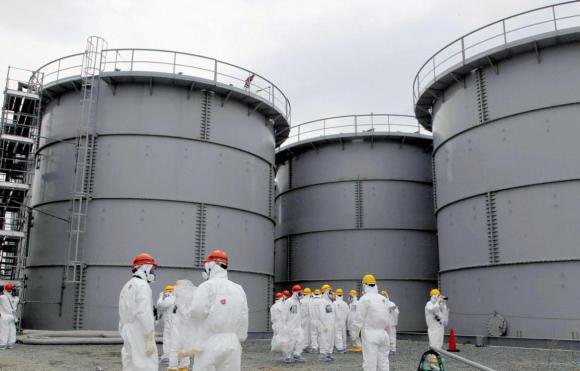
Of all the conflicts and consequences of the Fukushima Daiichi NPP disaster, the contaminated water issue is one of the most complicated, contentious, and potentially long-term. It’s a multifaceted problem ultimately rooted in the influx of groundwater into the damaged reactor buildings. A large volume of water is pumped into and out of the damaged reactors each day to keep them cool. This is treated to remove salt and most radionuclides and recirculated back into the reactors. If there were no additional water leaking into the reactor basements, this could function as an essentially closed loop. But a volume equal to the additional groundwater inflow needs to be removed from recirculation. It too is treated to remove all radionuclides except tritium, a radioactive form of hydrogen known as H-3, and is being stored in the now familiar rows of tanks onsite at Daiichi. A partially effective underground dam of frozen earth, together with a system of subdrain pumps, has reduced the volume necessary to be removed from about 400 cubic meters per day to about 150-200 cubic meters (though appreciably more when it rains heavily). About 850 large tanks now hold 850,000 tons of tritiated water, and TEPCO says that it will run out of space to store additional water onsite by 2020, so something must be done soon. As far back as 2014, the IAEA recommended a controlled release of this water to the ocean as the safest course of action, and Japan’s Nuclear Regulation Agency (NRA) has made similar recommendations. A Tritiated Water Task Force convened by METI in 2013 examined five options in detail, including evaporating it and releasing it into the atmosphere, releasing it into the atmosphere as hydrogen gas, injecting it into deep geologic strata, storing it underground, and diluting it and discharging it into the ocean. For reasons of cost, available technology, time required, and safety, in its final report issued in June, 2016, the task force concluded that ocean discharge was the least objectionable approach. TEPCO has made it clear that this is its preference as well, and in July of last year Takashi Kawamura, chairman of Tokyo Electric Power Company Holdings, Inc., said publicly that the decision to release the tritiated water had already been made. Many people were alarmed, particularly Fukushima fishermen who expected to be consulted, and the company backpedalled immediately. So far no decision has been officially announced. The reason for the delay in the decision is the very reasonable expectation of a strong public backlash. Meanwhile the window for the decision to be made is rapidly closing.
METI Tritiated Water Task Force Report, June 2016 (English version)
Preliminary Summary Report: IAEA International Peer Review Mission On Mid-And-Long-Term Roadmap Towards The Decommissioning Of Tepco’s Fukushima Daiichi Nuclear Power Station Units 1-4
(Third Mission), Feb. 2015
Japan Times: Regulator urges Tepco to release treated radioactive water from damaged Fukushima No. 1 nuclear plant into the sea, Jan. 11, 2018
Japan Times: Fukushima’s tritiated water to be dumped into sea, TEPCO chief says, July 14, 2017
TEPCO: Response to the article about the release of tritiated water into the ocean, July 14, 2017
Asahi Shimbun: New TEPCO executives tripping over their tongues, July 20, 2017
OPPOSITION
The strongest and most meaningful opposition comes from Fukushima’s fisheries cooperatives, which have suffered tremendously due to the disaster. Not only were their ports and fishing fleets destroyed by the tsunami, but the market for their fish collapsed after the sale of 44 marine species was prohibited by the Japanese government in 2011 due to radioactive contamination. The public seems largely unaware that in the years since the bans were initiated, the percentage of Fukushima marine products exceeding the 100 Bq/kg allowable level of radioactive cesium has decreased rapidly, and has actually been zero since 2015. People are right to be skeptical of this, perhaps, but it has been confirmed by official testing, by independent researchers, and by testing done by independent citizen groups. Testing is done for each marine variety on a fishing ground-by-fishing ground basis, and as they have gradually been demonstrated to meet the requirements, 34 of the 44 initially banned seafood varieties have been allowed back on the market. Thanks to incrementally improving consumer confidence, the market for Fukushima seafood has slowly improved. The Fukushima fisheries coops justifiably fear that if the tritiated water is released to the ocean, the resulting consumer backlash will totally destroy their livelihoods once again.
Fukushima Prefectural Federation of Fisheries Cooperative Associations
Japan Ministry of Agriculture, Forestry, and Fisheries (MAFF): Results of the monitoring on radioactivity level in fisheries products: Summary of Monitoring on fishery products (As of Mar. 31, 2018)
METI has jurisdiction over contaminated water releases from nuclear reactors like Daiichi because it is responsible for overseeing energy production systems as a whole, including accident consequences. The NRA, which is part of the Environment Ministry, has specific jurisdiction for nuclear power, and its evaluations and guidance are also important. But ultimately the decision of whether or not to release the tritiated water is TEPCO’s. A company spokesman explained to me recently that government guidelines and recommendations are taken very seriously, and that the company goes to great lengths to meet government expectations. But ultimately these recommendations are non-binding. TEPCO hopes to get the green light from METI and the NRA, and all of them have been delaying their decisions in the hopes that the approval of the fisheries coops can be obtained as well.
On the face of it, this hope is not totally unfounded, as there is an important precedent. The fisheries coops have been approving the release of water from two specific sources onsite at Daiichi for several years. One is a bypass system uphill of the reactors that intercepts groundwater before it reaches the reactor area. The other is a subdrain system that pumps water from the area around the reactors. In both cases, the water has relatively low levels of radioactive contamination, and is treated to remove radionuclides and then tested by TEPCO and third-parties (JAEA and the Japan Chemical Analysis Center). If the radioactivity is lower than TEPCO’s self-imposed target levels of 1 Bq/L each for Cs137 and Cs134, 5 Bq/L for Gross beta (including strontium), and 1500 Bq/L for tritium — all of which are many times lower than the limits for drinking water set by the WHO — the fisheries coops agree to its release. This agreement has been in place since 2014 for the bypass water, and since 2015 for the subdrain water. It appears to have been functioning smoothly, with over 350,000 tons of bypass water and about 500,000 tons of subdrain water released so far. The participation of third-parties in the monitoring has been the key to gaining trust in the measurements.
TEPCO – Water Discharge Criteria for Groundwater Bypass, February 3, 2014
TEPCO – Groundwater pump-up by Subdrain or Groundwater drain
WE’VE BEEN HERE BEFORE
The tritium in the tanks at Daiichi is much more radioactive than the subdrain or bypass water, however. The concentration levels of tritium in the tanks ranges from about 0.5 to 4 million Bq/L, a total of about 0.76 PBq (trillion Bq) in all. No decision has been made about how much is likely to be released per day, but technical and cost estimates have been based on 400 cubic meters (tons) per day, roughly equal to the maximum daily inflow of groundwater. It is expected that releases would continue for about five years. Under the scenarios being discussed, the water would be diluted to 60,000 Bq/L before being released to the ocean. This number alone seems alarming, but is the concentration level that has been legally allowed to be released from Japanese nuclear power plants and reprocessing facilities such as Tokaimura for decades. The science regarding what is likely to happen to the tritium in terms of dispersal by ocean currents and effects on fish and other biota is fairly well understood, primarily because of decades of monitoring done in Japan and near similar facilities abroad, such as Sellafield in the UK and LaHague in France. Data from the French government shows that the LaHague reprocessing plant releases about 12PBq (12 trillion Bq) per year, and the maximum concentration of tritium in the surrounding ocean has been about 7Bq/L. This means that the amount released yearly from LaHague is over 12 times the total being stored at Daiichi, and the daily release rate is over 20,000 times that expected in Fukushima. Dr. Jota Kanda, a professor at the Department of Ocean Sciences, Tokyo University of Marine Science and Technology, observed that the dispersal and further dilution of tritium is rapid, and says, “Based on what we’ve seen at La Hague, it seems likely that under the ocean release scenario being considered now, tritium concentrations in the ocean off Fukushima will not exceed a few Bq/L and will likely remain close to the background level.” Globally, the background levels of tritium in water currently range between 1 and 4 Bq/L, which includes 0.1 to 0.6 Bq/L that is naturally-occurring and more than doubled by tritium remaining from nuclear testing. In oceans, tritium concentration levels at the surface are around 0.1 to 0.2 Bq/L. For comparison, naturally occurring tritium in rainwater in Japan between 1980-1995 was between 0.5- 1.5 Bq/L, and prior to 2011 in Fukushima rivers and tap water was generally between 0.5-1.5 Bq/L. In the US, the EPA standard for tritium in drinking water is 740 Bq/liter, while the EU imposes a limit of 100Bq/L.
Fujita et al, Environmental Tritium in the Vicinity of Tokai Reprocessing Plant. Journal of Nuclear Science and Technology, 44:11, 1474-1480
Matsuura, et al, Levels of tritium concentration in the environmental samples around JAERI TOKAI. Journal of Radioanalytical and Nuclear Chemistry, Articles, Vol. 197, No. 2 (1995)295-307
METI Task Force Report supplement: About the physical properties of tritium,
Yamanishi Toshihiko, 2013
LaHague tritium release data, cited in METI Task Force Report supplement, p6
Radiological Protection Institute of Ireland (RPII): A survey of tritium in Irish seawater, July 2013
IRSN factsheet: Tritium and the environment
Michio Aoyama: Long-term behavior of 137Cs and 3H activities from TEPCO Fukushima NPP1 accident in the coastal region off Fukushima, Japan. Journal of Radioanalytical and Nuclear Chemistry, 2018
Tsumune et al: Distribution of oceanic 137Cs from the Fukushima Dai-ichi Nuclear Power Plant simulated numerically by a regional ocean model. Journal of Environmental Radioactivity 111 (2012) 100-108
Povinec, et al, Cesium, iodine and tritium in NW Pacific waters – a comparison of the Fukushima impact with global fallout. Biogeosciences Discuss., 10, 6377–6416, 2013
Dr. Kanda further explains that biological organisms such as fish have different concentration factors for different radionuclides. When the ambient level of Cs137 in seawater is 1 Bq/L, for instance, some fish species may show values approaching 100 Bq/kg. But for tritium (H3) the ratio is 1:1, and 1 Bq/L in seawater will result in 1Bq/kg in fish. Again, at La Hague, which has had a much higher release of tritium for decades, the concentrations in marine wildlife near the point of release between 1997-2006 has ranged from 4.0 – 19.0 Bq/kg, with a mean of 11.1 Bq/kg. Using this as a guideline, Kanda estimates that even with an ongoing release of 60,000 Bq/L of tritium offshore of Daiichi, the fish a short distance away are unlikely to exceed 1 Bq/kg. This can, and must be, confirmed by conscientious monitoring.
What about health effects to humans? Though the release from Daiichi would be many times smaller than what is ongoing from LaHague or Sellafield, and the levels in the ocean after release seem likely to be close to that in normal rivers and rainwater, it is understandable that people would be concerned about risk. The scientific consensus is that tritium presents a much lower risk than radionuclides such as radioactive cesium, radioactive iodine, or strontium. This is reflected in allowable limits in drinking water which are generally tens or hundreds of times higher for tritium than for these others, ranging from 100 Bq/L in the European Union, 740 Bq/L in the US, 7000 Bq/L in Canada, 30,000 Bq/L in Finland, and 76,103 Bq/L in Australia. The WHO limit for tritium in drinking water is 10,000 Bq/L. Allowable limits in food have in most cases not been established. While these limits reflect a general scientific consensus that tritium presents a very low risk, the wide range of official values suggests scientific uncertainty about how it actually affects the human body.
Canadian Nuclear Safety Commission (CNSC): Standards and Guidelines for Tritium in Drinking Water, 2008
SCIENTIFIC UNCERTAINTY
Because in its most common form, known as HTO, tritiated water behaves almost identically to water, it is eliminated from the human body with a biological half-life of 10 days, the same as for water. But when it is incorporated into living things or organic matter, a fraction of it binds with organic molecules to become organically bound tritium, known as OBT. In this form it can stay in the body for years, and its risks, while assumed to be fairly low, are not fully understood. Dr. Ian Fairlie, a UK-based researcher who has published widely on the risks of tritium exposure, believes that current guidelines underestimate the nuclide’s true risk. Fairlie points out that there is a long-running controversy among experts regarding the risks of OBT, which many believe are higher than official guidelines currently recognize. Many official agencies, like France’s IRSN, have issued reports that recognize these uncertainties, and Fairlie believes that the research findings indicate that the dose from OBT should be increased by a factor of 5 compared to HTO.
Fairlie: Tritium: Comments on Annex C of UNSCEAR 2016 Report, March 14, 2017
IRSN factsheet: Tritium and the environment
In the ocean release scenarios being considered in Fukushima, Fairlie agrees that there will be high levels of dilution. Nevertheless, as the tritium disperses, he says, “It will be found throughout the entire ocean food chain.” The ICRP suggests that 3% of the tritium metabolized from water by marine life becomes potentially riskier OBT, while the IAEA estimates the fraction at 50%. IRSN and others caution that the biological exchange of tritium and other aspects of its action in organisms, such as the effects of exposure on embryos and foetuses, is incomplete. The METI Tritiated Water Task Force report of June 2016 explains that, “When standard values pertaining to radioactive material in food were established [in Japan] in 2012, it was concluded that “it is difficult to conceive of the concentration of tritium in food reaching a dose that would require attention.” This must not be assumed to be the case. Any estimate of risks to humans from tritium exposure should take the uncertainties as well as the possibility of higher risk from OBT fully into account. That said, the roughly 1Bq/kg maximum expected by experts to be found in fish off Fukushima after release is roughly from 100 to 70,000 times lower than drinking water limits around the world. Assuming that 3%-50% of that 1 Bq/kg is OBT, with a potentially higher risk factor, the human exposure risks from this scenario nevertheless appear to be extremely low, close to those of normal background radiation. The Japanese Gov’t is arguing that it is negligible.
FUKUSHIMA FISHERIES COOPS
TEPCO, METI, and other government bodies which share the mandate for dealing with contaminated water from Fukushima Daiichi believe there is no scientific reason to prevent releasing the tritiated water into the Pacific. For them, the largest stumbling bock is the lack of approval from the Fukushima fisheries cooperatives. As described above, these coops agreed to other releases of treated water from Daiichi as long as it’s compliance with safety regulations could be independently confirmed. Since the science indicates similarly minimal risk from releasing the water from the tanks after considerable dilution, what is their objection now? “We are totally opposed to the planned release,” explained Mr Takaaki Sawada of the Iwaki Office of the Fukushima Prefectural Federation of Fisheries Cooperative Associations, known as FS Gyoren. “It’s not a question of money or compensation,” he continued, “nor of any level of concentration we might accept as safe. There aren’t any conditions we would set, saying ‘If you satisfy these conditions then we will agree.’ We do not think it should be our responsibility to decide whether or not to release it. That entire discussion is inappropriate.”
Over the course of our long conversation, Sawada frankly acknowledged that the scientific consensus indicates very low risk if the water is released. “It’s not a question of scientific understanding,” he said. “We understand that tritiated water is released from other nuclear power plants in Japan and around the world. But we think it will be impossible for the public in general to understand why tritium is considered low risk, and expect there will be a large new backlash against Fukushima marine products no matter how scientifically it is explained.” I pointed out that the coops agreed to the release of the subdrain and bypass water from Daiichi, and asked what was different about this. He pointed out that in those cases, the water is pumped out before it is contaminated, and the public seems to understand that the contamination levels are already very low.
Fisheries coops, or kumai, are organized at each fishing port, of which there are 14 in Fukushima, only 2 of which, in Soma and Iwaki, are now operating commercially. The Fukushima coops have a total of about 1400 members at present. FS Gyoren is a prefectural federation, or rengo kumiai, that exists to facilitate communication and cooperation among the individual coops. There is a national rengo kumiai as well, called Zengyoren. These are not companies, and are not top-down organizations. Rather, each local port kumiai maintains independence. And though in meetings with Tepco or the government FS Gyoren communicates the concerns of members based on the kumai’s own meetings, no real full consensus has been reached regarding the proposed releases. It is a difficult situation with many possibilities for dissatisfaction and dissent. As an outside observer, I expected that some trust-building conditions, such as more transparent and conscientious monitoring, or further limits to the concentration and quantities released, could be satisfied which would allow the coops to agree to the ocean discharge. But now I think they won’t budge, particularly after TEPCO chairman Kawamura’s surprise announcement last summer that the decision had already been made without their approval. The kumiai will, I think, force the decision to be made against their strong opposition. I think they’re right that Japanese society is primed for a large backlash against Fukushima seafood no matter what the science and measurement shows.
Azby Brown
Azby Brown is Safecast’s lead researcher and primary author of the Safecast Report. A widely published authority in the fields of design, architecture, and the environment, he has lived in Japan for over 30 years, and founded the KIT Future Design Institute in 2003. He joined Safecast in mid-2011, and frequently represents the group at international expert conferences.
https://blog.safecast.org/2018/06/part-1-radioactive-water-at-fukushima-daiichi-what-should-be-done/
About that tritiated water: Who will decide and when?

Hong Kong should ease post-Fukushima ban on some Japanese food imports, government says


1 This Month
Chernobyl: The Lost Tapes – A good documentary on Chernobyl on SBS available On Demand for the next 3 weeks– https://www.sbs.com.au/ondemand/tv-program/chernobyl-the-lost-tapes/2352741955560

of the week–London Campaign for Nuclear Disarmament

Tell the Ukrainian Government to Drop Prosecution of Peace Activist Yurii Sheliazhenko
To see nuclear-related stories in greater depth and intensity – go to https://nuclearinformation.wordpress.com
-
Archives
- April 2026 (139)
- March 2026 (251)
- February 2026 (268)
- January 2026 (308)
- December 2025 (358)
- November 2025 (359)
- October 2025 (376)
- September 2025 (257)
- August 2025 (319)
- July 2025 (230)
- June 2025 (348)
- May 2025 (261)
-
Categories
- 1
- 1 NUCLEAR ISSUES
- business and costs
- climate change
- culture and arts
- ENERGY
- environment
- health
- history
- indigenous issues
- Legal
- marketing of nuclear
- media
- opposition to nuclear
- PERSONAL STORIES
- politics
- politics international
- Religion and ethics
- safety
- secrets,lies and civil liberties
- spinbuster
- technology
- Uranium
- wastes
- weapons and war
- Women
- 2 WORLD
- ACTION
- AFRICA
- Atrocities
- AUSTRALIA
- Christina's notes
- Christina's themes
- culture and arts
- Events
- Fuk 2022
- Fuk 2023
- Fukushima 2017
- Fukushima 2018
- fukushima 2019
- Fukushima 2020
- Fukushima 2021
- general
- global warming
- Humour (God we need it)
- Nuclear
- RARE EARTHS
- Reference
- resources – print
- Resources -audiovicual
- Weekly Newsletter
- World
- World Nuclear
- YouTube
-
RSS
Entries RSS
Comments RSS
 nuclear-news