Guardian 9th May 2018 Chernobyl: History of a Tragedy by Serhii Plokhy review – Europe nearly
became uninhabitable. A compelling history of the 1986 disaster and its
aftermath presents Chernobyl as a terrifying emblem of the terminal decline
of the Soviet system. The turbine test that went catastrophically wrong was
not, he argues, a freak occurrence but a disaster waiting to happen. It had
deep roots in the party’s reckless obsession with production targets and
in the pliant nuclear industry’s alarming record of cutting corners to
cut costs. https://www.theguardian.com/books/2018/may/09/chernobyl-history-tragedy-serhii-plokhy-review-disaster-europe-soviet-system
No nuclear waste near Great Lakes, Detroit News Debbie Dingell and Fred Upton May 9, 2018
In Michigan, we know the value of our precious and finite natural resources. The Great Lakes account for more than 20 percent of the word’s freshwater supply — providing drinking water for millions of people and supporting our economy, jobs and our way of life. It is our responsibility to be good stewards of this vital resource for our children and grandchildren, which is why the Great Lakes delegation has been consistent in our strong opposition to efforts to store nuclear waste in or near the Great Lakes.
This should never be a consideration. Yet, a Canadian utility company, Ontario Power Generation, continues to seek approval to construct a deep geologic repository for nuclear waste less than one mile from Lake Huron in Kincardine, Ontario. This misguided proposal would mean radioactive waste would be buried less than a mile from the water source that 40 million people — Americans and Canadians — depend upon.
This is unacceptable. That’s why we worked closely with our colleagues on the House Energy and Commerce Committee to include an amendment to protect the Great Lakes in legislation being considered by the House of Representatives this week on nuclear waste policy.
Our amendment sends a strong, powerful, bipartisan message to our friends and neighbors in Canada that the U.S. Congress is united against storing nuclear waste in or near the Great Lakes.
By expressing the sense of the Congress that the governments of the United States and Canada should not allow storage of nuclear waste in or around the Great Lakes, we are sending a strong signal that we will not sit idly by and allow spent nuclear fuel or other radioactive waste near this precious water source.
While this amendment is critical to Michigan and the Great Lakes, the broader bill we will consider, the Nuclear Waste Policy Amendments Act of 2018, is also important because we in the United States need to find a place to dispose of our commercial spent nuclear fuel.
……….This bipartisan legislation would help solve this long-standing issue once and for all by providing for the construction of a permanent nuclear waste storage facility far from the Great Lakes. It also maintains interim storage facilities to hold nuclear waste in the meantime.
This legislation is good for Michigan because we are keeping nuclear waste out of the Great Lakes, and it is good for the United States because it finally provides a pathway to dispose of this nuclear waste.
We remain committed to working with our colleagues in the Michigan delegation to ensure we never see nuclear waste in the Great Lakes. Storing spent nuclear fuel and other radioactive material in the Great Lakes basin bears a great risk. All of our lakes are connected, and the potential of an accident contaminating this precious resource is too great.
Protecting the Great Lakes and the drinking water of 40 million people should be the No. 1 priority. We’re glad that today, we can take a bipartisan step forward to preserve these waters for future generations.
U.S. Rep. Debbie Dingell represents Michigan’s 12th Congressional district. U.S. Rep. Fred Upton represents its 6th Congressional district.
This bipartisan legislation would help solve this long-standing issue once and for all by providing for the construction of a permanent nuclear waste storage facility far from the Great Lakes. It also maintains interim storage facilities to hold nuclear waste in the meantime.
This legislation is good for Michigan because we are keeping nuclear waste out of the Great Lakes, and it is good for the United States because it finally provides a pathway to dispose of this nuclear waste.
We remain committed to working with our colleagues in the Michigan delegation to ensure we never see nuclear waste in the Great Lakes. Storing spent nuclear fuel and other radioactive material in the Great Lakes basin bears a great risk. All of our lakes are connected, and the potential of an accident contaminating this precious resource is too great.
Protecting the Great Lakes and the drinking water of 40 million people should be the No. 1 priority. We’re glad that today, we can take a bipartisan step forward to preserve these waters for future generations.
The solar industry accounts for the largest share of jobs in renewable energy, with nearly 3.4 million people employed in research, production, installation and maintenance of solar panels — an increase of 9 percent from 2016. The solar sector is followed by liquid biofuels, with 1.9 million jobs, and hydropower, with 1.5 million. The IRENA report finds that employment in the global wind industry decreased slightly from 2016 to 2017, shrinking to 1.15 million. China is home to 65 percent of the world’s solar jobs, and 43 percent of all renewable energy jobs. Due to the region’s robust manufacturing sector, four-fifths of all renewable energy jobs are located in Asia.
“The data underscores an increasingly regionalized picture, highlighting that in countries where attractive policies exist, the economic, social and environmental benefits of renewable energy are most evident,” said Adnan Z. Amin, director general of IRENA.
Mirror 9th May 2018 ,Tory ministers were slammed after they refused to rule out burying nuclear
waste under national parks. The government’s statement was branded
“absolutely shocking” by Green Party co-leader Caroline Lucas. It comes
more than five years after Cumbria County Council rejected a bid for an
underground storage unit under the Lake District.
Since then ministers have continued their search for a home for the Geological Disposal Facility.
Labour peer Lord Judd asked ministers to promise national parks, protected
areas and areas of outstanding natural beauty will be excluded from the
search.
But energy minister Lord Henley said he was “not excluding”
those areas yet while a National Policy Statement is finalised. He
insisted: “Development for a Geological Disposal Facility should only be
consented in nationally designated areas in exceptional circumstances and
where it would be in the public interest to do so. “Even if such
development were consented, the developer would be required to take a
number of measures to protect and where possible improve the
environment.” https://www.mirror.co.uk/news/politics/tory-ministers-refuse-rule-out-12508389
In this file photo, the No. 3 reactor, center left, of Shikoku Electric Power Co. Ikata Nuclear Power Station is seen from a Mainichi Shimbun helicopter on March 28, 2017.
IKATA, Ehime — Water containing radioactive materials has leaked from a purification system inside of a stalled nuclear reactor here, Shikoku Electric Power Co. and the Ehime Prefectural Government announced on May 9.
The leak occurred in the auxiliary building of the No. 3 reactor at the Ikata Nuclear Power Station in the town of Ikata, Ehime Prefecture. According to the prefectural government and Shikoku Electric, the coolant water was found to be leaking from the pressure gauge stop valve for the purification system at around 2:10 a.m. on May 9.
The radiation level of the materials in the roughly 130 milliliters of escaped water measured 20 becquerels, far below the standard for filing a report to the central government. The utility and Ehime Prefecture said there is no reported leakage outside of the facility, nor was there any danger posed to employees or the surrounding environment. Regardless, the reason for the leak will be investigated thoroughly.
The No. 3 Reactor at the facility was restarted in August 2016. However, while the rector was undergoing a scheduled inspection in December 2017, a temporary injunction was handed down by the Hiroshima High Court that halted operation at the site.
(Japanese original by Aoi Hanazawa, Matsuyama Bureau)
Japan’s 8th reactor is back online. Kansai Electric Power Company on Wednesday restarted a reactor at the Ohi plant in Fukui Prefecture, central Japan.
At the plant, workers pulled out the control rods that suppress atomic fission of the No.4 reactor.
The facility is expected to reach criticality early Thursday, begin power generation and transmission on Friday and go into commercial operation in early June.
The reactor had complied with new government regulations put in place following the 2011 Fukushima Daiichi nuclear accident.
Two months earlier, the utility reactivated the No.3 reactor at the plant. Two more reactors are running at its Takahama plant about 13 kilometers west of Ohi.
Although they all passed the government’s new regulations, attention is now focused on the threat of multiple accidents at these plants in the event of an earthquake and tsunami.
This summer, the government plans to hold its first drill based on a scenario that accidents have occurred simultaneously at the Ohi and Takahama plants.
In 2014, the Fukui District Court ruled against putting the No.3 and No.4 reactors at Ohi back online. It said estimated tremors of possible quakes at the plant are too optimistic. The ruling was appealed to a higher court, which has yet to decide the issue.
TEPCO published a Roadmap document right before leaving for Golden Week vacation. In this document is a 30+ page section of new data for unit 2’s missing fuel.
TEPCO has given varying explanations for unit 2’s meltdown and fuel location. Two muon scans have been completed for unit 2. The first found no fuel remaining in the RPV. A second scan by TEPCO claimed to have found some fuel in the bottom of the RPV, our analysis of the scan found otherwise. It is likely that all of the fuel inside the reactor vessel melted and all of it except for some residues is no longer in the RPV.
Fuel debris volume:
The volume of fuel debris inside unit 2 is difficult to calculate due to a number of factors. The debris is spread between multiple areas including the floor grate level, the pedestal floor and whatever debris may have burned down into the pedestal floor. The total volume of the fuel core is known for unit 2 but the exact size of the pedestal diameter is not known.
A fuel debris volume estimate was made for unit 1 based on known data and meltdown events at that reactor. Unit 1 is smaller than unit 2 in both fuel core size and size of the reactor structures. The general reactor building sizes and the fuel core sizes should be something that could roughly scale up for unit 2. Unit 1 estimate showed a fuel volume of all of the fuel and related melted structural materials as 60-100 cm deep.
Inside unit 2 about 50% of the pedestal floor was found to be covered with 70 cm of fuel debris. Additional fuel debris in an unknown volume is on the floor grate level. An unknown amount is burned down into the pedestal concrete basemat. Further fuel debris may be in lower reactor piping systems or the outer drywell floor. Unit 2’s fuel debris volume would also be reduced as the control rod drive array and bottom head of the reactor vessel are still intact. That large amount of metal structural material is known to not be part of the melted fuel debris in unit 2.
What has been found on inspection may be all of the fuel debris for unit 2 if a portion of the material is burned down into the pedestal basemat concrete. In most meltdown scenarios that is a given assumption unless the containment structure was heavily and repeatedly flooded with water at the time the fuel first dropped into the pedestal. With unit 2 that is an unlikely scenario.
There is an alternative possibility that a large amount of the radioactive materials in the fuel vaporized during the meltdown and escaped containment. This concept requires more investigation to confirm vaporization but this possibility for unit 2 is not completely ruled out. Fused microparticles containing nuclear fuel and other meltdown related materials have been found over a wide swath of Fukushima and beyond. Unit 2’s refueling floor blow out panel and reactor well containment gasket are one escape path for micro materials, steam and other gasses. Unit 2’s venting attempts are another concern. TEPCO has claimed the direct drywell venting of unit 2 didn’t work and the rupture disc for this system did not break as intended. TEPCO has provided no conclusive proof of this claim such as photos, video or other tangible evidence for this claim. Due to this, there is still the possibility that unit 2’s venting released some of these fused microparticles of fuel.
Radiation levels:
The radiation levels found in unit 2’s pedestal including a reading close to the fuel debris pile were between 7-8 Sieverts/hour. The high reading found along the CRD rail in 2017 was between 200-300 Sieverts/hour. These pedestal readings are drastically lower than what would be expected near an unshielded large pile of fuel debris.
By comparison, radiation levels along the outer containment wall in 2012 were within a similar range of the lower readings found on the CRD rail in 2017.
The elephant’s foot at Chernobyl, measured within the first year of the disaster, converted to Sieverts was 100 Sievert/hour.
Underwater readings in unit 1’s torus room near what is suspected fuel debris, taken in 2012 were 100,000 to 1 million Sieverts/hour.
Radiation levels near the fuel debris indicate that the top layers of debris may be mostly metallic materials with little fuel.
Radiation levels indicate that fuel bearing debris is not in the visible layer in the pedestal. (other possible locations – vaporized/vented, beneath the metallic layer, sml amounts in piping).
ETHOS Fukushima is a risk communication (RC) program organized after the Fukushima nuclear accident by the International Commission on Radiological Protection and other international organizations supported by the Japanese government.
ETHOS has been hailed as a model RC that is participatory and dialogue-based. Yet the critical and feminist literature has shown the need for analyzing the power relations in participatory projects, and for analyzing affect as a target of management by neoliberal governmentality.
The affective work of ETHOS is characterized by narratives of self-responsibility, hope and anticipation, and transnational solidarity with Chernobyl victims. These resonate with the affective regime under neoliberalism that privileges self-responsibility, anticipation, maximization of emotional potential, and cosmopolitan empathy.
This particular regime of affect has been integral in shifting risk from the nuclear industry and the government to individual citizens. ETHOS Fukushima has supported continued residence in contaminated areas.
It has helped portray the reduction of government/industry responsibility as morally defensible, and the decision to stay in Fukushima as a free choice made by hopeful and determined citizens.
At the same time, ETHOS has helped characterize the state’s and the nuclear industry’s roles in cleaning up and compensating the victims as restricting individual freedom and demoralizing the local people.
The recent RC literature increasingly argues for a positive assessment of emotion, but this argument warrants careful analysis, as emotion is socially regulated and entangled in power relations.
Moreover, deploying affective tropes is a crucial technique of neoliberal governmentality, especially because of affect’s seemingly oppositional and external relationship to neoliberalism.
Explanations are provided if the questions are clicked when passing through elevated land in front of the No. 1 reactor. (Captured from Tokyo Electric Power Co. website)
FUKUSHIMA–The crippled Fukushima No. 1 nuclear power plant is open for all to explore in a virtual tour on operator Tokyo Electric Power Co.’s website.
TEPCO released the “Inside Fukushima Daiichi” feature, only available on personal computers, so visitors can feel as if they are touring the decommissioning venue by car.
The service is aimed at helping more people understand the current state of the plant, also known as Fukushima Daiichi, after the nuclear crisis triggered by the 2011 Great East Japan Earthquake and tsunami.
While visitors can tour the plant grounds on the website, the radiation level around the displayed area is shown in the lower left portion of the monitor.
Front and side views of the No. 1 to No. 4 reactors, which suffered serious damage, can be seen up close.
In some sections, images taken both recently and immediately after the disaster are shown to offer comparisons. Explanations of the plant are provided in Q&A format for some areas as well.
A 360-degree view of the inside of the No. 5 reactor building, which has almost the same structure as the No. 1 to No. 4 reactors, and other facilities is also offered.
TEPCO is looking to provide an English-language version in the future.
Saudi Arabia says backs U.S. decision to withdraw from Iran nuclear deal, Reuters Staff RIYADH (Reuters) 9 May 18- Saudi Arabia welcomed President Donald Trump’s decision on Tuesday to withdraw the United States from the international nuclear agreement with Iran and to reimpose economic sanctions on its arch-foe Tehran.
The kingdom, a key U.S. ally, said it would work with the United States and the international community to address Iran’s nuclear program as well as its ballistic missile program and support of militant groups in the region……..
It confirmed “the need to deal with the danger that Iran’s policies pose to international peace and security through a comprehensive view that is not limited to its nuclear program but also includes all hostile activities” in the region……..
Saudi Arabia has called the 2015 nuclear deal a “flawed agreement”, and in March Saudi Crown Prince Mohammed bin Salman told CBS news that his kingdom would “without a doubt” develop nuclear weapons if Iran did so.
The Sunni Muslim kingdom has been at loggerheads with Shi’ite Iran for decades. They have fought a long-running proxy war in the Middle East and beyond, backing opposing sides in armed conflicts and political crises including in Iraq, Syria, Lebanon and Yemen.
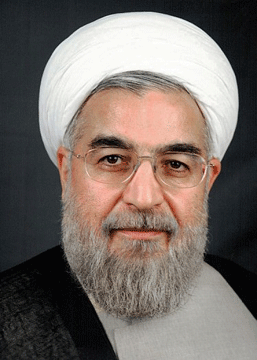
President Hassan Rouhani said on Tuesday that Iran would remain committed to a multinational nuclear deal despite U.S. President Donald Trump’s decision to withdraw from the 2015 agreement designed to deny Tehran the ability to build nuclear weapons, Reuters reported.
“If we achieve the deal’s goals in cooperation with other members of the deal, it will remain in place… By exiting the deal, America has officially undermined its commitment to an international treaty,” Rouhani said in a televised speech.
“I have ordered the foreign ministry to negotiate with the European countries, China and Russia in coming weeks. If at the end of this short period we conclude that we can fully benefit from the JCPOA with the cooperation of all countries, the deal would remain,” he added.
The Joint Comprehensive Plan of Action (JCPOA) is the full name for the nuclear deal, struck in 2015 between Iran, the five permanent members of the U.N. Security Council – the United States, Russia, China, Britain and France – and Germany.
Rouhani added that Iran was ready to resume its nuclear activities after consultations with the other world powers which are part of the agreement.
Budapest: European leaders have hinted at financial incentives or compensation for Iran to persuade it to stay it in the nuclear deal that the US has rejected.
And they are likely to act to protect European companies trading with Iran despite the US re-imposing sanctions.
In a joint statement UK prime minister Theresa May, German Chancellor Angela Merkel and French president Emmanuel Macron greeted with “regret and concern” Donald Trump’s announcement that he would re-impose sanctions against Iran and withdraw from the Iran nuclear deal.
“Together, we emphasise our continuing commitment to the (agreement),” they said. “This agreement remains important for our shared security.”
They said Iran “continues to abide by the restrictions” in the deal preventing its development of nuclear weapons, and “the world is a safer place as a result”.
“Our governments remain committed to ensuring the agreement is upheld, and will work with all the remaining parties to the deal to ensure this remains the case including through ensuring the continuing economic benefits to the Iranian people that are linked to the agreement.”
They encouraged Iran to “show restraint in response to the decision by the US” and to continue to meet all its obligations including atomic agency inspections and monitoring.
“In turn, Iran should continue to receive the sanctions relief it is entitled to whilst it remains in compliance with the terms of the deal,” the leaders said.
The European Commission’s foreign affairs representative and vice president Federica Mogherini said the nuclear deal “is not a bilateral agreement and it is not in the hands of any single country to terminate it”.
“It is a key element of the global nuclear non-proliferation architecture,” Mogherini said, adding that it was “even more” relevant in the context of negotiations with North Korea.
“The nuclear deal with Iran is crucial for the security of the region, of Europe and of the entire world,” she said.
She said Europe “fully trusted” the work of the nuclear watchdog which had certified Iran had fully complied with it s commitments under the deal.
And she too suggested Europe would look to compensate Iran for the impact of renewed US sanctions.
“The EU has repeatedly stressed that the lifting of nuclear related sanctions has a positive impact on trade and economic relations with Iran, including crucial benefits for the Iranian people,” she said
“The EU is fully committed to ensuring that this continues to be delivered on. I am particularly worried by the announcement of new sanctions. I will consult with all our partners in the coming hours and days to assess their implications. The EU is determined to act in accordance with its security interests and to protect its economic investments.”
And she appealed to Iran to “stay true to your commitments, as we will stay true to ours. And together, with the rest of the international community, we will preserve the nuclear deal.”
May, Macron and Merkel said they wanted to build on the nuclear deal to address other issues including Iran’s ballistic missile programme and “its destabilising regional activities, especially in Syria, Iraq and Yemen”.
Macron Tweeted that the three countries would “work collectively on a broader framework” covering nuclear activity after the deal ends in 2025, ballistic activity and “stability in the Middle East”.
On Monday UK Foreign Secretary Boris Johnson travelled to the US to make a last-ditch appeal to save the deal, but didn’t get an audience with the president.
Instead he appeared on the cable news program Fox & Friends – which Trump regularly watches – and remarked that “Plan B does not seem, to me, to be particularly well developed at this stage”.
Nuclear Inspectors Would Face Monumental Task in N.Korea http://english.chosun.com/site/data/html_dir/2018/05/08/2018050801221.html By Cho Yi-jun May 08, 2018
The U.S.’ call for a “permanent, verifiable, irreversible dismantlement” of North Korea’s nuclear and ballistic missile programs would pose a monumental task for international inspectors.
U.S. officials project “the most extensive inspection campaign in the history of nuclear disarmament, one that would have to delve into a program that stretches back more than half a century and now covers square miles of industrial sites and hidden tunnels across the mountainous North,” according to the New York Times on Sunday.
The success of any verification hinges on accurately assessing North Korea’s nuclear weapons and missile stockpiles, most of which are hidden away. Already U.S. intelligence agents are going all out to gather data about the North’s nuclear and ballistic missile facilities.
The U.S. National Geospatial-Intelligence Agency recently launched a project that tracks the movements of all vehicles in and out of North Korean military installations, CNN reported. Washington has also monitored North Korean responses to American fighter planes flying overhead to arrive at an overall assessment of the North’s hidden military bases.
One diplomatic source in Washington said the U.S. “may have assessed North Korea’s secret military installations much more accurately than the North thinks.”
The New York Times cited the RAND Corporation as arriving at no better assessment than that North Korea has 20 to 60 nuclear warheads and around 40 to 100 nuclear facilities, while one nuclear facility has more than 400 buildings.
“While there is no question Iran hid much of its weapons-designing past, North Korea has concealed programs on a far larger scale,” the daily said.
The RAND Corporation predicts that it would take 273,000 U.S. troops just to locate and secure North Korea’s weapons of mass destruction, which is more than the number of American soldiers deployed in Iraq at the peak of the U.S. invasion.
It warned that the International Atomic Energy Agency has only 300 inspectors, and 80 of them are already assigned to monitoring activities in Iran. If the North agrees in principle to denuclearize, the IAEA will have a huge task simply finding the personnel.
North Korea could easily conceal highly enriched uranium which could be used to produce a nuclear bomb, and it would be virtually impossible to find if the North fails to cooperate.
Justice Party lawmaker Kim Jong-dae, who recently visited Washington, told reporters that North Korea has “tens of thousands of facilities related to nuclear and missile development, while there are around 10,000 underground tunnels and storage facilities in the Mt. Baekdu area.”
“Realistically, the U.S.-North Korea summit should discuss nuclear arms reduction rather than complete dismantlement,” he added.
Mac Thornberry, head of the U.S. House Armed Services Committee, told Fox New that he is “very skeptical” that North Korea will completely dismantle its weapons of mass destruction and advised the U.S. to “prepare for the worst.”
But others warned that North Korea could face a grim future if it attempts to fool the U.S.
Hardline U.S. lawmaker Lindsey Graham said in a radio interview that North Korea played “every president before -– Clinton, Bush, all of them” but warned that Pyongyang would regret it if it tries to dupe the Trump administration since this would mean the “end of the North Korean regime.”
TOKYO — North Korean leader Kim Jong Un wants to talk to President Trump about “phased and synchronous measures” to deal with the standoff over the North’s nuclear program, Chinese state media reported Tuesday after Kim made his second visit to China in as many months.
This wording, coupled with Kim’s desire to “eventually achieve denuclearization and lasting peace on the peninsula,” will ring alarm bells in Washington as it reinforces suspicions that the North Korean leader will ask Trump to take simultaneous steps to reduce tensions.
The U.S. president said Tuesday in Washington that Secretary of State Mike Pompeo was en route to North Korea to finalize a date and location for a meeting between Trump and Kim. It would be the first such parley between a sitting American president and a North Korean leader.
“This wording about a ‘phased approach’ shows that this is going to be a process,” said Patrick McEachern, a fellow at the Woodrow Wilson Center who previously worked on North Korea at the State Department.
“There are no home runs here. Success in diplomacy with North Korea is going to be a series of singles, with some strikeouts and errors along the way,” he said.
There is considerable skepticism among analysts that Kim, having tried so hard to get a credible nuclear weapons program, is about to give it all up — certainly not without extracting major concessions from the United States. That could include reducing the U.S. military footprint in South Korea.
Kim made the remarks during a two-day visit to the Chinese port city of Dalian, not far from the North Korean border, where he met with President Xi Jinping, Xinhua reported Tuesday night. His younger sister and close aide, Kim Yo Jong, also was seen at the meetings………
South Korea has repeatedly said that the North is willing to discuss its nuclear program in talks with the United States, although “denuclearization” has not been defined. The language in the April 27 agreement has many American analysts worried that Kim will insist on U.S. military drawdowns from South Korea as part of any deal.
Although there is considerable skepticism in the United States and Japan about whether North Korea is genuine in its detente efforts, analysts point out that Kim appears to want to move on from nuclear to economic development.
“I do think North Korea would have a very strong interest to pivot to economic development,” Zhao said. “In this regard, it would have a strong motivation to build much stronger economic ties with China, South Korea and Russia.”
The South Korean government is exploring ways to increase economic cooperation with North Korea without breaching international sanctions or earning the ire of Trump. Reports from the Chinese-North Korean border suggest that Chinese authorities have already lost much of their enthusiasm for enforcing existing sanctions.








 nuclear-news