The boycott comes in advance of a meeting next Monday in Geneva, Switzerland, of 123 member nations of the United Nations discussing the challenges posed by lethal autonomous weapons. Twenty-two of those nations have already called for an outright and pre-emptive ban on such weapons.
The open letter announcing the boycott against the South Korean university said autonomous weapons are the “third revolution in warfare” and warned about letting the genie out of the bottle.
“At a time when the United Nations is discussing how to contain the threat posed to international security by autonomous weapons, it is regrettable that a prestigious institution like KAIST looks to accelerate the arms race to develop such weapons,” the letter said.
“We therefore publicly declare that we will boycott all collaborations with any part of KAIST until such time as the President of KAIST provides assurances, which we have sought but not received, that the Center will not develop autonomous weapons lacking meaningful human control,” the researchers said.
“If developed, autonomous weapons will be the third revolution in warfare. They will permit war to be fought faster and at a scale greater than ever before. They have the potential to be weapons of terror. Despots and terrorists could use them against innocent populations, removing any ethical restraints. This Pandora’s box will be hard to close if it is opened.”
Professor Walsh organised the boycott which involves researchers from 30 countries and includes three of the world’s top deep learning experts, Professor Stuart Russell from the University of California, Berkeley, who authored the leading textbook on AI and roboticist Prof Wolfram Burgard, winner of the Gottfried Wilhelm Leibniz Prize, the most prestigious research prize in Germany.
“Back in 2015, we warned of an arms race in autonomous weapons,” Professor Walsh said in a statement alongside the letter. “We can see prototypes of autonomous weapons under development today by many nations including the US, China, Russia and the UK. We are locked into an arms race that no one wants to happen.
“KAIST’s actions will only accelerate this arms race. We cannot tolerate this.”
Professor Walsh has long campaigned against the development of autonomous weapons.
He has previously travelled to speak in front of the United Nations in an effort to have the international body prevent the proliferation of so-called killer robots with the ability to think for themselves.
He believes it’s no longer a question of whether military weapons are imbued with some level of autonomy, it’s just a matter of how much autonomy — which poses a number of worrying scenarios, particularly if they fall into the wrong hands.
“They get in the hands of the wrong people and they can be turned against us. They can be used by terrorist organisations,” he warned.
“It would be a terrifying future if we allow ourselves to go down this road.
The Commons defence select committee report into the country said it was a ‘reasonable assumption’ the North could reach the UK already and that it is ‘almost certain’ to be able to carry nuclear warheads to these shores by 2019.
However, it also noted there had been ‘no sign’ of North Korean leader Kim Jong-un wanting to target the UK with nuclear weapons.
It said: ‘We believe it is obvious to North Korea that launching such weapons would lead inescapably to devastating military consequences from the US, South Korea and other countries too.
‘It would result in the downfall – indeed the annihilation of the regime: the polar opposite of what Kim Jong-un is seeking to achieve.
‘He is ruthless, like other Communist dictators before him, but he is rational.’
The North carried out a number of nuclear tests in 2016 and 2017 which led to escalating tensions between itself and South Korea and the United States.
But in announcing talks between Kim and US president Donald Trump, a South Korean official said the North Korean leader was committed to denuclearisation.
The select committee report also covers the cyber threat posed by North Korea – which was blamed for the WannaCry ransomware attack which struck computers at NHS trusts last year.
It said: ‘It is likely that North Korea has already successfully attacked the UK with the Wannacry ransonware, although we agree with the Government that the UK was probably not intended to be the principal target.
‘Nevertheless, the Wannacry attack highlighted basic vulnerabilities in UK information technology systems.
‘With North Korea unconcerned by who gets hurt when it lashes out, the UK will continue to be at risk from North Korean cyber-attacks.’
It called on the Government to find additional funding for cyber defence to counter this threat.
The proposed Sizewell C nuclear plant in Suffolk may not be feasible, EDF Energy’s UK boss told The Times, while the energy firm said it is discussing funding options with the government including using pension funds.
EDF Energy UK chief executive Simone Rossi told the newspapaer that the firm needs assurances from government that a “viable funding model exists” for Sizewell C this year. If EDF Energy believes the project is not feasible, it may stop its involvement in the project.
EDF Energy is currently in talks with the government over a funding model for the Suffolk nuclear power plant which would reduce costs for consumers. New Civil Engineer understands pension funds are being considered as a way to help finance Sizewell C.
Rossi told The Times: “This is the year where we need to understand whether this whole thing is really feasible or not.”
He added: “If we were to conclude that maybe it’s not feasible, then at that point maybe we say we are not in a position to continue the project.”
Rossi also said expected cost savings for Sizewell C could disappear if there is a “significant delay” between work on it and Hinkley Point C.
EDF Energy has said it expects construction costs for Sizewell C to be roughly 20% less than for the £19.5bn-plus Hinkley Point C plant. This is because the new plant would almost be a replica of Hinkley Point C, and because electricity grid connections are already in place at the Sizewell C site.
In June last year the National Audit office branded Hinkley Point C “risky and expensive”.
A spokesperson for EDF Energy denied Rossi’s comments were an ultimatum and said Sizewell C would benefit from an existing supply chain, while providing jobs for 5,600 construction workers.
The spokesperson added: “We are working with Government to look at alternative financing models because reducing the cost of capital can make a significant difference to the price for consumers. Financing models that create the conditions where institutional investors like pension funds can participate.”
An agreement recently reached between Japan Atomic Power Co. and six municipalities in Ibaraki Prefecture concerning the Tokai No. 2 nuclear plant highlights the sensitivities in the relationship between power companies and local governments in areas where nuclear power facilities are located. For the first time as a nuclear power plant operator, Japan Atomic Power included not just the plant’s host village of Tokai but five nearby cities as municipalities whose consent the firm will seek in restarting the idled plant. The company will not reactivate the Tokai plant if any of the municipalities opposed the move.
Other power companies are keen to see that this agreement does not set a precedent that could also change their arrangements with nearby municipalities concerning their own nuclear plants — because that would complicate the process for winning local endorsement for restarting their idled reactors. However, it’s reasonable that municipalities in the surrounding areas of nuclear plants want to be involved in the process because they would be affected in the event of a severe accident. The power companies should respond to such requests flexibly if they wish to obtain the full cooperation of nearby municipalities.
Operators of nuclear power plants conclude agreements with local municipalities to ensure the safety of residents in areas around the plants. The agreements stipulate the lines of communication when the plants have problems, as well as procedures for prior consent to restarting and modifying reactors or building new ones, though they are not legally binding.
So far, power companies have accorded the right to consent to a reactor restart to only to the municipalities and prefectures that host them, and not to surrounding municipalities.
The meltdowns at Tokyo Electric Power Co.’s Fukushima No. 1 plant in March 2011, however, illustrated how the fallout of radioactive materials during a disaster can spread well beyond the host municipality. The government made it mandatory for municipalities within 30 km of a nuclear power plant — instead of 10 km previously — to prepare evacuation plans in case of a severe accident.
The government has promoted restarting reactors idled in the wake of the 2011 Fukushima disaster once they have cleared the Nuclear Regulation Authority’s screening under revamped safety standards — and once the plant operators have obtained the consent of local governments. But in many instances, there is a split in opinion between the host municipality — which expects to gain economic benefits from the plant’s operation and national government grants for hosting the plant — and surrounding municipalities that could be similarly exposed to the risk from an accident but have no say in the operation of the plant. While municipalities and prefectures within 30 km of plants demand that they be given the right to consent to restarts, the power companies have been resistant because it would add more hurdles to winning restart approval.
When the No. 3 reactor at Kyushu Electric Power Co.’s Genkai plant in Saga Prefecture was reactivated in March, four of the eight municipalities within 30 km of the facility opposed the restart, but their objections went unheeded. Parts of Kyoto and Shiga prefectures fall within the 30-km radius of nuclear plants that Kansai Electric Power Co. runs in Fukui Prefecture, but neither Kyoto nor Shiga is consulted when Kepco seeks the nod to restart its reactors.
Japan Atomic Power had particular reasons to involve municipalities in the surrounding areas in the process. After the Fukushima accident, the mayor of the host village of Tokai called for a phaseout of nuclear power. The Tokai No. 2 plant is the sole nuclear power facility adjacent to the greater Tokyo area, and nearly 1 million people live within 30 km of it. Given the large number of residents who could be affected in case of an accident, the village argued that it cannot take sole responsibility for giving the go-ahead for its restart and called for a new agreement that involves the nearby cities of Mito, Naka, Hitachinaka, Hitachi and Hitachiota. The firm, which is now seeking the NRA’s approval of an extension of the aging No. 2 facility, apparently could not dismiss the request from the host municipality.
The agreement over the Tokai No. 2 plant should not be discounted as a special case. The dissatisfaction of many municipalities that are denied any say in restarting nuclear power plants — even though they face the same risk from possible accidents and the duty of ensuring safe evacuation of their residents — should not be left unaddressed. The other power companies should think again about whether the agreements they have over their nuclear power plants are sufficient to win the trust of nearby municipalities.
Nuclear power firms are scrambling to sell reactors to countries in one of the most troubled parts of the world, the Middle East. Many lack domestic customers and see this new market as a potential lifesaver.
A report last year by the US-based Center for Climate & Security included the Middle East in a list of what it called “potential crisis regions where combining security, climate, and nuclear risks must be addressed urgently.”
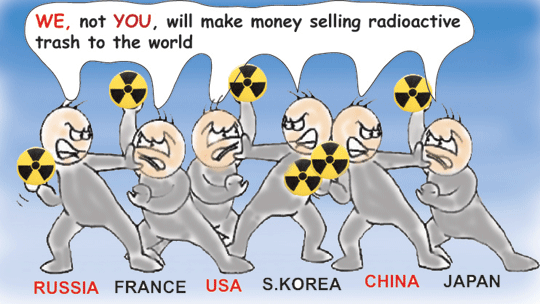
The biggest prize is the oil-rich kingdom of Saudi Arabia, which has announced plans to build 16 nuclear plants over the next 25 years at a cost of US$80 billion, part of an effort to diversify away from fossil fuels. South Korea, China, France, Russia, Japan and the United States are all bidding to build them.
In a region where renewables are half the price of nuclear power – because the sun shines for longer and with greater intensity than almost anywhere else in the world – building new nuclear plants may seem strange.
Saudi Arabia, which is also investing heavily in solar power, points to rapidly rising domestic demand for electricity and says renewables will not provide enough for its needs.
Other countries in the region that are already building or have signed contracts to build new reactors are Iran, United Arab Emirates, Jordan, Egypt and Turkey.
All say the decision to go for nuclear power is entirely a consequence of the local need for more electricity, although perhaps the Saudi rulers also have an eye on their power rival Iran, which already has an operating nuclear power station and is building more.
Mohammad bin Salman, the Saudi crown prince who effectively runs Saudi Arabia for his father King Salman, was asked about this on the US TV network CBS in March. He replied: “Saudi Arabia doesn’t want to own a nuclear bomb. But without a doubt, if Iran develops a nuclear bomb, we will follow suit as soon as possible.”
Rival contenders
Despite this, the Trump administration remains keen to sell its Westinghouse-designed nuclear power stations to the Saudis. Russia, China, Japan and South Korea also want to sell their own designs.
As well as the need to keep their national nuclear companies ticking over and grabbing lucrative exports, all these countries would welcome the political influence that providing such important infrastructure would give them in the Middle East.
Well ahead of Saudi Arabia in developing nuclear power is the neighbouring United Arab Emirates. Its first reactor was due to open this year and is almost complete, though its start-up date has been pushed back to 2019.
Again, the country has plenty of oil reserves and renewable resources, but wants nuclear power to provide a guaranteed electricity supply instead of having to rely on imported gas.
Jordan, which has no fossil fuel resource, and Egypt, with the region’s largest population, are also going nuclear. In both cases they have signed deals with the Russian state-owned giant Rosatom. Egypt has signed a deal for four nuclear plants costing $30bn, and Jordan for an energy package worth $12bn, but which also includes some American involvement, according to Bloomberg New Energy Finance.
Avoiding imports
Turkey, again a populous nation that has to import most of its energy in the form of fossil fuels, is building a nuclear power station at Akkuyu on its Mediterranean coast in partnership with Rosatom. The first reactor was expected to be operating by now, but the opening date has been put back to 2020. It has other plants planned on its northern Black Sea coast.
This sudden enthusiasm for nuclear power in such a volatile region has prompted a debate about some governments’ motives. Israel is the only country in the Middle East that has long had the means to make nuclear weapons with its Negev Nuclear Research centre in the desert near Dimona.
It is already alarmed by Iran’s nuclear programme. A number of other potentially hostile states may also soon have the means to produce highly enriched uranium or plutonium.
If they do, they will face an already fully armed Israel. According to an estimate by the Washington-based Carnegie Endowment for International Peace, Israel, which began operating a plutonium-production reactor in 1963, possesses enough material for between 100 and 170 atomic weapons. Israel has never admitted this.
Cyprus plans to lodge protests over the construction of Turkey’s first nuclear power plant a few dozen kilometres from the east Mediterranean island nation. Government spokesman Prodromos Prodromou said in Nicosia on Thursday that the Foreign Ministry will spearhead protests over the plant’s future operation on Turkey’s Mediterranean coast, AP reports.
According to Prodromou, Ankara has ignored concerns expressed by many including the European Parliament. One worry raised is that the Akkuyu area, where the plant is to be built, is earthquake-prone. He added Ankara also discounted studies about the plant’s possible environmental impact and failed to consult neighbouring countries. On Wednesday, the Turkish and Russian presidents launched the start of construction of the Russian-built plant.
The British authorities explicitly cite the poisoning of the former FSB agent Alexander Litvinenko in London as circumstantial evidence in the Skripal case. The Russians did it before, they will do it again, that’s the essence of the UK’s allegations against Russia. But doesn’t London itself have the capability, the intent and the motive for this kind of national character assassination? To discuss this, Oksana is joined by Walter Litvinenko, Father of Alexander Litvinenko.
Posted to nuclear-news.net by Shaun McGee 5th April 2018
This is an extract of an article published by Prof. Chris Busby in this months Fissionline magazine sent to me by a concerned member of the public. In it Prof. Busby discusses a change of strategy that has been submitted to the courts concerning health damage to the British Nuclear test Veterans. However, not only is the statutory response time for this submission been exceeded (by some weeks) by the UK “Misery” of Defence (MoD) but also his emails were hacked which delayed the submission of the final draft of the papers that supports the argument (Fusion Doctrine at work?). Here is a link to the Fissionline Magazine which has many interesting nuclear related articles and please support the Fissionline Magazine as it is being filtered (re-indexed etc) by Googles search engine etc (Which we have discussed and proven on this blog recently and discussed here, in part); https://issuu.com/fission/docs/fissionline-54
The June 2016 Pensions Appeals hearing in the Royal Courts of Justice was intended to be the last word on the Nuclear Veterans issue. The findings for the 14 appellants (of which I represented two—Don Battersby and Barry Smith—were intended to be automatically applicable to all test veteran pension appeals that came along in the future. To knock the issue of the test veteran illnesses on the head once and for all. In particular, it was the finding by the 2016 Tribunal under judge Sir Nicholas Blake, that the radiation doses received at the test sites in Australia and at Christmas Island were not large enough to cause cancer, or indeed any of the illnesses claimed, that laid down the law for all subsequent hearings. additionally, any other finding of that Tribunal (e.g. which cancers cannot be caused by radiation) could be used to defeat any subsequent use of the same argument in a new determination.
First let me write a few lines about justice and judges in England. Julian Assange, (Wikileaks) who is still in sanctuary at the Embassy of Ecuador in London, was recently told by a British judge that his new passport, issued by Ecuador, would not protect him from arrest if he emerged from the building. This is actually an assault on international law and the concept of passports. Assange attacked the judge for bias. He drew attention to an EU document which reported the results of a confidential questionnaire survey where judges in all the EU States were asked if they had decided a case in a direction under pressure from the government. Britain was one of the worst, only comparable with Albania, Bulgaria and Poland for lack of independent justice.
So, it was sad, but no surprise, that Blake, previously famous for the Deepcut Barracks decision not to investigate, refused to listen to our expert witnesses, ignored our Statement of Case, and effectively colluded with the Secretary of State’s lawyer, Adam Heppinstall, to avoid addressing any of the questions raised by our legal submissions. I myself subsequently made a formal complaint about Heppinstall’s behaviour to the Bar Standards Board.
The 2016 First Tier Tribunal process failed to follow the Directions made by Judge Charles in December 2014 and after Blake’s disgraceful decision I applied to the First Tier
(refused) and next to the Upper Tier (also refused) to appeal on this clear Point of Law. The Bar Standards Board did nothing. So, as the table from the EU study shows, England is a judicial Banana Republic. But never give up, never surrender! If 43% of British judges are dodgy, that means 57% are not. Certainly, the late judge Hugh Stubbs was an honest and a good person. Between 2004 and 2010, I was responsible, as expert witness, in persuading him in five Pension appeals to find for the veteran. Then in 2014 Judge Charles threw me out as an expert witness and I was refused any chance to appeal that decision on a point of law. Not only that, I was fined £2700 in costs for having the temerity to try.
I came back as the representative, and fielded four Professors, as expert witnesses in the new First Tier under judge Blake. Although that case was lost, a development enabled me to have another go at this. That was the death from pancreatic cancer of Trevor Butler in 2016. Trevor was one of the appellants in the 2016 list, but for a range of conditions relating to immune system and kidney damage. Needless to say, Blake threw out his appeal with the others. But Butler died from pancreatic cancer during the case. And Don Battersby, whom I was representing, and who was appealing for chronic lymphatic leukaemia, also died from pancreatic cancer during the case. Barry Smith, whose widow I represented died of pancreatic cancer too, as did Alun Williams who was one of the original appellants. So that is 4 appellants who all died from pancreatic cancer out of 14 appellants who had been selected at random.
In the same way as throwing four sixes one after another in dice is extremely unlikely, this cluster of 4 pancreatic cancers is statistically impossible unless the victims had a common cause for their deaths from pancreatic cancer. It is like a 50-sided die with one of the sides being pancreatic cancer. Imagine the odds of throwing four of those in a row. We are bringing this statistical argument back to the Tribunal with an eminent statistician, Prof Roy Carr-Hill. But the issue of the pancreatic cancers is ludicrous at the out- set. Two of these, Battersby and Williams, had been given pensions for their pancreatic cancer (by Stubbs and following Stubbs) and two had been refused: told by Blake (relying on evidence from Geraldine Thomas, a biochemist) that pancreatic cancer cannot be caused by radiation. What a farce.
However, the question is:
How to proceed in a legal atmosphere constrained by the precedent set by Blake. It is no good saying that Prof Geraldine Thomas is a dishonest, ignorant and biased scientist, in no way an expert in any area she gave evidence on, and that nothing she said could be relied upon. In English law, a judge can find that Black is White, and you cannot come along afterwards and say that it isn’t. These radiation dose arguments, were all laid to rest by Blake. We have to find a way round.
And there is one. It is based on avoiding the concept of radiation dose altogether and focusing on a new approach, chemistry, or specifically the interaction between chemistry
and radiation: Radiochemical Genotoxicity. This is a perfectly valid argument. It is emerging science in the last 20 years that certain radioactive materials, when ingested or inhaled, are chemically attracted to DNA. It is damage to DNA, in the form of mutations, that results in cells that become cancerous. The radiation “doses” delivered by these substances, and calculated painstakingly by the SSD witnesses using the current radiation model, are of little use in predicting or explaining the genetic damage they cause, because it is a combination of their chemical identity and form which is responsible for their genotoxicity, their ability to introduce cancer-causing mutations.
The most important of these is Uranium. The Uranium content of the Christmas Island bombs was obtained for us from the MoD by judge Stubbs in 2012. He had to threaten the MoD to get the data, which was secret. In the Blake hearing, the SSD finally conceded that these data showed that 95% of all the solid material from the bombs at Christmas Island was Uranium, and that it amounted to 8 tonnes. It fell out as nanoparticles, on the island and in the sea. The material from the sea washed ashore on the island, contaminating the coast and coastal lagoons through sea-to-land transfer. It was inhaled from the air and ingested from contaminated water and food.
So our new case is based on Uranium; it entirely by-passes all the argument about “dose” on which previous appeals were fought. It is the chemical composition and genetic effects of the internal Uranium which is now the issue. The Blake Determination is therefore irrelevant, except insofar as we can employ previous reports by both our experts and other experts to argue that there was Uranium contamination. And there is plenty of evidence for that U-235, the fissile isotope in the bombs was even measured in the south west coastal area by the New Zealand surveys in the 1980s, but was wrongly characterised as Radium dial material, a cover-up that continues. I trekked down to the Case management hearing in London on 31 st January, presided over by a new Judge, Fiona Monk. The MoD began by asking that Blake’s decision about what cancers could not be caused by radiation should be accepted by any new Tribunal. Amazingly, she refused: saying that each case must be re-heard on its merits. Then I said that we were bringing in a new argument—radiochemical genotoxicity.
This naturally upset the defence; but the judge said we could bring in our new evidence and experts, and that we had 28 days to do so and send it to the defence. The Secretary of State then had 28 days to respond. I prepared a Statement of Case for Trevor Butler in the allotted time, and presented expert reports by Dr Keith Baverstock, who has kindly agreed to act as expert witness, and by Prof Roy Carr- Hill, the eminent statistician. But the SSD (as usual, and as usual without any application or explanation) is now out of time.
There are 28 outstanding cases. Most of them are represented by the Royal British Legion. They have no defence against the argument that the radiation doses were too small, and I believe that they will all go down on this. But for Trevor Butler we have shifted the goalposts.
以上、西山さんの情報で精度の高そうなものは、瀬戸教授の内部告発による、行方不明者のうち数名が県立医大に検体として持ち込まれていた。 One other thing Prof Seto said that seemed close to the truthwas that several missing bodies that were found in the Fukushima Daiichi Nuclear Plant were taken into Fukushima Medical University and kept as specimen materials.
…“She said that there have been so many workers dead without being reported. Some died during the 2 days break, some didn’t turn up the next morning and were found dead…. Those who died haven’t been measured for how much exposure they got. Tepco doesn’t count and report the dead unless they die during their work hours.” …
(Editor’s comment: According to Mrs. Mako Oshidori of NPJ and of Yoshimoto Kogyo Co., Ltd., Tepco doesn’t keep a record of the worker’s radiation exposure and number of deaths (See the video: http://www.youtube.com/watch?v=0Pu5iLj7toE There has been some information in the Japanese blogs concerning Tepco worker’s deaths. I picked a few of them for this post.
I quickly show you how Google and Co. block anti establishment information and then explain the Novichok article I posted too. Here is the article mentioned;
Authors: Paul McKeigue, Jake Mason and Piers Robinson
Introduction
In view of the seriousness of the rapidly worsening relations between the West and Russia, and the quickly evolving military events in the Middle East, especially Syria, we have taken the step to publish relevant evidence-based analysis with respect to the Skripal incident of 4 March 2018. This update to our earlier briefing note covers new material that has become available. We welcome comments and corrections which can be sent to piers.robinson@sheffield.ac.uk or provided in the Comments section below.
Key Points
There is no corroboration of Mirzayanov’s story of a secret Russian “Novichoks” programme to develop a new class of nerve agents, although the compounds described in his book in…
Two weeks ago, I gave a keynote presentation about anthropogenic climate disruption (ACD) at a large sustainability conference in Chico, California. During the question-and-answer session following my talk, a student asked me what I thought the world would look like by 2050. His question stopped me in my tracks. I had to pause and take a deep breath, to prepare myself emotionally for what I had to tell him.
Here is the gist of what I said: Based on years of research for my forthcoming book, The End of Ice, along with my work compiling these monthly climate disruption dispatches for four years now, I know that by 2050, we will be inhabiting a dramatically different planet. I believe we will already have tens — if not hundreds — of millions of climate refugees from sea-level rise and conflicts born of lack of food and water. What we currently call extreme weather events (massive floods, droughts, hurricanes) will have long since become the norm. In the US, growing food in the Midwest and the central valley of California will be extremely difficult, if not largely impossible, due to shifting weather patterns of rainfall and drought. Some swaths of the world, including the Gulf states in the Middle East and parts of the US Southwest, will be largely uninhabitable due to simply being too hot. Greenland and the Antarctic will both be experiencing dramatically advanced melting, and most of the glaciers in the contiguous 48 US states will have long since ceased to exist. And given that we are officially already amidst the Sixth Mass Extinction Event of the planet, which humans triggered, the biological annihilation that comes with this is happening apace.
This portrait might seem far-fetched to some. But to understand that this is our future, all we need to do is look at what is already happening around the planet.
Unchecked ACD — which appears likely to continue, since governments (particularly that of the United States) are not preparing to undertake the kinds of drastic mitigation measures that might have any impact — will dramatically degrade global fish catch over the coming centuries, and may well reduce total oceanic plant life for a millennium, according to a recent study. The study also noted that these changes cannot be reversed until the climate cools.
The amount of warming humans have already caused on Earth is, according to a recent study, likely already enough to melt more than one-third of all the world’s glaciers outside of Antarctica and Greenland, regardless of ongoing efforts to reduce fossil fuel emissions. The study analyzed the lag between global temperature increases and the retreat of glaciers and found a relatively slow response of glaciers to planetary warming. Researchers noted that it will take until 2100, at least, to see any benefits from serious mitigation efforts over the next decades — assuming those efforts actually happen. One of the scientists involved in the study told Carbon Brief that this glacier loss is already “baked in” to the system and has been overlooked, which essentially means “we really are on course to obliterate many of these mountain landscapes.”
Meanwhile, a recently published World Wildlife Fund report has predicted catastrophic losses in the world’s forests: As much as 60 percent of the plants and half of all the animals are predicted to disappear by 2100. if temperatures rise by more than 1.5 degrees Celsius (1.5°C). The scientific consensus states that a 1.5°C rise is a given; in fact, some prominent scientists believe an increase of 3.2°C by 2100 is most likely, given current national commitments. If emissions remain unchanged, which is the current actual trajectory, a 4.5°C rise is the forecast. It is worth noting that oil giants BP and Shell are planning on 5°C of planetary warming by 2050.
Taking all this information in is necessary if we are to see the world clearly and live our lives accordingly.
Earth
The World Bank recently warned that if dramatic intervention doesn’t occur on the ACD front, 140 million people across three regions (sub-Saharan Africa, South Asia, Latin America) of the Earth will become refugees between now and 2050.
An example of one of the factors driving such mass movement of people can be found in California, where a recent report citing nearly 90 different studies found that warming temperatures could alter where key crops grow across that state. Bearing in mind that California produces roughly two-thirds of all the produce in the US, the report notes that ACD could decrease the yield of some of the crops grown in California by as much as 40 percent by 2050.
In Vermont, warming temperatures, particularly during the winter, are causing extreme weather events and unpredictable rainfall, which experts recently warned was making forests across that state particularly vulnerable to ACD. Boreal forests and moose populations will be the hardest hit, warned the study.
The world’s northernmost regions have not escaped extreme weather. The Svalbard Global Seed Vault, known as the Doomsday Vault, was created to protect the world’s seeds in the event of cataclysmic ACD impacts or nuclear war, whichever comes first. Disturbingly, it is now in need of an upgrade, thanks to ACD. Norway, which built and maintains the vault, is having to invest $13 million to upgrade the vault to make room for more seeds and make it more resilient, given a recent flooding event there. Last year, flooding at the entrance of the vault prompted the Norwegian government to begin looking into the upgrade, which is now going to move forward.
Bad news also abounds for Earth’s animal species. A recently published study in the journal Nature Climate Change showed that Antarctica’s king penguins could be extinct by 2100, due primarily to ACD impacts and overfishing.
In Florida, research revealed recently that nearly all the sea turtles being born there are female, due to higher temperatures. Obviously, if this trend continues, which it almost assuredly will, there will be no more sea turtles in Florida.
Meanwhile over in Europe, the authors of a recent report out of France’s National Museum of Natural History and the National Centre for Scientific Research showed a “catastrophic” decline in France’s bird populations. The trend signals the possibility of Europe’s farmland turning into desert, a situation that would ultimately threaten all human beings. The scientists warned of a wider crisis of biodiversity — or lack thereof — across that continent, with ACD impacts and pesticides to blame. This comes on the heels of concerning news of a 76 percent decline in the abundance of flying insects in Germany over the last 27 years.
Water
As is often the case in the spring, the watery realms of the planet are where the ACD impacts are most evident.
Widespread ongoing winter drought across the US, from Kansas, Oklahoma and Missouri to the Dakotas, Texas and California, have many farmers worried about this year being a repeat of 2012, the worst drought in the US since the Dust Bowl. At present, the winter drought is worse than it was in 2012.
The problem extends beyond those states. In Colorado, at the time of this writing, snow would need to fall at 200 percent of the state’s average through the end of April for its snowpack to catch up to normal. Water managers there are keeping a leery eye on reservoirs as summer looms on the horizon.
Colorado is not an anomaly. Snowpack across the Western US has been dramatically lower than it was a century ago. A recent study showed the average snowpack in the west has dropped by nearly one-third since 1915. That is equivalent to the decrease we’d see from permanently draining Nevada’s Lake Mead, the single largest man-made reservoir in the US.
Changing weather patterns and warmer year-round temperatures have scientists in Western Canada — a place you wouldn’t think needs to worry about water issues — worried about running out of water in the future. For example, in 2017 there was a record amount of snowfall in one region, but even all that snow was still not enough to prevent a drought on the southern part of the prairies below it. The changing climate there also means the snowpack is melting faster and earlier than usual, which means that water is moving through river basins faster and leaving them dry before the end of summer.
On the other side of the world, New Zealand is experiencing similar concerns. Its alps have become incredibly barren, as a recent aerial survey shows how the loss of snow there is now being called “extreme.”
A recently released UN report on the state of the world’s water warned that more than 5 billion people could suffer water shortages by 2050 due largely to ACD and increasing demand.
Furthermore, extreme weather events like major floods and extreme rainfall events have surged more than 50 percent this decade alone, and are now happening four times more often than they were in just 1980, according to a recent paper.
Meanwhile, seas continue to rise. A recent NOAA report warned that sea level rise will rapidly worsen flooding that is already happening in coastal communities around the US. The report warned that some cities will see flooding on a daily basis by 2100.
Adding to this, another recent study showed that lakes on the Greenland Ice Sheet are now forming further inland, meaning they are now potentially threatening to speed up ice flow once they drain to the glacial floor.
In Antarctica the news is no better. The absence of sea ice near that continent over the past six weeks (as of the time of this writing) has deeply concerned scientists conducting research there.
In addition to paying attention to large, continental changes, it’s important to take note of ACD-driven shifts on the level of microorganisms. A recent report showed that excessive rates of carbon dioxide (CO2) affect the health of critical microorganisms in the oceans, which could potentially undermine the base of vital marine food chains. This is happening largely due to ocean acidification, a result of ACD.
Fire
Given the low snowpack levels across much of the Western US, this summer is already expected to be another above-average wildfire season for much of that part of the country. Since snowpack functions as a water source through much of the summer, when warmer temperatures cause it to melt off faster than normal, drier conditions ensue.
Meanwhile in Australia, more than 70 homes and buildings have been destroyed in a fast-moving bushfire in New South Wales, while separate fires destroyed 18 properties in Victoria. Local authorities there described the fires as the worst of Australia’s summer season thus far.
As is always the case with extreme weather events, none of these fires can be solely attributed to ACD. However, climate disruption’s impacts are a key contributing factor to how often they occur, as well as to their intensity.
Air
In Australia, a new study reveals that the country’s record-setting 2012 heat wave was responsible for the destruction of roughly 1,000 square kilometers of seagrass meadows. which had acted as a repository for CO2. When the meadows were destroyed, the disaster released as much as 9 million tons of CO2 into the atmosphere.
Meanwhile, nearby New Zealand experienced its hottest summer on record last year. It definitively broke with normal temperatures, clocking in at a shocking 2.1°C above the past 35-year average temperature.
Back in the US, USGS data has revealed how spring has arrived much earlier than normal for much of the country, a clear indicator of how ACD is continuing to shift overall climate patterns.
In the Arctic, in fact, spring is beginning an average of 16 days earlier now than it did just one decade ago. A study in the journal Scientific Reports noted an increase in the number of warm temperature records in the spring, along with changes to the timing of bird migrations, flowers blooming and other seasonal indicators.
What makes this even more disconcerting is the fact that scientists have found a direct and strong link between warmer Arctic temperatures and abnormally high snowfall amounts and frigid temperatures further south of that region. So, for example, the severe weather that has been impacting the northeastern US this spring, is linked directly to the ACD-related warm wave happening across the Arctic region.
Lastly in this section, but perhaps most importantly, thawing Arctic permafrost is now likely to release more methane than previously expected. Methane is a far more potent greenhouse gas than CO2, as it is 100 times stronger over a 10-year time scale. The new study found that waterlogged wetland soils will produce considerably more methane than previously predicted.
Denial and Reality
There is never a dull moment in the Trump administration’s land of ACD-denial.
A recent and excellent article published at The Conversation outlined the four primary methods used by this administration to deny or hide the reality of ACD. These methods are, according to the article: making documents more difficult to find on government websites, burying web pages, altering language, and silencing the science. Truthout’s Mike Ludwig also detailed how ACD, as a threat to the US, has literally “gone missing” under Trump.
Meanwhile, the cabinet continues to be filled with ACD deniers. One of the more recent additions has been hardline climate denier Mike Pompeo as Secretary of State, who along with having longstanding close ties to the Koch brothers, in 2013 said during a C-SPAN interview: “There are scientists who think lots of different things about climate change. There’s some who think we’re warming, there’s some who think that the last 16 years have shown a pretty stable climate environment.”
A Trump administration official even went so far recently as to say that USGS scientists went “outside their wheelhouse” by writing that ACD has “dramatically reduced” glaciers in Montana. One of the scientists who bore this attack responded, “This is what we do…. It is our wheelhouse.”
Trump administration US Energy Secretary, Rick Perry, who thinks wearing thick-framed glasses makes him appear more intelligent, recently said that international efforts to reduce fossil fuel use were “immoral.”
On the reality front, thousands of scientists from the 22 Commonwealth countries have urged that stronger government action on ACD needs to be taken if there is hope to keep planetary warming lower than 2°C.
Underscoring that urgency, global demand for energy increased by 2.1 percent in 2017 — more than twice the previous year’s rate, according to the International Energy Agency. According to the same agency, energy-related CO2 emissions also increased by 1.4 percent during 2017, reaching a historic high of 32.5 gigatons.
Despite glaring warning signs from around the planet, governments around the world are not taking dramatic measures to mitigate ACD impacts. In fact, the US government continues to refuse to even acknowledge that those impacts exist. The world’s most powerful forces are taking a business-as-usual approach, as we are hurtled deeper into the Sixth Mass Extinction event.
Does Trump Even Know What He Wants From Kim Jong-un?
The president has shown no indication that he has any plan for next month’s all-important North Korea summit. Slate, By FRED KAPLAN , 3 April 18.
The biggest, riskiest diplomatic trip of his presidency—the summit with North Korean leader Kim Jong-un—is set to take place next month, and Donald Trump shows no signs of comprehending the issues or interests at stake.
Two statements from last week should have set off alarm bells that the president is not remotely ready for prime time.
The first came on Thursday, during a rambling, campaign rally–like speech in Ohio. At one point, Trump mentioned his recently reached trade deal with South Korea, saying, “I may hold it up until after a deal is made with North Korea. You know why? Because it’s a very strong card. And I want to make sure everyone is treated fairly.”
Within a few hours, aides to South Korean President Moon Jae-in were seeking clarification on the statement, working through various channels to understand Trump’s “true intentions.”Good luck on that.
I’ve sought some clarification myself, to no avail. The remark was either utterly incoherent or a terrible blunder. The former—yet another instance of Trump’s incoherence—is the likelier explanation. It’s not at all clear why Trump should hold up a trade deal with South Korea, pending the results of nuclear talks with North Korea. The two have little or nothing to do with each other.
But impolitic incompetence should never be dismissed as a source of confusion. Moon will be meeting with Kim—another historic first—on April 27 at Peace House, near the North-South border. It is expected that their meeting will tee up the issues, and to some degree set the agenda, for Kim’s meeting with Trump a few weeks later. Trump’s relations with Moon are rife with tensions. Trump has harshly criticized Seoul for fair-trade violations (and is said to see the new trade deal as an imperfect solution); he often grumbles that the South Koreans should pay more for their own defense and has threatened to withdraw U.S. forces from the region if they don’t—thus arousing fears, in South Korea and Japan, that Trump might do just that in exchange for a promise by North Korea to freeze or cut back its nuclear arsenal.
Trump’s remark in Ohio could be read as a threat to Moon: Push Kim hard on his nuclear weapons, maybe even get him to agree to dismantle them in advance of the U.S. summit—do the heavy lifting for us—or forget about the new trade deal. ……….
Does Trump have any idea what sorts of “phased, synchronized measures” he would like North Korea to take—and what sorts of measures he would permit the United States to take at the same time? For example, as a first step, North Korea could extend its freeze on nuclear testing and open up its production and test sites to international inspection—with the United States simultaneously removing some sanctions. What would be the second, third, and fourth synchronized measures, and what would be the ultimate goal—the finishing line of these steps? These are issues to be discussed by experts, debated in National Security Council meetings, and decided very carefully by the president and his top advisers. If officials at the State Department, the Pentagon, and the NSC aren’t already well into this project, they’re starting way too late.
It’s also worth noting that Trump’s incoming national security adviser, John Bolton, has spoken out against the whole concept of phased, synchronized measures, demanding that Kim dismantle his nuclear arsenal, all at once, and urging the United States to launch a first strike if he refuses. Will he offer Trump the same advice, now that he’s off Fox News and inside the White House? Will Trump listen? And who’s still around to offer countervailing advice?
Kim Jong-un will come to both negotiations—the one with Moon near the DMZ and the one with Trump at a location not yet determined—with a goal, an agenda, and a bag of bargaining tactics. He may also have sought and won consent for his approach (though there’s no way of knowing this) during his meeting in Beijing with Xi. Unless something dramatic happens in the next few weeks, Trump will arrive at the summit with no firm grip on a strategy or tactics—and wavering support from, and for, his allies. He may come instead with the cloak of an unearned self-confidence that he can prevail with a deal through his charisma and instincts. For this kind of deal, that won’t be enough. https://slate.com/news-and-politics/2018/04/does-trump-even-know-what-he-wants-from-kim-jong-un.html
Japanese Foreign Minister’s Reports of Tunneling at Punggye-ri: What Commercial Satellite Imagery Shows [excellent photos] BY: 38 NORTH, APRIL 2, 2018A Analysis by Frank V. Pabian, Joseph S. Bermudez Jr., and Jack Liu.
On March 31, 2018, Japan’s Foreign Minister, Taro Kono, in a lecture in Kochi city, is reported to have said that North Korea appears to be “working hard to get ready for the next nuclear test,” and the associated reporting claims that he had added that soil had been “removed from the tunnel at the nuclear test site where past tests were conducted.” The reporting also suggested that his remarks “may be based on satellite imagery provided by the United States.”
While it is unclear whether the Foreign Minister was referring to activity observed over the last few days or from earlier work conducted after North Korea’s September 2017 nuclear test, commercial satellite imagery from March 23 shows quite a different picture: namely, that activity at the test site has been significantly reduced compared to previous months. Tunneling at the West Portal, a site not associated with any of North Korea’s previous tests, had been active earlier this year but has slowed down significantly as has other personnel and vehicular movement around the site. (It appears that only a small amount of new spoil has been excavated from the tunnel recently).[1]
Nevertheless, it is highly likely that the North Koreans continue to maintain the readiness of the nuclear test facility—one indication is recent roadwork—to allow nuclear testing in the future should Pyongyang decide to do so.
1. Precise determination of the extent of new spoil accumulation is made difficult from March 17 to 23 due to variations in the imagery deriving from different sensors on different satellites from different vendors having different look angles and slightly different amounts of melted snow together with vegetative shadowing.
Nasdaq 29th March 2018,French uranium mining and nuclear fuel group Orano, formerly called Areva, said its 2017 revenue fell 11 percent to 3.9 billion euros ($4.80 billion) and core earnings fell 30 percent to 946 million euros as demand for nuclear fuel remains low.
Orano’s order book, while still representing nearly eight years of revenue, fell to 30.8 billion euros at the end of 2017 from 33.6 billion euros at the end of 2016 and the company expects revenue will fall again this year. The company continued to burn cash, with a negative cash flow of 1.06 billion euros compared to minus 915 million euros in 2016, but Orano said it targets positive net cash flow from company operations this year. https://www.nasdaq.com/article/nuclear-group-orano-earnings-slide-in-grim-uranium-market-20180329-00098








 nuclear-news