NASA will allow plutonium powered spacecraft – reversing previous policy prohibiting this dangerous system
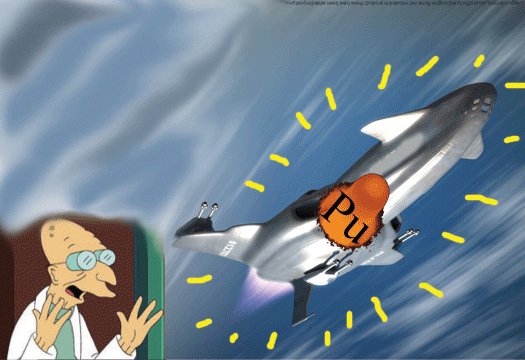 NASA to allow nuclear power systems for next Discovery mission, Space News WASHINGTON — Citing progress in producing plutonium-238, NASA will allow scientists proposing missions for an upcoming planetary science competition to use nuclear power sources.
In a statement issued March 17, Jim Green, director of NASA’s planetary science division, said the agency was reversing an earlier decision prohibiting the use of radioisotope power systems for spacecraft proposed for the next mission in the agency’s Discovery program.
A “long-range planning information” announcement about plans for the competition, issued Dec. 12, said that the use of such power systems would not be allowed, although missions could use radioisotope heater units, which use a very small amount of plutonium to keep spacecraft elements warm.
NASA made that decision based on projected use of existing stocks of plutonium-238 for upcoming missions, such as the Mars 2020 rover. Dragonfly, one of the two finalists for the next New Frontiers medium-class planetary science mission, also plans to use a radioisotope power system, as well as potential future missions the moon that require nuclear power to operate through the two-week lunar night.
“We have some liens against the radioisotope power,” Green said at a Feb. 21 meeting of NASA’s Planetary Science Advisory Group, citing those upcoming missions. The agency, he said, needed to balance mission demands against existing stocks of plutonium and efforts currently ramping up to produce new supplies of the isotope, which should reach a goal of 1.5 kilograms a year by around 2022. “The last thing we want to do is to select a mission and then not be ready to fly it.”
At the time of the meeting last month, though, Green said the agency was reviewing the prohibition against using nuclear power for the Discovery competition at the request of the scientific community, but didn’t offer a schedule for completing that review……. http://spacenews.com/nasa-to-allow-nuclear-power-systems-for-next-discovery-mission/
MP wants to stop Britain’s supplying of weapons grade nuclear materials to Russia
MP calls for sanctions on nuclear materials trade, Cambrian Newsby Alex Jones – Meirionnydd, Arfon & Dwyfor reporter @alexj_cn alexj@cambrian-news.co.uk
DWYFOR Meirionnydd’s MP has challenged the prime minister about nuclear materials following the suspected attempted murder of a former Russian double agent and his daughter.
Sergei Skripal and his daughter Yulia were in Salisbury earlier this month when both were found in a critical condition on a public bench.
It has since transpired that both had been inflicted with a nerve agent which has left both, and a police officer who attended, fighting for their lives.
The incident has sparked a marked decline in UK and Russian relations.
It has been suggested that Russian involvement was “the only plausible explanation” but the Kremlin has denied responsibility.
In a meeting in the House of Commons last week, Theresa May gave an update on the situation, prompting MP Liz Saville Roberts to challenge the Prime Minister regarding trade of nuclear materials with the former Cold War adversary.
Mrs Saville Roberts said: “Alongside many colleagues in the House, I speak on behalf of my party in calling for a robust and immediate response.
“Sources inform us that Russia is the UK’s biggest weapons-grade nuclear substances export market, despite several attempts at a moratorium on depleted uranium by the European Parliament and the United Nations.
“Will the Prime Minister confirm whether the UK is still exporting nuclear substances to Russia?
“If so, surely this should be among the very first sanctions imposed?”……..http://www.cambrian-news.co.uk/article.cfm?id=119768&headline=MP%20calls%20for%20sanctions%20on%20nuclear%20materials%20trade§ionIs=news&searchyear=2018
How a scientist studying earthquakes spent his career working to prevent nuclear explosions,
New plan for fracking method of isolating nuclear wastes
 This Father-Daughter Team Says It Has a Cheaper, Safer Way to Bury Nuclear Waste, Startup Deep Isolation wants to use fracking tech to drill horizontal disposal tunnels a mile below the Earth’s surface. Bloomberg By Ashlee Vance, 20 March 18 Richard and Elizabeth Muller have come up with one of the more unusual father-daughter businesses in recent memory. On March 20 they announced a startup called Deep Isolation that aims to store nuclear waste much more safely and cheaply than existing methods. The key to the technology, according to the Mullers, is to take advantage of fracking techniques to place nuclear waste in 2-mile-long tunnels, much deeper than they’ve been before—a mile below the Earth’s surface, where they’ll be surrounded by shale. “We’re using a technique that’s been made cheap over the last 20 years,” says Richard, a famed physicist and climate change expert. “We could begin putting this waste underground right away.”
Over 15 miles of piping at former uranium enrichment facility to be monitored by robots
Pipe-crawling robot will help decommission DOE nuclear facility, Radiation-measuring robots go where humans cannot Science Daily
- Date:
- March 20, 2018
- Source:
- Carnegie Mellon University
- Summary:
- A pair of autonomous robots will soon be driving through miles of pipes at the US Department of Energy’s former uranium enrichment plant in Piketon, Ohio, to identify uranium deposits on pipe walls.
-
A pair of autonomous robots developed by Carnegie Mellon University’s Robotics Institute will soon be driving through miles of pipes at the U.S. Department of Energy’s former uranium enrichment plant in Piketon, Ohio, to identify uranium deposits on pipe walls.
The CMU robot has demonstrated it can measure radiation levels more accurately from inside the pipe than is possible with external techniques. In addition to savings in labor costs, its use significantly reduces hazards to workers who otherwise must perform external measurements by hand, garbed in protective gear and using lifts or scaffolding to reach elevated pipes.
DOE officials estimate the robots could save tens of millions of dollars in completing the characterization of uranium deposits at the Portsmouth Gaseous Diffusion Plant in Piketon, and save perhaps $50 million at a similar uranium enrichment plant in Paducah, Kentucky.
…….. Shuttered since 2000, the plant began operations in 1954 and produced enriched uranium, including weapons-grade uranium. With 10.6 million square feet of floor space, it is DOE’s largest facility under roof, with three large buildings containing enrichment process equipment that span the size of 158 football fields. The process buildings contain more than 75 miles of process pipe.Finding the uranium deposits, necessary before DOE decontaminates, decommissions and demolishes the facility, is a herculean task. In the first process building, human crews over the past three years have performed more than 1.4 million measurements of process piping and components manually and are close to declaring the building “cold and dark.”
“With more than 15 miles of piping to be characterized in the next process building, there is a need to seek a smarter method,” said Rodrigo V. Rimando, Jr., director of technology development for DOE’s Office of Environmental Management……….https://www.sciencedaily.com/releases/2018/03/180320084315.htm
Japanese Court sides with power company over Oma nuclear plant
 Court sides with power company over Oma nuclear plant http://www.asahi.com/ajw/articles/AJ201803190056.html, By KAZUKI NUNOTA/ Staff Writer, March 19, 2018 HAKODATE, Hokkaido–A court in northern Japan on March 19 dismissed a lawsuit to halt construction of a nuclear power plant in Aomori Prefecture on grounds there was no realistic possibility of a serious accident occurring.
Electric Power Development Co. (J-Power) is overseeing construction of the Oma nuclear plant in Oma, across the sea from Hakodate.
The facility is undergoing screening by the Nuclear Regulation Authority to ensure it meets new safety standards imposed after the 2011 Fukushima disaster.
Presiding Judge Chikako Asaoka at the Hakodate District Court said in her ruling, “At the moment, it is difficult to readily recognize the tangible danger of a grave accident likely to occur at the plant.”
The lawsuit focused on whether an active seismic fault existed in the seabed near the construction site, the dangers posed by the possibility of volcanic eruptions in the area and concerns about using only mixed-oxide (MOX) fuel, consisting of plutonium and uranium, as nuclear fuel.
The suit was filed in July 2010 by a group of 1,000 or so plaintiffs.
UK Conservatives – inconsistent, incoherent, policy – agreeing to Russia’s involvement in UK’s nuclear power development
Times 18th March 2018, Ed Davey: Vladimir Putin’s ambitions have been evident for some time, but
the Conservatives’ position has long been incoherent and inconsistent.
During the coalition years, the Conservatives seemed torn between the
national security evidence of the country’s wrongdoings and the billions
of roubles it had to invest.
Russian industrial investment plans would
never have stood up to the sort of detailed scrutiny we gave to Chinese
ones. I was particularly astonished when David Cameron agreed to Putin’s
request that the Russian state nuclear power company, Rosatom, be
introduced to the UK’s civil nuclear power market and develop an
international consortium with Rolls-Royce.
It was left to the Lib Dems to insist of downgrading this to a simpler, meaningless memorandum of
understanding. I was gobsmacked that even after Putin’s annexation of
Crimea, the prime minister clung on to the idea — even as we searched
around for sanctions to impose. https://www.thetimes.co.uk/article/former-energy-minister-ed-davey-tories-position-on-russia-is-incoherent-and-inconsistent-fhnvfkmgp
Japan-led Turkish nuclear plant project mired in cost overruns.
Nikkei Asian Review 18th March 2018 Another
setback looms for Tokyo’s infrastructure export drive. A Japan-led nuclear
power plant project in Turkey looks to cost more than twice as much as
initially projected, highlighting challenges for Tokyo’s push to export
Japanese infrastructure.
The Japanese and Turkish governments agreed on the
public-private project in 2013. The estimated total cost, pegged at around
2 trillion yen ($18.8 billion at current rates) at the time, has since
ballooned to more than 5 trillion yen, according to sources close to the
matter, due largely to the need to meet tougher safety standards
implemented after the March 2011 meltdowns at Tokyo Electric Power Co.
Holdings’ Fukushima Daiichi plant.
The plan is to build four reactors with
a total output of 4,500 megawatts in the Black Sea coastal city of Sinop,
using Atmea1 reactors Japan’s Mitsubishi Heavy Industries is developing
with France’s Areva.
Though the goal is to put the first reactor into
service in 2023, in time for Turkey’s centennial, the cost problem could
cause that date to slip.
Japan views nuclear power as an integral part of
efforts to export infrastructure around the world. As Mitsubishi Heavy and
the others hash out the Turkish project, a group led by Hitachi is putting
the finishing touches on plans to build two nuclear reactors in the U.K.,
on the Welsh coast.
Yet the Fukushima accident still casts long shadows
 over the nuclear industry, and hurdles are growing higher. Vietnam has
cancelled orders for Japanese nuclear facilities amid financial concerns
and local opposition. Partly because of the rising cost of safety measures,
the financial risks of building nuclear plants abroad have grown too large
for companies alone to bear.
So Japan’s government has stepped in with
public financing and other aid, eager to support infrastructure exports,
which it considers a key economic growth strategy. Pursuing projects abroad
is in effect the only way for such companies as Mitsubishi Heavy and
Hitachi to maintain and profit from their nuclear technologies.
All nuclear power plants in Japan halted operations in the years after the Fukushima
disaster, and only a few have been approved to restart. Expanding plants or
building new ones is likewise difficult.
https://asia.nikkei.com/Politics-Economy/Economy/Japan-led-Turkish-nuclear-plant-project-mired-in-cost-overruns
Senator wants U.S. Energy Secretary Rick Perry for details on funding for proposed Yucca Mountain nuclear waste dump
Cortez Masto seeks details on Yucca spending since Trump’s election, The Nevada Independent, March 19th, 2018 , Sen. Catherine Cortez Masto has called on Energy Secretary Rick Perry to provide details on how the White House would spend funds requested for the Yucca Mountain nuclear waste repository, as well as how money has been spent since President Donald Trump was elected.
In a letter to Perry dated Monday, Cortez Masto, an opponent of the controversial project, noted that while the president has requested $120 million in both of his fiscal year (FY) 2018 and 2019 budget blueprints, with regard to the Department of Energy (DOE), neither of the budget documents provides a detailed account of how funding will be, or has been, spent.
“The FY 2019 Budget Justification, like the FY 2018 Budget Justification, provides little meaningful information on how DOE would actually spend these funds to participate in U.S. Nuclear Regulatory Commission licensing activities for the Yucca Mountain nuclear waste repository,” the letter said. “Moreover, neither of these budget documents provide any information on DOE expenditures from the Nuclear Waste Fund for Yucca Mountain activities during FY 2017 and FY2018.”
Cortez Masto wants Perry to disclose what the unobligated balances were in DOE’s Defense Nuclear Waste Disposal and Nuclear Waste Disposal accounts at the beginning of FY 2017, which started on Oct. 1, 2016, as well as for FY 2018.
She also wants to know how much was spent from these accounts during FY 2017 and 2018 for Yucca licensing activities; pension fund and related obligations for retired Yucca Mountain workers; administration of the Nuclear Waste Fund, financial audits; investment guidance; maintenance of records and technical and scientific information, including preservation and security of geologic samples. ……..https://thenevadaindependent.com/article/cortez-masto-seeks-details-on-yucca-spending-since-trumps-election
Don’t let Idaho become the transportation hub for radioactive material
http://magicvalley.com/opinion/letters/letter-don-t-let-idaho-become-the-transportation-hub-for/article_69ca6d43-c8bd-52d5-a7c4-1bb00edf7174.html Donna Pence What is it that Governors Andrus and Batt knew that current state officials seem to not understand concerning highly radioactive material entering Idaho? Could it be these gentlemen were more concerned about the people of Idaho than the money entering the state through the Department of Energy? I was disturbed, but not surprised, when I read that the DOE now wants our state to become the transportation hub for highly radioactive nuclear waste from all around the country. This will include nearly 50 million gallons from the Hanford site in the state of Washington. This hazardous material will need to be transported by rail or truck through southern Idaho to its destination at the Idaho Nuclear Laboratory (INL) in eastern Idaho. I still remember when Governor Andrus placed a blockade at the Idaho border to stop such shipments because of the risk to the public should an accident occur.
Finland’s nuclear power plant’s price tag – at least $11 billion
 Costlier Than Pyramids: Finnish NPP Becomes World’s Second-Priciest Building, Sputnik News
EUROPE 19.03.2018
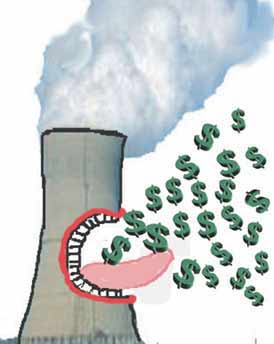
The Finnish Olkiluoto-3 nuclear reactor has been touted as the “flagship of European nuclear energy,” but has taken more than a decade to complete and cost the Nordic nation an arm and a leg.
When completed, the third reactor at Finland’s Olkiluoto nuclear power plant will have the distinction of being the world’s second most expensive building, higher than that of a number of luxury hotels, sports arenas, skyscrapers and even pyramids, Finnish national broadcaster Yle reported.
With a breathtaking price tag of €8.5 billion ($11 billion), Olkiluoto-3 is expected to be finished in 2019, 14 years after the start of the construction. For the sake of comparison, the Cheops Pyramid, the largest of the pyramids at Giza, took about 20 years to build. However, construction of the 4,500-year-old pyramid turned to be far more efficient, as it was built over roughly the same period of time and without access to modern technology. Also, its cost in today’s money has been estimated at only €4 billion ($4.9), half the Olkiluoto price tag.
To offer a more modern building for comparison, New York’s replacement One World Trade Center cost an estimated $3.8 billion to build. …….https://sputniknews.com/europe/201803191062679754-finland-npp-price/
Nuclearization and the public’s need to know
The Hill Times By MILAN ILNYCKYJ, PETER H. RUSSELL MAR. 19, 2018 The consequences of any large-scale nuclear attack are also now known. Unlike weapons tested in remote regions those targeted, as Russia’s and the U.S.’s are, on cities will inject masses of soot into the upper atmosphere dimming the sun for years with severe consequences for agriculture. Nuclear winter could result in omnicide: the extinction of most living creatures, including humankind.
TORONTO—For matters states keep secret, history unfolds in onion layers as memoirs are written and documents are declassified. This matter should be remembered when interpreting the world’s cautious relief about possible talks on denuclearization by Donald Trump and Kim Jung Un. These new accounts of possessing nuclear weapons make it nuclear that a nuclear detonation can arise as plausibly from a tool dropped in a silo as from a deliberate act of policy and that nuclear war is…….(subscribers only) https://www.hilltimes.com/2018/03/19/nuclearization-publics-need-know/137667
Fukushima Mother Calls at UN Rights Body Hearing for Full Implementation of “Fukushima Recommendations” by the Japanese Government

A message from Ms. Akiko Morimatsu, an evacuee from Fukushima
Northern Japan court rejects lawsuit against construction of Ohma nuclear plant

1 This Month
Chernobyl: The Lost Tapes – A good documentary on Chernobyl on SBS available On Demand for the next 3 weeks– https://www.sbs.com.au/ondemand/tv-program/chernobyl-the-lost-tapes/2352741955560

of the week–London Campaign for Nuclear Disarmament

Tell the Ukrainian Government to Drop Prosecution of Peace Activist Yurii Sheliazhenko
To see nuclear-related stories in greater depth and intensity – go to https://nuclearinformation.wordpress.com
-
Archives
- April 2026 (126)
- March 2026 (251)
- February 2026 (268)
- January 2026 (308)
- December 2025 (358)
- November 2025 (359)
- October 2025 (376)
- September 2025 (257)
- August 2025 (319)
- July 2025 (230)
- June 2025 (348)
- May 2025 (261)
-
Categories
- 1
- 1 NUCLEAR ISSUES
- business and costs
- climate change
- culture and arts
- ENERGY
- environment
- health
- history
- indigenous issues
- Legal
- marketing of nuclear
- media
- opposition to nuclear
- PERSONAL STORIES
- politics
- politics international
- Religion and ethics
- safety
- secrets,lies and civil liberties
- spinbuster
- technology
- Uranium
- wastes
- weapons and war
- Women
- 2 WORLD
- ACTION
- AFRICA
- Atrocities
- AUSTRALIA
- Christina's notes
- Christina's themes
- culture and arts
- Events
- Fuk 2022
- Fuk 2023
- Fukushima 2017
- Fukushima 2018
- fukushima 2019
- Fukushima 2020
- Fukushima 2021
- general
- global warming
- Humour (God we need it)
- Nuclear
- RARE EARTHS
- Reference
- resources – print
- Resources -audiovicual
- Weekly Newsletter
- World
- World Nuclear
- YouTube
-
RSS
Entries RSS
Comments RSS
 nuclear-news