Nucnet 16th March 2018, US-based Westinghouse Electric Company has completed a decommissioning
project at the Barseback nuclear power station in Sweden that included the
underwater segmentation and packaging of the reactor vessel internals.
Westinghouse said it had also carried out upfront engineering studies, and
equipment manufacturing and qualification for the project, which was part
of the first dismantling and decommissioning of a commercial nuclear power
plant in Sweden.
Barseback-2, a 600-MW boiling water reactor unit, began
commercial operation in July 1977 and was permanently shut down in May
2005, with decommissioning work beginning in August 2016. The closure
decision, announced in October 2004, followed what the government described
as failure to reach an agreement with the power industry on the details and
timetable for a voluntary phaseout of Sweden’s nuclear facilities Its
sister unit, Barseback-1, was permanently shut down in November 1999.
Westinghouse said it is now due to begin decommissioning work on
Barseback-1, with an estimated completion date of April 2019.
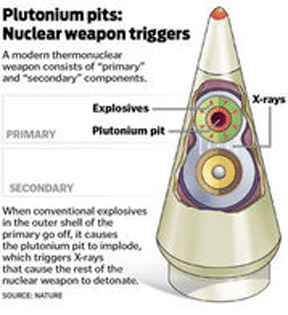
The U.S. military wants more plutonium triggers for nuclear warheads WP, By Paul SonneMarch 22 Email the author
The U.S. military is concerned that the government isn’t moving quickly enough to ramp up American production of the plutonium cores that trigger nuclear warheads, as the Trump administration proceeds with a $1 trillion overhaul of the nation’s nuclear force.
Questioning about production of the warhead cores is likely to figure into a testimony that Energy Secretary Rick Perry is slated to give Thursday to the Senate Armed Services Committee, a rare appearance by the top energy official at the Senate body that oversees the military.
Plutonium cores are often called plutonium pits because they rest inside nuclear bombs like pits inside stone fruits.
At issue is the Pentagon’s demand that the National Nuclear Security Administration — overseen by the Department of Energy — be able to produce 80 plutonium pits a year by 2030 to sustain the military’s nuclear weapons. Roughly the size of a grapefruit, plutonium pits that trigger warheads sometimes need to be replaced as they degrade or end up destroyed during evaluation……….
Since the fall of the Soviet Union, the United States has discontinued many of the nuclear weapons capabilities the nation built up during the Cold War. The United States began to rely largely on dismantling existing nuclear weapons for plutonium pits and stockpile management, as defense spending priorities diverted to the global war against terrorism.
Now the United States is facing a reckoning as Russia and China also race to advance their nuclear arsenals and much of the infrastructure the military relies on to support its nuclear capabilities ages out. The U.S. no longer operates the full range of facilities capable of producing new nuclear weapons.
……….Now the NNSA must decide how to expand production of plutonium pits to meet the Pentagon’s requirements by 2030. Under one option being considered, less ambitious “module” buildings would be constructed at the existing Los Alamos site.
An alternative would include repurposing one of the most problematic projects the Department of Energy has ever undertaken, the Mixed Oxide Fuel Fabrication Facility in South Carolina, to make pits.
Originally designed to turn weapons grade plutonium into commercial reactor fuel, the MOX facility is billions of dollars over budget and still only partially built.
Both the Obama and Trump administrations have tried to kill the project, but Congress has declined to discontinue construction owing primarily to political support from powerful members of the South Carolina delegation. Some have suggested transforming it to produce plutonium pits.
Saruhashi, born in Tokyo in 1920, lived through World War II as a young adult. Global events undoubtedly shaped her field of research.
Katsuko Saruhashi’s pioneering work
After graduating from Toho University (formerly the Imperial Women’s College of Science) in 1943, she went on to study carbon dioxide in ocean water at the Meteorological Research Institute. In 1957, she became the first woman in Japan to earn her PhD in chemistry from the University of Tokyo.
Few researchers were interested in studying carbon-dioxide levels in water when Saruhashi embarked on her work, which ended up being instrumental for decades. She penned the formula that would allow scientists to determine the amount of carbonic acid in oceans—now one of the hallmark measures of climate change—by hand. Now, researchers use computers for that task.
Saruhashi also studied the amount of radioactive isotopes of elements in seawater following nuclear- bomb test detonations. Working at the Central Meteorological Observatory, she found that tiny radioactive particles floating in the ocean waters along the coast of Japan resulting from the 67 nuclear explosions the US detonated in the Marshall Islands. “There was a controversy over her argument that the radioactive fallout in seawater was more than what they used to think,” Toshihiro Higuchi, a historian at Georgetown University, told the Verge.
Scientists at the US Atomic Energy Commission quickly became interested in her work, and invited Saruhashi to work at the Scripps Institution of Oceanography at UC San Diego to compare US methods of measuring these radioactive isotopes to those used by the Japanese. It wasn’t entirely a friendly working environment: One of her American male colleagues, Theodore Folsom, told her that there was no need for her to come into the office daily, and that instead she should work out of an isolated wooden hut (pdf, p. 4).
Nevertheless, Saruhashi persisted. Her analyses of radioactive isotopes were essentially identical to Folsom’s, despite her inferior working conditions.
Saruhashi became a beacon for women in science
Saruhashi became an advocate for her fellow female scientists and for world peace. In 1958, she co-founded Society of Japanese Women Scientists, and in 1981 established a prize in her name awarded annually to young Japanese female scientists for their excellence in research and mentorship. In 1980, she became the first woman elected to the Science Council of Japan, and went on to receive the Miyake Prize for geochemistry and the Tanaka Prize from the Society of Sea Water Sciences.
She died in September 2007, and her legacy as a scientist, pacifist, and feminist lives on. “I wanted to highlight the capabilities of women scientists,” she said. “Until now, those capabilities have been secret, under the surface.”
Best bad idea ever? Why Putin’s nuclear-powered missile is possible… and awful, Nuclear-powered cruise missiles? The US worked on them in the 1950s. Ars Technica, SEAN GALLAGHER–In a March 1, 2018 speech before Russia’s Federal Assembly, Russian President Vladimir Putin discussed new strategic weapons being developed to counter United States ballistic missile defenses. Two of these weapons are allegedly nuclear powered: a previously revealed intercontinental-range nuclear torpedo and a cruise missile. As Putin described them:
Russia’s advanced arms are based on the cutting-edge, unique achievements of our scientists, designers, and engineers. One of them is a small-scale, heavy-duty nuclear energy unit that can be installed in a missile like our latest X-101 air-launched missile or the American Tomahawk missile—a similar type but with a range dozens of times longer, dozens—basically an unlimited range. It is a low-flying stealth missile carrying a nuclear warhead, with almost an unlimited range, unpredictable trajectory and ability to bypass interception boundaries. It is invincible against all existing and prospective missile defense and counter-air defense systems.
Defense and nuclear disarmament experts did a double take. “I’m still kind of in shock,” Edward Geist, a Rand Corporation researcher specializing in Russia, told NPR. “My guess is they’re not bluffing, that they’ve flight-tested this thing. But that’s incredible.”
This is not the first time a government has worked on a nuclear-powered strategic weapon. Decades ago, the US developed engines first for a proposed nuclear-powered bomber and then for a hypersonic nuclear cruise missile. The US has also examined nuclear-powered rockets for space flight (that crazy Project Orion thing is a story for another time). These programs were all dropped, not because they didn’t work but because they were deemed impractical.
Oh… and there was always that small problem of radiation spewing from the engine exhaust.
So when Putin announced that Russia has tested the cruise missile engine successfully, it got us thinking about those past experiments in nuclear propulsion. Is it actually possible to create a nuclear reactor small enough and powerful enough to propel a cruise missile? We broke out our calculators, checked some engine ratings, and asked some experts in the field of nuclear physics.
Not everyone is sure that Russia is really this far along in developing a nuclear-powered cruise missile. But there’s plenty of evidence that they’re trying hard. An unnamed Defense Department source told Fox News recently that Russia had already crashed several test missiles in the Arctic. Other sources have suggested that the engines are still in testing and have thus far only been run with electric power.
Nuclear-powered flight is certainly possible, but it’s a terrible idea for all sorts of reasons. To understand how possible, yet horrible, it is, let’s consider the history of this absolutely insane but perfectly workable idea.
Blame Enrico FermiThe whole adventure into flying nuclear reactors began in 1942……………
The doomsday route
But even as nuclear-powered crewed aircraft were being abandoned, another bizarre chapter in nuclear aircraft propulsion was just getting started: Project Pluto…………….
At the same time Kennedy was scrapping the ANP program, the Livermore crew was finishing construction of a $1.2 million (in 1961 dollars) test facility at Jackass Flats, Nevada—Area 25 of the Nevada National Security Site. Jackass Flats has been home to all sorts of open-air testing of nuclear and ballistic missile systems, as well as depleted uranium weapons; it was also the proposed launch site for another bit of nuclear mad science, Project Orion—the idea of launching something into space using nuclear bombs as “pulse” propulsion.
Working with Vought, the aircraft company that built some of the US military’s earliest cruise missiles, Livermore researchers determined the requirements for the Pluto engine reactor:………..
The Soviet route
As with the US defense industry, the Soviets had competing design bureaus attempting to create nuclear aircraft. And just as with the US programs, the Soviets tried two different routes to nuclear-powered bombers. Neither design ever flew……….The only place the M-60 ever flew was on the pages of Aviation Week in 1958, where diagrams of the aircraft were run with an article claiming that a nuclear-powered supersonic bomber was being tested in the Soviet Union. It was an elaborate hoax………
Crawl out of the fallout
That wasn’t the end of nuclear-powered flight ideas, of course. NASA funded research into nuclear-powered thermal rockets in the 1960s and 1970s, and discussion of that sort of technology continues today as an option for interplanetary missions. But most people agreed that the risks of flying radiation-powered vehicles inside Earth’s atmosphere was too high even to consider testing them—that is, until the Russian Federation’s leadership decided the US was pushing the nuclear balance too far in its own favor.
It’s not clear whether the nuclear cruise missile engine Putin mentioned in his speech has been tested yet. Russian news outlet Vedomosti quoted a source in Russia’s military industry as saying that tests thus far have used “an electrical layout” to test the missile’s engine and not an actual nuclear reactor. But Russia does not appear to have been working hard on miniaturizing nuclear reactors.
Small-reactor technology has been advancing rapidly over the past decade. The US military has looked into using small modular reactors to power high-energy weapons and bases overseas. Other countries, including Russia, have continued research into molten-metal cooled reactors; it is rumored that the “Status-6” nuclear-powered “torpedo” Putin discussed in his speech is powered by a lead-bismuth reactor.
Putin said that the “innovative nuclear power unit” of Status-6 completed testing in December 2017 after a “test cycle that lasted many years.” Russia has been developing new reactors with lead-bismuth coolant for naval applications. Soviet “Alfa” class attack submarines were powered by lead-bismuth reactors, which are very tricky to maintain but deliver high power-to-weight ratios; the original test reactor for the “Alfa” class design (KM-1 in Sosnovy Bor) was decommissioned a year ago, and a new type of reactor was installed in its place.
A lead-bismuth reactor’s power-to-weight ratio may be perfect for a small drone submarine, but it may not be the ideal form for a missile’s engine. However, the thrust required to keep a cruise missile in flight is nowhere near what would be needed for a hypersonic missile or even a subsonic bomber.
The Williams F107 turbofan that powers the Tomahawk cruise missile puts out a thrust of 3.1 kiloNewtons (700 pounds). To fly the Tomahawk at its cruising speed of 550 mph (890 km/h), that means generating about 766 kilowatts of power. That’s well within the potential power range of a small modern nuclear reactor, according to Jeff Terry, professor of physics at Illinois Institute of Technology and an energy researcher. “One megawatt is certainly doable,” Terry said, since the core of the 85-megawatt High Flux Isotope Reactor at Oak Ridge National Laboratory is “the size of a beer keg.”
If the Russian designers of the engine for the as-of-yet-unnamed nuclear-powered cruise missile did not have any concerns about radiation shielding for anything other than the avionics, a small nuclear reactor could be incorporated into a cruise missile design. The missile could be launched with a booster and wait until it is at speed to take its reactor critical, as was planned with the SLAM.
From a deterrence standpoint, a nuclear-powered cruise missile is a destabilizing weapon. Its launch would not necessarily set off US early warning systems, and its flight path is unpredictable and long. It could be launched days or weeks before an intended attack, purposely avoiding areas where it could be detected and coming from directions that the US doesn’t watch for nuclear attacks. And if the missile uses a “direct” system like SLAM, it would spend that time spewing fallout wherever it flew, regardless of whether it ever executed its mission. In other words, just as US military planners in the 1960s found out, a nuclear cruise missile is a provocative weapon better suited to first strike than to deterrence.
Israel finally admitted it destroyed a Syrian reactor in 2007 — and set off a battle of egos, WP, By Ruth EglashMarch 22 JERUSALEM — Israel’s admission Wednesday that it was behind a mysterious attack on a suspected nuclear reactor in Syria more than a decade ago has caused a storm.
But not in the way one might think.
Within hours of the Israeli military censor permitting local media to publish most of the details of the 2007 air attack on a secret desert facility in northeastern Syria, as well as releasing blurry black-and-white video footage, former political and military leaders went to war over who should be credited for the operation.
In Israel’s eyes, the operation was a resounding success. It prevented its northern neighbor from obtaining nuclear capabilities. Ultimately, it also ensured that the Islamic State militant group would not possess nuclear weapons when it took over the region several years later.
But since Israel’s confirmation of its role in the airstrike, a battle has played out on Israeli television and radio and online, pitting two former Israeli prime ministers, Ehud Olmert and Ehud Barak; a former Mossad chief; and a former military intelligence chief against one another.
Israeli Defense Minister Avigdor Liberman later said he regretted allowing the material to be published.
When the US entered the nuclear age, it did so recklessly. New research suggests that the hidden cost of developing nuclear weapons were far larger than previous estimates, with radioactive fallout responsible for 340,000 to 690,000American deaths from 1951 to 1973.
From 1951 to 1963, the US tested nuclear weapons above ground in Nevada. Weapons researchers, not understanding the risks—or simply ignoring them—exposed thousands of workers to radioactive fallout. The emissions from nuclear reactions are deadly to humans in high doses, and can cause cancer even in low doses. At one point, researchers had volunteers stand underneath an airburst nuclear weapon to prove how safe it was:
The emissions, however, did not just stay at the test site, and drifted in the atmosphere. Cancer rates spiked in nearby communities, and the US government could no longer pretend that fallout was anything but a silent killer.
The cost in dollars and lives
Congress eventually paid more than $2 billion to residents of nearby areas that were particularly exposed to radiation, as well as uranium miners. But attempts to measure the full extent of the test fallout were very uncertain, since they relied on extrapolating effects from the hardest-hit communities to the national level. One national estimate found the testing caused 49,000 cancer deaths.
Those measurements, however, did not capture the full range of effects over time and geography. Meyers created a broader picture by way of a macabre insight: When cows consumed radioactive fallout spread by atmospheric winds, their milk became a key channel to transmit radiation sickness to humans. Most milk production during this time was local, with cows eating at pasture and their milk being delivered to nearby communities, giving Meyers a way to trace radioactivity across the country.
The National Cancer Institute has records of the amount of Iodine 131—a dangerous isotope released in the Nevada tests—in milk, as well as broader data about radiation exposure. By comparing this data with county-level mortality records, Meyers came across a significant finding: “Exposure to fallout through milk leads to immediate and sustained increases in the crude death rate.” What’s more, these results were sustained over time. US nuclear testing likely killed seven to 14 times more people than we had thought, mostly in the midwest and northeast.
A weapon against its own people
When the US used nuclear weapons during World War II, bombing the Japanese cities of Hiroshima and Nagasaki, conservative estimates suggest 250,000 people died in immediate aftermath. Even those horrified by the bombing didn’t realize that the US would deploy similar weapons against its own people, accidentally, and on a comparable scale.
And the cessation of nuclear testing helped save US lives—”the Partial Nuclear Test Ban Treaty might have saved between 11.7 and 24.0 million American lives,” Meyers estimates. There was also some blind luck involved in reducing the number of poisoned people: The Nevada Test Site, compared to other potential testing facilities the US government considered at the time, produced the lowest atmospheric dispersal.
The lingering effects of these tests remain, as silent and as troublesome as the isotopes themselves. Millions of Americans who were exposed to fallout likely suffer illnesses related to these tests even today, as they retire and rely on the US government to fund their health care.
“This paper reveals that there are more casualties of the Cold War than previously thought, but the extent to which society still bears the costs of the Cold War remains an open question,” Meyers concludes.
A U.S. Marine assists Japanese Self-Defense Force members in removing debris from the grounds of Minato Elementary School in Ishinomaki, Miyagi Prefecture, in this file photo taken on April 1, 2011.
TOKYO (Kyodo) — Some 200 U.S. residents filed a suit against Tokyo Electric Power Company Holdings Inc. and a U.S. firm seeking at least $1 billion to cover medical expenses related to radiation exposure suffered during the 2011 Fukushima nuclear disaster, the utility said Monday.
The lawsuit was filed last Wednesday with U.S. federal courts in the Southern District of California and the District of Columbia by participants in the U.S. forces’ Operation Tomodachi relief effort carried out in the wake of the March 11, 2011, earthquake and tsunami that crippled TEPCO’s Fukushima Daiichi nuclear plant.
Many of the plaintiffs are suing TEPCO and the U.S. company, whose name was withheld by TEPCO, for the second time after a similar suit was rejected by the federal court in California in January.
They are seeking the establishment of a compensation fund of at least $1 billion to cover medical and other costs, the utility said.
The plaintiffs claim that the nuclear accident occurred due to improper design and management of the plant by TEPCO. They are also seeking compensation for physical and psychological damage suffered as a result of the disaster, said the utility.
In Operation Tomodachi, which began two days after the natural disasters, the aircraft carrier Ronald Reagan and other U.S. military resources and personnel were deployed to deliver supplies and undertake relief efforts at the same time as three reactors at the Fukushima Daiichi complex suffered fuel meltdowns.
The No. 3 (right) and 4 reactors at Kyushu Electric Power Co.’s Genkai Nuclear Power Plant are seen in Genkai, Saga Prefecture, on March 13, 2018.
SAGA, Japan (Kyodo) — A district court in southwestern Japan on Tuesday rejected local residents’ request to suspend the planned restart of nuclear reactors in Saga Prefecture over safety concerns.
Some 70 people sought an injunction to halt the restart of the Nos. 3 and 4 reactors at the Genkai nuclear power plant of Kyushu Electric Power Co., scheduled for Friday and May, respectively, questioning safety standards and citing the risks of a volcanic eruption in the region.
But the Saga District Court’s Presiding Judge Takeshi Tachikawa said the utility’s safety measures are “reasonable” and that the court found “no specific risk of (the reactors) causing serious damage.”
The decision was in sharp contrast with a Hiroshima High Court ruling in December to halt the planned restart of a reactor of Shikoku Electric Power Co.’s Ikata plant on the grounds of a possible eruption of Mt. Aso.
As the 1,592-meter volcano is located some 130 kilometers from the Ikata plant, almost the same distance as from the Genkai plant, attention was on how the Saga court would evaluate the risk.
During the trial, the plaintiffs from Saga, Fukuoka, Nagasaki, Kumamoto and Yamaguchi prefectures expressed doubt about the credibility of the new safety standards introduced after the 2011 Fukushima nuclear disaster, saying they were compiled when the Fukushima crisis had yet to be resolved.
The plaintiffs also claimed that there is no measure to respond to a catastrophic volcanic eruption which cannot be forecasted.
Kyushu Electric argued it has taken safety steps and that there is no imminent danger of a serious accident.
In June last year, Judge Tachikawa dismissed a similar request from a different group of local residents for an injunction to stop the restart of the two Genkai plant reactors.
Separate from the lawsuits seeking injunctions, some 10,000 people in Japan and abroad have filed a suit demanding suspension of the Genkai reactors.
A Japanese woman who evacuated Fukushima after the 2011 nuclear accident has called for international support at the United Nations Human Rights Council.
Akiko Morimatsu delivered a speech at the Council in Geneva on Monday. She moved to Osaka with her 2 children after the accident.
Morimatsu criticized the Japanese government for focusing only on policies that encourage former residents to return to the affected areas.
She called on the international community for support to protect children from further radiation exposure.
A Japanese official said the government will do all it can to expedite reconstruction, keeping in mind that those affected still face difficulty in their daily lives.
The Human Rights Council recommended last November that Japan should continue to support affected residents and voluntary evacuees, in line with requests from Germany and other member states.
The Japanese government says it accepts Council recommendations related to the accident. But it also says it has been providing necessary support in accordance with laws.
The Oma nuclear plant (right) is shown under construction Monday in the town of Oma, Aomori Prefecture
HAKODATE, HOKKAIDO – A court has dismissed a request from residents of Hakodate, Hokkaido, for an injunction to halt the construction of Electric Power Development Co.’s nuclear power plant in the town of Oma, across the Tsugaru Strait in nearby Aomori Prefecture.
Handing down the ruling Monday at the Hakodate District Court, the presiding judge, Chikako Asaoka, said it is “difficult to assess the particular risk of a severe accident right now” because it is uncertain when the Oma plant will enter operation.
The ruling also noted that the plant being built by Electric Power Development, also known as J-Power, is undergoing Nuclear Regulation Authority screenings under new standards set after the March 2011 triple core meltdown at Tokyo Electric Power Company Holdings Inc.’s Fukushima No. 1 plant.
“It’s not reasonable for a court of law to conduct safety examinations without waiting for the NRA screenings,” the judge said.
The plaintiffs plan to appeal the ruling, which was the first on a nuclear plant under construction since the Fukushima disaster.
“It’s a terrible ruling that makes light of us,” said Toshiko Takeda, 69, the leader of the plaintiff group. “How did the court reflect on the Fukushima accident? It’s really mortifying.”
Construction on the Oma plant started in May 2008. It is about 23 km south of Hakodate, on the other side of the Tsugaru Strait.
In July 2010, a group of citizens including Hakodate residents sued the state and J-Power over the issue. The number of plaintiffs has since risen to 1,164.
The main issue in the lawsuit was the safety of the Oma plant, which will only burn mixed-oxide (MOX) fuel — a blend of uranium and weapons-grade plutonium extracted from spent fuel. The Oma plant will be the world’s first fully MOX-powered plant.
The plaintiffs demanded that the project be canceled, arguing that a MOX plant will pose a higher accident risk. They also claimed that the new regulatory standards are inadequate and that there are geographic faults around the plant site.
J-Power insisted that the use of MOX fuel will not necessarily make it difficult to control the reactors.
The Hakodate court admitted that an injunction against the Oma project could be issued if the regulatory standards contained irrational points. But it concluded that the standards could not be deemed to have such points.
Speaking to reporters in Mutsu, Aomori Prefecture, Oma Mayor Mitsuharu Kanazawa welcomed the ruling.
“We’ve awaited this result, as we hope to proceed steadily” with the nuclear plant project, Kanazawa said.
Separately from the citizens’ lawsuit, the Hakodate Municipal Government took similar action at the Tokyo District Court in 2014, unconvinced by the central government’s explanations about the Oma project.
A municipal official working on the Tokyo lawsuit said that an accident at the Oma plant could devastate the local fishing and tourism industries.
Hakodate Mayor Toshiki Kudo issued a statement saying that the ruling by the Hakodate court is very regrettable. “We will check details of the ruling to draw lessons for the city’s case.”
In effect, we are now seeing an egalitarian-individualist alliance against the conservative hierarchists.
even hierarchists cannot ignore economic reality entirely. The South Carolina project has beenabandoned and the Georgia project only survives through a very large federal loan bailout.
Contrast this with casino complexes in Nevada like MGM Resorts not only installing their own solar photovoltaic arrays but paying many millions of dollars to opt out from the local monopoly electricity supplier. They have campaigned successfully to win a state referendum supporting electricity liberalisation.
If recent trends continue for another two years, the global share of electricity from renewables excluding hydropower will overtake nuclear for the first time.
Even 20 years ago, this nuclear decline would have greatly surprised many people – particularly now that reducing carbon emissions is at the top of the political agenda.
On one level this is a story about changes in relative costs. The costs of solar and wind have plunged while nuclear has become almost astoundingly expensive.
Culture wars
The seminal text in this field, Risk and Culture (1982), by the British anthropologist Mary Douglas and American political scientist Aaron Wildavsky, argues the behaviour of individuals and institutions can be explained by four different biases:
Individualists: people biased towards outcomes that result from competitive arrangements;
Hierarchists: those who prefer ordered decisions being made by leaders and followed by others;
Egalitarians: people who favour equality and grassroots decision-making and pursue a common cause;
Fatalists: those who see decision-making as capricious and feel unable to influence outcomes.
The first three categories help explain different actors in the electricity industry. For governments and centralised monopolies often owned by the state, read hierarchists. For green campaigning organisations, read egalitarians, while free-market-minded private companies fit the individualist bias.
The priorities of these groups have not greatly changed in recent years. Hierarchists tend to favour nuclear power, since big power stations make for more straightforward grid planning, and nuclear power complements nuclear weapons capabilities considered important for national security.
Egalitarians like Greenpeace and Friends of the Earth usually oppose new nuclear power plant and favour renewables. Traditionally they have worried about radioactive environmental damage and nuclear proliferation. Individualists, meanwhile, favour whichever technologies reduce costs.
These cultural realities lie behind the problems experienced by nuclear power. To compound green opposition, many of nuclear power’s strongest supporters are conservative hierarchists who are either sceptical about the need to reduce carbon emissions or treat it as a low priority.
Hence they are often unable or unwilling to mobilise climate change arguments to support nuclear, which has made it harder to persuade egalitarians to get on board.
This has had several consequences.
Green groups won subsidies for renewable technologies by persuading more liberal hierarchists that they had to address climate change – witness the big push by Greenpeace and Friends of the Earth for the feed-in tariffs that drove solar uptake in the late 2000s, for example. In turn, both wind and solar have been optimised and their costs have come down.
Nuclear largely missed out on these carbon-reducing subsidies. Worse, greens groups persuaded governments as far back as the 1970s that safety standards around nuclear power stations needed to improve. This more than anything drove up costs. As for the individualists, they used to be generally unconvinced by renewable energy and sceptical of environmental opposition to nuclear. But as relative costs have changed, they have increasingly switched positions.
The hierarchists are still able to use monopoly electricity organisations to support nuclear power, but individualists are increasingly pressuring them to make these markets more competitive so that they can invest in renewables more easily.
In effect, we are now seeing an egalitarian-individualist alliance against the conservative hierarchists.
Both sides of the pond
Donald Trump’s administration in the US, for example, has sought subsidies to keep existing coal and nuclear power stations running.
This is both out of concern for national security and to support traditional centralised industrial corporations – classic hierarchist thinking.
Yet this has played out badly with individualist corporations pushing renewables. Trump’s plans have even been rejected by some of his own appointments on the Federal Energy Regulatory Commission.
In similarly hierarchist fashion, electricity supply monopolies in Georgia and South Carolina started building new nuclear power stations after regulatory agencies allowed them to collect mandatory payments from electricity consumers to cover costs at the same time.
Yet even hierarchists cannot ignore economic reality entirely. The South Carolina project has beenabandoned and the Georgia project only survives through a very large federal loan bailout.
Contrast this with casino complexes in Nevada like MGM Resorts not only installing their own solar photovoltaic arrays but paying many millions of dollars to opt out from the local monopoly electricity supplier. They have campaigned successfully to win a state referendum supporting electricity liberalisation.
The UK, meanwhile, is an example of how different biases can compete. Policy has traditionally been formed in hierarchical style, with big companies producing policy proposals which go out to wider consultation.
It’s a cultural bias that favours nuclear power, but this conflicts with a key priority dating back to Thatcher that technological winners are chosen by the market.
This has led policymakers in Whitehall to favour both renewables and nuclear, but the private electricity companies have mostly refused to invest in nuclear, seeing it as too risky and expensive.
The only companies prepared to plug the gap have been more hierarchists – EDF, which is majority-owned by France, and Chinese state nuclear corporations.
Even then, getting Hinkley C in south-west England underway – the first new nuclear plant since the 1990s – required an extensive commitment by the UK treasury to underwrite bank loans.
There is also an embarrassingly high price to be paid for the electricity over a very long 35-year period. Such has been the bad publicity that it’s hard to imagine a politician agreeing to more plant on such terms.
Where does this reality leave hierarchists? Increasingly having to explain prohibitive nuclear costs to their electorates – at least in democracies. The alternative, as renewable energy becomes the new orthodoxy, is to embrace it.
In Australia, for example, a big utility company called AGL is trying to seduce homeowners to agree to link their solar panels to the company’s systems to centralise power dispatch in a so-called a “virtual power plant”.
When the facts change, to misquote John Maynard Keynes, you can always change your mind.
Katharine Hayhoe Reveals Surprising Ways to Talk About Climate Change These climate-skeptic-whispering tactics have nothing to do with science Sierra BY KATIE O’REILLY | MAR 20 2018
Katharine Hayhoe on how to talk about climate change (highlights video)
Katharine Hayhoe isn’t your typical atmospheric scientist. Throughout her career, the evangelical Christian and daughter of missionaries has had to convince many (including her pastor husband) that science and religion need not be at odds when it comes to climate change. Hayhoe, who directs Texas Tech’s University’s Climate Science Center, is CEO of ATMOS Research, a scientific consulting company, and produces the PBS Kids’ web series “Global Weirding,” rose to national prominence in early 2012 after then-presidential candidate Newt Gingrich dropped her chapter from a book he was editing about the environment. The reason? Hayhoe’s arguments affirmed that climate change was no liberal hoax. The Toronto native attracted the fury of Rush Limbaugh, who encouraged his listeners to harass her.
After the ensuing deluge of hate mail, Hayhoe made a habit of reaching out to climate foes. Along with her husband Andrew Farley, she wrote A Climate for Change: Global Warming Facts for Faith-Based Decisions. She also authored 2014’s third National Climate Change Assessment for the National Academy of Sciences. Last year, Fortune magazine named Hayhoe one of the world’s 50 greatest leaders. While she frequently gives talks on climate science and faith, she often makes a point of keeping science out of her talks………..
Sierra: From a global perspective, the United States stands out for our considerable contingent of vocal climate change deniers. Why do you think this attitude is so uniquely American?
Katharine Hayhoe: There’s some of that sentiment in Australia as well, and in Alberta, the province known as the “Texas of Canada.” Interestingly, if you look across all countries’ fossil fuel resources and political positions on climate, you’ll find that economics doesn’t account for all of it. Fossil fuel influences certainly have an influence, but look at Norway—oil made them rich! One recent study concluded that the U.S. Republican Party is an anomaly. Social scientists study the characteristics of different cultures—some, for instance, are very hierarchical, some are very communal, and some are very independent. I can do it myself. If you correlate the predominance of rejection of climate science with the independence of the culture, I’d bet you anything you’d find a significant correlation. The U.S. is the most culturally independent country in the world, followed by Australia, and then Alberta is much more independent-minded than other Canadian provinces.
Where does this independence stem from?
It comes from the ruggedness of the terrain and the challenges that people had to overcome and endure—and the recency of those struggles.
……. Of course, fighting climate change requires people to work together for the benefit of the entire community—to not just go it alone. When you try to talk climate action to resilient pioneer types, they’re often hearing that the government is gonna be their nanny and pick their car, set their thermostat, limit their water, and tell them what they can and can’t do. And rugged individualists do not need a nanny. They believe the government wants to take away their freedom, and what’s more American than freedom?…….
So how can you make tough, self-reliant, freedom-loving types care about climate change?
That’s the real problem because no one thinks it really matters. Even the people who think it’s really important don’t tend to think it affects them. Particularly if you’re not already a dyed-in-the-wool environmentalist, climate action has be be framed as something that’s a natural expression of something you already are—something that makes you feel like a better version of yourself. ……. So when we have these conversations, we need to start from a place of genuine appreciation of values we share with that person or that group…… https://www.sierraclub.org/sierra/katharine-hayhoe-reveals-surprising-ways-talk-about-climate-change
Hero rescues pets from Fukushima nuclear wasteland
The 3/11 kitten that wasn’t The “forbidden life” of those caring for abandoned animals in Fukushima, Beyond Nuclear , By Linda Pentz Gunter, 20 March 18 “………. countless animals were indeed abandoned in Japan due to the natural disasters and the forced exile of those living too close to the stricken nuclear plant. Some international rescue groups did go in to try to help, but early on found conditions and access restrictions challenging if not prohibitive.
However, there were also individuals and groups in Japan who were not willing to sit back and watch animals starve. In addition to the rescue operations, a spay-neuter organization began work to prevent the inevitable proliferation of pets who, if they had survived at all, had now become strays. Shelters were eventually built with funds donated by supporters.
But there were some, chronicled in several remarkable films, who either never left, or who quickly returned to Fukushima Prefecture, with one sole purpose in mind: to look after the animals. Their charges soon multiplied and for some, it has become a full-time vocation.
In a 2013 ITN short news segment, we are introduced to 58-year old Keigo Sakamoto, who had already established an animal sanctuary in Nahara, just over 12 miles from the Fukushima plant. He was one who refused the order to evacuate, then found himself completely trapped within the zone, cut off from supplies. He survives on the generosity of individuals and stores outside the zone where he regularly collects discarded food and other supplies essential to keeping his animals — and himself — alive.
Then there are farmers who returned to save their livestock. One such, 53-year old Naoto Matsumura, is featured in the 18-minute Vice documentary, Alone in the Zone. He lives in what was then the ghost town of Tomioka — whose station reopening story we featured last week. But Matsumura could not accept the idea that dogs, cows, goats, ducks and even ostriches should be cast off without a care.
At first he evacuated with his family, fearing all the reactors were going to blow. But when his family faced rejection by relatives who said they were “contaminated”, and the hassle of evacuation shelters became unendurable, he returned home alone. And stayed. “I couldn’t leave the animals behind,” he said. “I am opposed to killing off the animals in the zone.”
Feeding them, and refusing to sign the “death warrant” requirement from the government, will, he hopes, spare them from slaughter. “So many of their fellow cattle died in pain,” he said, recalling the tragedy of cows left in barnes to starve. “To me, animals and people are equal.” ……https://beyondnuclearinternational.org/2018/03/16/the-3-11-kitten-that-wasnt/
https://mainichi.jp/english/articles/20180320/p2g/00m/0dm/023000c(Mainichi Japan) TOKYO (Kyodo) — Some 200 U.S. residents filed a suit against Tokyo Electric Power Company Holdings Inc. and a U.S. firm seeking at least $1 billion to cover medical expenses related to radiation exposure suffered during the 2011 Fukushima nuclear disaster, the utility said Monday.
The lawsuit was filed last Wednesday with U.S. federal courts in the Southern District of California and the District of Columbia by participants in the U.S. forces’ Operation Tomodachi relief effort carried out in the wake of the March 11, 2011, earthquake and tsunami that crippled TEPCO’s Fukushima Daiichi nuclear plant.
Many of the plaintiffs are suing TEPCO and the U.S. company, whose name was withheld by TEPCO, for the second time after a similar suit was rejected by the federal court in California in January.
They are seeking the establishment of a compensation fund of at least $1 billion to cover medical and other costs, the utility said.
The plaintiffs claim that the nuclear accident occurred due to improper design and management of the plant by TEPCO. They are also seeking compensation for physical and psychological damage suffered as a result of the disaster, said the utility.
In Operation Tomodachi, which began two days after the natural disasters, the aircraft carrier Ronald Reagan and other U.S. military resources and personnel were deployed to deliver supplies and undertake relief efforts at the same time as three reactors at the Fukushima Daiichi complex suffered fuel meltdowns.
With Russia building floating nuclear reactors and possibly testing nuclear-powered cruise missiles, there are good reasons for this training.The Drive, BY JOSEPH TREVITHICKMARCH 20, 2018The U.S. military, along with other federal and state authorities, has been training to respond to potentially dangerous releases of radioactive material in and around the Arctic. Though there is no clear indication of a direct link between Russia’s reported tests of nuclear-powered missiles or expanding use of nuclear power in the region, it is hard not to see these exercises in connection with those developments.
Earlier in March 2018, members of the U.S. National Guards from 10 different states arrived at the Donnelly Training Area, situated near the U.S. Army’s Fort Greely in Alaska. Alaska state authorities and members of Canada’s reserve 39 Canadian Brigade Group joined the exercise, nicknamed Arctic Eagle 2018, as well.
The drills included a number of different mock crises, including an overturned fuel truck creating a hazardous material spill, the potential for attacks on the Trans Alaskan Pipeline System, and even cyber attacks. But especially notable was a scenario involving the need to locate a crashed satellite and contain the radiological material it had deposited across a wide area as it plummeted to earth. ………
t’s definitely no secret that the U.S. military has become increasing interested in preparing for potential conflicts and other contingencies above and near the Arctic Circle in recent years. As global climate change has shrunk the polar ice cap and otherwise reduced the amount of ice buildup that occurs during certain parts of the year, the region has become increasingly important economically and various countries, especially Russia, have moved to enforce their territorial claims.
“The growing concerns regarding the increased number of nations competing for Arctic resources are well justified,” U.S. Air Force General Lori Robinson, head of U.S. Northern Command, which oversees operations in the region, and the designated “Advocate for Arctic Capabilities” within the Pentagon, reiterated to members of Congress during a hearing in February 2018. “Diminishing sea ice provides opportunities for significantly expanded access to a region that had previously been inaccessible to all but a handful of northern nations.”
…….. the idea of a crashing satellite creating a radiological disaster isn’t an entirely fictional scenario. In 1978, the Soviet Union’s Kosmos 954 reconnaissance satellite, which had a nuclear reactor as its power source, crashed into Canadian territory, touching off an international incident and prompting an expensive response and clean-up operation.
….. U.S. military and other agencies practicing specifically to handle a radiological incident in the region seems even more noteworthy in light of a number of recent events. Most importantly are Russian claims that it has been testing a cruise missile with theoretically unlimited range that uses a nuclear reactor-powered propulsion system in the Arctic. Anonymous U.S. government officials have since told various media outlets that this is true, but that the weapons have been crashing, potentially spreading radioactive material and components.
…… The Russians have also been dramatically expanding their use and plans to employ small and mobile nuclear reactors to support activities in the Arctic.
……..If any of these nuclear power systems were to fail, it could potentially cause a serious radiological incident that would impact both the United States and Canada. The same procedures American military and other government personnel have been training to employ in response to a crashed satellite would undoubtedly be applicable in those situations, too.






 nuclear-news