Australia could be in for a lecture from New Zealand on nuclear weapons disarmament.
Fukushima seafood ban
2018-02-25
Korea should strive to prove harmful effects

South Korea has decided to appeal the World Trade Organization’s ruling on its seafood import restrictions imposed following the 2011 Fukushima nuclear disaster.
The decision came after a WTO dispute panel ruled the restrictions were justified right after the nuclear meltdown, but continuing them violated the WTO’s sanitary and phytosanitary (SPS) agreement.
The ruling, however, does not mean the Seoul government should lift the limits immediately. As it decided to appeal, the country can keep them in place until the world body makes a final ruling which may come in the latter half of the year at the earliest.
Whatever the reason, the government should take the responsibility for losing out to Japan. It has taken only seven samples of affected Japanese seafood. It has failed to publish any reports about this matter in the past seven years. In addition, a committee of civilian radioactivity experts stopped its operations monitoring Japanese seafood. In a word, the authorities were ill-prepared for the dispute.
The seafood row began in May 2015 when the neighboring country filed a complaint against Korea over the restrictions. Korea imposed an import ban on 50 types of seafood caught in the waters near the disaster area. It also took further steps to limit fishery imports from seven other prefectures in 2013.
Those measures were to protect Korean consumers from the potential harmful effects of radioactive contamination. But the government has so far failed to prove such effects exist. Thus, it is no surprise Japan won the case.
Now, related government ministries and agencies should waste no efforts to collect scientific and objective data to prove the harmful effects. They also need to address Japan’s refusal to cooperate in probing seawater contamination near the disaster-hit area.
South Korea also needs to ask for help with 24 countries, including the U.S., Russia and Argentina, which also took measures against Japanese seafood after the Fukushima catastrophe. It must keep in mind that food safety is crucial to ensuring the people’s health.
New Zealand Prime Minister may pressure Australia to join the UN nuclear weapons ban
 NZ may lobby Aust on nuclear weapons ban New Zealand Prime Minister Jacinda Ardern is headed across the ditch for talks with Malcolm Turnbull at the end of the week. SBS News 27 Feb 18
NZ Prime Minister Jacinda Ardern will visit Australia for talks with Prime Minister Malcolm Turnbull at the end of the week.
She’ll be accompanied by Deputy Prime Minister Winston Peters, seven cabinet ministers and a business delegation.
Ms Ardern delivered a major foreign policy speech to the New Zealand Institute of Public Affairs on Tuesday and announced her government will reinstate the cabinet position of disarmament and arms control minister.
Last July, 122 countries voted in the United Nations to ban nuclear weapons.
Ms Ardern flagged in the speech her government was looking at an early ratification of the treaty.
“In a modern context, the greatest challenge comes from North Korea, situated right here in our region,” she said.
“At a time when risks to global peace and security are growing and the rules-based system is under such pressure, we must recommit ourselves to the cause of non-proliferation and disarmament.”
Australia has refused to sign up to the treaty ban and did not take part in the negotiations.
The country relies on the deterrent protection from the US’s nuclear weapons arsenal.
New Zealand has long adopted a firm line in opposing development of nuclear capabilities, which at times puts the small Pacific nation at odds with some allies.
……… Asked if she’ll raise the issue with Mr Turnbull, Ms Ardern told reporters in Wellington: “I have no qualms having conversations about it.”……. NZ also has an ongoing offer to resettle 150 refugees from Nauru and Manus Island, which has previously been rejected……..https://www.sbs.com.au/news/nz-may-lobby-aust-on-nuclear-weapons-ban
Navajo, Havasupai resist uranium mining
By Williams-Grand Canyon News , 27 Feb 18, SUPAI, Ariz. – Vice President Jonathan Nez joined Arizona State Rep. Eric Descheenie and six other runners on a run to the village of Supai Feb. 14 to collect handwritten letters from the students of Havasupai Elementary School.
The letters are addressed to U.S. President Donald Trump in response to speculation that he plans to lift a 20-year ban on uranium mining in the greater Grand Canyon region, which was established by the Obama administration in 2012.
“We came to support the efforts of Representative Eric Descheenie and the Havasupai tribe to elevate the voice of the Havasupai youth.” Vice President Jonathan Nez said. “Their voice needs to be heard, especially on issues that impact their health and way of life.”
“Uranium has killed fathers and grandfathers and great-grandfathers across the Navajo Nation. It has contaminated the water supply in numerous areas poisoning plants, animals and people. For this reason, mining and transportation of uranium are banned on Diné Bikéyah, said Vice President Nez.
At an assembly held at the school Rep. Descheenie said, “We are going to make sure your words are received and read by the president of the United States so when he makes decisions that impact your lives he does so with you in mind. You have a powerful voice and it must be heard.”
Rep. Eric Descheenie and Havasupai Chairwoman Carletta Tilousi are scheduled to hand-deliver the letters to the White House Feb. 14 at 9 p.m. …….. https://www.grandcanyonnews.com/news/2018/feb/27/navajo-havasupai-resist-uranium-mining/
A forgotten nuclear disaster? 1985 Russian submarine accident
In 1985, a Russian Submarine Created an Atomic Disaster. The Radiation Lingers to This Day. Kyle Mizokami, 27 Feb 18,
According to Nuclear Risks, the accident scene was heavily contaminated with radioactivity. Gamma ray radiation was not particularly bad; at an exposure rate of five millisieverts per hour, it was the equivalent of getting a chest CT scan every hour. However, the explosion also released 259 petabecquerels of radioactive particles, including twenty-nine gigabecquerels of iodine-131, a known cause of cancer. This bode very badly for the emergency cleanup crews, especially firefighters who needed to get close to the explosion site, and the nearby village of Shkotovo-22. Forty-nine members of the cleanup crew displayed symptoms of radiation sickness, ten of them displaying acute symptoms.
In 1985, a Soviet submarine undergoing a delicate refueling procedure experienced a freak accident that killed ten naval personnel. The fuel involved was not diesel, but nuclear, and the resulting environmental disaster contaminated the area with dangerous, lasting radiation. The incident, which remained secret until after the demise of the USSR itself, was one of many nuclear accidents the Soviet Navy experienced during the Cold War.
The Soviet Union’s nuclear war planners had a difficult time targeting the United States. While the United States virtually encircled the enormous socialist country with nuclear missiles in countries such as Turkey and Japan, the Western Hemisphere offered no refuge for Soviet deployments in-kind.
One solution was the early development of nuclear cruise missile submarines. These submarines, known as the Echo I and Echo II classes, were equipped with six and eight P-5 “Pyatyorka” nuclear land attack cruise missiles, respectively. Nicknamed “Shaddock” by NATO, the P-5 was a subsonic missile with a range of 310 miles and 200- or 350-kiloton nuclear warhead. The P-5 had a circular error probable of 1.86 miles, meaning half of the missiles aimed at a target would land within that distance, while the other half would land farther away.
The missiles were stored in large horizontal silos along the deck of the submarine. In order to launch a P-5 missile, the submarine would surface, deploy and activate a tracking radar, then feed guidance information to the missile while it flew at high altitude. The system was imperfect—the command link was vulnerable to jamming, and the submarine needed to remain on the surface, helpless against patrol aircraft and ships, until the missile reached the target. Eventually the P-5 missiles were withdrawn and the P-5 missile was replaced with the P-6, a similar weapon but one with its own radar seeker for attacking U.S. aircraft carriers.
The introduction of the P-6 gave the Echo II a new lease on life. ……
On August 10, the submarine was in the process of being refueled. Reportedly, the reactor lid—complete with new nuclear fuel rods—was lifted as part of the process. A beam was placed over the lid to prevent it from being lifted any higher, but incompetent handling apparently resulted in the rods being lifted too high into the air. (One account has a wave generated by a passing motor torpedo boat rocking the submarine in its berth, also raising the rods too high.) This resulted in the starboard reactor achieving critical mass, followed by a chain reaction and explosion.
The explosion blew out the reactor’s twelve-ton lid—and fuel rods—and ruptured the pressure hull. The reactor core was destroyed, and eight officers and two enlisted men standing nearby were killed instantly. A the blast threw debris was thrown into the air, and a plume of fallout 650 meters wide by 3.5 kilometers long traveled downwind on the Dunay Peninsula. More debris and the isotope Cobalt-60 was thrown overboard and onto the nearby docks.
According to Nuclear Risks, the accident scene was heavily contaminated with radioactivity. Gamma ray radiation was not particularly bad; at an exposure rate of five millisieverts per hour, it was the equivalent of getting a chest CT scan every hour. However, the explosion also released 259 petabecquerels of radioactive particles, including twenty-nine gigabecquerels of iodine-131, a known cause of cancer. This bode very badly for the emergency cleanup crews, especially firefighters who needed to get close to the explosion site, and the nearby village of Shkotovo-22. Forty-nine members of the cleanup crew displayed symptoms of radiation sickness, ten of them displaying acute symptoms. …….
The K-431 incident was one of several involving Soviet submarine reactors. Ten Soviet submarines experienced nuclear accidents, and one other, K-11, also suffered a refueling criticality….http://nationalinterest.org/blog/the-buzz/1985-russian-submarine-created-atomic-disaster-the-radiation-24669
Norway and Finland find tiny amounts of recently released radioactive particles in the air
 Barents Observer 26th Feb 2018. Finland’s Radiation and Nuclear Safety Authority (STUK) says tiny amounts
of radioactive iodine-131 were measured in the air Kotka, east of Helsinki
in late January. The same isotope was then measured again last week north
to Kajaani. The levels were very low, ranging from 0,7 to 1,6
micro-becquerel per cubic meter air, STUK says in a news release
From where the radioactivity is coming is still unknown. Radioactive iodine-131
has a half-life of only eight days so the measurements are proof of a
rather recent release.
The source could be a nuclear reactor, a facility
producing isotopes for medical purposes or by releases from a nuclear
weapons related test. Norway’s Radiation Protection Authority (NRPA) on
Monday confirms detection of radioactive iodine also at several of the
country’s air-measurement stations.
https://thebarentsobserver.com/en/ecology/2018/02/traces-radioactive-iodine-air
Global energy business is being transformed by cheap renewables
IEEFA 21st Feb 2018, We’ve just posted a research brief explaining through a telling combination of charts (and some written analysis) how the fast-growing
uptake of wind and solar around the world continues to shape
electricity-generation trends.
The phenomenon is unfolding across diverse
groups of markets that include ones in Latin America, the Middle East, and
the U.S. We note in the brief— “Cheap Renewables Are Transforming
Global Electricity Business”—how installations of wind and solar
totalled almost 155 gigawatts (GW) last year, actually outpacing coal-fired
power plant development.
We also note how lowest bids for solar dropped a
remarkable 50 percent from records set in 2014 and 2015, as solar power
continued its long-established expansion.
http://ieefa.org/ieefa-update-cheap-renewables-transforming-global-electricity-business/
Delay in transporting spent nuclear fuel from Japan’s closed Fugen reactor
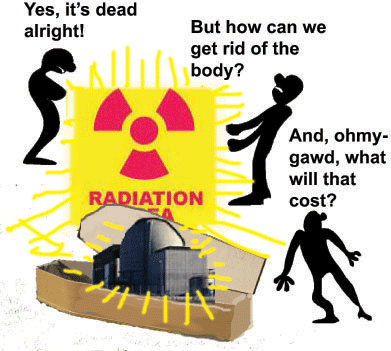 Mainichi 26th Feb 2018, The transportation of spent nuclear fuel from the site of the Fugen
prototype advanced converter reactor in central Japan will be postponed by
nine years to fiscal 2026 as a reprocessing facility has yet to be
determined, its operator said Monday.
Japan Atomic Energy Agency President Toshio Kodama announced the delay in a meeting with Fukui Gov. Issei
Nishikawa. The state-backed agency had initially aimed to complete
transportation of the fuel from the reactor in Tsuruga, Fukui Prefecture,
by next month. It was originally planned that the reprocessing facility in
Tokaimura, Ibaraki Prefecture, would receive the fuel, but the agency
decided in 2014 to scrap the plant due to the difficulty of satisfying
tighter safety regulations adopted following the 2011 Fukushima nuclear
crisis.
The agency had been looking to transport the fuel overseas for
reprocessing but discussions have not gone smoothly, sources close to the
matter said. The Fugen reactor is currently undergoing decommissioning
after being shut down in March 2003 without the prospect of being put to
commercial use, as a project to build a next-stage experimental reactor was
scrapped due to its high cost. Operation of the reactor started in 1979.
https://mainichi.jp/english/articles/20180226/p2g/00m/0dm/071000c
UWI researchers explore risks of medical treatments that involve radiation
Radiation warning! UWI researchers explore risks of medical treatments that involve radiation http://www.jamaicaobserver.com/news/radiation-warning-uwi-researchers-explore-risks-of-medical-treatments-that-involve-radiation_125898?profile=1373 BY FALON FOLKES, Staff reporter folkesf@jamaicaobserver.com, February 25, 2018
RESEARCHERS at The University of the West Indies (UWI) are working assiduously to gather information to educate Jamaicans about the risks of treatments that involve too much exposure to radiation.
The medical use of radiation is known for being the largest, man-made contribution to the overall annual radiation dose of humans receive.
An overview of the researchers’ study mentioned that, according to the World Health Organisation, more than 3.6 billion diagnostic examinations, 37 million nuclear medicine procedures and 7.5 million radiotherapy treatments are executed annually.
Head of the materials and Medical Physics Research Group, Professor Mitko Voutchkov, explained to the Jamaica Observer that radiation damages the (deoxyribonucleic acid) of the healthy tissue cells in one’s body.
“Cancer is the tissue cells that don’t have biological function. Interestingly, they grow quickly and the cancer spreads all over the body. So this is the radiation effect-radiation damage the cells,” he said.
In addition to this, radiation can also cause hair loss, redness of the skin, radiation burns, fatigue, and even osteoporosis, which is a medical condition in which a person’s bones become brittle and fragile.
“The risk comes from the medical diagnostics, especially if you go very frequently to CT (computed tomography) scan. If you do one or two per year it’s fine, but sometimes it [one’s illness] will require much more,” Professor Voutchkov explained.
“MRI (magnetic resonance imaging) is not so much damaging. If they can have an MRI instead of CT scan, let them choose that,” he added.
With the rapid advancements in technology, modern medical radiation equipment are emitting higher radiation doses. The researchers are concerned about people’s risk of overexposure to this man-made radiation.
The research group’s priority is creating a radiation safety culture in medical radiation imaging and radiotherapy. A part of this mandate requires them to carry out “regular quality control and calibration of medical radiation equipment”.
A survey was done on radiological safety practices in diagnostic centres in Jamaica, to assess their compliance with the Nuclear Safety and Radiation Protection Act. Additionally, a control study was conducted in a New York hospital to compare the radiation safety and management practices to that of Jamaica.
The recommendation arising from these studies is that, a management system is needed to keep records of the dose measurements, storage of dosimeters (a device that keeps track of a person’s exposure to radiation), and their safe use.
It is Professor Voutchkov’s notion that Jamaica’s patients need to be educated on the effects that radiation can have on them when they do treatments at diagnostic centres.
“I travel abroad and I see everywhere that they have videos, they have brochures, so the patients, they get prepared, so they accept the risk. Here, we have nothing,” he said.
With adequate information, he told the Sunday Observer, patients can decide whether or not to consult their general practitioner about alternative treatments, where possible.
As for the diagnostic centres, the professor recommends that equipment be checked for radiation levels to which patients are exposed. He asserted that new diagnostic techniques are developed to lower radiation dose, because radiation use during medical diagnostics should be limited.
Flamanville EPR: defects affect secondary circuit welds in nuclear reactor
Actus Environnement 23rd Feb 2018, [Machine Translation] The welds of the Flamanville EPR would not meet all the technical requirements. ASN will give its opinion in the second half of 2018. It also
mentions dysfunctions in the organization of the site.
On February 22nd, EDF announced that it had detected defects in the secondary circuit welds
of the EPR reactor under construction in Flamanville (Manche). In question:
the quality of realization of the welds of the circuit which evacuates
steam of the steam generators towards the turbine.
Thirty-eight of the 66 welds in the circuit are affected. Questioned on the subject in the
National Assembly, Pierre-Franck Chevet, president of the Nuclear Safety
Authority (ASN), described the subject as “serious” .
This Friday, the ASN publishes a note in which it indicates to have questioned February 7 EDF
and Framatome about the site of the EPR. The gendarme of the nuclear
indicates that it “informed EDF and Framatome that it will collect the
opinion of the permanent group of experts for GP ESPN nuclear pressure
equipment [about the anomalies of welding]” . But, assures EDF, “[the]
pipes are in compliance with the regulation of nuclear pressure equipment”
The company ”
https://www.actu-environnement.com/ae/news/defauts-soudures-circuit-secondaire-epr-flamanville-30722.php4#xtor=ES-6
Increasingly, cities are headed for 100% renewable energy
 Guardian 27th Feb 2018 The number of cities reporting they are predominantly powered by clean energy has more than doubled since 2015, as momentum builds for cities around the world to switch from fossil fuels to renewable sources.
Data published on Tuesday by the not-for-profit environmental impact researcher CDP found that 101 of the more than 570 cities on its books sourced atleast 70% of their electricity from renewable sources in 2017, compared to
42 in 2015. Nicolette Bartlett, CDP’s director of climate change,
attributed the increase to both more cities reporting to CDP as well as a
global shift towards renewable energy. The data was a “comprehensive
picture of what cities are doing with regards to renewable energy,” she
told Guardian Cities. In Britain, 14 more cities and towns had signed up to
the UK100 local government network’s target of 100% clean energy by 2050,
bringing the total to 84.
Among the recent local authority recruits were Liverpool City Region, Barking and Dagenham, Bristol, Bury, Peterborough, Redcar and Cleveland.
But the CDP data showed 43 cities worldwide were already entirely powered by clean energy, with the vast majority (30) in Latin America, where more cities reported to CDP and hydropower is more widespread. The Icelandic capital Reyjkavik, sourcing all electricity from hydropower and geothermal, was among them. It is now working to make all
cars and public transit fossil-free by 2040.
https://www.theguardian.com/cities/2018/feb/27/cities-powered-clean-energy-renewable
Climate change’s great threat to global health
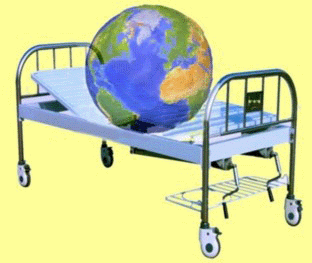 Impact of climate change on health is ‘the major threat of 21st century’ Skeptical Science [good graphs], 26 February 2018 This is a re-post from Carbon Brief by Daisy Dunne
The health of millions of people across the world is already being significantly harmed by climate change, a major new report finds.
From driving up the number of people exposed to heatwaves to increasing the risk of infectious diseases, such as dengue fever, climate change has had far-reaching effects on many aspects of human health in last few decades, the authors say.
In fact, the effect of climate change on human health is now so severe that it should be considered “the major threat of the 21st century”, scientists said at a press briefing held in London.
The report is the first from the Lancet Countdown on Health and Climate Change, a project involving 24 academic institutions and intergovernmental organisations from across the world. The project plans to release a report tracking progress on climate change and global health every year.
Feeling the heat
The report uses a set of 40 indicators to track the effects of climate change on global health. The first of these indicators assesses the “direct impacts” of climate change on human health, including the effects of exposure to extreme heat and natural disasters.
One of the report’s findings is that, from 2000 to 2016, the rise in the average temperatures that humans were exposed to was around three times higher than the rise of average global temperatures worldwide….
he average temperatures that humans are exposed to are significantly higher than the global surface average because most people live on land, where warming happens most quickly, explains Prof Peter Cox, an author of the new report and a climate scientist at the University of Exeter. He tells Carbon Brief:
“Generally speaking, when you look at where people are, the rate of change appears much larger than when we look at global averages. So maybe when we think about global targets, we should be always bearing in mind that the global mean temperature doesn’t really mean much to most people. We don’t live on the ocean, which is two-thirds of the global mean. We live on the land, and on the land that tends to warm fastest.”
The report also finds the number of “vulnerable” people exposed to “heatwave” events increased by around 125 million between 2000 and 2016. “Vulnerable” is here defined as being over the age of 65, while a “heatwave” is defined as three consecutive nights where temperatures are in the top 1% of the 1986-2006 average for the region.
In 2015, a record 175 million more people were exposed to heatwaves, when compared to the average for 1986-2008, the report finds
These spikes in exposure are a result of an increase in heatwave events, as well as other environmental and social factors, including population growth, Cox says.
Heatwave exposure has previously been linked to an increased risk of premature death in many parts of the world, he explains:
“During the 2003 European heatwave, there were 75,000 extra premature deaths in Europe, including 2,000 in the UK. That was mainly because of people not being able to recover, and I guess breathing gets harder when it’s hot too. There is a correlation between these periods of hot nights and mortality. I suspect there must be a correlation with ill health as well.”
Natural disasters
The report finds that the number of weather-related disasters from 2007 to 2016 increased by 46%, when compared with the average for 1990-1999.
Asia is the continent most affected by weather-related disasters, the report says – particularly because of its size and population. Between 1990 and 2016, 2,843 weather-related disasters were recorded in Asia, affecting 4.8 billion people and causing more than 500,000 deaths……..
Losses to the global workforce
Another set of indicators explored by the report look at the “human-mediated” impacts of climate change. These are impacts that are intrinsically linked to human society, but often exacerbated by climate change.
The first of these indicators explores how climate change has affected the productivity of the global workforce, particularly in the less economically-developed parts of the world. The report finds that the global productivity in rural labour capacity – defined as those who work in outdoor manual labour in rural areas, but excluding agricultural workers – has fallen by 5.3% from 2000 to 2016……….
Infectious diseases
The report also investigates the “environment-mediated” impacts of climate change. These are impacts on human health that are caused by environmental factors but can be worsened by climate change.
One such impact is the spread of infectious diseases around the globe. Rising temperatures can increase the spread of infectious diseases by allowing pests to conquer new parts of the world, as well as by creating ideal conditions for reproduction and virus replication.
Climate change has affected the prevalence of many infectious diseases, the report notes. However, as an example, the report focuses on how climate change has impacted the spread of dengue fever, a disease spread by mosquitoes native to much of southeast Asia, central and south America, and Africa………. https://www.skepticalscience.com/impact-cc-on-health-major-threat-21st-century.html
North Pole could be headed for disappearance within a relatively short time
There could be just two years left before the North Pole disappears, news.com.au, Charles Firth, DECEMBER 7, 2016
RIGHT now it’s an unprecedented 22 degrees hotter than normal in the Arctic, and in just two years the North Pole could be completely gone.
“…….Santa is a fantasy but climate change is not, and it’s started to do truly alarming things to the North Pole.
Over the past few weeks the temperature of the North Pole has been 22 degrees hotter than the average temperature for this time of year. That’s not a typo. It’s not 2.2 degrees hotter. It’s 22 degrees Celsius hotter.
The reason it’s such a huge difference is because even though night is now falling, the temperature around the poles is still getting hotter rather than colder. That’s never happened before. What it means is that the gap between average temperature and this year’s temperature is getting wider and wider by the day……..
In salt water, minus five degrees (which is the current air temperature in the North Pole) is too warm for ice to form. That means the planet’s natural airconditioner (and sun reflector) is not regrowing back this winter. Two of the ways the earth keeps itself cool have just broken down……..
The ice caps melt because it’s getting warmer and then because the ice caps have melted, the earth gets even warmer even faster.
Peter Wadhams, a professor of Ocean Physics at Cambridge University, now reckons that it could be as little as two years before ice disappears completely from the North Pole during the summer months………
In addition to the environmental implications, the cultural implications of this are also huge.
We will need to start changing the stories that we tell ourselves and our children about what our planet looks like. The idea that ice was once at the North Pole will become folklore, much like the fabled North-West passage through the Arctic, which as recently as a decade ago was considered treacherous and impassable, but has now become a common route for ships and tourist boats in the summer months.
This is why I’m seriously considering taking the kids out of school next July, and taking them up to the North Pole to see the ice. It’s probably the last chance to see it. Fantasies of the North Pole are such a vivid part of my own childhood. When was a kid, I always assumed I’d go there one day. Now I know my children will not.
If I do take my kids to see the North Pole and they live long lives, they’ll end be some of the last people on earth to be able to attest that there was indeed, ice at the top of our planet……..http://www.news.com.au/technology/environment/climate-change/there-could-be-just-two-years-left-before-the-north-pole-disappears/news-story/80111828cd33bdb2b24ca0540013a70e
Jacinda Ardern’s ‘sexist, creepy’ 60 Minutes interview angers New Zealand
Guardian, Eleanor Ainge Roy in Dunedin 26 Feb 18
Australian journalist Charles Wooley criticised for calling PM ‘attractive’ and discussing the conception of her baby.
New Zealanders have criticised an interview with their prime minister, Jacinda Ardern, as “creepy” and “sexist”.
In the opening segment of the Australian current affairs show 60 Minutes , which aired on Sunday night, the veteran reporter Charles Wooley described the 37-year-old Ardern as “attractive”.–
“I’ve met a lot of prime ministers in my time,” says Wooley, filmed strolling the corridors of Parliament House with Ardern, the camera pulling in for a close-up on Ardern’s smiling face. “But none so young, not too many so smart, and never one so attractive.”
Wooley goes on to say that like the rest of New Zealand, he is “smitten” with their prime minister, with Channel Nine describing the interview in promos as a behind-the-scenes special with a world leader “like no other”, who is “young, honest and pregnant”.
“Admittedly, although somewhat smitten just like the rest of her country, I do know, that what’s really important in politics has to be what you leave behind,” Wooley says.
The interview was immediately met with derision from many New Zealanders on social media, who leapt to the defence of Ardern at having to endure the overly personal line of questioning, and dismissed Wooley as misogynistic and inappropriate. Other viewers said the interview was “repugnant”, “creepy” and “painful”.
“How did a nice person like you get into the sordid world of politics?” Wooley asked Ardern
“Nice people go into politics,” replied Ardern, smiling.
Wooley’s questions about her pregnancy appeared to make her and her partner, Clarke Gayford, rather uncomfortable.
“One really important political question that I want to ask you,” Wooley said. “And that is, what exactly is the date that the baby’s due?”
Ardern replied that her baby was due on 17 June, to which Wooley replied: “It’s interesting how many people have been counting back to the conception … as it were,” which made Gayford blush and laugh uncomfortably, responding: “Really?”
Wooley continued: “Having produced six children it doesn’t amaze me that people can have children; why shouldn’t a child be conceived during an election campaign?”
At this, Ardern appeared to roll her eyes, responding: “The election was done. Not that we need to get into those details.”
Wooley’s interviewing style obviously irked Gayford, who later alluded to the program when he tweeted about great places in New Zealand where you could “escape for 60 Minutes or longer”……..
In her weekly media standup Ardern said she did not find the interview offensive though she was initially taken aback by the question concerning the conception date of her child. https://www.theguardian.com/world/2018/feb/26/sexist-creepy-jacinda-ardern-60-minutes-interview-angers-new-zealand
YUCCA MOUNTAIN NRC sets meeting on licensing issues despite lack of funding
Nuclear fission – the name of the game for space colonising – says nuclear enthusiast
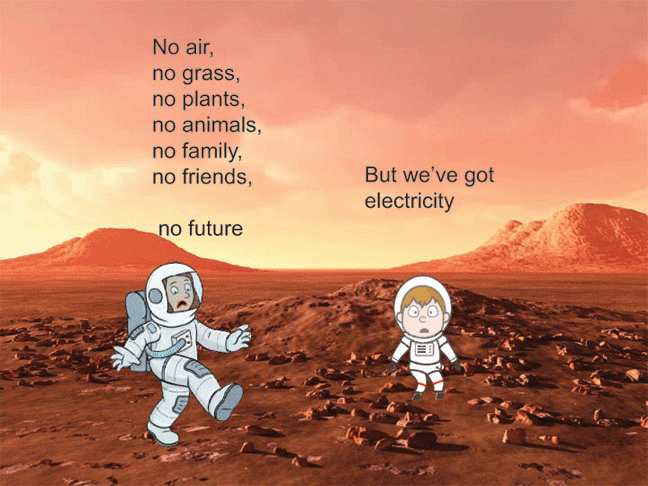
Kilowatt nuclear reactor could play role in powering manned missions on Mars, Las Vegas Now Patrick Walker Feb 26, 2018 “…….As humans prepare to venture out farther into the final frontier, the name of the game is nuclear fission.
1 This Month

of the week – Shut Down Drone Warfare!


Tell the Ukrainian Government to Drop Prosecution of Peace Activist Yurii Sheliazhenko

Petition to revoke the licensing of the Near Surface Nuclear Disposal Facility (NSDF) at Chalk River. https://www.ourcommons.ca/petitions/en/Petition/Details?Petition=e-7247
To see nuclear-related stories in greater depth and intensity – go to https://nuclearinformation.wordpress.com
-
Archives
- April 2026 (68)
- March 2026 (251)
- February 2026 (268)
- January 2026 (308)
- December 2025 (358)
- November 2025 (359)
- October 2025 (376)
- September 2025 (257)
- August 2025 (319)
- July 2025 (230)
- June 2025 (348)
- May 2025 (261)
-
Categories
- 1
- 1 NUCLEAR ISSUES
- business and costs
- climate change
- culture and arts
- ENERGY
- environment
- health
- history
- indigenous issues
- Legal
- marketing of nuclear
- media
- opposition to nuclear
- PERSONAL STORIES
- politics
- politics international
- Religion and ethics
- safety
- secrets,lies and civil liberties
- spinbuster
- technology
- Uranium
- wastes
- weapons and war
- Women
- 2 WORLD
- ACTION
- AFRICA
- Atrocities
- AUSTRALIA
- Christina's notes
- Christina's themes
- culture and arts
- Events
- Fuk 2022
- Fuk 2023
- Fukushima 2017
- Fukushima 2018
- fukushima 2019
- Fukushima 2020
- Fukushima 2021
- general
- global warming
- Humour (God we need it)
- Nuclear
- RARE EARTHS
- Reference
- resources – print
- Resources -audiovicual
- Weekly Newsletter
- World
- World Nuclear
- YouTube
-
RSS
Entries RSS
Comments RSS
 nuclear-news