Has North Korea’s week at the Winter Olympics diminished the nuclear threat? Guardian, Tania Branigan, 15 Feb 18, “……Pyongyang has no intention of giving up its nuclear programme, as Washington demands. Although it has in the past committed itself to peaceful reunification, no one believes it is willing to change in the way that it would be needed. The real issue is that the doomsday clock is ticking closer to midnight since the election of Donald Trump – and any attempt to halt the hands is welcome.
The North is increasingly close to developing a nuclear-tipped ICBM that can hit the continental US. Washington knows it cannot destroy all the country’s capabilities – so hawks are now arguing for a “bloody nose” strategy to warn Kim Jong-un off threatening the US (though he must know any attack would be suicidal). Seoul, just 35 miles from the border, would bear the brunt of any retaliation. A conflict could kill tens of thousands and potentially draw in other regional powers, including China.
“There’s a real concern that for the first time there is a US administration that could take unilateral action against
North Korea without consulting the South,” says Professor Hazel Smith of the centre of Korean studies at Soas Univeristy of London. “People are pushing, virtually preparing, for a so-called ‘surgical strike’ – even though the majority of US and South Korean military planners argue that it would be risky to the point of likely catastrophe for the South, and US troops there.
“The Olympic initiative was never going to solve the nuclear question overnight, but I think it has stopped the mad escalation of the conflict that was going on.”
The task of Kim Yo-jong and the bevy of cheerleaders has been to normalise the image of a country that looks utterly abnormal to outsiders. ………
Kim has cemented his position, in part through tighter control. He purged and executed his uncle Jang Song-thaek; and he is believed to have ordered the killing of his self-exiled brother, Kim Jong-nam, a year ago. There have been repeated crackdowns on smuggled – especially South Korean – media.
On the other hand he has promised his people a return to prosperity, and though this has mostly been signalled by totemic projects such as a ski resort, there have been some broader economic shifts, such as an increase in marketisation, apparently producing modest improvements in the economy. And, in dispatching the Olympic delegation, and then inviting the South Korean president Moon Jae-in to visit him, he has shown he can reduce tensions as well as increase them.
Sending his sister was doubly inspired. A family member is a more intimate representative than a high-ranking official. And for a patriarchal culture, Kim Yo-jong and the cheerleaders are – by virtue of gender – not only charming and unthreatening but somehow morally elevated, detached from worldly, manly concerns of power (never mind that, in reality, Kim is at the heart of her brother’s regime). ……..
Is the North’s participation in Pyeongchang a first step to denuclearisation and eventual reunification? No. Events in Iraq and Libya hardened the regime’s beliefs that hanging on to WMDs is a matter of survival. The thaw may not even be a precursor to substantive reengagement with the South, or broader talks, let alone a breakthrough (although the North might freeze its programme if offered a cast-iron US security guarantee, it is hard to see that happening under Trump). But if the softening of the North’s image and approach make it harder for US hawks to strike, then Seoul – and the rest of us – should be grateful for those synchronised chants and armwaves.
https://www.theguardian.com/world/2018/feb/14/what-north-koreas-week-at-the-winter-olympics-tells-us-about-the-nuclear-threat
February 16, 2018
Posted by Christina Macpherson |
North Korea, politics international, USA |
Leave a comment
For 2 weeks in September and October last year, traces of the humanmade isotope ruthenium-106 wafted across Europe, triggering detectors from Norway to Greece and Ukraine to Switzerland. The radioactive cloud was too thin to be dangerous, containing no more than a few grams of material, but its origin posed an outsize mystery.
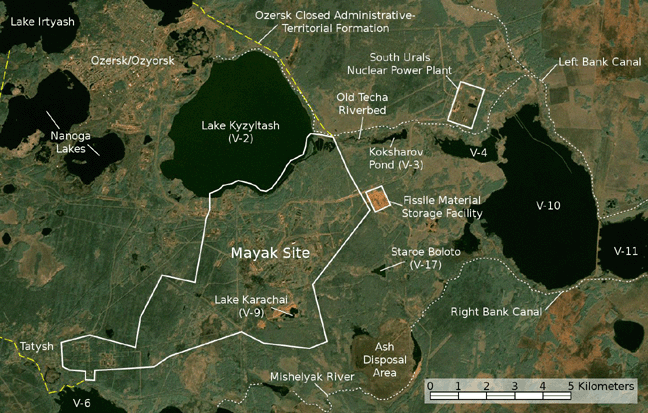
Now, scientists at the French Institute of Radioprotection and Nuclear Security (IRSN) in Paris say the isotope may have been released from the Mayak nuclear facility near Ozyorsk in southern Russia. IRSN argues that the leak could have taken place when Mayak technicians botched the fabrication of a highly radioactive component for a physics experiment at the Gran Sasso National Laboratory in L’Aquila, Italy.
The Russian government and state nuclear operator Rosatom have vehemently denied that an accident took place, however. Meanwhile, an international committee set up by the Russian Academy of Sciences’s Nuclear Safety Institute (IBRAE) in Moscow that met on 31 January is divided over the origins of the pollution.
Based on a computer model that used the air-sampling data and weather patterns, IRSN concluded in early October 2017 that the ruthenium most likely originated in the southern Urals; its German counterpart agreed. The French team went on to rule out a number of potential sources, including a mishap at a nuclear reactor. Such an incident would have spewed many other radioactive pollutants besides ruthenium.
The southern Urals are home to the secretive Mayak facility, the scene of one of the world’s worst nuclear accidents 60 years ago, and speculation soon turned to a possible accident at its reprocessing plant, which extracts isotopes from spent nuclear fuel. The IRSN report, made public on 6 February, says Mayak’s attempt to manufacture a capsule of cerium-144 destined for Gran Sasso “should be investigated” as a possible cause. Scientists at Gran Sasso needed the cerium for a search—now called off—for hypothetical particles called sterile neutrinos.
The estimated amount of radioactive ruthenium released could only have come from processing several tons of spent nuclear fuel, IRSN says. What’s more, the ratio of ruthenium-106 to the faster-decaying isotope ruthenium-103, detected in smaller amounts last autumn, reveals that the fuel must have been removed from its reactor only a year or two earlier. Spent fuel is normally cooled for up to a decade before it is reprocessed, so it seems the plant was preparing material for an application requiring high levels of radioactivity, IRSN says.
That fits the description of the sterile neutrino experiment at Gran Sasso, known as SOX and supported by Italy’s National Institute for Nuclear Physics (INFN) and the French Alternative Energies and Atomic Energy Commission. It required a source that was both extremely radioactive and very small, says SOX spokesperson Marco Pallavicini, a particle physicist at the University of Genoa in Italy. He says Mayak Production Association, the only company able to supply it, signed a contract in fall 2016 to produce a cerium capsule, expected to arrive in early 2018.
But in December 2017 the company stated it could not reach the desired radioactivity level. (“The Russians said absolutely nothing” about a radiation leak, Pallavicini says.) That meant SOX would lack the required sensitivity, and on 1 February, INFN announced it had axed the experiment, in what Pallavicini described as “a big blow” for scientists.
Jean-Christophe Gariel, IRSN’s director of health, says an uncontrolled temperature rise during the separation of cerium from the spent fuel at Mayak might have converted some of the ruthenium in the waste to gaseous ruthenium oxide. That gas would have escaped through the facility’s filters and solidified in the cool outside air, he says, turning into small solid oxide particles that could have wafted across Europe.
IBRAE Director Leonid Bolshov calls IRSN’s scenario “a good hypothesis,” but says it’s incorrect. For one thing, he says, the separation process never reached “the hot phase.” And in any case, he adds, “major operations” on the spent fuel at Mayak were done in late October 2017, after the ruthenium release. Bolshov says that a “rather rare meteorological event” might have transported the ruthenium from an as-yet-unidentified place to the southern Urals, from which it then appeared to spread.
Non-Russian members of IBRAE’s international panel, which is due to meet again in April, support IRSN’s conclusion that the southern Urals is the likely source of the leak, says IRSN physicist Jean-Luc Lachaume, a panel member, although some argue that the region is too large to pinpoint an exact location. Russian members claim the leak could have arisen “in the eastern part of the Russian federation,” Lachaume says. He says a representative of the Russian nuclear regulator Rostechnadzor who inspected Mayak in November 2017 told the panel that he saw no anomalies from a month earlier, but didn’t supply data to support that statement.
Princeton University physicist Frank von Hippel, a nonproliferation expert, says he doesn’t see “anything wrong with the IRSN analysis.” He notes that the amount of ruthenium-106 that the French team estimates was emitted—between 1 gram and 4 grams—matches the 30 grams of cerium-144 required for SOX, given that spent fuel contains the two isotopes in a ratio of about one to 14. And although the cloud over Europe was harmless, an accident at Mayak could mean that people living close by took in “potentially significant lung doses,” Von Hippel says.
February 16, 2018
Posted by Christina Macpherson |
environment, EUROPE |
Leave a comment

Kobe Steel firm suspected of nuclear waste data falsification http://www.asahi.com/ajw/articles/photo/AS20180215003253.html, By MASANOBU HIGASHIYAMA/ Staff Writer,February 15, 2018
A subsidiary of Kobe Steel Ltd. may have falsified test data on highly radioactive waste disposal, the Nuclear Regulation Authority (NRA) announced on Feb. 14.
Kobelco Research Institute Inc. is suspected of tampering with data it gathered on behalf of the Japan Atomic Energy Agency (JAEA), which is contracted to carry out tests by the NRA.
The aim of the tests is to help form a regulatory standard for final disposal sites for nuclear waste, but a report the NRA received from the JAEA said that figures in the original data and those in reports Kobelco submitted to it did not match. Furthermore, some original data could not be located.
The NRA has instructed the JAEA to confirm details about the possible data falsification in response to the report.
A Kobelco source said, “Why data inconsistencies occurred remains unknown at the moment,” but that the research institute “will examine the case with data falsification in mind.”
The tests are designed to examine what happens to metal cladding tubes that had previously contained spent nuclear fuel when they are disposed of deep underground, including possible corrosion and by-products of gas, according to the NRA.
The nuclear watchdog outsourced the testing to the JAEA in fiscal 2012 through fiscal 2014 at a cost of about 600 million yen ($5.59 million).
Kobelco was subcontracted to undertake some of the tests for about 50 million yen.
February 16, 2018
Posted by Christina Macpherson |
Japan, secrets,lies and civil liberties |
Leave a comment
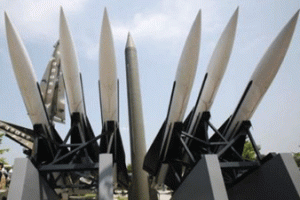
 Is Japan About to Hit Its Nuclear Tipping Point? Tokyo almost built a bomb in 1945 and now has enough plutonium stockpiled for 5,000 nukes. North Korea may give its hawkish government an excuse to build them. The Daily Beast, JAKE ADELSTEIN 02.15.18 TOKYO—“Don’t be fooled by North Korea’s smiley-face diplomacy,” Japan’s foreign minister, Taro Kono, warned last week in the middle of the Winter Olympics’ warm fuzzy photo ops with Hermit Kingdom emissaries.
Kono’s skepticism was quite serious, as is the confrontation he sees looming. Earlier this month he shocked Japan by broaching the idea that the Japanese should gain access to “usable” nuclear weapons, and he lavished praise on U.S. President Donald Trump’s Nuclear Posture Review.
While much of the rest of the world was entranced by North Korean cheerleaders and Kim Jong Un’s baby sister, Japan was quietly considering if and when to build its own nuclear missiles to discourage North Korea from so much as contemplating a missile strike.
The hawkish government of Prime Minister Shinzo Abe and his ruling coalition are exploiting real and unreal fears of a North Korean nuclear attack to drum up support for a Japan that can wage war, and possibly as a prelude to pushing harder for nuclear weapons development.
At a minimum, it should be apparent to the world that this administration has no interest in nuclear disarmament, and is preparing for a possible showdown.
This week, The Ministry of Culture, Education and Science announced that in the Risk Management manual distributed to schools nationwide, it would be urging teachers to conduct missile evacuation drills. That should ratchet up the paranoia a few notches.
North Korean leader Kim Jong Un announced last year that his country’s nuclear program is now complete, after the “successful” launch of a new missile that threatens all of the continental United States. But Japan has been in the crosshairs of the hermit kingdom for some time, and the storm over Kim’s atomic posturing has reignited a simmering, almost taboo, debate about nuclear weapons here.
The question isn’t whether Japan could become a nuclear weapons power. There’s really no doubt about that. But should it? And when? And if so, politically, how?
Japan As A Nuclear Power
Japan’s consumer nuclear energy industry has generated enough plutonium to make an estimated 5,000 nuclear warheads, this has long stood as an implicit threat. As former Defense Minister Satoshi Morimoto once declared, Japan’s commercial nuclear power reactors have “very great defensive deterrent functions.” He was implying that the plants Japan has built to make reactor fuel could be used to make fuel for nuclear arms, if Japan ever decides to do so.
In case anyone missed the point, in the spring of 2016, the Abe government explicitly stated that there is nothing in the nation’s Constitution that forbids pacifist Japan from possessing or using nuclear weapons……… https://www.thedailybeast.com/is-japan-about-to-hit-its-nuclear-tipping-point
February 16, 2018
Posted by Christina Macpherson |
Japan, weapons and war |
Leave a comment
 NASA Is Bringing Back Nuclear-Powered Rockets to Get to Mars Fortune, By BLOOMBERG , 15 Feb 18, In the race to land humans on Mars, NASA is blowing the cobwebs off a technology it shelved in the 1970s — nuclear-powered rockets.
Last year, NASA partnered with BWXT Nuclear Energy Inc. for an $18.8 million contract to design a reactor and develop fuel for use in a nuclear-thermal propulsion engine for deep-space travel. While that small start is a long way from the the heady days of the Space Race of the Cold War, it marks the U.S. return to an idea that is also being pursued by Russia and China.
Unlike conventional rockets that burn fuel to create thrust, the atomic system uses the reactor to heat a propellant like liquid hydrogen, which then expands through a nozzle to power the craft……..
While the system would be a niche market in the global nuclear industry, it could be highly lucrative for the company that cracks the technology, especially for nations like the U.S., where the atomic energy sector has been in the doldrums for decades. …….
Russia’s Rosatom Corp. has said it plans this year to test a prototype nuclear engine for a spacecraft that can go to Mars. Russia so far has led research in the field and has deployed more than 30 fission reactors in space, according to the World Nuclear Association. China aims to use atomic-powered shuttles as part of its space exploration plans through 2045, according to state Xinhua News Agency.
NASA faces competition in the race to Mars from industrialists like Elon Musk, who have also vowed to get people to the red planet. Space Exploration Technologies Corp., founded by Musk, is developing a liquid oxygen and methane fueled engine. Jeff Bezos’ Blue Origin is testing an engine that uses liquid oxygen and liquefied natural gas.
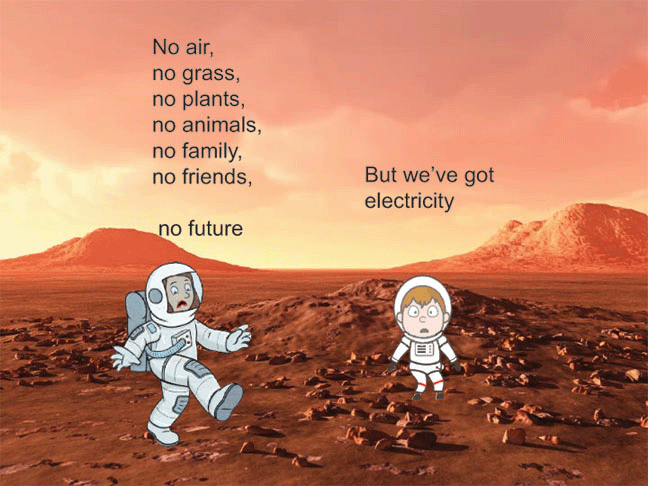
 NASA also has its eye on atomic technology to power human colonies once they get to Mars. The agency and the Department of Energy are developing a space-ready nuclear fission reactor, known as Kilopower, that could provide up to 10 kilowatts of power and be deployed on other planets and moons. NASA has employed radioisotope thermoelectric generators — batteries that run off the heat from radioactive materials — on previous space missions, including the Mars Curiosity rover.
……… Nuclear propulsion may be the favored option for deep space travel, but the intricacies of the technology and the testing mean that development costs could be a major barrier, said Claudio Bruno, a professor at the University of Connecticut. Using technology developed by NASA decades ago could help speed up the process, he said.Getting to Mars is no small task — it requires a 55 million-kilometer (34 million-mile) space flight, more than 100 times the distance from Earth to the Moon. NASA probably won’t send humans to orbit the planet until at least the early 2030s.
Ground testing would require a costly system that captures and scrubs exhaust to remove tiny radioactive materials, according to Purdue University’s Heister.
“Space exploration is a captivating passion that many folks have – they are not necessarily motivated by profit,” said Heister. “In our business, we joke that the best way to become a millionaire in the space propulsion industry is to start out as a billionaire.” http://fortune.com/2018/02/15/nasa-nuclear-rockets-mars/
February 16, 2018
Posted by Christina Macpherson |
technology, USA |
Leave a comment
Nuclear submarine commander ‘took eye off ball’ before collision
Justin Codd pleads guilty to negligently hazarding HMS Ambush during training course Guardian, 15 Feb 18, A senior naval officer in charge of teaching future submarine captains “took his eye off the ball”, leading his nuclear submarine to collide with a tanker, a court martial has heard.
Cdr Justin Codd, 45, was sentenced to forfeiting a year of seniority after pleading guilty at Portsmouth naval base to negligently hazarding the £1.1bn submarine HMS Ambush.
The Astute-class submarine was taken out of service for three months to undergo repairs costing £2.1m. ………https://www.theguardian.com/uk-news/2018/feb/15/nuclear-submarine-commander-admits-hazarding-ship-after-collision
February 16, 2018
Posted by Christina Macpherson |
UK |
Leave a comment
 Russia and Congo to cooperate in nuclear power, WNN, 14 February 2018 Rosatom and the Ministry of Scientific Research and Technological Innovations of the Republic of Congo have signed a Memorandum of Understanding (MoU) on cooperation in the peaceful uses of nuclear energy.
The document was signed yesterday in Moscow by the Russian state nuclear corporation’s deputy director general for international relations, Nikolay Spassky, and the ambassador extraordinary and plenipotentiary of the Republic of the Congo in Russia, David Maduka.
The document establishes a legal basis for the implementation of bilateral cooperation in a wide range of areas, Rosatom said. These include the development of nuclear infrastructure in the Republic of Congo and programmes aimed at increased awareness of nuclear technologies and their applications…..http://www.world-nuclear-news.org/NP-Russia-and-Congo-to-cooperate-in-nuclear-power-14021801.html
February 16, 2018
Posted by Christina Macpherson |
AFRICA, marketing, Russia |
Leave a comment
Nikkei Asian review 14th Feb 2018, American
concerns about potential diversion of idle fuel leave the agreement at
risk.
The decision Jan. 16 to automatically extend a nuclear agreement with
the U.S. came as a relief to a Japanese government worried about the
prospect of renegotiating the basis for a cornerstone of its energy policy.
But friction remains over a massive store of plutonium that highlights the
problems with the nation’s ambitious nuclear energy plans. The nuclear fuel
cycle pursued by Japan’s government and power companies centers on
recovering uranium and plutonium from spent fuel for reuse in reactors.
This is made possible by the unique agreement with the U.S. that lets Japan
make plutonium. The radioactive element can be used in nuclear weapons, so
its production is generally tightly restricted. Japan has amassed roughly
47 tons of plutonium stored inside and outside the country — enough for
some 6,000 nuclear warheads. With the nation’s nuclear power plants
gradually taken offline after the March 2011 Fukushima Daiichi disaster,
and progress on restarting them sluggish, Japan has been left with no real
way to whittle down a pile drawing international scrutiny.
https://asia.nikkei.com/Politics-Economy/International-Relations/Japan-s-plutonium-glut-casts-a-shadow-on-renewed-nuclear-deal
February 16, 2018
Posted by Christina Macpherson |
- plutonium, Japan |
Leave a comment
How Trump budget would boost Yucca project, cut Nevadans’ safety net Las Vegas Sun, By Yvonne Gonzalez (contact), Feb. 14, 2018 “…….Yucca Mountain. The administration is also again seeking money for the proposed Yucca Mountain nuclear waste repository, though not nearly the amount that would be required to see the project through. The Nuclear Regulatory Commission is proposing $48 million for work related to Yucca Mountain, and the Department of Energy is asking for $120 million for the project and interim storage.
Robert Halstead, executive director of the state’s Agency for Nuclear Projects, says both agencies are pursuing licensing using leftover funds from the 2010-2011 fiscal year. The commission has about a half-million dollars and DOE has more than $10 million that they were court-ordered in 2013 to use to continue the licensing process. The commission expects the process to cost $330 million, but the state pegs the pricetag at about $1.6 billion.
Lawmakers say the whole process would cost at least $96 million, and the requested appropriations are just a small fraction of that total.
“That sum would be a tiny down payment on a project that will cost $100 billion and ship nuclear waste through hundreds of congressional districts across the country,” said Rep. Dina Titus, D-Nev……….
It has now been 20 years since the federal government was mandated by law to start accepting nuclear waste for safe long-term storage in a deep geological repository,” Nye County Commission Vice Chairman Dan Schinhofen said in a statement. “Not only is the repository not complete, but we haven’t been allowed to see if the proposed site, at Yucca Mountain, is even safe for its construction.”
Nevada’s Republican Gov. Brian Sandoval said the state will fight the proposal. Nevada has committed millions of dollars over the years to lawsuits and efforts related to stopping the project.
“Yucca Mountain is incapable of safely storing the world’s most toxic substance and Nevada will continue to oppose any efforts to dump nuclear waste in our state,” Sandoval said in a statement. “I am disappointed that the administration’s budget appears to resurrect this dormant project and we will leave no stone unturned in fighting any attempt to revive this failed idea.”……..https://lasvegassun.com/news/2018/feb/14/how-trump-budget-would-boost-yucca-project-cut-nev/
February 16, 2018
Posted by Christina Macpherson |
general |
Leave a comment
 Seattle Times 14th Feb 2018, Sorry, Hanford: Your radiation leaks aren’t as important as tax cuts.
Probably no place in America shows more acutely how incoherent politics has
become than our own Hanford nuclear reservation.
Consider this recent sequence of events at the Western Hemisphere’s most polluted spot:
First, in November, a board that oversees Hanford nuclear-waste cleanup warned
that the effort is so underfunded it has become shoddy and dangerous. More
spending for better work and expertise “is the only way to help avert a
major catastrophe.”
Then on cue, in December, plutonium particles again
contaminated dozens of workers and cars because of shoddy demolition work
at a defunct bomb factory.
Then the federal government put out the most
eye-popping cost revision I’ve ever seen. It found that the cost of
cleaning up tanks of old radioactive waste — the most serious pollution
problem at Hanford — will now run to $111 billion, an extraordinary $61
billion more than predicted just three years earlier.
Then on Monday the president’s budget recommended … slashing Hanford clean-up spending by
10 percent. “It’s a big disconnect with reality, probably as big I’ve
seen,” says Tom Carpenter, of the watchdog group Hanford Challenge.
https://www.seattletimes.com/seattle-news/politics/sorry-hanford-your-radiation-leaks-arent-as-important-as-tax-cuts/
February 16, 2018
Posted by Christina Macpherson |
USA, wastes |
Leave a comment
VT Digger, By Mike Faher, Feb 12 2018 State regulators will consider the testimony of two prominent nuclear power critics in deciding whether a cleanup company should be allowed to buy Vermont Yankee.
The Vermont Public Utility Commission has ruled that the majority of testimony offered by Ray Shadis and Arnie Gundersen is admissible. In doing so, the commission overruled most objections filed last fall by Entergy and NorthStar Group Services, the idled nuclear plant’s current and prospective owners.
In a key finding, the commission ruled that Shadis should be allowed to weigh in as an expert. Commissioners noted that Shadis – a longtime adviser to the Brattleboro-based New England Coalition – testified when Entergy bought Vermont Yankee 16 years ago.
“Mr. Shadis’ experience constitutes sufficient knowledge of matters that could assist the commission in understanding the issues before us as much today as it did in 2002, and the level of Mr. Shadis’s experience will go to the weight that we give his admitted testimony,” the commission’s Feb. 8 decision says.
Entergy stopped producing power at Vermont Yankee in late 2014, and the company had been planning an extended decommissioning process that could have lasted until 2075…….. https://vtdigger.org/2018/02/12/nuclear-power-critics-to-testify-vermont-yankee-case/
February 16, 2018
Posted by Christina Macpherson |
legal, USA |
Leave a comment
GE Hitachi, Holtec Announce Cooperation to Accelerate Commercialization of SMR-160 Small Modular Reactor, Power Magazine
02/14/2018 GE Hitachi Nuclear Energy (GEH), Global Nuclear Fuel (GNF), Holtec International and SMR Inventec, LLC (SMR, LLC), today announced a collaboration to advance the SMR‐160, a single loop, 160 MWe pressurized light water reactor based on existing light water technologies.In a Memorandum of Understanding, the companies have agreed to enter into a procompetitive collaboration to progress the SMR-160 which SMR, LLC intends to develop, design, license, commercialize, deploy and service globally. The cooperation will initially include nuclear fuel development supported by GNF and control rod drive mechanisms designed by GEH, and may later extend to other areas.
“We are excited to leverage the experience and capabilities of world class nuclear companies like GEH and GNF as we bring our game changing SMR-160 technology to global markets,” said Holtec President and CEO Dr. Kris Singh. “SMR-160 has prioritized safety in its design, to produce a right-sized, passively safe and cost-effective solution for carbon-free energy. This collaboration will ensure the SMR-160 supply chain, to deliver and fabricate critical SMR-160 technologies and components, including at our new Advanced Manufacturing Division in Camden, New Jersey.”……http://www.powermag.com/press-releases/ge-hitachi-holtec-announce-cooperation-to-accelerate-commercialization-of-smr-160-small-modular-reactor/
February 16, 2018
Posted by Christina Macpherson |
marketing, Small Modular Nuclear Reactors |
Leave a comment
Scientists Have No Idea Why This Enriched Uranium Particle Was Floating Above Alaska Gizmodo, Ryan F. Mandelbaum, Feb 14, 2018, On 3 August 2016, 7km above Alaska’s Aleutian Islands, a research plane captured something mysterious: An atmospheric aerosol particle enriched with the kind of uranium used in nuclear fuel and bombs.
February 16, 2018
Posted by Christina Macpherson |
general |
Leave a comment

Fukushima 7th Anniversary Events List As of today this is the list of the major events organized in various countries and towns worldwide for the commemoration of the March 11 2011 beginning of the Fukushima nuclear disaster, ongoing for 7 years now:
JAPAN
In Koriyama – March 11 3・11 Fukushima Anti Nuclear Action ‘ 18 Location : KORIYAMA City Cultural Center , Big Hall Starts at 13:00 After the rally we have demonstration to Koriyama Station http://fukushimaaction.blog.fc2.com/blog-entry-361.html
In Tokyo — March 9 http://www.foejapan.org/energy/evt/180309.html
In Osaka – March 17 https://www.facebook.com/events/1955332334716083/
In Kyoto – March 11 https://www.facebook.com/events/1599975136756649/
SOUTH KOREA
In Seoul March 10 from 13:00~17:00.
Place: Gwanghwamun Square, King Sejong the Great, + Gwanghwamun march
https://www.facebook.com/311fukushimaparade/
USA
In New York – March 10 https://www.facebook.com/events/802843189916923/
In San Francisco – March 11 The 68th Every 11th of Month No Nukes Rally in San Francisco, in front of the S.F. Japanese Consulate
In Richmond, Virginia – March 11 at 11 AM – 12 PM Remembering Fukushima
https://www.facebook.com/events/786967918175803/
UNITED KINGDOM
In London – March 9 – March 11 – March 14 https://www.facebook.com/events/336322393516248/
FRANCE
In Paris – March 11 http://www.sortirdunucleaire.org/11-mars-2018-grand-rassemblement-pour-la-sortie
In Flamanville – March 15 https://leblogdejeudi.fr/tag/cano/
In Grenoble – March 17 at 6pm Conferences Meeting with three families evacuated from Fukushima Mothers’ tour to protect children from radiation after the Fukushima accident. Bibliothèque Centre-Ville 10 Rue de la République 38000 GRENOBLE
Mail : voisins311@gmail.com
https://www.facebook.com/events/1986157938311149/
In Valence – March 19 at 8:30pm Conferences Meeting with three families evacuated from Fukushima Mothers’ tour to protect children from radiation after the Fukushima accident. Maison pour Tous Petit Charran 30 Rue Henri Dunant 26000 VALENCE
Mail : voisins311@gmail.com
https://www.facebook.com/events/1986157938311149/
In Lyon – March 20 at 7pm Conferences Meeting with three families evacuated from Fukushima Mothers’ tour to protect children from radiation after the Fukushima accident. Hôtel Novotel Lyon Confluence 3 Rue Paul Montrochet 69002 LYON
Mail : voisins311@gmail.com
https://www.facebook.com/events/1986157938311149/
SWITZERLAND
In Geneva – March 16 Conferences Meeting with three families evacuated from Fukushima Mothers’ tour to protect children from radiation after the Fukushima accident.
Mail : voisins311@gmail.com
BELGIUM
In Namur – March 8 https://www.quefaire.be/tu-n-as-rien-vu-a-fukushima-843749.shtml
RUSSIA
In Saint Petersburg – March 11 https://www.facebook.com/events/1882949795348632/
GERMANY
In Berlin – March 10 https://www.facebook.com/events/204920653395925/
In Regensburg – April 26 https://www.facebook.com/events/169657723642015/
AUSTRALIA
In New South Wales – March 11 https://www.facebook.com/events/343840736130676/permalink/343966142784802/
February 15, 2018
Posted by dunrenard |
Fukushima 2018 | Anniversary, Fukushima Daiichi, Nuclear Disaster |
Leave a comment
President Trump’s $4.4 Trillions Budget Features Soaring Deficits 2 News 13 Feb 18
 President Donald Trump is sending Congress a $4.4 trillion spending planthat provides a huge increase in defense spending while cutting taxes by $1.5 trillion over the next decade. The result is soaring budget deficits.
Trump’s first budget last year projected that the government would achieve a small surplus by 2027. But the new budget never gets to balance. It proposes $7.1 trillion in red ink over the next decade, basically doubling last year’s forecast……..
Trump last week signed a $300 billion measure to boost defense and domestic spending, negating many of the cuts in his new budget plan. …..
Meanwhile, the Trump administration wants NASA out of the International Space Station by 2025, and private businesses running the place instead.
Under the proposed budget released, U.S. government funding for the space station would cease by 2025. The government would set aside $150 million to encourage commercial development…..
Altogether, the budget seeks to increase NASA’s budget slightly to $19.6 billion.
And – the Pentagon is proposing to spend hundreds of millions more in 2019 on missile defense.
The budget calls for increasing the number of strategic missile interceptors from 44 to 64. The additional 20 interceptors would be based at Fort Greely, Alaska. Critics question the reliability of the interceptors, arguing that years of testing have yet to prove them effective against sophisticated threats.
The Pentagon also would invest more heavily in the ship-based Aegis system and the Army’s Patriot air and missile defense system. Both are designed to defend against missiles with ranges shorter than the intercontinental ballistic missile that is of greatest U.S. concern in the context of North Korea.
Trump’s proposed 2019 budget calls for slashing funding for the Environmental Protection Agency by more than one third, including ending the Climate Change Research and Partnership Programs.
The president’s budget would also make deep cuts to funding for cleaning up the nation’s most polluted sites, even as EPA Administrator Scott Pruitt says that’s one of his top priorities. Trump’s budget would allocate just $762 million for the Hazardous Substance Superfund Account, a reduction of more than 30%.
Current spending for Superfund is down to about half of what it was in the 1990s. Despite the cut, the White House says the administration plans to “accelerate” site cleanups by bringing “more private funding to the table for redevelopment.”
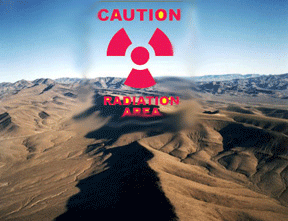 ……Congressman Ruben J. Kihuen issued the statement after the release of President Trump’s 2019 budget proposal which supports plans for an interim storage program and the licensing of the Yucca Mountain geologic repository:
“I am disappointed that President Trump’s latest budget request dedicates $120 million to revive the long-dead nuclear waste repository at Yucca Mountain, money that would be much better spent on research and development of the renewable energy technology that we need to power our clean-energy future. Rather than pursue a realistic attempt to develop a substantive nuclear waste management program, this is a colossal waste of funding that goes directly against the will of Nevadans. I have been proud to help lead the fight against dumping nuclear waste in Nevadans’ backyards, and I will continue working to ensure this project remains dead.”
U.S. Senator Dean Heller released this statement:
“Despite Congress’ refusal to fund the Yucca Mountain project, the Administration is once again prioritizing it. Whether it’s the threat that Yucca Mountain poses to the people of southern Nevada or its potentially catastrophic effect on our tourism economy, I’ve made it clear why Nevada does not want to turn into the nation’s nuclear waste dump,” said Heller. “Under my leadership Congress has not appropriated funding for licensing activities at Yucca Mountain as requested in the last budget, and I’m going to continue to fight to make sure that this project doesn’t see the light of day.”
U.S. Senator Catherine Cortez Masto said in a statement:
“It’s a disgrace that president trump and some members of congress find it acceptable to continue throwing away tax payer money on a failed project.”
http://www.ktvn.com/story/37484935/president-trumps-44-trillions-budget-features-soaring-deficits
February 14, 2018
Posted by Christina Macpherson |
politics, USA, wastes, weapons and war |
1 Comment


 NASA also has its eye on atomic technology to power human colonies once they get to Mars. The agency and the Department of Energy are developing a space-ready nuclear fission reactor, known as Kilopower, that could provide up to 10 kilowatts of power and be deployed on other planets and moons. NASA has employed radioisotope thermoelectric generators — batteries that run off the heat from radioactive materials — on previous space missions, including the Mars Curiosity rover.






 nuclear-news