Not much has changed this week: the simmering North-Korean -USA nuclear continued to simmer quietly while the Winter Olympics were on: the global nuclear waste anxieties ratcheted up a little.
We got an insight into Donald Trump’s mindset about how to deal with teenage gunmen, (or anyone difficult?) . He suggests giving bonuses to teachers who carry guns into the classroom. As a former teacher, I shudder to think what might happen in some classrooms with a bunch of obstreperous kids.
. Class legal action for victims of West Lake Landfill radiation. Documentary “Atomic Homefront” delves into St. Louis-area radioactive landfill – nuclear weapons before people. https://www.youtube.com/watch?v=-0RsT14RNqQ Parks Township nuclear dump cleanup delayed again.
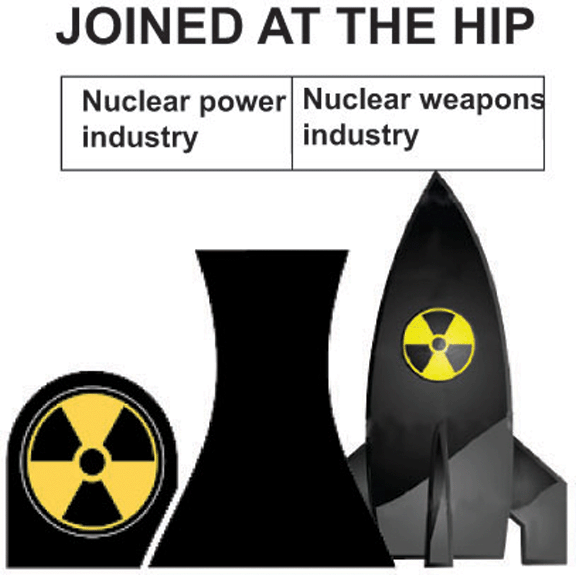
USA’s new Nuclear Posture Review – an (unsustainable) gift to the nuclear weapons industry.
USA Dept of Energy’s plan to run nuclear reactors for 80 years. Utah politicians received big donations – now they’re ready to waive the fee for inspecting EnergySolutions radioactive landfill. Lawyers kept busy with the chaos of South Carolina’s failed nuclear project.
SOUTH KOREA. South Korean president says Olympics have lowered tensions with North. (Washington Post). A South Korean province considers co-hosting the 2021 Asian Winter Games with North Korea.
She may be very smart, and even have a bit of integrity. I hope so. But are we here seeing the macho nuclear weapons lobby copying the “new nukes” gimmick of appointing a good-looking young woman to front their dangerous operation?
First woman in history takes helm of US nuclear weapons arsenal, Washington Examiner by John Siciliano | Energy Secretary Rick Perry on Thursday swore in the first woman in history as head of the nation’s nuclear weapons arsenal.
Lisa E. Gordon-Hagerty was sworn in as administrator of the National Nuclear Security Administration, which under President Trump’s fiscal 2019 budget proposal would comprise nearly half of the Energy Department’s funding.
“The selection of Gordon-Hagerty, who [came] to USEC without any experience operating a company, surprised some enrichment industry analysts,” USEC Watch commented December 22, 2003. “But some sources suggested that the new COO [would] concentrate on improving USEC’s relationships with DOE and with the national security community. https://www.sourcewatch.org/index.php/Lisa_E._Gordon-Hagerty
“MILITARY PLUTONIUM To be manufactured at Hinkley”
The charade of Atoms for Peace, Dr David Lowry , 23 Feb 18, “……Atoms for Peace ( in reality a cynical project promoting US global nuclear technology dominance launched by President Eisenhower at the UN in New York in December 1953) using a special atomic train taking nuclear scientists around the country promoting nuclear power.
But it was a charade. The first public hint came with a public announcement on 17 June 1958 by the Ministry of Defence, on: “the production of plutonium suitable for weapons in the new [nuclear ] power stations programme as an insurance against future defence needs…” in the UK’s first generation Magnox (after the fuel type, magnesium oxide) reactor.
A week later in the UK Parliament, Labour Roy Mason, who incidentally later became Defence Secretary, asked (HC Deb 24 June 1958 vol 590 cc246-8246) why Her Majesty’s Government had
“decided to modify atomic power stations, primarily planned for peaceful purposes, to produce high-grade plutonium for war weapons; to what extent this will interfere with the atomic power programme; and if he will make a statement.?” to be informed by the Paymaster General, Reginald Maudling
“At the request of the Government, the Central Electricity Generating Board has agreed to a small modification in the design of Hinkley Point and of the next two stations in its programme so as to enable plutonium suitable for military purposes to be extracted should the need arise.
The modifications will not in any way impair the efficiency of the stations. As the initial capital cost and any additional operating costs that may be incurred will be borne by the Government, the price of electricity will not be affected.
The Government made this request in order to provide the country, at comparatively small cost, with a most valuable insurance against possible future defence requirements. The cost of providing such insurance by any other means would be extremely heavy.”
The headline story in the Bridgwater Mercury, serving the community around Hinkley, on that day (24 June} was:
“MILITARY PLUTONIUM To be manufactured at Hinkley”
The article explained: “An ingenious method has been designed for changing the plant without reducing the output of electricity…”
CND was reported to be critical, describing this as a “distressing step” insisting
“The Government is obsessed with a nuclear militarism which seems insane.”
The then left wing Tribune magazine (on 27 June 1958) was very critical of the deal under the headline ‘Sabotage in the Atom Stations’:
“For the sake of making more nuclear weapons, the Government has dealt a heavy blow at the development of atomic power stations.
And warned:
“Unless this disastrous decision is reversed, we shall pay dearly in more ways than one for the sacrifice made on the grim alter of the H-bomb.”
North Korea says it’s deploying nuclear missiles https://www3.nhk.or.jp/nhkworld/en/news/20180223_18/ North Korea’s ruling party newspaper says the country’s military is pushing forward with its deployment of nuclear warheads and ballistic missiles.
The Rodong Sinmun made the comment in an editorial on Friday.
The article says the country possesses intercontinental ballistic missiles, submarine-launched ballistic missiles, and hydrogen bombs. It insists that it has made all preparations for a possible nuclear attack on the United States.
The editorial also says that wishing for the denuclearization of North Korea is more foolish than waiting for the ocean to dry up.
North Korea has been fostering a reconciliatory mood with South Korea during the ongoing PyeongChang Winter Olympics.
But the North staged a military parade on February 8th, the eve of the Games’ opening ceremony, displaying the new ICBM-class missile known as the Hwasong-15.
US imposes largest package of sanctions against North Korea, SMH, 24 Feb 18 US President Donald Trump says the United States will impose the “largest-ever” package of sanctions on North Korea, intensifying pressure on the reclusive country to give up its nuclear and missile programmes.
In addressing the Trump administration’s biggest national security challenge, the US Treasury sanctioned one person, 27 companies and 28 ships, according to a statement posted on the US Treasury Department’s website.
The Treasury’s Office of Foreign Assets Control announced the measures, which are designed to disrupt North Korean shipping and trading companies and vessels and to further isolate Pyongyang.
The ships are located, registered or flagged in North Korea, China, Singapore, Taiwan, Hong Kong, Marshall Islands, Tanzania, Panama and Comoros.
Diablo Canyon Power Plant is due to shut down in 2025, maybe earlier, but the radioactive waste it has generated will threaten our lives for another 200,000 years.
Society owns this Pandora’s box—but we haven’t owned up to the responsibility.
“For 30 years, the Nuclear Regulatory Commission has kept its head in the sands,” U.S. Rep. Salud Carbajal (D-Santa Barbara) said.
To his credit, Carbajal understands the urgency of the nuclear waste problem and has co-signed a bipartisan bill, HR 3035, that he hopes will provide a temporary solution.
Unfortunately, that legislation is seriously flawed. Without amendments or follow-up legislation, the bill threatens huge population centers in the event of likely unavoidable transportation accidents. It also establishes unsafe consolidated waste dumps without mandating a permanent, geological repository.
Having lived in the shadow of Diablo Canyon since 1985, most of us on the Central Coast have become inured to the dangers that lurk there. But even after decades of decay, it takes just a few minutes of exposure for spent fuel rods to deliver a killing dose of radioactivity. According to the Nuclear Information and Resource Service (NIRS), “Certain radioactive elements (such as plutonium-239) in ‘spent’ fuel will remain hazardous to humans and other living beings for hundreds of thousands of years. Other radioisotopes will remain hazardous for millions of years. Thus, these wastes must be shielded for centuries and isolated from the living environment for hundreds of millenia.”
“Today, there are 100 reactors operating at 59 sites in the U.S., and 35 permanently shut-down reactors at 25 additional sites,” noted Tim Judson, NIRS executive director.
How many tons of highly dangerous waste has accumulated at these sites? “The last reliable estimate was 74,000 tons in 2015—more than the 70,000-ton mandated capacity limit for Yucca Mountain [the stalled U.S. geologic repository located in Nevada],” said Judson.
On average, the industry generates about 2,000 tons of additional irradiated fuel each year, bringing the total tonnage to 80,000 tons.
Just over the hill from San Luis Obispo, approximately 2,200 metric tons of toxic waste is stored onsite at Diablo Canyon. By the time the plant closes, we’ll face a 2,690-metric-ton, 200,000-year-long local problem.
No wonder Carbajal has embraced HR 3035, which would authorize mass transportation of waste to parking lot dumps, supposedly “interim” consolidated storage sites—now proposed in Texas and New Mexico. Under the bill, our mountain of waste would become someone else’s problem.
Or would it? Why does NIRS, the Union of Concerned Scientists, San Onofre Saftey, Beyond Nuclear, and SLO-based Mothers for Peace, among others, oppose the bill?
First, consider transportation of the world’s deadliest waste. Shipments would travel through 45 states, exposing millions of people to murderous radiation in an accident.
And accidents do happen. Amtrak’s latest derailment in December sent train cars plummeting onto the interstate in DuPont, Washington. Meanwhile, in 1999, the American Petroleum Institute reported that heavy truck accidents occur approximately six times per million miles. According to the Federal Motor Carrier Safety Administration, in 2015 alone there were 57,313 fatal and injury crashes involving large trucks on our highways. Of those accidents, at least 154 resulted in the release of hazardous material.
Imagine if that hazardous material was radioactive.
OK, but aren’t the shipment casks built to withstand accidents?
Nope. The Nuclear Regulatory Commission (NRC) allows U.S. nuclear plants to store or transport spent fuel waste in thin walled welded stainless steel canisters designed to withstand a crash at 30 miles per hour. Do you want to bet lives that they would hold up in a calamity at 80 miles per hour?
Before HR 3053 is approved—and before any more thin-walled canisters are stored at earthquake-prone Diablo Canyon—there needs to be legislation mandating upgraded, thick-walled casks such as those used in Europe and Japan. We should also demand continuous, long-term monitoring and inspection of all transportation containers and/or dry storage casks, whether they’re stacked at Diablo Canyon or at consolidated the “interim” sites envisioned in HR 3053.
And let’s be honest: The Nuclear Waste Policy Act currently disallows “interim” nuclear waste storage at consolidated sites unless a permanent U.S. geologic repository is built. HR 3053, however, does away with that mandate. Without that leverage—and in light of the enormous political and scientific challenges to establishing a permanent repository—in all likelihood, “interim” will de facto become “permanent.”
What to do? Carbajal and his congressional colleagues should listen to the Union of Concerned Scientists (UCS), which has testified that “spent fuel can be managed safely at reactor sites for decades, but only if … the security of dry cask storage is enhanced.” UCS told a House committeee last year that interim facilities should not be allowed unless a permanent repository is established. And, finally, the science-based group has called for Congress to fully support the technical work needed to build a safe and secure permanent repository.
Carbajal agrees that HR 3053 is only a temporary fix and that Mothers for Peace and other opponents have legitimate concerns. But we cannot let what he terms a “Sophie’s choice” bill to become a pact with the devil.
Carbajal and Congress must address the problems before this legislation goes forward. Because, as Mothers for Peace spokesperson Linda Seeley said, “Diablo Canyon is our baby—a horrible, poisonous monster—but we have to take care of it. It’s morally wrong to do otherwise.” Δ
Amy Hewes is actively involved in grassroots political action. Send comments through the editor atclanham@newtimesslo.com.
Lawsuits: Widespread radioactive contamination in north county, The lawsuits seek relocation and financial awards for thousands of people. ksdk.comGrant Bissell, ebruary 22, 2018 ST. LOUIS COUNTY – A pair of lawsuits announced Wednesday claim radioactive contamination could be widespread in north St. Louis County.
The suits seek, among other things, buyouts or relocation and financial awards for thousands of people who live or own businesses near the West Lake Landfill and Coldwater Creek.
One suit was filed in relation to the landfill. The other in relation to the creek.
St. Louis lawyers Ryan Keane of Keane Law and Anthony Gray of Johnson Gray Law lead a team of attorneys filing suit against many companies and agencies that at one time dealt with radioactive waste leftover from the creation of the first atom bomb.
That waste was moved in the 1940’s from a processing facility in downtown St. Louis to a storage site near present-day St. Louis Lambert International Airport.
It was then relocated to a site in Hazelwood where it was stored in the open and contaminated Coldwater Creek. In the 1970’s the waste was illegally dumped at West Lake Landfill.
“It’s already a disaster and it could get much, much worse,” said Keane during a news conference Wednesday.
According to the lawsuits, crews with Massachusetts-based Boston Chemical Data Corporation tested dozens of properties in north county and found high levels of radioactive contamination that can scientifically be tied to the waste in the landfill and the creek.
“The uranium that was extracted and brought into this country has a unique fingerprint because it originated outside the United States,” said Keane.
The firms released maps Wednesday identifying areas of possible contamination.
Carla Miller of Maryland Heights lives within the boundaries identified by the lawsuits. She’s been in her home since 2004 and said she’s always felt safe there. But, with the possibility of radioactive contamination, she’s no longer sure.
“I’m really very concerned especially with people with children who are still growing and developing. That scares me,” said Miller. Missouri Representative Mark Matthiesen (R – District 70) issued a statement Wednesday that read:
There were some serious claims of airborne contamination made in this press conference by attorneys representing families surrounding the Bridgeton/ West Lake Landfill. While I wait to see what scientific information the attorneys are willing to share to support this claim, I continue to push my own legislation, HB 1804 to fund testing by the DNR for radioactivity that may be killing Missouri residents.
Missouri Senator Maria Chappelle-Nadal (D – District 14) released her own statement:
“I am overjoyed at the announcement of two additional lawsuits regarding legacy nuclear waste left from the Manhattan Project. In the last two years, I’ve held one hundred town hall meetings on the subject matter and interviewed nearly one thousand residents. While worked to pass legislation for a home buyout for vulnerable citizens, it failed due to powerful corporate interests seeking to ease financial liability.The HBO documentary (Atomic Homefront) has opened up a new door for St. Louis residents. The EPA preliminary decision has also opened doors for our region. However, I must warn the public, the circumference of contamination is much larger than what the attorneys are outlining in their lawsuit.
In my heart, I want compensation for my constituents to ease their pain. I want a federal “Downwinder” status which will track the health status of residents in the region. There are multiple policy changes we need to adopt immediately.
Rosatom stakes out wind power to gird against blustery nuclear futures, Russia’s state nuclear corporation unveiled plans this week to build up to 600 megawatts of wind energy in the Krasnodar region in southern Russia in what appears to be part of the company’s tentative diversification within renewable energy. Bellona, by Charles Digges
“…….. the new wind farm and several battery production ventures the company is pursuing come as an evident bow to declining global demand for the nuclear power plant builds on which until recently the company had staked its future growth.
The new wind plant will be built by VetroOGK, a subsidiary of Rosatom, and will comprise a 150 megawatt park in the Shovgenovsky and Giaginsky districts of the southerly Republic of Adygea using equipment supplied by Dutch wind turbine maker Lagerwey, according to a Rosatom release. It expects to obtain construction permits for the project in March or April, while commissioning is scheduled for December 2018 or January 2019.
The VetroOGK had likewise inked a letter of intention to install another 200 megawatts of wind power in the Krasnodar Region at a wind park the company says it will open by the end of 2018. For the two parks Rosatom has invested $364 million, though its release also anticipates further funding for a 300 megawatt wind park in the Rostov Region, though the start date for that project remains unclear.
Though it would be a stretch to suggest that the wind projects could financially buoy the consolidated bulk of Russia’s monolithic nuclear monopoly, they nonetheless acknowledge sour facts about the company’s prospects for building its AES-2006, or VVER-1200, reactor package on the foreign market.
Speaking last summer at Novosibirsk’s Tekhnoprom-2017 technical trade conference, the company’s deputy director, Vyacheslav Pershukov said Rosatom’s international nuclear market was “exhausted” – the starkest acknowledgment yet from the company that its marquee product was selling poorly. …….
Czechs risk wrath of EU over nuclear power project, Prague is hoping Brussels will loosen its requirements for picking a nuclear project. Otherwise it may pursue a deal with Russia. Politico, By NICHOLAS WATSON, 2/23/18, PRAGUE — The Czech Republic looks set for a confrontation with the European Commission — and its anti-nuclear neighbors — over its ambitions to expand nuclear power.Prague wants to streamline a project to build a new reactor at the Dukovany nuclear power plant, 50 kilometers north of the Austrian border, to replace a Soviet-era reactor. That means persuading Brussels to exempt the project from strict EU rules on government bids.
If it fails, the Czech government is considering striking a nuclear deal with Russia along the same contentious lines as Hungary, which signed with Moscowlast year.
The second option would raise trouble for the Commission, which reluctantly approved Hungary’s Paks II nuclear project last year following long negotiations with Budapest. The decision was widely criticized for seeming to appeal to political interests over technical merits and is now being challenged by Austria for breaching EU state aid rules.
No to a permissive US-Saudi nuclear deal, Bulletin of the Atomic Scientists, Victor Gilinsky, Henry Sokolski , 22 Feb 18,
A US-Saudi nuclear agreement is said to be in the works. The reported deal would allow Saudi Arabia to buy US nuclear power reactors and—because of Saudi resistance to stricter terms—would be “flexible” on Saudi uranium enrichment and on reprocessing of spent reactor fuel. The trouble with flexibility regarding these critical technologies is that it leaves the door open to production of nuclear explosives.
More disappointing, although perhaps not surprising, is that the proposed agreement has the support of more than a few nuclear policy experts outside government. They make a familiar argument regarding nuclear exports: If the United States insists on stricter terms—terms that bar enrichment and reprocessing—the Saudis will turn to Russia or China for nuclear technology, granting these countries greater influence in the Middle East. The United States has been down this road before, in the cases of Iran and India, and it didn’t turn out well. A permissive US-Saudi nuclear agreement would be strategically dangerous for the United States and the region. Congress should not approve such a deal.
What’s driving the administration to cut such an agreement? Let’s set aside the Energy Department’s claims that the Saudis need nuclear power plants and that Westinghouse has a chance to get the business for the United States. First, the Saudis have cheaper energy options—natural gas and renewables. This is clear from the decision of the similarly situated United Arab Emirates not to build more nuclear plants beyond four reactors already planned or under construction. Second, Westinghouse—now bankrupt—has no chance to get the business, and in any case it is no longer a US-owned company. The Saudis, if they did go forward with developing nuclear energy, would do business with the South Koreans, who are successfully completing a proven reactor design next door in the United Arab Emirates.
If buying American is not the key driver of this deal, what is? The Saudis, to maintain theoption of using in its plants US parts whose export is controlled by law, want an umbrella agreement. But they obviously have more in mind than nuclear energy. They compete with Iran for influence in the Middle East, and they are obsessed with this rivalry. They are convinced that they need to match Iran’s nuclear potential. That means being within arm’s reach of a Bomb. These circumstances shouldn’t surprise anyone, and in fact one of the main reasons to restrain Iran is precisely to avoid such a scenario. If Saudi Arabia opts for nuclear weapons, Turkey and Egypt may be close behind. Taking into account Israel’s nuclear arsenal, the Middle East could turn into a nuclear cauldron.
One must also consider the longer-term consequences of allowing “flexibility” in a nuclear deal with Saudi Arabia. Nuclear plants proposed for the Middle East, or now being built, will last many decades. But will governments in the region last that long? The Saudi kingdom—despite recent, overhyped steps toward modernity such as allowing women to drive—is an anachronism. However firmly entrenched the kingdom appears in the person of Crown Prince Mohammad bin Salman, it could disappear overnight, as almost happened in the fundamentalist attack on the Grand Mosque in 1979.
French nuclear watchdog raps EDF over Flamanville failings, Regulator says EDF must improve pre-startup testing, Orders EDF to send it report on weldings problems (Adds ASN comment on welding problems), By Geert De Clercq, PARIS, Feb 23 (Reuters) – French nuclear regulator ASN said it has told EDF to improve the running of the construction of the Flamanville nuclear reactor, which is years behind schedule and billions over budget.
The ASN has repeatedly said a schedule to load nuclear fuel at the EPR reactor in Flamanville, which is the same type as EDF is building in Britain’s Hinkley Point, by year-end is tight.
ASN said EDF must improve the follow-up of pre-startup test as well as the treatment of any flaws, and to improve the information flow to the regulator.
“EDF has promised to put in place an action plan to remedy these dysfunctions,” ASN said in a statement on Friday.
The ASN also said it had questioned EDF and Framatome, the company formerly called Areva, about flaws in the welding of the Flamanville reactor’s steam pipes.
………Any further delay to Flamanville would be another blow to the image of the EPR reactor. Three others have been under construction for years in Finland and China and are all over budget and schedule.
Santee Cooper will pay $19 million a year to preserve site of failed S.C. nuclear project, Post and Courier, By Thad Moore tmoore@postandcourier.com, Santee Cooper will preserve the site of South Carolina’s abandoned nuclear project at least temporarily, taking control of the unfinished power plant months after its partner decided to walk away for good.
That’s according to a letter sent Wednesday from Santee Cooper’s board chairman to Gov. Henry McMaster, who had called for the partially built reactors to be maintained.The letter indicates that it will cost Santee Cooper $16 million a year to maintain the reactors and the enormous stockpile of equipment purchased for the project. It’ll cost another $3 million to buy insurance and lease warehouses to store parts………..
Santee Cooper has been under pressure from state lawmakers to keep up the site ever since the project’s majority owner, South Carolina Electric & Gas, decided it was abandoning the site permanently. SCE&G says it can claim a tax write-off worth billionsby letting the reactors rust away.
At the end of last year, Flemish nationalists spoke publicly against the withdrawal of nuclear power endorsed by the Energy Pact project that was designed by the country’s four ministers for energy on the basis of the cost for households and companies. The Plan Office and Professor Johan Albrecht have been asked to evaluate the cost evolution of power in Belgium in the years to come, taking various scenarios into consideration.
The extra cost for households would come to 15 euros plus VAT as of 2025, the planned date for the phasing-out of nuclear power. It includes the producers’ investment in gas power plants, the price of gas necessary for the production of electricity, as well as the federal government’s subsidies for plants. This figure, however, does not take into account the cost of the plants’ dismantlement or the nuclear waste reprocessing, and it only covers the expenses which fall within the federal competence. The support cost for the sustainable, therefore, is not included.
For the companies, the situation will be “slightly more complicated,” according to the minister. Discounts to be discussed with partners of the majority could be granted to companies competing with foreign offers, she indicated.
Mahlobo must accept death knell of Nuclear Deal – Gavin Davis, Politics Web, Gavin Davis | 22 February 2018
DA MP says President must stop the gazetting of Integrated Resource Plan
Nuclear Deal: Ramaphosa must stop the gazetting of the Integrated Resource Plan
22 February 2018
Minister Gigaba’s Budget Speech, which contained no funding for a new nuclear build, should signal the death knell of the nuclear deal.
The time has come for Minister Mahlobo to accept that his attempt to deliver the nuclear deal has failed. With Zuma gone, he has outlasted his usefulness and should be removed from Cabinet without delay.
The Integrated Resource Plan (IRP), that was apparently approved by the Zuma Cabinet in December, left the door open for a new nuclear build. This was despite every credible study rejecting new investment in nuclear as part of the IRP and recommending investment in renewables and gas instead.
We call on President Ramaphosa to put a stop to the gazetting of Mahlobo’s IRP. Instead, Minister Mahlobo should be removed from office and a new Minister appointed to ensure that the new IRP is based on the latest cutting-edge modelling and research……..
















 nuclear-news