After safety breaches, new Los Alamos director pushes for accountability at nuclear weapons lab, Science , By April Reese, —The new director of Los Alamos National Laboratory here, Terry Wallace, took the helm earlier this month at a particularly challenging time in the U.S. nuclear weapons lab’s storied 75-year history. Repeated safety violations necessitated a temporary shutdown of much of the lab’s plutonium facility from 2013 to 2015, and further infractions in August 2017— including improper storage of plutonium metal that could have triggered an uncontrolled fission reaction—prompted the U.S. Department of Energy, Los Alamos’s overseer, to put the lab’s management contract out for bid. A consortium will continue to run the national laboratory until the winning bidder takes over the $2.5-billion-a-year operation this fall.
Since it was built in secret in 1943 to house the Manhattan Project, which created the first atomic bomb in 1945, Los Alamos has diversified its R&D portfolio. Its research areas now include everything from studying wildfire behavior to developing vaccines. But the lab’s central mission may well be updated in the coming months: President Donald Trump’s administration’s Nuclear Posture Review, leaked to the media earlier this month, signaled interest in developing new low-yield nuclear weapons, even as some of the lab’s most knowledgeable weapons experts are nearing retirement age. …….
We’re the only place [in the United States] that does large-scale work on plutonium. We must meet the expectations to be the safest and most secure site in the country. At the same time, the realization that those expectations are under a magnifying glass, sometimes I think we miss that.
We cannot have any accidents. We do things at times that are simply unacceptable……..
100 Hanford workers moving to new offices after radiation confusion, Tri City Herald, BY ANNETTE CARY, acary@tricityherald.com 19 Jan 18, One hundred workers are being moved out of the trailer village of offices at the Hanford nuclear reservation’s Plutonium Finishing Plant.
As careful surveying for radioactive contamination is continuing after a spread of radioactive particles was discovered in December, the “overwhelming presence of naturally occurring radon” in the trailer village offices is causing a problem, workers were told in a memo.
Any detection of radiation is treated as if it is a potential spread of radioactive particles from the open-air demolition of the plant until further analysis determines whether it is naturally occurring radon or a spread of contamination.
Radon, which is radioactive, is present in almost all rock, soil and water on the Earth’s surface.
The spread of contamination was found after workers finished demolishing most of the plant’s Plutonium Reclamation Facility in mid-December.
The demolition is suspected by Hanford officials as being the source of the airborne spread.
The control zone around the demolition project was broadly expanded on Jan. 7 to tightly regulate access to a wide area around the plant, including closing some roads. Some contamination spread from the plant across a road used by Hanford workers.
This week five more government or government contractor vehicles had possible contamination detected. They are in addition to 16 government and contractor vehicles previously detected with contamination and seven personal vehicles with exterior contamination.
However, the checks of vehicles include some that were used in radiological control areas, zones set up where it was known that radioactive material was likely to be present.
As of Wednesday, 271 workers had requested checks for possible inhalation or ingestion of radioactive particles from the contamination spread. Workers should receive their results in the next few weeks, according to Hanford officials.
The Plutonium Finishing Plant workers were being told to park at the 200 West Pump and Treat a mile away, and were being shuttled to the plant.
Sputnik News, 19 Jan 18 The submarines have already been withdrawn from operational status in the Russian Navy as their further use is unprofitable.
The two largest nuclear-powered submarines of Project 941 (the Akula code) Arkhangelsk and Severstal are planned to be decommissioned, a source in the shipbuilding industry told RIA Novosti.
“Their further operation is unprofitable: they have already been withdrawn from the Navy, Rosatom is to decommission them after 2020,” the source said.
Forget Britain’s nuclear deterrent – here’s what Russia is really afraid of,The Guardian, Mark Galeotti,19 Jan 18, Russia is being weaponised to justify big-ticket buys for the UK military, yet there’s little talk of what Moscow thinks matters
British defence spending and capabilities are in the middle of a bitter review in which the potential threat from Russia is frequently invoked, whether that means cutting ocean-bottom internet cables, flying bombers into our airspace, or invading Nato territory.
Russia is – to use a word of the day – being weaponised in the name of particular service interests and justifying big-ticket new systems. Nonetheless, given that Russia is the most serious aggressor the UK might have to face, it is striking how little discussion there has been about what kind of British military capabilities genuinely concern Russian soldiers and planners.
Insofar as one can glean lessons from their military writings, and courtesy of my own conversations with Russian officers, both serving and retired, I can see three definite concerns of theirs and one glaring omission.
The suggestion that the UK merges and shrinks its special and intervention forces would no doubt be roundly cheered in the Russian general staff’s massive building on Znamenka Street, Moscow. As a recently retired officer from its planning directorate once said to me, with more enthusiasm than originality: “Britain has always had the best light infantry in the world, and the bastards get places faster than we would like.”…….
In a way, the Russians have a similar perspective on the Royal Navy. What bothers them is not our massive new aircraft carrier, which one naval officer said would make a great “missile magnet” in time of war. Rather, the concern is about smaller, lighter forces. …..
Thirdly, it is not just specific forces and units that the Russians believe gives the UK its edge, but training and morale. Russian successes in Crimea and Syria partly represent an unfamiliar new emphasis on the human side of their military. Britain’s problems of having to scrimp on training and overstretch its forces have not gone unnoticed…….
if deterring the Russians is a major concern, then it is worth paying attention to what might really deter them: a flexible, fast-moving and versatile force of true professionals. Not necessarily with the heaviest kit, the biggest ships or the priciest aircraft, but able to get where they are needed, when they are needed. Dr Mark Galeotti is a senior researcher at the Institute of International Relations Prague and head of its Centre for European Security. https://www.theguardian.com/commentisfree/2018/jan/19/nuclear-weapons-uk-defence-review-russia
UCD is educating next generation of nuclear scientists, Davis Enterprise, By Lisa Howard, 19 Jan 18,High school and college students in the greater Sacramento region have a unique opportunity to learn about nuclear science at the UC Davis McClellan Nuclear Research Center.
A new educational outreach program, the Nautilus Program, named after the U.S. Navy’s first nuclear submarine, is giving students hands-on experience with the center’s nuclear reactor, the largest university-operated reactor on the West Coast.
The program also gives students a chance to learn directly from veterans who have been part of the U.S. Navy’s nuclear program. Exposing students from diverse backgrounds to different aspects of STEM careers (science, technology, engineering and math) is one of the main goals of the Nautilus Program.
“I think there is a real need for this type of STEM engagement with young students in the community,” said Wesley Frey, director of the McClellan Nuclear Research Center………
The McClellan Nuclear Research Center has partnered with the Luther Burbank High School Naval Junior ROTC, as well as with Sacramento City College, the UC Berkeley Naval ROTC and other area institutions. The center also is working with local teachers through the Sacramento Area Science Project……
Students who attend the tours, and are interested in learning more about nuclear science, can apply to participate in one of center’s more intensive summer programs through a UCD outreach program.
A new series of courses also is being offered at UCD as part of the Nautilus Program. The “Designated Emphasis on Nuclear Sciences classes,” offered by the department of physics, will be available to UCD undergraduate and graduate students who are studying math, physical sciences or engineering.
The initiation of the Manhattan project in 1943 marked the emergence of the discipline of health physics and an expansion of research on the health effects of ionizing radiation. The health effects of occupational exposure to radiation were viewed from different perspectives by different members of the Atomic Energy Commission (AEC). There were those with immediate concerns and a focus on issues related to wartime production and health effects which were definite biological changes which are immediately evident or are of prognostic importance to health. Others had an interest in a more general understanding the effects of radiation on human health, including long term and genetic consequences. There were also managerial concerns, which persist today; Stafford Warren, medical director of the program, encouraged health research to help strengthen the government’s interest in case of lawsuits or demands for workers’ compensation. These concerns motivated a large scale epidemiological program of research on nuclear workers. Beginning in the mid-1980’s, numerous publications on cancer among workers at nuclear facilities appeared, mostly in the US and UK. Risk estimates from individual studies were uncertain, with wide confidence intervals; and, positive associations between radiation and cancer were observed in some, but not all cohorts. To summarize results across studies and improve statistical precision, pooling projects were undertaken. This lecture reviews the history of these pooled studies and then presents results from the most recent, largest, and most informative of these analyses, known as INWORKS. This is a combined study of 308,297 nuclear workers from the United Kingdom, France, and the United States of America. Quantitative results are presented and the strengths and limitations of INWORKS are discussed. (Lecture at Hiroshima Peace Institute, 30 November 2017)
We owe it to our children to end the nuclear age http://thehill.com/opinion/energy-environment/369535-we-owe-it-to-our-children-to-end-the-nuclear-age BY ANDREAS NIDECKER, EMILIE GAILLARD AND ALYN WARE, — 01/18/18As nuclear tensions increase, dangerous times have raised legally-loaded questions about nuclear weapons. Should the U.S. violate or undermine the Iran nuclear deal? Does the president have unfettered power to launch a preemptive nuclear strike on North Korea? What’s the legal status of the Trump administration’s intention, telegraphed in the newly leaked Nuclear Posture Review, to expand U.S. nuclear capabilities and arsenals when the Nuclear Non-Proliferation Treaty supposedly commits us to cutting and eventually eliminating them?
But there’s an even broader legal dilemma looming over production, testing and threatened use of nuclear weapons: how they affect the human rights of future generations. Those threats to the future are also compounded by nuclear energy, which generates radioactive waste we’re manifestly unable to control, and by destabilizing the climate that has enabled and sustained human civilization.
Can such crimes against the future be legal? How can we respect the human rights of future generations in view of them? International symposia at the University of Basel (Switzerland), University of Caen (France) and Charles University in Prague (Czech Republic) recently grappled with those questions. The Basel conference produced a declaration on human rights and trans-generational crimes resulting from nuclear weapons and nuclear energy.
Protecting future generations from the threat of nuclear weapons was an important consideration in the International Court of Justice’s 1996 affirmation that threat or use of nuclear weapons is generally illegal, given their long-term and indiscriminate impact. But despite the Court’s decision, most nuclear-armed states retain (illegal) policies to use nuclear weapons, including in a first, pre-emptive strike.
In general, current law fails to safeguard the rights of future generations. But that doesn’t make failure defensible, sustainable or in accord with legal principles. Evolution of this area of law is necessary and inevitable.
Some 2000 nuclear weapons were detonated for “testing” since 1945, releasing millions of curies of radiation. This impacted human health globally, and will continue to do so for generations. Most nuclear testing victims live in remote areas like the Pacific islands, the Kazakhstan steppe, or the North African Sahara. They have largely been forgotten; today’s younger generations are unaware of their sacrifice. Yet forgetting is perilous, because today’s youth will be tomorrow’s victims unless the cycle is broken.
There are some legal efforts to break it. For example, the 2017 Treaty on the Prohibition of Nuclear Weapons obligates signatories to provide environmental remediation and assistance for nuclear testing victims. But the provision is unenforceable, because none of the nine nuclear weapons states signed the treaty.
Like nuclear weapons, nuclear energy also poses enduring threats to human health. The Chernobyl explosion caused widespread contamination across the region and the whole European continent. High volumes of radiologically contaminated water from Fukushima continue to leak into the Pacific.
These, too, are crimes against the future. Some lethal isotopes in nuclear waste have half-lives of thousands of years. Waste repositories will need to be guarded for unimaginable time periods, with associated financial, logistical and security implications for future societies, an enormous burden we leave to our descendants.
Like the Treaty on the Prohibition of Nuclear Weapons, the International Covenant on Economic, Social and Cultural Rights (ICESCR) asserts a human right to health, applicable to nuclear contamination. But in practice that right isn’t respected.
For example, Japan ratified the covenant, and the Japanese constitution even defends the trans-generational principle of human rights in articles 11 and 97. But despite those legal principles being articulated, the Japanese media is still prevented from reporting on current events in Fukushima, and medical research on the effects of the meltdown is still restricted. The Japanese government maintains that small amounts of radiation are harmless, so limits for public radiation exposure could be increased from 1 to 20 millisieverts per year, the same as for radiation workers.
That’s unconscionable and untenable, not to mention discriminatory against young women and children who are much more susceptible to radiation exposure than men, with higher risks of cancer and non-cancerous diseases. Radiation exposure may present mutations and diseases in their offspring decades later. That’s why Japan’s handling of the Fukushima fails to accord with its own constitution as well as the ICESCR.
Failing to combat climate change effectively is also a crime against the future. The chances of meeting the Paris goal of limiting global warming to 2°C are receding since the U.S. withdrew and financial contributions of many signatories remain out of scale with the problem. Greenhouse gas emissions have risen in the two years since the Paris accord. If we stay on this too-little, too-late trajectory, we’ll not only fail to protect human rights, but much of life on earth.
Can all this be considered legal? Not for long. The dawn of the nuclear age marked the acquisition of unprecedented human power over the earth and all forms of life, as the Caen symposium pointed out. Many legal experts believe that in this new anthropocene era, a new code of medical and legal ethics is necessary. Trans-generational impacts of nuclear war, nuclear catastrophes and climate change must now be seriously considered, and require a paradigm shift in our legal thinking about the future.
The District Court of Hague took a step in that direction in 2015 when it affirmed in Urgenda Foundation v. the Dutch State that the government had a responsibility to protect future generations by limiting greenhouse gas emissions. A similar case in the United States — People v Climate Change — was granted jurisdiction and is proceeding to consideration of its merits.
There remains a long way to go to adapt the current legal framework to the realities of nuclear threats and climate change. Current laws need better implementation, and new laws need to be established. But those changes are vital to protecting the human rights of future generations.
Emilie Gaillard is an Assoc. Professor of law and a researcher at the University of Caen Normandy (France). She is a member of the Pôle Risques, Qualité et Environnement Durable at Maison de la recherché et des Sciences de l’Homme (Caen).
Andreas Nidecker MD is a Professor Emeritus of Radiology at the University of Basel, Switzerland. Board member and past president of PSR / IPPNW Switzerland and member of the organizing Committees of the symposium “Human Rights, Future Generations & Crimes in the Nuclear Age.”
Alyn Ware is a member of the World Future Council and consultant for the International Association of Lawyers Against Nuclear Arms.
Facebook is testing in six countries the separation into two separate threads of friends’ posts and advertisements on the one hand and media, association or business posts on the other. Consequence: the free visibility of the pages is in danger.
Facebook is currently testing a feature that can be highly detrimental to content creators online. The company is experimenting in six countries (Sri Lanka, Bolivia, Slovakia, Serbia, Guatemala and Cambodia) a new formula in which it divides its newsfeed in two. On the one hand, your friends’ posts, advertisements and sponsored posts. On the other hand, posts sent by news sites, business pages, associations and native content such as non-sponsored videos for example.posts, advertisements and sponsored posts. On the other hand, posts sent by news sites, business pages, associations and native content such as non-sponsored videos for example.
In Slovakia, the change quickly translated into a significant drop in the country’s media interactions, according to Filip Struharik, a Slovak journalist who first spotted this test. Less exposed to these contents, Facebook users were in fact less inclined to share them
“The reach of several Facebook pages dropped between Thursday and Friday last two-thirds from previous days,” he says. According to him, the Facebook pages of the sixty main Slovakian media have generated four times fewer interactions since the beginning of the test. The analyst firm Crowdtangle, acquired by Facebook in November 2016, has similar results in Cambodia and Guatemala.
Network dependence The deployment of such a feature worldwide threatens both small sites and large news sites, which have become partially dependent on social networks for their traffic. In France, some media even bet on a diffusion exclusively based on social networks.
For example, Brut, Explicite or Minute Buzz online media. The change would also cause Pages publishers to pay for advertising in order to reach their audience. The organic reach of their content, namely reaching readers without paying distribution, would be considerably reduced.
Aware of the intense emotion provoked in the media and community managers by the discovery of this test, Facebook said Tuesday evening in a statement: “The purpose of this test is to understand if users prefer to have two separate spaces for personal publications and public posts. People tell us that they want easier access to the publications of their friends and family, “says Adam Mosseri, head of Facebook’s news feed.
“We do not currently plan to extend this test to other countries or ask pages to pay Facebook to appear in the newsfeed,” says the social network. He added that he will take into account the results of the tests in the six countries, to understand if it is an “idea that deserves to be continued”.For several months, Facebook has been trying to renew its news feed and get rid of filter bubbles, this algorithmic straitjacket that only offers users of its network content recommended according to their tastes. In early August, the network tested the introduction of political content in the news feed. The company intends to put forward publications, images and videos of politicians to allow users to see messages on a political edge different from theirs. Since the US presidential election, the social network is struggling with the problem of “fake news”, or false information, which are shared on its pages and can influence voters.
The world has been living with the threat of a nuclear apocalypse since the 1950s. Over the past decade, intelligence experts have increasingly warned about the threat of a catastrophic cyber attack. Now the two fears appear to have merged, with the US on the point of revising its defence policy — to allow the use of nuclear weapons, in retaliation for a devastating cyber attack. The Trump administration has not yet released America’s revised, “Nuclear Posture Review”. But the draft document has leaked to the press. According to the New York Times, it would change US policy to allow the first use of nuclear weapons, in response to “attempts to destroy wide-reaching infrastructure, like a country’s power grid or communications, that would be most vulnerable to cyberweapons”.
Developed nations are now almost completely reliant on the internet and functioning computer systems. That, however, increases their vulnerability to cyber warfare. Security experts lose sleep worrying about a range of nightmarish scenarios — including viruses that shut down transport infrastructure, such as air-traffic control; or that disrupt the operations of banks, causing the financial system to seize up. Among the most common horror scenarios are fears for the vulnerability of power generation and distribution.
In recent years, there have been some indications that these scenarios are moving from the pages of science fiction into reality. A computer virus that disrupted Britain’s National Health Service last year, seems to have originated in North Korea. As long ago as 2007, operatives in Russia unleashed a “denial-of-service” attack on Estonia, disrupting the operation of the internet there. A really concerted cyber attack, targeting critical infrastructure, could cause social turmoil and mass casualties. Experts have considered a number of responses to this threat. There are frequent calls for a new international treaty to establish some rules for cyber space. Intelligence agencies have also considered the possibilities for cyber-retaliation — and the balance between offensive and defensive capabilities. Introducing nuclear weapons into the equation is, however, a new departure. It demonstrates how seriously the US is now taking the threat of cyber warfare; and is clearly designed to massively increase America’s deterrence capacity.
At the same time, however, the policy shift carries considerable risks. By lowering the bar to the first use of nuclear weapons, it makes nuclear war more thinkable. The dangers of such a move are increased because concerns about nuclear proliferation are mounting — with North Korea’s nuclear weapons programme making rapid progress, and both Pakistan and Russia incorporating the early use of nuclear weapons into their war-fighting plans. Another danger is that any nation contemplating a cyber attack, may now also have to consider efforts to disable an adversary’s nuclear capability. The US, for example, has almost certainly considered whether, in the event of a war, there are cyber or electronic means of taking out North Korea’s nuclear missiles. Other nations will now have to make similar calculations about the US. gideon.rachman@ft.com
Pentagon Suggests Countering Devastating Cyberattacks With Nuclear Arms, NYT,
查看简体中文版 查看繁體中文版 By DAVID E. SANGER and WILLIAM J. BROAD JAN. 16, 2018 WASHINGTON— A newly drafted United States nuclear strategy that has been sent to President Trump for approval would permit the use of nuclear weapons to respond to a wide range of devastating but non-nuclear attacks on American infrastructure, including what current and former government officials described as the most crippling kind of cyberattacks.
For decades, American presidents have threatened “first use” of nuclear weapons against enemies in only very narrow and limited circumstances, such as in response to the use of biological weapons against the United States. But the new document is the first to expand that to include attempts to destroy wide-reaching infrastructure, like a country’s power grid or communications, that would be most vulnerable to cyberweapons.
The draft document, called the Nuclear Posture Review, was written at the Pentagon and is being reviewed by the White House. Its final release is expected in the coming weeks and represents a new look at the United States’ nuclear strategy. The draft was first published last week by HuffPost.
It called the strategic picture facing the United States quite bleak, citing not only Russian and Chinese nuclear advances but advances made by North Korea and, potentially, Iran.
………the biggest difference lies in new wording about what constitutes “extreme circumstances.”
In the Trump administration’s draft, those “circumstances could include significant non-nuclear strategic attacks.” It said that could include “attacks on the U.S., allied, or partner civilian population or infrastructure, and attacks on U.S. or allied nuclear forces, their command and control, or warning and attack assessment capabilities.”
The draft does not explicitly say that a crippling cyberattack against the United States would be among the extreme circumstances. But experts called a cyberattack one of the most efficient ways to paralyze systems like the power grid, cellphone networks and the backbone of the internet without using nuclear weapons.
……….It is relatively easy for presidents to change the country’s declaratory policy on the use of nuclear arms and quite difficult for them to reshape its nuclear arsenal, which takes not only vast sums of money but many years and sometimes decades of planning and implementation.
The price tag for a 30-year makeover of the United States’ nuclear arsenal was put last year at $1.2 trillion. Analysts said the expanded Trump administration plan would push the bill much higher, noting that firm estimates will have to wait until the proposed federal budget for the 2019 fiscal year is made public.
“Almost everything about this radical new policy will blur the line between nuclear and conventional,” said Andrew C. Weber, an assistant defense secretary during the Obama administration who directed an interagency panel that oversaw the country’s nuclear arsenal.
If adopted, he added, the new policy “will make nuclear war a lot more likely.”
FT 16th Jan 2018, The British and Japanese governments have agreed to explore options for
joint-financing of a nuclear power station in Wales, a softening of the
UK’s previous refusal to commit public funds to construction of new
reactors.
Letters have been exchanged between London and Tokyo in which the
governments expressed support for the Wylfa nuclear project on Anglesey and
agreed to consider contributing to its financing, according to several
people involved in the process.
Wylfa is being developed by Horizon, a subsidiary of Hitachi, the Japanese conglomerate whose reactor technology
will be used by the plant. Partial public financing for Wylfa would
represent a new approach to nuclear construction in the UK by drawing on
the government’s access to cheap debt to reduce capital costs.
But it would also expose taxpayers to some of the associated heavy expense and
high risk. Ministers have been rethinking policy after heavy criticism of
the £20bn Hinkley Point C plant under construction in Somerset. The full
cost of that project is being met by its French and Chinese investors and
recovered through a levy on consumer bills.
Japan’s Asahi Shimbun newspaper reported last week that the UK and Japanese governments were
willing to work with financial institutions to extend as much as $20bn in
loans to finance Wylfa, and also to acquire a stake in Horizon. Several
people involved in the project said no such details had yet been agreed but
the exchange of letters between the two governments late last month had
“increased confidence on all sides”. https://www.ft.com/content/dd916c18-facd-11e7-9b32-d7d59aace167
UK Government Denies Failing To Protect Nuclear Scientist Stabbed To Death In Suspected Kremlin Hit
The British government has denied that it failed in its duty of care towards a state scientist who was found stabbed to death after his research helped connect the Kremlin to a high-profile assassination on British soil.Heidi Blake, BuzzFeed News Investigations Editor, Jim WatersonBuzzFeed UK Political Editor A top nuclear scientist found stabbed to death after returning from a research trip to Russia was given an official briefing before he travelled and was not judged to be in any danger, the British government has declared.
The body of Dr Matthew Puncher was found riddled with knife wounds in 2016, weeks after his nuclear research helped a judge determine that the KGB defector Alexander Litvinenko had been poisoned in London by Russia’s secret service – and shortly after he visited the country on separate government business.
The police and coroner declared Puncher’s death a suicide – concluding that he had managed to stab and slash himself repeatedly with two separate knives before succumbing to his wounds. But BuzzFeed News last year revealed that US intelligence agencies had passed MI6 evidence connecting Puncher’s death – and 13 others – to Russian state or mafia assassins, yet the police had treated every case as non-suspicious.
The government denied failing in its duty of care towards Puncher in a letter to Lord Rooker, a Labour peer who wrote to Theresa May in November asking why the scientist had been sent to Russia on state business in the immediate aftermath of the Litvinenko verdict. “It was known how explosive the issue was between the UK and Russia, so why was Dr Puncher not withdrawn?” he asked, noting that the prime minister had made public her commitment to “the population being kept safe” and yet “it appears the Government failed in respect of Dr Puncher”.
Lord Rooker received a response last week noting his concerns but insisting that the government had no reason to believe Puncher was at risk when he was assigned to visit the Mayak nuclear facility in Russia to study the effects of long-term radiation exposure on the local population…….
The discovery of the levels of polonium in Litvinenko’s system put the Kremlin squarely in the frame for his killing. Russia, which keeps the substance under rigorous state control, is the only country in the world that produces polonium in the amounts used to kill Litvinenko. On the basis of that evidence, the judge leading the public inquiry into Litvinenko’s death concluded in 2016 that the defector had been assassinated by hitmen sent by Russia’s secret service and the operation had “probably” been approved by President Vladimir Putin.
Weeks after that damning verdict – dismissed by the Kremlin as a “blatant provocation” by the British government – Puncher was sent to the same Mayak nuclear facility where polonium is manufactured to carry out state-funded research.
The investigation into Puncher’s death by BuzzFeed News uncovered suspicions that the scientist and his colleagues were being tailed by the Russian secret service during visits to the country in the months before he died. And though British police testified at the inquest into Puncher’s death that “no one in his family seemed particularly surprised he had taken his own life”, BuzzFeed News revealed that officers never interviewed several close relatives and colleagues, some of whom suspect foul play. One source close to the family said Puncher’s death was “highly suspicious” and likely connected to work he was doing in Russia that came to the attention of the FSB. “If that’s the case,” the relative said, “it could only have come from Putin.”
Lord Rooker’s letter also raised questions over why none of the 14 Russian-linked deaths exposed by BuzzFeed News have been treated as suspicious by the British police – which the government has still failed to answer. He used a speech in the chamber of the House of Lords last June to call for all 14 cases to be fully investigated.
In July last year, the man responsible for the debacle – incompetent former Group Chief Executive of Carillion Richard Howson – stood down and seemingly disappeared on the same day the company’s disastrous finances were revealed.
But only after paying himself £1.5 million in pay and tens of thousands in bonuses and perks and leaving the firm with a massive £800 million pension deficit and debts of £1.4 billion of course:
So where is Howson now?
Locked up in a monastery somewhere, contemplating his failures and atoning for his sins?
Surprise surprise.
Here he is, hidden away as a new director of engineering and technical services company Wood Group: Wood Group has just won a lucrative contract to carry out inspections at the UK government’s new Hinkley Point C nuclear power plant: Plus ça change …
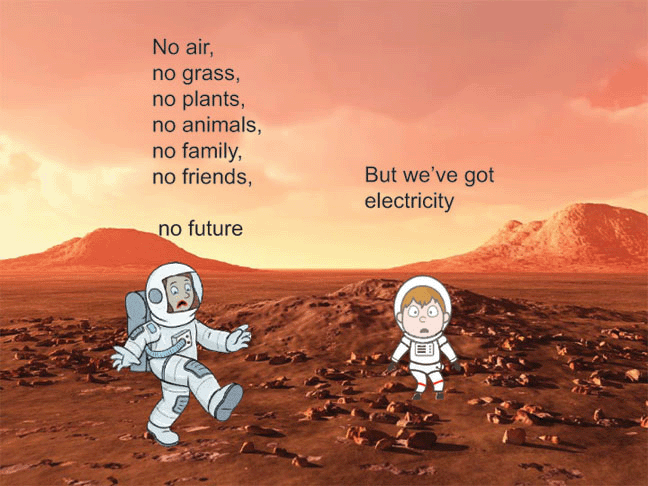
U.S. tests nuclear power system to sustain astronauts on Mars –#SCIENCE NEWS, JANUARY 19, 2018, Will Dunham, WASHINGTON (Reuters) – Initial tests in Nevada on a compact nuclear power system designed to sustain a long-duration NASA human mission on the inhospitable surface of Mars have been successful and a full-power run is scheduled for March, officials said on Thursday.
Officials from the National Aeronautics and Space Administration and U.S. Department of Energy, at a news conference in Las Vegas, detailed the development of the nuclear fission system under NASA’s Kilopower project.
Months-long testing of the system began in November at the energy department’s Nevada National Security Site, with an eye toward providing energy for future human and robotic missions in space and on the surface of Mars, the moon or other solar system destinations………..
“Mars is a very difficult environment for power systems, with less sunlight than Earth or the moon, very cold nighttime temperatures, very interesting dust storms that can last weeks and months that engulf the entire planet,” said Steve Jurczyk, associate administrator of NASA‘s Space Technology Mission Directorate…….
President Donald Trump in December signed a directive intended to pave the way for a return to the moon, with an eye toward an eventual mission to Mars.













 nuclear-news