South Koreans still distrustful of Japanese fish products after nuclear meltdown

US stealth bombers in Guam getting ready for a pre-emptive nuclear strike on North Korea?
 US stealth bombers in Guam appear to be readying for a tactical nuclear strike on North Korea, Business Insider, ALEX LOCKIE, JAN 25, 2018,
Trump May Consider Preemptive Strike on North Korea – CIA Director
CIA Boss Gives Latest Indication Trump May Consider Preemptive Strike on North Korea, Daily Beast The spy agency is briefing the president about military options on North Korea, which outside analysts warn could escalate to nuclear war. SPENCER ACKERMAN, 01.23.18 THE CENTRAL INTELLIGENCE AGENCY IS BRIEFING President Donald Trump on the risks and opportunities of a limited attack on North Korea, its director suggested on Tuesday.
CIA Director Mike Pompeo would not discuss the “wisdom of a preemptive strike” on Pyongyang or its nuclear weapons program, he told an audience at the conservative American Enterprise Institute. But in rare public remarks, Pompeo portrayed North Korea as an urgent priority for the agency, and disclosed aspects of its role in setting back Kim Jong Un’s nuclear program during his first year at Langley……..
A former North Korean spy, Kim Hyon-hui, indicated to NBC News that Trump’s goal of denuclearizing a country that has been a nuclear state for over a decade is not achievable diplomatically: “North Korea won’t give up its nuclear weapons. They’re its lifeline.”……….
Trump has given reason to doubt Pompeo’s statement that he is looking to resolve the Korea nuclear crisis peacefully. In October, he said Secretary of State Rex Tillerson was “wasting his time” attempting negotiations with Kim. After Tillerson stated publicly last month that he was willing to talk with North Korea without any precondition, the White House again shut him down. All that followed Trump’s infamous August declaration that North Korean provocations would be “met with fire and fury like the world has never seen.”……. https://www.thedailybeast.com/cia-director-mike-pompeo-gives-latest-indication-trump-is-considering-preemptive-strike-on-north-korea
Epic crisis in USA’s nuclear industry – Trump’s trying to stop solar power will not save nukes
 Trump’s Assault on Solar Masks an Epic Crisis in the Nuclear Industry, The Progressive , by Harvey Wasserman, January 25, 2018 As Donald Trump launches his latest assault on renewable energy—imposing a 30 percent tariff on solar panels imported from China—a major crisis in the nuclear power industry is threatening to shut four high-profile reactors, with more shutdowns to come. These closures could pave the way for thousands of new jobs in wind and solar, offsetting at least some of the losses from Trump’s attack.
Like nearly everything else Trump does, the hike in duties makes no rational sense. Bill McKibben summed it up, tweeting: “Trump imposes 30% tariff on imported solar panels—one more effort to try and slow renewable energy, one more favor for the status quo.”………
the burgeoning U.S. market for cheap Chinese panels has birthed a very large industry. More than a quarter-million Americans now work in photovoltaics, with most of the jobs in building desert arrays or perching the panels on rooftops. Except for the very marginal pressure from Suniva and SolarWorld, solar advocates have focussed on the rapid spread of low-cost panels, even if they come from China.
Powered largely by Chinese product, the cost of a solar-generated watt of power has dropped from $6.00 in the late 1990s to around $0.72 in 2016. Further drops are considered inevitable. At that price, there is virtually no economic margin for any other new energy production construction except wind and natural gas. Even gas—with its uncertain long-term supply—is on the cusp of being priced out.
Thus, the industry’s reactionto Trump’s solar panel tariff has been fierce.
“We are not happy with this decision,” Abigail Ross Hopper, president of the American Solar Energy Association, told Reuters. “It’s just basic economics—if you raise the price of a product, it’s going to decrease demand for that product.” Trump’s move is predicted to drop upcoming solar installations by 10 to 15 percent and cost some 23,000 jobs.
Sustainable energy professor Scott Sklar, in an email to The Progressive, estimated that Trump’s 30 percent tariff will, after four years, “retard the solar market by 9 percent, cause the loss of thousands of U.S. jobs, and not save the two companies that brought the anti-competitive tariff request initially. The tariff was a political statement to China rather than specifically addressing the health of the U.S. solar industry and increasing U.S. solar jobs.”
Two major developments in the nuclear power industry further illustrate the absurdity of Trump’s decision.
In California, the Public Utilities Commission has gutted a major agreement that would have kept two mammoth reactors at Diablo Canyon operating for several more years. The landmark deal—cut between Pacific Gas & Electric, the host communities around San Luis Obispo, the reactors’ union workers and two environmental groups—called for PG&E to collect some $1.3 billion from ratepayers.
But the California commission cut PG&E’s take to about $300 million. To continue running the two fast-deteriorating old reactors would require massive capital repairs. The company also has admitted that all of Diablo’s power can be otherwise produced with zero- and low-carbon green technologies.
While Trump’s tariffs may slightly alter the math, they’re not expected to make photovoltaics, wind, geothermal, or increased efficiency more expensive than the power Diablo might generate in the coming seven years. Thus, Diablo opponents like Linda Sealey of the San Luis-based Mothers for Peace are extremely hopeful for early shutdowns.
“We think this makes it likely they’ll shut as early as 2020,” she told me January 18 on California Solartopia at KPFK radio in Los Angeles. “They just can’t compete.”
A parallel fate may soon overtake Ohio’s ancient Perry and Davis-Besse reactors on Lake Erie. Because the increasingly decrepit nuclear plants have been priced out of the market and face huge capital repairs, their owner FirstEnergy has been desperately begging the Ohio legislature for massive bailouts, which it has so far resisted. As a result FirstEnergy is poised to go bankrupt, and may soon be bought out by financiers expected to insist the two reactors finally shut. A decision is expected in April.
The shutdown of four more major reactors would be a huge blow to the downwardly spiraling atomic energy industry. California’s booming solar business employs more than 100,000 Americans, more than are currently digging coal nationwide. The void left by Diablo’s shutdown would generate thousands of Golden State jobs and billions in renewable revenue.
In northern Ohio, massive wind potential is also poised to create far more jobs than are currently in place at the two reactors, with energy to be generated far more cheaply. Overall, the closure of these four high-profile plants would thus accelerate the already rapid run away from nuclear power toward renewable sources, regardless of any attempt by the Trump Administration to alter the course.
Harvey “Sluggo” Wasserman’s “California Solartopia Show” is broadcast at KPFK-Pacifica 90.7FM in Los Angeles. His “Green Power & Wellness Show” is podcast at prn.fm. His History of the US and Solartopia! are at www.solartopia.org, which will publish his America at the Brink of Rebirthlater this year. http://progressive.org/dispatches/trumps-assault-on-solar-masks-an-epic-crisis-in-nuclear-180125/
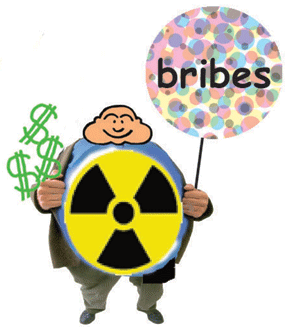
UK’s £1m a year bribes to communities to host nuclear waste

 Communities offered £1m a year to host nuclear waste dump https://www.theguardian.com/environment/2018/jan/25/communities-offered-1m-a-year-to-host-nuclear-waste-dump
New search for communities willing to host underground site for thousands of years, Guardian, Adam Vaughan, 25 Jan 18, Local communities around England, Wales and Northern Ireland will be offered £1m a year to volunteer to host an underground nuclear waste disposal facility for thousands of years, as part of a rebooted government programme.
The financial incentive is one way the government hopes to encourage communities to host the £12bn facility, after previous efforts failed in 2013 when Cumbria county council rejected the project.
Under new plans published on Thursday, a test of public support will be required for the scheme to go ahead, which could include a local referendum.
The only areas to explore the idea last time round were Copeland and Allerdale borough councils in Cumbria, and Shepway District Council in Kent.
This time, interested communities that explore hosting the facility will also receive £1m a year, which officials say could be spent on developing skills locally or apprenticeships. The payments, which could rise to £2.5m annually as a community considers whether to proceed, are expected to last for around five years.
The geological disposal facility (GDF) is seen by experts as the best long-term solution to storing the estimated 750,000 cubic metres of waste generated by half a century of nuclear power and defence, which would fill three quarters of Wembley Stadium.
It also includes the radioactive material created by potentially five new plants that the government expects to be built, including Hinkley Point C, which EDF Energy is constructing in Somerset.
The Institute of Directors said storing waste deep underground would be cheaper than storing it above ground, as it is at present at around 30 sites.Business, unions and local authority groups welcomed the renewed bid to site a GDF.
“Running costs for a geological disposal facility storing the waste 1,000 metres below the surface would be significantly lower,” the business group said.
Richard Harrington, energy minister, said: “We owe it to future generations to take action now to find a suitable permanent site for the safe disposal of our radioactive waste. And it is right that local communities have a say.”
But Greenpeace criticised the payments, calling them bribes, and said new nuclear power plants should not go ahead without a long-term solution in place for their waste.
Doug Parr, the group’s chief scientist, said: “Having failed to find a council willing to have nuclear waste stored under their land, ministers are resorting to the tactics from the fracking playbook – bribing communities and bypassing local authorities.
“With six new nuclear plants being planned, the waste problem is just going to get much worse. Since there is no permanent solution for the disposal of spent nuclear fuel, the responsible thing to do would be to stop producing more of it instead of just passing the radioactive buck to future generations.”
Nuclear waste is currently stored at about 30 sites, but predominantly at ground level at Sellafield in Cumbria. The GDF project is expected to cost £12bn, spread over a century.
Scientists aim to limit Trump’s power to launch nuclear vweapons
 A group of scientists is trying to limit Trump’s nuclear authority, CNBC 25 Jan 18
- A plan pushed by group of scientists would cut presidential authority to unilaterally order nuclear strikes.
- As commander in chief, the U.S. president currently has the authority to order the military to launch nuclear missiles.
- This proposal would require the vice president and speaker of the House to also approve any nuclear strike.
- “No one person should be able to order a nuclear attack,” wrote one of the scientists proposing the plan.
The plan would require that the president first obtain approval from the next two officials in the presidential succession chain — the vice president and speaker of the House, according to a paper in the Bulletin of the Atomic Scientists, a global disarmament advocacy.
As commander in chief, the U.S. president currently has the authority to order the U.S. military to launch nuclear missiles.
Back in November, there was discussion in the Senate Foreign Relations Committee about limiting the president’s nuclear strike authority after some Democratic lawmakers cited Trump’s “unstable” behavior.
“No one person should be able to order a nuclear attack,” said paper co-author Lisbeth Gronlund, a senior scientist and co-director of the Global Security Program at the Union of Concerned Scientists (UCS). “There’s no reason to maintain this dangerous policy, since there are viable alternatives that would allow other officials to take part in any decision to use nuclear weapons, whether it’s a first use or a launch responding to a nuclear attack.”
According to the paper, “the risks are not hypothetical. During the Watergate scandal, President [Richard] Nixon was drinking heavily and many advisers considered him unstable. During the 1974 impeachment hearings, Nixon told reporters that ‘I can go back into my office and pick up the telephone and in 25 minutes 70 million people will be dead.'”
The paper was co-authored by David Wright, a UCS senior scientist, and University of Maryland professor Steve Fetter.
The authors of the paper said the “proposal applies to any use of nuclear weapons, regardless of whether it would be the first use of nuclear weapons or in response to a nuclear attack or warning of an attack.”………
military generals can essentially refuse to follow what they consider “illegal orders,” retired Gen. Robert Kehler testified at the Senate Foreign Relations Committee hearing in November. Kehler is the former commander of the U.S. Strategic Command. https://www.cnbc.com/2018/01/24/scientists-seek-to-limit-trumps-power-in-ordering-a-nuclear-strike.html
Austria sues Commission over Hungary’s nuclear plant
 EU Observer, By ESZTER ZALAN Austria decided on Wednesday (24 January) to sue the European Commission for allowing the expansion of Hungary’s controversial Paks nuclear plant, to be built and financed by Russia.
The project is viewed by critics as an example of Hungary’s prime minister, Viktor Orban, cosying up to Russian president Vladimir Putin.
Austrian sustainability minister Elisabeth Koestinger tweeted: “Austria will take action against the use of nuclear power plants at all levels. That is why today we have taken a decision in the council of ministers to sue Paks II at European level”.
“There are enough reasons to sue Paks II. We are optimistic to prevail. To protect our country and our children,” she added in a tweet. EU competition commissioner Margrethe Vestager, whose services were responsible for scrutinising the state aid plans for the nuclear plant, told reporters on Wednesday that the EU executive takes Austria’s decision “very seriously”.
“We will of course defend our decision with the arguments that are in the decision,” she added.
Last March the Commission gave its final approval for the project, and that said Hungary’s state aid is not illegal after commitments Budapest had made to limit distortions in competition.
An earlier infringement procedure looking into whether the project was in line with EU procurement rules, as it was initiated without a tender, was closed in 2016 with the ruling that Hungary did not break EU rules.
The project, signed in 2014 in Moscow, would see Russian state-owned company and its international sub-contractors build two new reactors.
The Russian state has also loaned up to €10 billion to Hungary to finance 80 percent of the project.
On track
Austria, Hungary’s neighbour, has no nuclear power plants. Last October, then prime minister Christian Kern said Austria would challenge the Commission’s decision on Paks.
Vienna launched a similar legal action against the Commission in 2015 over its approval of the UK’s state aid support for the Hinkley Point C nuclear power plant project.
“EU assistance is only permissible when it is built on common interest. For us, nuclear energy is neither a sustainable form of energy supply, nor is it an answer to climate change,” a spokesman for Koestinger, a member of right-wing Austrian People’s Party, was quoted by Reuters………
Green MEP Benedek Javor, who has challenged the commission’s decisions and shed light on shady dealings between commissioner Guenther Oettinger and German lobbyist of Russian interests Klaus Mangold with possible links to Paks , argued it is time to rethink the Euratom treaty.
“Is this possible to exempt a major energy generating sector, nuclear energy, from common competition or public procurement law, based on a 60 years old and never really updated regulation, the Euratom treaty? Without giving a clear negative answer to this question, any plans of the Energy Union or the single European energy market might remain a dream,” he said, arguing that the case is not only an Austro-Hungarian dispute.
“It is simply not true, that high amount of state subsidy for a nuclear power plant with 2400 MW of capacity does not distort the market. And it is simply misinterpretation of the Euratom treaty, that the paragraph saying that ‘the development of nuclear energy is a community interest’ means that unprofitable powerplants producing electricity for the market and built from Russian money, with Russian technology and using Russian fuel should be regarded as a community interest and heavily subsidised,” Javor argued………https://euobserver.com/energy/140690
New tactic in Small Modular Nuclear Reactor lobbying – claim to help electric cars
-
Small modular reactors more versatile than conventional plants
-
Battery storage still too pricey for large-scale use
Nuclear Free Local Authorities (NFLA) advise UK government to learn from Sweden’s court ruling on nuclear waste
 NFLA 24th Jan 2018, As the UK Government plans yet another attempt to deliver a deep
underground radioactive waste repository, NFLA urges them and the
regulators to look carefully at a Swedish court ruling rejecting a
repository licence around real safety concerns.
The Nuclear Free Local Authorities (NFLA) has been made aware that the UK Government imminently
plans its latest attempt, which is the sixth attempt in the past 42 years,
to start a process to find a willing community to host a deep underground
radioactive waste repository.
This process now could be, and should be, completely reconsidered after a Swedish court ruling rejecting a licence
application on the waste capsules for a similar development, after many
years of planning.
For over 4 decades, several UK bodies – UKAEA, Nirex,
RWMD and now Radioactive Waste Management Ltd (RWM) – have been
established by the UK Government to deliver a deep underground radioactive
waste repository, often referred to in the industry as a geological
disposal facility (GDF).
Three consultations are expected to be issued
imminently – one on the definition of the community that would decide on
such a repository and how engaging with the public would take place, a
second on a National Policy Statement for a deep waste repository, and the
third the publication by RWM of a national geological screening of England,
Wales and Northern Ireland (Scotland is pursuing a separate policy of
‘near site, near surface’ storage of its highly active radioactive
waste).
Throughout its 38 years of operation, NFLA has been heavily engaged
in this debate. It remains sceptical that a deep underground repository is
the most environmentally sound solution for managing the UK’s huge burden
of radioactive waste.
It notes that the Nuclear Waste Advisory Associates
have outlined over 100 key technical and scientific concerns around such
developments, and NFLA has seen no resolution to these issues from the
government or RWM.
Macron’s France weakening on plans to phase out nuclear power?
 France crimps debate on reducing reliance on nuclear: activists say https://www.reuters.com/article/us-france-nuclearpower/france-crimps-debate-on-reducing-reliance-on-nuclear-activists-say-idUSKBN1FE2MU, 26 Jan 18, Geert De Clercq PARIS (Reuters) – The French government is hampering discussion about how to reduce the country’s reliance on nuclear energy by limiting debate about more radical alternatives, renewable energy advocates said on Thursday.
France’s previous socialist government pledged to reduce the share of nuclear in power generation to 50 percent by 2025, from 75 percent today. President Emmanuel Macron promised to respect that pledge during his election campaign last year, but since taking office he has pushed the target back by a decade.
Macron now wants to set new targets in a multi-year energy plan that will be debated this year and presented in early 2019.
But renewable energy activists say that at some workshops earlier this month, the government blocked discussion of scenarios under which France would radically reduce its nuclear power capacity, instead focusing on more pro-nuclear scenarios.
Energy and Environment Minister Nicolas Hulot has denied that the government favored the most pro-nuclear scenarios, saying it merely eliminated the two most extreme scenarios and kept the “median” scenarios. He did not specify which scenarios had been eliminated.
Late last year, French grid operator RTE published four 2035 scenarios under which nuclear capacity would be reduced to various degrees from the current 63 gigawatt (GW).
Under the “Volt” scenario, nuclear capacity would be cut to 55 GW by closing just nine of state-owned utility EDF’s 58 nuclear reactors and leaving the share of nuclear in power production at 56 percent. The “Ampere” scenario would close 16 reactors and leave the share of nuclear at 46 percent.
Two more radical scenarios, “Watt” and “Hertz”, would close as many as 52 and 25 reactors respectively, with the Watt scenario cutting the share of nuclear to as little as 11 percent. The remaining power would come from renewables (71 percent) and gas (18 percent).
“The Watt and Hertz scenarios were eliminated from the presentations at the government’s request,” said Yves Marignac of NegaWatt, a group which advocates higher renewables use.
NegaWatt took part in two workshops to prepare the public debate on the issue. It was joined by several energy-focused NGOs, EDF, nuclear firm Orano, and lobby groups. The debates are supposed to lead to a first draft of a multi-year energy plan by summer and a final plan in early 2019. Its conclusions will be crucial for European power markets as they will determine how much nuclear baseload capacity remains available.
· A source involved with organizing the workshops confirmed the government had instructed RTE to withdraw two scenarios.
· “All scenarios were mentioned, but only two were reviewed in detail,” he said.
· A ministry spokeswoman said two scenarios had indeed been removed from the presentation but declined to give details.
· “It is inconceivable that these two scenarios would be withheld from public debate,” NegaWatt’s Thierry Salomon said.
· France has withheld key information on nuclear before.
· In the months before the parliament vote on the 2015 energy law, Hulot’s predecessor Segolene Royal barred publication of an environment agency ADEME report showing France could switch to 100 percent renewables without extra costs.
· “At least this time the information is public. But it looks like the government is putting the interests of the nuclear industry ahead of the energy policy debate,” Salomon said.
· > Link to ADEME report story: tinyurl.com/y84ow838</a Reporting by Geert De Clercq. Editing by Jane Merriman
Lawsuit against Nuclear Subsidies headed for Court Trial
 Challenge to N.Y. Nuclear Subsidies Will Go to Trial, Power, 01/25/2018 | Sonal Patel A lawsuit challenging subsidies for New York’s nuclear plants will head to trial after the state’s Supreme Court rejected motions to dismiss it.
The measure deals a small setback for Exelon Corp., whose subsidiaries own the R.E Ginna and Nine Mile Point nuclear plants in upstate New York. Defendants in the lawsuit also include Entergy Corp., which owns Indian Point 2 and 3, and the New York State Public Service Commission (PSC).
Exelon had successfully lobbied the state to approve the Clean Energy Standard in August 2016, a program that requires all six New York investor-owned utilities and other energy suppliers to pay for the intrinsic value of carbon-free emissions from nuclear power plants by purchasing “Zero-Emission Credits” (ZECs) between 2017 and 2029.
The measure has drawn strong opposition. The lawsuit filed by several citizens’ groups—including the Nuclear Information Research Service, Beyond Nuclear, New York Public Interest Research Group, Indian Point Safe Energy Coalition, Promoting Health and Sustainable Energy, and Goshen Green Farms—charges that PSC failed to follow the law by giving up more than $7.6 billion in ratepayer funds over 12 years to the companies’ financially ailing nuclear plants.
Specifically, the groups argued that the PSC failed to follow requirements in the State Administrative Procedure Act, and that the PSC’s actions were arbitrary and capricious—both by misapplying the social cost of carbon metric as a legal basis to include nuclear reactors in the Clean Energy Standard, and by declaring the reactors “publicly necessary.” Other stated causes of action allege that the PSC violated pubic service law by setting rates that are “unjust, unreasonable, unjustly discriminatory, and unduly preferential.”
The state and nuclear plant owners sought to dismiss the lawsuit, arguing that some claims are untimely because they were filed outside of the four-month statute of limitations after the Clean Energy Standard became final and binding. Respondents also argued that petitioners lack sufficient standing to pursue some claims, because alleged economic injuries were outside a defined zone of interests.
On Monday, Judge Roger D. McDonough dismissed claims by 56 of the 61 petitioners on the basis that they were time-barred. However, he denied five of the six objections posed by the respondents, ruling that the lawsuit should be fully heard rather than preempted by the respondents’ objections. “The Court declines to entertain such discussions without the benefit of answers and the full administrative record,” he wrote.
The ruling notes that at least three of the nuclear plants—James A. Fitzpatrick, R.E. Ginna, and Nine Mile Point Unit 1 and Unit 2—have received an estimated $360 million in subsidies over the past nine months. McDonough ruled, however, that while Indian Point was eligible for ZECs amounting to about $2 billion, contentions concerning that plant were not ripe for adjudication as the plant has not yet received them.
The citizens’ groups hailed the decision as a major victory for the rule of law. …….. http://www.powermag.com/challenge-to-n-y-nuclear-subsidies-will-go-to-trial/
UK’s Atomic Weapons Establishment (AWE) wants to raise permissable levels of radiation release
 AWE bids for ‘more realistic’ nuclear terrorism tests licence, The UK’s nuclear warhead factory is bidding for a licence change to run “more realistic” tests in preparation for “nuclear terrorism”.
The Atomic Weapons Establishment (AWE) in Berkshire wants to raise levels of radiation it can release from its site……..http://www.bbc.com/news/uk-england-oxfordshire-42801822
UK new nuclear build would create an intolerable waste burden on communities into the far future
Exposing UK government folly of investment in new nuclear https://www.theguardian.com/environment/2018/jan/24/exposing-uk-government-folly-of-investment-in-new-nuclear
In 1976, Lord Flowers pronounced that there should be no further commitment to nuclear energy unless it could be demonstrated that long-lived highly radioactive wastes could be safely contained for the indefinite future. Ever since, efforts to find a suitable site for a geological disposal facility have been rejected by communities (Wanted: community willing to host a highly radioactive waste dump in their district, 22 January).
There is, therefore, little evidence to support the government’s claim that “it is satisfied that effective arrangements will exist to manage and dispose of the waste that will be produced from new nuclear power stations”. Deep disposal may be the eventual long-term solution but demonstrating a safety case, finding suitable geology and a willing community are tough challenges and likely to take a long time. The search for a disposal site diverts attention from the real solution for the foreseeable future, which is to ensure the safe and secure management of the unavoidable legacy wastes that have to be managed. It is perverse to compound the problem by a new-build programme that will result in vastly increased radioactivity from spent fuel and other highly radioactive wastes which will have to be stored indefinitely at vulnerable sites scattered around our coasts.
The fact that the UK government is still going ahead with plans to construct new power stations, generating even more toxic radioactive waste, troubles and puzzles me immensely. Here, on the beautiful isle of Anglesey, where tidal, solar and wind energy production are all highly feasible alternatives and could also provide opportunities for well-paid employment, politicians appear to be happy for an area of outstanding natural beauty to be contaminated for further than the foreseeable future, not to mention the immense eyesore that will occupy acres of fertile land. It is an eye-wateringly costly venture that many fear will expose taxpayers to huge financial risk and will also leave future generations guarding the threat to their environment and health long after it ceases to function.
Future generations will doubtless wonder, when most of Europe is shutting down its nuclear power stations and not planning any more, why in the world the local population didn’t protest harder.
Rose Heaney
Holyhead, Gwynedd
A new-build programme would create an unmanageable and intolerable burden on communities into the far future. To suggest that a repository is the solution is in the realm of fantasy.
Prof Andrew Blowers
Member of the first Committee onRadioactive Waste Management
South Africa has no money for nuclear power: Ramaphosa
SA has no money for nuclear power: Ramaphosa, ENC.com, SOUTH AFRICA, JOHANNESBURG – “We have excess power right now and we have no money to go for major nuclear plant building.”
Swedish Environmental Court rejects plan for spent nuclear fuel repository
 MKG 23rd Jan 2018, The Swedish Environmental Court says no to the power industry’s Nuclear
Waste Company SKB’s license application for a final repository for spent
nuclear fuel in Forsmark, Sweden.
This is a huge triumph for safety and environment – and for the Swedish NGO Office for Nuclear Waste Review
(MKG), the Swedish Society for Nature Conservation (SSNC), and critical
scientists who have been presenting risks of the malfunction of the
selected method. Now it is up to the Swedish government to make the final
decision. This is a triumph for us.
From now on, the work on evaluating safer disposal solutions will continue. The decision that will be made
concerns waste that will be hazardous for thousands of years. Several
independent researchers have criticized both the applied method and the
selected site. There is a solid documentation as base for the Environmental
Court’s decision. It is hard to believe the Swedish Government’s
conclusions will be any different from that of the Court’s, says Johan
Swahn, Director at MKG.
http://www.mkg.se/en/the-swedish-environmental-court-s-no-to-the-final-repository-for-spent-nuclear-fuel-a-triumph-for-th
1 This Month


Tell the Ukrainian Government to Drop Prosecution of Peace Activist Yurii Sheliazhenko

Petition to revoke the licensing of the Near Surface Nuclear Disposal Facility (NSDF) at Chalk River. https://www.ourcommons.ca/petitions/en/Petition/Details?Petition=e-7247


of the week – STOP SMALL MODULAR REACTORS IN CANADA
To see nuclear-related stories in greater depth and intensity – go to https://nuclearinformation.wordpress.com
-
Archives
- March 2026 (204)
- February 2026 (268)
- January 2026 (308)
- December 2025 (358)
- November 2025 (359)
- October 2025 (376)
- September 2025 (258)
- August 2025 (319)
- July 2025 (230)
- June 2025 (348)
- May 2025 (261)
- April 2025 (305)
-
Categories
- 1
- 1 NUCLEAR ISSUES
- business and costs
- climate change
- culture and arts
- ENERGY
- environment
- health
- history
- indigenous issues
- Legal
- marketing of nuclear
- media
- opposition to nuclear
- PERSONAL STORIES
- politics
- politics international
- Religion and ethics
- safety
- secrets,lies and civil liberties
- spinbuster
- technology
- Uranium
- wastes
- weapons and war
- Women
- 2 WORLD
- ACTION
- AFRICA
- Atrocities
- AUSTRALIA
- Christina's notes
- Christina's themes
- culture and arts
- Events
- Fuk 2022
- Fuk 2023
- Fukushima 2017
- Fukushima 2018
- fukushima 2019
- Fukushima 2020
- Fukushima 2021
- general
- global warming
- Humour (God we need it)
- Nuclear
- RARE EARTHS
- Reference
- resources – print
- Resources -audiovicual
- Weekly Newsletter
- World
- World Nuclear
- YouTube
-
RSS
Entries RSS
Comments RSS
 nuclear-news