Ticking Time Bomb at San Onofre Nuclear Plant
What happens to SoCal radioactive waste is anybody’s guess…and everybody’s worry
The seaside nuclear reactors at the San Onofre Nuclear Generating Station in San Clemente were permanently shut down in 2013 following steam generator malfunction. What to do with the 3.6 million pounds of highly radioactive waste remains an epic problem, however, pitting concerned citizens against Southern California Edison, the California Coastal Commission and the Nuclear Regulatory Commission (NRC). Edison operates San Onofre, the Coastal Commission is charged with protecting the coastline, and the NRC is responsible for long-term storage of spent nuclear fuel and protecting the public.
The Problem

A reactor’s spent nuclear fuel must be stored safely for 250,000 years to allow the radioactivity to dissipate. San Onofre’s nuclear waste has been stored in containers 20 feet under water in cooling pools for at least five years, the standard procedure for on-site temporary storage. Long-term storage necessitates transfer to fortified dry-storage canisters for eventual transportation to a permanent national storage site which, under the Nuclear Waste Policy Act of 1982, the federal government is under obligation to construct.
However, the plan to build an underground repository at Yucca Mountain in the Nevadan desert was ditched in 2011 out of concern that deep groundwater could destabilize the canisters, leaving the United States with literally no plan on the horizon for permanent storage of nuclear waste from San Onofre or any other of the country’s nuclear power plants. In fact, under the NRC’s newest plan – the so-called Generic Environmental Impact Statement – nuclear power plant waste might be stored on-site forever.
Given this, informed southern Californians are up in arms about the 2015 permit by the Coastal Commission allowing Edison to build a dry-storage bunker right at San Onofre – near major metropolitan areas and within a few hundred feet of both the I-5 Freeway and the shoreline in a known earthquake zone – using thin-wall canisters never proven safe for storage or transport (Coastal Development Permit No. 9-15-0228). Most other countries, including Germany, France, Japan, Russia and Australia, utilize thick-wall canisters with time proven safety technology.
The Current Plan
The dry-storage plan OK’ed by the Coastal Commission is the Holtec Hi-Storm system: cheaper canisters with 5/8-inch thick stainless steel walls, wildly short of the 10 to 20-inch thick-walled ones used in other countries. Each of 72 remaining canisters slated to be converted from wet to dry storage will contain about 50,000 pounds of nuclear waste and as much radiation as was released from Chernobyl.

At the controversy’s core is the susceptibility of Holtec canisters to cracking, which could leak radiation into the environment, both land and sea. Seawater seepage into canisters can produce explosive substances.
Holtec canisters have no seismic rating, are not proven safe for transport, and there is no means to even inspect them for cracks or for existing cracks to be repaired in a safe manner. A crack can’t even be detected until after a radiation leak has occurred.
The Coastal Commission acknowledges these issues but is allowing Edison 20 years to hopefully come up with a solution.
In the meanwhile, loading into dry-canisters already began in December, 2017 and is scheduled to be completed by 2019. Furthermore, Edison plans to empty the cooling pools once the dry transfer is completed, eliminating the only approved method to replace a defective canister.
A highly disturbing report from Sandia National Laboratories states that a crack in a hot canister can penetrate the wall in under 5 years. Notwithstanding, Holtec’s 25-year warranty of their canisters is an absurdity given that nuclear waste radiation takes thousands of years to reach safe levels.
There is also no community evacuation plan in place in the event of radiation leakage at San Onofre. The fear is that failure of even one canister could leave Orange and San Diego counties an uninhabitable wasteland for eons, with exposed humans suffering permanent genetic damage. And, home and business insurance doesn’t cover losses due to radiation contamination.
The very real specter of radiation havoc from a terrorist bomb attack launched from an offshore boat or a truck on the I-5 Freeway looms as well.
In the minds of many, the reckless plan allowed by the NRC and endorsed by the Coastal Commission and Edison creates imminent risk of a “Fukushima” in South Orange County.
The Solution
A lawsuit filed by the San Diego watchdog organization Citizens Oversight in 2015 asserted that the Coastal Commission failed to adequately consider both the special risks of on-site storage in an earthquake zone next to the ocean and the shortcomings of the Holtec system. In a court settlement just reached on Aug. 25, 2017, Edison agreed to hire a team of experts in hopes of locating an alternative temporary storage site. Edison also agreed to develop a plan for dealing with cracked canisters, though there is no assurance that such a plan is feasible for Holtec canisters.
Though the settlement plan appears a first step toward a saner solution to San Onofre’s nuclear waste problem, the obligations in the plan are far too vague to assuage the concerns of local residents. Their main points are threefold: There are other safer temporary storage sites inland that can be considered; maintaining the cooling pools is imperative until all nuclear waste has been moved off-site; and Holtec canisters should be abandoned in favor of thick-wall options that already have a 40-year track record of safety during both transport and storage in countries across the globe.
Case in point, the thick-wall canisters in place at Fukushima survived both the earthquake and the tsunami.
Take action to protect yourself and your family by signing on to a petition from PublicWatchdogs.org to revoke the Coastal Commission’s permit to turn San Onofre into a nuclear waste dump.
San Onofre 2050: Tide’s in, nukes out
Nuclear waste in the sand now will create a toxic ocean later
Are northern San Diego County and southern Orange County headed for another Fukushima Daiichi–like nuclear disaster? Possibly, but not necessarily in our lifetimes. The economic severity of such a disaster could destroy the California economy, flatten the United States economy, and severely harm the world economy while killing and maiming many people, says Carlsbad scientist Tom English.
English got a PhD in electrical engineering at Carnegie Mellon and did postdoctoral work in environmental engineering at Vanderbilt. He has lectured at more than 100 universities and given eight presentations at the White House. Now he is giving lectures about the greed and stupidity behind the decision to bury nuclear waste 108 feet from the ocean at the shuttered San Onofre nuclear plant.
Major owner Southern California Edison has quietly completed construction of its beach-front nuclear waste dump despite promises to look elsewhere.
Why is Japan’s Fukushima disaster of 2011 a possible model for what could happen in Southern California? Japan’s Fukushima Nuclear Accident Independent Investigation Commission concluded that people should not blame the tsunami for the disaster. Fukushima “cannot be regarded as a natural disaster,” said the panel’s chairman. “It was a profoundly man-made disaster…governments, regulatory authorities and Tokyo Electric Power lacked a sense of responsibility to protect people’s lives.”
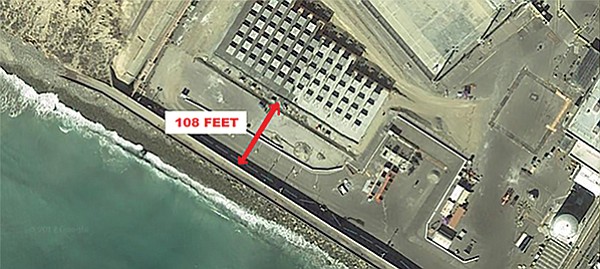
Edison’s scheme to pawn the cost of the decommissioning onto ratepayers and to bury 3.6 million pounds of nuclear waste next to the ocean displays the same greed and incompetence as Tokyo Electric and its regulators. As Californians have learned, Edison’s corporate duplicity knows no bounds. The California Public Utilities Commission is a classic case of “regulatory capture,” or regulators run by the utilities. The federal Nuclear Regulatory Commission also bows to utilities, and the California Coastal Commission thinks spent nuclear fuel should be stored where it originated (in our case, at San Onofre) because the federal government hasn’t developed any options for either temporary or permanent storage of this extremely deadly waste, says English.
On nuclear issues, the coastal commission believes that its mandate to include environmental, health, and safety issues has been preempted by federal law, says English. Therefore, the commission has made a point of deliberately excluding these crucial considerations from their licensing hearings, even though they are well aware of their critical importance. That is a fatal weakness in the commission’s nuclear permitting process.
The regulators practice the malodorous “revolving door” policy — employees stay awhile at the regulator and then go work at a utility at a high salary. This is practiced at other so-called regulators such as the Securities and Exchange Commission. In effect, regulators are temps until they can get that fat job at a company.
Fukushima showed that storage of the dangerous spent fuel in pools of water has dangers, so now utilities put the spent fuel into dry storage, slipped into canisters that are surrounded by concrete. “You create a problem worse than the problem you were trying to solve,” says English. To bury the canisters 108 feet from the ocean is “absolutely stupid.” Canisters should be “as far away from water as possible.” Reason: global warming is melting the earth’s polar ice caps, causing massive sea-level rise. According to James Hansen, one of the world’s leading climate-change experts, by the year 2050 the sea level could rise by ten feet. If this happens, the canisters holding the deadly spent fuel will be one-third under water.
English speaks of the “washing machine effect”: the water level where the canisters will repose will vary with the tides, and salt water going up-down, up-down will cause erosion. English thinks the canisters are too thin and not fully protected. “If a crack is developing, they won’t know it,” he says. The San Onofre crew should have studied the old technique adopted years ago when gasoline tanks were leaking. “They tore out the old tanks and put in double-wall tanks. A leak in an inner tank can be detected right away, and no poisons are released into the environment. There is no protection like that with the proposed Edison canisters.”
Edison’s strategy “was driven by economics instead of safety,” says English. “They have chosen both a bad location and containers that are not very good. The dry-storage canisters must be able to be monitored, inspected — inside and out for radiation leaks — and repaired. Edison came up with a plan with completely unacceptable risks.”
It’s that old mentality of “not on my watch,” says English. Executives cut corners, getting bloated paychecks as profits rise, knowing they will be retired or deceased when despair sets in.
English is particularly concerned about terrorism. “If you store the nuclear waste canisters on the beach, there is no existing adequate defense on the ocean side. A small group of motivated terrorists could attack the interim storage site and spread radioactive materials all over the place,” he says. People within 50 miles would be evacuated — about 8.5 million persons. Abandonment of the region could cost $1 trillion to $2 trillion. Industrial output would plunge, severely damaging the California economy.
“Since California is the sixth-largest economy on Earth, this kind of event could be devastating to both the U.S. and world economy.”
The 1986 Chernobyl accident was in Ukraine, then part of the Soviet Union. “The attitude was that it happened in the Soviet Union because the Russians weren’t qualified,” says English. Japan was considered near-perfect industrially and technically. “But they screwed up at Fukushima,” says English. The Japanese prime minister Naoto Kan came within an hour of evacuating 80 million people in the Tokyo area. The Fukushima disaster almost destroyed the Japanese economy. Dislocated people are still ailing physically and psychologically because of Fukushima.
In common with several other activists, English believes that a mesa across I-5 from San Onofre might accommodate the temporary storage of spent fuel.
“It’s limited space that [Edison] has in its lease with the Navy. It’s maybe 50 to 80 feet higher than the beach storage site. That mesa is the only place that would not be totally stupid. This location would at least eliminate the near-term climate-change threat to canisters.” There is also some space on the ocean side that might work, but Charles Langley of Public Watchdogs believes that Edison has dumped toxic (non-nuclear) waste on that site and wouldn’t permit dumping of nuclear waste there.
https://www.sandiegoreader.com/news/2018/jan/03/city-lights-san-onofre-2050-tides-nukes-out/#
Nuclear news for the first week of 2018
 With regret, this newsletter is now going to focus mainly on nuclear issues. Climate change is no less important – indeed the harsh reality of climate change is worse than we thought. Climate change is being covered brilliantly by excellent websites, such as Radio Ecoshock and Global Weirding with Katharine Hayhoe. Renewable energy and energy efficiency are being left out, too, despite their huge importance. The new, narrower, focus is just because it’s all been getting, too much, too hard, and – newsletter too long.
My thanks to Lonnie Clarke of The Age of Fission– radio programme, (Missouri) for her information service, and for interviewing me this week . Also thanks to David Archer (TMI Podcasts) (Toronto) for the interview today.
With the Trump government now overturning net neutrality laws, it becomes ever more important for all the avenues of independent media to work together to spread information on the nuclear threat.
UN officials welcome reopening of communication between the two Koreas.
Nuclear industry desperately lobbying for financial help to be counted as “clean”.
Population Oscillations OR Collapsing Ecosystems.
Nuclear fusion – not really close at all.
USA.
- Former military analyst Daniel Ellsberg warns ‘50-50’ chance of nuclear war in coming weeks. Donald Trump’s National Security Strategy (NSS) puts America in peril.
- Facebook now willing to be censored by U.S. government.
- Trump’s NASA Space Plans – Potential for a Nuclear Catastrophe.
- U.S. Congressional Budget Office fails to consider costs of nuclear-weapons making clean-up.
- New Jersey stops fast-track pursuit of nuclear subsidy bill, for now. New Jersey’s flawed legislation – a gift to the nuclear lobby, and its fan Governor Christie. South Carolina’s Base Load Review Act, even Florida’s, – a licence for the nuclear industry to rip off the people.
- Anxiety over safety of Holtec canisters in San Onofre’s stranded nuclear wastes.
- Damaged Hanford Nuclear Reservation waste tank to be permanently closed. Radioactive material again found in cars and trucks at Hanford Plutonium Finishing Plant.
- Tepco, GE Escape $5B Fukushima Radiation Lawsuit. Sailors Fight to Keep Fukushima Radiation Case in USA.
UK. Renewables a better option than nuclear power: but nuclear is needed for maintaining nuclear weapons. Britain’s Hinkley nuclear project rife with scandalous conflicts of interest. Blunders, catastrophic, delays, even bankruptcy… ANOTHER nuclear power plant is going into financial meltdown. Delay in removal of nuclear wastes from Anglesey’s Wylfa power station.
NORTH KOREA. Improvement of inter-Korean relations.
JAPAN. Japanese gov’t to guarantee bank loans for Hitachi’s “risky” nuclear plant project in Britain. Westinghouse, Toshiba’s troubled nuclear unit, is acquired.
Radioactive debris at Fukushima – a huge challenge to Japanese govt and TEPCO. Fears of children who have to check radiation levels outside before they can go and play. Is Fukushima a healthy place to play Olympic ball games?
CANADA. Ontario’s nuclear emergency plan – inadequate, says Greenpeace.
FRANCE. French Greenpeace activists in court for breaking into the first nuclear plant.
CHINA. Another blow further delays China’s nuclear energy programme.
INDIA. Stop nuclear power expansion – says Former Chairman of India’s Atomic Energy Regulatory Board.
PAKISTAN.Pakistan and India exchange information on their nuclear installations and facilities.
MALAYSIA. ISIS supporters in Malaysia, and plans to make a thorium “dirty bomb”– Concern in Malaysia over radioactive thorium and uranium in building materials
BELGIUM. Belgium became the world leader in problems at nuclear power plants– Nine nuclear incidents in Belgium in 2017
TAIWAN.Taiwan’s green shift defies energy security fears.
GERMANY. Radioactive leak in German nuclear reactor. Germany has broken another renewable energy record.
KENYA. Growing concerns on the safety and feasibility of Kenya’s planned Sh2 trillion nuclear energy project.
Japanese taxpayers now join in Britain’s scandalous subsidising of the nuclear industry

The profitability of nuclear plant construction has been worsening all over the world
Nevertheless, the government intends to extend all-out support for the project.
Japanese gov’t to guarantee bank loans for Hitachi’s nuclear plant project in Britain https://mainichi.jp/english/articles/20180103/p2a/00m/0na/004000c (Mainichi Japan) The Japanese government is poised to guarantee the full amount of loans that three megabanks will extend for a nuclear plant construction project in Britain by Hitachi Ltd., sources familiar with the project said.
A group of banks, including the three megabanks and the government-affiliated Japa n Bank for International Cooperation (JBIC), will extend approximately 1.5 trillion yen in loans to Hitachi’s atomic power station project.
Of the amount, the government will fully guarantee loans to be extended by the megabanks, while the governmental Development Bank of Japan (DBJ) will support the project by making capital investments. Chubu Electric Power Co. and other utilities are also considering investing in the project.
The state will thus join hands with the private sector in extending all-out support for the project to export a nuclear plant worth some 3 trillion yen.
However, concerns have been raised that if the project were to run into the red, taxpayers could be forced to shoulder the burden.
The project to be covered with loans and investments is an atomic power station that a Hitachi subsidiary in Britain is aiming to build in Anglesey, Britain. The firm hopes to start operations at the plant in the mid-2020s.
Hitachi Ltd. is poised to make a final decision on whether to invest in the project by the end of fiscal 2019. However, Hitachi is consulting with the Japanese and British governments and financial institutions over loans, their guarantees and investment on the grounds that the electronics giant alone cannot take risks.
Japanese financial institutions and the governmental Nippon Export and Investment Insurance (NEXI) offered in December last year to extend financial assistance for the project.
According to the sources, Hitachi estimates the total cost of the project at about 3 trillion yen. Hitachi aims to obtain about 1.5 trillion yen in loans to cover half of the amount while raising another 1.5 trillion yen through investments.
Each of the three megabanks — the Bank of Tokyo-Mitsubishi UFJ, Ltd., Sumitomo Mitsui Banking Corp. and Mizuho Bank, Ltd. — intend to extend loans of more than 100 billion yen, totaling some 500 billion yen. NEXI will guarantee the loans. Hitachi intends to obtain the reminder of the loans from the JBIC and commercial financial institutions in Britain.
The DBJ has notified Hitachi of its intention to make capital investments in the atomic power station project, while Chubu Electric Power and Japan Atomic Power Co. are also considering investing in the venture.
Hitachi has also asked other utilities including Tokyo Electric Power Co. and trading houses to invest in the project in a bid to disperse risks involving the project.
The British government, which is speeding up the construction of nuclear plants, also intends to invest in the project, and Japanese and British Cabinet ministers in charge of energy policy exchanged a memorandum on cooperation in December last year.
The profitability of nuclear plant construction has been worsening all over the world due to an increase in the costs of ensuring safety since the outbreak of the Fukushima nuclear crisis in March 2011, contributing to the financial crisis of Toshiba Corp., another electronics giant.
Nevertheless, the government intends to extend all-out support for the project.
“It’s essential to win a contract on the British project in order to maintain Japan’s nuclear technology,” said a high-ranking official of the Economy, Trade and Industry.
New Jersey Bill to subsidise nuclear power – dead in the water – for now
 PSEG NUCLEAR SUBSIDY BILL KILLED IN LAME-DUCK SESSION, NJ Spotlight, TOM JOHNSON | JANUARY 4, 2018 “………..A controversial bill to subsidize nuclear power plants apparently is dead — at least in the lame-duck session scheduled to end next week, with opposition from too many quarters finally taking a toll.
The legislation, pushed by Public Service Enterprise Group for more than a year, would have asked ratepayers to pony up $300 million annually to help prop up the company’s three nuclear units in South Jersey.
The bill (S-3560), up for a vote in the Senate today, faltered in the lower house when Assembly Speaker Vincent Prieto, a Democrat from Secaucus, balked at posting it. His decision came after a meeting with Gov.-elect Phil Murphy yesterday and rising concern among some lawmakers over the bill being rushed through in the last days of the current session…..http://www.njspotlight.com/stories/18/01/03/pseg-nuclear-subsidy-bill-killed-in-lame-duck-session/
$280 Billion – New USA Subsidies for Old Reactors

 The Astronomical Cost of New Subsidies for Old Reactors: $280 Billion. https://safeenergy.org/2016/10/14/the-astronomical-cost-of-new-subsidies-for-old-reactors-280-billion/#more-14163 GreenWorld has covered the unfolding story of the American nuclear power industry’s clamor for new subsidies and bailouts since it started in 2014. Purely as a spectator sport, it might have been entertaining to watch the country’s largest utilities go from proclaiming a “Nuclear Renaissance” a decade ago to peddling the message that “Nuclear Matters.”
But there is just too much at stake to treat it like a game. The utility industry’s ramped-up efforts to block renewable energy and horde billions of our clean energy dollars to prop up old nukes risks both climate and nuclear disaster. Most of these proposals have been failing, thanks to the dogged persistence of grassroots activists and clean energy groups–and, it must be said, the outrageous sticker price of subsidies the industry needs. In fact, just this week, the two-year saga of FirstEnergy’s $8 billion nuclear-plus-coal bailout plan seems to have ended, with what amounts to a consolation gift to a couple FirstEnergy utility companies. Still an outrageous corporate giveaway, but no subsidies for nuclear or coal, even after it seemed like a done deal a few months ago.
But New York Governor Cuomo’s decision in August to award a 12-year, $7.6 billion subsidy package to four aging reactors–including reversing Entergy’s decision to close the FitzPatrick reactor this coming January–has put wind into the industry’s sails. Even that chapter isn’t over, with lawsuits already being filed and several more expected. And environmental groups this week launched a new campaign to get Governor Cuomo to smell the coffee and cancel what will not only be the largest corporate give-away in the state’s history, but relegate clean energy to second-class status behind old nukes.
The lingering uncertainty hasn’t stopped the industry PR and lobbying machines, though–after all, billions of dollars in free money is at stake! Exelon, FirstEnergy, and other companies touted New York as a national model, and began urging states from Connecticut to Illinois to follow suit. Having to get each state to line up is going to be a tall order. In addition to FirstEnergy’s failed Ohio bailout, Exelon hasn’t been able to sell a much smaller five-year, $1.5 billion subsidy in Illinois. And nukes in Connecticut and New Jersey are still making millions in profits each year, without heaping billions more in subsidies onto ratepayers’ utility bills.
So the industry has started pushing for a national bailout. NIRS thought we should take a look at what that might cost. Next week, we will publish a short report showing that a federal nuclear subsidy based on the EPA’s estimate of the social cost of carbon (as New York approved) would be massively expensive: up to $280 billion by 2030. Even if it were only applied to reactors that are already becoming unprofitable–more than half of the nukes in the country, according to a recent report–it would total at least $160 billion. In Illinois and Pennsylvania alone, it would cost ratepayers in each state $30 billion.
NIRS is launching a petition to the next President urging the new administration to say no to a national nuclear bailout, and to end subsidies for nuclear and fossil fuels. We hope you’ll sign the petition and help us get to our goal of 100,000 signatures. Whoever wins the election in November needs to know that another nuclear bailout isn’t going to fly with the American people.
There is no nuclear bridge to a clean energy future. If we are going to make good on the global climate treaty and prevent runaway global warming, we need to go all in on renewable energy (and efficiency!) and not waste our time and money propping up dirty energy sources. Nobody is even talking about putting the kind of money a national nuclear bailout would cost into climate action. But if we did, we could get off nuclear and fossil fuels in a generation. And maybe save the world.
US Centers for Disease Control and Prevention now officially planning for a nuclear attack
The CDC is now officially planning for a nuclear attack, Quartz, BY Karen Hao 5 Jan 17, Welcome to 2018. It’s been an apocalyptic start to the new year. And according to the US Centers for Disease Control and Prevention, the worst could be yet to come.
The agency wants the American public to get ready for the possibility of a nuclear strike, reports Politico, and it has posted a notice for a Jan. 16 briefing titled “Public Health Response to a Nuclear Detonation.” The session in Atlanta, Georgia will include experts on radiation and disaster preparedness and discuss what federal, state and local governments are doing to prepare……https://qz.com/1172895/the-cdc-is-holding-a-briefing-to-prepare-the-public-for-a-nuclear-attack/
General Electric cutting back on energy division, especially nuclear
-
CEO Flannery holds fire on job cuts in France due to pledges
-
Amid parliamentary probe, unions say posts will eventually go
French workers were spared in General Electric Co.’s decision to axe thousands of jobs, but they won’t be protected for long.
The beleaguered U.S. industrial company is seeking to trim its bloated power division just two years after acquiring French rival Alstom SA’s turbine-making operations. Yet cutting jobs in France wasn’t part of GE’s plan unveiled last month to eliminate 12,000 positions worldwide.
Instead, French workers were shielded by guarantees offered by former Chief Executive Officer Jeffrey Immelt to clinch the $10 billion takeover. As he sought crucial French government backing for the deal, Immelt pledged to not only maintain existing employment levels, but add 1,000 net jobs by the end of 2018.
Now, the Alstom bet is looking increasingly ill-timed. The outlook for power activity has soured and GE’s new CEO, John Flannery, is fighting to reverse a deep slump in shares by cutting $1 billion of costs at the unit. Under pressure from investors, he’s narrowing the Boston-based company’s focus and selling assets. French labor groups say the moves have made French job cuts inevitable, since GE’s pledge only lasts through the end of this year.
Slashing Workforce
GE is cutting back after swallowing Alstom’s energy business in 2015…….https://www.bloomberg.com/news/articles/2018-01-05/clock-ticks-for-french-workers-as-ge-confronts-bloated-legacy
1 This Month

of the week – Shut Down Drone Warfare!


Tell the Ukrainian Government to Drop Prosecution of Peace Activist Yurii Sheliazhenko

Petition to revoke the licensing of the Near Surface Nuclear Disposal Facility (NSDF) at Chalk River. https://www.ourcommons.ca/petitions/en/Petition/Details?Petition=e-7247
To see nuclear-related stories in greater depth and intensity – go to https://nuclearinformation.wordpress.com
-
Archives
- March 2026 (251)
- February 2026 (268)
- January 2026 (308)
- December 2025 (358)
- November 2025 (359)
- October 2025 (376)
- September 2025 (257)
- August 2025 (319)
- July 2025 (230)
- June 2025 (348)
- May 2025 (261)
- April 2025 (305)
-
Categories
- 1
- 1 NUCLEAR ISSUES
- business and costs
- climate change
- culture and arts
- ENERGY
- environment
- health
- history
- indigenous issues
- Legal
- marketing of nuclear
- media
- opposition to nuclear
- PERSONAL STORIES
- politics
- politics international
- Religion and ethics
- safety
- secrets,lies and civil liberties
- spinbuster
- technology
- Uranium
- wastes
- weapons and war
- Women
- 2 WORLD
- ACTION
- AFRICA
- Atrocities
- AUSTRALIA
- Christina's notes
- Christina's themes
- culture and arts
- Events
- Fuk 2022
- Fuk 2023
- Fukushima 2017
- Fukushima 2018
- fukushima 2019
- Fukushima 2020
- Fukushima 2021
- general
- global warming
- Humour (God we need it)
- Nuclear
- RARE EARTHS
- Reference
- resources – print
- Resources -audiovicual
- Weekly Newsletter
- World
- World Nuclear
- YouTube
-
RSS
Entries RSS
Comments RSS
 nuclear-news