Trump administration, Michael Flynn, and dodgy nuclear deals with Saudi Arabia
 White House May Share Nuclear Power Technology With Saudi Arabia, The overture follows an intense and secretive lobbying push involving Michael Flynn, Tom Barrack, Rick Gates and even Iran-Contra figure Robert McFarlane. Pro Publica by Isaac Arnsdorf, The Trump administration is holding talks on providing nuclear technology to Saudi Arabia — a move that critics say could upend decades of U.S. policy and lead to an arms race in the Middle East.
The Saudi government wants nuclear power to free up more oil for export, but current and former American officials suspect the country’s leaders also want to keep up with the enrichment capabilities of their rival, Iran.
Saudi Arabia needs approval from the U.S. in order to receive sensitive American technology. Past negotiations broke down because the Saudi government wouldn’t commit to certain safeguards against eventually using the technology for weapons.
Now the Trump administration has reopened those talks and might not insist on the same precautions. At a Senate hearing on Nov. 28, Christopher Ford, the National Security Council’s senior director for weapons of mass destruction and counterproliferation, disclosed that the U.S. is discussing the issue with the Saudi government. He called the safeguards a “desired outcome” but didn’t commit to them.
Abandoning the safeguards would set up a showdown with powerful skeptics in Congress. “It could be a hell of a fight,” one senior Democratic congressional aide said.
The idea of sharing nuclear technology with Saudi Arabia took an unlikely path to the highest levels of government. An eccentric inventor and a murky group of retired military brass — most of them with plenty of medals but no experience in commercial nuclear energy — have peddled various incarnations of the plan for years.
Many U.S. officials didn’t think the idea was serious, reputable or in the national interest. “It smelled so bad I said I never wanted to be anywhere close to that,” one former White House official said. But the proponents persisted, and finally found an opening in the chaotic early days of the Trump administration, when advisers Michael Flynn and Tom Barrack championed the idea……
In 2008, the Saudi government made a nonbinding commitment not to pursue enrichment and reprocessing. They then entered negotiations with the U.S. for a pact on peaceful nuclear cooperation, known as a 123 agreement, after a section of the Atomic Energy Act of 1954. A 123 agreement is a prerequisite for receiving American technology.
The talks stalled a few years later because the Saudi government backed away from its pledge not to pursue enrichment and reprocessing, according to current and former officials. “They wouldn’t commit, and it was a sticking point,” said Max Bergmann, a former special assistant to the undersecretary of state for arms control and international security at the time those negotiations occurred……..
The Obama administration held firm with the Saudis because it’s one thing to cap nuclear technology where it already exists, but it’s longstanding U.S. policy not to spread the technology to new countries. As Saudi Arabia and Iran — ideological and religious opponents — increasingly squared off in a battle for political sway in the Middle East, Republicans argued that the Obama administration had it backwards: It was enshrining hostile Iran’s ability to enrich uranium while denying the same to America’s ally Saudi Arabia.
One such critic of Obama’s Iran policy was Michael Flynn, a lieutenant general who was forced out as head of the Defense Intelligence Agency in 2014. Flynn quickly took up a variety of consulting assignments and joined some corporate boards. One of the former was an advisory position for a company called ACU Strategic Partners, which, according to a later financial disclosure, paid Flynn more than $5,000.
Flynn was one of many retired military officers whom ACU recruited. ACU’s chief was a man named Alex Copson, who is most often described in press accounts as a “colorful British-American dealmaker.” Copson reportedly made a fortune inventing a piece of diving equipment, may or may not have been a bass player in the band Iron Butterfly, and has been touting wildly ambitious nuclear-power plans since the 1980s. (He didn’t answer repeated requests for comment.)
By 2015, Copson was telling people he had a group of U.S., European, Arab and Russian companies that would build as many as 40 nuclear reactors in Egypt, Jordan and Saudi Arabia. Copson’s company pitched the Obama administration, but officials figured he didn’t really have the backers he claimed. “They would say ‘We have Rolls-Royce on board,’ and then someone would ask Rolls-Royce and they would say, ‘No, we took a meeting and nothing happened,’” recalled a then-White House official.
In his role with ACU, Flynn flew to Egypt to convince officials there to hold off on a Russian offer (this one unrelated to ACU) to build nuclear power plants. Flynn tried to persuade the Egyptian government to consider Copson’s proposal instead, according to documents released by Rep. Elijah Cummings, the ranking Democrat on the House Oversight and Government Reform Committee. Flynn also tried to persuade the Israeli government to support the plan and spoke at a conference in Saudi Arabia. (The trip would later present legal problems for Flynn because he didn’t report contacts with foreign officials on his application to renew his security clearance, according to Cummings. Cummings referred the information to Robert Mueller, the special counsel investigating Trump’s associates and Russia’s interference in the 2016 election. Flynn’s lawyer declined to comment.)
Copson’s outfit eventually splintered. A retired admiral named Michael Hewitt, who was to head up the security services part of the project, struck out on his own in mid-2016. Flynn went with him.
Hewitt’s new company is called IP3 International, which is short for “International Peace Power & Prosperity.” IP3 signed up other prominent national security alumni including Gens. Keith Alexander, Jack Keane and James Cartwright, former Middle East envoy Dennis Ross, Bush Homeland Security adviser Fran Townsend, and Reagan National Security adviser Robert “Bud” McFarlane.
IP3’s idea was a variation on ACU’s. Hewitt swapped out one notional foreign partner for another (Russia was out, China was in), then later shifted to an all-American approach. That idea resonated with the U.S. nuclear-construction industry, which never recovered from the Three Mile Island disaster in the 1970s and was looking to new markets overseas.
But nuclear exports are tightly controlled because the technology is potentially so dangerous. A 123 agreement is only the first step for a foreign country that wants to employ U.S. nuclear-power technology. In addition, the Energy Department has to approve the transfer of technology related to nuclear reactors and fuel. The Nuclear Regulatory Commission licenses reactor equipment, and the Commerce Department reviews exports for equipment throughout the rest of the power plant.
IP3 — whose sole project to date is the Saudi nuclear plan — never went through those normal channels. Instead, the company went straight to the top.
At the start of the Trump administration, IP3 found an ally in Tom Barrack, the new president’s close friend and informal adviser and an ultra-wealthy investor in his own right. During the campaign, Barrack wrote a series of white papers proposing a new approach to the Middle East in which economic cooperation would theoretically reduce the conditions for breeding terrorism and lead to improved relations.
Barrack wasn’t familiar with nuclear power as an option for the Middle East until he heard from Bud McFarlane. McFarlane, 80, is most remembered for his role in the defining scandal of the Reagan years: secretly selling arms to Iran and using the money to support Nicaraguan rebels. He pleaded guilty to withholding information from Congress but was pardoned by George H.W. Bush.
Nevertheless, Barrack was dazzled by McFarlane and his IP3 colleagues. “I was like a kid in a candy shop — these guys were all generals and admirals,” Barrack said in an interview. “They found an advocate in me in saying I was keen on trying to establish a realignment of U.S. business interests with the Gulf’s business interests.”
McFarlane followed up the meeting by emailing Flynn in late January, according to six people who read the message or were told about it. McFarlane attached two documents. One outlined IP3’s plan, describing it as consistent with Trump’s philosophy. The second was a draft memo for the president to sign that would officially endorse the plan and instruct his cabinet secretaries to implement it. Barrack would take charge of the project as the interagency coordinator. Barrack had discussions about becoming ambassador to Egypt or a special envoy to the Middle East but never committed to such a role. (McFarlane disputed that account but repeatedly declined to specify any inaccuracies. IP3 declined to comment on the memos.)
Flynn, now on the receiving end of IP3’s lobbying, told his staff to put together a formal proposal to present to Trump for his signature, according to current and former officials.
The seeming end run sparked alarm. National Security Council staff brought the proposal to the attention of the agency’s lawyers, five people said, because they were concerned about the plan and how it was being advanced. Ordinarily, before presenting such a sensitive proposal to the president, NSC staff would consult with experts throughout government about practical and legal concerns. Bypassing those procedures raised the risks that private interests might use the White House to their own advantage, former officials said. “Circumventing that process has the ability not only to invite decisions that aren’t fully vetted but that are potentially unwise and have the potential to put our interests and our people at risk,” said Ned Price, a former CIA analyst and NSC spokesman.
Even after those concerns were raised, Derek Harvey, then the NSC’s senior director for the Middle East, continued discussing the IP3 proposal with Barrack and his representative, Rick Gates, according to two people. Gates, a longtime associate of former Trump campaign chief Paul Manafort, worked for Barrack on Trump’s inaugural committee and then for Barrack’s investment company, Colony NorthStar.
By then, Barrack was no longer considering a government position. Instead, he and Gates were seeking investment ideas based on the administration’s Middle East policy. Barrack pondered the notion, for example, of buying a piece of Westinghouse, the bankrupt U.S. manufacturer of nuclear reactors. (Harvey, now on the staff of the House intelligence committee, declined to comment through a spokesman. In October, Mueller charged Manafort and Gates with 12 counts including conspiracy against the U.S., unregistered foreign lobbying, and money laundering. They both pleaded not guilty. Gates’ spokesman didn’t answer requests for comment.)
Ultimately, it wasn’t the NSC staff’s concerns that stalled IP3’s momentum. Rather, Jared Kushner, the president’s son-in-law and senior aide tasked with reviving a Middle East peace process, wanted to table the nuclear question in favor of simpler alliance-building measures with the Saudis, centered on Trump’s visit in May, according to a person familiar with the discussions. (A spokesperson for Kushner, asked for comment, had not provided one at the time this article was published; we’ll update the article if he provides one later.)
In recent months, the proposal has stirred back to life as the Saudi government kicked off a formal process to solicit bids for their first reactors. In October, the Saudis sent a request for information to the U.S., France, South Korea, Russia and China — the strongest signal yet that they’re serious about nuclear power.
The Saudi solicitation also gave IP3 the problem its solution was searching for. The company pivoted again, narrowing its pitch to organizing a consortium of U.S. companies to compete for the Saudi tender. IP3 won’t say which companies it has signed up. IP3 also won’t discuss the fees it hopes to receive if it were part of a Saudi nuclear plan, but it’s vying to supply cyber and physical site security for the plants. “IP3 has communicated its strategy to multiple government entities and policy makers in both the Obama and Trump administrations,” the company said in a statement. “We view these meetings and any documents relating to them as private, and we won’t discuss them.”
The Saudi steps lit a fire under administration officials. Leading the charge is Rick Perry, the energy secretary who famously proposed eliminating the department and then admitted he didn’t understand its function. (It includes dealing with nuclear power and weapons.) Perry had also heard IP3’s pitch, a person familiar with the situation said. In September, Perry met with Saudi delegates to an international atomic energy conference and discussed energy cooperation, according to a photo posted on his Facebook page. Perry’s spokeswoman didn’t answer requests for comment.
Other steps followed. Soon after, a senior State Department official flew to Riyadh to restart formal 123 negotiations, according to an industry source. (A State Department spokeswoman declined to comment.) In November, Energy and State Department officials joined a commercial delegation to Abu Dhabi led by the Nuclear Energy Institute, the industry’s main lobby in Washington. Assistant Secretary for Nuclear Energy Edward McGinnis said the administration wants to revitalize the U.S. nuclear energy industry, including by pursuing exports to Saudi Arabia. The Department of Commerce’s International Trade Administration and the Energy Department are organizing another industry visit in December to meet with Saudi officials, according to a notice obtained by ProPublica. And in the days before Thanksgiving, senior U.S. officials from several agencies met at the White House to discuss the policy, according to current and former officials.
The Trump administration hasn’t stated a position on whether it will let the Saudis have enrichment and reprocessing technology. An NSC spokesman declined to comment. But administration officials have begun sounding out advisers on how Congress might react to a deal that gives the Saudis enrichment and reprocessing, a person familiar with the discussions said.
Senators have started demanding answers. At the Nov. 28 hearing before the Senate Foreign Relations Committee, Ford, the NSC nonproliferation official who has been nominated to lead the State Department’s Bureau of International Security and Nonproliferation, testified that preliminary talks with the Saudis are underway but declined to discuss the details in public. As noted, Ford wouldn’t commit to barring the Saudi government from obtaining enrichment and reprocessing technology. “It remains U.S. policy, as it has been for some time, to seek the strongest possible nonproliferation protections in every instance,” he told the senators. “It is not a legal requirement. It is a desired outcome.” Ford added that the Iran deal makes it harder to insist on limiting other countries’ capabilities.
Sen. Ed Markey, the Massachusetts Democrat who led the questioning of Ford on this topic, seemed highly resistant to the idea of the U.S. helping Saudi Arabia get nuclear technology. “If we continue down this pathway,” he said, “then there’s a recipe for disaster which we are absolutely creating ourselves.” Markey also accused the administration of neglecting its statutory obligation to brief the committee on the negotiations. (The White House declined to comment.)
Any agreement, in this case with Saudi Arabia, would not require Senate approval. However, should an agreement be reached, Congress could kill the deal. The two houses would have 90 days to pass a joint resolution disapproving it. The committee’s ranking Democrat, Ben Cardin, suggested they wouldn’t accept a deal that lacked the same protections as the ones in the UAE’s agreement. “If we don’t draw a line in the Middle East, it’s going to be all-out proliferation,” he said. “We need to maintain the UAE’s standards in our 123 agreements. There’s just too many other countries that could start proliferating issues that could be against our national interest.”
Bob Corker, the committee’s chairman, has been a stickler on nonproliferation in the past; he criticized the Obama administration for not being tough enough. Corker isn’t running for reelection and has criticized Trump for being immature and reckless in foreign affairs, so he’s unlikely to shy away from a fight. (A spokesman declined to comment.) “The absence of a consistent policy weakens our nuclear nonproliferation efforts, and sends a mixed message to those nations we seek to prevent from gaining or enhancing such capability,” Corker said at a hearing in 2014. “Which standards can we expect the administration to reach for negotiating new agreements with Jordan or Saudi Arabia?” https://www.propublica.org/article/white-house-may-share-nuclear-power-technology-with-saudi-arabia
University research indicates that global warming will accelerate as CO2 levels rise
 Study Discovers Why Global Warming Will Accelerate As CO2 Levels Rise, http://www.enn.com/pollution/article/53315 From: The University of Reading
 November 29, 2017 The findings are supported by observations, suggesting that forecasts made by climate models evaluated by the Intergovernmental Panel on Climate Change are realistic.
Paulo Ceppi, researcher at the University of Reading and lead author of the study, said: “This resemblance of computer simulations to observations increases our confidence in projections that the climate sensitivity to the progressive rise in carbon dioxide concentrations will increase over time into the future.”
Evidence suggests that the upper level of the Earth’s atmosphere warms faster than the surface in response to CO? levels. However, the new study shows that as CO? levels increase further, the rate of warming in the upper levels slows in comparison with that closer to the Earth’s surface.
Continue reading at The University of Reading.
Underground bunkers – a promising marketing opportunity for South Korean and UK businessmen
Bomb shelter boss ‘wants North Korea to launch nuclear attack’ to help sell new ‘high street bunkers’ Mirror UK, 30 Nov 17 British bunker experts have been working alongside a Korean company on making the world’s toughest shelters to prepare for nuclear war A bomb shelter boss ‘wants North Korea to launch a nuclear attack’ to help sell ‘high street bunkers’.

The bunkers have been built to withstand a nuclear attack, by Kim Jong-un are now being sold on Seoul’s high street.
A ‘bunker showroom’ has now been opened in downtown Seoul, in the same shopping area where people are buying clothes and cosmetics. CBS owner Go Wan Hyeok says that demand from ‘petrified’ locals for affordable bunkers led him to set up in the busy retail district of Jangan-Dong – and wants to branch out to Europe and the UK within five years.
He said: “I’m wishing that he presses the button and shoots the bomb!
“I think more people will be selling bunkers on the high street in the next five years but I’m the first in the world. I want to then open up showrooms in Europe and my friends in the UK.”……http://www.mirror.co.uk/news/world-news/bomb-shelter-boss-wants-north-11613699
Another corruption investigation of French nuclear company AREVA

 Times 29th Nov 2017, The headquarters of the French state-owned company that designed Britain’s
new nuclear reactors was raided by police yesterday. About 50 officers
searched the offices of Areva, the nuclear engineering group, as part of a
preliminary inquiry into corruption allegations. The inquiry was launched
by the French national financial prosecution service into Areva’s purchase
in 2011 of uranium from Niger worth $319.8 million.
The uranium was sold later to Russian traders who made an $82 million profit and then to a
Lebanese company that made $17.6 million, according to French media
reports. A spokesman for Areva said that the deals had been lawful and were
part of negotiations with an unspecified customer to build a nuclear
reactor.
In the end the reactor was never built. A spokesman for Niger’s
government told Le Monde that it had made about $800,000 from the
transactions and had used the money to buy cars for presidential
bodyguards.
Areva, which designed the two reactors being built at Hinkley
Point by EDF, the state-owned French energy provider, is already under
investigation in connection with Niger. An inquiry was opened in 2014 into
allegations that it overpaid Uramin, a Canadian mining group, whose main
uranium mines were in Niger.
Looks as if UK nuclear power is coming to the end of the line
 Is This The End Of Nuclear Power In The UK? https://oilprice.com/Alternative-Energy/Nuclear-Power/Is-This-The-End-Of-Nuclear-Power-In-The-UK.html,
First, let’s put the Hinkley Point C nuclear power station in context. The UK government first announced its nuclear power expansion program in 2006. The plan was to build five new nuclear generating stations, producing 16 GWs, to be on-line by 2030. The units planned are at Sizewell, Wylfa, Moorside, Oldbury and Hinkley.
At the time the government cited two concerns with respect to the adequacy of national electric power generation. First, that “security of supply (was) jeopardized” and second, that by 2025 there would be a need to replace aging coal-fired and nuclear power generating plants. The ensuing decade was not kind to the assumptions of UK energy planners.
The price of both renewables and natural gas dropped significantly. License extensions could keep most existing nuclear power stations running. And demand for power has fallen below expectations due to moderating economic trends and the dampening impact of conservation measures.
From a UK power generation perspective, the big winners in recent years have been natural gas and renewables. Coal burn has dropped drastically and nuclear has remained stable.
On a price competition basis, the future looks like a race to the bottom between natural gas and the ever-declining costs of wind and solar technology. On a cost basis, the Hinkley guarantee of £92.50 per MWh looks rather steep compared with the £57.50 recent price for off-shore wind.
We can already hear the harrumphing from the pro nuclear contingent. But this to us is the problem of making commercial nuclear technology the Zelig of the energy world. In a world eager for low carbon, base load capacity, nuclear has attempted to re-brand itself as the low carbon option. But in countries facing stagnant or declining electrical demand, the need for new, non-intermittent base load power generating resources is diminishing as well.
You can find Leonard Hyman’s lastest book ‘Electricity Acts’ on Amazon
And the other low carbon generating resources, renewables, intermittent though they may be, are now much cheaper than new nuclear construction (£57.50 vs £92.50).
At another level, electricity is a commodity. A commodity that we can’t store, but still. And in a commodity business, where the product is wholly undifferentiated, price is the only consideration. Taken in this context, new nuclear is a non-starter.
Western nuclear nations snub Nobel Peace Prize ceremony
 Ambassadors of Western nuclear powers to snub Nobel ceremony
Head of anti-nuke group set to receive prize says decision by US, UK and France not to send top envoys shows its campaign is working, Times of Israel, OSLO, Norway, 30 Nov 17, — Breaking with tradition, nearly all ambassadors of the world’s nuclear powers will not attend this year’s Nobel Peace Prize ceremony which honors efforts to ban atomic weapons, the Nobel Institute said Thursday.
“We are disappointed that the ambassadors from the United Kingdom, the United States and France won’t be there,” the head of the International Campaign to Abolish Nuclear Weapons Beatrice Fihn told AFP.
“They claim to be committed to a world without nuclear weapons, and they should be celebrating civil society’s work on the issue,” she said, regretting their “defensive” position, yet noting that it “shows that this treaty and the campaign is already having an impact on them.”
The Peace Prize was awarded on October 6 to ICAN, a coalition of non-governmental organizations lobbying for a historic treaty banning atomic weapons, which was signed in July by 122 countries though none of the nuclear powers.
ICAN will formally receive its prize at a lavish ceremony in Oslo on December 10.
During a meeting in the Norwegian capital last week, the United States, France and Britain all informed the Nobel Institute of their joint decision to be represented by their embassy’s second-in-charge.
“They clearly received instructions to express their reservations towards ICAN and the global treaty” to ban weapons of mass destruction, the head of the Nobel Institute, Olav Njolstad, told AFP.
Of the nine countries believed to have nuclear weapons capabilities, Russia and Israel, which has never acknowledged having nuclear weapons, will be the only ones sending their ambassadors to the ceremony………
The Nobel Institute said the ambassadors of India and Pakistan will be travelling at the time of the ceremony, while China has not attended the prize-giving since 2010, when a Chinese dissident was awarded the honor.
North Korea does not have an embassy in Oslo. The Nobel Institute said the ambassadors of India and Pakistan will be travelling at the time of the ceremony, while China has not attended the prize-giving since 2010, when a Chinese dissident was awarded the honor.
North Korea does not have an embassy in Oslo. https://www.timesofisrael.com/ambassadors-of-western-nuclear-powers-to-snub-nobel-ceremony/
Aboriginal grandmother to testify on nuclear bomb test damage at Maralinga site, in Australia
 World spotlight shines on Maralinga horror, https://au.news.yahoo.com/a/38090548/world-spotlight-shines-on-maralinga-horror/ Lisa Martin, 30 Nov 17, Sue Coleman-Haseldine was a toddler crawling around in the dirt when the winds brought the black mist.
Her white nappies on the washing line were burnt.
It was in the 1950s when the British began testing nuclear weapons at Maralinga in the South Australian outback.
The legacy of the bombs dropped continues to haunt the 67-year-old Aboriginal grandmother. “We weren’t on ground zero at Maralinga, otherwise we would all be dead,” she told AAP. “I was born and grew up on a mission at Koonibba, but the winds came to us.”
Ceduna, the main township before the Nullarbor, is the cancer capital of Australia, Ms Coleman-Haseldine says. She’s had her thyroid removed and will be on medication for the rest of her life.
Her 15-year-old granddaughter is also battling thyroid cancer..
There are birth defects and cancers right across the community. “It’s changed our genes,” she said.”These diseases weren’t around before the bombs.”
On December 10, Ms Coleman-Haseldine will be in Oslo for the Noble Peace Prize award ceremony.
The International Campaign to Abolish Nuclear Weapons (ICAN) is being recognised for its work to achieve a treaty-based ban on nuclear weapons.
So far 122 countries have adopted the treaty, excluding Australia and countries with nuclear weapons – the US, UK, Russia, China, France, India, Pakistan, North Korea and Israel.
Only three countries have ratified the treaty and 50 are needed for it to become international law.
ICAN is a grassroots movement that began in Carlton, Melbourne more than a decade ago.
In Norway, Ms Coleman-Haseldine will tell the story of her people and their contaminated land.”You’ve got to keep the past alive to protect the future,” she said.
Ms Coleman-Haseldine hopes Australia will reverse its opposition and sign the treaty.
The Turnbull government has ruled that out but the Labor Party will debate the issue at its national conference next year.
Strong civic movement opposes Canadian proposal for nuclear waste dump close to Lake Huron
Canadian, American civic leaders urge feds to reject nuclear-waste proposal National Post, 30 Nov 17, TORONTO — More than 100 mayors and other elected officials on both sides of the Canada-U.S. border are urging Environment Minister Catherine McKenna to put the kibosh on a proposed nuclear-waste bunker near Lake Huron.

In an open letter to McKenna on Thursday, the officials say they speak for 16 million people who want the Ontario Power Generation proposal shelved as a potential eco hazard.
“We are deeply concerned that Ontario Power Generation (OPG) is proposing to bury nuclear waste in close proximity to the Great Lakes,” the letter states. “We find it irresponsible and deeply troubling that OPG failed, and continues to refuse, to investigate any other actual sites.”
The 104 signatories include mayors, wardens and reeves in Ontario, among them Keith Hobbs, of Thunder Bay, Maureen Cole, of South Huron, Heather Jackson, of St. Thomas, and Pat Darte, from Niagara-on-the-Lake. American signatories include mayors Ron Meer, of Michigan City, Ind., Stephen Hagerty of Evanston, Ill., and Mike Vandersteen, of Sheboygan, Wisc.
A covering note from Mayor Mike Bradley of Sarnia, Ont., says the message in the letter is clear.We oppose the risk to our precious fresh water,” Bradley writes.
The Ontario Power Generation project, estimated to cost $2.4 billion and growing, would see a bunker built at the Bruce nuclear power plant near Kincardine, Ont., close to the Lake Huron shoreline. Hundreds of thousands of cubic metres of low and intermediate radioactive waste — stored for years at the site above ground — would be buried 680 metres deep……. http://nationalpost.com/pmn/news-pmn/canada-news-pmn/canadian-american-civic-leaders-urge-feds-to-reject-nuclear-waste-proposal
South Africa’s anti nuclear movement ready for President Zuma’s next pro nuclear move
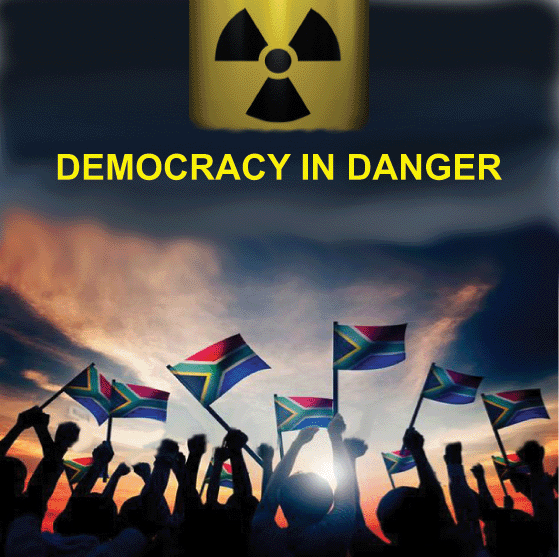
Zuma’s ANC countdown puts anti-nuclear groups on high alert, Fin 24, , Matthew le Cordeur,
WITH the countdown to the African National Congress (ANC) elective conference having started, civil society is on high alert that President Jacob Zuma – and his supportive Energy Minister, David Mahlobo – will sign a deal with the Russians to build a fleet of nuclear power stations. Fin24’s Matthew le Cordeur explains…
THE level of anxiety regarding a possible nuclear deal being struck before the year is up has been evident with the media analysis on Mahlobo’s every utterance, civil societies’ concern regarding an energy indaba next week and Wednesday’s urgent court interdict against a nuclear deal rushing ahead.
The unproven and denied allegation that Zuma has been bribed with billions of dollars by the Russians as part of a “secret nuclear deal” has driven the debate against nuclear energy in recent years. Zuma himself said South Africa is committed to procuring nuclear energy at a “pace and scale South Africa can afford”.
However, if the allegations are true, the ANC elective conference from December 16 to 20 is a major deadline for the “secret deal” to go through. If Cyril Ramaphosa succeeds Zuma as ANC president, the nuclear plans will likely be scrapped because it is seen as fiscal suicide by Ramaphosa’s faction.
If the allegations are true and if Zuma feels threatened by Ramaphosa’s chances of a victory, it would make sense to sign a nuclear procurement deal with Rosatom before then.
The official nuclear procurement programme run by Eskom this year would have likely been signed by now. However, a court ruling in April changed that and the Department of Energy under newly-appointed Minister Mmamoloko Kubayi said government would start from scratch……….
there is still concern that Mahlobo intends pushing through the energy policy document following what some believe may be a sham public participation process next week. If the new energy policy states that large amounts of nuclear energy is required, the government may see this as enough to start the process.
That is why over 20 civil society organisations wrote to Mahlobo on Tuesday asking him to clarify the purpose of the department’s Energy Indaba being held next week on Thursday and Friday in Midrand.
Action group OUTA also wrote to Mahlobo on Wednesday asking for clarity, saying that “the event programme has not yet been circulated and clarity is required on the accessibility of this indaba to the public [both interested and affected parties].”
“According to the ministry, it would appear the planned Energy Indaba constitutes a formal public engagement process on energy matters in general, including on the nuclear energy matter.
“We believe the planned Energy Indaba in the format currently being pursued falls well short of the requirements in law and reason for meaningful engagement on decisions relating to energy mix and procurement,” OUTA told the minister.
The civil society groups that wrote to Mahlobo on Tuesday include WWF, Earthlife Africa, Safcei, Greenpeace Africa and the Centre for Environmental Rights…….
With the alarm sounded, all eyes will remain on Zuma and Mahlobo regarding nuclear in the coming weeks.
Secret deal or not, the opposition groups to nuclear energy are on full alert and will turn to the courts to fight the process to the last drop. https://www.fin24.com/Opinion/zumas-anc-countdown-puts-anti-nuclear-groups-on-high-alert-20171129
The effect of the Agung volcano in Bali, on global temperatures
Analysis: How could the Agung volcano in Bali affect global temperatures? Carbon Brief, ZEKE HAUSFATHER 25.10.2017 While human activity has been the dominant driver of climate change over the past century, natural factors can influence short-term variations in global temperature.
Major volcanic eruptions, in particular, can have a sizable cooling impact on the climate lasting for five years or so.
The Mount Agung volcano in Bali, Indonesia has been showing signs that an eruption is likely to occur this year. Last time Agung erupted, back in 1963, it had a noticeable cooling effect on the Earth’s climate.
Here, Carbon Brief examines how volcanoes influence the climate, and suggests that a new Agung eruption would likely only result in a modest and temporary cooling of global temperatures.
Volcanic eruptions also release CO2 into the atmosphere, meaning they contribute to warming by strengthening the greenhouse effect. But this influence is very small, and is outweighed by the cooling impact of the dust and ash.
The location of volcanoes also matter. Major volcanic eruptions near the equator are more likely to have a big effect on global temperatures, while high-latitude eruptions (like Laki) will have their effects more limited to the one hemisphere. Sulphate aerosols from high-latitude volcanoes generally will not cross the equator, while tropical volcanoes tend to cool both hemispheres………
This projection, which is based on the historical relationship between volcanic eruptions and temperature, suggests that an Agung eruption would reduce global temperatures between 0.1C to 0.2C in period from 2018 to 2020, with temperatures mostly recovering back to where they otherwise would be by 2023.
There is no guarantee that an eruption of Agung today would be the same size as the one in 1963, however. A small volcanic eruption that doesn’t reach the stratosphere would have a relatively minor climate impact, as sulphur dioxide from the volcano would quickly fall out of the atmosphere.
On the flip side, we have records of much larger volcanic eruptions, such as Tambora in 1815 that may have cooled the globe by 0.6C or more and led to the “year without a summer”. Even in large eruptions this cooling only lasts a few years, however, as once sulphate aerosols eventually fall back to earth the climate quickly returns to normal.
This projection, which is based on the historical relationship between volcanic eruptions and temperature, suggests that an Agung eruption would reduce global temperatures between 0.1C to 0.2C in period from 2018 to 2020, with temperatures mostly recovering back to where they otherwise would be by 2023.
There is no guarantee that an eruption of Agung today would be the same size as the one in 1963, however. A small volcanic eruption that doesn’t reach the stratosphere would have a relatively minor climate impact, as sulphur dioxide from the volcano would quickly fall out of the atmosphere.
On the flip side, we have records of much larger volcanic eruptions, such as Tambora in 1815 that may have cooled the globe by 0.6C or more and led to the “year without a summer”. Even in large eruptions this cooling only lasts a few years, however, as once sulphate aerosols eventually fall back to earth the climate quickly returns to normal……..https://www.carbonbrief.org/analysis-how-could-agung-volcano-bali-affect-global-temperature
Fukushima’s radioactive water amount grows every day
 Japan is poised to flood the Pacific Ocean with one million tons of radioactive water contaminated by the Fukushima nuclear power plant —The amount of radioactive water at Fukushima is still growing, by 150 tons a day. | 26 Nov 2017 | The Japanese government is being urged by experts to gradually release radioactive water in to the Pacific Ocean more than six years after a tsunami overwhelmed the Fukushima nuclear power plant. The water is stored on site in around 900 large and densely packed tanks and could spill should another major disaster strike. The government has been urged to release the water into the ocean as all the radioactive elements of the water except tritium have [*allegedly*] been removed through treatment. But if the tank breaks, the contents may not be able to be controlled.
South Korea looks for a stake in building UK’s Moorside Nuclear Power Station
 Carlisle News and Star 30th Nov 2017, The British and Korean governments have agreed to greater collaboration onnuclear developments, fuelling speculation that a Korean company is about
to invest in West Cumbria’s Moorside power station.
Greg Clark, the secretary of state for business, energy and industrial strategy, and Paik
Un-gyu, South Korean minister of trade, industry and energy, signed a
Memorandum of Understanding on Monday in London. It promises greater
collaboration in both the construction and decommissioning of nuclear power
stations.
The signing appears to have only been reported by World Nuclear
News and Business Korea websites. State-run Korea Electric Power
Corporation (Kepco) has revealed it is in “working-level” talks to buy
a stake in NuGen – which plans to build three new reactions in West
Cumbria to provide seven per cent of the UK’s electricity needs.
Toshiba, NuGen’s current owner, has been exploring a range of options to fund the
project after its then subsidiary Westinghouse Electric – due to supply
three AP1000 reactors to Moorside – filed for Chapter 11 bankruptcy
protection in the US having overpaid by several billion dollars for another
nuclear construction and services business….http://www.newsandstar.co.uk/news/business/International-agreement-fuels-Korean-interest-in-Moorside-2cefe362-b678-4e12-9214-ad75be6a1933-ds
Russian refugee talks about radioactive leak, and Mayak living conditions
France TV 29th Nov 2017, [Machine Translation] Ruthenium leak: Russian refugee activist in France
tackles nuclear taboo in Russia. Today a Russian activist testifies about
the living conditions around the nuclear site of Maïak. She is convinced
that the ruthenium 106 found in Western Europe comes from a leak on this
site. https://www.francetvinfo.fr/replay-radio/c-est-ma-planete/fuite-de-ruthenium-une-militante-russe-refugiee-en-france-s-attaque-au-tabou-du-nucleaire-en-russie_2468374.html
France joins the rush to market nuclear power to Saudi Arabia
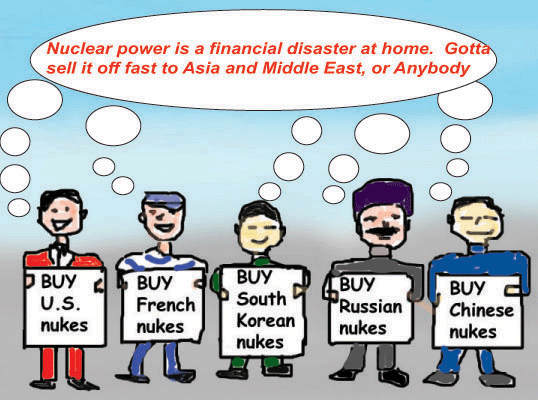 Reuters 29th Nov 2017, French state-controlled utility EDF intends to take part in a tender to
build two nuclear reactors in Saudi Arabia, two sources familiar with the
situation told Reuters.
Saudi Arabia, which wants to reduce domestic oil
consumption, is considering building 17.6 gigawatts of nuclear-fuelled
power generation capacity by 2032 and has sent a request for information to
international suppliers to build two reactors
With answers to the request due by the end 2017 or early 2018, a formal tender could be launched by
mid-2018, but more likely toward the end of 2018 or early 2019, industry
specialists say. https://www.reuters.com/article/saudi-nuclear-edf/update-1-frances-edf-plans-to-bid-in-saudi-arabia-nuclear-tender-sources-idUSL8N1NZ1YN
Mushrooms contaminated with radioactive cesium 137 stopped by France, – shipment from Belarus
 France stops large shipment of radioactive Belarus mushrooms, Geert De Clercq, PARIS (Reuters), 30 Nov 17 – France has stopped a large shipment of Belarus mushrooms contaminated with low-level radioactivity probably from Chernobyl and not linked to a radioactive cloud that appeared in southern Russia last month, officials said on Thursday.
Earlier, the head of French nuclear regulator ASN Pierre-Franck Chevet told the French senate that traces of cesium had been found on imported mushrooms from Russia and did not mention Belarus.
A spokesman for French nuclear safety institute IRSN said that a few days ago customs officials found that a 3.5 tonne shipment of Belarus mushrooms coming through Frankfurt, Germany was contaminated with cesium 137, a radioactive nuclide that is a waste product of nuclear reactors…….https://www.reuters.com/article/us-russia-nuclearpower-accidentedf/france-stops-large-shipment-of-radioactive-belarus-mushrooms-idUSKBN1DU1CW
1 This Month
Chernobyl: The Lost Tapes – A good documentary on Chernobyl on SBS available On Demand for the next 3 weeks– https://www.sbs.com.au/ondemand/tv-program/chernobyl-the-lost-tapes/2352741955560

of the week–London Campaign for Nuclear Disarmament

Tell the Ukrainian Government to Drop Prosecution of Peace Activist Yurii Sheliazhenko
To see nuclear-related stories in greater depth and intensity – go to https://nuclearinformation.wordpress.com
-
Archives
- April 2026 (189)
- March 2026 (251)
- February 2026 (268)
- January 2026 (308)
- December 2025 (358)
- November 2025 (359)
- October 2025 (376)
- September 2025 (257)
- August 2025 (319)
- July 2025 (230)
- June 2025 (348)
- May 2025 (261)
-
Categories
- 1
- 1 NUCLEAR ISSUES
- business and costs
- climate change
- culture and arts
- ENERGY
- environment
- health
- history
- indigenous issues
- Legal
- marketing of nuclear
- media
- opposition to nuclear
- PERSONAL STORIES
- politics
- politics international
- Religion and ethics
- safety
- secrets,lies and civil liberties
- spinbuster
- technology
- Uranium
- wastes
- weapons and war
- Women
- 2 WORLD
- ACTION
- AFRICA
- Atrocities
- AUSTRALIA
- Christina's notes
- Christina's themes
- culture and arts
- Events
- Fuk 2022
- Fuk 2023
- Fukushima 2017
- Fukushima 2018
- fukushima 2019
- Fukushima 2020
- Fukushima 2021
- general
- global warming
- Humour (God we need it)
- Nuclear
- RARE EARTHS
- Reference
- resources – print
- Resources -audiovicual
- Weekly Newsletter
- World
- World Nuclear
- YouTube
-
RSS
Entries RSS
Comments RSS
 nuclear-news