Protest against South African govt’s plan s for nuclear power
Greenpeace activists stage nuclear protest https://www.iol.co.za/pretoria-news/greenpeace-activists-stage-nuclear-protest-12205544, PRETORIA NEWS / 30 NOVEMBER 2017 MATLHATSI DIBAKWANE matlhatsi.dibakwane@iml.co.za
A group of 15 Greenpeace activists have blocked the main entrance of the Department of Enviromental Affairs with nuclear barrels to send a message to the department to stop nuclear as they said it was never safe.
The group sat on the department’s entrance demanding with a huge banner that read “Stop nuclear! Protect our future” that they want the Department of Environmental Affairs to withdraw the environmental authorisation that has been issued for a proposed nuclear power station at Duynefontein.
They did so early in the early hours of the morning by unloading nuclear barrels filled with smoke and staged what could happen in a nuclear disaster.
Melita Steele senior climate and energy campaign manager for Greenpeace Africa said the protest was to send a message to the department that nuclear was dangerous and expensive and should not be under consideration in South Africa.
Steele added that the approval and the construction of a nuclear power station was negligent and that the minister of environmental affairs was putting all South Africans at risk.
“South Africans are clearly saying no to nuclear, and there is no point coming to work if you are going to completely fail to do your job,” she said.
Gabon’s uranium miners’ long wait for compensation for radiation-caused illness
The 82-year-old is a retired geochemist who used to work in a uranium mine in Gabon owned by French nuclear giant Areva.
He and hundreds of other former workers say they fell ill from their work to extract the uranium — a source of nuclear power and warheads, but toxic and potentially carcinogenic.
The miners worked for an Areva subsidiary — the Compagnie des mines d’uranium de Franceville, better known by its abbreviation of COMUF.
Over 38 years, the mine extracted some 26,000 tonnes of uranium near Mounana, southeastern Gabon, before closing in 1999 after the global price of uranium fell and the seam of ore began to thin.
By the end of 2016, 367 former workers had died from “pulmonary respiratory infections” linked to working in the mine, according to MATRAC, a campaign group gathering 1,618 former employees.
The surviving miners, many of them old and sick, have unsuccessfully demanded compensation for 12 years in the belief they were exposed to dangerous levels of uranium contamination.
Areva, a multi-billion-dollar business majority-owned by the French state, has repeatedly denied that it has any case to answer. “No occupational disease related to exposure to ionising radiation” has ever been detected, it says.
‘Many serious diseases’ An internal company mail dating from 2015, seen by AFP and independently verified, acknowledges that the company was aware many of its former employees had developed serious ailments.
In the mail, Areva’s health director, Pierre Laroche, wrote that “many serious diseases have been detected among former employees, for example contagious tuberculosis”.
For former workers, this proves the company’s liability and justifies their claims for compensation, even if it does not legally prove all their illnesses are directly linked to excessive levels of uranium exposure.
The firm has refused to give payouts to the vast majority of its employees, apart from compensation payments in 2011 to the families in France of two French former mine workers who died of lung cancer.
The company has repeatedly argued it was difficult to establish if the rate of cancer cases among former miners was greater than those occurring in the wider population.
“That there was radioactivity in Mounana is a reality. (But) to what degree and to what extent the workers were affected, it will be very difficult to establish,” a former senior executive of the mine told AFP, on condition of anonymity.
In similar disputes elsewhere in the world, experts acknowledge the difficulty of pinning cancer and respiratory diseases on nuclear exposure at work.
Smoking and other “lifestyle” habits could, for instance, be a cause.
‘We are sick’
Areva has been under pressure to compensate its employees for more than a decade.
In 2007, French NGOs Sherpa and Medecins du Monde (Doctors of the World) carried out field surveys in Mounana and in Niger, another Areva uranium mining site.
They published a report denouncing what they described as high rates of cancer among former employees.
Areva agreed to investigate the situation and launched a health initiative in 2009 — the Mounana Health Observatory (OSM) — promising to pay compensation and treat former miners who fell ill, provided scientific and medical panels confirmed their disease was attributable to industrial causes.
Seven years on, not one former employee has been compensated.
“I’ve had difficulty breathing for 10 years,” says 77-year-old Roland Mayombo, who spent 27 years in the mine.
“I went to the OSM four times a year, but I have never had a result,” he complained.
“We decided to stop going (to the OSM) because no one has ever given us our analysis results,” said Estime Beno Ngodi, president of MATRAC, who says he is suffering from lung cancer.
COMUF accuses MATRAC of spreading “misinformation” and defends its handling of the health initiative.
It looked at more than 650 former workers but suspended the project in 2015 because of a boycott by MATRAC, says Gilles Recoche, COMUF’s director of the board.
“We’re proud of having set up a unique tripartite structure, which enabled former COMUF workers to benefit from a free medical visit,” he adds.
For the surviving miners, their long battle to prove a direct link between their illness and uranium contamination goes on. But, for many, age and sickness are wearing them down.
New decommissioning regulations released by USA’s Nuclear Regulatory Commission
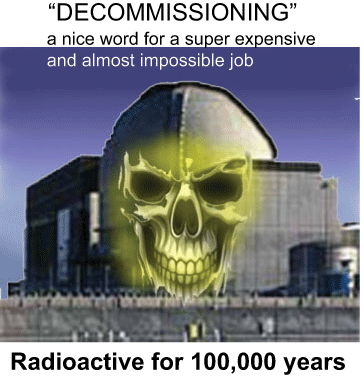 Nuclear Regulatory Commission releases first step in new decommissioning regulations https://dailyenergyinsider.com/news/9290-nuclear-regulatory-commission-releases-first-step-new-decommissioning-regulations/ November 30, 2017 by Chris Galford The Nuclear Regulatory Commission (NRC) recently completed the regulatory basis it will use for the proposal of new decommissioning regulations for commercial nuclear power reactors next year. The NRC staff have determined that new regulations are necessary in a number of areas, including emergency preparedness, physical security, cyber security, drug and alcohol testing, training requirements for certified fuel handlers, decommissioning trust funds, financial protection requirements, indemnity agreements, and how the backfit rule is applied. Many of these revolve around the decommissioning process.
Not all of these require new rules, however. NRC staff has recommended that some are simply in need of updated guidance or inspection procedures. In the case of the management of spent fuel and environmental reporting, though, they have likewise recommended greater clarity among requirements. Staff in requirements, aging management of plant systems, structures, and components, as well as the active role state and local governments are expected to play in decommissioning scenarios, could all be affected.
This process of this new regulatory basis has been underway since November 2015, and the results are now publicly available.
Former Defense Secretary William Perry Sounds the Alarm Over the Present Nuclear Danger
What will the consequences be if the bipartisan consensus on Russia continues to be almost completely untethered from reality?, The Nation, By James Carden, 30 Nov 17, “……Kerry observed that, while many in Congress and in the administration are agitating to implement ever-greater sanctions on Iran (in order, of course, to destroy the deal), few are aware that the we have fewer sanctions in place against North Korea, which has roughly 20 nuclear weapons, than we have in place against Iran, which has none.
And so: What to do with the world on the nuclear brink, with the very real potential for an outbreak of perhaps simultaneous crises between the United States, Russia, Iran and North Korea?
As Perry pointed out, climate change is another looming catastrophe, but it is one of which the public is, for the most part, aware. Perry argued that, as is the case with climate change, “we need a program of public education” regarding the growing nuclear danger.
And for his part, Perry pledged to dedicate the remainder of his public career to the task.
In his recent book, My Journey at the Nuclear Brink, Perry writes: “Our chief peril is that the poised nuclear doom, much of it hidden beneath the seas and in remote badlands, is too far out of the global public consciousness. Passivity shows broadly.”
Finding, he said, his motivation in a wish that his grandchildren not have to live with the ever-present specter of nuclear catastrophe hanging like a Sword of Damocles above their heads, Perry has proved to be anything but a passive player in this continuing, and very troubling, drama. https://www.thenation.com/article/former-defense-secretary-william-perry-sounds-the-alarm-over-the-present-nuclear-danger/
Workers report strange odors at Hanford nuclear reservation
http://komonews.com/news/local/workers-report-strange-odors-at-hanford-nuclear-reservation 30 Nov 17 HANFORD, Wash. (AP) – Employees at a Washington nuclear reservation reported smelling strange odors.
The Tri-City Herald reports eight workers reported the odors Tuesday at AW Tank Farms in Hanford, with three of the workers receiving medical evaluations before being cleared to return to work. The other five reported smelling odors but declined medical evaluations.
The workers were preparing an empty storage box to receive containerized tank waste samples when they reported smelling a glue-like odor.
Washington River Protection Solutions says the workers were told to leave the building. Access to the area was then restricted.
Technicians used instruments to examine the area, but did not detect anything above background levels.
The contractor says other air samples tested in a lab came back as “below action levels.” Access to the building was then restored.
1 This Month
Chernobyl: The Lost Tapes – A good documentary on Chernobyl on SBS available On Demand for the next 3 weeks– https://www.sbs.com.au/ondemand/tv-program/chernobyl-the-lost-tapes/2352741955560

of the week–London Campaign for Nuclear Disarmament

Tell the Ukrainian Government to Drop Prosecution of Peace Activist Yurii Sheliazhenko
To see nuclear-related stories in greater depth and intensity – go to https://nuclearinformation.wordpress.com
-
Archives
- April 2026 (189)
- March 2026 (251)
- February 2026 (268)
- January 2026 (308)
- December 2025 (358)
- November 2025 (359)
- October 2025 (376)
- September 2025 (257)
- August 2025 (319)
- July 2025 (230)
- June 2025 (348)
- May 2025 (261)
-
Categories
- 1
- 1 NUCLEAR ISSUES
- business and costs
- climate change
- culture and arts
- ENERGY
- environment
- health
- history
- indigenous issues
- Legal
- marketing of nuclear
- media
- opposition to nuclear
- PERSONAL STORIES
- politics
- politics international
- Religion and ethics
- safety
- secrets,lies and civil liberties
- spinbuster
- technology
- Uranium
- wastes
- weapons and war
- Women
- 2 WORLD
- ACTION
- AFRICA
- Atrocities
- AUSTRALIA
- Christina's notes
- Christina's themes
- culture and arts
- Events
- Fuk 2022
- Fuk 2023
- Fukushima 2017
- Fukushima 2018
- fukushima 2019
- Fukushima 2020
- Fukushima 2021
- general
- global warming
- Humour (God we need it)
- Nuclear
- RARE EARTHS
- Reference
- resources – print
- Resources -audiovicual
- Weekly Newsletter
- World
- World Nuclear
- YouTube
-
RSS
Entries RSS
Comments RSS
 nuclear-news