ICAN official urges Japan to join anti-nuke weapons treaty

THE ASAHI SHIMBUN
December 3, 2017 at 18:05 JS
GENEVA–An executive of the international nongovernmental organization that won this year’s Nobel Peace Prize vowed to strengthen the campaign to ask Japan and other countries to sign and ratify the Treaty on the Prohibition of Nuclear Weapons.
Beatrice Fihn, 35, executive director of the International Campaign to Abolish Nuclear Weapons (ICAN), also said that her group will use the Nobel Peace Prize award money to establish a new fund to promote its activities.
She made those remarks in an interview with The Asahi Shimbun here on Dec. 1 ahead of the awards ceremony to be held Dec. 10 in Oslo.
ICAN, based in Geneva, was awarded the Nobel Peace Prize in October on the grounds that it advocated the inhumanity of nuclear weapons and contributed to the adoption of the treaty in July.
In the interview, Fihn pointed out that the Japanese government’s stance of relying on the U.S. nuclear umbrella means that it supports the idea of threatening other countries with nuclear weapons.
She cast doubts on that stance, saying ICAN will ask Japanese politicians and people the serious question of whether Japan is accepting the idea of threatening to do the same thing to others as what happened to Hiroshima and Nagasaki at the end of World War II.
Amid North Korea’s ongoing development of nuclear weapons and missiles, Fihn said, “With the threats, we no longer have to convince people that the threat is real. People are feeling it. They know it’s real. So I think we have a unique opportunity now to really make progress.
“I think when we’re thinking about the humans or putting humans first, that’s when we make progress … Not ‘America First,’ (but) humans first.”
The signing of the treaty started in September but only three countries have ratified it. Ratification of 50 countries is necessary for the treaty to take effect, which ICAN is aiming to realize within two years. For that purpose, it plans to set up a new fund within ICAN.
The group named it the “1,000-day fund” so that it can achieve the ratification of 50 countries within 1,000 days from Dec. 10, the day of the awards ceremony.
In addition to the prize money of 9 million Swedish kronor (about 120 million yen, or $1.1 million), ICAN will collect donations for the fund.
The fund will be used to support activities of cooperating groups throughout the world so that they can promote their campaigns to urge the governments and the people of their countries to sign and ratify the treaty.
Fihn harbors strong doubts on the “nuclear deterrence” that Japan is relying on, saying that it will be unable to stop accidents from occurring due to misunderstandings, cyberattacks or individuals that aren’t rational.
“Nuclear deterrence isn’t flawless. Even if it does work to some extent, it can still fail and the consequences would be devastating,” she said.
As Foreign Minister Taro Kono says, the Japanese government asserts that nuclear weapons are necessary to deter North Korea.
However, Fihn said that the mechanism to create peace and stability based on fear of nuclear weapons is not working and, on the contrary, is creating an unstable situation.
“Introducing nuclear weapons in a conflict situation makes it more tense and increases the risk of an accident where these weapons will actually be used,” she said.
(This article was written by correspondents Tsutomu Ishiai and Ichiro Matsuo.)
http://www.asahi.com/ajw/articles/AJ201712030021.html
Further info;
Yemen’s Houthi group says fires missile toward Abu Dhabi nuclear reactor

DUBAI (Reuters) – Yemen’s Houthi group has fired a cruise missile towards a nuclear power plant in Abu Dhabi in the United Arab Emirates, the group’s television service said on its website on Sunday, without providing any evidence.
“The missile force announces the launching of a winged cruise missile … towards the al-Barakah nuclear reactor in Abu Dhabi,” the website said. It gave no further details.
(Reporting by Sami Aboudi; Editing by Mark Potter)
http://www.journalistbook.com/2017/12/03/yemens-houthi-group-says/
Earthquake detected near North Korea nuclear site
Earthquake detected near North Korea nuclear site
A 2.5-magnitude earthquake has been detected in North Korea near where the country recently conducted a nuclear test, Seoul’s weather agency said.
The tremor occurred at 7.45am on Saturday in Kilju, North Hamgyeong Province, around 2.7 kilometres away from the Punggye-ri nuclear site, according to the Korea Meteorological Administration (KMA).
Kim Jong-Un‘s regime conducted its sixth and most powerful nuclear test at the site on 3 September, damaging geological structures in the area, the agency said. Four tremors have been detected there since.
“The quake is a natural one and it is believed to have occurred in the aftermath of the sixth nuclear test,” the KMA said.
The September atomic explosion triggered an artificial 6.3-magnitude earthquake at the test site, monitors at the time said. It was almost 10 times more powerful than the 10-kiloton test carried out by the North last year, according to South Korean experts.
North Korean monitoring group 38 North said the tremors could be an indication of “Tired Mountain Syndrome” — a condition where rock becomes increasingly permeable following a below-ground nuclear blast.
Reports have speculated the nuclear test site will have to close because of the tremors, but 38 North said “complete abandonment of the test site as a whole remains unlikely”.
The isolationist state recently tested a new intercontinental ballistic missile that, it claimed, could reach anywhere on the US mainland.
Experts said the Hwasong-15 appeared capable of transporting a nuclear warhead, although it is unclear whether the isolated state is yet capable of making a weapon small enough to be fitted to the missile.
At the end of November the US unveiled fresh sanctions against the North, which it said were designed to stop its funding of nuclear and ballistic missile programmes.
Donald Trump has also redesignated North Korea as a state sponsor of terrorism.
On Friday the US state of Hawaii tested a nuclear attack warning siren for the first time since the Cold War. Some experts believe a North Korean missile could take just 20 minutes to reach the state.
Although Hawaii is protected by US anti-missile systems, local people are being told to have an emergency plan if alarms warn a strike is imminent.
The independent UK
Pope says world has reached moral limit on nuclear deterrence

By Cindy Wooden
ABOARD THE PAPAL FLIGHT FROM BANGLADESH (CNS) — The Cold War policy of nuclear deterrence appears morally unacceptable today, Pope Francis said.
St. John Paul II, in a 1982 message to the U.N. General Assembly, said deterrence “may still be judged morally acceptable” as a stage in the process of ridding the world of nuclear weapons.
But Pope Francis, in a message in early November to a Vatican conference, said “the very possession” of nuclear weapons “is to be firmly condemned.”
During a news conference Dec. 2 on his flight back to Rome from Dhaka, Bangladesh, Pope Francis was asked what had changed since St. John Paul wrote to the United Nations and whether the war of words between U.S. President Donald Trump and North Korea’s Kim Jong Un influenced his position.
“What has changed?” the pope responded. “The irrationality has changed.”
Pope Francis said his position is open to debate, but “I’m convinced that we are at the limit of licitly having and using nuclear weapons.”
The world’s nuclear arsenals, he said, “are so sophisticated that you risk the destruction of humanity or a great part of humanity.”
Even nuclear power plants raise questions, the pope said, because it seems that preventing accidents and cleaning up after them is almost impossible.
Pope Francis said he was not dictating “papal magisterium,” or formal church teaching, but was raising a question that a pope should raise: “Today is it licit to maintain the nuclear arsenals as they are or, to save creation and to save humanity, isn’t it necessary to turn back?”
The weapons are designed to bring one side victory by destroying the other, he said, “and we are at the limit of what is licit.”
Pope says world has reached moral limit on nuclear deterrence
More info
For info
For actions
Vietnam ditched nuclear power plans over local concerns: ex-leader
(Mainichi Japan)
HO CHI MINH CITY (Kyodo) — Vietnam last year abandoned plans to build the country’s first nuclear power plants with Japanese and Russian assistance due to heightened concern over nuclear energy in the wake of events such as the Fukushima nuclear disaster, according to former President Truong Tan Sang.
In an interview in Ho Chi Minh City on Thursday, Sang, 68, said, “The situation in the world had changed. Due to the fluctuations of the world situation, the Vietnamese people were very worried, especially the people in the area where the nuclear power plants were to be located. They had reactions. Therefore, we had to temporarily halt (the plans).”
The interview was his first with a foreign news media outlet since stepping down from power in April last year.
In scrapping the plans to build two multi-billion-dollar nuclear power plants in November last year, the government cited the country’s tight financial situation, saying safety was not an issue.
On Vietnam’s territorial conflict with China in the South China Sea, Sang said his country welcomes the concerns of countries in and outside the region to contribute to ensuring peace and stability in the South China Sea.
“We protect our interests on the basis of international law, and at the same time we also respect the interests of the countries concerned on the basis of international law,” he said.
“Japan is very close to Vietnam’s view,” he added, expressing hope for Tokyo’s continued support for its stance in the dispute.
On the economic front, he praised Japan for its active promotion of globalization, especially after U.S. President Donald Trump withdrew from the Trans-Pacific Partnership, a free trade agreement signed by 12 nations including Vietnam and Japan.
“(Japanese Prime Minister) Shinzo Abe was one of the first leaders to promote and connect remaining countries together. As a result, at the APEC meeting in Danang recently, the TPP 11 meeting successfully took place,” he said.
On bilateral relations, he said the relationship between the two countries is “very good. There is no obstacle.”
“The extensive strategic partnership in all areas has been strengthened, bringing clear benefits,” he said.
By taking advantage of Japan’s advanced technology and Vietnam’s abundant natural and human resources, he expressed hope for greater cooperation in areas such as high-quality infrastructure, high-tech agriculture and renewable energy.
“Vietnam learns from the experience and realities of countries around the world to perfect the organizational model of our political system,” he said, indicating the necessity of reform of Vietnam’s ruling Communist Party and government based on global trends and the domestic situation.
https://mainichi.jp/english/articles/20171203/p2g/00m/0in/062000c
Morningstar’s Sunny Outlook For Nuclear Power Suddenly Clouds Over
Morningstar analysts broke with the pessimistic consensus on nuclear power this fall when they predicted the industry would not just hold its own against renewables and cheap natural gas, it might even grow up to 5 percent.
But that prediction, which appeared in the October/November issue of Morningstar magazine, has already fallen flat.
“At the time we were developing the forecasts, we were assuming the two new units at the VC Summer (SC) plant would go forward, totaling 2.2 GW of new capacity. But as you probably know, Scana and partner Santee Cooper decided to cancel the project in late July,” said Travis Miller, an equity strategist with Morningstar Research Services LLC.
“The VC Summer plant is key. If indeed it never goes into service, you would have to remove that 2.2 GW from our forecast, thus our base estimate would go from flat to down 2.2 GW. Other than that, the status of the Exelon plants are the primary difference from our high- and low-end estimates.”
Exelon operates five nuclear plants in Illinois and New York that it has threatened to close. Both states passed subsidies to keep the plants open, but those subsidies are being challenged in the courts.
“If courts strike down those subsidies, we expect those plants to close, absent other power market reforms,” Miller said.
In their original forecast, the analysts suggested pessimism about nuclear power was short-sighted and overlooked nuclear’s “more favorable” environmental profile, given political pressure to reduce emissions. They argued that nuclear capacity could grow through uprates—a process in which the Nuclear Regulatory Commission grants permission to operate plants “hotter” than is typically allowed.
Competition from cheap natural gas generation and renewable energy are pinching profits now, but we think a long-term perspective is important… Our forecast for flat or growing U.S. nuclear capacity is more bullish than most forecasts. In particular, we disagree with the U.S. Energy Information Administration’s prediction that nuclear capacity will fall 11% by 2040. We think the U.S. could add as much as 5% net new nuclear capacity by 2040.”
In addition to Exelon and Scana, the analysts profiled the “actionable” stocks of Dominion Energy, Southern Company, and FirstEnergy.
The nuclear technology was born 75 years ago yesterday when a team of physicists led by Enrico Fermi successfully triggered the first manmade nuclear reaction at the University of Chicago.
Stalkers in Chernobyl: Radioactive exclusion zone plagued by thrill-seekers & looters
The latest group of Chernobyl trespassers was busted on Saturday. A trio aged between 18 and 23 was caught by a patrol after crossing into the expulsion zone, the police reported, describing them as “extreme tourists.” In mid-November a 21-year-old man from Ukraine and a 20-year-old woman from Russia were likewise caught sneaking in. Three separate groups of thrill-seekers had been busted in mid-October.
Chernobyl, once a byword for the terror experienced millions of people following the 1986 nuclear power plant explosion, has by now become a magnet for the curious. Access to the exclusion zone remains restricted, but most of it has long been safe for brief visits. The exception is the ruin of the plant itself, which is to be covered by a new shelter construction commissioned last year and expected to be finished in the first half of 2018.
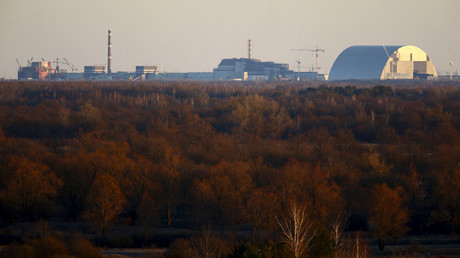
The zone is a destination for scientists studying the effects of long-term radiation exposure on wildlife, as well as for documentary film crews and curious tourists. But some people don’t want to deal with the red tape and prefer to simply trespass, sometimes with the help of local guides, knowing that the only thing they risk if caught is a fine. The experience however may be far more dangerous than expected even for seasoned extreme travelers.
On Tuesday, a 33-year-old father of three died in the Chernobyl exclusion zone after a 15-meter fall. Dmitry Shkinder from Belarus went inside to climb the abandoned Soviet missile silo via the receiving antenna of early warning radar Duga, located a dozen kilometers from the destroyed nuclear power plant. Judging by his social media accounts, he had climbed the massive construction in the past, but the latest selfie quest proved to be fatal.
“That object has seen no maintenance for three decades. Its rusty, some ladders are loose. On that day it was really wet and cold and there was thick fog,” his friend Roman, who was with Dmitry when he died, told a Belarusian TV station.
While most of the trespassers come to Chernobyl for the thrill, other visits have a more practical purpose. Occasionally Ukrainian police report catching somebody trying to smuggle scrap metal, which can be later sold for recycling. A man carrying about 200 kg of rusty metal in his motorcycle sidecar was caught last week. In September, a man tried to carry out 15kg of lead pellets from Chernobyl, but was busted at a checkpoint. Metal hunters are typically unconcerned that their loot may be radioactive.
Arguably an even more irresponsible way to make money on Chernobyl is picking mushrooms and wild berries in the exclusion zone, where competition for the foodstuffs is virtually non-existent. In September, the police reported intercepting two villagers leaving the restricted area carrying 40kg of mushrooms, which they claimed were for their personal consumption. The report said Geiger meters proved that this was not the best idea: the mushroom radiation levels were some 30 times higher than what is considered safe.
https://www.rt.com/news/411729-chernobyl-thrill-seekers-looters/
Other resources; https://nuclear-news.net/?s=timothy+mousseau+chernobyl+fukushima
Life after Fukushima and Chernobyl nuclear disasters with Prof. T. Mousseau
Comparing Fukushima and Chernobyl concerning radionuclide distribution and Isotopic variations on Land and effects on the environment. New studies by Timothy Mousseu and his team. Tim was interviewed and he gave us an overall look at the situation and compares the 2 nuclear disasters for us. Link to Timothy Mousseau cricket.biol.sc.edu/Mousseau/Mousseau.html Link to podcast here; … Continue reading
Michael Flynn covered up his nuclear marketing trip to the Middle East, among other business and lobbying trips
Flynn started a private lobbying and consulting practice that did business in foreign countries including Russia and Turkey. Flynn didn’t disclose those contacts and payments, as required, when applying for his security clearance to work in the Trump White House.
 Top House Democrats have pointed out that Flynn failed to disclose a 2015 Middle East business trip tied to a plan to build nuclear plants in the region using money from Saudi and Russian investors. The Democrats called the omission a crime.
Flynn Said to Have Reached Out to Russia at Kushner’s Behest, By David Kocieniewski, Greg Farrell, Andrew M Harris, and David McLaughlin, Bloomberg,
-
Ex-security adviser pleads guilty and agrees to cooperate
Former national security adviser Michael Flynn pleaded guilty to lying to federal agents and is providing cooperation that promises to take Special Counsel Robert Mueller deep into Donald Trump’s administration.
Flynn now says he lied to the FBI in January about the conversations, but that he had fully informed the transition team of the talks.
“This shows a Trump associate negotiating with the Russians against U.S. policy and interests before Donald Trump took office and after it was announced that Russia had interfered in our election,” Senator Dianne Feinstein, a Democrat from California, said in a statement, adding that it’s critical to find out “who knew and approved his actions.”……..
In cooperating with Mueller’s inquiry, Flynn is seeking leniency for himself and possibly his son, who worked with him in his private business. The charge doesn’t delve into Flynn’s work on behalf of Turkey, which is also under investigation, or his failure to promptly disclose such work to U.S. authorities. At the hearing, Flynn admitted to lying about contacts with Turkey. In admitting to false statements, he faced a maximum of five years in prison and a $250,000 fine, but is likely to get no more than six months and $9,500 under his plea agreement……
After he left the administration, Flynn filed an updated foreign registration form showing that he hadn’t disclosed multiple contacts and payments from foreign entities while serving as an campaign adviser to Trump starting in February 2016….
Flynn retired [from military service] in 2014 after Obama fired him as director of the Defense Intelligence Agency.
Afterward, Flynn started a private lobbying and consulting practice that did business in foreign countries including Russia and Turkey. Flynn didn’t disclose those contacts and payments, as required, when applying for his security clearance to work in the Trump White House.
Top House Democrats have pointed out that Flynn failed to disclose a 2015 Middle East business trip tied to a plan to build nuclear plants in the region using money from Saudi and Russian investors. The Democrats called the omission a crime.
Flynn’s son, Michael Flynn Jr., also worked for the consulting firm and is under investigation by the special counsel. The son gained attention during the 2016 president election for promoting conspiracy theories about Hillary Clinton on social media. https://www.bloomberg.com/news/articles/2017-12-01/michael-flynn-is-charged-as-mueller-intensifies-russia-probe
$billions to clean up radioactive waste in tanks at Hanford
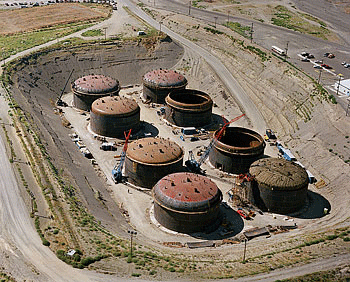 Hanford Tank Waste Among Top Federal Challenges For 2018 http://nwpr.org/post/hanford-tank-waste-among-top-federal-challenges-2018, By ANNA KING , 2 Dec 17, Cleaning up radioactive waste contained in tanks at the Hanford nuclear reservation is one of the top challenges facing the U.S. Department of Energy, according to a new special report by the department’s Inspector General.
The independent oversight arm of the U.S. Department of Energy didn’t mince words.
It said there were about 88 million gallons of radioactive tank waste across the nation that need to be cleaned up. Most is at Hanford.
The report noted that the factory meant to treat all of Hanford’s waste isn’t going so well — it’s behind schedule and will cost billions more than planned.
The report also highlighted problems that Hanford has had with its subcontractors. Specifically, several companies have agreed to pay a $125 million settlement for using substandard materials. Hanford’s tank waste and treatment plant were ranked at the top of the Department of Energy’s concerns along with cyber security and safeguarding the nation’s nuclear stockpile.
Michael Flynn claims that the Trump campaign ordered him to contact Russia
Michael Flynn says senior Trump campaign officials directed his communications with Russians
The former national security adviser has pleaded guilty to lying to the FBI, Independent UK, Emily Shugerman New York, 1 Dec 17, Donald Trump’s former national security adviser has claimed the Trump campaign ordered him to contact Russia during their transition to the White House.
Michael Flynn alleged in a plea deal that a senior campaign official directed him to make contact with Russian officials. The plea deal did not name the senior official.
Mr Flynn pleaded guilty on Friday to making a false statement to the FBI regarding the investigation. The ex-adviser lied to agents about his conversations with former Russian ambassador Sergey Kislyak, telling them he had not counselled Mr Kislyak on how to respond to sanctions imposed by then-President Barack Obama during the transition.
The former national security adviser is the first senior member of the Trump transition team to plead guilty as a result of the Russia investigation.
In a statement, Mr Flynn called his actions “wrong,” and said he had chosen to cooperate with special counsel Robert Mueller’sinvestigation “in the best interests of my family and of our country”. Mr Mueller is investigating possible collusion with Russia and obstruction of justice by the Trump team……..
The 58-year-old is the fourth Trump campaign associate to be charged in Mr Mueller’s Russia probe. Former Trump campaign manager Paul Manafort and his deputy Rick Gates were charged with various financial crimes last month. Both pleaded not guilty.
George Papadopolous, a former campaign adviser also charged by Mr Mueller, pleaded guilty to lying to the FBI about his contacts with Russia sources http://www.independent.co.uk/news/world/americas/us-politics/michael-flynn-trump-russia-directed-communications-mar-a-lago-senior-official-latest-news-updates-a8087431.html
USA nuclear industry keen to sell to ANYBODY – pushing for Saudi Arabia sales
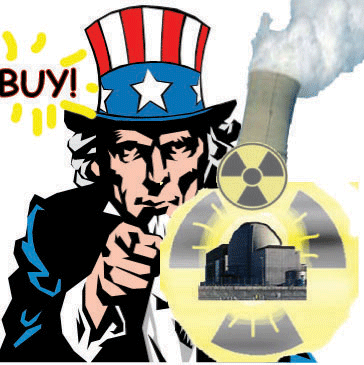
 U.S. firms push Washington to restart nuclear pact talks with Riyadh: sources https://www.reuters.com/article/us-saudi-nuclear-usa/u-s-firms-push-washington-to-restart-nuclear-pact-talks-with-riyadh-sources-idUSKBN1DV586?feedType=RSS&feedName=worldNews. Reem Shamseddine, Sylvia Westall RIYADH/DUBAI (Reuters) 1 Dec 17, – U.S. firms attracted by Saudi Arabia’s plans to build nuclear reactors are pushing Washington to restart talks with Riyadh on an agreement to help the kingdom develop atomic energy, three industry sources said.
Saudi Arabia has welcomed the lobbying, they said, though it is likely to worry regional rival Iran at a time when tensions are already high in the Middle East.
One of the sources also said Riyadh had told Washington it does not want to forfeit the possibility of one day enriching uranium – a process that can have military uses – though this is a standard condition of U.S. civil nuclear cooperation pacts.
“They want to secure enrichment if down the line they want to do it,” the source, who is in contact with Saudi and U.S. officials, said before U.S. Energy Secretary Rick Perry holds talks in Riyadh early next week.
Another of the industry sources said Saudi Arabia and the United States had already held initial talks about a nuclear cooperation pact.
U.S. officials and Saudi officials responsible for nuclear energy issues declined to comment for this article. The sources did not identify the U.S. firms involved in the lobbying.
Under Article 123 of the U.S. Atomic Energy Act, a peaceful cooperation agreement is required for the transfer of nuclear materials, technology and equipment.
In previous talks, Saudi Arabia has refused to sign up to any agreement with the United States that would deprive the kingdom of the possibility of one day enriching uranium.
Saudi Arabia, the world’s top oil producer, says it wants nuclear power solely for peaceful uses – to produce electricity at home so that it can export more crude. It has not yet acquired nuclear power or enrichment technology.
Riyadh sent a request for information to nuclear reactor suppliers in October in a first step towards opening a multi-billion-dollar tender for two nuclear power reactors, and plans to award the first construction contract in 2018.
Reuters has reported that Westinghouse is in talks with other U.S.-based companies to form a consortium for the bid. A downturn in the U.S. nuclear industry makes business abroad increasingly valuable for American firms.
Reactors need uranium enriched to around 5 percent purity but the same technology in this process can also be used to enrich the heavy metal to a higher, weapons-grade level. This has been at the heart of Western and regional concerns over the nuclear work of Iran, which enriches uranium domestically.
Riyadh’s main reason to leave the door open to enrichment in the future may be political – to ensure the Sunni Muslim kingdom has the same possibility of enriching uranium as Shi‘ite Muslim Iran, industry sources and analysts say.
POTENTIAL PROBLEM FOR WASHINGTON
Saudi Arabia’s position poses a potential problem for the United States, which has strengthened ties with the kingdom under President Donald Trump.
Washington usually requires a country to sign a nuclear cooperation pact – known as a 123 agreement – that forfeits steps in fuel production with potential bomb-making uses.
“Doing less than this would undermine U.S. credibility and risk the increased spread of nuclear weapons capabilities to Saudi Arabia and the region,” said David Albright, a former U.N. weapons inspector and president of the Washington-based Institute for Science and International Security (ISIS).
It is not clear whether Riyadh will raise the issue during Perry’s visit, which one of the industry sources said could include discussion of nuclear export controls.
Under a nuclear deal Iran signed in 2015 with world powers – but which Trump has said he might pull the United States out of – Tehran can enrich uranium to around the level needed for commercial power-generation.
It would be “a huge change of policy” for Washington to allow Saudi Arabia the right to enrich uranium, said Mark Fitzpatrick, executive director of the Americas office at the International Institute for Strategic Studies think tank.
“Applying the ‘golden standard’ of not allowing enrichment or preprocessing (of spent fuel) has held up a 123 agreement with Jordan for many years, and has been a key issue in U.S. nuclear cooperation with South Korea,” said Fitzpatrick, a nuclear policy expert.
The United States is likely to aim for restrictions, non-proliferation analysts say.
These could be based on those included in the 123 agreement Washington signed in 2009 with the United Arab Emirates, which is set to start up its first South Korean-built reactor in 2018 and has ruled out enrichment and reprocessing.
“Perhaps Saudi Arabia is testing the Trump administration and seeing if the administration would be amenable to fewer restrictions in a 123 agreement,” ISIS’s Albright said.
It would be “a huge change of policy” for Washington to allow Saudi Arabia the right to enrich uranium, said Mark Fitzpatrick, executive director of the Americas office at the International Institute for Strategic Studies think tank.
“Applying the ‘golden standard’ of not allowing enrichment or preprocessing (of spent fuel) has held up a 123 agreement with Jordan for many years, and has been a key issue in U.S. nuclear cooperation with South Korea,” said Fitzpatrick, a nuclear policy expert.
The United States is likely to aim for restrictions, non-proliferation analysts say.
These could be based on those included in the 123 agreement Washington signed in 2009 with the United Arab Emirates, which is set to start up its first South Korean-built reactor in 2018 and has ruled out enrichment and reprocessing.
“Perhaps Saudi Arabia is testing the Trump administration and seeing if the administration would be amenable to fewer restrictions in a 123 agreement,” ISIS’s Albright said.
A Terrorist State? Saudi Arabia? (and it might get nuclear weapons)
Is Saudi Arabia also amongst the terrorists? The News, Nigeria Dec 1 2017 By Owei Lakemfa.
US threatens to ‘utterly destroy’ N. Korea regime
DAILY NATION, NOVEMBER 30 2017
The United States on Wednesday warned that North Korea’s leadership will be “utterly destroyed” if war breaks out as it called on countries to cut all diplomatic and trade ties with North Korea — including Chinese oil shipments to Pyongyang.
Washington urged tough action at an emergency meeting of the Security Council called to respond to North Korea’s launch of an intercontinental ballistic missile (ICBM).
“The dictator of North Korea made a choice yesterday that brings the world closer to war, not farther from it,” US Ambassador Nikki Haley told the council.
“If war comes, make no mistake: The North Korean regime will be utterly destroyed.”
US President Donald Trump derided Kim Jong-Un as a “sick puppy” and threatened “major” new sanctions after Pyongyang tested its third ICBM — which it claimed was capable of striking anywhere in the United States.
The test ended a two-month lull in missile tests that had raised hopes for the opening of diplomatic talks.
North Korean leader Kim said the test of the Hwasong-15 weapons system had helped his country achieve the goal of becoming a full nuclear power, as the international community expressed outrage.
“We call on all nations to cut off all ties with North Korea,” Haley told the council.
The US ambassador said Trump had called Chinese President Xi Jinping and urged him to “cut off the oil from North Korea”, a move that would deal a crippling blow to North Korea’s economy………
There are concerns in Seoul that Trump might be considering military action against the North that could trigger a full-scale war.
Seoul is home to 10 million people and only about 50 kilometers from the border — well within range of Pyongyang’s artillery.
Russia urged the United States to scrap military exercises planned with South Korea in December, arguing they would exacerbate tensions.
“It is essential to take a step back,” said Russian Ambassador Vassily Nebenzia, who urged Washington “to revise its policy of mutual threats and intimidation.”
China once again pressed its proposal that the North stop missile and nuclear tests in exchange for a freeze of US military exercises — a proposal Washington has repeatedly rejected…….. http://www.nation.co.ke/news/world/US-threatens-to-destroy-North-Korea/1068-4208568-rn6tbxz/
An immense glacier is melting, in Antarctica
 UNFROZEN IN TIME, Huffington Post, Video and Pictures: Tom Compagnoni | Words: Josh Butler, 1 December 17 There’s a glacier in Antarctica so immense that, if it melted, would raise sea levels globally by 3.5 metres.
It’s melting. Right now.
“The facts around climate change are undeniable. It’s happening,” Australian glaciologist Ben Galton-Fenzi told The Huffington Post Australia. “The research we do now isn’t about trying to convince ourselves it’s real, because it’s irrefutable. What we’re trying to do is understand what the response time of the system is going to be into the future, so we can adapt to it.”
The Totten glacier is the biggest in east Antarctica. The glacier itself is around 120 kilometres long, 30 kilometres wide and drains some 538,000 square kilometres of the continent. That’s an area bigger than California. The ice is kilometres thick, but it’s melting at 70 metres a year in some spots. A study released in December reported warmer water was melting the Totten ice from below.
Galton-Fenzi and his small team will spend the next few months trying to work out exactly how fast the glacier is melting, gathering data to build better models to predict melt rates and how that will affect sea levels.
“The majority of the heat that has gone into the global climate system has gone into the ocean, about 90 percent over the last few decades of measurements,” he said. “The hypothesis is ocean temperatures around Antarctica will keep warming and drive the melting of the glaciers. If the glaciers flow faster, sea levels will rise, and that has profound implications for global civilisation.”……..“Climate change is a reality. There’s the whole debate around how we deal with it, and the work we do in Antarctica is influencing our ability to look forward and genuinely understand how much things are going to change,” Australian Antarctic Division director, Dr Nick Gales told HuffPost Australia from Hobart, the base of operations for the AAD.
“It is alarming. There is huge change going on there. The more we learn, the more we see change happening at rates faster than we predicted. It’s fundamentally important to support the science, communicate the science really well, and make sure the policy makers are aware of the science so they can take account of that in forming mitigation and adaptation strategies around the world.”
The AAD is the government body that administers Australian operations in Antarctica, from delivering workers and equipment to the continent, to selecting the research applications to be undertaken each season, to making sure the kitchen at Casey is well stocked with chocolate.
“When we started doing science in Antarctica, it was important and interesting because we were learning about things we simply didn’t know about.”
“Nowadays, the science is really critically important to what we do in the future.”
It’s critical to our wellbeing and our ability to understand what’s coming, and adapt and mitigate the effects. What about the droughts? Are they going to become more regular? What will happen to our low-lying areas and Pacific islands in relation to sea level rise? The science we do is critical for informing that.”This season, the AAD will support almost 100 projects in Antarctica and the Southern Ocean. More than 500 expeditioners will make their way down each year for major “season-defining” projects such as Galton-Fenzi’s Totten glacier work, and smaller-scale operations. Gales said around two-thirds of the Australian-led research in Antarctica is related to climate science.
It is a continent almost entirely covered by ice, the largest ice sheet in the world and the planet’s largest single reserve of fresh water. It’s almost entirely untouched by humans, uninhabited but for the research teams (and a whole lot of amazing animal life, as we soon discovered); a continent literally devoted to science.
The 1959 Antarctic treaty, signed by the 12 countries which had been active in Antarctica — Argentina, Australia, Belgium, Chile, France, Japan, New Zealand, Norway, Russia, South Africa, the United Kingdom and United States — agreed to set aside territorial claims and enshrine the continent as a place for peace, science and international collaboration. Scientists work together, sharing resources, manpower and findings, for the good of humanity under this treaty, which states:
– Antarctica shall be used for peaceful purposes only (Art. I)
– Freedom of scientific investigation in Antarctica and cooperation toward that end … shall continue (Art. II).
– Scientific observations and results from Antarctica shall be exchanged and made freely available (Art. III).
“It’s unique. It’s extraordinary that, in a place like that, the world can agree to set aside differences and focus on those really important issues,” Gales said………
Johnstone and Black are cutting through the frozen sea ice for experiments on ocean acidification. As the Earth continues to emit carbon dioxide, the oceans soak up a large percentage of that extra CO2; around 30 percent, Black said.
Rob King, an AAD biologist based in Hobart, said around eight billion tonnes of CO2 is going into oceans each year.
“It increases the acidity of the ocean and lowers the pH. The global ocean average is about 8.2pH, and we’re expecting by the year 2100 with the current emissions scenarios we have, the pH will drop to 7.8,” Black said.
That’s a massive change for the ocean, with the water becoming far more acidic. That’s bad news for many tiny organisms and plankton that make up the bottom of the oceanic food chain, upon which larger creatures like penguins, fish, dolphins, seals, sharks and whales depend. Black and Johnstone have planted tiny chambers on the ocean floor to simulate how the water and the organisms will react to more acidic waters. They will also collect water and loads of these tiny organisms for experiments in the lab.
“As we acidify the water, anything with a calcium carbonate structure in its shell, like shellfish, pteropods and other organisms, will actually have trouble forming that shell and maintaining it,” Black said.
“When we look at the relative biomass of different organisms, we get about 600 million tonnes of phytoplankton down here. That’s the most biomass of any organism in the Southern Ocean. While they seem small and insignificant, they are the most important part of the ecosystem. Any change in that under climate change conditions will have flow on effects up the food chain.”……….
“Under the sea ice you’ve got a really stable environment. It’s always the same temperature, even though it’s a really harsh temperature of minus 1.85C all year, but it doesn’t vary much so they only have to adapt to one temperature,” the marine biologist said.’
“There’s very little current under here, because for 10 months of the year, there’s a covering of sea ice. They don’t have to deal with big tidal currents or waves or storms or wind action, or temperature changes. The conditions are relatively stable through the year.”
The word ‘frozen’ is often used to denote something which has stopped; static, not moving. It is synonymous with lifelessness, death, a barren wasteland. Antarctica is a frozen continent, but it is by no means dead. It grows and shrinks like a living organism. With the yearly melt and refreeze, as the continent effectively doubles in size during the winter as sea water becomes ice, it is arguably the most alive continent on Earth. The life that exists down here — human, animal and plant alike — is some of the hardiest, most resilient on the planet. It’s an entire continent devoted to peace and science, to work for the betterment of the entire planet.
It’s alive with purpose………. http://stories.huffingtonpost.com.au/antarctica/
India kickstarts process to build 6 nuclear-powered attack submarines
Dec 01, 2017, NEW DELHI: India has kick-started an ambitious project to build six nuclear-powered attack submarines that is expected to boost the Navy’s overall strike capabilities in the face of China’s naval build-up and increasing military manoeuvring in the Indo-Pacific region. ………https://economictimes.indiatimes.com/news/defence/india-kickstarts-process-to-build-6-nuclear-powered-attack-submarines/articleshow/61880118.cms
1 This Month
Chernobyl: The Lost Tapes – A good documentary on Chernobyl on SBS available On Demand for the next 3 weeks– https://www.sbs.com.au/ondemand/tv-program/chernobyl-the-lost-tapes/2352741955560

of the week–London Campaign for Nuclear Disarmament

Tell the Ukrainian Government to Drop Prosecution of Peace Activist Yurii Sheliazhenko
To see nuclear-related stories in greater depth and intensity – go to https://nuclearinformation.wordpress.com
-
Archives
- April 2026 (189)
- March 2026 (251)
- February 2026 (268)
- January 2026 (308)
- December 2025 (358)
- November 2025 (359)
- October 2025 (376)
- September 2025 (257)
- August 2025 (319)
- July 2025 (230)
- June 2025 (348)
- May 2025 (261)
-
Categories
- 1
- 1 NUCLEAR ISSUES
- business and costs
- climate change
- culture and arts
- ENERGY
- environment
- health
- history
- indigenous issues
- Legal
- marketing of nuclear
- media
- opposition to nuclear
- PERSONAL STORIES
- politics
- politics international
- Religion and ethics
- safety
- secrets,lies and civil liberties
- spinbuster
- technology
- Uranium
- wastes
- weapons and war
- Women
- 2 WORLD
- ACTION
- AFRICA
- Atrocities
- AUSTRALIA
- Christina's notes
- Christina's themes
- culture and arts
- Events
- Fuk 2022
- Fuk 2023
- Fukushima 2017
- Fukushima 2018
- fukushima 2019
- Fukushima 2020
- Fukushima 2021
- general
- global warming
- Humour (God we need it)
- Nuclear
- RARE EARTHS
- Reference
- resources – print
- Resources -audiovicual
- Weekly Newsletter
- World
- World Nuclear
- YouTube
-
RSS
Entries RSS
Comments RSS
 nuclear-news